International Journal of Emerging Technology and Advanced Engineering
Website: www.ijetae.com (ISSN 2250-2459, Volume 2, Issue 11, November 2012)523
Operating Three Phase Induction Motor Connected to Single
Phase Supply
Shivanagouda.B.Patil
1, M. S. Aspalli
21,2 Department of Electrical and Electronics Engineering, P.D.A.C.E, Gulbarga, Karnataka, India
Abstract – This paper presents a simple converter topology for driving a three-phase induction motor with a single-phase ac supply. Using only two active switches and a Triac, the converter can start the motor with high starting torque and low input current, and run the motor at rated speed. The converter supplies balanced output voltages at rated frequency, the proposed control approaches are supported by test results. In the proposed scheme, dsPIC30F2010 controller is used to produce PWM signals. A 3-phase, 415V, 1440RPM, 1.5HP Induction motor is used as load for testing the developed hardware. Textronics TDS2024B storage oscilloscope is used to store the gate pulses and waveforms. The experimental result showed that PWM pulses produced remained approximately constant with increase in load and the developed hardware has satisfactory converted the single phase power to three phase power.
Keywords – Single phase to Three phase, TRIAC, IGBTs, Induction Motor, Split Capacitor
I. INTRODUCTION
Motor drives constitute a predominant load for the agricultural sector. As most rural communities in the India are supplied with single-phase ac power, these drives have to be realized with single-phase motors, or with three phase motors (Induction Motors) driven by phase converters. Autotransformer capacitor phase converters and rotary phase converters have been used for several decades [1].Both have the advantages of simple structure and reasonably low cost. Autotransformer capacitor phase converters, however, cannot easily obtain balanced output voltage with reasonable cost, and rotary converters are heavy and have significant no-load losses, also both topologies have high inrush current during motor startup [2]. The three-phase induction motors have some advantages in the machine efficiency, power factor, and torque ripples compared to their single-phase counterparts [3]. Though the precise control of single phase induction motor is less complex in comparison to the three phase induction motor, but when the torque requirement is considered then three phase induction motor is the best choice. The applications for these motors cover almost every stage of manufacturing and processing. It is not surprising to find that among all type of electric motors, Induction motor is so popular, when one considers its simplicity, reliability, and low cost.
Therefore, it is desirable to replace the single-phase induction motor drives by the three-phase induction motor drives in some low-power industrial applications [4] and [5]. However, in some rural areas where only a single-phase utility is available, we should convert a single-phase to a three-phase supply. This paper proposes an alternative solution for phase conversion with very low overall cost, moderate motor performance during start up and high steady-state performance at line frequency. This system fits the requirements in rural areas where only a single-phase supply is available. This paper describes the conversion of 1-phase power supply to 3-phase and driving 3-phase AC induction motor using 16 bit High Performance Digital Signal Controller. The dsPIC30F2010 devices contain extensive Digital Signal Processor (DSP) functionality with high performance 16-bit microcontroller (MCU) architecture.
The use of this 16-bit Digital Signal Controllers yields enhanced operations, fewer system components, lower system cost and increased efficiency. The system is designed for driving medium power (1.5hp), 3-phase AC induction motors. Our work consists of a half-bridge rectifier, a split-capacitor dc bus, two active devices(IGBTs) realizing the inverter section for regulating the motor current and a TRIAC for controlling the motor current.
The developed hardware is tested on a 3-phase, 415V, 50Hz Induction motor. According to the requirement, a software program is written and is fed to the digital signal controller (dsPIC30F2010) for the necessary action. The inverter output current is regulated by a sine wave reference, generated by software, and the TRIAC is triggered at constant delay angle. The various graphs/waveforms are analyzed and studied on Digital
Storage Oscilloscope.
II. BLOCK DIAGRAM AND ITS EXPLANATION
A. System overview
The block diagram of the proposed single phase to three phase power conversion and driving three phase induction motor is shown in figure 1.
International Journal of Emerging Technology and Advanced Engineering
Website: www.ijetae.com (ISSN 2250-2459, Volume 2, Issue 11, November 2012)Each set has two diodes connected in parallel to increase/double current rating. The output of the rectifier is filtered by using two 1000µF, 450V capacitors which acts as split capacitor.
The half bridge inverter has 2-FGA25N120ANTD-IGBT’s switches. The triac used is TO-220AB (BTB16-800) with the snubber circuit to meet the requirement. The output of half bridge rectifier with split capacitor, half bridge inverter and triac is applied to the three phase induction motor. A digital signal controller (dsPIC30F2010) is used to implement the core of the control function, which simplifies the hardware setup.
Fig1. Block diagram of the proposed system
B. Power circuit design
The power circuit designed contains half bridge rectifier with split capacitors assembly, half bridge inverter assembly and Triac assembly. At the start of the motor it experiences a very high current and the motor may not run at the rated speed. An electromagnetic relay is used in the proposed scheme. Starting current of the induction motor is six times that of the rated current for a duration of 4 Seconds. To limit this heavy current flow, two wire wound resistances of 50Ω, 10W each are connected in parallel to the input supply. A single pole change over relay is used to insert these wire wound resistors for a period of 4secs and then the relay bypasses these resistors for the rest of the operation.
F ig2. Half bridge rectifier and half bridge inverter
Single phase 230V, 50Hz AC supply is applied to the half bridge rectifier and Triac via starter assembly. Triac switches are protected against surge voltages using snubber circuit. This half bridge rectifier converts single phase AC input into DC which is filtered by two split capacitors. The pure DC supply is applied to the half bridge inverter which is made up of two IGBT switches. The 3-phase induction motor is connected to half bridge rectifier with split capacitors, half bridge inverter and Triac as shown in figure 1. The half bridge with split capacitors and half bridge inverter is shown in figure 2. The energy that a switching power converter delivers to a motor is controlled by Pulse Width Modulated (PWM) signals applied to the gates of the switches. PWM signals are pulse trains with fixed frequency and magnitude and variable pulse width.
C. Control circuit
International Journal of Emerging Technology and Advanced Engineering
Website: www.ijetae.com (ISSN 2250-2459, Volume 2, Issue 11, November 2012)525 III. EXPERIMENTAL SETUP AND ITS RESULTS
The conversion from single phase to three phase is done successfully and the developed hardware is tested with load. The proposed control system is implemented by a DSC (dsPIC30F2010) based PWM inverter. C language is used to develop the program. The device is programmed using MPLAB Integrated Development Environment (IDE) tool. It is a free, integrated toolset for the development of embedded applications employing Microchip's PIC and dsPIC controllers. For execution of C-code, MPLAB compiler is used. In this work, I have used 415V, 50Hz, 3-Ph, 1.5 HP Induction motor.
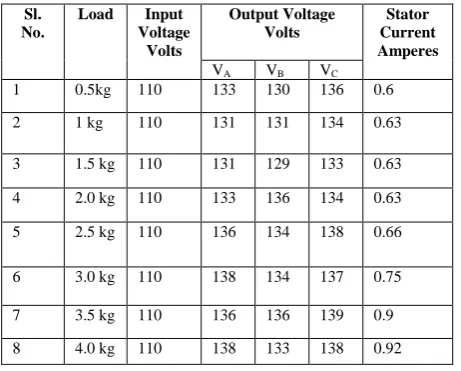
The hardware set is developed and tested in power electronics laboratory and the photograph of complete setup is shown in fig 3. The test is carried out on induction motor for different loads and voltages. For different loads and voltages, current drawn by the motor and voltages across all lines are noted and are tabulated.
In the complete experiment the oscilloscope used is Tektronix TDS2024B Digital Storage Oscilloscope (DSO) to store gate pulses and voltage waveforms. The speed of the induction motor is 1410 RPM, At particular RPM, load is varied from 1KG to 4KG and corresponding voltages and currents are noted.
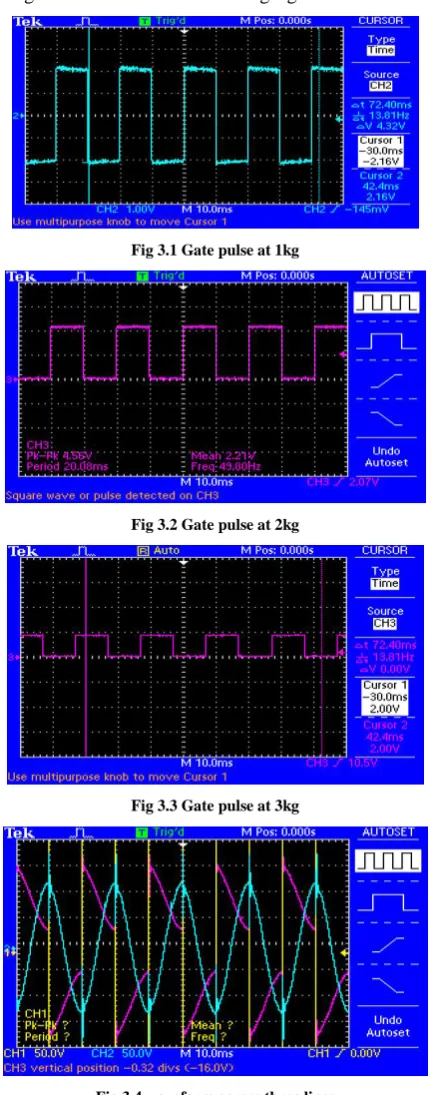
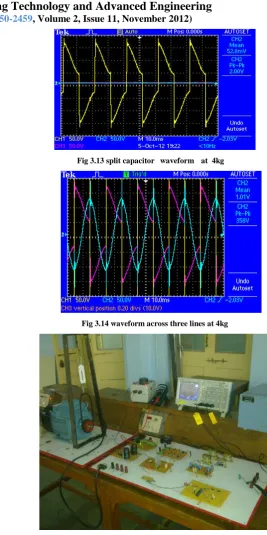
Table 3.2, 3.4, 3.6 shows the output for variable voltages and variable loads, corresponding waveforms are taken from the DSO and are shown in figs 3.4 to 3.14. The gate pulses are observed for different loads and voltages are shown in the figs 3.1, 3.2, 3.3.
[image:3.595.316.561.187.399.2]3.1 Experimental Result for the Input Voltage 110V, 50Hz
Table 1
Experimental Result for the Input Voltage 110V, 50Hz
3.2 Experimental Result for the Input Voltage 140V, 50Hz
Table 2
Experimental Result for the Input Voltage 140V, 50Hz
Sl. No.
Load Input Voltage Volts Output Voltage Volts Stator Current Amperes VA VB VC
1 0.5kg 140 181 178 188 0.62
2 1 kg 140 179 181 186 0.63
3 1.5 kg 140 173 183 188 0.64
4 2.0 kg 140 181 178 186 0.64
5 2.5 kg 140 181 178 186 0.7
6 3.0 kg 140 183 183 186 0.75
7 3.5 kg 140 181 183 186 0.8
8 4.0 kg 140 187 181 189 0.85
3.3 Experimental Result for the Input Voltage 180V, 50Hz
Table3
Experimental Result for the Input Voltage 180V, 50Hz
Sl. No.
Load Inpu t Volt age Volts Output Voltage Volts Stator Current Amperes
VA VB VC
1 0.5kg 180 22 8 22 9 23 1 0.62
2 1 kg 180 22 7 23 1 23 3 0.65
3 1.5 kg
180 22 7 22 9 23 1 0.7
4 2.0 kg
180 23 0 23 1 22 9 0.7
5 2.5 kg
180 22 8 23 1 23 4 0.75
6 3.0 kg
180 23 1 22 8 22 9 0.83
7 3.5 kg
180 23 3 22 7 23 0 0.9
8 4.0 kg
180 23 1 23 1 23 3 0.95 Sl. No.
Load Input
Voltage Volts Output Voltage Volts Stator Current Amperes VA VB VC
1 0.5kg 110 133 130 136 0.6
2 1 kg 110 131 131 134 0.63
3 1.5 kg 110 131 129 133 0.63
4 2.0 kg 110 133 136 134 0.63
5 2.5 kg 110 136 134 138 0.66
6 3.0 kg 110 138 134 137 0.75
7 3.5 kg 110 136 136 139 0.9
[image:3.595.42.273.533.718.2]International Journal of Emerging Technology and Advanced Engineering
Website: www.ijetae.com (ISSN 2250-2459, Volume 2, Issue 11, November 2012)The gate pulses are observed for different loads and voltages are shown in the following figs.
Fig 3.1 Gate pulse at 1kg
Fig 3.2 Gate pulse at 2kg
[image:4.595.324.539.117.724.2]Fig 3.3 Gate pulse at 3kg
Fig 3.4 waveform across three lines
Fig 3.5 split capacitor waveform at 1kg
Fig 3.6 Traic waveform at 1kg
Fig 3.7 Traic waveform at 2kg
[image:4.595.65.495.127.715.2][image:4.595.56.273.156.704.2]
International Journal of Emerging Technology and Advanced Engineering
Website: www.ijetae.com (ISSN 2250-2459, Volume 2, Issue 11, November 2012) [image:5.595.59.549.94.740.2]527
Fig 3.9 split capacitor waveform a 2kg
Fig 3.10 waveform across inveter at 2kg
Fig 3.11 Traic waveform at 3kg
Fig 3.12 waveform across inverter 3kg
Fig 3.13 split capacitor waveform at 4kg
[image:5.595.276.544.106.643.2]
Fig 3.14 waveform across three lines at 4kg
Fig4. photograph of complete Experimental setup
IV. CONCLUSION
[image:5.595.60.270.211.730.2]International Journal of Emerging Technology and Advanced Engineering
Website: www.ijetae.com (ISSN 2250-2459, Volume 2, Issue 11, November 2012)Operating a three phase induction motor using single phase supply has been presented. The developed single phase to three phase conversion hardware setup is tested on a three phase 1.5hp, 415V, 50Hz induction motor with loading in power electronics laboratory. From the experimental setup and results chapter it is clear that the developed hardware satisfactory converts from single phase power to three phase power.
The developed system is useful in remote areas where three phase supply is not available easily.
Applications of single phase to three phase converter are:
In Irrigation Pumps for Agriculture purpose. Rural Area Water Supply.
APPENDIX
The following defines the nomenclature and system parameters used in this paper :
A. Molar parameters and nomenclature :
50Hz, 415V, 1.5hp, 3-phase, 4-pole induction machine.
B. Inverter parameters : Vin : lnput voltage 230V
C1, C2 : DC bus capacitors 1000µ , 250V each Q1,Q2: IGBTs FGA25N120ANTD
1200V, 25A
REFERENCES
[1 ] C. Hertz, “Current techniques in phase conversion systems,” IEEE Rural Electric Power Con$ Rec., pp. 3549, 1978.J. [2 ] J. Nesbitt et al., “A novel single phase to three phase converter,”
IEEE APEC Con$ Rec., pp. 95-99, 1991.
[3 ] P. N. Enjeti et al., “Economic single phase to three phase converter topologies for fixed frequency output,” IEEE APEC Con$ Rec., pp. 88-94, 1991.
[4 ] C. Chen et ab, “A single phase to three phase power converter for motor drive applications,” IEEE IAS Con$ Rec., pp. 639-646, 1992.
[5 ] P. N. Enjeti and A. Rahman, “A new single-phase to three-phase converter with active input current shaping for low cost ac motor drives,”IEEE Trans. Ind. Applicar., vol. 29, no. 4, pp. 80C813 July/Aug. 1993.
[6 ] Chingchi Chen, “A Hybrid Inverter/cylcoconverter-Based Variable-Speed Three-phase Induction Motor Drive for Single-phase Inputs” IEEE Tran. on Industry application,Vol.31.no.3,may/june 1995