LONDON SCHOOL OF ECONOMICS
Estimating Parameters in the Presence
of Many Nuisance Parameters
by
Billy Wu
Thesis submitted in fulfilment for the
MPhil Degree
in the
Department of Statistics
Supervisor: Prof. Qiwei Yao
I, BILLY WU, declare that this report titled, ‘Estimating Parameters in the Presence
of Many Nuisance Parameters’ and the work presented in it are my own.
Signed:
Date:
Abstract
This paper considers estimation of parameters for high-dimensional time series with the
presence of many nuisance parameters. In particular we are interested in data consisting
ofptime series of lengthn, withpto be as large or even larger thann. Here we consider the composite-likelihood estimation and the profile quasi-likelihood estimation. The
asymptotic properties of these methodologies are investigated. Simulations are used to
illustrate our both of these methods and explore the performance of these methods.
Key words: composite likelihood, nuisance parameter, profile likelihood, quasi-likelihood,
I would like to thank my advisor Professor Qiwei Yao, he gave me a huge amount of
support and guidance. He has a seemingly endless well of knowledge and an incredible
amount of patience. I hope to one day repay his immeasurable amount of help.
I would also like to thank my family for their all their support. I owe them a great deal
for everything in my life, and for making me the person I am today. My parents and
my grandparents raised me and nurtured me, I have had an incredible life experience.
They always had my best interests at heart and worked extremely hard to give me the
best opportunities available, I will forever be grateful.
Last but not least I would also like to thank all my friends. Without their moral
support and friendship, my entire life would not be the same. I am fortunate to have
such amazing friends.
Contents
Declaration of Authorship i
Abstract ii
Acknowledgements iii
1 Introduction 1
1.1 Introduction. . . 1
2 Methodology 4 2.1 Composite-likelihood estimation . . . 4
2.1.1 Theorem 1 . . . 7
2.1.2 Theorem 2 . . . 7
2.2 Profile quasi-likelihood estimation . . . 8
2.2.1 Theorem 3 . . . 9
3 Numerical Properties 10 3.1 Example 1 . . . 10
3.2 Example 2 . . . 13
4 Proofs 17 4.1 Proof of Theorem 1. . . 17
4.2 Proof of Theorem 2. . . 20
4.3 Proof of Theorem 3. . . 23
5 Appendix: U-statistics 26 5.1 Proposition 1 . . . 27
5.2 Proposition 2 . . . 28
5.2.1 Proof . . . 28
6 References 30
Introduction
1.1
Introduction
Rapid developments in technology in this information age has led to data collection in an
unprecedentedly large scale. This brings a new opportunity with challenge to statistics.
The availability of large data sets enable statisticians to look into complex structures
using sophisticated models. In this paper we consider a class of models in which the
number of parameters of interest is finite while the number of nuisance parameters is
large or excessively large in relation to the sample size. Those models arise in various
statistical applications. For example, in a longitudinal model with a large number of
sites the primary interest lies in a small number of parameters representing the common
effects while the individual levels of different sites are treated as nuisance parameters. For
a large panel of time series data, one is often interested in a few common factors which
drives the dynamics of all the component series and treats the parameters representing
each idiosyncratic components as nuisance parameters. In the attempts to model the
volatilities of large number of financial securities, it is often to assume that the dynamic
volatilities are controlled by a small number of parameters in the presence of large
number of nuisance parameters representing marginal covariance matrices.
In this paper we consider two methods to obtain the estimators of a fixed number of
pa-rameters of interest in presence of a large number of nuisance papa-rameters. The methods
concerned are the maximum profile quasi-likelihood estimation (MPQLE) and the
maxi-mum composite quasi-likelihood estimation (MCQLE). With an initial estimator for the
nuisance parameter vector, the MPQLE maximises a profile quasi-likelihood function to
obtain the estimation. This is in line with more conventional approach. By plugging in
an initial estimator for the nuisance parameters, we avoid a maximisation problem with
Chapter 1. Introduction 2
a large number of variables. However it is intuitively clear that the quality of the initial
estimator impacts on the ultimate outcome of the procedure.
Another method to be considered is the composite likelihood, the name coined by
Lind-say (1988). See also a recent survey Varin et al. (2011). A composite likelihood is
a function derived by multiplying a collection of, typically two- or there-dimensional,
marginal density functions. In our context, each low dimensional density function only
depends on a small number of nuisance parameters, hence can be easily profiled. The
resulting composite profile likelihood function depends on those parameters of interest
only, can be solved to obtain the estimator without running into high-dimensional
opti-misation problems. Because the marginal densities are multiplied together, ignoring the
original distribution structure, the MCQLE can be viewed as derived from a (seriously)
misspecified model.
The major contribution of this paper is the establishment of the asymptotic properties for
both the MCQLE and the MPQLE under the condition which is relevant to the settings
concerned. The conventional asymptotic theory is typically under the assumption that
the sample size goes to infinity while everything else remains fixed. For our setting,
the number of nuisance parameters is of a comparable magnitude of the sample size.
Hence it is more pertinent to consider the asymptotics when both the sample size and
the number of nuisance parameters go to infinity together. Though bearing a similar
banner, our theory is different from large literature on the theory for the so-called ‘large
pand small n’ regression problem; see, among the others, Zou (2006), Fan and Lv (2008), Huang et al (2008), Zhang and Huang (2008), Bickel et al (2009) and Zhang (2009).
The name of ‘composite likelihood’ was introduced by Lindsay (1988), although the
idea of using ‘submodels’ or ‘marginal models’ had appeared before. As the full
lihood with complex models are often computationally infeasible, The composite
like-lihood methods have been used in different regression with dependent errors (Eicher
1967), problems including modelling spatial processes (Besag 1974), case control studies
(Liang 1987), inference for nonlinear dynamic models (Gallant and White 1988),
cor-related binary data (Kuk and Nott 2000), grouped data (deLeon 2005), longitudinal
studies (Molenberghs and Verbeke 2005), multivariate volatility modeling (Engle et al.
2008), bioinformatice (Larribe and Fearnhead 2011). The asymptotic theory under the
assumption that only sample size tends to infinity has been studies by, for example,
Cox (1961), Eicher (1967), White (1982), Gallant and White (1988), and Cox and Reid
(2004). To our knowledge, no results have been derived under our setting when both the
sample size and the number of nuisance parameters go to infinity together. For more
comprehensive survey in the composite likelihood methodology, we refer to the first issue
The rest of the paper is organised as follows. Section 2 deals with the MCQLE and
section 3 is on MPQLE. In each of those two sections, we outline the method and
state the asymptotic normality results. Both the methods are illustrated in simulation
Chapter 2
Methodology
2.1
Composite-likelihood estimation
Let {X1,· · · ,Xn} bep×1 observations from a stationary process with the underlying
distribution depending on parameter (θ,ω)∈Θ×Ω⊂Rd+q, whereθis ad×1 parameter
of interest, andωis aq×1 nuisance parameter. Our goal is to estimateθ. We consider now a maximum composite quasi-likelihood estimation method forθ. We will show that
such an estimator is asymptotically normal with the standard root-n convergence rate
asn, q → ∞together while dis fixed, andp may also diverge to infinity.
Let Xt1,· · ·,Xtr be r subvectors of Xt. The lengths of those r subvectors may be
different from each other, and some of those subvectors may share common components
from Xt. With the observations Xtj, t = 1,· · ·, n, the log marginal quasi-likelihood
function is defined as
lj(θ,ωj) = n
X
t=1
logfj(Xtj;θ,ωj),
which depends on the parameter of interest θ, and a subset of nuisance parameter
denoted by ωj. Let
e
ωj(θ) = arg max
ωj
lj(θ,ωj). (2.1.1)
We define a composite quasi-likelihood function forθ as
l(θ) =
r
X
j=1
lj θ,ωej(θ)
. (2.1.2)
The maximum composite quasi-likelihood estimator (MCQLE) for θ is defined as
b
θ= arg max
θ l(θ). (2.1.3)
We assume that r=r(q)→ ∞ asq→ ∞, while all the lengths of Xtj and ωj are fixed.
One implicit condition for the MCQLE defined in (2.1.3) being reasonable is that the nuisance parametersω1,· · · ,ωrare distinct from each other such that the maximisation
(2.1.1) may be carried out independently for eachjwithout confounding constraints from each other. This is a rather strong requirement, and may only be facilitated by selecting
subvectors Xt1,· · · ,Xtr in a restrictive manner. It is very likely there may be a heavy
loss of information if we adhere to this requirement in practice. One alternative is to
adopt the so-called ‘variation-free’ condition imposed by Engle, Hendry and Richard
(1983), which ignores the links among different ωj and treats ω1,· · · ,ωr as different
and unconnected nuisance parameters. See also Engle, Shephard and Sheppard (2008).
Of course there will be some efficiency loss in estimation of θ resulted from neglecting
the links among different ωj. The trade-off is that we will be able to reduce an extra
high-dimensional optimisation problem to many low-dimensional problems, which is the
essential motivation of using composite-likelihood approach. Note that this
variation-free condition also implies thatbθ is the global maximiser in the sense that
(bθ, b
ω1, · · · , ωbr) = arg max
θ,ω1,···,ωr
r
X
j=1
lj(θ,ωj),
where we treat ω1,· · ·,ωr as different and independent parameters. In the rest of this
section, we always adopt this assumption.
Letβ= (θ0,ω01,· · ·,ω0r)0, andl(β) =Pr
j=1lj(θ,ωj).In practice we takeβb = (θb
0 ,ωb
0
1,· · · ,ωb
0
r)0
as a solution of the likelihood equation
˙ l(βb) ≡
∂ ∂βl(β)
β=
b
β = 0. (2.1.4)
Let
βo≡(θ0o,ω01o,· · · ,ω0ro)0 = arg max
θ,ω1,···,ωr E{
r
X
j=1
logfj(Xtj;θ,ωj)} (2.1.5)
be the true value of the parameter, which is assumed to be an inner point of the
param-eter space. Put
atj(θ,ωj) =
∂
∂θlogfj(Xtj;θ,ωj), btj(θ,ωj) = ∂ ∂ωj
logfj(Xtj;θ,ωj),
Atj(θ,ωj) =
∂2
∂θ∂θ0 logfj(Xtj;θ,ωj), Btj(θ,ωj) = ∂2
∂θ∂ω0j logfj(Xtj;θ,ωj),
Ctj(θ,ωj) =
∂2 ∂ωj∂ω0j
Chapter 2. Methodology 6
We simply writeatj=atj(βo,ωjo), andbtj,Atj,Btj and Ctj in the same manner. Put
M1 =−
Pr
j=1EAtj EBt1 · · · EBtr EB0t1 ECt1
..
. . ..
EB0tr ECtr
, (2.1.6)
M2=−
1 r Pr
j=1EAtj 1 √
rEBt1 · · ·
1 √
rEBtr
1 √
rEB
0
t1 ECt1 .. . . .. 1 √ rEB 0
tr ECtr
, (2.1.7)
and the elements at the blank places in the above matrices are 0.
We introduce some regularity conditions first.
A1 {Xt}satisfies the mixing condition stated in C3 in the Appendix.
A2 fj are smooth enough such that all the required derivatives exist and are continuous
and integrable whenever necessary.
A3 Denote byξtj any component ofatj, andηtj any component ofbtj. Forν >2 given
in A1 above, it holds that
lim
r→∞E
1 r r X j=1 ξtj ν
<∞, (2.1.8)
lim r→∞ 1 r r X j=1
[E(ηtj2) +{E(|ηtj|ν)}2/ν]<∞. (2.1.9)
By Hlder’s inequality this is equivalent to
lim r→∞ 1 r r X j=1
[E(|ηtj|ν)2/ν]<∞. (2.1.10)
A4 Denote byηtj any element of Atj−E(Atj), Btj−E(Btj) orCtj−E(Ctj). Then
(2.1.9) holds.
A5 The matrix M1 is positive-definite. Furthermore all the eigenvalues of the matrix
M2 are bounded above from ∞and below from 0, asr → ∞.
A6 There exists a constantc1>0 and positive functionsλj(·) such that| ∂
3
∂β`∂βi∂βklogfj(xj;θ,ωj)| ≤ λj(xj) for any||θ−θo|| ≤c1and||ωj−ωjo|| ≤c1. Furthermore limr→∞sup1≤j≤rE{λj(Xtj)}<
A7 (2.1.9) holds with ηtj being any component of ζtj ≡ atj −E(B1j)(EC1j)−1btj.
Furthermore the limits of the convariance
Wk = limr→∞r12
Pr
j=1ζ1j,
Pr
j=1ζk+1,j
, k= 0,1,· · · , n.Exists
Remark 1. (i) Note that M1 = −E
n
∂2
∂β∂β0
Pr
j=1logfj(Xtj;θ,ωj)
o
. The condition
that M1 > 0 in A5 implies that βo, defined in (2.1.5), is an isolated maximiser. It
also implies that M2 is positive-definite as M2 = ΛM1Λ, where Λ is an appropriate
full-ranked diagonal matrix.
(ii) If X1,· · ·,Xn are independent observations, conditions A3, A4 and A6 may be
reduced to those withν = 2 only.
2.1.1 Theorem 1
Theorem 1. Let conditions A1 – A6 hold. Then there exists a solution of the likelihood
equation (2.1.4) for which
m||bθ−θo||2+
1 r
r
X
j=1
||ωbj −ωjo||2 P
−→0
for any m→ ∞,r/m→0 andr2m/n→0.
Remark 2. The convergence rates in Theorem 1 are not optimal; see, for example,
The-orem 2 below which indicates that the convergence rate for bθ is root-n. The important
message here is the difference in the convergence rates betweenbθand{ b
ωj, j= 1,· · · , r}.
Asr → ∞together withn, the rate for the uniform convergence ofω1b ,· · · ,ωbr is slower.
It also imposes some restrictions on the number of parameters which can be consistently
estimated, although the implied rates such asr =o(n1/3) is presumably too restrictive. In region of the true parameter if there is a unique solution then this would be the true
min.
2.1.2 Theorem 2
Theorem 2. Let conditions A1 – A7 hold, matricesE(C1j),j= 1,· · ·, r, be invertible,
and the limit of M2, defined in (2.1.7), exist (as r → ∞). Furthermore, let r/n → 0. For any consistent solution of the likelihood equation (2.1.4) in the sense that
||θb−θo||2+
r
X
j=1
||ωbj−ωjo||2 P
Chapter 2. Methodology 8
it holds that
√
n(θb−θ)
D
−→N
0, L−1 W0+ 2 ∞
X
k=1 Wk
L−1
,
whereWkare defined in A7, andL= limr→∞r−1Prj=1{E(A1j)−E(B1j)(EC1j)−1E(B01j)}.
Remark 3. (i) The consistence condition (2.1.10) is weaker than that identified in Theorem 1, asm/r→ ∞.
(ii) The limit which defines the matrix L exists. This is implied by the existence of the
limit of M2.
2.2
Profile quasi-likelihood estimation
We consider now the asymptotic properties of a qMLE for θ, obtained based on a
reasonable initial estimator for the nuisance parameterω. We will show that the qMLE
is asymptotically normal with the standard root-n convergence rate in spite that the
number of nuisance parameters q goes to∞.
We use a log quasi-likelihood function
l(θ, ω) =
n
X
t=1
logf(Xt;θ,ω), (2.2.12)
wheref is a density function defined onRp. With an initial estimatorωb for the nuisance parameterω, a profile quasi-likelihood function forθ is defined as
l(θ) =
n
X
t=1
logf(Xt;θ,ωb),
and the maximum profile quasi-likelihood estimator (MPQLE) is defined as
e
θ= arg max
θ l(θ) = arg maxθ
n
X
t=1
logf(Xt;θ,ωb).
Let (θo,ωo) = arg maxθ,ωE{logf(Xt;θ,ω)}be the true parameter values. Since ˙l(eθ) =
0, it follows a Taylor expansion that
√
n(eθ−θo) = −
1
nm
¨l(θ?) −1 1 m√n
˙
l(θo), (2.2.13)
We introduce the regularity conditions first. Let
˙
l(θ) = ∂l(θ) ∂θ ,
¨
l(θ) = ∂ 2l(θ)
∂θ∂θ0, a(x;θ,ω) = ∂
∂θlogf(x;θ,ω),
B(x;θ,ω) = ∂ 2
∂θ∂θ0logf(x;θ,ω), C(x;θ,ω) = ∂2
∂θ∂ω0 logf(x;θ,ω), and D(θ,ω) =E{C(Xt;θ,ω)}.
B1 The initial estimator ωb = (ωb1,· · · ,ωbq)
0 is asymptotically linear in the sense that
for each 1≤j≤q,ωbj−ωjo= n1
Pn
t=1gj(Xt) +oP(n−1/2), where E{gj(Xt)}= 0,
Var{gj(Xt)} ≤ c < ∞, and c > 0 is a constant independent of j. Furthermore
||ωb−ωo||2=OP(q/n), andq/n→0.
B2 f(x;θ,ω) is smooth such that all the required partial derivatives exists and are continuous. Denoted by aj the j-th component of a. There exists a positive
number c1 and a positive functionλ1(·)
such that
u
0∂2aj(x;θo,ω)
∂ω∂ω0 u
≤λ1(x)||u||
2 for any ||ω−ω
o|| ≤c1, u∈Rq and 1≤j≤q,
and E{λ1(Xt)} is bounded (asq → ∞). Furthermoreq/(m
√
n)→0.
B3 {Xt}satisfies condition C1 in the Appendix, and
ψn(Xt,Xs) ={C(Xt;θo,ωo)g(Xs) +C(Xs;θo,ωo)g(Xt)}/m
satisfies condition C2.
B4 For someγ >2 andγ > δ0given in C1, limq→∞E{||a(Xt;θo,ωo)+2D(θo,ωo)g(Xt)||γ}/mγ <
∞.Furthermore
Σj ≡ lim q→∞
1
m2Cov{a(X1;θo,ωo)+2D(θo,ωo)g(X1), a(X1+j;θo,ωo)+2D(θo,ωo)g(X1+j)}
exists for allj≥0.
B5 Letbij(x;θ,ω) be the (i, j)-th element ofB(x;θ,ω). There exist a positive number
c2 and a positive function λ2(·) such that ||∂∂θbij(x;θ,ω)||+||∂∂ωbij(x;θ,ω)|| ≤
λ2(x) for any ||θ −θo|| ≤ c2, ||ω −ωo|| ≤ c2 and 1 ≤ i, j ≤ d, the limit of
E{bij(Xt;θo,ωo)}/mexists, and bothE{λ2(Xt;θo,ωo)ν}/mν andE{bij(Xt;θo,ωo)ν}/mν
are bounded (as q→ ∞), where ν >2 is given as in C3. Furthermore,eθ
P
Chapter 2. Methodology 10
2.2.1 Theorem 3
Theorem 3. Under conditions B1-B5,√n(eθ−θo) is asymptotically normal with mean 0
and covariance matrixM−1(Σ0+2P∞j=1Σj)M−1, whereM= limq→∞E{B(Xt;θo,ωo)}/m >
Numerical Properties
3.1
Example 1
One-way error component model for panel data(Baltagi 2005, Chapter 2). Let
Ytj =µ+X0tjβ+µj+εtj, t= 1,· · ·, n; j = 1,· · · , r.
In the above modelYtj is the observation on thej-th individual at the timet,Xtj is the
k×1 observation onkexplanatory variables,µj denotes the individual-specific effect,εtj
are i.i.d. noise with mean 0 and variance σ2. To make the parameters identifiable, we assume that P
jµj = 0. Suppose that we are interested in the effect of the explanatory
variables on individuals. Therefore we would like to estimateβandµ, treatingµ1,· · · , µr
as nuisance parameters. We consider the case that r is large in relation to nwhile k is fixed.
The conventional approach is to treatµj i.i.d. from an unknown distribution. Then the
MCQLE may be viewed as a conditional inference on µj. It is interesting to compare
the two approaches.
As an example, Ytj could be a country’s GDP. Xtj are explanatory variables for each
country j at year t such as population, literacy rate, unemployment rate etc. We are interested in the parameters µ and β for the linear regression Ytj = µ+X0tjβ. The
time-invariantµj accounts for any idiosyncratic domestic productivity. An example of
µj could be the amount the j-th country’s GDP is boosted by the timber which its
sub-tropical climate produces, assuming sustainable cutting and re-planting of trees this
constant boost is time-invariant and specific to this country. We are not interested in
such country specific factors and treat it as a nuisance parameter.
Chapter 2. Methodology 12
We will conduct a Monte Carlo simulation with 1000 repetitions. Newton Raphson
algorithm will be used to solve the likelihood equations for this and all subsequent
examples. First we generate β as random numbers from U(−1,1). Next we generate
µj ∼ N(0,1), we then constructµ= 1r
Pr
j=1(µj). We transformµj →µj−µso that the
condition P
jµj = 0 is satisfied. We then generate Xtj where each element is a random
number fromN(0,1), let ¯Xj = n1Pnt=1(Xtj). We will transformXtj →Xtj−X¯j so that
the new Xtj satisfy the condition n1 Pnt=1(Xtj) = 0. Finally we generate the dependent
variableYtj =µ+X0tjβ+µj +εtj by adding the i.i.d noiseεtj ∼ N(0,1).
We wish to minimise the log likelihood function of the form
l(µ,β,µ) =b −1
2
X
j
X
t
(Ytj−µ−Xtj0 β−µj)2,
FOR MCQLE we will use 2 different approaches. First we pick all subsets (Xti,Xtj) for
1≤i6=j ≤r. The number of subsets isr(r−1)/2 and will grow rapidly as r increases, which is computationally costly. Our second approach we will pick consecutive subsets
of (Xti,Xtj) with 1≤i≤r−1, andj =i+ 1.
For MPQLE we’ll need to find an initial estimator bµj.
1 n
n
X
t=1
(Ytj) =µ+
1 n
n
X
t=1
(Xtj0 β) +µj +
1 n
n
X
t=1 (εtj),
Since we constructedXtj such that n1 Pnt=1(Xtj) = 0 andεtj ∼ N(0,1) we have:
1 n
n
X
t=1
(Ytj) =µ+µj,
µ= 1 n
1 r
n
X
t=1
r
X
j=1 (Ytj),
b
µj =
1 n
n
X
t=1
(Ytj)−
1 n
1 r
n
X
t=1
r
X
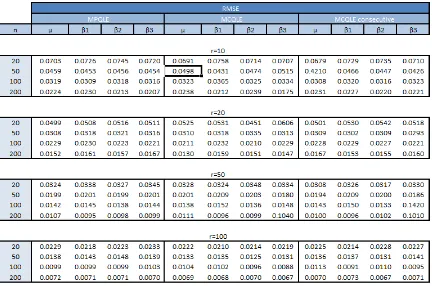
Table 1: The root mean square error of the methods over 1000 replications. n is the
number of observation, and r the number of nuisance parameters.
The results above illustrate the nice ”blessings of dimensionality”. As r increases the number of nuisance parameteresµj also increases, however the additional ”information”
available improves our estimates forµand β. Asn the number of observations increase we see improvements in our estimators as we would expect. The main hinderance to the
accuracy of our estimator would come from an increase ink, the number of explanatory variables.
The performance of MPQLE and MCQLE is very similar at all nandr, it is important to remember that the performance of MPQLE depends heavily on the quality of the
initial estimator, for this example our initial estimator is very good.
The quality of estimators from MCQLE and MCQLE consecutive are very close across all
Chapter 2. Methodology 14
3.2
Example 2
Scalar BEKK model(Engle, Shephard and Sheppard 2008). Let us considerp×1 return series Xt defined by
Xt=H1t/2εt, εt∼i.i.d.(0, Ip), (3.2.1)
Ht= (1−α−β)Σ+αXt−1X0t−1+βHt−1, (3.2.2)
whereα, β > 0 are dynamic parameters, α+β <1,Σ≡(σij)>0 is the unconditional
covariance matrix of Xt. Note that the model admits a strictly stationary solution.
Our interest is to estimate the dynamic parameters α and β while σij play the role of
nuisance parameters. It may be shown that (3.2.2) admits the solution
Ht=
1−α−β 1−β Σ+α
∞
X
j=1
βj−1Xt−jX0t−j. (3.2.3)
Assumingεt∼N(0,Ip), the log-likelihood function is of the form
l(α, β,Σ) =−1
2
X
t
(log|Ht|+X0tH
−1
t Xt),
which involves both the inverse and the determinant ofp×pmatrices Ht.
For MCQLE, we may consider two options: using all binary pairs (Xti, Xtj) for all
1≤i6=j≤p, or using only the consecutive pairs (Xti, Xt,i+1) for i= 1,· · ·, p−1. For MPQLE, we use the initial estimator
b
Σ= 1 n
n
X
t=1
(Xt−X)(X¯ t−X)¯ 0,
where ¯X=n−1P
tXt.
First we generate a random unconditional covariance matrixσ, steps are made to ensure it is positive semi-definite. We explicitly choose true values of α and β in the region of the empirical values of α and β when using the BEKK model on equity indices such as DAX30, FTSE100, S&P500, in a similar fashion to Engle, Shephard and Sheppard
2008.
(α, β) = (0.1,0.8),(0.05,0.93),(0.02,0.97) andp= 5,10,50,100, n= 2000.
Then we will generateXtandHtstepwise. During our estimation we use the constraint
For MCQLE, we may consider two options: using all binary pairs (Xti, Xtj) for all
1≤ i6=j ≤p; we call this MCQLEA, or using only the consecutive pairs (Xti, Xt,i+1) fori= 1,· · · , p−1 we call this MCQLEB. For MPQLE, we use the MLE of the covariance matrix as the initial estimator for Σ. Since we use the sample covariance matrix as anb
initial estimator the conditions for theorem 2 is met.
b
Σ= 1 n
n
X
t=1
(Xt−X)(X¯ t−X)¯ 0,
where ¯X=n−1P
Chapter 2. Methodology 16
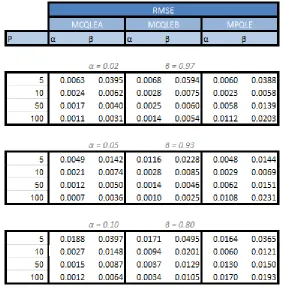
Table 2: Root mean square error of the methods over 500 replications. Where the
number of observationn is fixed at 1000, and different values are taken for the number of nuisance parametersp. 3 Sub-tables with different true values for the parameters we wish to estimate.
From the table above we can see for both MCQLEA and MCQLEB we gain performance
with the increase of dimensionality inp, however for MPQLE whenpincreases and gets closer to the size of n the quality of estimators starts to get worse. We will further investigate the impact on all 3 approaches when the size of p is large compared to n with another simulation shown below.
MCQLEB does not perform as well as MCQLEA when the dimension pof Xt is small,
but in the cases where p is large there are no significant differences in performance. However the number of subset pairings of MCQLEA is p(p−1)/2 while MCQLEB only havep−1 pairs. The huge increase of computational cost of MCQLEA is not justified for reasonably largep. In some situations, for example indices derivatives trading, a decision or price quotation could be extremely time sensitive, it may be worth investigating
what impact reducing the number of pairings even further could have. We saw similar
results in example 1 in terms of the computational cost benefits of not choosing subsets
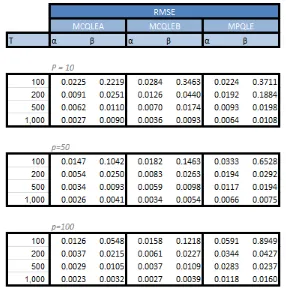
Table 3: We perform 500 replications where each sub-table has a fixed number of
nui-sance parametersp, with the number of observationsT ranging from 100 to 1000.
We perform further simulations to cross examine how the estimation methods compare
with each other when p is large in relation to n. We will perform 500 replications for each simulation. We use the values α = 0.03 and β = 0.95, p = 10,50,100 and t= 100,200,500,1000
The results above show that the increase innimproves our estimators for all 3 approaches as we would expect, since more information from an increase of observations would yield
Chapter 4
Proofs
We use the same notation as in chapter 2.
4.1
Proof of Theorem 1
The basic idea in the proof of Theorem 1 is the same as that of Theorem 6.5.1 of
Lehmann and Casella (1998), although it becomes technically much more involved in
order to handle the increasing number of parameters asn→ ∞.
Let
Qδ=
(θ,ω1,· · · ,ωr)
||θ−θo||2+
1 r
r
X
j=1
||ωj−ωjo||2=δ2/m .
We will show that for any δ > 0 fixed, l(β) < l(βo), for all β ∈ Qδ, with probability
converging to 1. Therefore with probability arbitrarily close to 1 l(β) attains a local maximum in the interior ofQm for all sufficiently large n. Letβb be the local maximum
closest to β0. By the above argument, βb must lie in the interior of Qδ for any δ > 0.
This entails the required assertion.
To establish the needed fact concerning the behaviour of l(β) on Qδ, we evoke a Taylor
expansion:
1
nr{l(β)−l(βo)} = 1
nr(β−βo) 0˙
l(βo) + 1
2nr(β−βo) 0¨
l(βo)(β−βo)
+ 1
6nr
X
`,i,k
(β`−β`o)(βi−βio)(βk−βko)
∂3 ∂β`∂βi∂βk
l(β?) ≡ S1+S2+S3(4.1.1),
whereβ? lies between βand βo.
For β∈Qδ, write θ−θo= √δmγ and ωj −ωjo=δpmrγj. Then all the elements of γ
and γj are between−1 and 1. Furthermore,
S1 = δγ0 n√m
n X t=1 1 r r X j=1 atj+
δ√r n√m
n X t=1 1 r r X j=1
γ0jbtj. (4.1.2)
Letξtj denote any component of atj. Since E(Pjatj) = 0, it holds for any >0 that
P √ m n n X t=1 1 r r X j=1 ξtj > ≤ m n2
Var(ζtr) + 2 n−1
X
t=1 (1− t
n)Cov(ζ1r, ζ1+t,r)
≤ m
n2
Var(ζtr) + 2E(|ζtr|ν)2/ν
∞
X
t=1
α(t)1−2/ν →(4.1.3)0.
whereζtr =r−1P1≤j≤rξtj. The last inequality follows from Proposition 2.5 of Fan and
Yao (2003); see also conditions A1 and A3. Hence the first sum on the RHS of (4.1.2) is of the orderoP(m−1), and the convergence is uniform for γ in any compact subset of
Rd.
To estimate the second term on the RHS of (4.1.2), let dj denotes the length of btj ≡
(btj1,· · · , btjdj)
0. Then max
1≤j≤rdj are bounded (as r→ ∞). Note
sup {γj}
n X t=1 r X j=1 γ0jbtj
= sup
{γj}
r
X
j=1 γ0j
n X t=1 btj ≤ r X j=1 dj X i=1 n X t=1 btji . Hence P sup {γj}
√ rm n n X t=1 1 r r X j=1 γ0jbtj
> ≤ P √ rm n r X j=1 dj X i=1 n X t=1 btji > r ≤ r X j=1 P √ rm n dj X i=1 n X t=1 btji
> } ≤
r X j=1 dj X i=1 P √ rm n n X t=1 btji
> /dj}
≤ rm(maxjdj)
2 n2 r X j=1 dj X i=1
{Var(btji) + 2(E|btji|ν)2/ν
∞
X
t=1
α(t)1−2/ν} →0, (4.1.4)
as r2m/n → 0 and condition A3 stands. The last inequality in the above expression follows the same argument as for (4.1.3). This shows that the second sum on the RHS of (4.1.2) is alsooP(m−1). ThereforeS1 =oP(m−1), and the convergence is uniform for
Chapter 4. Proofs 20
To calculateS2, we first note that similar to (4.1.4), condition A4 implies that 1 nr n X t=1 r X j=1
(θ−θo)0Atj(θ−θo)−
1 r
r
X
j=1
(θ−θo)0E(A1j)(θ−θo)
= 1 n n X t=1 1 r r X j=1
(θ−θo)0(Atj−EAtj)(θ−θo) =oP(m−1),
1 nr n X t=1 r X j=1
(θ−θo)0Btj(ωj−ωtj)−
1 r
r
X
j=1
(θ−θo)0E(B1j)(ωj−ωtj) =oP(m−1),
1 nr n X t=1 r X j=1
(ωj−ωtj)0Ctj(ωj−ωtj)−
1 r
r
X
j=1
(ωj −ωtj)0E(C1j)(ωj−ωtj) =oP(m−1).
Furthermore, all the convergences above are uniform for β ∈ Qδ, as the sizes of all
the matrices on the LHS of in the above expressions are fixed, and the the uniform
convergence may be established in the same manner as in (4.1.4). Now
S2 = 1 2nr n X t=1 r X j=1
{(θ−θo)0Atj(θ−θo) + 2(θ−θo)0Btj(ωj−ωjo) + (ωj−ωjo)0Ctj(ωj−ωjo)}
= 1 +oP(1) 2r
r
X
j=1
{(θ−θo)0EAtj(θ−θo) + 2(θ−θo)0EBtj(ωj−ωjo) + (ωj−ωjo)0ECtj(ωj−ωjo)}
=− 1
2r(β−βo) 0
M1(β−βo){1 +oP(1)}=−
1 2β
0
rM2βr{1 +oP(1)},
whereM1,M2 are defined in (2.1.6) and (2.1.7), and
βr = ((θ−θo)0,(ω1−ω1o)0/
√
r,· · ·,(ωr−ωro)0/
√
r)0.
Forβ∈Qδ,||βr||2 =δ2/m. Since all the eigenvalues of M2 are bounded between 0 and
∞ (see condition A5),β0rM2βr = 2c||βr||2 = 2cδ2/m, wherec >0 is a constant. Hence
Finally we deal with S3. Note that ∂
2
∂ωi∂ω0jl(β) = 0 for anyi
6
=j. Similar to the above, it may be proved using condition A6 that
|S3| ≤
1 +oP(1)
6r
X
`,i,k
(θ`−θ`o)(θi−θio)(θk−θko)
r
X
j=1
E{λj(Xtj)}
+ X
i,k
(θi−θio)(θk−θko)
r X j=1 X `
(ωj`−ωj`o)
E{λj(Xtj)}
+ X
k
(θk−θko)
r X j=1 X `,i
(ωj`−ωj`o)(ωji−ωjio)
E{λj(Xtj)}
+ r X j=1 X `,i,k
(ωj`−ωj`o)(ωji−ωjio)(ωjk−ωjko)
E{λj(Xtj)}
≡ (S31+S32+S33+S34){1 +oP(1)}.
Note that E{λj(Xtj)} is bounded by a constant for 1 ≤j ≤r, |θi−θio| ≤δ/
√
m and
|ωjk−ωjko| ≤δ
p
r/mfor allβ∈Qδ, and all the lengths ofωj are bounded. It is easy to
seeS31=O(m−3/2) =o(m−1) and S32=O(m−3/2r1/2) =o(m−1). On the other hand,
S33 ≤ c2 r√m
r X j=1 X `,i
(ωj`−ωj`o)(ωji−ωjio)
=
c2 r√m
r X j=1 X i
(ωji−ωjio)
2
≤ c3
r√m
r
X
j=1
||ωj−ωjo||2 ≤
c3
m3/2 = o(m −1),
S34≤ c4 √ mr r X j=1 X i
(ωji−ωjio)
2
≤ c5r
1/2
m3/2 =o(m −1).
This concludes that S3=oP(m−1).
Combining the above asymptotic approximations for S1, S2 and S3 together, we have shown that uniformly for β∈Qδ
1
nr{l(β)−l(βo)}=−c δ
2/m+o
P(m−1),
wherec >0 is a constant. This completes the proof.
4.2
Proof of Theorem 2
Since ˙l(βb) = 0, it follows from a simple Taylor expansion that
b
Chapter 4. Proofs 22
where ¨l= ∂β∂∂2lβ0, and β? lies on the line betweenβb and βo. Note
¨ l(β) =
n X t=1 Pr
j=1Atj(θ,ωj) Btj(θ,ω1) · · · Btr(θ,ωr) Bt1(θ,ω1)0 Ct1(θ,ω1)
..
. . ..
Btr(θ,ωr)0 Ctr(θ,ωr)
,
where the entries at the blank places are all 0. We partition the above matrix into
2×2 blocks withP
t
P
jAtj(θ,ωj) as the (1,1)-th block. By inverting this partitioned
matrix, the first dcomponents of (4.2.5) may now be expressed as
√
n(θb−θo)
= −n 1
nr r X j=1 Xn t=1
Atj(θ?,ω?j)− n
X
t=1
Btj(θ?,ω?j)
n
X
t=1
Ctj(θ?,ω?j)
−1Xn
t=1
Btj(θ?,ω?j)
0o−1
× √1
n r r X j=1 Xn t=1 atj−
n
X
t=1
Btj(θ?,ω?j)
n
X
t=1
Ctj(θ?,ω?j)
−1Xn
t=1 btj
. (4.2.6)
For any matrix B, denote by |B|a the sum of the absolute values of all the elements of B. Note that all the sizes of the matricesAtj, Btj andCtj are bounded. It follows from
condition A6 that
max 1≤j≤r
1 n n X t=1
Atj(θ?,ω?j)−E(A1j)
a (4.2.7)
≤ max 1≤j≤r
1 n n X t=1
{Atj(θ?,ω?j)−Atj}
a+ max1≤j≤r
1 n n X t=1
Atj−E(A1j)
a
≤ {|θ?−θo|a+ max
1≤j≤r|ω ?
j −ωjo|a} max
1≤j≤r
1 n
n
X
t=1
λj(Xtj) + max
1≤j≤r
1 n n X t=1
Atj−E(A1j)
a.
For any >0,
P max 1≤j≤r
1 n n X t=1
Atj−E(A1j)
a > ≤ r X j=1 P 1 n n X t=1
Atj−E(A1j)
a> (4.2.8)
≤ c n X ηtj r X j=1
Var(ηtj) + 2{E(|ηtj|ν)}2/ν
∞
X
k=1
α(k)1−2/ν → 0.
same way we may show that maxj|n1Pnt=1[λj(Xtj)−E{λj(Xtj)}]| P
−→0, and therefore
max 1≤j≤r
1 n
n
X
t=1
λj(Xtj) =OP(1). (4.2.9)
Now we show that
max 1≤j≤r|ω
?
j −ωjo|a−→P 0. (4.2.10)
It follows from (2.1.10) that for any >0, it holds for all sufficiently largenthat
P
r
X
j=1
||ωbj−ωjo||2 ≤2/k02 >1−,
wherek0 is the maximum length of the vectorsω1,· · · ,ωr, which is fixed. Since ω?j lies
betweenωbj andωjo,|ω
?
j −ωjo|a≤ |ωbj−ωjo|a. Hence
P{max 1≤j≤r|ω
?
j −ωjo|a≤} ≥ P{max
1≤j≤r|ωbj−ωjo|a≤}
≥ P
r
X
j=1
||ωbj −ωjo||2 ≤2/k20 >1−.
Therefore (4.2.10) holds. Combining (4.2.7) – (4.2.10), we conclude
max 1≤j≤r
1 n n X t=1
Atj(θ?,ω?j)−E(A1j)
a P
−→0. (4.2.11)
It may be established in the same manner that
max 1≤j≤r
1 n n X t=1
Btj(θ?,ω?j)−E(B1j)
a P
−→0, max 1≤j≤r
1 n n X t=1
Ctj(θ?,ω?j)−E(C1j)
a P
−→0,
which implies that
max 1≤j≤r
1 n n X t=1
Btj(θ?,ω?j){ n
X
t=1
Ctj(θ?,ω?j)}−1 n
X
t=1
Btj(θ?,ω?j)0−E(B1j)(EC1j)−1E(B01j)
a P −→0.
Combining this with (4.2.11), we obtain that 1 nr r X j=1 Xn t=1
Atj(θ?,ω?j)− n
X
t=1
Btj(θ?,ω?j)
n
X
t=1
Ctj(θ?,ω?j)
−1
n
X
t=1
Btj(θ?,ω?j)
0 = 1 r r X j=1
Chapter 4. Proofs 24
Using the similar arguments, we may show that
1 √ n r r X j=1 n X t=1
Btj(θ?,ω?j)
n
X
t=1
Ctj(θ?,ω?j)
−1Xn
t=1 btj−
1 √ n r r X j=1
E(B1j)(EC1j)−1 n X t=1 btj P −→0.
Now it follows from (4.2.6) that
√
n(θb−θo) =L−1
1 √ n n X t=1 1 r y X j=1
{atj−E(B1j)(EC1j)−1btj}{1 +oP(1)}.
The required asymptotic normality follows from Proposition 2 in the Appendix now; see
condition A7. This concludes the proof.
4.3
Proof of Theorem 3
Using the notation in section 3, we have
1 m√n
˙ l(θo)−
1 m√n
n
X
t=1
a(Xt;θo,ωo) =
1 m√n
n
X
t=1
a(Xt;θo,ωb)−a(Xt;θo,(4.3.12)ωo)}
= 1
m√n
n
X
t=1
C(Xt;θo,ωo)(ωb −ωo) +
1 m√n
n X t=1
(ωb−ωo)0∂
2a
1(Xt;θo,ω?)
∂ω∂ω0 (ωb−ωo)
.. .
(ωb−ωo)0∂
2a
d(Xt;θo,ω?)
∂ω∂ω0 (ωb−ωo)
= 1
n3/2m
n
X
t,s=1
C(Xt;θo,ωo)g(Xs) +OP
q m√n
,
where ω? is between ωb and ωo, and g = (g1,· · ·, gq)0. The last equality in the above
expression follows from conditions B1 and B2. Note that
n
X
t,s=1
C(Xt;θo,ωo)g(Xs) = 2
X
1≤t<s≤n
{C(Xt;θo,ωo)g(Xs) (4.3.13)
+ C(Xs;θo,ωo)g(Xt)} + n
X
t=1
C(Xt;θo,ωo)g(Xt).
By applying the Hoeffding decompostion (A.1) (with m = 2) to the first sum on the RHS of (4.3.13), it follows from (4.3.12) and (4.3.13) that
1 m√n
˙
l(θ) = 1 m√n
n
X
t=1
a(Xt;θo,ωo) +
2(n−1) n3/2m
n
X
t=1
D(θo,ωo)g(Xt) (4.3.14)
+ Ln +
1 n3/2m
n
X
t=1
C(Xt;θo,ωo)g(Xt) + OP
q m√n
where
Ln=
2 n3/2m
X
1≤t<s≤n
C(Xt;θo,ωo)g(Xs)+C(Xs;θo,ωo)g(Xt)−D(θo,ωo){g(Xt)+g(Xs)}
.
By Proposition 1 in the Appendix,E{(n−1/2Ln)2}=O(n−1−γ). Hence it holds for any
constantc,
P(|Ln| ≥c) =P
n(n−1/2Ln)2 > c =n·O(n−1−γ) =O(n−γ)→0;
see condition B3. We may also show in the similar (but simpler) manner that
1 n3/2m
n
X
t=1
C(Xt;θo,ωo)g(Xt) =OP(n−1/2).
Therefore it follows from (4.3.14) that 1
m√n ˙ l(θo) =
1 m√n
n
X
t=1
{a(Xt;θo,ωo) + 2D(θo,ωo)g(Xt)}+oP(1).
Note conditions B4 and B3 imply conditions C3 and C4. By Proposition 2,
1
m√nl(˙θo)
D
−→N(0, Σ0+ 2 ∞
X
j=1
Σj). (4.3.15)
Furthermore, the convergence of the sum P
j≥1Σj is guaranteed by condition B4. On the other hand,
1 nm
¨
l(θ?) = 1 nm
n
X
t=1
B(Xt;θo,ωo) +
1 nm
n
X
t=1
G(Xt;θ??,ω?,θ?−θo,ωb−ωo), (4.3.16)
where (θ??,ω?) lies between (θ?,ωb) and (θo,ωo), and G is a d×d matrix with the
(i, j)-th element
(θ?−θo)0
∂
∂θbij(Xt;θ
??,ω?) + (
b
ω−ωo)0
∂
∂ωbij(Xt;θ
??,ω?), (4.3.17)
and bij denotes the (i, j)-th element of B. Write µij,m = E{bij(Xt;θo,ωo)}/m. Then
for any >0,
P 1 nm n X t=1
bij(Xt;θo,ωo)−µij,m(θo,ωo)
> ≤
1 2n2Var
1
m
n
X
t=1
Chapter 4. Proofs 26
The limit is guaranteed by B5 and the mixing condition on Xt; see Proposition 2.5 of
Fan and Yao (2003). Hence
1 nm
n
X
t=1
B(Xt;θo,ωo) P
−→M,
whereMis a d×dmatrix with the limit ofµij,m as its (i, j)-th element. Note that the
absolute value of the expression in (4.3.17) is bounded from the above by
λ2(Xt;θo,ωo){||θ?−θo||+||ωb−ωo||}.
Condition B5 implies that there exists a positive and finite constantc for which
P 1 nm
n
X
t=1
λ2(Xt;θo,ωo)≤c →1.
Since||θ?−θo||+||ωb−ωo||
P
Appendix:
U
-statistics
Letξt be ap×1 strictly stationary process,ξtisFt-measurable, andF1⊂ F2 ⊂ · · · is a sequence of σ-algebra. Letψn(x1,· · · ,xm) be a real-valued function defined on (Rp)m,
and it is symmetric in its m(≥ 2) arguments. A U-statistic based on n observations ξ1,· · · ,ξn is defined as
Un=
m!(n−m)! n!
X
1≤i1<···<im≤n
ψn(ξi1,· · · ,ξim).
Fork= 1,· · ·, m−1, let
ψn,k(x1,· · · ,xk) =
Z
ψn(x1,· · ·,xk,xk+1,· · · ,xm) n
Y
j=k+1
F(dxj),
where F(·) denotes the marginal distribution ofξt. For the simplicity in presentation, we assume thatE{ψn,1(ξt)}= 0. (Otherwise we replace ψn by ψn−E{ψn,1(ξt)}.) Put
hn,1(x1) = ψn,1(x1),
hn,2(x1,x2) = ψn,2(x1,x2)−hn,1(x1)−hn,1(x2),
hn,3(x1,x2,x3) = ψn,3(x1,x2,x3)− 3
X
j=1
hn,1(xj)−
X
1≤i<j≤3
hn,2(xi,xj),
· · · ·
hn,m(x1,· · · ,xk) = ψn(x1,· · ·,xk)− m
X
j=1
hn,1(xj)−
X
1≤i<j≤m
hn,2(xi,xj)− · · ·
− X
1≤i1<···im−1≤m
hn,m−1(xi1,· · ·,xik).
Chapter 5. Appendix: U-statistics 28
The Hoeffding decomposition (Lemma A, pp. 178 in Serfling 1980) is of the form
Un =
m n
n
X
j=1
ψn,1(ξj) + m
X
k=2 m!
(m−k)!Sn,k, (A.1)
where
Sn,k =
(n−k)! n!
X
1≤i1<···<ik≤n
hn,k(ξi1,· · · ,ξik). (A.2)
As long as the variance of ψn,1(ξj) does not diminish to 0, the asymptotic property
of Un is determined by that of the first sum on the RHS of (A.1). The lemma below
shows indeed that the remainder term (i.e. the other sum) is asymptotically negligible.
Different from conventional setting, we allow the kernel functionψnto vary with respect
to the sample size n. Furthermore, we allow the dimension p of ξj to diverge to ∞
together with n. We first introduce some regularity conditions.
C1. {ξt} is a strictly stationary and β-mixing (i.e. absolutely regular) process with the β-mixing coefficients satisfying the condition β(n) = O(n−(2+δ0)/δ0), where δ0 ∈(0, δ) is a constant.
C2. It holds for alln,pand 1≤i1<· · ·< im ≤nthatE{|ψn(ξi1,· · · ,ξim)|
2+δ} ≤M,
and
Z
ψn(x1,· · ·,xm)
2+δYm
j=1
F(dxj)≤M,
whereδ >0, M >0 are fixed constants.
Proposition 1. Under conditions C1 and C2, it holds that E(Sn,k2 ) = O(n−1−γ) for k= 2,· · · , m, where Sn,k is defined as in (A.2) andγ = min{1, 2(δ−δ
0)
δ0(2+δ)}.
5.1
Proposition 1
Proposition 1 is essentially Lemma 2 of Yoshihara (1976). The only difference here is to
allow ψn to vary with n and the dimension p to grow. Nevertheless the original proof
is still applicable. However it was an error to define γ = 2(δ0(2+δ−δδ0)) in Yoshihara (1976), as
the optimal rate for E(Sn,k2 ) is n−2. Therefore it must hold that γ ≤1. Note that this optimal rate is attainable when, for example,{ξt} is a sequence of independent r.v.s, or the rate of the mixing coefficients is strengthened to satisfy the condition
∞
X
k=1
Now we turn to the asymptotic normality of the first term on the RHS of (A.1). We state the required regularity conditions separately below.
C3. {ξt} is a strictly stationary and α-mixing (i.e. strong mixing) process with α-mixing coefficients satisfying the condition P
k≥1α(k)1−2/ν < ∞, where ν > 2 is a constant.
C4. Forν >2 given in C3 above, limn→∞E{|ψn,1(ξ1)|ν}<∞. Furthermore, the limit of Cov{ψn,1(ξ1), ψn,1(ξj)}exists for any 1≤j ≤n.
Put
Bn2 = 1 nVar
n
X
t=1
ψn,1(ξt) = Var{ψn,1(ξ1)}+ 2
n−1
X
j=1 1−j
n
Cov{ψn,1(ξ1), ψn,1(ξ1+j)}.
5.2
Proposition 2
Proposition 2. Under conditions C3 and C4, it holds that
1
√
nBn n
X
t=1
ψn,1(ξt) D
−→N(0,1).
5.2.1 Proof
Proof. By Proposition 2.5 of Fan and Yao (2003) withp=q =ν,
|Cov{ψn,1(ξ1), ψn,1(ξ1+j)}| ≤8α(j)1
−2
ν{E|ψn,1(ξ
1)|ν}2/ν,
see condition C4. Hence it follows from condition C3 that
lim
n→∞
n−1
X
j=1
|Cov{ψn,1(ξ1), ψn,1(ξ1+j)}| ≤8 limn→∞{E|ψn,1(ξ1)|ν}2/ν ∞
X
j=1
α(j)1−2/ν<∞.
Now by the Lebesgue dominated convergence theorem, it holds that
lim
n→∞B 2
n= limn→∞
1 nVar
n
X
t=1
ψn,1(ξt) =σ2∈(0,∞), (A.3)
whereσ2 is a constant.
Now we partition the set {1,· · · , n} into 2kn+ 1 subsets with large blocks of size ln,
Chapter 5. Appendix: U-statistics 30
sn are selected such that
sn→ ∞, sn/ln→0, ln/n→0, and kn= [n/(ln+sn)] =O(sn).
For example, we may choose ln = O(n
a−1
a ) and sn = O(n1/a) for any a > 2. Then kn=O(n1/a) too. Forj = 1,· · · , kn, define
ηj =
jln+(j−1)sn
X
i=(j−1)(ln+sn)+1
ψn,1(ξi), ζj =
j(ln+sn)
X
i=jln+(j−1)sn+1
ψn,1(ξi), χ=
n
X
i=kn(ln+sn)+1
ψn,1(ξi).
Similar to (A.3), it may be proved that
lim n→∞ 1 nVar kn X j=1 ζj = lim n→∞ knsn
n 1 knsn
Var kn X j=1 ζj = 0,
and n−1Var(χ)→0. Hence
1 √ nBn n X t=1
ψn,1(ξt) =
1 √ nBn kn X j=1 ηj +
kn
X
j=1
ζj+χ}=
1 √ nBn kn X j=1
ηj+oP(1). (A.4)
By Proposition 2.6 of Fan and Yao (2003),
E
exp √it
nBn kn
X
j=1
ηj − kn
Y
j=1
E{exp √itηj
nBn
≤ 16(kn−1)α(sn)→0, (A.5)
see condition C3. Again similar to (A.3), it holds that Var(P
1≤j≤knηj)/Bn → 1. It follows from condition C4 that
lim sup
n
E|ψn,1(ξ1)|2I{|ψn,1(ξ1)| ≥ε
√
n}
≤ 1
εν−2nν/2−1limn E{|ψn,1(ξ1)|
ν} →0,
for any ε >0. Noticing (A.3), it follows from the theorem on page 31 of Serfling (1980) that
kn
Y
j=1
E{exp √itηj
nBn
→e−t2/2.
References
Baltagi, B.H. (2005). Econometric Analysis of Panel Data. Wiley, New York.
Besag, J. (1974). Spatial interaction and the statistical analysis of lattice systems (with
discussion). J. Royal Stats. Soc B,36, 192-236.
Bickel, P., Ritov Y. and Tsybakov, A. (2009). Simultaneous analysis of Lasso and
Danzig selector. Ann. Statist. 37 1705-1732.
Cox, D.R. (1961). Tests if separate families of hypotheses. Proceedings of the Berkeley
Symposium 4, 105-123.
Cox, D.R. and Reid, N. (2004). A note on pseudo-likelihood constructed from marginal
densities. Biometrika,91, 729-737.
deLeon, A.R. (2005). Pairwise likelihood approach to grouped continuous model and
its extension. Stats. and Probab. Letters,75, 49-57.
Eicker, F. (1967). Limit theorems for regressions with unequal and dependent errors.
Proceedings of the Berkeley Symposium 5,1, 59-82.
Engle, R.F., Hendry, D.F. and Richard, J.F. (1983). Exogeneity. Econometrica, 51,
277-304.
Fan, J. and Lv, J. (2008). Sure independence screening for ultra-high dimensional
feature space. J. Roy. Stats. Soc. B,70, 849-911.
Fan, J. and Yao, Q. (2003). Nonlinear Time Series: Nonparametric and Parametric
Methods. Springer, New York.
Engle, R.F., Shephard, N. and Sheppard, K. (2008). Fitting and testing vast
dimen-sional time-varying covariance models. A preprint.
Chapter 6References 32
Gallant, A.R. and White, H. (1988). A unified theory of estimation and inference for
nonlinear dynamic models.
Huang, J., Ma, S. and Zhang, C.-H. (2008). Adaptive LASSO for sparse high-dimensional
regression models. Statistica Sinica 18, 1603-1618.
Kuk, A. and Nott, D. (2000). A pairwise likelihood approach to analyzing correlated
binary data. Stats. Probab. Letters,47, 329-335.
Larribe, F. and Fearnhead, P. (2011). On composite likelihoods in statistical genetics.
Statistica Sinica,21, 43-69.
Lehmann, E.L. and Casella, G. (1998). Theory of Point Estimation. Springer, New
York.
Liang, K.-Y. (1987). Extended Mantel-Haenszel estimating procedure for multivariate
logistic regression models. Biometrics,43, 289-299.
Lindsay, B. (1988). Composite likelihood methods. In Statistical Inference from
Stochastic Processes (ed. Brabhu, N.U.). pp.221-239. Providence, RI:
Ameri-can Mathematical Society.
Molenberghs, G. and Vervbeke, G. (2005). Models for Discrete Longitudinal Data.
Springer, New York.
Serfling, R.J. (1980). Approximation Theorems of Mathematical Statistics. Wiley,
New York.
Varin, C., Raid, N. and Firth, D. (2011). An overview of composite likelihood methods.
Statistica Sinica,21, 5-42.
Yoshihara, K. (1976). Limiting behaviour of U-statistics for stationary, absolutely regular processes. Z. Wahrsch. verw. Gebiete,35, 237-252.
Zhang, C.-H. and Huang, J. (2008). The sparsity and bias of the LASSO selection in
high-dimensional regression. Ann. Statist. 36, 1567-1594.
Zhang, T. (2009a). Some sharp performance bounds for least squares regression with
L1 regularisation. Ann. Statist. 37, 2109-2144.
Zou, H. (2006). The adaptive lasso and its oracle properties. J. Amer. Statist. Assoc.