1
The London School of Economics and Political Science
Information Technology, Contract and Knowledge in the Networked Economy: A Biography of Packaged Software for Contract Management
Carolyn E. C. Paris
3
Declaration
I certify that the thesis I have presented for examination for the PhD degree of the London School of Economics and Political Science is solely my own work other than where I have clearly indicated that it is the work of others (in which case the extent of any work carried out jointly by me and any other person is clearly identified in it).
The copyright of this thesis rests with the author. Quotation from it is permitted, provided that full acknowledgement is made. This thesis may not be reproduced without the prior written consent of the author.
I warrant that this authorization does not, to the best of my belief, infringe the rights of any third party.
I declare that my thesis consists of 99,546 words (including footnotes, but excluding references and appendices).
Certain portions of the dissertation were included in ISIG (Information Systems and Innovation Group) Early Stage Working Paper “Transactionalizing Technologies versus Performing Contracts: From ERP to Credit Default Swaps at AIG”, Susan Scott and Carolyn Paris, May 2009, http://eprints.lse.ac.uk/26701/1/ES02.pdf; in “The Place of Contract in Organizational Awareness: Deconstructing Process, Market and Connectedness”, Carolyn Paris and Susan Scott, First International Workshop for Design and Engineering, Lisbon, Portugal, December 11-12, 2009; or in “Applying the Biography of Software Methodology to the Making of a Software Market: The Case of Contract Management Software”, a paper presented by Carolyn Paris at the Society for the Social Studies of Science Annual Meeting, Tokyo, August 25-29, 2010. The dissertation incorporates research carried out in 2007-2008 for my dissertation to meet the requirements of the MSc (ISOR) at the Information Systems and Innovation Group at the LSE, as well as data collected from 2002-2003, all as described in Chapter 4. Jonny Potton provided assistance in formatting and Jonathan Paris provided assistance in proofreading.
4
Abstract
5
Acknowledgments
Many, many thanks are first of all due to my PhD supervisor Dr. Susan Scott for her patience, generosity, encouragement, and inspired and insightful guidance – without which, it is no exaggeration to say, this project would not have been possible. I am very grateful to her, and to the Information Systems and Innovation Group, for allowing me this opportunity to learn and study.
I also thank my colleague and former professor at Columbia Business School, Professor Nelson Fraiman, who originally suggested the subject of contract management to me, and who has encouraged me in taking the step toward academia.
Tim Cummins and his colleagues at the International Association for Contract and Commercial Management have provided invaluable help in terms of facilitating access and sharing their thoughts. Many thanks are owing to them.
6
Table of Contents Declaration
Abstract
Acknowledgments Table of Contents List of Figures List of Tables List of Appendices
List of Terms and Acronyms Used
Chapter 1 Introduction………..17
1.1 Research background: ICT, contract and knowledge in the networked economy…17 1.2 The motivating question: what happened to contract management software?...19
1.3 The research questions; overview of the thesis……….…………20
1.4 Outline of the dissertation……….23
Chapter 2 Literature review: packaged software from a market perspective…………...………26
2.1 How packaged software is understood………..………27
2.1.1 A definition of packaged software; packaged software as compared to custom software………..27
2.1.2 How the logic of scale shapes the business model for packaged software; the threat of commoditization……….29
2.1.3 The logic of scale and the problem of standardization………..……31
2.1.4 The problem of procurement……….…33
2.1.5 Summary: how packaged software is understood..………...…35
2.2. Pollock and Williams’s biography of software as a framework for this study…....36
2.2.1 Rationale; key concepts: the knowledge network, the organizing vision and generification………...………36
2.2.2 Relating the biography of software approach and key concepts to other studies of technology production………...……37
2.2.3 A preliminary hypothesis……….….39
2.3 Developing the market perspective: the theory of commoditization and studies of markets from economic sociology………..……40
2.3.1 Key concepts from the theory of commoditization: classification as an element of commoditization and knowledge networks in extended or remote production………...……41
7
2.3.3 Performativity in markets……….……….47
2.3.4 Breakdown of performative operations as a lens on market failure……..51
2.4 Summary: developing a market perspective on packaged software………..52
Chapter 3 Literature review: ICT, contract and knowledge in the networked economy………..54
3.1 Transaction cost economics and its theory of contract as related to this study………..………..55
3.1.1 Transaction cost economics and its theory of contract………..…55
3.1.2 The electronic markets hypothesis………56
3.1.3 Relating the electronic markets hypothesis to the digital transformation of the organization………..57
3.1.4 Relating the electronic markets hypothesis to recent developments in contracting………..………58
3.1.5 Transaction cost economics: qualifications and criticisms………...60
3.2 Alternative theories of contract……….…62
3.2.1 Contract as legal construct………62
3.2.2 Relational contract……….62
3.2.3 Contract as social and technological artefact………63
3.2.4 Contracting as a knowledge competence……….….64
3.2.5 Networks as connected contracts………..64
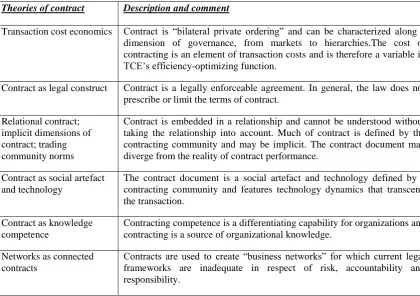
3.2.6 Summary of theories of contract……….……..65
3.3 Empirical studies of ICT, contract and knowledge………..…….65
3.3.1 Revisiting the electronic markets hypothesis; empirical studies of ICT-supported contracting and IT contracting ……….…...65
3.3.2 ICT as related to governance (markets and hierarchies)…………..…….70
3.3.3 Specifying the problem of organizational contracting knowledge……....72
3.4. Summary: ICT, contract and knowledge in the networked economy…………..…78
Chapter 4 Methodology………...….79
4.1 Epistemological and ontological stance: Barad’s agential realism……….…..79
4.1.1 Barad’s agential realism………...…….79
4.1.2 The notion of apparatus as related to technology……….….82
4.1.3 Agential realism as relevant to IS research and this study………….…...84
4.1.4 Agential realism, performativity in markets and breakdown…………....86
4.2 The biography of software approach as methodology for this study………...…….89
8 4.2.2 A historical account informed by grounded theory and shaped by
principles of corpus construction………...……90
4.2.3 CMS as biographical subject; CMS and regions of contract………….…91
4.3 Overview of research design; multiple sources and multiple methods………...…..95
4.3.1 From inside to outside: the iterative cycle of constant comparison and corpus construction………....95
4.3.2 The interviews, including the site visit………101
4.3.3 The survey………..…….102
4.3.4 Archival research……….103
4.4 Summary of methodology; developing a table of breakdown…………...……….105
Chapter 5 Empirical material: a biography of CMS as an organizing technology for contract.107 5.1 Why CMS seemed promising: the organizing vision for CMS………..….108
5.1.1 Predecessor technologies……….108
5.1.2 The founding of the IACCM and the idea of contract management…...109
5.1.3 The organizing vision: automating the contract lifecycle across the enterprise………..…110
5.2 How CMS compared to the organizing vision in successful implementation……114
5.2.1 The reference customer………...114
5.2.2 Procurement and implementation………114
5.2.3 How CMS was used………116
5.2.4 Knowledge production: searches, reports and queries………..…..119
5.2.5 Two years on………...…122
5.2.6 Summary: CMS in this implementation in comparison to the organizing vision and in comparison to two other implementations……….….122
5.3 The IACCM and CMS………...….124
5.4 Evidence of breakdown from interview, site visit and survey data and IACCM archival material………...…….125
5.4.1 Breakdown in generification……….…..125
5.4.2 Breakdown in the organizing vision: CMS did not “enclose” contracting………...…….126
5.4.3 Breakdown in the organizing vision: CMS did not produce contracting knowledge………..………..127
5.4.4 Breakdown in the organizing vision: CMS was associated with “algorithmic” contracting……….130
9 5.5 Summary: a biography of CMS as organizing technology for contract; the initial
table of breakdown………..……..138
Chapter 6 Empirical material: a biography of CMS as a commodity………...….141
6.1 The analysts and their role in the biography of CMS………..…141
6.1.1 The analyst firms……….142
6.1.2 The analyst role in the IT marketplace: evidence from a recent litigation………..….143
6.1.3 Analyst coverage of CMS………..……….145
6.2 Five focus vendors………...………152
6.2.1 I-Many………...152
6.2.2 Selectica………...156
6.2.3 Ariba………...…….159
6.2.4 Emptoris………..162
6.2.5 Upside………..165
6.2.6 “Supply-side rhetoric”: marketing CMS……….…166
6.3 Evidence of breakdown from analyst and vendor archival material………….…..168
6.3.1 Further evidence of breakdown of the business model for packaged software………...….171
6.3.2 Direct evidence of category breakdown………..………172
6.3.3 Breakdown of correspondence between market expectations and market performance……….……….173
6.4 Summary: a biography of CMS as a commodity………...173
Chapter 7 Analysis: accounting for the failure of CMS from a market perspective on packaged software and in relation to contract………176
7.1 Revisiting the preliminary hypothesis: a failure of generification………..…176
7.2 Performative assumptions and operations in the biography of CMS: analysing the evidence of breakdown………..178
7.2.1 Packaged software as an information good and the generalizability of generification………178
7.2.2 The organizing vison: contract management as process automation…..182
7.2.3 The organizing vision: knowledge as structured data………….………185
7.2.4 The organizing vision: contract as algorithmic……….……..187
10 7.3. The logic of commoditization in the biography of CMS: a “substitution of
performance”……….………194
7.4 Accounting for the failure of CMS from the market perspective on packaged software and in relation to contract; retrospective on CMS………..……202
Chapter 8 Implications of this study………...…211
8.1 Implications for packaged software………212
8.1.1 Questioning the business model for packaged software………….……212
8.1.2 A market perspective on packaged software: the logic of commoditization in packaged software production………..214
8.2 Implications for process commoditization………..216
8.3 Implications for ICT, contract and knowledge in the networked economy……....220
8.3.1 The dis-location of contracting knowledge and practice vis-à-vis the organization………..………220
8.3.2 Respecifying the problem of organizational contracting knowledge…..223
8.3.3 Theorizing ICT and contract: contract as a technology of connectedness………...……228
8.4 Implications for practice……….…….230
8.5 Implications for the theory of performativity………..……231
Chapter 9 Conclusion………...…..235
9.1 Key findings: evidence of breakdown in the biography of CMS………..…..235
9.2 Summary of analysis………..….239
9.3 Summary of implications………...……….241
9.4 Contribution……….243
9.5 Reflections and limitations………..………244
9.6 Areas for further research………..……..245
References………..247
11
List of Figures
5.1 The contract lifecycle as defined by Forrester………..………..110
5.2 The contract lifecycle as envisioned by CMS……….………111
5.3 Linking contract to the income statement and the balance sheet………113
5.4 An example of a “dashboard” from Upside’s entry level on-demand product……….…..116
5.5 Forrester’s version of the maturity model………..…….137
6.1 Gartner’s analysis of CMS implementation style………..…..147
6.2 Forrester Wave for Contract Life-Cycle Management 2006………...……148
6.3 Forrester Wave for Contract Life-Cycle Management 2008………...……149
6.4 Forrester Wave for Contract Life-Cycle Management 2011………..…….150
6.5 Aberdeen’s “The Impact of Poor Contract Management within the Enterprise”………....151
6.6 I-Many’s “Enterprise Software for Contract Management – A Buyer’s Guide”……...….155
List of Tables 2.1 Comparing custom software to packaged software……….………..29
2.2 Resolving the problem of standardization for packaged software………..………..33
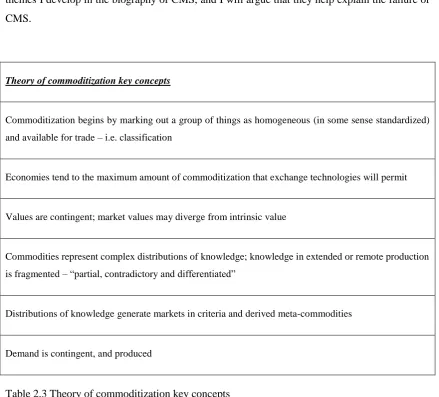
2.3 Theory of commoditization key concepts………...……..44
3.1 Theories of contract………..….65
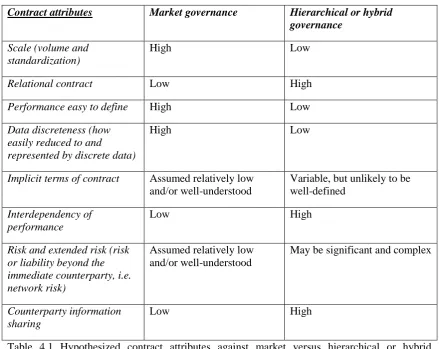
4.1 Hypothesized contract attributes of market versus hierarchical or hybrid governance…...98
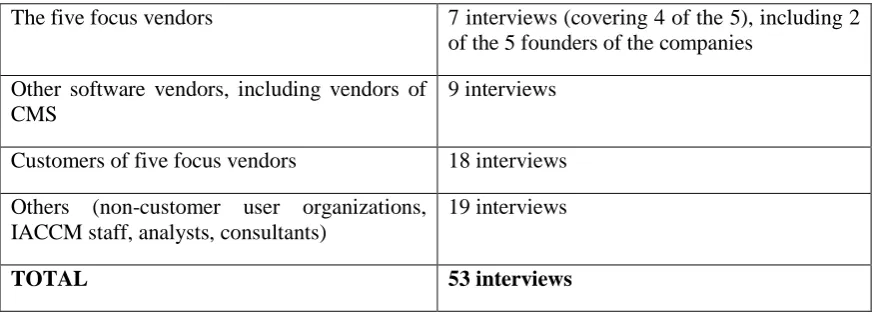
4.2 Summary of interviews by market position………..………...……101
5.1 Anticipated benefits of CMS………...112
5.2 Survey results regarding hypothesized contract attributes of market versus hierarchical or hybrid governance………..………131
5.3 The CMS “region” of contract: responses to questions about the most important type of contract as related to CMS adoption………..132
5.4 Initial table of breakdown………..……..139
6.1 Selectica top customers by revenue shares, fiscal years 2001-2003………..…….157
6.2 Extended table of breakdown……….…….169
7.1 Breakdown of execution of the business model for packaged software……….180
7.2 Breakdown of the organizing vision – contract management as process automation…….183
7.3 Breakdown of the organizing vision – structured data as knowledge……….………185
7.4 Breakdown of the organizing vision – contract as algorithmic………...……188
7.5 Category breakdown………192
7.6 Breakdown of correspondence of market expectations to market performance……...…..194
12
7.8 Completed table of breakdown………..…………..204
8.1 Respecifying the problem of organizational contracting knowledge………..………227
List of Appendices 4.1 Table of interviews………..273
4.2 Interview protocol (second and third stage interviews)……….….277
4.3 Questions in Part 1 of the survey……….……279
4.4 Questions in Part 2 of the survey……….289
4.5 Profile of the respondents………309
4.6 Survey responses regarding status of CMS……….310
4.7 Gartner coverage of CMS and CMS vendors (indicative)………..…312
5.1 Vendor versus non-vendor comparison of CMS priorities………..…313
5.2 Scope of CMS implementation……….……..314
5.3 Access to CMS………...….314
5.4 Type of most important contract as related to risk-shifting; risk-shifting by type of contract and relationship to CMS adoption……….……….315
5.5 CMS features expected to be used within 1 year of implementation………..316
5.6 Precise definition of contract performance as related to data discreteness……….317
5.7 Capture of contract data generally as related to CMS adoption………..…317
5.8 Particular contract datapoints captured as related to CMS adoption………...…318
5.9 Other IT systems as related to CMS adoption……….…319
5.10 Factors important when selecting CMS………320
5.11 CMS selection among pure-play vendors, other software vendors and built in-house….321 5.12 The business case for CMS – three perspectives………..…….322
6.1 Magic Quadrants………...325
6.2 Aberdeen marketing communications and categories……….……327
6.3 Gartner blog on the contract lifecycle……….……331
6.4 I-Many financial overview………..332
6.5 Excerpts from I-Many agreement with Procter & Gamble……….……333
6.6 I-Many strategic acquisitions………..334
6.7 Excerpt from I-Many investor conference call at time of sale of company in 2009……...339
6.8 I-Many business description at year end 2008 and when acquired in June 2009……..…..340
6.9 I-Many segment reporting………...……341
6.10 I-Many revenue classification………...…342
6.11 Selectica financial overview………..……343
13
6.13 Selectica customers………..……….345
6.14 Selectica revenue classification……….346
6.15 Ariba financial overview……….………..347
6.16 Ariba strategic transactions………...……348
6.17 Ariba revenue classification………..350
6.18 Ariba 2010 business description………351
6.19 Emptoris spend analysis solution……….….352
6.20 Upside company description……….362
6.21 Ariba on marketing, training and support………..……364
6.22 Pictures of the contract lifecycle and contract management………...…..365
6.23 Upside’s UpsideLive……….366
6.24 Mentions of IACCM and analysts in press releases (Emptoris and Upside)………367
6.25 Targeted web ads ………..369
14
List of Terms and Acronyms Used
buy-side – a firm’s function and activities as a buyer of goods and services
CLM – contract lifecycle management, used by Forrester as its term for contract management software
commoditization, or commodification – in the first meaning as used herein, commoditization refers to the process of making a thing (a good or service) into a commodity, or thing for exchange; in a second meaning, commoditization refers to a product becoming undifferentiated or generic, and widely available, and thus competing on price alone
contract lifecycle – the notion that a particular contract goes through phases from pre-contract through negotiation, execution, performance and finally retirement or expiry
CPQ – the name used for Selectica’s configuration, pricing and quoting software
CRM – customer relationship management systems
data discreteness – a term introduced here to refer to how easily and completely a contract (or other document) can be reduced to structured data (without significant loss of meaning)
demo – a term commonly used to refer to a software demonstration to prospective customers
distributed contract – a term introduced used here to refer to a contract the terms of which are constituted and made of record across multiple ICT and other tangible or intangible modalities
distributed organization – a term used here to refer to an organization that contracts out many corporate functions and activities
ECM – enterprise content management systems
EMH or the electronic markets hypothesis – the hypothesis that ICT promotes market coordination relative to hierarchical coordination
15 ERP – enterprise resource planning systems, such as SAP or Oracle
goodwill – the portion of the purchase price for a business that cannot be allocated to particular assets and therefore is booked as an asset (goodwill) on the acquiring firm’s balance sheet
hard coding – in reference to software (or a software demo), refers to features or data that could or should be variable or optional but instead are pre-specified and fixed in the software
IACCM – International Association for Contract and Commercial Management
IP – intellectual property
IPO – initial public offering, that is, when a firm offers its shares to the public for the first time
metadata – with respect to any document or other file, structured data, codes or tags associated with the document or file
NASDAQ – the American stock market on which many technology companies are listed
networked economy – a digitally connected economy trading products that are to an increasing degree intangible
process commoditization – as used here, the conversion of organizational processes into products, following a program of functional simplification and closure, or decontextualization
pure-play – with respect to a software vendor, means that it offers or specializes in a particular type of software
repository – as used here, a library of digital documents
RFQ, RFP, RFI, RFX – requests for quotations, proposals, information or generally, all referring to a firm going to market with a specification for something that it wants to buy
16 SaaS – software-as-a-service, referring to software delivery in the form of subscription access to the vendor’s server, which hosts the software
SEC – the Securities and Exchange Commission, the United States securities regulatory agency
sell-side – a firm’s function and activities as a buyer of goods and services
SRM – seller relationship management systems
structured data – refers to data that is in a fixed format for entry into a database or spreadsheet where it can be queried, manipulated, calculated or generally become the subject of computer operations; compare the unstructured data in the form of a natural language document
STS – science and technology studies, also here referring to concepts such as the social construction of technology or the social shaping of technology
TCE or transaction cost economics – a theory of firm formation and governance associated with Coase and Williamson which at its core hypothesizes an efficiency-optimizing function that minimizes the sum of production costs and transaction costs
template – with respect to contracts or other documents, a standard form of document that can be completed by filling in blanks, selecting among options or otherwise revising for a particular use
vertical – used here in two ways, to refer to a particular industry, or to refer to a form of business organization which incorporates multiple stages in the entire chain of production, e.g. from raw materials to ultimate consumers
webinar – a presentation made over the internet, usually incorporating some level of interactivity
17
Chapter 1 Introduction
1.1 Research background: ICT, contract and knowledge in the networked economy
Recent developments in information and communication technology (ICT), in particular the internet, have changed the way we do business, and the business that we do. We live in a digitally connected economy trading products that are to an increasing degree intangible (Asprey and Ceruzzi 2008; Castells 2010) – what I call in this dissertation the “networked economy”. While the financial markets are in the vanguard, (see Bátiz-Lazo et al. 2011; Chiasson and Davidson 2005; Knorr Cetina and Grimpe 2008; Lepinay 2007a, 2007b; Zaloom 2006; Zuboff 1988), ICT has also transformed the travel industry, retail commerce, the media industry and the IT industry itself (see Asprey and Ceruzzi 2008). In the networked economy, it makes more sense to “buy” than to “make” (Ciborra 2007), and organizations become digitized, distributed, even “virtual” (the “crisis of the vertical corporation model”; Castells 2010, p. 178). Supply chain management, outsourcing and cloud computing evidence this de-composition and re-configuration of organizational resources, capabilities and boundaries characteristic of the networked economy.
One way of understanding how ICT is changing the way we do business is through transaction cost economics (TCE), a theory of firm formation and governance associated with Coase (1937) and Williamson (e.g. 1979, 2010) which at its core hypothesizes an efficiency-optimizing function that minimizes the sum of production costs and transaction costs – including the cost of contracting. Malone et al. (1987) hypothesized that as ICT makes contracting more efficient, market transactions would increase relative to hierarchical governance inside vertical organizations. This is the so-called electronic markets hypothesis (EMH) (see Mithas et al. 2008).
18 The generative effects of ICT on the economy, through the enabling of markets and the creation of new markets, are now largely taken for granted. Less well understood are the associated implications for organizational knowledge, that is, how the organization understands itself and its situation in relation to actions it might take (cf. Clark et al. 2007; D’Adderio 2004; Nonaka 1994; Weick 1995). Knowledge has been identified as key in firm formation (Nonaka and von Krogh 2009) and in inter-organizational economic relations and structures, such as industrial clusters (Arikan 2009), production communities (cf. Lee and Cole 2003 regarding Linux kernel development), supply chain relationships (Fayard 2012; He et al. 2011; Malhotra et al. 2005; Subramani 2004), and outsourcing and offshoring (Cha et al. 2008; Dibbern et al. 2008; Gefen and Carmel 2008; Leonardi and Bailey 2008). The increase in contracting predicted by EMH puts a premium on contracting as an organizational competence – perhaps the residual organizational competence – and on organizational contracting knowledge; Argyres and Mayer (2007) identify contracting competence as a differentiating capability for organizations. Nonaka (1994) implicitly describes one aspect of contracting knowledge as a key element in organizational knowledge creation:
It should be noted that the process of organizational knowledge creation is a never-ending, circular process that is not confined to the organization but includes many interfaces with the environment. At the same time, the environment is a continual source of stimulation to knowledge creation within the organization. For example, Hayek (1945) pointed out that the essential function of market competition is to discover and mobilize knowledge "on-the-spot," i.e., the implicit, context-specific knowledge held by market participants.
In the case of business organizations, one aspect of the relationship between knowledge creation and the environment is illustrated by reactions to the product by customers, competitors, and suppliers. For example, many dimensions of customer needs take the form of tacit knowledge that an individual customer or other market participants cannot articulate by themselves. A product works as a trigger to articulate the tacit knowledge. Customers and other market participants give meaning to the product by their bodily actions of purchasing, adapting, using, or not purchasing. This mobilization of tacit knowledge of customers and market will be reflected to the organization, and a new process of organizational knowledge creation is again initiated. (Nonaka 1994, pp. 27) However, research points to gaps in organizational contracting knowledge (Håkansson and Lind 2004), and financial crises and scandals over the last fifteen years (Enron, Long-Term Capital Management, the ongoing financial crisis with origins in 2007-2008, the 2010 “flash crash”, the collapse of MF Global, and a major trading loss at JP Morgan in 2012)1 suggest that, at least in the financial arena, where ICT has arguably had the biggest impact on markets, organizations do not understand their contracts. This lack of understanding seems to extend to counterparties,
1 See Counterparty Risk Management Policy Group III (2008); Murphy (2012); O’Malia (2012); Powers
19 investors and regulators, and the failure to understand and manage contractual commitments can have systemic consequences. The indications are that the relationship of ICT, contract and knowledge in the networked economy can be characterized as evolving, perhaps undertheorized, and, in some circumstances, problematic.
1.2 The motivating question: what happened to contract management software?
In this dissertation I explore the relationship of ICT, contract and knowledge in the networked economy by examining the “life” of a packaged software product – contract management software (CMS) – that promised to support contracting as an organizational competence along both process and knowledge dimensions. CMS was introduced toward the end of the dot.com era, around 2000-2001, and in 2002, Gartner, a technology research firm, predicted that contract management would be a $20 billion software and services market by 2007 (Gartner Inc. 20022). Instead, CMS revenues have fallen well short of $1 billion (IACCM 2007, Forrester Research Inc. 2011a). This gap between market expectations and market performance provides the motivating question and point of departure for this dissertation: “What happened to contract management software?”
In 2002, the prospects for CMS were promising. A few years earlier, in 1999, global information technology (IT) and telecommunications companies had established a professional organization for contract managers, the International Association for Contract and Commercial Management (IACCM), signalling recognition of the growing importance of contracting for these major industries. The IACCM was committed to establishing contract management as a core organizational function and professional discipline, and strongly supported the use of automation tools for contract management. Typical contracting processes in organizations were fragmented and inefficient, and in many organizations it was difficult even to locate contract documents. By 2001, several packaged software vendors had identified contract management as an opportunity.
Contract management software bridged the gap between enterprise resource planning (ERP) systems and customer relationship management (CRM) systems. While ERP systems managed the structured data for sales and purchases (e.g. delivery of goods), and CRM systems provided a place to store information about customers, neither ERP nor CRM provided an organizing technology for the contracting process, contract documents, and contract information. CMS filled this need. Automating the contract lifecycle across the enterprise, CMS promised efficiency and control in contracting, but also “visibility” into contracting – i.e. organizational contracting knowledge.
20 Contract management software provided workflow, automated document assembly, and a contracts repository, together with alerts, reporting and analytics capabilities, and was designed to support the entire contract lifecycle. Bidding, negotiation and approvals would take place within the workflow application. Then a contract document would be generated based on the key terms agreed. The finalized contract would be filed in an electronic document repository, with the key contract terms serving as document metadata (structured data about the contract, tagged to the document). These key terms could then be used to feed other IT systems internally and possibly external (counterparty) systems as well. CMS modelled contracting as a closed and continuous production function, joining up fragmented processes and generating structured data that would flow through to transactional databases and analytics applications. With its design based on the generic contract lifecycle, CMS would work for all types of contracts, and for all types of businesses, in any industry.
CMS seemed like an appropriate packaged software solution to the contract management problem. The concept attracted large amounts of investor funding and benefited from millions of dollars in research and development and sales and marketing expenditures. CMS has been successfully adopted by many customers, and did not fail in a technical sense. Instead, the case of CMS is about a failure to meet expectations (Pollock and Williams 2010; cf. Lyytinen and Hirschheim 1987) – specifically the failure to meet market expectations. In this dissertation I refer to this as the “market failure” of CMS or as the failure of CMS as a packaged software product or market.
To understand what happened to CMS, I first consider whether there was a “generic” failure in making a packaged software market – not specific to contract, contracting or contract management. In this regard, the case of CMS can be expected to contribute to our understanding of packaged software from a market perspective (cf. Sawyer 2001). Second I consider how the failure of CMS was related to contract, taking the case of CMS as an opportunity to study the nexus between ICT, contract and knowledge.
1.3 The research questions; overview of the thesis To summarize, my research questions are:
(1) How can we account for the failure of CMS from a market perspective on packaged software? What are the implications for packaged software?
21 As noted above, most organizations buy rather than build much of their software, but the phenomenon of packaged software has not received a proportionate amount of attention in IS research literature (Light and Sawyer 2007; Sawyer 2000, 2001). In particular, while Sawyer (2001) called for a market-based perspective on information systems development, a market perspective on packaged software and its implications for organizations is still underdeveloped. Pollock and Williams’s (2009a) biography of software approach provides a framework for studying a packaged software from a market perspective. Their study of a successful packaged software product – ERP – suggests that a successful packaged software market requires the mobilization of a knowledge network in support of an “organizing vision” (Swanson and Ramiller 1997) together with the successful execution of a strategy of “generification” – reconciling the diverse needs of users toward development of a standardized software product. The data indicates that in the case of CMS, an active knowledge network was enlisted in support of a coherent and compelling organizational vision – automating the contract lifecycle across the enterprise – but that generification failed.
In this dissertation I go beyond that conclusion to investigate how and why generification failed, and more generally how and why market creation failed. To do this I extend my analytical and empirical frame to incorporate, on the one hand, the vendors and the analyst firms and, on the other, contracting in relation to CMS, within a broader market perspective drawing upon the theory of commoditization (Appadurai 1986a; Kopytoff 1986) and on studies of markets from economic sociology (e.g. Callon 1998a; Cochoy 2010; Lepinay 2007a, 2007b; MacKenzie and Millo 2003). The theory of commoditization identifies the role of classification in bringing products to market and hypothesizes a knowledge network at work in extended or remote production, where producers are separated from consumers. From the studies of markets two additional notions are particularly relevant here – product qualification and performativity in markets. Product qualification refers to the processes by which products are defined, described, given attributes and stabilized (Callon 2010; Callon et al. 2002; Lepinay 2007b; Muniesa et al. 2007; cf. Caliskan and Callon 2010; Pollock and Williams 2009b), with classification (see generally Bowker and Star 1999) an important element (Sjögren and Helgesson 2007; cf. Pollock and Williams 2010, 2011).
22 Austin’s theory of performativity entailed a notion of “misfire” (Austin 1962), when a performative statement failed to have its intended effect, which corresponds to Callon’s “overflowing” of a frame (Callon 1998c) or to a notion of “breakdown” (Butler 2010; Callon 2010). In this dissertation I develop the notion of breakdown – the failure of expectations associated with a performative assumption or operation – as an analytical device for the study of market failure.
Using these concepts and working with a variety of data sources – interviews, a site visit, survey data and archival material – dating from 2000 to 2011, I first develop a biography of CMS as an organizing technology for contract. Next I develop an alternative biography of CMS as a commodity. Extending the analytical and empirical frame in this second step to include the analysts and vendors within the process of commoditization both disrupts and informs the biography of CMS an organizing technology for contract, toward offering a fuller explanation. An analysis of the evidence of breakdown in the biography of CMS reveals performative assumptions and operations relating to both packaged software and the relationship of ICT, contract and knowledge – assumptions that were not valid and operations that did not work in the case of CMS. This analysis traces the logic of commoditization in packaged software markets, encompassing vendor firms and their investors as well as software and its users. My analysis challenges prevailing conceptualizations of packaged software and process commoditization (the conversion of organizational processes into products, following a program of decontextualization). Relating the findings of this study to trends in ICT-enabled contracting and other aspects of contracting in the networked economy, I identify issues that make organizational contracting knowledge a more difficult problem than research to date would suggest and set an agenda for further research regarding the relationship of ICT, contract and knowledge based on an open and underspecified theorization of contract as a technology of connectedness, in a relationship of potential convergence, complementarity and substitution with ICT.
23 theorization of contract as a technology of connectedness and to other phenomena characteristic of the networked economy.
1.4 Outline of the dissertation
In Chapter 2, I review research literature that informs a market perspective on packaged software. In section 2.1, I describe how packaged software is generally defined and understood in relation to custom software, the business model for packaged software, and the problems of standardization and procurement. Existing research tends to analyse packaged software failure in terms of either loss of value due to commoditization (when a product becomes undifferentiated or generic, and widely available) or organizational misfit, the subject of many so-called implementation studies of ERP. In section 2.2, I explain how the biography of software approach developed by Pollock and Williams (2009a) provides a better framework for this study because it accommodates a market perspective on packaged software failure, and I develop a preliminary hypothesis that the failure of CMS might be traced to the lack of a knowledge network in support of an organizing vision or to a failure in generification. Toward developing the market perspective on this case of market failure, in section 2.3 I develop a theoretical complement to the biography of software approach by calling on the theory of commoditization and studies of markets from economic sociology, in particular developing the notion of breakdown as an analytical device for understanding market failure. Section 2.4 summarizes this research literature toward forming a market perspective on packaged software. In Chapter 3, I survey research literature on ICT, contract and knowledge, which is often framed in relation to transaction cost economics and its governance dimension (markets and hierarchies). In section 3.1, I briefly describe transaction cost economics, its theory of contract, and the electronic markets hypothesis, and I relate EMH to the digital transformation of the organization as described by Kallinikos (2006) and to recent developments in contracting. I go on to note that TCE has been qualified and questioned over the years, and, in section 3.2, I briefly survey alternative (non-TCE) theories of contract. In section 3.3, I survey empirical studies of ICT, contract and knowledge. From this survey I conclude in section 3.4 that knowledge has been identified as a key element of contracting, but has been explored mostly in terms of its inter-organizational dimension, not from the perspective of the organization’s need for synthesizing contracting knowlege. Indeed, research indicates that organizational contracting knowledge is not well-supported by financial accounting or other any other organizing technology for contract. This frames the opportunity and the challenge for CMS.
24 relating her notion of posthumanist performativity to performativity in markets and to breakdown. In section 4.2, I go on to explain my use of the biography of software approach as methodology, positioning it in relation to other approaches and explaining how I apply it as a historical account informed by grounded theory and shaped by principles of corpus construction. Also in section 4.2, I discuss CMS as a biographical subject and how, taking up a second-level subject-object analytical framework, CMS as subject relates to “regions” of contract. In section 4.3, I describe my research design, provide a history of the study, and describe in detail the sources of data and methods of data collection. In section 4.4, I summarize my methodology and relate it to the presentation of data in Chapters 5 and 6 and the analysis in Chapter 7.
In Chapters 5 and 6, I present my empirical material as I develop a biography of CMS in two stages or at two levels – first as an organizing technology for contract and second as a commodity – which I draw upon sequentially to build a table cataloguing evidence of breakdown for analysis. In Chapter 5, I present interview (including site visit) data, survey data, and archival material (vendor selling material and material from the IACCM archives) toward developing a biography CMS as an organizing technology for contract. In section 5.1, I explain why CMS seemed promising, by describing predecessor technologies, the founding of the IACCM and the idea of contract management and CMS as an organizing technology for contract management. In section 5.2, I describe the reference customer site visit I made in 2009, where I saw the benefits of CMS in use. In section 5.3, I describe the role of the IACCM in the biography of CMS. In section 5.4, I present evidence of breakdown from the data. I summarize this empirical material in section 5.5 with a brief biography of CMS as an organizing technology for contract and an initial table of breakdown.
In Chapter 6, applying a market perspective that incorporates archival data relating to analysts and vendor firms, I construct a second superceding biography of CMS as commodity, and extend the table of breakdown. In section 6.1, I describe the analysts and their role in the biography of CMS. Section 6.2 sets out brief histories of five focus vendors, ending with a discussion of marketing by the vendors. In section 6.3, I discuss the further evidence of breakdown from the analyst and vendor material with a summary table presenting the evidence of breakdown from all of the data presented in Chapters 5 and 6. In section 6.4, I recast the biography of CMS, this time as a commodity.
25 commoditization and markets (sections 7.2 and 7.3). In section 7.4, I draw these discussions together toward in an explanation of how CMS failed from a market perspective on packaged software, and the extent to which the failure related to contract, concluding that section and the chapter with a retrospective on CMS.
In Chapter 8, I draw out the implications of this study. In section 8.1, I argue that this study challenges the business model for packaged software and spell out the implications of the logic of commoditization at work in packaged software production. In section 8.2, I generalize the findings of this study to question how we understand product qualification for process commodities. In section 8.3, I turn more generally to the implications of this study for ICT, contract and knowledge in the networked economy, beginning with some observations regarding the location of contracting knowledge and practice. I go on to respecify the problem of organizational contracting knowledge in light of this study and propose a research agenda around the theorization of contract as a technology of connectedness. In section 8.4, I draw together several of the implications of this study for practice, and, in section 8.5, I conclude with a discussion of the implications of this study regarding performativity, both as theory and as relevant to understanding the networked economy.
26
Chapter 2 Literature review: packaged software from a market perspective
In this chapter, I review literature relating to to the first research question: “How can we account for the failure of CMS from a market perspective on packaged software? What are the implications for packaged software?” I begin, in section 2.1.1, with a definition of packaged software and by describing how packaged software is generally understood in relation to custom software – in particular how the logic of scale provides the rationale for the packaged software industry and the buy-versus-build procurement model. Next (section 2.1.2) I relate the logic of scale to the business model for packaged software as an information good and describe the threat of loss of value due to commoditization (when a product becomes undifferentiated or generic, and widely available, and thus competes on price alone). The logic of scale sets up the core design problem for packaged software, the problem of standardization, which can be resolved through a number of different strategies (section 2.1.3). The problem of standardization also sets up an ongoing tension between vendors and customers, manifest in implementation (section 2.1.3) and procurement (section 2.1.4). I conclude (in section 2.1.5) that packaged software is an important phenomenon but the market perspective is lacking; in particular, existing research tends to analyse packaged software failure in two ways: as a general phenomenon of commoditization (with the meaning above) or as organizational misfit, which has been the subject of many so-called implementation studies of ERP. Neither of these approaches promises a complete explanation for the failure of CMS.
In section 2.2, I explain how the biography of software approach developed by Pollock and Williams (2009a) provides a better framework for this study. In section 2.2.1, I describe how the biography of software approach lifts the analysis out of the particular organizational setting, foregrounds the processes of packaged software production, and thus accommodates a market perspective on packaged software. Also in that section, I draw out three key concepts from Pollock and Williams’s biography of ERP: the knowledge network, the organizing vision (from Swanson and Ramiller 1997), and their concept of generification. In section 2.2.2, I relate their biography of ERP to technology histories associated with science and technology studies (STS) and the three key concepts to comparable concepts from other studies of technology production. I conclude in section 2.2.3 with a preliminary hypothesis, based on my reading of this research, that the failure of CMS might be traced to the lack of a knowledge network in support of an organizing vision or to a failure in generification.
27 commoditization as relevant to this study, classification in commoditization and the role of knowledge networks in extended or remote production being of particular relevance here. The theme of classification in commoditization has been further developed as an element of product qualification (the processes by which products are defined, described, given attributes and stabilized) in studies of markets from economic sociology, as I describe in section 2.3.2. In section 2.3.3, I discuss performativity in markets as explored in that literature, and, in section 2.3.4, I develop the notion of “breakdown” in performativity as an analytical device for understanding market failure. In section 2.4 I draw this research together to derive four key themes regarding packaged software from a market perspective: the knowledge network, the organizing vision and generification as factors in successful market creation, and breakdown as an analytical tool for understanding market failure.
2.1 How packaged software is understood
According to Campbell-Kelly (2007), it was in the 1980s that software research turned away from a focus on software languages to consider the software industry, which was becoming an increasingly important phenomenon. In 1987, Fred Brooks, author of The Mythical Man-Month (Brooks 1995 [1975]), wrote about off-the-shelf software as providing “the most radical possible solution for constructing software … not to construct it at all” (Brooks 1987, p. 16). As Brooks saw it, buying packaged software would always be cheaper than building custom software, and today, most organizational software is bought, not custom-designed (Pollock and Williams 2009a, pp. 60-61; Vitari and Ravarini 2009; see also Howcroft and Light 2006, 2010; Strong and Volkoff 2010; Xu and Brinkkemper 2007). In light of the importance of packaged software to organizations, it is notable that in 2000 when a group of prominent scholars convened to draw up a list of software research topics, they did not include application software (Campbell-Kelly 2007), and packaged software, with the exception of ERP, has continued to receive proportionately little research attention (Light and Sawyer 2007). Furthermore, despite Sawyer’s (2001) calling for a market-based perspective on IS development, research on packaged software has for the most part remained centered around the organizational setting. 2.1.1 A definition of packaged software; packaged software as compared to custom software Vitari and Ravarini (2009) define packaged software as:
29
Comparing custom software to packaged software
Custom software Packaged software
Scale Localized, no scale benefits Benefits of scale and concentrated expertise
Skills required of user organizations
Requirements specification and software engineering
Procurement skills, including RFX and contract management
Method of development Close interaction between developer and user
Mediated interactions involving analysts, resellers, consultants and system integrators across multiple channels
Measures of success User acceptance and user satisfaction
[image:29.595.109.545.89.343.2]Profitability and market share
Table 2.1 Comparing custom software to packaged software (cf. Keil and Carmel 1995; Sawyer 2000, 2001)
2.1.2 How the logic of scale shapes the business model for packaged software; the threat of commoditization
30 proxies for understanding the product based on prior experience. This dynamic has been discussed by Pollock and Williams (2009b) in relation to the role of analyst firms in the packaged software market as “the commodification of networked reputation” or “the commodification of community knowledge”.
To achieve scale and capture possible network effects, packaged software firms seek rapid growth of market share, through “first mover advantage” (Shapiro and Varian 1999, pp. 29-32). Kirsch and Goldfarb (2008) link the idea of first mover advantage – that competitive advantage goes to the first to exploit a digital commerce opportunity – to the predominance in the dot.com era of what they call the “get big fast” strategy. The emphasis was on growth, even in the absence of revenues. But growth is not enough. Information goods are subject to the risk that competing products might be made available more cheaply or even for free. This is the threat of “commoditization” (Shapiro and Varian 1999, pp. 23-24), meaning here a product becoming undifferentiated or generic, and widely available, and thus competing on price alone. Haigh’s (2008) history of web and e-mail technologies demonstrates the sometimes elusive character of profits in software production. As Haigh concluded: “nobody got rich selling Internet e-mail programs” (p. 118).
The challenge for packaged software firms is well illustrated by Vitari and Ravarini’s (2009) study of content management software (packaged software to manage web content) over the period 2002-2007. They counted software functionalities, including the offering of services, as against prices, and observed an increase in functionality, including the development of service offerings, and a reduction in price over time. The increase in functionality corresponded to an expansion to support other activities such as e-commerce, knowledge management and document management, “blurring even further the already fuzzy boundaries between these different types of applications”. Vitari and Ravarini found that, over time, the content management software applications faced increasing competition not only from internal software development but from open source software, which also added functionality over time. The authors conclude that packaged software vendors, confronted with the “general expected trend of declining cost-to-performance ratio over time of IT assets”, including software, had moved to a differentiation strategy based on service offerings (Cusumano et al. 2007; see also Campbell-Kelly and Garcia-Swartz 2007). Overall, they found their study was consistent with “the shift towards commoditization (Carr 2003) and services in the IT industry (Rai and Sambamurthy 2006)” and the development of open source software – although they pointed out that in 2002, when they started their study, these trends were not apparent to them.
31 with possible increasing returns from network effects. So understood, the principle risk for packaged software is the threat of commoditization. However, this view elides the central problem for packaged software production – the problem of standardization.
2.1.3 The logic of scale and the problem of standardization
The logic of scale for packaged software sets up the problem of standardization in packaged software production: how to reconcile particular user requirement with the need to standardize a product. This problem can be resolved in a number of ways. For example, users can adjust to the requirements imposed by standard software. Brooks (1987) observed that initially there was a lot of resistance to packaged software for payroll, inventory and accounts receivable, as businesses claimed that their needs were unique. Over time this resistance faded. Brooks attributed this to the ubiquity of cheap computing: Companies that bought low-cost computers could not justify expensive custom programming, and simply adapted their processes to match packaged software requirements.
At the same time, developers can work with their software to eliminate particularized aspects and make it more generic, in other words to decontextualize it. In Chiasson and Green (2007), the authors were involved in a project which they characterize as an exemplar for packaged software development. The project was to take a specific piece of software developed for breast cancer healthcare planning and turn it into a more generic application. This project advanced through several stages, including reduction of linear pre-scripting of user interactions, rationalization of the database, and, finally, stripping out the data components tied to the specific healthcare domain. The project team ended up with software that could be used for any healthcare planning context and indeed for any planning context, by using configuration options to drop user-specific content into the framework provided by the software.
In another approach to decontextualization, developers can design their software so that user-specific requirements are localized through configuration (pre-enabled user options), modular construction (variable bundling of basic elements depending on user needs), and a layered, hierarchical architecture, which together create openness, optionality and flexibility (Pollock and Williams 2009a). Hanseth and Lyytinen (2009) define a hierarchy consisting of (1) IT capabilities, (2) applications, (3) platforms and (4) information infrastructures (such as the internet or industry-wide EDI networks). In this hierarchy:
32 generating effectively a closure in the included IT capabilities as to meet user’s needs … .
Platforms differ from applications due to their heterogenous and growing user base, that is their design context is not fixed due to the constant generification of included IT capabilities ([Pollock and Williams 2009a]). (Hanseth and Lyytinen 2009, pp. 2, 4) Platforms, such as Microsoft Office, Windows, or ERP or CRM packages, provide a “(semi)-closed, and highly complex suite of IT capabilities, which, thanks to the original architecting, can be extended” (Hanseth and Lyytinen 2009, p. 4). For comparison to Hanseth and Lyytinen’s hierarchy, Adomavicius et al. (2008), in an “ecosystem view” of the IT landscape, classify information technologies under three categories: products and applications, components, and infrastructure. An alternative cut is proposed by Matthiassen and Sorensen (2008). They envision organizational IT as consisting of a portfolio of information services supported by infrastructure (citing inter alia Broadbent and Weill 1997), and distinguish between systems (how IT artefacts are designed and intended to be used) and services (the everyday, possibly idiosyncratic actual use of IT artefacts). This carries an echo of Brooks’s suggestion that “the single most powerful software-productivity strategy for many organizations today is to equip the computer-naïve workers who are on the firing line with personal computers and good generalized writing, drawing, file and spreadsheet programs and then to turn them loose” (Brooks 1987, p. 17). In all of these strategies for IS design, the problem of standardization is managed by sterilizing core IT, i.e. isolating it from particularizing interferences.
Still, there are limits to packaged software-imposed standardization. These generate problems in implementation and can require costly customizations. Lucas et al. (1988) drew early attention to the problems in implementing packaged software, and the many studies of ERP implementation or “misfit” continue this theme. Strong and Volkoff (2010), following and expanding on work by Soh (Soh et al. 2000; Soh et al. 2003; Soh and Sia 2004), analyse enterprise systems in terms of organization-enterprise system fit, noting that:
Packaged software raises important theoretical issues associated with its definitional characteristic, namely that it is designed to fit generic rather than specific requirements, and hence is likely to be an imperfect fit in any particular instance. … According to one source, “The standard software customization rule of thumb states that 80 percent of the software application package should fit the organization as it, and only 20 percent of the software application should be customized” (Foster 2001, p. 4), and according to another, “it has been estimated that in the best case, integrated enterprise systems only address about 70% of the needs of the average organization” (Markus 2000, p. 20). (Strong and Volkoff 2010, pp. 731-732)
33
Resolving the problem of standardization for packaged software
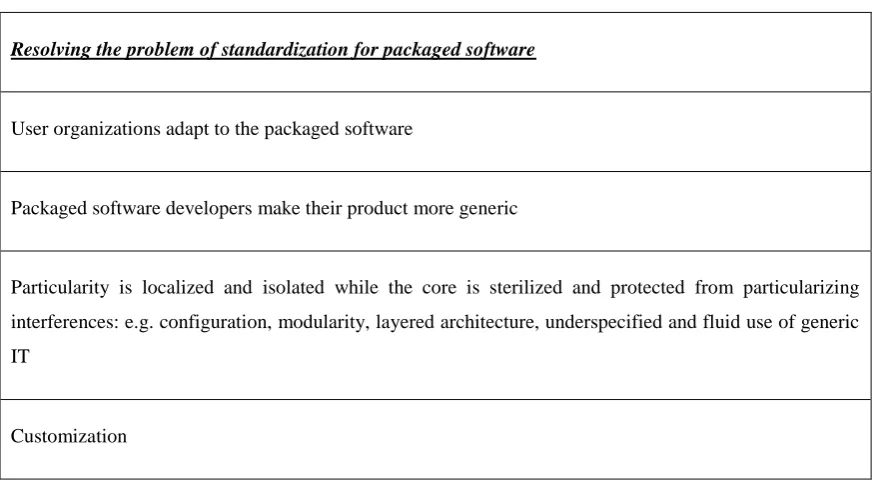
User organizations adapt to the packaged software
Packaged software developers make their product more generic
Particularity is localized and isolated while the core is sterilized and protected from particularizing interferences: e.g. configuration, modularity, layered architecture, underspecified and fluid use of generic IT
[image:33.595.108.545.85.327.2]Customization
Table 2.2 Resolving the problem of standardization for packaged software
The problem of standardization in packaged software has been framed as an ongoing conflict between vendors and customers:
[O]ne important implication of our study is that packaged software design and consumption is about competing and complementary objectives between vendors and consumers. Vendors attempt to develop software with as much generality as possible, to capture a wider market share … . They hope their software is ‘far’ enough away from specific organisational uses so that it can be shaped by many users, but not too far that it requires substantial resources to shape it to support specific practices. On the other hand, customers are (or should be) motivated to search for specific software systems that support their current or future practices. Where the two interests cross, customers are left with the choice of generic software that is hopefully less expensive to purchase and shape than starting-from-scratch. (Chiasson and Green 2007, pp. 551-552)
2.1.4 The problem of procurement
34 software procurement), where users tend to recall misinformation provided by analysts rather than their own beliefs and knowledge. These observations suggest that packaged software procurement is not as straightforward as repurposing the requirements-based “waterfall” of custom software development in requirements-based RFX practice. For example, Pollock and Williams (2009b, 2010), note that user organizations need to take into account not only the various attributes of the technologies but the viability of vendors, and whether they will invest in their products.
Howcroft and Light (2010) also question whether packaged software is really standardized: Packaged software products are often conceptualized as standardized commodities, yet the more critical literature suggests they are in constant development, always provisional (Pozzebon and Pinsonneault 2005), and should be viewed in more fluid terms, as a “biography” that evolves across multiple cycles of development (Pollock and Cornford 2004). … It is difficult to query the claims being made by vendors and consultants, since they sell packages with the promise of transferring exemplary business practices – best practices – (Wagner et al. 2006) that are embedded within the technology. (p. 127)
Adomavicius et al. (2008) observe the difficulty of “making sense of technology trends in the information technology landscape”:
The sheer number of available technologies and the complex set of relationships among them make IT landscape analysis extremely challenging. Most IT-consuming firms rely on third parties and suppliers for strategic recommendation on IT investments, which can lead to biased and generic advice. (p. 779)
The problem of procurement is further complicated by new product delivery formats, such as software as a service (SaaS) (Campbell-Kelly and Garcia-Swartz 2008), cloud computing (Armbrust et al. 2010; Willcocks et al. 2012) and IT outsourcing (e.g. Lacity et al. 2009; Lacity et al. 2010; Lacity and Willcocks 2012) that may present existential, or at least definitional, challenges to the packaged software concept. Campbell-Kelly and Garcia Swartz (2008, p. 220) argue that “the current incarnation of the SaaS concept and the computer utility represents a new attempt to shift the locus of software, and potentially computing power, outside the corporation” – to the servers of hosting companies, to the servers of on-demand software providers (such as salesforce.com) or “the network (in the case of Web services that involve the interfacing of many Web service providers)”. SaaS threatens to upset many accepted product and service categories:
35 Application Program Interfaces, and hundreds of firms exist by offering software and Web-service complements. (Campbell-Kelly 2007, pp. 50-51)
This theme of definitional fluidity is generalized in the dynamic of digital convergence and its correlates – device, network and market convergence – which entails the “interconnection, overlapping, contestation, and reconfiguration of physical and logical socio-technical infrastructures” and “non-linear interactions across layers” (Tilson et al. 2010). In the context of digital convergence, the notion of “packaged software” – what it is, where it is located, its interactions with and dependencies on other software and on hardware, rights to ownership and use – becomes somewhat fluid, inchoate and indeterminate.
2.1.5 Summary: how packaged software is understood
Packaged software has long been identified as an important phenomenon for organizational IS, but is still relatively under-researched. Looking at Table 2.1, we can observe uneven progress toward understanding packaged software from a market perspective. The rationale of scale for packaged software has been generally accepted, though the problem of standardization problem in the form of organizational misfit has been studied extensively (e.g Strong and Volkoff 2010). Procurement remains a subject marked for further research (e.g. Chiasson and Green 2007; Howcroft and Light 2006; Pollock and Williams 2009a). Pollock and Williams (2009a, 2009b, 2010, 2011) and Howcroft and Light (2010) have illuminated the mediated interactions that shape packaged software production. Less understood is what it means when profitability and market share, not user satisfaction, are the measures of success (Chiasson and Green 2007; Ó Raian 2010; Sawyer 2000).
36 2.2 Pollock and Williams’s biography of software as a framework for this study
2.2.1 Rationale; key concepts: the knowledge network, the organizing vision and generification In their study of ERP, The Biography of the Enterprise-Wide System, or How SAP Conquered the World, Pollock and Williams (2009a) develop a “biography of software” approach that subsumes the problems of standardization and procurement into an integrated view of packaged software production. By lifting the analysis out of the specific organizational context (e.g. implementation or procurement), the software itself and the processes of its production are foregrounded; the technological artefact is no longer taken for granted (cf. Orlikowski and Iacono 2001), nor its production treated as “design from nowhere” (Suchman 2002).
The integrated end-to-end perspective on technology production is exemplified by Pollock and Williams’s concept of the supplier-user nexus, the “various interfaces between suppliers and users which constitute nexuses in which competing requirements are presented and worked out” (2009a, p. 88). The supplier-user nexus solves the problem of distance between users and developers. It includes intermediaries such as resellers, consultants and analysts, as well as customers as references and demonstrator sites – “webs of knowledge and influence from the vendors as they seek to manage and sustain their existing user base and expand their markets” (p. 92). Extending this line of research, Pollock and Williams (2009b, 2010, 2011) have followed their biography of ERP with studies of the role of industry analysts, such as Gartner, who create categories for software products and produce market research ranking software products and vendors, thus shaping the IT marketplace.
In this dissertation I refer to the suppler-user nexus as the “knowledge network” (see Pollock and Williams 2009a, p. 91). This knowledge network works in part by promulgating “supply-side rhetoric”, in the form of advertising, supplier literature and software demonstrations (Pollock and Williams 2009a, pp. 91-93). Supply-side rhetoric associates software with business programs, or “organizing visions” (Swanson and Ramiller 1997), that link a technology, its name and a managerial best practice (Pollock and Williams 2009a, pp. 119, 125-127), in ways that are sometimes “opportunistic and ephemeral” (p. 125). Swanson and Ramiller’s (1997) “organizing vision” is “a focal community idea for the application of information technology in organizations” (p. 460).
37 technology, and material processes of adoption and diffusion – provide the discourse with its content, structure, motivation and direction. (Swanson and Ramiller 1997, p. 458) (emphasis added)
While marking the importance of supply-side rhetoric in shaping expectations according to organizing visions, Pollock and Williams also emphasize the characteristics of the software product as it evolves over time. As Pollock and Williams see it, in early development, packaged software is unstable and development may follow tactical lines, from one set of customer requirements to the next, as designers try to find sufficient commonalit