2017 2nd International Conference on Manufacturing Science and Information Engineering (ICMSIE 2017) ISBN: 978-1-60595-516-2
Reliability Evaluation Model of Embedded
System Based on Machine Learning Method
Hongmei Ge, Chao Xu* and Pengwei Li
ABSTRACT
Embedded system is widely used in all walks of life, and its reliability has become the focus of attention. According to the embedded system reliability evaluation problem, we propose a reliability evaluation model based on machine learning, classification and analysis of the model based on the gradient descent method in machine learning, adaptability of the model itself, which has a strong versatility. The experimental results show that this method has higher accuracy rate and average accuracy of 91.15%. It can provide good support for the reliability evaluation of embedded system.1
KEYWORDS
Machine Learning; Classification Learning; Gradient Descent; Reliability;
INTRODUCTION
current lack of a covering multiple embedded field and single embedded field unified evaluation model, evaluation model is usually based on a single embedded system independent. This results in an independent evaluation model designed for each embedded system with high reliability requirements, which greatly increases the workload of reliable embedded system development. Therefore, many embedded systems even completed the function debugging is put into use, the lack of reliability verification, resulting in many embedded products appear unstable situation in the application, such as intelligent mobile phone is now running a long time often Caton, crash phenomenon. How to design a more suitable qiangpu with embedded software reliability evaluation model is an important problem to be solved urgently.
Machine learning is one of the most widely used techniques for adaptive problems. It is a method used to devise complex models and algorithms that lend themselves to prediction. Machine learning is employed in a range of computing tasks where designing and programming explicit algorithms with good performance is difficult or infeasible, example applications include email filtering, detection of network intruders or malicious insiders working towards a data breach, optical character recognition (OCR), learning to rank, and computer vision.
This paper from the perspective of embedded system composition, function performance, operating environment and other factors, with the help of the theory of machine learning, research on the reliability of embedded system with strong adaptive ability evaluation model, the rapid construction of embedded system reliability assessment model provides the basis.
MACHINE LEARNING BASED RELIABILITY MODEL
The accuracy of the reliability evaluation model directly affects the implementation of embedded reliability enhancement methods. In order to effectively guide the implementation of various methods to strengthen the reliability, the reliability of the embedded system can adapt to all kinds of complex operating environment, a reliability evaluation model to meet the needs of accurate assessment, strong adaptive capacity requirements.
Evaluation Factor Extraction Method Based on Classification Analysis
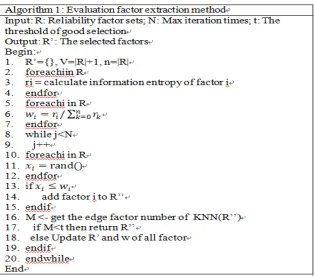
The evaluation factor is mainly used to characterize the reliability of the system. In order to obtain accurate and effective evaluation factors, this paper uses the method based on classification learning to extract. The method mainly includes the following steps:
With all the features of the hardware features of embedded system and its environment as the basis, influencing factors to construct the initial reliability evaluation model of the set R, the main contents include environmental factors (such as temperature, humidity, electromagnetic etc.), electrical characteristics (current, voltage, clock frequency, control signal output etc.), critical path of software. The number of factors represents by n.
The operating states of different systems in different environments are calculated, and the information entropy[1-2] of each factor (represented by r ) relative to the running state is calculated. The weights of each factor (represented by w) are obtained by normalization according to formula 1.
/ ∑ (1)
Get n value using random function, if x w, the ith factor will be added to the candidate evaluating factor set.
Based on the KNN[3-5] classification analysis algorithm, formula 2 is used as the distance calculation formula, and the two cluster analysis of the training sample set is carried out. If the number of edge nodes more than two iterations or clustering is greater than the threshold value t is out of the loop, to be selected as the evaluating factor evaluation factor set back extraction results; otherwise update the selected evaluation factors set, adjust the weights of each factor, redo the steps of c). The detail algorithm is shown in Fig 2.
Figure 1. Reliability evaluation model.
[image:4.612.152.466.292.569.2]
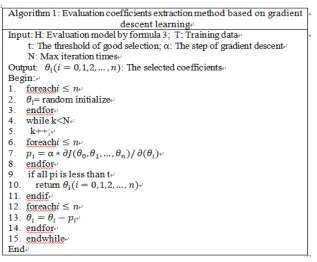
Figure 3. Evaluation coefficients extraction method.
Evaluation Coefficient Extraction Based on Gradient Descent Learning
When the model evaluation factor is determined or updated, the model can be represented by the formula 3. Where θ i 0,1,2, … , n is the coefficients of the model, and x i 0,1,2, … , n is the factor of the model.
ℎ , , … , ⋯ (3)
The coefficients of each evaluation factor need to be updated. The gradient descent learning method is adopted to optimize the coefficients, according to the sample data of the training set. The detail algorithm is shown in Fig. 3. The loss function J is calculated by formula 4 and the m is the number of training data.t the same time, in order to guarantee the effectiveness of training set, the training set is updated regularly with the latest system running state and environment information.
J θ , θ , … , θ ∑ h x , x , … , x y (4)
EXPERIMENT
implemented by Matlab. The test data contains 4 types, a total of 239 control systems, and 326 kinds of status information, in which there are 136 unreliable systems. Figure 4 and Figure 5 are the results of the evaluating model in this paper for the all tested control systems.
From Figure 4, we can see that the evaluation model of this paper can effectively find almost all unreliable control system in the various types of systems (which happened fault). For all types of control system, the fault detection rate of recall is more than 90%, and the highest rate is reached 98.1%. The average recall rate is 94.04%.
[image:6.612.99.491.224.321.2]
Figure 4. The recall rate of unreliable system. Figure 5. The recall rate of unreliable system.
As can be seen from Figure 5, the evaluation model of this paper also has higher accuracy rate. The accuracy of the 4 types of control systems is more than 85%, and the highest is 93.91%. The average is also reached to 91.15%.Thus, our method is more practical and can meet the reliability evaluation of different types of systems.
RELATED WORKS
Although the traditional method reliability evaluation model, such as statistical regression based model, time series based model, Bias based model[6-10] provides a positive thinking model, but the fusion machine construction reliability evaluation model of learning technology is more in line with the background of big data analysis and intelligent future requirements, and based on the reliability evaluation model of the component also greatly enhance the operational efficiency accuracy and adaptability.
The paper [11] for the traditional reliability evaluation model in the efficiency and accuracy of the problem, put forward the multilevel fast learning machine learning model based on reliability, effectively enhance the reliability evaluation model itself. In [12], it uses genetic iterative algorithm to solve the problem of how to set up the weight coefficients of each factor in software reliability evaluation model.
adaptation to reach satisfactory, literature [13] describes the non-parametric artificial neural networks and other learning methods improved evaluation model of reliability based on the results, and put forward a dynamic weight before based on the feedback of multilayer learning network. In order to adapt to the complex changes of the future environment, the paper [14] uses Bayesian rules to optimize the dynamic neural network, and constructs a reliability evaluation model for solving the complex environment of large data.
CONCLUSIONS
To evaluate the reliability of embedded systems, and to guide the study of subsequent reliability enhancement algorithms, a unified model for reliability evaluation of embedded systems is needed. Based on the component, function, performance index and operating environment of embedded system, a reliability evaluation model with adaptive capability is designed under the guidance of machine learning technology. The model can adapt to many embedded fields and provide a strong support for embedded system reliability evaluation.
ACKNOWLEDGEMENT
This work is supported by Project supported by Emergency Management Program of National Natural Science Foundation of China (Grant No. 61640220) and Natural Science Foundation of Jiangsu Province, China (Grant No.15KJB520019).
REFERENCES
1. Núñez J.A., Cincotta P.M, Wachlin F.C. Information entropy [J]. Celestial Mechanics & Dynamical Astronomy, 1996, 64(1-2): 43-53.
2. Zhang Q.S., Jiang S.Y. A note on information entropy measures for vague sets and its applications [J]. Information Sciences, 2008, 178(21): 4184-4191.
3. Deng Z., Zhu X., Cheng D., et al. Efficient kNN classification algorithm for big data [J]. Neurocomputing, 2016, 195(C): 143-148.
4. Aburomman A.A., Reaz M.B.I. A novel SVM-kNN-PSO ensemble method for intrusion detection system [M]. Elsevier Science Publishers B. V. 2016.
5. Rahal, Imad, Perrizo, et al. An optimized approach for KNN text categorization using P-trees [J]. International Journal of Radiation Oncology Biology Physics, 2016, 60(1): 51.
6. Huang W., Loman J., Song T. A reliability model of a warm standby configuration with two identical sets of units. Reliab Eng Syst Safe. 2015; 133: 237-45.
7. Huang W., Askin R.G. A generalized SSI reliability model considering stochastic loading and strength aging degradation [J]. Reliability IEEE Transactions on, 2015, 53(1): 77-82.
9. Aktekin T., Caglar T. Imperfect debugging in software reliability: A Bayesian approach. EUR JOPER RES. 2013; 227(1): 112-21.
10. Landon J., Özekici S., Soyer R. A Markov modulated Poisson model for software reliability. Eur J Oper Res. 2013; 229(2): 404-10.
11. Noekhah S., Hozhabri A.A., Rizi H.S. Software reliability prediction model based on ICA algorithm and MLP neural network. 2013, p. 1-15.
12. Hsu C., Huang C. Optimal Weighted Combinational Models for Software Reliability Estimation and Analysis. IEEE T Reliab. 2014; 63(3): 731-49.
13. Roy P., Mahapatra G.S., Rani P., Pandey S.K., Dey K.N. Robust feedforward and recurrent neural network based dynamic weighted combination models for software reliability prediction. Appl Soft Comput. 2014; 22: 629-37.