http://dx.doi.org/10.4236/jemaa.2014.69025
An Inductor Model for Analyzing the
Performance of Printed Meander Line
Antennas in Smart Structures
Shih-Ming Yang, Chih-Hsin Huang
Department of Aeronautics and Astronautics, National Cheng Kung University, Taiwan Email: [email protected]
Received 24April 2014; revised 21May 2014; accepted 18June 2014
Copyright © 2014 by authors and Scientific Research Publishing Inc.
This work is licensed under the Creative Commons Attribution International License (CC BY).
http://creativecommons.org/licenses/by/4.0/
Abstract
Meander line antenna has been considered desirable on flight vehicles to reduce drag and mini-mize aerodynamic disturbance; however, the antenna design and performance analysis have made mostly by trial-and-error. An inductor model by simulating the meander line sections as electrical inductors and the interconnecting radiation elements as a quasi-monopole antenna is developed to analyze the antenna performance. Experimental verifications of the printed meander line antennas embedded in composite laminated substrates show that the inductor model is effec-tive to design and analyze. Of the 4 antennas tested, the discrepancy of resonant frequency in simulation and experiment is within 4.6%.
Keywords
Inductor Model, Meander Line Antenna, Smart Structure
1. Introduction
Design of meander line antenna is mainly by folding a monopole or dipole antenna into a zigzag pattern. Na-kano et al.[13] investigated the shortening ratio, radiation pattern and input impedance of meander line antennas. Warnagiris and Minardo [14] improved the antenna performance by switching the phase of a meander line. The above works assumed that the antennas are installed in free space. In many applications, however, the antennas have to be integrated with the feed lines on the same substrate. Suh and Chang [15] and Tong et al.[16] found that the size of a dipole antenna on a dielectric substrate was reduced as compared to that in free space. A recent study showed that performance of meander line antenna is also influenced by the substrate properties [17]. Computation methods have been proposed to simulate meander line antenna applications [18]-[20]. Design and analysis of printed meander line antennas by trial-and-error are tedious, if not fruitless. An effective model to analyze the antenna performance is necessary.
2. An Inductor Model of Meander Line Antenna
A monopole or dipole antenna can be implemented by meander line antenna integrated on flexible printed circuit substrate. Figure 1(a) shows the configuration of a meander line antenna of size L W1× with line width D
printed on the substrate layer of thickness h and dielectric constant εr. The electrical signals are fed by a mi-crostrip line of length L2 and width w. The effect of the meander line sections is similar to a load, and they
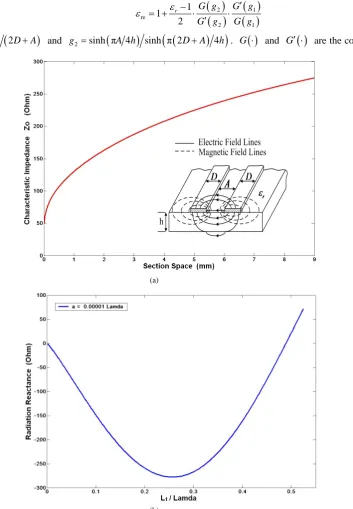
are considered as shorted-terminated transmission lines as shown inFigure 1(b). Each section can be modeled by an equivalent electrical inductor with inductance calculated by the geometrical parameters: the pitch of the meander line sections A, width W , and line width w. The radiation pattern is determined by the current dis-tribution on the meander line. The current in the x-axis constructively contribute to the field in the E-plane, but that in the y-axis direction cancels out in the E-plane. Thus, the radiation field of a meander line antenna will
(a) (b)
[image:2.595.127.497.358.695.2](c)
Figure 1. (a) Configuration of a printed meander line antenna; (b) the inductor model of a meander line section; and (c) the radiation parts of a modeled line antenna modeled by a quasi-monopole antenna.
x z
y
≈
Radiation parts of a printed meander line antenna
Quasi-printed monopole antenna
W
1
be only from the parts along x-axis constituting an equivalent quasi-monopole antenna with radiation charac-teristics similar to a monopole antenna as shown inFigure 1(c).
The inductance of each meander line section
( )
Lin is determined by the transmission line model; i.e., aprinted meander line section is similar to a pair of coplanar strips of equal width D at distance A on a di-electric substrate as shown inFigure 2(a). Because of the complementary nature, the effective dielectric con-stant can be calculated by the conformal mapping method,
( )
( )
2( )
( )
1re
2 1
1 1
2
r G g G g
G g G g
ε
ε = + − ⋅ ⋅ ′
′ (1)
where g1=A
(
2D+A)
and g2 =sinh(
π 4A h)
sinh(
π 2(
D+A)
4h)
. G( )
⋅ and G′ ⋅( )
are the complete el-(a)
(b)
[image:3.595.143.497.162.672.2]liptic integrals of the first kind and its complement,
( )
(
(
)(
)
)
1 1
2 2 2 2
0
d 1 1
G g =
∫
t −g t −t and G g′( )
=G g( )
′with g′ = 1−g2 . The impedance of a pair of coplanar strips can be then derived as
(
) (
)
(
)
re
120π π
for 0 1 2
ln 2 1 1
o Z g g g ε = ⋅ ≤ ≤ ′ ′
+ − (2)
(
) (
)
(
)
re
120π 1
ln 2 1 1 for 1 2 1
π o
Z g g g
ε
= ⋅ ⋅ + − ≤ ≤ (3)
For the given line width D=2 mm,Figure 2(a) also illustrates that the impedance of a meander line section on the substrate (h=1.6 mm and εr =4.4 mm) is dependent upon the pitch A. One can calculate the imped-ance of a meander line section on a substrate by
( )
in otan
Z = jZ kW (4)
where k=ko εre , ko is the wave number in free space. The equivalent inductance Lin of each meander
sec-tion is
(
)
in 1 tan oL Z kW
ω
= (5)
and ω is the operating frequency. For an antenna with M meander line sections, the total inductance is
in
M L⋅ .
It has been known that any attempt to reduce the size of a monopole while preserving the same natural fre-quency leads to bandwidth deterioration, pattern distortion, and gain reduction. Thus an antenna’s dimension must be on the same order as the wavelength to radiate at maximum efficiency. Given a quasi-monopole antenna of reduced length L1 as shown inFigure 1(c), its reactance may be similar to that of a monopole antenna and
can be obtained by the induced electromagnetic field,
( )
( )
( )
(
)
( )
( )
(
)
(
)
{
2}
1 1 1 1 1 1 1 1
2 cos 2 2 sin 2 2 2
4π
X = η S kL + kL S kL −S kL − kL C kL −C kL −C ka L (6)
where η = µ ε is an intrinsic impedance, µ is permeability, ε is permittivity, C kL
( )
1 and S kL( )
1are the cosine and sine integrals,
( )
1 1cos d
kL y
C kL y
y ∞
≡
∫
and( )
11 0
sin d
kL y
S kL y
y
=
∫
, and a is the equivalentradius of the antenna. Figure 2(b) illustrates that the radiation reactance is negative if the antenna length
1 2
L ≤λ , and it will decrease further as L1 becomes smaller, hence reducing the antenna efficiency. At
1
3 L 2
λ ≤ λ , the reactance can be approximated by a linear function. The meander line sections with positive inductance are therefore required to compensate the printed meander line antenna by
( )
tan 0
o
X+MZ kW = (7)
where X is the radiation reactance of a quasi-monopole antenna and M is the number of meander line sec-tions of the antenna. In antenna design within a given area, L1 is first defined and the radiation reactance of the
quasi-monopole antenna is calculated by Equation (6), then the number
( )
M and geometry (A and W) of the meander line section can determined by the inductor model in Equation (5).3. Antenna Design and Experiment
Consider a printed meander line antenna operating at 900 MHz on a substrate εr =4.4. For D=2 mm, 5 mm
A= , and W=20 mm, the impedance of the meander line section from Equation (5) is Lin =130.8 Ω.
Two meander line sections
(
M =2)
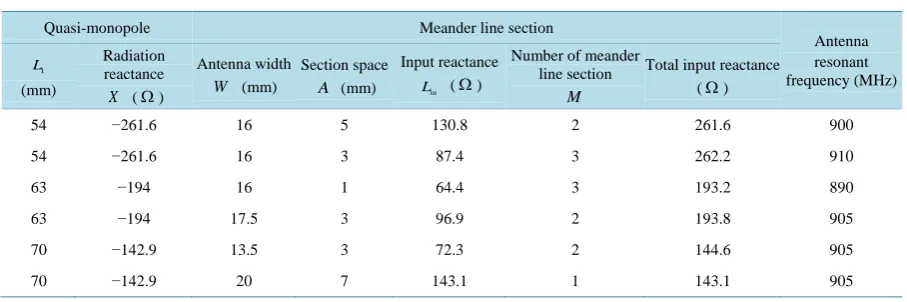
are to compensate the radiation reactance of the quasi-monopole antenna, and the antenna of length 54 mm with X = −261.6 Ω can be predicted by the interpolation in Figure 2(b). Table 1 lists six printed meander line antennas operating at the same frequency. For an antenna of length1 54 mm
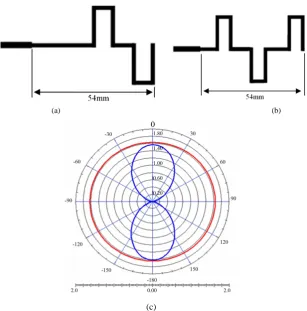
16 3 mm× as shown inFigure 3(a) andFigure 3(b). Both achieve the same operating frequency. Similarly for the antenna of length L1=63 mm, there are two designs for the same frequency: 3 meander line sections at
16 1 mm× or 2 at 17.5 2 mm× . For the meander line antenna of length L1=70 mm, either 2 meander line
sections at 13.5 3 mm× or 1 at 20 7 mm× is capable to operate at 900 MHz . These analyses validate the inductor model in predicting the inductance of the meander line sections and in approximating the reactance of the quasi-monopole. The radiation pattern of a meander line antenna is similar to that of a monopole antenna as illustrated inFigure 3(c).
The meander line antenna aims at reducing the physical dimension while maintaining the required electrical length. However, because of the corner effects between the adjacent meander line sections, the antenna length will be higher than λ 4 of monopole. The effects of the number of the meander line sections are illustrated as follows. Consider a printed monopole antenna of length 89.5 mm at 900 MHz . Multiple meander line sec-tions with A=5 mm at different W and M are added to the monopole while keeping the total length con-stant. By using the inductor model, the inductance of the meander line sections can be calculated, and the reso-nant frequency is shown to decrease with increasing A and W as listed inTable 2. The reactance of the quasi-monopole and the resonant frequency are plotted in Figure 4, where they are shown within acceptable accuracy as predicted by the inductor model. These results indicate that if the geometry limit of a meander line antenna is known, then the antenna length and reactance can be calculated and the meander line section can be determined.
4. Experimental Verification
[image:5.595.87.541.402.553.2]Smart structures integrating sensor/actuator offer many potential advantages in vibration control and structural health monitoring. A smart layer module utilizing flexible printed circuit process to encapsulate sensor/actuator and electrical circuit in polyimide layers has been recently developed [4], and an antenna embedded in compos-ite laminated substrate has been shown to achieve better performance oven that attached on an isotropic sub-
Table 1. The dimension of a printed meander line antenna operating at 900 MHz.
Quasi-monopole Meander line section
Antenna resonant frequency (MHz) 1 L (mm) Radiation reactance
X (Ω)
Antenna width
W (mm)
Section space
A (mm)
Input reactance
in
L (Ω)
Number of meander line section
M
Total input reactance (Ω)
54 −261.6 16 5 130.8 2 261.6 900
54 −261.6 16 3 87.4 3 262.2 910
63 −194 16 1 64.4 3 193.2 890
63 −194 17.5 3 96.9 2 193.8 905
70 −142.9 13.5 3 72.3 2 144.6 905
[image:5.595.91.538.589.719.2]70 −142.9 20 7 143.1 1 143.1 905
Table 2. The resonant frequency (MHz) of a meander line antenna as function of the number of meander line sections M and width W (mm) at pitch A=5 mm.
Width (W) Quantity (
M )
1 2 3 4
12 825 792 762 734
14 809 767 732 698
16 796 748 708 666
18 786 736 684 634
20 780 716 656 610
(a) (b)
[image:6.595.161.469.80.392.2](c)
Figure 3. Configuration of the printed antennas operating at 900 MHz, (a) L1=54 mm, M =2 W× =A 20 5 mm× and (b) L1=54 mm, M=3, W× = ×A 16 3 mm and (c) the antenna pattern of a meander line antenna similar to that a
monopole antenna.
Figure 4. The reactance of a quasi-monopole due to length reduction can be compensated by the meander line sections
with A=5 mm at different W and number of section M.
strate [5]. By the smart layer concept, the printed meander line antennas (W=20 mm, A=5 mm, and 2 mm
D= ) are embedded inside the [45/−45/45/45/−45/45] symmetric substrate of thickness h=2.0 mm to verify the inductor model.
[image:6.595.203.427.450.601.2]12.5 µm thickness and a copper layer of 17.5 µm thickness. Shielding is by the copper film on the back side of the polyimide layer to reduce back-radiation. An SMA (subminiature version A) connector of 50 Ω impedance is attached at the feed line (length L2=15 mm and width w=3.06 mm) on the polyimide layer. Figures
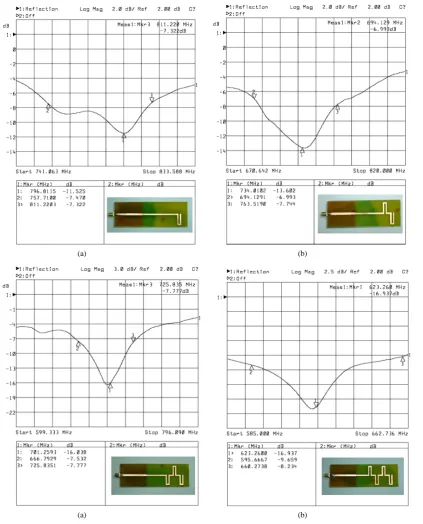
5(a)-(d) shows the resonant frequency comparison of the prediction by the inductor model and the measurement by the network analyzer (Agilent 8714ET). The experimental results of the resonant frequency are at 797, 734,
(a) (b)
[image:7.595.103.527.155.680.2](a) (b)
Figure 5. Measurement of the return loss of the printed meander line antennas, (a) illustration of a meander line antenna embedded in the composite laminated substrate; (b) M =1 with ω =797 MHz; (c) M =2 with ω =734 MHz; (d)
3
701, and 623 MHz, respectively, for the meander line antennas M = 1 to 4, and they are also listed onTable 2. The predictions from the inductor model are in good agreement, and the discrepancies are within 6.4%. These validations confirm that the inductor model is effective to design and analysis of a printed meander line antenna. It should be noted that the bandwidth of printed meander line antennas decreases with the antenna length. The radiation pattern is determined by the current distribution on the meander line. As a consequence of the current cancellation and reinforcement, a number of high resonances may be present in meander line antenna. Care has to be taken since these resonances often result in low voltage standing wave ratio (VSWR) when embedding the antenna in composite laminated substrate.
5. Conclusions
1) Recent smart structure development of Conformal Load-bearing Antenna Structure (CLAS) by embedding microstrip antenna inside composite laminated substrates has been considered desirable to have sufficient struc-tural and antenna performance. Meander line antenna can be installed in airframe to eliminate air drag and minimize aerodynamic disturbance. An inductor model is developed to facilitate systematic design and analysis of the antenna. The meander line sections providing positive inductance are modeled by the inductors while the radiation parts are by a quasi-monopole of much shorter length.
2) The inductor model shows that the reactance of a quasi-monopole antenna can be calculated by a linear function at λ 3≤L1λ 2. The reactance can be compensated by that of the meander line sections, which are
de-termined by the geometry parameters A, D, W and M. The polarization of a meander line antenna is similar to a monopole antenna when the length of the meander line section (W) is small compared to the antenna length. Based on the smart layer concept, four meander line antennas (W =20 mm, A=5 mm, D=2 mm, M =1, 2, 3 and 4) on polyimide layer are developed, and they are embedded in [45/−45/45/45/−45/45] symmetric composite laminated substrates. Discrepancies of resonant frequency between the prediction of the inductor model and the measurement results are within 4.6%.
Acknowledgements
This work was supported in part by the National Science Council, Taiwan, ROC under NSC100-2221-E006- 098-MY3.
References
[1] Yang, S.M. and Chen, C.W. (1996) Application of Single Mode Optical Fiber in Structural Vibration Suppression. Journal of Intelligent Material Systems and Structures, 7, 71-77. http://dx.doi.org/10.1177/1045389X9600700108
[2] Yang, S.M. and Bian, J.J. (1996) Vibration Suppression Experiment of Composite Laminated Plates by Embedded Piezoelectric Sensor and Actuator. Smart Materials and Structures, 5, 501-507.
http://dx.doi.org/10.1088/0964-1726/5/4/014
[3] Yang, S.M. and Jeng, C.A. (1996) Structural Vibration Suppression by Concurrent Piezoelectric Sensor and Actuator. Smart Materials and Structures, 5, 806-813. http://dx.doi.org/10.1088/0964-1726/5/6/011
[4] Yang, S.M. Hung, C.C. and Chen, K.H. (2005) Design and Fabrication of a Smart Layer Module in Composite Lami-nated Structures. Smart Materials and Structures, 14, 315-320. http://dx.doi.org/10.1088/0964-1726/14/2/003
[5] Yang, S.M. and Hung, C.C. (2009) Modal Analysis of Microstrip Antenna on Fiber Reinforced Anisotropic Substrates. IEEE Transaction on Antennas and Propagation, 57, 792-796. http://dx.doi.org/10.1109/TAP.2009.2013443
[6] Chan, K.K., Ang, T.W. and Chio, T.H. (2008) Accurate Analysis of Meanderline Polarizers with Finite Thicknesses Using Mode Matching. IEEE Transactionon Antennas and Propagation, 56, 3580-3585.
http://dx.doi.org/10.1109/TAP.2008.2005548
[7] Eldek, A.A. (2008) Analysis and Design of a Compact Multi-band Antenna for Wireless Communication Applications. Microwave Journal, 51, 281.
[8] You, C.S., Hwang, W. and Eom, S.Y. (2005) Design and Fabrication of Composite Smart Structures for Communica-tion, Using Strucutral Resonance of Dadiated Field. Smart Materials and Structures, 14, 441-448.
http://dx.doi.org/10.1088/0964-1726/14/2/019
[10] Ramesh, P. and Washington, G. (2009) Analysis and Design of Smart Electromagnetic Structures. Smart Materials and Structures, 18, Article ID:104006.
[11] Son, S.H., Eom, S.Y. and Hwang, W. (2008) Development of a Smart-Skin Phased Array System with a Honeycomb Sandwich Microstrip Antenna. Smart Materials and Structures, 17, 1-9.
[12] Jang, H.K., Lee, W.J. and Kim, C.G. (2011) Design and Fabrication of a Microstrip Patch Antenna with a Low Radar Cross Section in the X-Band. Smart Materials and Structures, 20, Article ID: 015007.
[13] Nakano, H., Tagami, H., Yoshizawa, A. and Yamauchi, J. (1984) Shortening Ratios of Modified Dipole Antennas. IEEE Transactions on Antennas and Propagation, 32, 385-386. http://dx.doi.org/10.1109/TAP.1984.1143321
[14] Warnagiris, T.J. and Minardo, T.J. (1998) Performance of a Meandered Line as an Electrically Small Transmitting An- tenna. IEEE Transactions on Antennas and Propagation, 46, 1797-1801. http://dx.doi.org/10.1109/8.743815
[15] Suh, Y.H. and Chang, K. (2000) Low Cost Microstrip-Fed Dual Frequency Printed Dipole Antenna for Wireless Com- munications. Electronics Letters, 36, 1177-1179. http://dx.doi.org/10.1049/el:20000880
[16] Tong, K.F., Luk, K.M., Chan, C.H. and Yung, E.K.N. (2000) A Miniature Monopole Antenna for Mobile Communica-tions. Microwave and Optical Technology Letters, 27, 262-263.
http://dx.doi.org/10.1002/1098-2760(20001120)27:4<262::AID-MOP13>3.0.CO;2-O
[17] Yan, Z.Z. and Majedi, A.H. (2009) Experimental Investigations on Nonlinear Properties of Superconducting Nanowire Meanderline in RF and Microwave Frequencies. IEEE Transactions on Applied Superconductivity, 19, 3722-3729. [18] Vinoy, K.J., Jose, K.A., Varadan, V.K. and Varadan, V.V. (2001) Hilbert Curve Fractal Antenna: A Small Resonant
Antenna for VHF/UHF Applications. Microwave and Optical Technology Letters, 29, 215-219.
http://dx.doi.org/10.1002/mop.1136
[19] Vinoy, K.J., Jose, K.A. and Vardan, V.K. (2001) Design of Reconfigurable Fractal Antennas and RF-MENS for Space- Base Systems. Smart Materials and Structures, 10, 1211-1223.