A Survey on Video Deblurring Via Direct
Patch Method
Keerthi G B1, Vijayakumar R2
M.Tech Student, Dept. of CSE., New Horizon College of Engineering Bengaluru, India
Assistant Professor, Dept of CSE, New Horizon College of Engineering, Bengaluru, India
ABSTRACT: Motion blur from camera shake is a major problem in videos captured by hand held devices. Shaky cameras often capture videos with motion blurs, especially when the light is insufficient. Unlike single image de-blurring, video based approaches can take advantage of the abundant information that exists across neighboring frames. In this paper, we present a framework that can restore blurry frames effectively by synthesizing the details from sharp frames. Our method compares a blur patch directly against sharp candidates, in which the nearest neighbor matches can be recovered with sufficient accuracy for the de-blurring. Moreover, to restore one blurry frame, instead of searching over a number of nearby sharp frames, we only search from a synthesized sharp frame that is merged by different regions from different sharp frames via an MRF-based region selection. This method achieves a very good quality with an improved efficiency and robustness.
KEYWORDS: Video de-blurring, blur patch, patch match, synthesis, nearest neighbors.
I. INTRODUCTION
Handheld video capture devices are now commonplace As a result, video stabilization has become an essential step in video capture pipelines, often performed automatically at capture time (e.g., iPhone, Google Pixel), or as a service on sharing platforms (e.g., YouTube, Facebook). While stabilization techniques have improved dramatically, the remaining motion blur is a major problem with all stabilization techniques. This is because the blur becomes obvious when there is no motion to accompany it, yielding highly visible “jumping” artifacts. In the end, the remaining camera shake motion blur limits the amount of stabilization that can be applied before these artifacts become too apparent. The most successful video de-blurring approaches use information from neighboring friends to sharpen blurry frames, taking advantage of the fact that most handshake motion blur is both short and temporally uncorrelated. By borrowing “sharp” pixels from nearby frames, it is possible to reconstruct a high quality output.
One of the main challenges associated with aggregating information across multiple video frames is that the differently blurred frames must be aligned. This can either be done, for example, by nearest neighbor patch lookup [4], or optical flow [6].
II. RELATED WORK
1. Full-Frame Video Stabilization with Motion Inpainting[4]
Matsushita et. all propose a practical and robust approach of videos stabilization that produces full frame stabilized videos with good visual quality. To achieve this, Motion Inpainting is used to enforce spatial and temporal consistency of the completion in both static and dynamic image areas. In addition, the image quality in the stabilized video is enhanced by a new practical deblurring algorithm.
1. Video Completion with Motion Inpainting
II. PRACTICAL MOTION DEBLURRING METHOD
Here, they propose a method to transfer the sharper pixels to the blurry pixels to increase the sharpness. It transfers pixels and replaces them by weighted interpolation. Thus it doesn’t increase the resolution of the frames but restores the resolution of the blurry frames.
Fig.1. Flow chart of full frame video stabilization.
2. Inter-Frame Information Transfer via Projection Onto Convex Set for Video Deblurring[2]
In this work, Yizhen Huang and Na Fan propose a new method that projects the resulting image onto two convex sets: an observed constraint set in the spatial domain and a detail constraint set in the wavelet domain. This is a software-only solution widely applicable for and requiring no hardware change on the commercially available cameras.
2.1 The method of Projection onto convex set (POCS)
The main idea of POCS is to find an element of feasible set defined by their intersection of some convex constraints starting from an infeasible sub-optimal element. An advantage of POCS is its guaranteed convergence. POCS has a very successful application in the problem of demosaicking.
3. Video Deblurring for Hand-held Cameras Using Patch-based synthesis[3]
Sunghyun Cho, Seungyong Lee, et. all proposed a video deblurring method that effectively restore sharp frames from blurry ones caused by camera shakes. Due to the camera shakes, not all video frames are equally blurry. They use the sharp regions in the video to restore the blurry ones in the nearby frames. It also ensures that deblurred frames are both spatially and temporally coherent using patch based synthesis.
3.1Approximate blur Model
This method of deblurring approximates the blurs of video frames by using homographes as shown in the figure 3.
Fig. 3 Illustration of Approximate blur model.
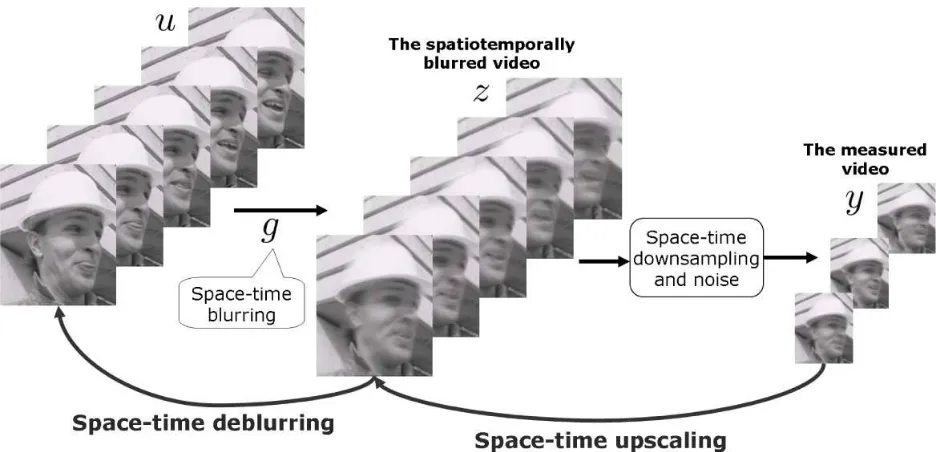
4.Removing Motion Blur With Space–Time Processing[10]
Hiroyuki Takeda, and Peyman Milanfar proposed that instead of deblurring the video frames individually, a 3-D deblurring method can be used to reduce motion blur from a single motion-blurred video to produce high resolution video in both space and time. Here, the proposed deblurring kernel is free from the knowledge of local-motions. Here, they have used a two-step approach as described below:
a) Upscale the input video in space and time without explicit estimates of the local motions.
b) Perform a 3-D deblurring to obtain the restored sequence.
Here, they point out that motion blur is by nature a temporal blur, which is caused by the relative motion of the camera and the objects in the scene when the shutter is open. Therefore temporal blur degradation model is more appropriate and physically more meaningful for the general motion deblurring problem than the usual spatial blur model.
5.Generalized Video Deblurring for Dynamic Scenes[5]
Many of the video deblurring methods are based on the assumption that the captured scenes are static whereas they are very dynamic. So, Tae Hyun Kim and Kyoung Mu Lee came up with a method of video deblurring to deal with the inherent blurs in dynamic scenes.
They propose a generalized video deblurring method that estimates the latent frames without using the global motion parameterization and segmentation. They estimate bi-directional optical flows and use them to estimate pixel-wise varying kernels.
Fig.5 (a). Bidirectional optical flows (b).Piece-wise linear blur kernel at location X
III. PROPOSED ALGORITHM
A synthesis-based approach that neither estimates kernels nor performs deconvolutions. Specifically, first step is to locate all blurry frames in a video. For every blurry frame, we find the nearby sharp frames. To deblur one frame, we adopt a process of pre-alignment that roughly aligns all sharp frames to the target blurry frame before the DPM searching. Moreover, instead of search over all sharp frames, we only search over a synthesized sharp frame that is fused from different regions of sharp frames through an “Markov random field” (MRF) region selection that ensures the spatial and temporal coherence. Each blur patch will find one sharp patch, which is used to synthesize the deblurred frame. Notably, the key differences between our method and is that we do not estimate blur kernels and only search in merged sharp frames. In summary, our contributions are:
• We propose to use DPM for a synthesis-based video deblurring, which is free from the challenges of blur kernel estimations and image deconvolutions.
• With pre-alignment and region selection, we only search in a limited search space, which highly accelerates the whole system.
IV.FLOWDIAGRAM
Input: Blurred video. Output: Deblurred video.
V.CONCLUSION
This paper provides survey on vedio deblurring. Video deblurring through direct patch method achieve more accuracy than the traditional video deblurring method. Paper describes detail description of other methods and proposed method.We found that our proposed DPM can successfully approximate CPM and works well in practice. Without forward convolution or deconvolution, our method is simple yet effective. We use the pre-alignment and the sharp map to reduce the search space, which not only increase the efficiency but also improve the accuracy of DPM. Moreover, the proposed method is scalable for parallel computing. Its robustness has been tested over various challenging videos.
REFERENCES
[1] Y. Matsushita, E. Ofek, W. Ge, X. Tang, and H. Shum, “Full-frame video stabilization with motion inpainting,” IEEE PAMI, vol. 28, pp. 1150– 1163, 2006.
[2] Y. Huang and N. Fan, “Inter-frame information transfer via projection onto convex set for video deblurring,”
IEEE J. of Selected Topics in Signal Processing, vol. 2,no. 5, pp. 275–284, 2011.
[3] S. Cho, J. Wang, and S. Lee, “Vdeo deblurring for hand-held cameras using patch-based synthesis,” ACM TOG, vol. 31, no. 4, pp. 64:1–64:9, 2012.
[5] R. Fergus, B. Singh, A. Hertzmann, S. Roweis, and W. Freeman, “Removing camera shake from a single photograph,” ACM TOG, vol. 25, no. 3, pp. 787–794, 2006.
[6] Q. Shan, J. Jia, and A. Agarwala, “High-quality motion deblurring from a single image,” ACM TOG, vol. 27, no. 3, pp. 73, 2008. [7] L. Xu and J. Jia, “Two-phase kernel estimation for robust motion deblurring,” in ECCV, pp. 157–170. 2010.
[8] O. Whyte, J. Sivic, A. Zisserman, and J. Ponce, “Non-uniform deblurring for shaken images,” IJCV, vol. 98, no. 2, pp. 168–186, 2012.
[9] M. Hirsch, C. J Schuler, S. Harmeling, and B. Scholkopf,¨ “Fast removal of non-uniform cam- era shake,” in ICCV, 2011, pp.
463–470.
[10] S. Cho, Y. Matsushita, and S. Lee, “Removing non-uniform motion blur from images,” in ICCV, 2007, pp. 1–8.
BIOGRAPHY
Ms. Keerthi G B. Mtech Student, Dept. of Computer Science and Engineering in New Horizon College of Engineering, which is located in Outer Ring Road, Panathur Post, Kadubisanahalli, Bangalore – 560087.