Using Facebook as a Cloud Platform for Solving
Numerical Optimization Problem
T.M. Rezwanul Islam
CIT department Islamic university of Technology
S.M. Al Mahi
CIT department Islamic university of Technology
Abu Sina Mohammad Raju Chowdhury
CIT department Islamic university of Technology
ABSTRACT
In case of numerical optimization problem, the size of data sets and computational complexity is rising enormously. These numerical optimization problem generally has lots of local minima and Evo-lutionary Algorithms helps quickly to find the optimal solution in this exigent search space. Not only that but also computing the ob-jective functions becomes a very complicated and time consuming task. For this reason distributed computing system is very help-ful. That’s why Facebook is used as a cloud platform. Facebook users voluntarily support this scientific work of finding the solution for Numerical Optimization problems by sharing their CPU cycle.
General Terms:
Evolutionary Algorithms, Distributed Computing
Keywords:
Numerical Optimization, Cloud, Sketching, Evolutionary Algo-rithms, Distributed Computingifx
1. INTRODUCTION
In mathematics and computer science, an optimization problem is the problem of finding the best solution from all feasible solu-tions. More formally, an optimization problem A is a quadruple (I, f, m, g), where,
—I is a set of instances.
—given an instance x∈I , f(x) is the set of feasible solutions. —given an instance x and a feasible solution y of, m(x,y) denotes
the measure of y, which is usually a positive real. —g is the goal function, and is either min or max.
The goal is then to find for some instance x an optimal solution, that is, a feasible solution y with,
m(x, y) =g{m(x, y0)|y0 ∈f(x)}
The high computational cost of complex engineering optimiza-tion problems has motivated the development of parallel opti-mization algorithms. As using a super computer appears very costly. So it was necessary to use volunteer grid. In volunteer grid mechanism, people help by sharing their CPU cycle time. Now a days, Social networking has become an everyday part of many peoples lives and some social networking site has huge users. As for example Facebook has more than 750 million ac-tive users. Social networking has also extended beyond commu-nication between friends, for instance, there are a large num-ber of integrated applications and some organizations even use Facebook credentials. The structure of a social Network is basi-cally a dynamic virtual organization with intrinsic trust relation-ships between friends. We used our friends idle CPU power to solve our optimization problems. Cloud environments typically
provide low level abstractions of computation or storage. Com-putation and Storage clouds are often used to extend the capa-bilities of storage-limited devices such as phones and desktops, and provide transparent access to data from anywhere. There are a large number of commercial Cloud providers such as Ama-zon EC2/S3, Google App Engine, Microsoft Azure and also many smaller scale open clouds like Nimbus and Eucalyptus. These clouds provide access to scalable virtualized resources contributed by users are dynamically provisioned amongst a group of friends[9].
In this paper, we show the results and analysis for numerical op-timization problems run in normal environment and in parallel environment by optimizing with the help of Niched Genetic Al-gorithm[10] and Differential Evolution. In the following sections we discuss about some related works (in section ii), Facebook applications (in section iii), Facebook as cloud platform (in sec-tion iv), optimizasec-tion methods (in secsec-tion iv), simulated environ-ments (in section vi), results (in section vii).
2. RELATED WORKS
There are numerous example of social network and cloud com-puting association. Most applications use cloud platforms to host social networks. But our application uses the enormous users in the social networks who are willing to share their CPU and opti-mizes scientific problems. As instance, Facebook users can built cloud based applications hosted by Amazon Web Services. There are similar efforts in the Grid community to leverage So-cial networking concepts, communities, and mechanisms. Po-larGrid is one such example which collects Social data using theOpenSocial interface and relies on OpenID for identification. Different social networking functions are then in corporated and an application specific portal is developed.
3. FACEBOOK APPLICATIONS
Facebook launched the Facebook Platform on May 24, 2007, providing a framework for software developers to create appli-cations that interact with core Facebook features[14]. A markup language called Facebook Markup Language was introduced si-multaneously; it is used to customize the ”look and feel” of ap-plications that developers create. Facebook JavaScript (FBJS) is parsed when a page is loaded to create a virtual application. Usually Facebook applications are hosted independently. User retrieves the Facebook canvas url and the user can map this canvas url to a specific url which is hosted remotely. When a page is requested by the user through the Facebook Canvas URL (http://apps.facebook.com/numerical-opt/) the Facebook server forwards the request to the defined callbackURL. The applica-tion creates a page based on the request and returns it to Face-book. At this point the page is parsed and Face-book specific content is added according to the FBML page instructions. The final page is then returned to the user[9].
4. GLOBAL OPTIMIZATION METHOD
Evolutionary optimization is probably the most active and pro-ductive area in Evolutionary computation measured by the num-ber of papers published and the numnum-ber of successful appli-cations reported. Although neither evolutionary programming nor genetic algorithms were first proposed as optimization rithms, people had quickly realized they could adapt these rithms to carry out combinatorial and function optimization rithms, people had quickly realized they could adapt these algo-rithms to carry out combinatorial and function optimization[1]. An EA uses some mechanisms encouraged by biological evolu-tion: reproduction, mutation, recombination, and selection. Can-didate solution to the optimization problem play the role of indi-viduals in a population, and the fitness function determines the environment within which the solutions ’live’. Evolution of the population then takes place after the repeated application of the above operators.
4.1 Evolution Program
The evolution program is a probabilistic algorithm which main-tains a population of individuals,P(t) = {xt
1, ...xtn}for it-eration t. Each individual represents a potential solution to the problem at hand, and, in any evolution program, is implemented as some data structure S. Each solution is evaluated to give some measure of its ’fitness’. Then a new population (iteration t + 1) is formed by selecting the more fit individuals. Some mem-bers of the new population undergo transformations by means of genetic operators to form solutions. There are many transfor-mations (mutation type), which create new individuals by small change in a single individual(mi : S → S), and higher or-der transformations (crossover type), which create new individ-uals by combining parts from several (two or more) individindivid-uals (cj :S....S →S). After some number of generations the pro-gram converges-it is hoped that the best individual represents a near-optimum (reasonable) solution[2].
4.2 Differential Evolution
Differential Evolution is a Stochastic Direct Search and Global Optimization algorithm, and is an instance of an Evolutionary Algorithm from the field of Evolutionary Computation. It is re-lated to sibling Evolutionary Algorithms such as the Genetic Al-gorithm, Evolutionary Programming, and Evolution Strategies, and has some similarities with Particle Swarm Optimization. The Differential Evolution algorithm involves maintaining a population of candidate solutions subjected to iterations of re-combination, evaluation, and selection. The recombination ap-proach involves the creation of new candidate solution
compo-nents based on the weighted difference between two randomly selected population members added to a third population mem-ber. This perturbs population members relative to the spread of the broader population. In conjunction with selection, the pertur-bation effect self-organizes the sampling of the problem space, bounding it to known areas of interest.
Differential Evolution has a specialized nomenclature that de-scribes the adopted configuration. This takes the form of DE/x/y/z, where x represents the solution to be perturbed (such a random or best). The y signifies the number of difference vec-tors used in the perturbation of x, where a difference vecvec-tors is the difference between two randomly selected although distinct members of the population. Finally, z signifies the recombination operator performed such as bin for binomial and exp for expo-nential[2].
5. DISTRIBUTED EVOLUTIONARY
ALGORITHMS
There have been many different approaches for making EAs work on different distributed computing systems. Here, popular sequential method has followed.
5.1 Sequential Approach
Distributed EAs typically use a single population strategy for generating new populations by evaluating each individual in par-allel; repeating this process until the population has reached con-vergence criteria. It is possible to increase scalability past the population size by additionally evaluating the objective function in parallel. This type of approach is best suited to highly reliable and homogeneous computing nodes as found in clusters and su-percomputers[8].
5.2 Asynchronous Approach
Single-population and a master-worker model is used in asyn-chronous distributed EAs. Here the generated population is kept in the server and workers evaluate individuals, using a work-stealing model. Asynchronous optimization generates new indi-viduals based on a populations current state in response to re-quests for work and later inserts the results to the population when and if they are reported. As the heuristics for generating new individuals in the discussed EAs are randomized, this al-lows asynchronous evolutionary algorithms to generate as many unique individuals are required to satisfy all potential workers. There are also no dependencies between generated individuals, so if a worker fails and does not report the fitness of its indi-vidual, the search does not need to wait for that individual to be recalculated[8].
6. SIMULATED ENVIRONMENT: FACEBOOK
AS A CLOUD PLATFORM
We have simulated an environment which is massively dis-tributed. Here the computation power comes from Facebook use who are using our application. Users are contributing by running a java Applet . This java applet looks like (fig : 1).
Fig. 1. Java Applet
Fig. 2. Simulation process
7. RESULTS
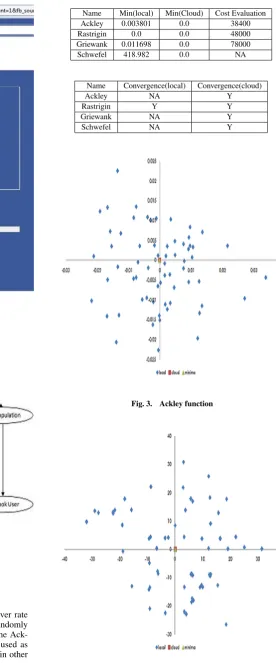
For genetic algorithm, a mutation rate of .1 and crossover rate .8 was used. In Differential Evolution scale factor was randomly chosen between 0≈1 and recombination rate was .8. The Ack-ley, Griewank, Rastrigin and Schwefel problems were used as benchmark optimization problems which are described in other works[8].
In the following figures (fig : 3,4,5,6) we tried to show that opti-mization of different numerical functions. The dots in the figure
Name Min(local) Min(Cloud) Cost Evaluation Ackley 0.003801 0.0 38400 Rastrigin 0.0 0.0 48000 Griewank 0.011698 0.0 78000 Schwefel 418.982 0.0 NA
Name Convergence(local) Convergence(cloud) Ackley NA Y Rastrigin Y Y Griewank NA Y Schwefel NA Y
Fig. 3. Ackley function
[image:3.595.58.329.96.674.2]Fig. 5. Rastrigin function
Fig. 6. Schwefel function
indicates the individuals after a certain number of evaluation of the function. Blue, red, magenta are for individuals resulted from the local machine, individuals resulted from Facebook applica-tion and global optimum respectively. We can see that Facebook application individuals are closer to global optima. As we ex-pected our result is giving more way of solving numerical opti-mization problem.
8. CONCLUSION
This work presents a simulation framework that depicts how per-formance is better in cloud network than in comparison with lo-cal machine run . Almost for every case, the lolo-cal machine and cloud provides the accurate result but in case of cloud platform the performance is tuned greatly. Though in this paper we have
used only four benchmark functions but we are looking forward to increase the number of functions for our simulation in future. We also looking forward to test the functions in broader spec-trum as well in supercomputer but due to resource limitation it is impossible right now.
9. ACKNOWLEDGEMENT
We wish to acknowledge our profound indebtedness to Prof. Dr. M.A. Mottalib (Head, Department of Computer Science and In-formation Technology, IUT ) and AKM Khaled Ahsan Talukder (Assistant Professor, Department of Computer Science and In-formation Technology). Their deep knowledge in the field of Nu-merical Optimization and Distribued computing influenced us to carry out this project up to this point. We wish to express our gratitude to the Islamic University of Technology (IUT) for pro-viding us the environment and support.
10. REFERENCES
[1] R. Sarker, M. Mohammadian and X. Yao (eds.),”Evolutionary Optimization”, INTERNATIONAL SERIES IN OPERATIONS RESEARCH AND MANAGEMENT SCIENCE Volume: 48, Kluwer Academic, ISBN 0-7923-7654-4, January 2002, 432 pp.
[2] Zbigniew Michalewicz ”Genetic Algorithms + Data Struc-tures = Evolution Programs” 3rd rev and extended edition, Springer-Verlag, Berlin, 1996Tavel, P. 2007 Modeling and Simulation Design. AK Peters Ltd.
[3] K. Price and R. Storn, ”Differential Evolution: Numerical Optimization Made Easy”,Dr. Dobb’s Journal, 1997 Forman, G. 2003.
[4] K. V. Price, ”An introduction to differential evolution”, in New Ideas in Optimization, pages 79 - 108, McGraw-Hill Ltd., UK, 1999.
[5] K. V. Price and R. M. Storn and J. A. Lampinen, ”Differ-ential evolution: A practical approach to global optimization”, Springer, 2005. ISBN 978-3-540-20950-8.
[6] R. Storn and K. Price, ”Differential Evolution: A Simple and Efficient Adaptive Scheme for Global Optimization over Continuous Spaces”,Technical Report TR-95-012, International Computer Science Institute, Berkeley, CA, 1995.
[7] R. Storn and K. Price, ”Differential evolution: A simple and efficient heuristic for global optimization over continuous spaces”,Journal of Global Optimization, 1997.
[8] Travis Desell. ”Asynchronous Global Optimization for Massive-Scale Computing” PhD thesis,Rensselaer Polytechnic Institute, December 2009.
[9] Kyle Chard, Simon Caton, Omer Rana, Kris Bubendorfer. ”Social Cloud : Cloud Computing in Social Networks”,2010 IEEE 3rd International Conference on Cloud Computing. [10] Ole J.Mengshoel, David E. Goldberg. ”The Crowding approach to Niching in Genetic Algorithm”, 200X by the Massachusetts Institute of Technology.
[12] A.L.Beberg and V.S.Pande. ”Storage@home: Petascale distributed storage”.In Parallel and Distributed Processing Symposium,2007. IPDPS2007. IEEE International, pages 1 -6,2007.
[13] David P. Anderson .”Boinc : A system for public-resource computing and storage”,In GRID 04: Proceedings of the 5th
IEEE / ACM International Workshop on Grid Computing,pages 410 ,Washington, DC, USA, 2004 .IEEE Computer Society.