Journal of Chemical and Pharmaceutical Research
__________________________________________________
ISSN No: 0975-7384
J. Chem. Pharm. Res., 2010, 2(1): 53-61
Acoustic Study of Intermolecular Interactions in Binary Liquid
Mixtures
S. Thirumaran*, R. Murugan, N. Prakash
*Department of Physics (DDE), Annamalai University, Annamalainagar-608 002, India
___________________________________________________________________________
Abstract
The ultrasonic velocity, density and viscosity have been measured for the binary mixtures of 1-propanol with toluene, benzene and cyclohexane at 303K The experimental data have been used to calculate the acoustical parameters namely adiabatic compressibility (β), free length (Lf), free
volume (Vf), internal pressure (πi), acoustic impedance (Z) and molar volume (Vm). The excess
values of some the above parameters are also evaluated and presented. A weak molecular interaction between the component molecules is observed in the present investigation. Also, the additionof non-polar component with polar 1-propanol causes dissociation of its hydrogen bonded structure. A weak magnitude of molecular association is observed in 1-prpoanol-cyclohexane system.
Key Words: Adiabatic compressibility, hydrogen bonding, intermolecular free length,
dipole-dipole interaction.
______________________________________________________________________________
Introduction
have greatly stimulated the need for extensive information on the acoustic and transport properties of these liquids and their mixtures. Commercial uses of benzene include synthesis of different intermediate compounds during the process of manufactures of plastics, dye stuffs, detergents and insecticides.[7-8]
1-propanol is used as a blending agent for petroleum naptha, resins and gums and also as an extractant in the production of vitamins, harmones, essentials oils, antibodies and sulphonated oils[9]. The above salient features of these liquids had motivated the authors to carry-out the
present study of binary liquid mixtures of 1-propanol with toluene, benzene and cyclohexane at 303K.
The present work deals with the measurement of ultrasonic velocity and evaluation of the related parameters in the following binary liquid systems at 303 K
System-I 1-propanol + toluene
System-II 1-propanol + benzene
System-III 1-propanol + cyclohexane
Materials and Methods
In all the systems, the various concentrations are prepared by varying mole fraction from 0.1 to 0.9 so as to have thorough concentrations of 1-propanol (x1) and toluene, benzene and
cyclohexane -(x2) which have been measured at 303K. The ultrasonic velocity in liquid mixtures
have been measured using an ultrasonic interferometer (Mittal Enterprises, New Delhi, Model:F81) working at frequency 3MHz with an overall accuracy of ± 0.1 ms-1. The density and viscosity are measured using a Pyckno meter and on Ostwald's Viscometer an accuracy of ±0.1kg m-3 and ± 0.001 Nsm-2 respectively. All the precautions were taken to minimize the possible experimental error. The set-up is checked for standard liquids. The values obtained are compared with literature and found that they makes very well with each other. The chemicals used in the present work were analytical reagent (AR) and spectroscopic reagent (SR) grade with minimum assay of 99.9% were obtained from Sd fine chemicals India and E-merck, Germany as such without further purification.
Theory
Using the measured data,
the Adiabatic compressibility (β) have been calculated.
ρ
β 12
U
= ..(1)
Intermolecular free length (Lf) has been calculated from relation
β
T f K
where KT is a temperature dependent constant.
Free volume (Vf) has been calculated from relation,
2 / 3 = η K U M
Vf eff …(3)
where Meff is the effective molecular weight (Meff = Σmi xi, in which mi and xi are the molecular weight and the mole fraction of the individual constituents respectively). K is a temperature independent constant which is equal to 4.28 × 10⁹ for all liquids.
Internal pressure (πi) has been calculated from relation,
= 7/6
3 / 2 2 / 1 eff i M U K
bRT η ρ
π …(4)
K is a constant, T the absolute temperature, η the viscosity in Nsm–2, U the ultrasonic velocity in ms–1, ρ the density in Kgm–3, Meff the effective molecular weight.
The excess values are calculated as,
id E
A A
A = exp− …(5)
where
∑
= = n 1 i i i
id A X
A , A is any acoustical parameters and Xi i the mole fraction of the liquid
component.
Results and Discussion
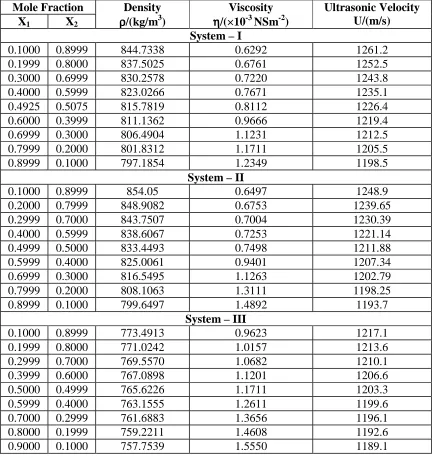
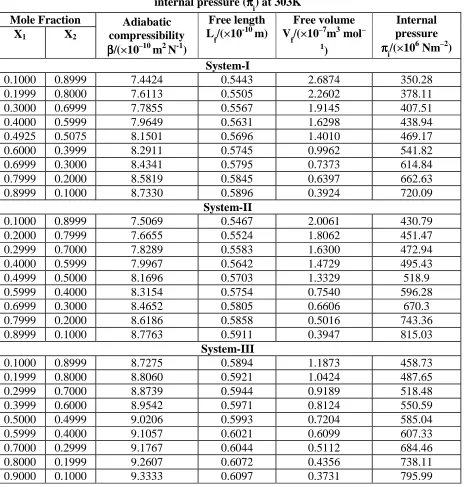
The experimentally determined values of density (ρ), viscosity (η) and ultrasonic velocity (U) of all the three liquid systems are given Table1. The values of adiabatic compressibility (β), free length (Lf), free volume (Vf), internal pressure (πi) of the above systems are tabulated in Table 2.
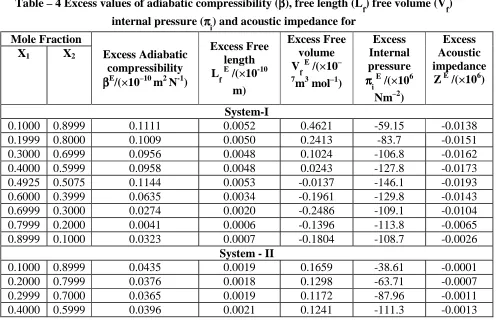
Molar volume (Vm) and acoustic impedance (Z) of all the binary mixtures have been computed and reported in Table 3. The excess values of some these parameters have been evaluated and presented in Table 4.
Table -1 Values of density (ρρρρ), viscosity (ηηηη) and velocity (U) at 303K
Mole Fraction Density
ρρρρ/(kg/m3)
Viscosity
ηηηη/(×10-3 NSm-2)
Ultrasonic Velocity U/(m/s) X1 X2
System – I
0.1000 0.8999 844.7338 0.6292 1261.2
0.1999 0.8000 837.5025 0.6761 1252.5
0.3000 0.6999 830.2578 0.7220 1243.8
0.4000 0.5999 823.0266 0.7671 1235.1
0.4925 0.5075 815.7819 0.8112 1226.4
0.6000 0.3999 811.1362 0.9666 1219.4
0.6999 0.3000 806.4904 1.1231 1212.5
0.7999 0.2000 801.8312 1.1711 1205.5
0.8999 0.1000 797.1854 1.2349 1198.5
System – II
0.1000 0.8999 854.05 0.6497 1248.9
0.2000 0.7999 848.9082 0.6753 1239.65
0.2999 0.7000 843.7507 0.7004 1230.39
0.4000 0.5999 838.6067 0.7253 1221.14
0.4999 0.5000 833.4493 0.7498 1211.88
0.5999 0.4000 825.0061 0.9401 1207.34
0.6999 0.3000 816.5495 1.1263 1202.79
0.7999 0.2000 808.1063 1.3111 1198.25
0.8999 0.1000 799.6497 1.4892 1193.7
System – III
0.1000 0.8999 773.4913 0.9623 1217.1
0.1999 0.8000 771.0242 1.0157 1213.6
0.2999 0.7000 769.5570 1.0682 1210.1
0.3999 0.6000 767.0898 1.1201 1206.6
0.5000 0.4999 765.6226 1.1711 1203.3
0.5999 0.4000 763.1555 1.2611 1199.6
0.7000 0.2999 761.6883 1.3656 1196.1
0.8000 0.1999 759.2211 1.4608 1192.6
0.9000 0.1000 757.7539 1.5550 1189.1
The parameters such as adiabatic compressibility (β) and intermolecular free length (Lf) show
reverse trend – both are found to be increased with the increasing molar concentration of 1-propanol in all the three liquid systems, which are tabulated in Table 1. In the three liquid systems, namely, in 1-propanol-benzene system, the adiabatic compressibility (β) and free length (Lf) increase with increasing molar concentrations of alcohol. Such an increase in β as
well as Lf suggest that the hydrogen bonded association of alcohols breaks up gradually with
Table -2 Values of adiabatic compressibility (ββββ), free length (L
f) free volume (Vf) and
internal pressure (ππππ
i) at 303K
Mole Fraction Adiabatic compressibility
ββββ/(×10–10 m2 N-1)
Free length L
f/(×10 -10
m)
Free volume V
f/(×10 –7
m3 mol–
1
)
Internal pressure
ππππi/(×106 Nm–2) X1 X2
System-I
0.1000 0.8999 7.4424 0.5443 2.6874 350.28
0.1999 0.8000 7.6113 0.5505 2.2602 378.11
0.3000 0.6999 7.7855 0.5567 1.9145 407.51
0.4000 0.5999 7.9649 0.5631 1.6298 438.94
0.4925 0.5075 8.1501 0.5696 1.4010 469.17
0.6000 0.3999 8.2911 0.5745 0.9962 541.82
0.6999 0.3000 8.4341 0.5795 0.7373 614.84
0.7999 0.2000 8.5819 0.5845 0.6397 662.63
0.8999 0.1000 8.7330 0.5896 0.3924 720.09
System-II
0.1000 0.8999 7.5069 0.5467 2.0061 430.79
0.2000 0.7999 7.6655 0.5524 1.8062 451.47
0.2999 0.7000 7.8289 0.5583 1.6300 472.94
0.4000 0.5999 7.9967 0.5642 1.4729 495.43
0.4999 0.5000 8.1696 0.5703 1.3329 518.9
0.5999 0.4000 8.3154 0.5754 0.7540 596.28
0.6999 0.3000 8.4652 0.5805 0.6606 670.3
0.7999 0.2000 8.6186 0.5858 0.5016 743.36
0.8999 0.1000 8.7763 0.5911 0.3947 815.03
System-III
0.1000 0.8999 8.7275 0.5894 1.1873 458.73
0.1999 0.8000 8.8060 0.5921 1.0424 487.65
0.2999 0.7000 8.8739 0.5944 0.9189 518.48
0.3999 0.6000 8.9542 0.5971 0.8124 550.59
0.5000 0.4999 9.0206 0.5993 0.7204 585.04
0.5999 0.4000 9.1057 0.6021 0.6099 607.33
0.7000 0.2999 9.1767 0.6044 0.5112 684.46
0.8000 0.1999 9.2607 0.6072 0.4356 738.11
0.9000 0.1000 9.3333 0.6097 0.3731 795.99
Such addition of benzene causing breaking of hydrogen bonded association of alcohols leads to expansion in volume. Hence, an increase in molar volume (Vm) is observed which are tabulated
Further, the decrease in free volume and increase in internal pressure with rise in concentration of alkanol in all the systems clearly show the increasing magnitude of interactions[16]. Further, the increase in internal pressure (πi) generally indicates association through hydrogen bonding. Similar results were observed by earlier workers [17].
Table - 3 Values of molar volume (Vm) and acoustic impedance (Z) at 303K
Mole Fraction Molar volume Vm/(×10–3 m3 mol-1)
Acoustic impedance Z/(×106 Kg m2 s–1 ) X1 X2
System-I
0.1000 0.8999 0.0794 1.0654
0.1999 0.8000 0.0829 1.0490
0.3000 0.6999 0.0864 1.0327
0.4000 0.5999 0.0899 1.0165
0.4925 0.5075 0.0936 1.0005
0.6000 0.3999 0.0964 0.9891
0.6999 0.3000 0.0994 0.9779
0.7999 0.2000 0.1024 0.9666
0.8999 0.1000 0.1053 0.9554
System-II
0.1000 0.8999 0.0774 1.0666
0.2000 0.7999 0.0788 1.0523
0.2999 0.7000 0.0802 1.0381
0.4000 0.5999 0.0816 1.0241
0.4999 0.5000 0.0829 1.0100
0.5999 0.4000 0.0845 0.9961
0.6999 0.3000 0.0862 0.9821
0.7999 0.2000 0.0878 0.9683
0.8999 0.1000 0.0893 0.9545
System-III
0.1000 0.8999 0.9414 0.0825
0.1999 0.8000 0.9357 0.0855
0.2999 0.7000 0.9312 0.0884
0.3999 0.6000 0.9256 0.0914
0.5000 0.4999 0.9213 0.0942
0.5999 0.4000 0.9155 0.0972
0.7000 0.2999 0.9111 0.0999
0.8000 0.1999 0.9054 0.1029
0.9000 0.1000 0.9010 0.1057
impedance’ of the medium. This factor is governed by the inertial and elastic properties of the medium. It is important to examine specific acoustic impedance in relation to concentration and temperature. When a plane ultrasonic wave is set up in a liquid, the pressure and hence density and refractive index show specific variations with distance from the source along the direction of propagation. In the present investigation, it is observed that these acoustic impedance (Z) values decrease with increasing concentration of 1-propanol. Such a decreasing values of acoustic impedance (Z) further supports the possibility of molecular interactions between the unlike molecules.
In order to understand the nature of molecular interactions between the components of the liquid mixtures, it is of interest to discuss the same in term of excess parameter rather than actual values. Non-ideal liquid mixtures show considerable deviation from linearity in their physical behavior with respect to concentration and these have been interpreted as arising from the presence of strong or weak interactions. The extent of deviation depends upon the nature of the constituents and composition of the mixtures.
The excess values of adiabatic compressibility (βE
), free length (LfE), free volume (VfE) and
internal pressure (πiE) for all the three liquid systems are furnished in Table 4. It is learnt that the
[image:7.595.64.563.411.731.2]dispersion forces are responsible for possessing positive excess values, while dipole-dipole, dipole-induced dipole, charge transfer interaction and hydrogen bonding between unlike molecules are responsible for possessing negative excess values[18].
Table – 4 Excess values of adiabatic compressibility (ββββ), free length (L
f) free volume (Vf)
internal pressure (ππππ
i) and acoustic impedance for
Mole Fraction
Excess Adiabatic compressibility
ββββE
/(×10–10 m2 N-1)
Excess Free length L
f E
/(×10-10 m)
Excess Free volume V
f E
/(×10–
7
m3 mol–1)
Excess Internal pressure
ππππi E
/(×106 Nm–2)
Excess Acoustic impedance Z E /(×106) X1 X2
System-I
0.1000 0.8999 0.1111 0.0052 0.4621 -59.15 -0.0138
0.1999 0.8000 0.1009 0.0050 0.2413 -83.7 -0.0151
0.3000 0.6999 0.0956 0.0048 0.1024 -106.8 -0.0162
0.4000 0.5999 0.0958 0.0048 0.0243 -127.8 -0.0173
0.4925 0.5075 0.1144 0.0053 -0.0137 -146.1 -0.0193
0.6000 0.3999 0.0635 0.0034 -0.1961 -129.8 -0.0143
0.6999 0.3000 0.0274 0.0020 -0.2486 -109.1 -0.0104
0.7999 0.2000 0.0041 0.0006 -0.1396 -113.8 -0.0065
0.8999 0.1000 0.0323 0.0007 -0.1804 -108.7 -0.0026
System - II
0.1000 0.8999 0.0435 0.0019 0.1659 -38.61 -0.0001
0.2000 0.7999 0.0376 0.0018 0.1298 -63.71 -0.0007
0.4999 0.5000 0.0480 0.0024 0.1477 -133.5 -0.0017
0.5999 0.4000 0.0293 0.0017 -0.2674 -101.9 -0.0018
0.6999 0.3000 0.0145 0.0011 -0.1970 -73.67 -0.0020
0.7999 0.2000 0.0033 0.0006 -0.1922 -46.38 -0.0020
0.8999 0.1000 0.0036 0.0001 -0.1353 -20.48 -0.0021
System - III
0.1000 0.8999 0.0748 0.0026 -0.0598 -14.49 0.0080
0.1999 0.8000 0.0121 0.0004 -0.1069 -30.87 0.0012
0.2999 0.7000 0.0399 0.0014 -0.0090 -45.39 -0.0043
0.3999 0.6000 0.1045 0.0035 -0.1411 -58.62 -0.0110
0.5000 0.4999 0.1551 0.0052 -0.1351 -69.56 -0.0163
0.5999 0.4000 0.2244 0.0075 -0.1478 -92.57 -0.0231
0.7000 0.2999 0.2796 0.0092 -0.1485 -60.83 -0.0286
0.8000 0.1999 0.3478 0.0115 -0.1262 -52.52 -0.0353
0.9000 0.1000 0.4037 0.0134 -0.0910 -40.03 -0.0408
In the present study, the excess values of adiabatic compressibility (βE) and free length (LfE)
exhibit positive deviations over the entire range of composition in all the three liquid binary systems. The positive values of βE is attributed to the breaking of homopolymerisation with addition of non-polar aromatic compounds. (toluene, benzene) Similar observations found in the binary systems of Miyanaaga et.al.,[19] and Oswel et.al. [20]. The positive deviation of excess free length (LfE) also suggests that there is a possibility of some weak interactive forces
(dipole-induced dipole) in all the three liquid systems. Such an observation is quite obvious in the cases of non-polar with polar mixtures. Similar types of observations were reported by Miyanaga et.al. [19]
The excess internal pressure (πiE) values are furnished in the Table 4. The excess values of
internal pressure is often described in terms of molecular interaction in liquid mixtures, whose negative deviations in all the three liquid systems over the entire range of composition clearly suggest that the dispersive forces or weak dipole-induced dipole types of forces are existing between the system components.
Conclusion
From ultrasonic velocity, related acoustical parameters and their excess values it is concluded that there exists a weak molecular association between the component molecules in the mixtures. Further the addition of non-polar component with polar 1-propanol leads to breaking of its hydrogen bonded association . This results in subsequent weak molecular interaction (dipole-induced dipole) existing between the unlike molecules. Comparing the three binary liquid systems, the weak magnitude of molecular association is identified in 1- propanal- cyclohexane system. (System - III)
References
[1] S Thirumaran; P Anbuselvi; Asian Journ Chem, 2009, 21(9), 7261.
[2] S Thirumaran ; Deepesh George ; ARPN Journ of Engg & Appl Sci. 2008, 27D(2), 281. [3] Zielikewiez, J., Journ Chem Thermodyn., 26 (1994) 959.
[4] S Thirumaran; J Ramesh; Rasayan Journ chem, 2009, vol 2 (3), 733. [5] S Thirumaran; K Ramya; Asian Journ Chem. 2009, 21(8), 6359.
[6] S Thirumaran; J Earnest Jayakumar, Ind.Journ pure & Appl. Phys, 2009, 47, 265. [7] Lide D R , C.R.C. Handbook of Chemistry 81st Edn (Boca Raton, New York) 2001.
[8] Dean J A Lange’s Handbook of Chemistry, 13th Edn Mcgraw Hill, New York 1987.
[9] Monic A J Alcohots, (Chapman Reinhold Inc New York) 1968. [10]Tiwari K, Patra C, & Chakravorthy V, Acoust Lett, 19 (1995) 53. [11]Kannappan AN & Palaniappan L, Ind Journ Phys., 73B (1999) 531.
[12]S Thirumaran; M Suguna; SR Selvi; Research Journ Chem & Envioron, 2009, 13 (3), 81. [13]Rao T S, Veeriah, Rao G S, Ramachandran D, & Rambabu C, Ind J. Chem., 42A (2003) 1876.
[14]Nikam P S Kapade V M & Hassan M, Journ Pure & Appl Ultraso, 22 (2000) 16. [15]Reddy N Y, Naidu P S & Prassad K R, Ind Jou Pure & Appl Phys., 32 (1994) 958. [16]Anbananthan, D, J. Accoust. Soc. India, 7 (1979) 123.
[17]Pandey J D, Hassan N A, Shukla J N, & Dey R, Acoust Lett., 23 (1999) 06. [18]Alculea Palofax M, Ind Journ Pure & Appl Phys. 31 (1993) 90.
[19]Miyanaga S, Tamura K, & Murakami S, Themochmica Acta, 198 (1992) 237. [20]Oswel S L, Oswel P, & Dove J P, Journ Mol Liq., 94 (2001) 203.