464
RECONSTRUCTIONS OF MARKET VALUES ACCORDING
TO THE ICT-BASED CREATED VALUES TO REACH
MARKET EQUILIBRIUM
1HYUN JUNG LEE, 2YONG SIK CHANG
160, Taegeuk-ro, Ilsandong-gu, Goyang-si, Gyeonggi-do, 10374. Goyang Research Institute, Department of
Economic and Social Research, South Korea
2137 Hanshindae-gil, Osan-si, Gyeonggi-do, 18101. Hanshin University, Department of IT Management,
South Korea
E-mail: 1[email protected], 2[email protected]
ABSTRACT
In this research, we are focusing on the reconstructions of market values according to created services and products in ICT-based environment. The 4th industrialrevolution is based on ICT-based technologies like
IoT, Big data, AI, and so on. The converged technologies are applied to economies and societies in the direction of creation of new services and products. In the market, it is possible to be conflicted between market values which come from ICT- and non-ICT-based services and products. So, we propose the market equilibrium to solve the confliction of value chains. In the created ICT-based new market, it is possible for multiple value-chains to share values in a market unlike traditional market. To do this, in the value chains, we define priority values which are created primary values in the value chains. It is also necessary to determine conflicted and destroyed values to maximize the market value in each value chain. It also accelerates to increase the global market value in the converged market like a platform. To do this, it is important to reconstruct the market values because ICT-based market creation will be tremendously increased. In this paper, we will discuss for the coexistence of the ICT-based created values in a market and the traditional and ICT-based value chains. To do this, especially, we are comparing the market value of healthcare service with that of ICT-based e-healthcare service.
Keywords: ICT, Market Value, Equilibrium, Healthcare Service, Value Chain
1. INTRODUCTION
In this research, we are focusing on the reconstruction of market values in a platform that includes multiple value chains which creates different values. It is possible to bring conflictions in the platform among the multiple market values. So, it is important to solve the conflictions to construct the platform, successfully. Nowadays, according to the upcoming 4th industrial revolution,
there are arising a lot of ICT-based new markets. In addition, ICT-based new technologies are leading new type industries and markets to provide services and products according to customers’ demands.
The features of ICT-based new markets are different from the traditional markets even if they are developed on ICT-based technologies. For instances, as an old ICT-based service markets, there are the IPTV service or 2G mobile phone service. IPTV service is produced by adoption of
465 cars. Nowadays it has been called by sharing economy.
Uber creates a new value chain. In the value chain, the suppliers and buyers are not ramified. In traditional market, it was general to ramify between suppliers and buyers. In ICT-based new market like Uber, every private car owner can be suppliers and customers. If car owners supply taxi services to customers, then they can be suppliers, even if they are not engaged in taxi companies. Healthcare services also create new ICT-based services like e-healthcare services, tele-healthcare services, robot-tele-healthcare services and so on [1, 2, 17]. The ICT-based services create new values by the reimagined businesses differentiated from the traditional businesses [3, 4, 19, 20]. In the new value chain systems, it is necessary to newly define the suppliers and customers because the ICT-based services are conducted by multiple value chain systems. For instance, in the tele-healthcare service, there is a shared platform by multiple value chains like ICT related suppliers and customers, medical devices suppliers and customers and so on above the medical service value chain with medical team and patients.
In this light, in new-type markets, it is necessary to define the created market values as well as destroyed. In addition, it needs to define the conflicted and sharable values between the new and old market values. So, in this research, we do discuss the created, destroyed, conflicted and shared values between the created and traditional value chains.
In section 2, we review the ICT-based created values and newly generated value chains. Section 3 describes ICT-based created values in new markets. Section 4 proposes market equilibrium methodologies to solve the conflicted values in markets. Section 5 discusses the experiment and expected value. Finally, we conclude this research and propose the further research.
2. LITERATURE REVIEW
A lot of products and services have been changed and converged into new products and services which are based on the developed ICT [6, 7, 10, 16] according to the market demands and social needs. The new products are equipped with efficiency, productivity, marketability and have been changed into value-added products [14]. Above such products are developed by social or market needs or by the chance of technology developments even if the engineers did not intend.
To develop the services, traditional services are mounted on ICT-based developed technology [8]. The expected new services are predicted by three-type as follows: traditional services are topped on ICT-based infra service, ICT-based new services are created in traditional infra, and totally changed new services are created depending on the development of ICT. The converged or created businesses in industry, products, services, platforms, etc. are having a direction to improve customer satisfaction, satisfy customers’ requirements or create new requirements from customers. Especially, on-demand and customized services on forward of value chain have been generalized which are based on dynamics of interactive, personalized, customized services and derived by ICT-based industries. In other words, it can represent decay or change of supplier-based value chain in traditional manufacturing or technology-based industries [13]. However, service-based industries are better qualified on customer side according to the maturation of information industries and society and the development of ICT technology [12, 18, 15, 16]. The newly developed services or the upgrade of traditional services lead supplies of a variety of services in our society and economy. In addition, they are having major roles on creations of social and economic values in our community.
In this research, we discuss conflicted values between newly generated markets and traditional markets and to make equilibrium in market for coexistence of different typed markets. We compare priority values from traditional business with ICT-based new business. In the new and old business, the priority values have been changed, created, improved, disappear and so on within changed value chain structure. It is necessary to discuss how the different typed markets can be sustained in the chaining economy ecosystem [9].
In this discussion, we expect to propose the bright plan to build sound future business according to the creation of a variety of services, because the advent of ICT technology caused the confliction between newly developed value chain and traditional businesses.
3. ICT LEADING MARKET VALUES
466 value chain with supplier and customer side. The created new markets can be composed of multiple value chains because the markets are generated by converged products and services with ICT. This kind of market is generally called by the platform. The platform can be substituted by markets which were places to trade a single type of the goods. However, ICT-based cyber physical system-based markets are including multiple types of goods to trade between shake holders. Even the goods are also completed by the convergence of multiple goods. So in a platform, it is necessary to manage the various types of market values which can be highly related to multiple value chains. In addition, in a platform there are not only complete goods as traditional markets but also half-finished goods. In the platform, it is possible to trade not only products but also services and the roles of suppliers and buyers can be also changed depends on the contextual environment. In short, anything goods can be traded among the suppliers and buyers and the roles of participants in a value chain can be easily changed depending on market conditions if it creates market values.
[image:3.612.93.296.429.586.2]To do this, in this section, we define four dimensions of market values like created, destroyed, conflicted and shared values as in Figure 1.
Figure 1: The market values in a market
According to the emerging ICT-based market, new types of market values are created. The created values can be shared by participants in multiple value chains. Some values can bring conflictions with market values in the existed value chains. As the results of conflictions, some values can be destroyed in markets. Thus, the reconstruction of the emerging market structure is indispensable to develop and sustain market values in a new market.
In the platform, there are conflictions among the market values between value chains. So, it is necessary to control the values as was controlled in the traditional market using the supply chain.
In the supply chain, it was true that the markets were focused on the trading of tangible products from inbound to outbound of the value chain. However, the advent of ICT caused the production and trading of intangible products like services. For this reason, the new market values create a new type of a value chain to trade the products in the market. Therefore, the occurrence of conflictions is inevitable because the heterogeneous values are in a market. So, it is necessary to discuss the confliction among values and how to solve the problems.
The created market values are defined as follow.
C={ci|ci is ith created value in a new value chain}
If the created market value provides the same value to the market, then the traditional market value can be destroyed.
The destroyed value is described as follow.
D = {di | di is ith destroyed value in the traditional
value chain}
The destroyed values are occurred by confliction between traditional and new market values which are generated from different value chain, even if the market values are not changed.
The conflicted value is described as follow.
F = {fi | fi is ith conflicted value between the new
and the traditional value chain}
467 taxi service. Even if they are creating a same market value like the taxi service, it is possible that there are both services with different value chains in a market. They are not shared by the customers but share a market. In addition, it is possible that there are multiple value chains in the market.
If it is possible that there are different value chains which create and deliver a same market value but not in a market, then it is called by the shared value which is defined as follow.
S ={si|si is ith shared value between value chains,
but it is not share a market}
For coexistence of multiple value chains in a market, the market should be segmented by contextual customers. The more players share a same market with a same value, the more conflictions will be occurred. On the other hand, the more customers exclusively consumed the values in different markets, the markets will be stabilized.
A market including multiple value chains should create new markets which can be dynamically generated by customers’ contexts.
4. RECONSTRUCTION OF MARKET VALUES
In the 4th industrialrevolution, according to
the advent of ICT-based services and products, it is necessary to make a segmentation of the market with multiple value chains. A market depending on the ICT related converged works creates customer-based values which can be segmented by the types of customers’ contextual conditions.
In this research, we are focusing on the reconstructions of market values according to created services and products in ICT-based environment. The 4th industrialrevolution is based
on ICT-based technologies like IoT, Big data, AI, and so on. The converged technologies are applied to economies and societies in the direction of creation of new services and products. In the market, it is possible to be conflicted between market values which come from ICT- and non-ICT-based services and products. To solve the problem, we propose market equilibrium to solve the conflicted values among different value-chains. In the created ICT-based new market, it is possible for multiple value-chains to exist in a market unlike the past market.
It is also necessary to define conflicted and destroyed values to maximize the market value in
each value chain. It can also accelerate to increase the global market value in the converged market like a platform. In the multiple-sided market, it is possible to individualize the products and to differentiate the value of each product according to the c)ustomers’ satisfaction.
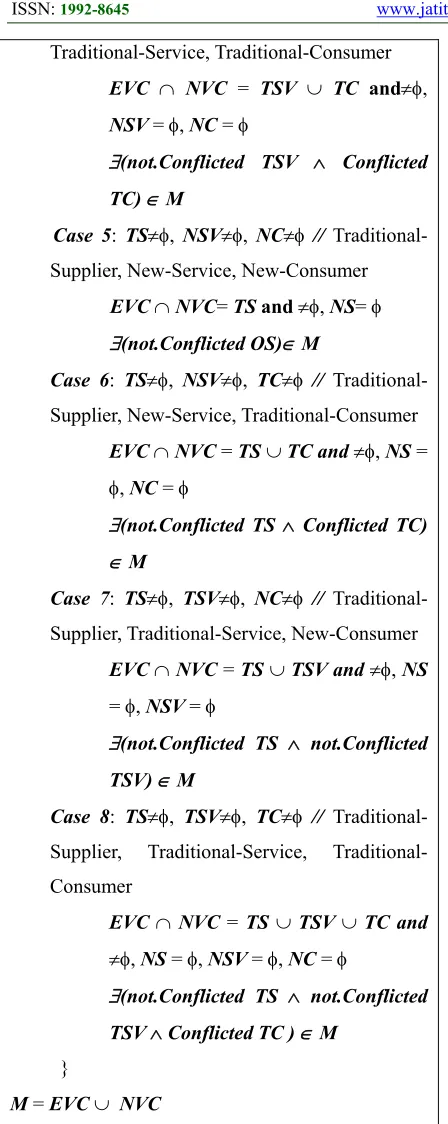
The value chains are constructed by convergence of traditional- and new- suppliers, services and customers. In addition, the value chains can be dynamically reconstructed by primary values as in Figure 2.
//When a new value chain enters in a market already having traditional value chains.
M ← Market with multiple value chains
TS ← Traditional-Supplier;
TSV ← Traditional-Service value;
TC ← Traditional-Consumer
NS ← New-Supplier;
NSV ← New-Service value;
NC ← New-Consumer
EVC ← Existing Value Chain which as a set with
TS, TSV, TC;
NVC ← Created New Value Chain as a set
Switch with (Participants) {
Case 1: NS, NSV, NC //
New-Supplier, New-Service, New-Consumer
EVCNVC =
Case 2: NS, NSV, TC // New-Supplier,
New-Service, Traditional-Consumer
EVCNVC = TC and, NC =
(Conflicted TC) M
Case 3: NS, TSV, NC // New-Supplier,
Traditional-Service, New-Consumer
EVCNVC = TSV and, NSV =
(not.Conflicted TSV) M
468 Traditional-Service, Traditional-Consumer
EVC NVC = TSV TC and,
NSV = , NC =
(not.Conflicted TSV Conflicted
TC) M
Case 5: TS, NSV, NC //
Traditional-Supplier, New-Service, New-Consumer
EVCNVC= TS and, NS=
(not.Conflicted OS) M
Case 6: TS, NSV, TC //
Traditional-Supplier, New-Service, Traditional-Consumer
EVCNVC = TS TC and , NS =
, NC =
(not.Conflicted TS Conflicted TC)
M
Case 7: TS, TSV, NC //
Traditional-Supplier, Traditional-Service, New-Consumer
EVCNVC = TS TSV and , NS
= , NSV =
(not.Conflicted TS not.Conflicted
TSV) M
Case 8: TS, TSV, TC //
Supplier, Service, Traditional-Consumer
EVC NVC = TS TSV TC and
, NS = , NSV = , NC =
(not.Conflicted TS not.Conflicted
TSV Conflicted TC) M
}
[image:5.612.85.309.74.636.2]M = EVC NVC
Figure 2: The value chains creation and reconstruction in a market
In Figure 2, the possible conflictions between value chains are classified with 8 types when a new value chain enters to the traditional market. It is an example when a new tele-healthcare
service enters to the traditional healthcare service market.
We can determine the market price P and market value V. In traditional market, it is true that
P>V, but in ICT-based market, it is not easy to equally measure the V. In the market, depending on the customers’ satisfaction, in some cases are V>P. In addition, V can be dynamically measured depending on the customers’ contextual environments.
If there are multiple value chains in a market, then the market value will be summed by the values like v1, v2, and so on.
V=N(vi) (1)
In formula (1), vi is a market value of ith value chain
and N is the number of value chains.
If vi is all the same in all value chains in
multiple-sided market and 1, then the total value in the market is N(vi)=N. However, in the market, all
of vi is not the same. If there is V = N(v1, v2) and
confliction between v1 and v2, then one of market
values or both of them can be destroyed in the market. Therefore, one of them will be survived or a new market value will be created. If a new market value is created in a market, then it is general that they are conflicted between them. In traditional market, it was general that one of market values will be destroyed.
However, in ICT-based creative market, the market values can be differently depended on customers’ contextual conditions. Even both of them can coexist in the same market. To do this, each value should be included in each segment as follow.
v1 seg1; v2 seg2
v1 is created from seg1which issegmentation 1 and
v2 is created from seg2 which is segmentation 2.
The seg1 and seg2 areincluded in a market M.
M = seg1 seg2
As was stated, in ICT-based creative market, the market value can be V>P unlike traditional market. So, the market can be shared by multiple value chains because V is increased.
469 In addition, the priority values vi in
multiple value chains should be excluded with segmentation as the central. Thus, the market will be stabilized and the multiple value chains will be sustained in a same market. For instance, if Uber taxi wishes to share a taxi customers’ market with the traditional taxi industry, then Uber should create a new consumer-based segmentation with its priority value in the market. So, there is no confliction between v1 as a market value of
traditional taxi industry and v2 as a market value of
Uber.
In addition, in taxi industry including Uber and traditional, the total market value will be increased from V to V+α. In the strict sense, Uber
and traditional taxi are belonged into different value chains. Even, in real market, Uber and traditional taxi industry are constructing different customer-based segmentation. In another case, in the healthcare service market with the traditional and tele-healthcare service, there are different value chains. So they can have big opportunities to create new market values in the market.
5. MARKET EQUILIBRIUM
In advance of ICT, market should be more detailed segmented. However, the market structure is still based on the traditional value chains. To reach market equilibrium, the created market values are should be controlled by a new market structures. In technology-based market, there is multiple-sided market with multiple value chains. So, it is important to control the value chains in the market to maintain the market equilibrium.
In addition, the importance of coexistence of multi-value chains in a market is that the TV as total of market values in a market including multiple value chains can be larger than the summation of IVi as individual market values in
each value chains.
For instance, in ICT-based tele-healthcare service, the construction of healthcare cloud can have opportunities to increase total market values by making the collaborative market values between traditional- and tele-healthcare. This kind of service can make additive market values in the multiple value chains market. So, multiple value chains can be coexisted in a market with the market equilibrium.
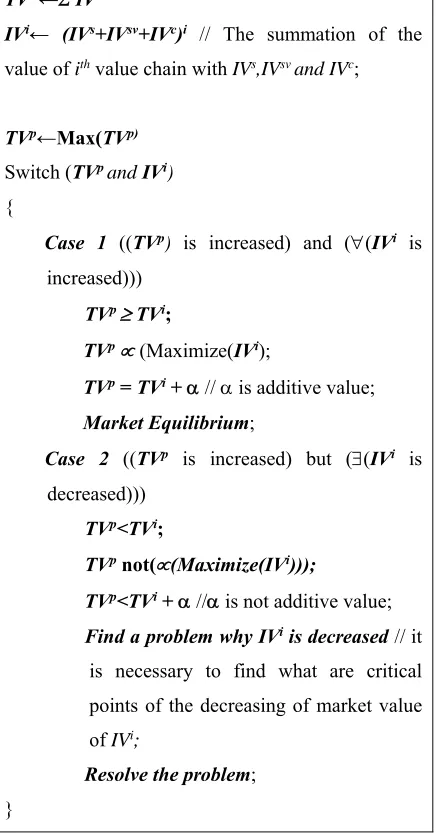
For the market equilibrium in multiple value chains, the algorithm is as follow in Figure 3.
IVi← Individual value of ith value chain; TVp← Total value of a multiple-sided market;
TVi← Total value of individual value chains;
Vs← Value of suppliers in the market;
Vsv← Value of services value in the market;
Vc← Value of customers in the market;
TVpTVi // TVp should be equal to TVi;
TVp←(Vs+Vsv+Vc)p // The summation of Vs,Vsv and Vc in the market;
TVi ← IVi
IVi← (IVs+IVsv+IVc)i // The summation of the
value of ith value chain with IVs,IVsv and IVc;
TVp←Max(TVp)
Switch (TVp and IVi)
{
Case 1 ((TVp) is increased) and ((IVi is
increased)))
TVp TVi;
TVp(Maximize(IVi);
TVp = TVi + // is additive value;
Market Equilibrium;
Case 2 ((TVp is increased) but ((IVi is
decreased)))
TVp<TVi;
TVpnot((Maximize(IVi)));
TVp<TVi + // is not additive value;
Find a problemwhy IVi is decreased// it
is necessary to find what are critical points of the decreasing of market value of IVi;
Resolve the problem;
[image:6.612.311.529.275.692.2]}
470
6. EXPERIMENTS AND DISCUSSION
In this research, we simulate the distribution of market values to reach the market equilibrium between the healthcare and healthcare service. The development of the tele-healthcare service is based on ICT technology. The newly developed tele-healthcare and traditional healthcare service have different value chains. In short, in tele-healthcare service value chain, the created values should be different from those of the traditional healthcare value chain. In traditional healthcare value chain, the players are defined by medical teams and patients, but in tele-healthcare service, the players are defined by medical contents provider, ICT-based medical Apps, medical networks, and so on as well as medical teams and patients. Additively, the boundaries of patients are also expanded to ageing group, tele-located patients, guardians, and so on, if the patients can use the tele-healthcare service.
The tele-healthcare service value chain is generated by convergence of ICT-based technology and the traditional healthcare service. The ICT-based technology creates new values like medical contents, tele-services, and so on in the newly created value chain. So, in this simulation, we try to prove the expansion of traditional markets when we adopt the ICT to the traditional market.
The generated priority values from the value chains are as follows.
V = {v1, v2}
, wherev1 is the created value from the traditional
medical service and v2 is the ICT-based created
value from tele-healthcare service. v1 is v2 can be
narrowly segmented by customers’ demands as follows.
v1 = {v11, v12}
v2= {v21, v22}
For instance, wherev11 can be the created values
frommedical teams, v12 can be from patients’ care,
v21 comes from medical contents, v22 can be from
medical infra like medical contents or information providing, and so on.
We assume that the value of medical contents is α, and the value of medical service is β. In the healthcare service value chain creates value α and tele-healthcare service value chain creates value β which is interpreted by β= α+δ. In the view points of the priority players, in healthcare service,
there are medical teams (ψ), patients (ω) and in the tele-healthcare service, some players are added such as ICT technology-based medical contents service providers (φ) and contents consumers (χ). The ICT-based medical service providers are providing advanced medical information and contents as well as medical appliances and medical supplies. So ψ will be expanded to ψ′≥ ψ, ψ′+ ε. The patients’ markets are also expanded to ω′≥ ω, ω′+χ, χ is medical contents consumers.
It shows that the tele-healthcare service produces more productive values than the traditional healthcare service. In addition, the number of participating players is also numerically or not increased. Therefore, it proves that the totally created values are also expanded. From the lesson, we can expect the possibility of market equilibrium between the traditional and ICT-based created business through solving conflictions between market values in a market.
7. CONCLUSIONS
In this research, we discuss the coexistence of multiple value chains through the market equilibrium. The advance of ICT-based market caused the confusion between traditional and ICT-based newly generated businesses. For instance, there are market value conflictions among the different value chains in a market.
In the proposed the market equilibrium, it is possible to coexist multiple values in a same market. In addition, the ICT-based newly generated market can create new values which are differentiated from the values of traditional business. So the different value chains can create new creative values in their value chains. The creative values can be play roles of priority values in multiple value chains. The segmentations of a market according to the customers’ contextual conditions can guarantee the creation of a variety of market values. Finally, in the multiple value chain in a market, some values can be conflicted and destroyed, but others will be created and can collaborate with multiple value chains. As the results, the market when a new value chain enters, it can make more converged, collaborative, shared and emerged market values and they can be coexisted in a market.
471 created than the summation of individual market values.
To show this, we adopt the tele-healthcare service which is compared with the healthcare services. We find that the participating players are increased and additively the created values are also increased. So the size of total market can be increased when we adopt the ICT technology to businesses. From the instance, we tried to define newly generated participating players and created priority values in the market.
In further research, to polish the proposed market equilibrium, it is necessary to research an in-depth study for a modeling and to adopt more detailed cases for in-depth discussion. In addition, it is expected using real data to prove the proposed market equilibrium to solve the conflicted market values in a market.
REFRENCES:
[1] J. Anderson, “Evaluation in health informatics: social network analysis,” Computers in
Biology and Medicine, Vol. 32, 2002, pp.
179-193.
[2] B. Andre´, Gerd Ringdal, Jon H. Loge, Toril Rannestad, Hallvard Laerum, and Stein Kaasa, “Experiences with the implementation of computerized tools in health care units: a review article,” International Journal of
Human-Computer Interaction, Vol. 24, No. 8,
2008, pp. 753-775.
[3] R. L. Chapman, Claudine Soosay, and Jay Kandampully, “Innovation in logistic services and the new business model: a conceptual framework,” International Journal of Physical
Distribution & Logistics Management, Vol. 33,
No. 7, 2003, pp. 630-650.
[4] P. F. Drucker, Innovation and Entrepreneurship, Harvard Business School, Cambridge, MA, 1985.
[5] D. Flint, Everth Larsson and Britta Gammelgaard, “Exploring processes for customer value insights, supply chain learning and innovation: an international study,”
Journal of Business Logistics, Vol. 29, No. 1,
2008, pp. 257-281.
[6] B. Flynn and Edmund Flynn, “Synergies between supply chain management and quality management: emerging implications,”
International Journal of Production Research,
Vol. 43, No. 16, 2005, pp. 3421-36.
[7] J. Franks, “Supply chain innovation,” Work
Study, Vol. 49, No. 4, 2005, pp. 152-155.
[8] F. Hacklin, Management of convergence in innovation: Strategies and capabilities for value creation beyond blurring industry boundaries, Physics-Verlag Heidelberg, Springer, 2008.
[9] D. Lambert, Ronald Adams and Margaret Emmelhainz, “Supplier selection criteria in the healthcare industry: a comparison of importance and performance,” International
Journal of Purchasing and Materials, Vol. 33,
No. 1, 1997, pp. 16-22.
[10]D. Li, and Christopher O’Brien, “Integrated decision modeling of supply chain efficiency,”
International Journal of Production
Economics, Vol. 59, No 1-3, 1999, pp.
147-157.
[11]C. Lin, Wing S. Chow, Christian N. Madu, Chu-Hua. Kuei and Pei Pei Yu, “A structural equation model of supply chain quality management and organizational performance,”
International Journal of Production
Economics, Vol. 96, No. 3, 2005, pp. 355-365.
[12]B. A. Lundvall, “Innovation as an interactive process: from user-producer interaction to the national system of innovation,” in Dosi, G., Freeman, C., Nelson, R., Silverberg, G. and Soete, L. (Eds), Technical Change and Economic Theory, Pinter, London, pp. 349-369, 1985.
[13]OECD, WTO, and World Bank Group, Global Vlaue Chains: Challenges, Opportunities, and Implications for Policy, Report prepared for submission to the G20 Trade Ministers Meeting Sydney, Australia, 19 July, 2014. [14]J. J. Okello, “Does use of ICT-based market
information services (MIS) improve welfare of smallholder farmers? Evidence from Kenya,”
Proceedings of the 4th ACORN-REDECOM
Conference, (Brasilia, D.F.), May 14-15, 2010,
pp.1-10.
[15]S. Roy, K. Sivakumar and Ian. F. Wilkinson, “Innovation generation in supply chain relationships: a conceptual model and research propositions,” Journal of the Academy of Marketing Science, Vol. 32, No. 1, 2004, pp.
61-79.
[16]E. Schneller, Larry R. Smeltzer, Lawton R. Burns, “Strategic Management of the Health Care Supply Chain,” Jossey-Bass, San Francisco, CA, 2006.
[17]S. Shih, Patrick A. Rivers, and H. Y. Sonya Hsu, “Strategic information technology alliances for effective health-care supply chain management,” Health Care Management
472 [18]E. Sivadas and F. Robert Dwyer, “An
examination of organizational factors influencing new product success in internal and alliance-based processes,” Journal of
Marketing, Vol. 64, 2000, pp. 31-49.
[19]J. Tidd, J. Bessant and K. Pavitt, Managing Innovation: Integrating Technological, Market, and Organizational Change, Wiley, New York, NY, 1997.
[20]P. T. Y. Tseng and Huei-Huang Chen, “Reinventing Healthcare Service through M-care Business Model: The Strategy Analysis of
WiMAX Adoption,” Journal of