5962
A CONCEPTUAL FRAMEWORK FOR DETERMINING THE
SUCCESS FACTORS OF E-LEARNING SYSTEM
IMPLEMENTATION USING DELPHI TECHNIQUE
DR. MOHAMMED AMIN ALMAIAH¹, DR. AHMED AL MULHEM²
¹Assistant Professor, King Faisal University, Saudi Arabia
² Assistant Professor, Department of Educational Technology, King Faisal University, Saudi Arabia
Email: [email protected], [email protected]
ABSTRACT
Several obstacles face the successful implementation of e-learning systems, and one of the most important of these is user acceptance of the system. This research investigated the critical factors that lead to successful implementation of e-learning systems. We used the Delphi technique to obtain consensus from expert respondents about the most critical factors that will contribute to successful e-learning implementation at Saudi Arabian universities. We then used these results to create a framework that highlights 11 critical factors grouped into four domains that cover website quality, technology options, top management support, and e-learning awareness by academic faculty and students. The results of this research will help designers, developers, and decision-makers to better understand the most important guidelines for a successful development of an e-learning system.
Keywords:E-Learning System Implementation; Success Factors; Delphi Technique; Saudi Arabia.
1. INTRODUCTION
With the tremendous and fast development of information and telecommunication technologies, there is a strong tendency to use information technology in education sectors (Gaebel, Kupriyanova, Morais, & Colucci, 2014). After the emergence of internet services, many educational institutions around the world have attempted to make use of these tools for educational purposes. Due to the rapid increase in the use of modern technology, the internet has become a key element in many universities because of its importance for students, academic, and administrative staff (Liebowitz & Frank, 2016). After the revolution of the internet in the mid-1990s, Watkins and Leigh (2003) pointed out that 1.6 million college students throughout the world took at least one online course. More than half a million of those students completed their degrees entirely online. So, it is evident that e-learning is an effective learning system (Sun & Cheng, 2007), and can be exploited and enhanced by the development of technology. It can be applied everywhere, and at any time. A recent report shows that 95% of universities and colleges in the US and UK have adopted e-learning systems in their settings (Arroway,
5963 systems fell below the satisfactory level (Al Gamdi & Samarji, 2016). Therefore, this research study aims to investigate the critical factors that could lead to the successful implementation of e-learning system.
1.1 Research Motivation and Objective
Although most Saudi universities have used several types of commercial learning management systems, such as Blackboard, WebCT, and Design2Learn, higher education institutions of Saudi Arabia have not yet reached the required level of use (Al-Gahtani, 2016). Furthermore, the author indicated that only a few faculty staff at each university have implemented these systems (Al-Gahtani, 2016). Reflecting on this issue, a gap still exists between the infrastructure of the facilities that are provided, and the real use and acceptance of e-learning systems among students and academic staff. Research focusing on the acceptance and use of e-learning systems has received little attention and remains relatively insufficient in Saudi universities (Alharbi & Drew, 2014). Thus, this study focuses on determining the critical factors that could lead to successful implementation of e-learning systems in Saudi universities.
2. LITERATURE REVIEW
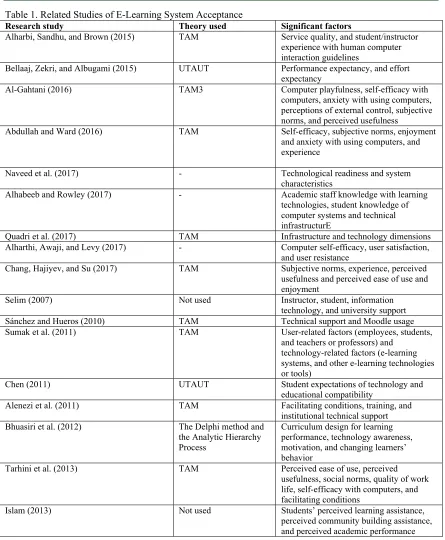
2.1 Related Studies of E-Learning Acceptance
Several studies have addressed the use and acceptance of e-learning in Saudi Arabian universities. For instance, Al-Gahtani (2016) investigated the factors influencing student acceptance of e-learning at Saudi Arabian universities based on the third version of the Technology Acceptance Model (TAM3). He found that the most significant determinants of e-learning acceptance are the human emotions of playfulness, self-efficacy, and anxiety while using computers, perceptions of external control, subjective norms, and perceived usefulness. However, in the Saudi context, social influence, demonstrability, and perceived enjoyment are not related to acceptance of e-learning systems. Naveed et al. (2017) revealed that technological readiness with system characteristics are the most significant factors that affect the acceptance of e-learning as perceived by respondents in Saudi Arabia. Alharbi, Sandhu, and Brown (2015) found that service quality and student/instructor interactions with their computers were sufficient to extend use of e-learning systems in Saudi Arabia. Similarly, Alhabeeb and Rowley (2017) found that
academic staff knowledge of learning technologies, student knowledge of computer systems, and technical infrastructure are the most significant factors that facilitate the successful acceptance of e-learning in Saudi Arabian universities.
A survey study, conducted on a sample of 257 respondents at Saudi Arabian universities, investigated the acceptance and usage of e-learning (Quadri et al., 2017). The results indicated that infrastructure and technology decisions made during the implementation process were important in motivating students to use and accept e-learning systems. Abdullah and Ward (2016) also investigated the factors influencing e-learning acceptance using TAM. Their findings revealed that self-efficacy, subjective norms, enjoyment, and anxiety and experience with using computers have a significant effect on student acceptance of e-learning.
Alharthi, Awaji, and Levy (2017) investigated the factors that influence faculty member’s acceptance and use of e-learning systems at Saudi universities. They found that self-efficacy with computer usage, user satisfaction, and user resistance are strong factors related to e-learning acceptance. Bellaaj, Zekri, and Albugami (2015) used the Unified Theory of Acceptance and Use of Technology (UTAUT) model to explore the factors affecting student use of e-learning systems at the University of Tabuk in Saudi Arabia. They found that expectations around performance and effort have a strong influence on e-learning acceptance. In another study in Azerbaijan, Chang, Hajiyev, and Su (2017) revealed that acceptance of e-learning was influenced by subjective norms, experience, and enjoyment.
Sumak et al. (2011) conducted a meta-analysis of the causal effect sizes between common TAM-related relationships. Their study found that TAM is the most commonly used acceptance theory in e-learning acceptance research. They also found that the size of the causal effects between individual TAM-related factors depends on the type of user and the type of e-learning technology: user-related factors (employees, students, and teachers or professors) and technology-related factors (e-learning systems, and other e-learning technologies or tools) had moderate effects on several of the evaluated causal paths.
5964 critical success factors—namely, instructor, student, information technology, and university support. The survey revealed eight categories that were critically successful, and each of these included several critical e-learning acceptance and success measures. The criticality of the measures included in each critical success factor were tested using a confirmatory factor modeling approach. Bhuasiri et al. (2012) highlighted the success factors for e-learning in developing countries by using the Delphi method and the Analytic Hierarchy Process. Six dimensions and 20 critical success factors were found. The most important factors were curriculum design for learning performance, technology awareness, motivation, and changing learners’ behavior. Meanwhile, Chen (2011) investigated the influence of student expectations of technology and their educational compatibility on their acceptance of e-learning using UTAUT. He collected data from 626 students and found that both factors affect e-learning acceptance. However, he concluded that educational compatibility had more influence than technology expectations.
Alenezi et al. (2011) explored institutional support and student e-learning acceptance in five Saudi universities using TAM. They found that three variables significantly contributed to student acceptance of e-learning—namely, facilitating conditions, training, and institutional technical support. Sánchez and Hueros (2010) found similar results that technical support has a
direct influence on perceived ease of use and perceived usefulness. They tested Moodle usage and found that it was positively influenced by perceived ease of use and attitude.
Tarhini et al. (2013) believe that decision-makers should consider critical success factors related to individual, social, and institutional factors when implementing e-learning systems. The authors administered a cross-sectional survey to 604 students using e-learning systems at Brunel University in England. The study results illustrated that perceived ease of use, perceived usefulness, social norms, quality of work life, self-efficacy with computers and facilitating conditions play a significant role in the adoption and usage of the Blackboard system.
5965 Table 1. Related Studies of E-Learning System Acceptance
Research study Theory used Significant factors
Alharbi, Sandhu, and Brown (2015) TAM Service quality, and student/instructor experience with human computer interaction guidelines
Bellaaj, Zekri, and Albugami (2015) UTAUT Performance expectancy, and effort expectancy
Al-Gahtani (2016) TAM3 Computer playfulness, self-efficacy with computers, anxiety with using computers, perceptions of external control, subjective norms, and perceived usefulness
Abdullah and Ward (2016) TAM Self-efficacy, subjective norms, enjoyment and anxiety with using computers, and experience
Naveed et al. (2017) - Technological readiness and system characteristics
Alhabeeb and Rowley (2017) - Academic staff knowledge with learning technologies, student knowledge of computer systems and technical infrastructurE
Quadri et al. (2017) TAM Infrastructure and technology dimensions Alharthi, Awaji, and Levy (2017) - Computer self-efficacy, user satisfaction,
and user resistance
Chang, Hajiyev, and Su (2017) TAM Subjective norms, experience, perceived usefulness and perceived ease of use and enjoyment
Selim (2007) Not used Instructor, student, information
technology, and university support Sánchez and Hueros (2010) TAM Technical support and Moodle usage Sumak et al. (2011) TAM User-related factors (employees, students,
and teachers or professors) and technology-related factors (e-learning systems, and other e-learning technologies or tools)
Chen (2011) UTAUT Student expectations of technology and
educational compatibility
Alenezi et al. (2011) TAM Facilitating conditions, training, and institutional technical support Bhuasiri et al. (2012) The Delphi method and
the Analytic Hierarchy Process
Curriculum design for learning performance, technology awareness, motivation, and changing learners’ behavior
Tarhini et al. (2013) TAM Perceived ease of use, perceived usefulness, social norms, quality of work life, self-efficacy with computers, and facilitating conditions
5966
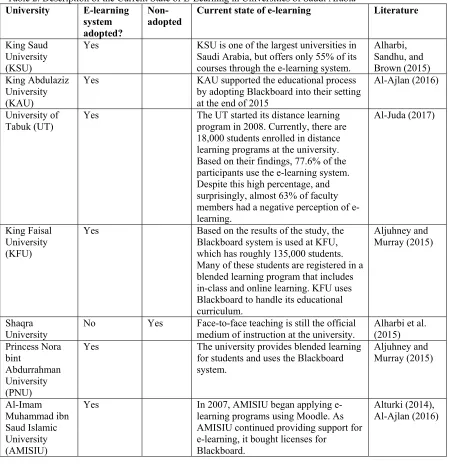
[image:5.612.83.533.113.581.2]2.2 E-Learning in Saudi Arabian Universities
Table 2. Description of the Current State of E-Learning in Universities of Saudi Arabia
University E-learning system adopted?
Non-
adopted Current state of e-learning Literature
King Saud University (KSU)
Yes KSU is one of the largest universities in
Saudi Arabia, but offers only 55% of its courses through the e-learning system.
Alharbi, Sandhu, and Brown (2015) King Abdulaziz
University (KAU)
Yes KAU supported the educational process
by adopting Blackboard into their setting at the end of 2015
Al-Ajlan (2016)
University of Tabuk (UT)
Yes The UT started its distance learning
program in 2008. Currently, there are 18,000 students enrolled in distance learning programs at the university. Based on their findings, 77.6% of the participants use the e-learning system. Despite this high percentage, and surprisingly, almost 63% of faculty members had a negative perception of e-learning.
Al-Juda (2017)
King Faisal University (KFU)
Yes Based on the results of the study, the
Blackboard system is used at KFU, which has roughly 135,000 students. Many of these students are registered in a blended learning program that includes in-class and online learning. KFU uses Blackboard to handle its educational curriculum.
Aljuhney and Murray (2015)
Shaqra University
No Yes Face-to-face teaching is still the official medium of instruction at the university.
Alharbi et al. (2015) Princess Nora
bint
Abdurrahman University (PNU)
Yes The university provides blended learning
for students and uses the Blackboard system.
Aljuhney and Murray (2015)
Al-Imam Muhammad ibn Saud Islamic University (AMISIU)
Yes In 2007, AMISIU began applying
e-learning programs using Moodle. As AMISIU continued providing support for e-learning, it bought licenses for
Blackboard.
Alturki (2014), Al-Ajlan (2016)
3. Research Methodology
We applied four main steps to achieve the
objective of this research. Each step has its own method and objective. Figure 1 presents these four steps.
Step 1: A review of the literature
Content analysis method
Propose the preliminary list of e‐
learning system acceptance factors
Step 2: Preparation of a
questionnaire for experts in e‐
5967
Figure 1. Steps of Our Research Methodology
4. CONDUCT THE RESEARCH WORK 4.1 Phase One: The Preliminary List
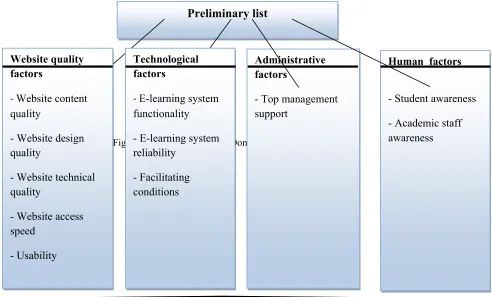
To propose the preliminary list of e-learning system acceptance factors, a systematic review of the literature was carried out, and several articles, reports and dissertations, presented in Section 2.1, were analyzed with the purpose of drawing up an academic basis of concepts and
[image:6.612.83.575.440.737.2]dimensions for the assessment of e-learning system acceptance. Based on analyzed data from the literature review, a preliminary list was completed. This list comprised 11 dimensions divided into four domains (Figure 2). This list served as basis to the first round of the Delphi process.
Figure 2. Preliminary List of Domains and Dimensions .
Step 3: Conduct a Delphi study
Delphi technique
Determine the final success
factors of e‐learning acceptance
Step 4: Develop the conceptual
framework for e‐learning system
implementation
Analysis
Preliminary list
Website quality factors
‐ Website content
quality
- Website design quality
- Website technical quality
- Website access speed
- Usability
Technological factors
‐ E-learning system
functionality
- E-learning system reliability
- Facilitating conditions
Administrative factors
- Top management support
Human factors
- Student awareness
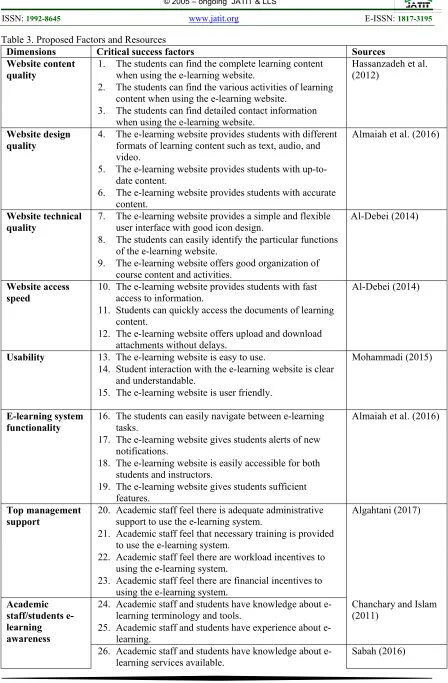
5968 Table 3.Proposed Factors and Resources
Dimensions Critical success factors Sources
Website content
quality 1. The students can find the complete learning content when using the e-learning website. Hassanzadeh et al. (2012) 2. The students can find the various activities of learning
content when using the e-learning website. 3. The students can find detailed contact information
when using the e-learning website.
Website design
quality 4. The e-learning website provides students with different formats of learning content such as text, audio, and video.
Almaiah et al. (2016)
5. The e-learning website provides students with up-to-date content.
6. The e-learning website provides students with accurate content.
Website technical quality
7. The e-learning website provides a simple and flexible user interface with good icon design.
Al-Debei (2014)
8. The students can easily identify the particular functions of the e-learning website.
9. The e-learning website offers good organization of course content and activities.
Website access speed
10. The e-learning website provides students with fast
access to information. Al-Debei (2014)
11. Students can quickly access the documents of learning content.
12. The e-learning website offers upload and download attachments without delays.
Usability 13. The e-learning website is easy to use. Mohammadi (2015) 14. Student interaction with the e-learning website is clear
and understandable.
15. The e-learning website is user friendly.
E-learning system functionality
16. The students can easily navigate between e-learning tasks.
Almaiah et al. (2016)
17. The e-learning website gives students alerts of new notifications.
18. The e-learning website is easily accessible for both students and instructors.
19. The e-learning website gives students sufficient features.
Top management support
20. Academic staff feel there is adequate administrative support to use the e-learning system.
Algahtani (2017)
21. Academic staff feel that necessary training is provided to use the e-learning system.
22. Academic staff feel there are workload incentives to using the e-learning system.
23. Academic staff feel there are financial incentives to using the e-learning system.
Academic staff/students e-learning awareness
24. Academic staff and students have knowledge about e-learning terminology and tools.
Chanchary and Islam (2011)
25. Academic staff and students have experience about e-learning.
26. Academic staff and students have knowledge about
5969
Dimensions Critical success factors Sources
27. Academic staff and students have knowledge about e-learning limitations.
4.2 Phase Two: The Delphi Study
We used the Delphi technique to obtain a consensus about the critical factors for e-learning system acceptance. A Delphi technique comprises the following five steps as mentioned by Hsu and Sandford (2007):
1. consult a mature field of experts 2. in an anonymous manner 3. in different rounds
4. with feedback on the results, and
5. the opportunity for participants to reconsider their position.
We selected the Delphi technique because it is specifically directed toward generating consensus in a group of respondents (Hsu and Sandford, 2007; Shaikh and Khoja, 2014). Developing a framework can be another outcome of a Delphi study (Okoli and Pawlowski, 2004).
In our research, we strove for a consistent framework of the critical factors necessary for the acceptance of e-learning system in Saudi universities to induce consensus.
4.2.1 Selection of Experts
[image:8.612.86.539.60.131.2]In the Delphi method, proven expertise is considered to be the most important criterion for selecting a Delphi participant (Shaikh and Khoja, 2014). We selected our respondents to include a group of experts with responsibilities and technical profiles in Information Systems and e-learning fields at universities across the world. Six participants distributed across two groups participated in this research. These groups included three experts in the field of Information Systems and three experts in e-learning, as shown in Table 4. Each group participated in three rounds of the Delphi study.
Table 4. Participants of the Delphi study
Group Field Number in the 1st
round Number in the 2nd round Number in the 3rd round
1 Information Systems 3 3 3
2 E-Learning 3 3 3
Total of participants 6 6 6
4.2.2 Data Analysis and Results
We conducted a quantitative survey to reach consensus on the most important factors leading to increased use and acceptance of e-learning systems among users. The experts scored each factor on a three-point Likert scale from high to
low. They also added in new factors and new dimensions and requirements via an open-ended question, “Which factors are important for the acceptance of e-learning systems?” Table 5 presents the results from the Delphi Analysis.
Table 5.Results from the Delphi Analysis
Dimensions Critical success factors IQR
score
Degree of Consensus* Website
content quality 1. The students can find the complete learning content when using the e-learning website. 0.6 Moderate 2. The students can find the various activities of
learning content when using the e-learning website. 0.3 High 3. The students can find detailed contact information
when using the e-learning website. 0.8 Moderate
Website design quality
4. The e-learning website provides students with different formats of learning content such as text, audio, and video.
0.2 High
5. The e-learning website provides students with
up-to-date content. 0.3 High
6. The e-learning website provides students with
accurate content. 0.1 High
Website technical
7. The e-learning website provides a simple and
[image:8.612.90.538.522.728.2]5970
Dimensions Critical success factors IQR
score Consensus* Degree of quality 8. The students can easily identify the particular
functions of the e-learning website. 1.3 Low
9. The e-learning website offers good organization of
course content and activities. 0.3 High
Website access speed
10. The e-learning website provides students fast access
to information. 0.3 High
11. Students can quickly access the documents of
learning content. 0.5 High
12. The e-learning website offers upload and download
attachments without delays. 0.4 High
Usability 13. The e-learning website is easy to use. 0.7 Moderate 14. Students interaction with the e-learning website is
clear and understandable. 0.3 High
15. The e-learning website is user friendly. 0.9 Moderate
E-learning system functionality
16. The students can easily navigate between e-learning
tasks. 0.3 High
17. The e-learning website gives students alerts of new
notifications. 0.3 High
18. The e-learning website is easily accessible for both
students and instructors. 1.2 Low
19. The e-learning website gives students sufficient
features. 0.6 Moderate
Top
management support
20. Academic staff feel there is adequate administrative
support to use the e-learning system. 0.2 High
21. Academic staff feel that necessary training is
provided to use the e-learning system. 0.4 High
22. Academic staff feel there are workload incentives to
using the e-learning system. 1.2 Low
23. Academic staff feel there are financial incentives to
using the e-learning system. 0.6 Moderate
Academic staff/students e-learning awareness
24. Academic staff and students have knowledge about
e-learning terminology and tools. 0.3 High
25. Academic staff and students have experience about
e-learning. 0.3 High
26. Academic staff and students have knowledge about
e-learning services available. 0.5 High
27. Academic staff and students have knowledge about
e-learning limitations. 0.4 High
Note. IQR = interquartile range.
*placeholder text
4.3 Discussion
5971
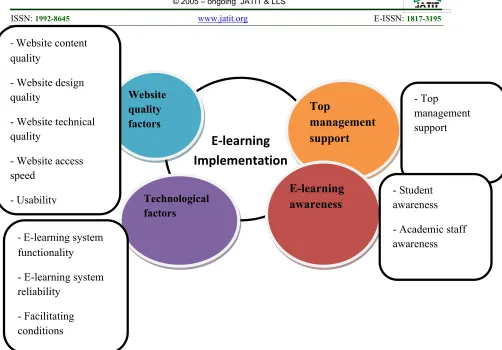
Figure 3. A Conceptual Framework Of The Success Factors For E-Learning System Implementation
(1) Website Quality Factors
Website quality is defined as the necessary website features that meet the user’s needs and reflect the overall excellence of the website (Aladwani and Palvia, 2002). Zhong and Ying (2008) state that website quality is the quality of services provided by the website or the quality of website itself. They indicate that the quality of a website is measured by several dimensions including website design, website content, ease of use, security, and website functionality. Other studies have reported that the quality of websites that provide e-learning systems is a critical factor in promoting learner satisfaction, lead to an enhanced intention to use the site, and thus, facilitate acceptance. Furthermore, several studies have indicated that website quality has a significant effect on user acceptance (Almaiah, Jalil & Man, 2016; Almaiah, 2018; Al-Qeisi et al., 2014; Collier and Bienstock, 2009; Lee, Younghwa, and Kozar, 2006; Tan, 2013).
• Website Content Quality
The content of e-learning materials must be precise, accurate, updated, timely, and suitable. The website must offer exact and effective
learning content that allows learners to find and carry out their learning activities without problems. The website must also support several types of learning content that meet learner requirements. The availability of high-quality learning content in the website is closely linked to the level of satisfaction that users experience, and subsequently, their acceptance of the system (Almaiah, Jalil, & Man, 2016).
• Website Design Quality
The design of learning content is a crucial factor in the success of e-learning system acceptance. Content design refers to aesthetics such as the use of color and appealing multimedia features. These features encourage easy use of the system (Almaiah, Jalil, & Man, 2016).
• Website Technical Quality
This element focuses on the infrastructure requirements that support the website and indicates whether the current infrastructure can accommodate such initiatives (Smith, 2005). It also considers observable and measurable technical competencies (Chapnick, 2000). Technology experts, educators, and students at various stages of university education have
E‐learning
Implementation
Websitequality factors
Top
management
support
Technological factors
E-learning
awareness
- Top management support
‐ Website content
quality
- Website design quality
- Website technical quality
- Website access speed
- Usability - Student awareness
- Academic staff awareness ‐ E-learning system
functionality
- E-learning system reliability
5972 overcome the distance problem and the lack of communication with each other and have raised the desire and enthusiasm to effectively change the qualitative and quantitative assessment of the education process. Fawcett (2003) refers to infrastructure maintenance as a reliable and robust technical factor to use e-learning effectively and successfully.
• Website Access Speed
Website access speed refers to the satisfaction level that users experience toward fast response times of their e-learning portal. This includes both the execution time and the delivery time of a service. Fast system responses reduce the time that users spend waiting for information.
• Usability
Usability is defined as the collection of qualitative characteristics that make e-learning systems easy to use, easy to learn and easy to understand. It refers to the extent to which an e-learning system can be used by specified users to achieve specified goals with effectiveness, efficiency, and satisfaction, in a specified context of use (Abdalha, 2013). Learning systems that are delivered via websites should be simple and easy to use and update, even by different groups of users in terms of their age or educational background.
(2) Technological Factors
Nowadays, information technology is considered an important factor when using technology in any project, because the system can save data and information for a long time and enhance the education process. According to Molla (2006) and Almusaswi and Abdelraheem (2004), the following technological factors play a significant role in the successful implementation of e-learning.
According to Mobaideen (2006), technology industries depend on science and technology innovation to create new or improved products and services. Technology is an important factor in e-learning implementation, because the learning process can be effectively shaped through technology innovation in an educational establishment (Rogers, 2003). Rogers views technology components in two parts: first is the hardware that includes the physical components; and second is the software that consists of the information aspects that help users perform tasks. These parts refer to the information technology base of an organization. They determine the extent of computerization within
educational departments, the flexibility of existing systems, and the ease of use of network-based applications. It is also helpful to know how to use these tools (Molla, 2006).
(3) Top Management Support
Top management support refers to the degree to which senior management believe in and understand the importance of e-learning. It is also defined as “the involvement and participation of top-level leaders” (Liu, Huang, & Lin, 2012, p 134). This factor is believed to play a crucial role in the success of e-learning systems (Alhmod & Shafi, 2013; Al Mulhem, 2013; Al-Enazi, 2016; Alharbi & Lally, 2017; Algahtani, 2017). According to Alhmod & Shafi (2013), 79% of the respondents in their study indicated that management support is the topmost, or at least a very important factor, in the success of e-learning programs at King Saud University. Management support ensures that academic staff are sufficiently trained to use e-learning systems (Al Mulhem, 2013; Alhmod & Shafi, 2013; Alharbi & Lally, 2017), which, in turn, reduces academic load and allows faculty to learn and adapt (Al Mulhem, 2013; Alharbi & Lally, 2017). Management support also determines the level of adequate technical and financial support (Al-Jarf, 2007; Al Mulhem, 2013).
(4) E-Learning Awareness of Academic Staff and Students
E-learning awareness is a significant factor that can either encourage or hinder academic staff and student usage of e-learning (Chanchary & Islam, 2011; Al-Hujran, Al-Lozi & Al-Debei, 2014). In this paper, e-learning awareness includes academic staff and/or student knowledge about e-learning tools and systems in general, e-learning tools and systems available to them through their institutions, and their usage and implementation in education. The literature shows that students with more e-learning awareness are better at using e-learning tools (Sabah, 2016; Almaiah & Jalil, 2014). According to Alshammari (2015), academic staff in Saudi universities do not fully benefit from e-learning management systems and limit their use to only one or two functions. Therefore, e-learning awareness must be closely investigated to achieve higher acceptance of e-learning system.
5. Conclusions and Future Work
5973 research. We believe that the framework developed in this research can be used to close this gap by those responsible for the development of e-learning systems in Saudi universities. In our research approach, we reviewed and assessed a broad set of 11 specific dimensions for e-learning systems. These dimensions were grouped, according to relevance, into four domains. We started with a literature review to identify the dimensions for the assessment of e-learning acceptance. In this analysis, we covered 20 previous studies and reviewed the current state of e-learning in Saudi universities to determine the first list of dimensions, based on our perceptions of the local context. We then conducted an empirical study based on a set of questionnaires sent to six experts. Based on our collected and analyzed
data, we created a preliminary list composed of 11 dimensions divided into four domains and this became our input into the Delphi method process.
This research does not end with the present paper, as there are lines of development that can be followed in future investigations: As the framework was developed in an academic context and under time restrictions, we intend to continue the study and carry out an in-depth validation of the framework. We also want to use the proposed framework in an extended case study to empirically investigate its components using one of the Technology Acceptance Models (TAM or UTAUT). It will be important to test and validate its applicability within a learning context.
ACKNOWLEDGMENTS
[image:12.612.90.530.378.723.2]The authors acknowledges the Deanship of Scientific Research at King Faisal University for the financial support.
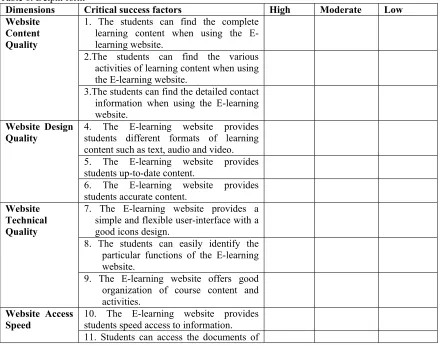
Table 6: Delphi form
Dimensions Critical success factors High Moderate Low Website
Content Quality
1. The students can find the complete learning content when using the E-learning website.
2.The students can find the various activities of learning content when using the E-learning website.
3.The students can find the detailed contact information when using the E-learning website.
Website Design Quality
4. The E-learning website provides students different formats of learning content such as text, audio and video. 5. The E-learning website provides students up-to-date content.
6. The E-learning website provides students accurate content.
Website Technical Quality
7. The E-learning website provides a simple and flexible user-interface with a good icons design.
8. The students can easily identify the particular functions of the E-learning website.
9. The E-learning website offers good organization of course content and activities.
Website Access
5974 learning content in fast time.
12. The E-learning website offers upload and download attachments without any delay.
Usability 13. The E-learning website is easy to use. 14. Students interaction with the E-learning
website is clear and understandable. 15. The E-learning website is
user-friendly.
E-learning System Functionality
16. The students can easily navigate between E-learning tasks.
17. The E-learning website gives students alerts for new notifications.
18. Access to the E-learning website for both students and instructors.
19. The E-learning website gives students sufficient features.
Top
management support
20. Academic staff feel there is adequate administrative support to use e-learning. 21. Academic staff feel there is necessary training to e-learning.
22. Academic staff feel there are workload incentives if they use e-learning.
23. Academic staff feel there are financial incentives if they use e-learning.
Academic staff/students e-learning awareness
24. Academic staff and students have knowledge about e-learning terminologies and tools.
25. Academic staff and students have experience about e-learning.
26. Academic staff and students have knowledge about e-learning services available.
27. Academic staff and students have knowledge about e-learning limitation.
REFERENCES
[1] Abdullah, F., & Ward, R. (2016). Developing a General Extended Technology Acceptance Model for E-Learning (GETAMEL) by analysing commonly used external factors. Computers in Human Behavior, 56, 238-256.
[2] AL-Enazi, G. (2016). Institutional support for academic staff to adopt Virtual Learning Environments (VLEs) in Saudi Arabian universities.Doctoral dissertation, Durham
University,UK.
[3] Al-Ajlan, A. (2016). A Comparative Study of E-Learning Systems in Saudi Arabia
Universities. International Journal of Computer Science and Information Security, 14(12), 150.
[4] Al-Gahtani, S. S. (2016). Empirical investigation of e-learning acceptance and assimilation: A structural equation
model. Applied Computing and
Informatics, 12(1), 27-50.
[5] Algahtani, M. (2017). Factors influencing the adoption of learning management systems in the Kingdom of Saudi Arabian universities by female academic staff.
5975 [6] Al Gamdi, M. A., & Samarji, A. (2016).
Perceived barriers towards e-Learning by faculty members at a recently established university in Saudi Arabia. International Journal of Information and Education Technology, 6(1), 23.
[7] Alhabeeb, A., Alhabeeb, A., Rowley, J., & Rowley, J. (2017). Critical success factors for eLearning in Saudi Arabian universities. International Journal of Educational Management, 31(2), 131-147.
[8] Alharbi, H., Sandhu, K., & Brown, T. (2015). Factors for the Acceptance of Recommender Systems in E-Learning for Saudi Universities: A Proposed Framework. Recent Patents on Computer Science, 8(2), 90-99.
[9] Alharbi, S., & Drew, S. (2014). Using the technology acceptance model in understanding academics’ behavioural intention to use learning management systems. International Journal of Advanced Computer Science and Applications, 5(1),
143-155.
[10] Alharbi, O., & Lally, V. (2017). Adoption of e-learning in Saudi Arabia university education: Three factors affecting educators.
European Journal of Open Education and E-learning Studies, 2(2), 63-85.
[11] Alharthi, S. H., Awaji, M. H., & Levy, Y. (2017). Empirical Assessment of the Factors that Influence Instructors’ Usage of E-Learning Systems in Saudi Arabia.
[12] Alhomod, S., & Shafi, M. M. (2013). Success factors of e-learning projects: A technical perspective. TOJET: The Turkish Online Journal of Educational Technology, 12(2), 247-253.
[13] Al-Hujran, O., Al-Lozi, E., & Al-Debei, M. M. (2014). Get Ready to Mobile Learning”: Examining Factors Affecting College Students' Behavioral Intentions to Use M-Learning in Saudi Arabia. Jordan Journal of Business Administration, 10(1), 111-128.
[14] Al-Juda, M. Q. B. (2017). Distance Learning Students’ Evaluation of E-Learning System in University of Tabuk, Saudi
Arabia. Journal of Education and
Learning, 6(4), 324.
[15] Aljuhney, Y., & Murray, L. (2015). A comparison of the utilization of E-learning management systems in the Republic of Ireland and Kingdom of Saudi Arabia: A case study (2016). International Journal on
Recent and Innovation Trends in Computing and Communication, 4(2), 1-12.
[16] Al-Jarf, R. (2007). E-integration challenges for rectors and deans in higher education. In
Computer and Advanced Technology in Education Conference Proceedings. ACTA.
[17] Almaiah, M. A., & Jalil, M. A. (2014). Investigating students' perceptions on mobile learning services. International Journal of Interactive Mobile Technologies (iJIM), 8(4), 31-36.
[18] Almaiah, M. A., & Man, M. (2016). Empirical investigation to explore factors that achieve high quality of mobile learning
system based on students’
perspectives. Engineering science and technology, an international journal, 19(3),
1314-1320.
[19] Almaiah, M. A., Jalil, M. A., & Man, M. (2016). Extending the TAM to examine the effects of quality features on mobile learning acceptance. Journal of Computers in Education, 3(4), 453-485.
[20] Almaiah, M. A., Jalil, M. A., & Man, M. (2016). PRELIMINARY STUDY FOR EXPLORING THE MAJOR PROBLEMS
AND ACTIVITIES OF MOBILE
LEARNING SYSTEM: A CASE STUDY OF JORDAN. Journal of Theoretical and Applied Information Technology, 93(2), 580.
[21] Almaiah, M. A. (2018). Acceptance and usage of a mobile information system services in University of Jordan. Education and Information Technologies, 1-23.
[22] Al Mulhem, A. (2013). Developing an e-learning training package for academic staff in one university in Saudi Arabia.
[23] Alturki, U. T. (2014). The Development of Online Distance Education in Saudi Arabia. eLearn, 2014(11), 5.
[24] Alshammari, M. (2015). Academics’ adoption and usage of learning management systems in Saudi Arabia’s universities. PhD
thesis, De Montfort University, Leicester, UK.
[25] Arroway, P., Davenport, E., Xu, G., & Updegrove, D. (2010). EDUCAUSE core data service fiscal year 2009 summary report. EDUCAUSE White Paper.
[26] BELLAAJ, M., ZEKRI, I., & ALBUGAMI, M. (2015). THE CONTINUED USE OF E-LEARNING SYSTEM: AN EMPIRICAL
INVESTIGATION USING UTAUT
5976 TABUK. Journal of Theoretical & Applied Information Technology, 72(3).
[27] Chanchary, F. and Islam, S. (2011). Is Saudi Arabia ready for e-learning?- A case study.
The 12th International Arab Conference on
Information Technology, Naif Arab
University for Security Sciences, Saudi Arabia.
[28] Chang, C. T., Hajiyev, J., & Su, C. R. (2017). Examining the students’ behavioral intention to use e-learning in Azerbaijan? The General Extended Technology Acceptance Model for E-learning approach. Computers & Education, 111,
128-143.
[29] Gaebel, M., Kupriyanova, V., Morais, R., & Colucci, E. (2014). E-Learning in European Higher Education Institutions: Results of a Mapping Survey Conducted in October-December 2013. European University Association.
[30] Liebowitz, J., & Frank, M. (Eds.). (2016). Knowledge management and e-learning. CRC press.
[31] Mirza, A. A., & Al-Abdulkareem, M. (2011). Models of e-learning adopted in the Middle East. Applied computing and informatics, 9(2), 83-93.
[32] Naveed, Q. N., Muhammad, A., Sanober, S., Qureshi, M. R. N., & Shah, A. (2017). A Mixed Method Study for Investigating Critical Success Factors (CSFs) of
E-Learning in Saudi Arabian
Universities. methods, 8(5).
[33] Quadri, N. N., Muhammed, A., Sanober, S., Qureshi, M. R. N., & Shah, A. (2017). Barriers Effecting Successful Implementation of E-Learning in Saudi Arabian Universities. International Journal of Emerging Technologies in Learning (iJET), 12(06), 94-107.
[34] Liu, Y. C., Huang, Y. A., & Lin, C. (2012). Organizational factors’ effects on the success of e-learning systems and organizational benefits: An empirical study in Taiwan. The International Review of Research in Open and Distributed Learning, 13(4), 130-151.