Integrating Phrase-based Reordering Features into a Chart-based
Decoder for Machine Translation
ThuyLinh Nguyen Language Technologies Institute
Carnegie Mellon University Pittsburgh, PA 15213, USA
Stephan Vogel
Qatar Computing Research Institute Tornado Tower
Doha, Qatar
Abstract
Hiero translation models have two lim-itations compared to phrase-based mod-els: 1) Limited hypothesis space; 2) No lexicalized reordering model. We pro-pose an extension of Hiero called Phrasal-Hiero to address Phrasal-Hiero’s second problem. Phrasal-Hiero still has the same hypoth-esis space as the original Hiero but in-corporates a phrase-based distance cost feature and lexicalized reodering features into the chart decoder. The work consists of two parts: 1) for each Hiero transla-tion derivatransla-tion, find its corresponding dis-continuous phrase-based path. 2) Extend the chart decoder to incorporate features from the phrase-based path. We achieve significant improvement over both Hiero and phrase-based baselines for Arabic-English, Chinese-English and German-English translation.
1 Introduction
Phrase-based and tree-based translation model are the two main streams in state-of-the-art machine translation. The tree-based translation model, by using a synchronous context-free grammar for-malism, can capture longer reordering between source and target language. Yet, tree-based trans-lation often underperforms phrase-based transla-tion in language pairs with short range reordering such as Arabic-English translation (Zollmann et al., 2008; Birch et al., 2009).
We follow Koehn et al. (2003) for our phrase-based system and Chiang (2005) for our Hiero sys-tem. In both systems, the translation of a source sentencefis the target sentencee∗that maximizes a linear combination of features and weights:
he∗,a∗i= argmax
he,ai∈H(f) X
m∈M
λmhm(e,f,a). (1)
where
• a is a translation path of f. In the phrase-based system,aphrepresents a segmentation
ofeandf and a correspondance of phrases. In the Hiero system,atr is a derivation of a
parallel parse tree offande, each nontermi-nal representing a rule in the derivation.
• H(f)is the hypothesis space of the sentence f. We denote Hph(f) as the phrase-based
hypothesis space off andHtr(f)as its
tree-based hypothesis space. Galley and Manning (2010) point out that due to the hard con-straints of rule combination, the tree-based system does not have the same excessive hy-pothesis space as the phrase-based system.
• M is the set of feature indexes used in the decoder. Many features are shared between phrase-based and tree-based systems includ-ing language model, word count, and trans-lation model features. Phrase-based systems often use a lexical reordering model in addi-tion to the distance cost feature.
The biggest difference in a Hiero system and a phrase-based system is in how the reordering is modeled. In the Hiero system, the reordering cision is encoded in weighted translation rules, de-termined by nonterminal mappings. For example, the ruleX → ne X1 pas;not X1 :windicates
the translation of the phrase betweenneandpasto be after the English wordnotwith scorew. During decoding, the system parses the source sentence and synchronously generates the target output.
To achieve reordering, the phrase-based sys-tem translates source phrases out of order. A re-ordering distance limit is imposed to avoid search space explosion. Most phrase-based systems are equipped with a distance reordering cost feature to tune the system towards the right amount of reordering, but then also a lexicalized reordering
model to model the direction of adjacent source phrases reordering as either monotone, swap or
discontinuous.
There are two reasons to explain the shortcom-ings of the current Hiero system:
1. A limited hypothesis space because the syn-chronous context-free grammar is not appli-cable to non-projective dependencies.
2. It does not have the expressive lexicalized re-ordering model and distance cost features of the phrase-based system.
When comparing phrase-based and Hiero trans-lation models, most of previous work on tree-based translation addresses its limited hypothesis space problem. Huck et al. (2012) add new rules into the Hiero system, Carreras and Collins (2009) apply the tree adjoining grammar formalism to al-low highly flexible reordering. On the other hand, the Hiero model has the advantage of capturing long distance and structure reordering. Galley and Manning (2010) extend phrase-based trans-lation by allowing gaps within phrases such as hne . . . pas, noti, so the decoder still has the dis-criminative reordering features of phrase-based, but also uses on average longer phrases. How-ever, these phrase pairs with gaps do not capture structure reordering as do Hiero rules with non-terminal mappings. For example, the rule X →
ne X1 pas;not X1 explicitly places the
transla-tion of the phrase betweenneandpasbehind the English word notthrough nonterminalX1. This
is important for language pairs with strict reorder-ing. In our Chinese-English experiment, the Hiero system still outperforms the discontinuous phrase-based system.
We address the second problem of the origi-nal Hiero decoder by mapping Hiero translation derivations to corresponding phrase-based paths, which not only have the same output but also pre-serve structure distortion of the Hiero translation. We then include phrase-based features into the Hi-ero decoder.
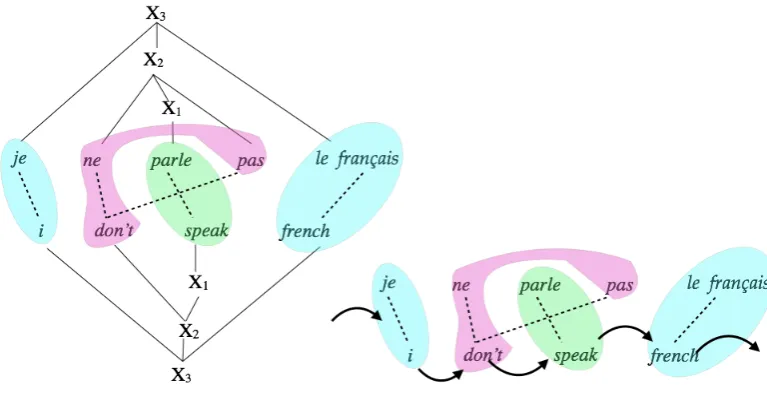
A phrase-based translation path is the sequence of phrase-pairs, whose source sides cover the source sentence and whose target sides generate the target sentence from left to right. If we look at the leaves of a Hiero derivation tree, the lexicals also form a segmentation of the source and target sentence, thus also form a discontinuous phrase-based translation path. As an example, let us look
at the translation of the French sentenceje ne parle pas le franc¸aiseinto English i don’t speak french
in Figure 1. The Hiero decoder translates the sen-tence using a derivation of three rules:
• r1 = X→parle; speak.
• r2 = X→neX1 pas; don0tX1.
• r3 = X→
JeX1le F ranc¸ais; I X1f rench.
From this Hiero derivation, we have a seg-mentation of the sentence pairs into phrase pairs according to the word alignments, as shown on the left side of Figure 1. Or-dering these phrase pairs according the word sequence on the target side, shown on the right side of Figure 1, we have a phrase-based translation path consisting of four phrase pairs: (je, i),(ne . . . pas, not),(parle, speak),
(lef rancaise, f rench) that has the same output
as the Hiero system. Note that even though the Hiero decoder uses a composition of three rules, the corresponding phrase-based path consists of four phrase pairs. We name this new variant of the Hiero decoder, which uses phrase-based features, Phrasal-Hiero.
Our Phrasal-Hiero addresses the shortcomming of the original Hiero system by incorporating phrase-based features. Let us revisit machine translation’s loglinear model combination of fea-tures in equation 1. We denoteph(a)as the
corre-sponding phrase-based path of a Hiero derivation a, andMP h\H as the indexes of phrase-based fea-tures currently not applicable to the Hiero decoder. Our Phrasal-Hiero decoder seeks to find the trans-lation, which optimizes:
he∗,a∗i= argmax
he,ai∈Htr(f)
X
m∈MH
λmhm(e,f,a) +
+ X
m0∈MP h\H
λm0hm0(e,f, ph(a))
.
Figure 1: Example of French-English Hiero Translation on the left and its corresponding discontinuous phrase-based translation on the right.
Rules Alignments Phrase pairs & nonterminals
r1= X→parle; speak. 0-0 (parle; speak)
r2= X→neX1pas; don0tX1. 0-0 1-1 2-0 (ne . . . pas; don0t);X1
[image:3.595.102.486.67.264.2]r3= X→JeX1le F rancais; IX1F rench 0-0 1-1 3-2 (Je;I);X1; (le F rancais; f rench) r4= X→jeX1leX2;iX1X2 0-0 1-1 3-2 Not Applicable
Table 1: Rules and their sequences of phrase pairs and nonterminals
Previous work has attempted to weaken the con-text free assumption of the synchronous concon-text free grammar formalism, for example using syn-tactic non-terminals (Zollmann and Venugopal, 2006). Our approach can be viewed as applying soft context constraint to make the probability of substituting a nonterminal by a subtree depending on the corresponding phrase-based reordering fea-tures.
In the next section, we explain the model in de-tail.
2 Phrasal-Hiero Model
Phrasal-Hiero maps a Hiero derivation into a dis-continuous phrase-based translation path by the following two steps:
1. Training: Represent each rule as a sequence of phrase pairs and nonterminals.
2. Decoding: Use the rules’ sequences of phrase pairs and nonterminals to find the corresponding phrase-based path of a Hiero derivation and calculate its feature scores.
2.1 Map Rule to A Sequence of Phrase Pairs and Nonterminals
We segment the rules’ lexical items into phrase pairs. These phrase pairs will be part of the phrase-based translation path in the decoding step. The rules’ nonterminals are also preserved in the se-quence, during the decoding they will be substi-tuted by other rules’ phrase pairs. We now explain how to map a rule to a sequence of phrase pairs and nonterminals.
Let r = X →
s0X1s1. . . Xksk;t0Xα(1)t1. . . Xα(k)tkbe a rule
of k nonterminals, α(.) defines the sequence of
nonterminals on the target. si orti , i = 0. . . k
are phrases between nonterminals, they can be empty because nonterminals can be at the border of the rule or two nonterminals are adjacent. For example the rule X → ne X1 pas ; not X1
hask = 1, s0 = ne, s1 = pas, t0 = not, t1 is
an empty phrase because the target X1 is at the
rightmost position.
rule’s lexical alignment is the most frequent one in the training data. We use the lexical alignments of a rule to decide how source phrases and tar-get phrases are connected. In the ruler, a source phrase si is connected to a target phrase ti0 if at least one word insialigns to a target word inti0. In the ruleX→JeX1 le F ranc¸ais; I X1 f rench
extract from sentence pair in Figure 1, the phrase
le Franc¸aisconnects to the phrasefrenchbecause the French wordFranc¸aisaligns with the English wordfrencheven thoughleis unaligned.
[image:4.595.318.511.61.105.2]We then group the source phrases and target phrases into phrase pairs such that only phrases that are connected to each other are in the same phrase pair. So phrase pairs still preserve the lexi-cal dependency of the rule. Phrase pairs and non-terminals are then ordered according to the target side of the rule. Table 1 shows an example of rules, alignments and their sequences of phrase pairs and nonterminals on the last column.
Figure 2: Alignment of a sentence pair.
There are Hiero rules in which one of its source phrases or target phrases is not aligned. For exam-ple in the ruler4 = X → je X1 le X2 ;iX1 X2
extracted from the sentence pair in Figure 2, the phrase le is not aligned. In our Arabic-English experiment, rules without nonaligned phrases ac-count for only48.54%of the total rules. We
com-pared the baseline Hiero translation from the full set of rules and the translation from only rules without nonaligned phrases. The later translation is faster and Table 2 1 shows that it outperforms
the translation with the whole set of rules. We therefore decided to not use rules with nonaligned phrases in Phrasal-Hiero.
It is important to note that there are different ways to use all the rules and map rules with un-aligned phrases into a sequence of phrase pairs.
1The dataset and experiment setting description are in
sec-tion 4.
[image:4.595.88.282.340.465.2]Test set MT04 MT05 MT09 All rules 48.17 47.85 42.37 Phrasal Hiero 48.52 47.78 42.8
Table 2: Arabic-English pilot experiment. Com-pare BLEU scores of translation using all ex-tracted rules (the first row) and translation using only rules without nonaligned subphrases (the sec-ond row).
For example, adding these unaligned phrases to the previous phrase pair i.e. the ruler4has one
dis-continuous phrase pair(je . . . le, i) or treat these unaligned phrases as deletion/insertion phrases. We started the work with Arabic-English transla-tion and decided not to use rules with nonaligned phrases in Phrasal-Hiero. In the experiment sec-tion, we will discuss the impact of removing rules with nonaligned sub-phrases in our German-English and Chinese-German-English experiments.
2.2 Training: Lexicalized Reordering Table
Phrasal-Hiero needs a phrase-based lexicalized re-ordering table to calculate the features. The lexi-calized reordering table could be from a discontin-uous phrase-based system. To guarantee the lexi-calized reordering table to cover all phrase pairs of the rule table, we extract phrase-pairs and their reordering directions during rule extraction.
Let(s,t)be a sentence pair in the training data
andr= X→s0X1s1. . . Xksk;t0X1t1. . . Xktk
be a rule extracted from the sentence. The lex-ical phrase pair corresponding to the rule r is ph = (s0. . . s1. . . sk, t0. . . t1. . . tk), with
non-terminals are replaced by the gaps. Because the nonterminal could be at the border of the rule, the lexical phrase pair might have smaller coverage than the rule. For example, the training sentence pair in Figure 2 generates the rule r2 = X →
ne X1 pas; don0t X1 spanning(1. . .3,1. . .2)
but its lexical phrase pair (ne . . . pas, not) only
spans(1. . .3,1. . .1).
Also, two different rules can have the same lexical phrase pairs. In Phrasal-Hiero, each lex-ical phrase pair is only generated once for a sentence. Look at the example of the train-ing sentence pair in Figure 2, the rule X → je;Ispanning(0. . .1,0. . .1)and the ruleX→
je X1 ; I X1 spanning(0. . .3,0. . .2)are both
sharing the same lexical phrase pair (je, i)
gen-erates (je, i) once for the sentence. Phrase pairs are generated together with phrase-based reorder-ing orientations to build lexicalized reorderreorder-ing ta-ble.
3 Decoding
Chiang (2007) applied bottom up chart parsing to parse the source sentence and project on the tar-get side for the best translation. Each chart cell
[X, i, j, r]indicates a subtree with rulerat the root covers the translation of thei-th word upto thej-th word of the source sentence. We extend the chart parsing, mapping the subtree to the equivalent dis-continuous based path and includes phrase-based features to the log-linear model.
In Phrasal-Hiero, each chart cell[X, i, j, r]also
stores the first phrase pair and the last phrase pair of the phrase-based translation path covered thei -th to -thej-th word of the source sentence. These two phrase pairs are the back pointers to calcu-late reordering features of calcu-later larger spans. Be-cause the distance cost feature and phrase-based discriminative reordering feature calculation are both only required the source coverage of two ad-jacent phrase pairs, we explain here the distance cost calculation.
We will again use three rules r1, r2, r3 in
Ta-ble 1 and the translationje ne parle pas le franc¸ais
intoI don’t speak Frenchto present the technique. Table 3 shows the distance cost calculation.
First, when the rule r has only terminals, the rule’s sequence of phrase pairs and nonterminals consists of only a phrase pair. No calculation is needed, the first phrase pair and the last phrase pair are the same. The chart cell X1 : 2. . .2 in
Table 3 shows the translation with the rule r1 = X→ parle;speak. The first phrase pair and the last phrase pair point to the phrase(parle, speak)
spanning2. . .2of the source sentence.
When the translation rule’s right hand side has nonterminals, the nonterminals in the sequence belong to smaller chart cells that we already found phrase-based paths and calculated their features before. The decoder then substitute these paths into the rule’s sequence of phrase pairs and non-terminals to form the complete path for the current span.
We now demonstrate finding the phrase based path and calculate distance cost of the chart cell X2 spanning 1. . .3. The next phrase pair
of (ne . . . pas, don0t) is the first phrase pair
of the chart cell X1 which is (parle, speak).
The distance cost of these two phrase pairs ac-cording to discontinuous phrase-based model is |2−3−1| = 2. The distance cost of the whole chart cellX2 also includes the cost of the
translation path covered by chart cell X1 which
is 0, therefore the distance cost for X2 is 2 + dist(X1) = 2. We then update the first phrase
pair and the last phrase pair of cellX2. The first
phrase pair of X2 is (ne . . . pas, don0t), the last
phrase pair is also the last phrase pair of cellX1
which is(parle, speak).
Similarly, finding the phrase-based path and calculate its distortion features in the chart cell
X3 include calculate the feature values for
mov-ing from the phrase pair (je, I) to the first
phrase pair of chart cell X2 and also from last
phrase pair of chart cell X2 to the phrase pair (le f ranc¸aise, f rench).
4 Experiment Results
In all experiments we use phrase-orientation lex-icalized reordering (Galley and Manning, 2008)2
which models monotone, swap, discontinuous orientations from both reordering with previous phrase pair and with the next phrase pair. There are total six features in lexicalized reordering model.
We will report the impact of integrating phrase-based features into Hiero systems for three lan-guage pairs: Arabic-English, Chinese-English and German-English.
4.1 System Setup
We are using the following three baselines:
• Phrase-based without lexicalized reodering features. (PB+nolex)
• Phrase-based with lexicalized reordering fea-tures.(PB+lex)
• Hiero system with all rules extracted from training data. (Hiero)
We use Moses phrase-based and chart decoder (Koehn et al., 2007) for the baselines. The score difference between PB+nolex and PB+lex results indicates the impact of lexicalized reordering fea-tures on phrase-based system. In Phrasal-Hiero we
2Galley and Manning (2008) introduce three orientation
Chart Cell Rule’s phrase pairs & NTs Distance First Phrase Pair Last Phrase Pair
X1: 2. . .2 (parle, speak) ∅ 2. . .2 (parle, speak)
X2: 1. . .3 (ne . . . pas, don0t);X1 2 + dist (X= 2 1) 1(ne . . . pas, don. . .3 0t) 2. . .2 (parle, speak)
X3: 0. . .5 (Je(le F ran;I);Xc¸2ais;; f rench) 0 + dist (X+1 = 32) 0. . .0 (je, I) 4(le F ran. . .5 c¸ais;f rench)
Table 3: Phrasal-Hiero Decoding Example: Calculate distance cost feature for the translation in Figure 1.
will compare if these improvements still carry on into Hiero systems.
The original Hiero system with all rules ex-tracted from training data (Hiero) is the most rele-vant baseline. We will evaluate the difference be-tween this Hiero baseline and our Phrasal-Hiero.
To implement Phrasal-Hiero, we extented Moses chart decoder (Koehn et al., 2007) to in-clude distance-based reordering as well as the lex-icalized phrase orientation reordering model. We will report the following results for Phrasal-Hiero:
• Hiero translation results on the subset of rules without unaligned phrases. (we denote this in the table scores as P.H.)
• Phrasal-Hiero with phrase-based distance cost feature (P.H.+dist).
• Phrasal-Hiero with phrase-based lexicalized reordering features(P.H.+lex).
• Phrasal-Hiero with distance cost and lexical-ized reordering features(P.H.+dist+lex).
4.2 Arabic-English Results
The Arabic-English system was trained from 264K sentence pairs with true case English. The Arabic is in ATB morphology format. The guage model is the interpolation of 5-gram lan-guage models built from news corpora of the NIST 2012 evaluation. We tuned the parameters on the MT06 NIST test set (1664 sentences) and re-port the BLEU scores on three unseen test sets: MT04 (1353 sentences), MT05 (1056 sentences) and MT09 (1313 sentences). All test sets have four references per each sentence.
The results are in Table 4. The three rows in the first block are the baseline scores. Phrase-based with lexicalized reordering fea-tures(PB+lex) shows significant improvement on all test sets over the simple phrase-based system without lexicalized reordering (PB+nolex). On av-erage the improvement is1.07BLEU score (45.66
MT04 MT05 MT09 Avg. PB+nolex 47.40 46.83 42.75 45.66 PB+lex 48.62 48.07 43.51 46.73
Hiero 48.17 47.85 42.37 46.13
P.H.
48.52 47.78 42.80 46.37 (48.54%rules)
P.H.+dist 48.46 47.92 42.62 46.33 P.H. +lex 48.70 48.59 43.84 47.04 P.H +lex+dist 49.35 49.07 43.40 47.27
Improv. over 0.73 1.00 0.34 0.54 PB+lex
Improv. over 0.83 1.29 1.04 0.90 P.H.
Improv. over 1.18 1.22 1.47 1.14 Hiero
Table 4: Arabic-English true case translation scores in BLEU metric. The three rows in the first block are the baseline scores. The next four rows in the second block are Phrasal-Hiero scores, the best scores are in boldface. The three rows in the last block are the Phrasal-Hiero improvements.
versus46.73). We make the same observation as
Zollmann et al. (2008), i.e, that the Hiero baseline system underperforms compared to the phrase-based system with lexicalized phrase-phrase-based re-ordering for Arabic-English in all test sets, on av-erage by about 0.60 BLEU points (46.13 versus
46.73). This is because Arabic language has
rel-ative free reordering, but mostly short distance, which is better captured by discriminative reorder-ing features.
The next four rows in the second block of Ta-ble 4 show Phrasal-Hiero results. The P.H. line is the result of Hiero experiment on only a subset of rules without nonaligned phrases. As mentioned in section 2.1, Phrasal-Hiero only uses48.54%of the rules but achieves as good or even better per-formance (on average 0.24 BLEU points better)
compared to the original Hiero system using the full set of rules.
[image:6.595.75.526.62.144.2]distance-based reordering feature (P.H+dist) to the Arabic-English experiment but get significant im-provements when adding the six features of the lexicalized reordering (P.H+lex). Table 4 shows that the P.H.+lex system gains on average 0.67
BLEU points (47.04versus46.37). Even though
the baseline Hiero underperforms phrase-based system with lexicalized reordering(P.B+lex), the P.H.+lex system already outperforms P.B+lex in all test sets (on average47.04versus46.73).
Adding both distance cost and lexicalized re-ordering features (P.H.+dist+lex) performs the best. On average P.H.+dist+lex improves 0.90
BLEU points over P.H. without new phrase-based features and 1.14 BLEU score over the
base-line Hiero system. Note that Hiero rules already have lexical context in the reordering, but adding phrase-based lexicalized reordering features to the system still gives us about as much improvement as the phrase-based system gets from lexicalized reordering features, here1.07 BLEU points. And
our best Phrasal-Hiero significantly improves over the best phrase-based baseline by 0.54 BLEU
points. This shows that the underperformance of the Hiero system is due to its lack of lexicalized reordering features rather than a limited hypothe-sis space.
4.3 Chinese-English Results
The Chinese-English system was trained on FBIS corpora of 384K sentence pairs, the English cor-pus is lower case. The language model is the tri-gram SRI language model built from Xinhua cor-pus of 180 millions words. We tuned the parame-ters on MT06 NIST test set of 1664 sentences and report the results of MT04, MT05 and MT08 un-seen test sets. The results are in Table 5.
We also make the same observation as Zoll-mann et al. (2008) on the baselines for Chinese-English translation. Even though the phrase-based system benefits from lexicalized reordering, PB+lex on average outperforms PB+nolex by1.16
BLEU points (25.87versus27.03), it is the Hiero system that has the best baseline scores across all test sets, with and average of27.70BLEU points.
Phrasal Hiero scores are given in the second block of Table 5. It uses84.19%of the total
train-ing rules, but unlike the Arabic-English system, using a subset of the rules costs Phrasal-Hiero on all test sets and on average it loses 0.49 BLEU
points (27.21 versus 27.70). Similar to Chiang
MT04 MT05 MT08 Avg. PB+nolex 29.99 26.4 21.23 25.87 PB+lex 31.03 27.57 22.41 27.03
Hiero 32.49 28.06 22.57 27.70
P.H. 31.83 27.66 22.16 27.21
(84.19%rules)
P.H.+dist 32.18 28.25 22.46 27.63 P.H.+lex 32.55 28.51 23.08 28.05 P.H+lex+dist 33.06 28.78 23.23 28.35
Improv. over 2.03 1.21 0.82 1.32 PB+lex
Improv. over 1.23 1.12 1.07 1.14 P.H.
[image:7.595.310.525.61.257.2]Improv. over 0.57 0.72 0.66 0.65 Hiero
Table 5: Chinese-English lower case translation scores in BLEU metric.
et al. (2008) in their Chinese-English experiment, we benefit by adding the distance cost feature. PH.+dist outperforms P.H. on all test sets. We have better improvements when adding the six fea-tures of the lexicalized reordering model: P.H.+lex on average has 28.05 BLEU points, i.e. gains 0.84over P.H.. The P.H.+lex system is even better than the best Hiero baseline using the whole set of rules.
We again get the best translation when adding both the distance cost feature and the lexicalized reordering features. The P.H+dist+lex has the best score across all the test sets and on average gains
1.14 BLEU points over P.H. So adding phrase-based features to the Hiero system yields nearly the same improvement as adding lexicalized re-ordering features to the phrase-based system. This shows that a strong Chinese-English Hiero system still benefits from phrase-based features. Further more, the P.H+dist+lex also outperforms the Hi-ero baseline using all rules from training data.
4.4 German-English Results
WMT test 08 09 11 Avg. PB+nolex 17.46 17.38 16.76 17.20 PB+lex 18.16 17.85 17.18 17.73
Hiero 18.20 18.23 17.46 17.96
P.H. 18.24 18.15 17.39 17.92
(80.54%rules)
P.H. +dist 18.19 17.97 17.41 17.85 P.H. +lex 18.59 18.46 17.69 18.24 P.H.+lex+dist 18.70 18.53 17.81 18.34
Improv. over 0.54 0.68 0.63 0.61 PB+lex
Improv. over 0.46 0.38 0.42 0.42 P.H.
[image:8.595.75.288.60.268.2]Improv. over 0.50 0.30 0.35 0.38 Hiero
Table 6: German-English lower case translation scores in BLEU metric.
The Hiero baseline performs on average 0.26
BLEU points better than the phrase-based sys-tem with lexicalized reordering features (PB+lex). The hrasal-Hiero system used80.54%of the total
training rules, but on average the P.H. system has the same performance as the Hiero system using all the rules extracted from training data. Similar to the Arabic-English experiment, Phrasal-Hiero does not benefit from adding the distance cost fea-ture. We do, however, see improvements on all test sets when adding lexicalized reordering fea-tures. On average the P.H.+lex results are 0.32
BLEU points higher than the P.H. results. The best scores are achieved with P.H+lex+dist. The German-English translations on average gain0.38
BLEU score by adding both distance cost and dis-criminative reordering features.
4.5 Impact of segment rules into phrase pairs
Phrasal Hiero is the first system using rules’ lexi-cal alignments. If lexilexi-cal alignments are not avail-able, we can not divide the rules’ lexicals into phrase pairs without losing their dependancies. An alternative approach would be combining all lex-icals of a rule into one phrase pair. We run an addition experiment for this approach on Arabic-English dataset. Table 7 shows the examples rules and its new sequence of nonterminals and phrase pairs. The rules r1 and r2 have the same
se-quences as in Table 1. Without segment rules into phrase pairs, the ruler3 has only one phrase pair:
ph = (Je . . . le F rancaise; I . . . f rench) and
ph is repeated twice in r3’s sequence of phrase
pairs and nonterminals. The new experiment uses the complete set of rules so the ruler4is included.
According to the new sequence of phrase pairs and nonterminals, during decoding the ruler3 has discontinous translation directions on both from phrase pair ph to the nonterminal X1 and from X1 toph. But using lexical alignment and divide
the rule into phrase pairs as in section 2.1 , the sequence preserves the translation order ofr3 as
twomonotonetranslations from(je; I)toX1and
fromX1to(le F rancaise; f rench).
Avg
Hiero 46.13
Hiero+lex 46.45 ( +0.32) (no lex. alignments)
P.H 46.37
P.H.+lex
47.04 (+0.67) (with lex. alignments)
Table 8: Average of Arabic-English translation scores in BLEU metric. Compare the improve-ment of using rules’ lexical alignimprove-ments (2nd block) and not using rules’ lexical alignments (1st block).
Table 8 compares the two experiments results. The additional experiment is denoted as Hiero+lex in the table. The first block shows an improvement of 0.32 BLEU score when adding discriminated
reordering features on Hiero (using the whole set of rules and no rule segmentation). The second block is the impact of adding discriminated re-ordering features on Phrasal Hiero (using a sub-set of rules and segment rules into phrase pairs). Here the improvement of P.H+lex over P.H is 0.67 BLEU score. It shows the benefit of segment rules into phrase pairs.
4.6 Rules without unaligned phrases
A-E C-E G-E
Hiero 46.13 27.70 17.96
P.H. 46.36 27.21 17.92
%Rules used 48.54% 84.19% 80.54%
[image:8.595.318.515.236.336.2]P.H.+lex+dist 47.27 28.35 18.34
Table 9: The impact of using only rules without nonaligned phrases on Phrasal-Hiero results.
[image:8.595.309.523.619.691.2]Phrasal-Rules Phrase pairs & nonterminals
r1= X→parle; speak. (parle; speak)
r2 = X→neX1 pas; don0tX1. (ne . . . pas; don0t);X1
[image:9.595.94.503.62.147.2]r3= X→JeX1le F rancais; IX1F rench (Je . . . le F rancais;I . . . f rench);X1; (Je . . . le F rancais;I . . . f rench) r4= X→jeX1leX2 ;iX1X2 (je . . . le; i) ; X1 ; X2
Table 7: Example of translation rules and their sequences of phrase pairs and nonterminals when lexical alignments are not available.
Hiero. Using only rules without nonaligned phrases can get the same performance with trans-lation with full set of rules for Arabic-English and German-English experiments but underperforms for the Chinese-English system. We suggest the difference might come from the linguistic diver-gences of source and target languages.
Phrasal Hiero includes all lexical rules (rules without nonterminal) therefore it still has the same lexical coverage as the original Hiero system. In the Arabic-English system, the Arabic is in ATB format, therefore most English words should have alignments in the ATB source, rules with nonaligned phrases could be the results of bad alignments or non-informative rules, therefore we could have better performance by using a subset of rules in Phrasal-Hiero.
As Chinese and English are highly divergent, we expect many phrases in one language correctly unaligned in the other language. So leaving out the rules with nonaligned phrases could degrade the system. Even though the current Phrasal-Hiero with extra phrase-based features outperforms the Hiero baseline, future work for Phrasal-Hiero will focus on including all rules extracted from training corpora.
4.7 Discontinuous Phrase-Based
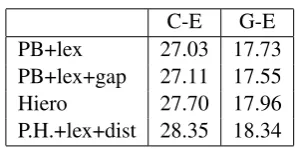
C-E G-E PB+lex 27.03 17.73 PB+lex+gap 27.11 17.55 Hiero 27.70 17.96 P.H.+lex+dist 28.35 18.34
Table 10: Comparing Phrasal-Hiero with transla-tion with gap for Chinese-English and German-English. The numbers are average BLEU scores of all test sets.
We compare Phrasal-Hiero with a discontinu-ous phrase-based system introduced by Galley and
Manning (2010) for Chinese-English and German-English system. Table 10 shows the average re-sults. We used Phrasal decoder (Cer et al., 2010) for phrase-based with gaps (PB+lex+gap) results. While we do not focus on the differences in the toolkits, our Phrasal-Hiero still outperforms the phrase-based with gaps experiments.
Conclusion
We have presented a technique to combine phrase-based features and tree-phrase-based features into one model. Adding a distance cost feature, we only get better translation for Chinese-English transla-tion. Phrasal-Hiero benefits from adding discrim-inative reodering features in all experiment. We achieved the best result when adding both distance cost and lexicalized reordering features. Phrasal-Hiero currently uses only a subset of rules from training data. A future work on the model can in-clude complete rule sets together with word inser-tion/deletion features for nonaligned phrases.
References
A. Birch, P. Blunsom, and M. Osborne. 2009. A Quantitative Analysis of Reordering Phenomena. In
StatMT ’09: Proceedings of the Fourth Workshop on Statistical Machine Translation, pages 197–205. X. Carreras and M. Collins. 2009. Non-Projective
Parsing for Statistical Machine Translation. In Pro-ceedings of the 2009 Conference on Empirical Methods in Natural Language Processing: Volume 1 -Volume 1, EMNLP ’09, pages 200–209.
D. Cer, M. Galley, D. Jurafsky, and C. Manning. 2010. Phrasal: A Statistical Machine Translation Toolkit for Exploring New Model Features. InProceedings of the NAACL HLT 2010 Demonstration Session, pages 9–12. Association for Computational Linguis-tics, June.
[image:9.595.106.254.587.662.2]Processing, pages 224–233. Association for Com-putational Linguistics.
D. Chiang. 2005. A Hierarchical Phrase-Based Model for Statistical Machine Translation. InProc. of ACL. D. Chiang. 2007. Hierarchical phrase-based
transla-tion. Computational Linguistics, 33(2):201–228.
M. Galley and C. Manning. 2008. A Simple and Effec-tive Hierarchical Phrase Reordering Model. In Pro-ceedings of the 2008 Conference on Empirical Meth-ods in Natural Language Processing, pages 847– 855, Honolulu, Hawaii, October.
M. Galley and C. D. Manning. 2010. Accurate Non-Hierarchical Phrase-Based Translation. In Proceed-ings of NAACL-HLT, pages 966–974.
M. Huck, S. Peitz, M. Freitag, and H. Ney. 2012. Dis-criminative Reordering Extensions for Hierarchical Phrase-Based Machine Translation. InEAMT, pages 313–320.
P. Koehn, F. J. Och, and D. Marcu. 2003. Statistical Phrase-Based Translation. InProc. of HLT-NAACL, pages 127–133.
P. Koehn, H. Hoang, A. Birch, C. Callison-Burch, M. Federico, N. Bertoldi, B. Cowan, W. Shen, C. Moran, R. Zens, C. Dyer, O. Bojar, A. Constantin, and E. Herbst. 2007. Moses: Open source toolkit for statistical machine translation. InACL demon-stration session.
C. Tillmann. 2004. A Unigram Orientation Model for Statistical Machine Translation. In Proceedings of HLT-NAACL: Short Papers, pages 101–104.
A. Zollmann and A. Venugopal. 2006. Syntax Aug-mented Machine Translation via Chart Parsing. In
Proc. of NAACL 2006 - Workshop on Statistical Ma-chine Translation.