Improved Reordering for Phrase-Based Translation using Sparse Features
Colin Cherry
National Research Council Canada [email protected]
Abstract
There have been many recent investigations into methods to tune SMT systems using large numbers of sparse features. However, there have not been nearly so many examples of helpful sparse features, especially for phrase-based systems. We use sparse features to ad-dress reordering, which is often considered a weak point of phrase-based translation. Using a hierarchical reordering model as our base-line, we show that simple features coupling phrase orientation to frequent words or word-clusters can improve translation quality, with boosts of up to 1.2 BLEU points in Chinese-English and 1.8 in Arabic-Chinese-English. We com-pare this solution to a more traditional max-imum entropy approach, where a probability model with similar features is trained on word-aligned bitext. We show that sparse decoder features outperform maximum entropy hand-ily, indicating that there are major advantages to optimizing reordering features directly for BLEU with the decoder in the loop.
1 Introduction
With the growing adoption of tuning algorithms that can handle thousands of features (Chiang et al., 2008; Hopkins and May, 2011), SMT system de-signers now face a choice when incorporating new ideas into their translation models. Maximum like-lihood models can be estimated from large word-aligned bitexts, creating a small number of highly informative decoder features; or the same ideas can be incorporated into the decoder’s linear model di-rectly. There are trade-offs to each approach. Max-imum likelihood models can be estimated from mil-lions of sentences of bitext, but optimize a mis-matched objective, predicting events observed in
word aligned bitext instead of optimizing translation quality. Sparse decoder features have the opposite problem; with the decoder in the loop, we can only
tune on small development sets,1 but a translation
error metric directly informs training.
We investigate this trade-off in the context of re-ordering models for phrase-based decoding. Start-ing with the intuition that most lexicalized reorder-ing models do not smooth their orientation distri-butions intelligently for low-frequency phrase-pairs, we design features that track the first and last words (or clusters) of the phrases in a pair. These features are incorporated into a maximum entropy reorder-ing model, as well as sparse decoder features, to see which approach best complements the now-standard relative-frequency lexicalized reordering model.
We also view our work as an example of strong sparse features for phrase-based translation. Fea-tures from hierarchical and syntax-based transla-tion (Chiang et al., 2009) do not easily transfer to the phrase-based paradigm, and most work that has looked at large feature counts in the context of phrase-based translation has focused on the learn-ing method, and not the features themselves (Hop-kins and May, 2011; Cherry and Foster, 2012; Gim-pel and Smith, 2012). We show that by targeting reordering, large gains can be made with relatively simple features.
2 Background
Phrase-based machine translation constructs its tar-get sentence from left-to-right, with each translation operation selecting a source phrase and appending its translation to the growing target sentence, until
1Some systems tune for BLEU on much larger sets
(Simi-aner et al., 2012; He and Deng, 2012), but these require excep-tional commitments of resources and time.
all source words have been covered exactly once. The first phrase-based translation systems applied only a distortion penalty to model reordering (Koehn
et al., 2003; Och and Ney, 2004). Any
devia-tion from monotone transladevia-tion is penalized, with a single linear weight determining how quickly the penalty grows.
2.1 Lexicalized Reordering
Implemented in a number of phrase-based decoders, the lexicalized reordering model (RM) uses word-aligned data to determine how each phrase-pair tends to be reordered during translation (Tillmann, 2004; Koehn et al., 2005; Koehn et al., 2007).
The core idea in this RM is to divide reordering events into three orientations that can be easily deter-mined both during decoding and from word-aligned data. The orientations can be described in terms of
the previously translated source phrase (prev) and
the next source phrase to be translated (next):
• Monotone (M):nextimmediately followsprev.
• Swap (S):previmmediately followsnext.
• Discontinuous (D):nextandprevare not
adja-cent in the source.
Note thatprevandnextcan be defined for
construct-ing a translation from left-to-right or from right-to-left. Most decoders incorporate RMs for both direc-tions; our discussion will generally only cover left-to-right, with the right-to-left case being implicit and symmetrical.
As the decoder extends its hypothesis by trans-lating a source phrase, we can assess the implied orientations to determine if the resulting reordering makes sense. This is done using the probability of
an orientation given the phrase pairpp = [src,tgt]
extending the hypothesis:2
P(o|pp)≈ Pcnt(o,pp) ocnt(o,pp)
(1)
whereo∈ {M, S, D},cntuses simple heuristics on
word-alignments to count phrase pairs and their
ori-entations, and the≈symbol allows for smoothing.
The log of this probability is easily folded into the linear models that guide modern decoders. Better
2
pp corresponds to the phrase pair translatingnextfor the left-to-right model, andprevfor right-to-left.
performance is achieved by giving each orientation its own log-linear weight (Koehn et al., 2005).
2.2 Hierarchical Reordering
Introduced by Galley and Manning (2008), the hier-archical reordering model (HRM) also tracks statis-tics over orientations, but attempts to increase the consistency of orientation assignments. To do so, they remove the emphasis on the previously
trans-lated phrase (prev), and instead determine
orienta-tion using a compact representaorienta-tion of the full trans-lation history, as represented by a shift-reduce stack. Each source span is shifted onto the stack as it is translated; if the new top is adjacent to the span be-low it, then a reduction merges the two.
Orientations are determined in terms of the top
of this stack,3 rather than the previously translated
phrase prev. The resulting orientations are more
consistent across different phrasal decompositions of the same translation, and more consistent with the statistics extracted from word aligned data. This re-sults in a general improvement in performance. We assume the HRM as our baseline reordering model.
It is important to note that although our maximum entropy and sparse reordering solutions build on the HRM, the features in this paper can still be applied without a shift-reduce stack, by using the previously translated phrase where we use the top of the stack.
2.3 Maximum Entropy Reordering
One frequent observation regarding both the RM and the HRM is that the statistics used to grade
orien-tations are very sparse. Each orientation
predic-tionP(o|pp)is conditioned on an entire phrase pair.
Koehn et al. (2005) experiment with alternatives, such as conditioning on only the source or the tar-get, but using the entire pair generally performs best. The vast majority of phrase pairs found in bitext with standard extraction heuristics are singletons (more than 92% in our Arabic-English bitext), and the
cor-respondingP(o|pp)estimates are based on a single
observation. Because of these heavy tails, there have been several attempts to use maximum entropy to create more flexible distributions.
One straight-forward way to do so is to continue predicting orientations on phrases, but to use
maxi-3
mum entropy to consider features of the phrase pair. This is the approach taken by Xiong et al. (2006); their maximum entropy model chooses between M and S orientations, which are the only two options available in their chart-based ITG decoder. Nguyen et al. (2009) build a similar model for a phrase-based HRM, using syntactic heads and constituent labels to create a rich feature set. They show gains over an HRM baseline, albeit on a small training set.
A related approach is to build a reordering model over words, which is evaluated at phrase bound-aries at decoding time. Zens and Ney (2006) pro-pose one such model, with jumps between words binned very coarsely according to their direction and distance, testing models that differentiate only left jumps from right, as well as the cross-product
of{left, right} × {adjacent, discontinuous}. Their
features consider word identity and automatically-induced clusters. Green et al. (2010) present a sim-ilar approach, with finer-grained distance bins, us-ing word-identity and part-of-speech for features. Yahyaei and Monz (2010) also predict distance bins, but use much more context, opting to look at both sides of a reordering jump; they also experiment with hard constraints based on their model.
Tracking word-level reordering simplifies the ex-traction of complex models from word alignments; however, it is not clear if it is possible to enhance a word reordering model with the stack-based his-tories used by HRMs. In this work, we construct a phrase orientation maximum entropy model.
3 Methods
Our primary contribution is a comparison between the standard HRM and two feature-based alterna-tives. Since a major motivating concern is smooth-ing, we begin with a detailed description of our HRM baseline, followed by our maximum entropy HRM and our novel sparse reordering features.
3.1 Relative Frequency Model
The standard HRM uses relative frequencies to build smoothed maximum likelihood estimates of orien-tation probabilities. Orienorien-tation counts for phrase pairs are collected from bitext, using the method de-scribed by Galley and Manning (2008). The
proba-bility modelP(o|pp = [src,tgt])is estimated using
recursive MAP smoothing:
P(o|pp) = cnt(o,ppP) +αsPs(o|src) +αtPt(o|tgt) ocnt(o,pp) +αs+αt
Ps(o|src) =
P
tgtcnt(o,src,tgt) +αgPg(o)
P
o,tgtcnt(o,src,tgt) +αg
Pt(o|tgt) =
P
srccnt(o,src,tgt) +αgPg(o)
P
o,srccnt(o,src,tgt) +αg
Pg(o) =
P
ppcnt(o,pp) +αu/3
P
o,ppcnt(o,pp) +αu
(2)
where the various α parameters can be tuned
em-pirically. In practice, the model is not particularly
sensitive to these parameters.4
3.2 Maximum Entropy Model
Next, we describe our implementation of a maxi-mum entropy HRM. Our goal with this system is to benefit from modeling features of a phrase pair, while keeping the system architecture as simple and replicable as possible. To simplify training, we learn our model from the same orientation counts that power the relative-frequency HRM. To simplify de-coder integration, we limit our feature space to in-formation from a single phrase pair.
In a maximum entropy model, the probability of
an orientationogiven a phrase pairppis given by a
log-linear model:
P(o|pp) = Pexp(w·f(o,pp)) o0exp(w·f(o0,pp))
(3)
wheref(o,pp)returns features of a phrase-pair, and
wis the learned weight vector. We build two models,
one for left-to-right translation, and one for right-to-left. As with the relative frequency model, we limit our discussion to the left-to-right model, with the other direction being symmetrical.
We construct a training example for each unique phrase-pair type (as opposed to token) found in our bitext. We use the orientation counts observed for
a phrase pair ppi to construct its example weight:
ci=Pocnt(o,ppi). The same counts are used to
construct a target distribution P˜(o|ppi), using the
4We use a historically good setting ofα
Base:
bias;src∧tgt;src;tgt
src.first;src.last;tgt.first;tgt.last clust50(src.first);clust50(src.last)
clust50(tgt.first);clust50(tgt.last)
×Orientation{M, S, D}
Table 1: Features for the Maximum Entropy HRM.
unsmoothed relative frequency estimate in Equa-tion 1. We then train our weight vector to minimize:
1 2||w||
2+CX
i
ci
"
logP
oexp (w·f(o,ppi)) −P
oP˜(o|ppi) (w·f(o,ppi))
#
(4)
where C is a hyper-parameter that controls the
amount of emphasis placed on minimizing loss
ver-sus regularizingw.5 Note that this objective is a
de-parture from previous work, which tends to create an example for each phrase-pair token, effectively
as-signingP˜(o|pp) = 1to a single gold-standard
ori-entation. Instead, our model attempts to reproduce
the target distributionP˜ for the entire type, where
the penaltyci for missing this target is determined
by the frequency of the phrase pair. The resulting model will tend to match unsmoothed relative fre-quency estimates for very frequent phrase pairs, and will smooth intelligently using features for less fre-quent phrase pairs.
All of the features returned byf(o|pp)are derived
from the phrase pairpp = [src,tgt], with the goal
of describing the phrase pair at a variety of granu-larities. Our features are described in Table 1, using
the following notation: the operatorsfirst andlast
return the first and last words of phrases,6while the
operatorclust50maps a word onto its corresponding
cluster from an automatically-induced,
determinis-tic 50-word clustering provided by mkcls (Och,
1999). Our use of words at the corners of phrases (as opposed to the syntactic head, or the last aligned word) follows Xiong et al. (2006), while our use of word clusters follows Zens and Ney (2006). Each
feature has the orientationoappended onto it.
To help scale and to encourage smoothing, we only allow features that occur in at least 5 phrase pair
5
Preliminary experiments indicated that the model is robust to the choice ofC; we useC= 0.1throughout.
6first=lastfor a single-word phrase
Base:
src.first;src.last;tgt.first;tgt.last top.src.first;top.src.last;top.tgt.last between words
×Representation
{80-words, 50-clusters, 20-clusters}
×Orientation
{M, S, D}
Table 2: Features for the Sparse Feature HRM.
tokens. Furthermore, to deal with the huge number of extracted phrase pairs (our Arabic system extracts roughly 88M distinct phrase pair types), we subsam-ple pairs that have been observed only once, keeping only 10% of them. This reduces the number of train-ing examples from 88M to 19M.
3.3 Sparse Reordering Features
The maximum entropy approach uses features to model the distribution of orientations found in word alignments. Alternatively, a number of recent tun-ing methods, such as MIRA (Chiang et al., 2008) or PRO (Hopkins and May, 2011), can handle thou-sands of features. These could be used to tune simi-lar features to maximize BLEU directly.
Given the appropriate tuning architecture, the sparse feature approach is actually simpler in many ways than the maximum entropy approach. There is no need to scale to millions of training exam-ples, and there is no question of how to integrate the trained model into the decoder. Instead, one simply implements the desired features in the decoder’s fea-ture API and then tunes as normal. The challenge is to design features so that the model can be learned from small tuning sets.
The standard approach for sparse feature design in SMT is to lexicalize only on extremely fre-quent words, such as the top-80 words from each language (Chiang et al., 2009; Hopkins and May,
2011). We take that approach here, but we also
use deterministic clusters to represent words from
both languages, as provided bymkcls. These
corpus sentences words (ar) words (en)
train 1,490,514 46,403,734 47,109,486
dev 1,663 45,243 50,550
mt08 1,360 45,002 51,341
[image:5.612.77.293.54.123.2]mt09 1,313 40,684 46,813
Table 3: Arabic-English Corpus. For English dev and test sets, word counts are averaged across 4 references.
Lin and Wu, 2009), we cluster at two granularities (20 clusters and 50 clusters), and allow the discrim-inative tuner to determine how to best employ the various representations.
We add the sparse features in Table 2 to our
decoder to help assess reordering decisions. As
with the maximum entropy model, orientation is ap-pended to each feature. Furthermore, each feature has a different version for each of our three word representations. Like the maximum entropy model, we describe the phrase pair being added to the hy-pothesis in terms of the first and last words of its phrases. Unlike the maximum entropy model, we make no attempt to use entire phrases or phrase-pairs as features, as they would be far too sparse for our small tuning sets. However, due to the sparse features’ direct decoder integration, we have access to a fair amount of extra context. We represent the
current top of the stack (top) using its first and last
source words (accessible from the HRM stack), and its last target word (accessible using language model context). Furthermore, for discontinuous (D) orien-tations, we can include an indicator for each source word between the current top of the stack and the phrase being added.
Because the sparse feature HRM has no access to phrase-pair or monolingual phrase features, and because it completely ignores our large supply of word-aligned training data, we view it as compli-mentary to the relative frequency HRM. We always include both when tuning and decoding. Further-more, we only include sparse features in the left-to-right translation direction, as the features already
consider context (top) as well as the next phrase.
4 Experimental Design
We test our reordering models in Arabic to English and Chinese to English translation tasks. Both sys-tems are trained on data from the NIST 2012 MT
corpus sentences words (ch) words (en)
train 3,505,529 65,917,610 69,453,695
dev 1,894 48,384 53,584
mt06 1,664 39,694 47,143
mt08 1,357 33,701 40,893
Table 4: Chinese-English Corpus. For English dev and test sets, word counts are averaged across 4 references.
evaluation; the Arabic system is summarized in Ta-ble 3 and the Chinese in TaTa-ble 4. The Arabic sys-tem’s development set is the NIST mt06 test set, and its test sets are mt08 and mt09. The Chinese sys-tem’s development set is taken from the NIST mt05 evaluation set, augmented with some material re-served from our NIST training corpora in order to better cover newsgroup and weblog domains. Its test sets are mt06 and mt08.
4.1 Baseline System
For both language pairs, word alignment is per-formed by GIZA++ (Och and Ney, 2003), with 5 iterations of Model 1, HMM, Model 3 and Model 4. Phrases are extracted with a length limit of 7 from alignments symmetrized using
grow-diag-final-and (Koehn et al., 2003). Conditional
phrase probabilities in both directions are estimated from relative frequencies, and from lexical probabil-ities (Zens and Ney, 2004). 4-gram language mod-els are estimated from the target side of the bitext
with Kneser-Ney smoothing. Relative frequency
and maximum entropy RMs are represented with six features, with separate weights for M, S and D in both directions (Koehn et al., 2007). HRM orien-tations are determined using an unrestricted shift-reduce parser (Cherry et al., 2012). We also em-ploy a standard distortion penalty incorporating the minimum completion cost described by Moore and Quirk (2007). Our multi-stack phrase-based decoder is quite similar to Moses (Koehn et al., 2007).
For all systems, parameters are tuned with a batch-lattice variant of hope-fear MIRA (Chiang et al., 2008; Cherry and Foster, 2012). Preliminary ex-periments suggested that the sparse reordering fea-tures have a larger impact when tuned with lattices
[image:5.612.319.539.54.123.2]4.2 Evaluation
We report lower-cased BLEU (Papineni et al., 2002), evaluated using the same English tokenization used in training. For our primary results, we perform ran-dom replications of parameter tuning, as suggested by Clark et al. (2011). Each replication uses a dif-ferent random seed to determine the order in which MIRA visits tuning sentences. We test for signifi-cance using Clark et al.’s MultEval tool, which uses a stratified approximate randomization test to ac-count for multiple replications.
5 Results
We begin with a comparison of the reordering mod-els described in this paper: the hierarchical
reorder-ing model (HRM), the maximum entropy HRM
(Maxent HRM) and our sparse reordering features (Sparse HRM). Results are shown in Table 5.
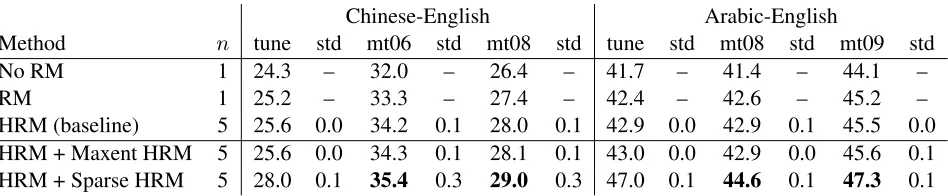
Our three primary points of comparison have been tested with 5 replications. We report BLEU scores averaged across replications as well as standard de-viations, which indicate optimizer stability. We also provide unreplicated results for two systems, one
us-ing only the distortion penalty (No RM), and one
using a non-hierarchical reordering model (RM).
These demonstrate that our baseline already has quite mature reordering capabilities.
The Maxent HRM has very little effect on trans-lation performance. We found this surprising; we expected large gains from improving the reorder-ing distributions of low-frequency phrase-pairs. See
§5.1 for further exploration of this result.
The Sparse HRM, on the other hand, performs very well. It produces significant BLEU score im-provements on all test sets, with imim-provements rang-ing between 1 and 1.8 BLEU points. Even with millions of training sentences for our HRM, there is a large benefit in building HRM-like features that are tuned to optimize the decoder’s BLEU score on small tuning sets. We examine the impact of subsets
of these features in§5.2.
The test sets’ standard deviations increase from 0.1 under the baseline to 0.3 under the Sparse HRM for Chinese-English, indicating a decrease in opti-mizer stability. With so many features trained on so few sentences, this is not necessarily surprising. Fortunately, looking at the actual replications (not
Base:
src.first;src.last;tgt.first;tgt.last
×Representation
{80-words, 50-clusters}
×Orientation
{M, S, D}
Table 6: Intersection of Maxent & Sparse HRM features.
shown), we confirmed that if a replication produced low scores in one test, it also produced low scores in the other. This means that one should be able to outperform the average case by using a dev-test set to select among replications.
5.1 Maximum Entropy Analysis
The next two sections examine our two solutions in detail, starting with the Maxent HRM. To avoid excessive demands on our computing resources, all experiments report tuning with a single replication with the same seed. We select Arabic-English for our analysis, as this pair has high optimizer stability and fast decoding speeds.
Why does the Maxent HRM help so little? We begin by investigating some design decisions. One possibility is that our subsampling of frequency-1
training pairs (see §3.2) harmed performance. To
test the impact of this decision, we train a Max-ent HRM without subsampling, taking substantially longer. The resulting BLEU scores (not shown) are well within the projected standard deviations for op-timizer instability (0.1 BLEU from Table 5). This indicates that subsampling is not the problem. To confirm our choice of hyperparameters, we conduct a grid search over the Maxent HRM’s
regulariza-tion parameterC (see Equation 4), covering the set
{1,0.1,0.01,0.001}, where C = 0.1 is the value
used throughout this paper. Again, the resulting
BLEU scores (not shown) are all within 0.1 of the means reported in Table 5.
Chinese-English Arabic-English
Method n tune std mt06 std mt08 std tune std mt08 std mt09 std
No RM 1 24.3 – 32.0 – 26.4 – 41.7 – 41.4 – 44.1 –
RM 1 25.2 – 33.3 – 27.4 – 42.4 – 42.6 – 45.2 –
HRM (baseline) 5 25.6 0.0 34.2 0.1 28.0 0.1 42.9 0.0 42.9 0.1 45.5 0.0
HRM + Maxent HRM 5 25.6 0.0 34.3 0.1 28.1 0.1 43.0 0.0 42.9 0.0 45.6 0.1
[image:7.612.79.553.53.151.2]HRM + Sparse HRM 5 28.0 0.1 35.4 0.3 29.0 0.3 47.0 0.1 44.6 0.1 47.3 0.1
Table 5: Comparing reordering methods according to BLEU score. nindicates the number of tuning replications, while standard deviations (std) indicate optimizer stability. Test scores that are significantly higher (p <0.01) than the HRM baseline are highlighted in bold.
Method −HRM +HRM
HRM (baseline) – 44.2
Original Maxent HRM 44.2 44.2
Sparse HRM 45.4 46.0
Intersection Maxent HRM 43.8 44.2
Sparse HRM 45.2 46.0
Table 7: Arabic-English BLEU scores with each system’s original feature set versus the intersection of the two fea-ture sets, with and without the relative frequency HRM. BLEU is averaged across mt08 and mt09.
the baseline HRM included, performance does not change for either system with the intersected feature set. Sparse features continue to help, while the max-imum entropy model does not. Without the HRM, both systems degrade under the intersection, though the Sparse HRM still improves over the baseline.
Finally, we examine Maxent HRM performance as a function of the amount of word-aligned train-ing data. To do so, we hold all aspects of our sys-tem constant, except for the amount of bitext used to train either the baseline HRM or the Maxent HRM. Importantly, the phrase table always uses the com-plete bitext. For our reordering training set, we hold out the final two thousand sentences of bitext to cal-culate perplexity. This measures the model’s sur-prise at reordering events drawn from previously un-seen alignments; lower values are better. We pro-ceed to subsample sentence pairs from the remain-ing bitext, in order to produce a series of trainremain-ing bitexts of increasing size. We subsample with the
probability of accepting a sentence pair, Pa, set to
{0.001,0.01,0.1,1}. It is important to not confuse
this subsampling of sentence pairs with the
sub-sampling of low-frequency phrase pairs (see §3.2),
[image:7.612.71.299.213.298.2]which is still carried out by the Maxent HRM for each training scenario.
Figure 1 shows how BLEU (averaged across both test sets) and perplexity vary as training data in-creases from 1.5K sentences to the full 1.5M. At
Pa < 0.1, corresponding to less than 150K
sen-tences, the maximum entropy model actually makes a substantial difference in terms of BLEU. However, these deltas narrow to nothing as we reach millions of training sentences. This is consistent with the re-sults of Nguyen et al. (2009), who report that maxi-mum entropy reordering outperforms a similar base-line, but using only 50K sentence pairs.
A related observation is that held-out perplexity does not seem to predict BLEU in any useful way. In particular, perplexity does not predict that the two systems will become similar as data grows, nor does it predict that maxent’s performance will level off. Predicting the orientations of unseen alignments is not the same task as predicting the orientation for a phrase during translation. We suspect that perplexity places too much emphasis on rare or previously un-seen phrase pairs, due to phrase extraction’s heavy tails. Preliminary attempts to correct for this us-ing absolute discountus-ing on the test counts did not resolve these issues. Unfortunately, in maximizing (regularized or smoothed) likelihood, both maxent and relative frequency HRMs are chasing the per-plexity objective, not the BLEU objective.
5.2 Sparse Feature Analysis
The results in Table 7 from §5.1 already provide
1.55 1.6 1.65 1.7 1.75 1.8 1.85 1.9 1.95 2
0.001 0.01 0.1 1 Perplexity as Data Grows
MaxEnt
RelFreq
41.5 42 42.5 43 43.5 44 44.5
[image:8.612.96.517.54.166.2]0 0.001 0.01 0.1 1 BLEU as Data Grows
Figure 1: Learning curves for Relative Frequency and Maximum Entropy reordering models on Arabic-English.
Feature Group Count BLEU
No Sparse HRM 0 44.2
Between 312 44.4
Stack 1404 45.2
Phrase 1872 45.9
20 Clusters 506 45.4
50 Clusters 1196 45.8
80 Words 1886 45.8
Full Sparse HRM 3588 46.0
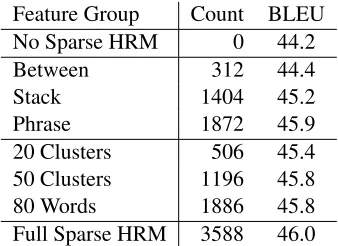
Table 8: Versions of the Sparse HRM built using or-ganized subsets of the complete feature set for Arabic-English. Count is the number of distinct features, while BLEU is averaged over mt08 and mt09.
intersected features indicates that modeling context outside a phrase is not essential for strong
perfor-mance. Furthermore, the−HRMportion of the
ta-ble indicates that the sparse HRM does not require the baseline HRM to be present in order to outper-form it. This is remarkable when one considers that the Sparse HRM uses less than 4k features to model phrase orientations, compared to the 530M
proba-bilities7maintained by the baseline HRM’s relative
frequency model.
To determine which feature groups are most im-portant, we tested the Sparse HRM on Arabic-English with a number of feature subsets. We report BLEU scores averaged over both test sets in Table 8. First, we break our features into three groups accord-ing to what part of the hypothesis is used to assess orientation. For each of these location groups, all forms of word representation (clusters or frequent
words) are employed. The groups consist of
Be-7
88.4M phrase pairs×3 orientations (M, S and D) ×2 translation directions (left-to-right and right-to-left).
tween: the words between the top of the stack and
the phrase to be added; Stack: words describing
the current top of the stack; andPhrase: words
de-scribing the phrase pair being added to the hypothe-sis. Each group was tested alone to measure its use-fulness. This results in a clear hierarchy, with the phrase features being the most useful (nearly as use-ful as the complete system), and the between fea-tures being the least. Second, we break our feafea-tures into three groups according to how words are rep-resented. For each of these representation groups, all location groups (Between, Stack and Phrase) are
employed. The groups are quite intuitive: 20
Clus-ters,50 Clustersor80 Words. The differences be-tween representations are much less dramatic than
the location groups. All representations perform
well on their own, with the finer-grained ones per-forming better. Including multiple representations provides a slight boost, but these experiments sug-gest that a leaner model could certainly drop one or two representations with little impact.
In its current implementation, the Sparse HRM is roughly 4 times slower than the baseline decoder. Our sparse feature infrastructure is designed for flex-ibility, not speed. To affect reordering, each sparse feature template is re-applied with each hypothesis extension. However, the intersected feature set from
§5.1 is only 2 times slower, and could be made faster
[image:8.612.101.270.211.334.2]Chinese-English tune mt06 mt08
Base 27.7 39.9 33.7
+Sparse HRM 29.2 41.0 34.1
Arabic-English tune mt08 mt09
Base 49.6 49.1 51.6
[image:9.612.93.277.53.151.2]+Sparse HRM 51.7 49.9 52.2
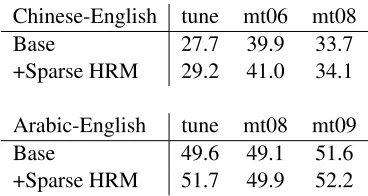
Table 9: The effect of Sparse HRMs on complex systems.
5.3 Impact on Competition-Grade SMT
Thus far, we have employed a baseline that has been designed for both translation quality and replicabil-ity. We now investigate the impact of our Sparse HRM on a far more complex baseline: our internal system used for MT competitions such as NIST.
The Arabic system uses roughly the same bilin-gual data as our original baseline, but also includes a 5-gram language model learned from the English Gigaword. The Chinese system adds the UN bitext as well as the English Gigaword. Both systems make heavy use of linear mixtures to create refined transla-tion and language models, mixing across sources of corpora, genre and translation direction (Foster and Kuhn, 2007; Goutte et al., 2009). They also mix many different sources of word alignments, with the system adapting across alignment sources us-ing either binary indicators or linear mixtures. Im-portantly, these systems already incorporate thou-sands of sparse features as described by Hopkins and May (2011). These provide additional information for each phrase pair through frequency bins, phrase-length bins, and indicators for frequent alignment pairs. Both systems include a standard HRM.
The result of adding the Sparse HRM to these sys-tems is shown in Table 9. Improvements range from 0.4 to 1.1 BLEU, but importantly, all four test sets improve. The impact of these reordering features is reduced slightly in the presence of more carefully tuned translation and language models, but they re-main a strong contributor to translation quality.
6 Conclusion
We have shown that sparse reordering features can improve the quality of phrase-based translations, even in the presence of lexicalized reordering mod-els that track the same orientations. We have
com-pared this solution to a maximum entropy model, which does not improve our HRM baseline. Our analysis of the maximum entropy solution indicates that smoothing the orientation estimates is not a ma-jor concern in the presence of millions of sentences of bitext. This implies that our sparse features are achieving their improvement because they optimize BLEU with the decoder in the loop, side-stepping the objective mismatch that can occur when train-ing on word-aligned data. The fact that this is possi-ble with such small tuning corpora is both surprising and encouraging.
In the future, we would like to investigate how to incorporate useful future cost estimates for our sparse reordering features. Previous work has shown future distortion penalty estimates to be important for both translation speed and quality (Moore and Quirk, 2007; Green et al., 2010), but we have ig-nored future costs in this work. We would also like to investigate features inspired by transition-based parsing, such as features that look further down the reordering stack. Finally, as there is evidence that ideas from lexicalized reordering can help hierarchi-cal phrase-based SMT (Huck et al., 2012), it would be interesting to explore the use of sparse RMs in that setting.
Acknowledgments
Thanks to George Foster, Roland Kuhn and the anonymous reviewers for their valuable comments on an earlier draft.
References
Phil Blunsom and Trevor Cohn. 2011. A hierarchi-cal pitman-yor process hmm for unsupervised part of speech induction. InACL, pages 865–874, Portland, Oregon, USA, June.
Colin Cherry and George Foster. 2012. Batch tuning strategies for statistical machine translation. In
HLT-NAACL, pages 427–436, Montr´eal, Canada, June.
Colin Cherry, Robert C. Moore, and Chris Quirk. 2012. On hierarchical re-ordering and permutation parsing for phrase-based decoding. In Proceedings of the
Workshop on Statistical Machine Translation, pages
200–209, Montr´eal, Canada, June.
David Chiang, Kevin Knight, and Wei Wang. 2009. 11,001 new features for statistical machine translation.
InHLT-NAACL, pages 218–226.
Jonathan H. Clark, Chris Dyer, Alon Lavie, and Noah A. Smith. 2011. Better hypothesis testing for statistical machine translation: Controlling for optimizer insta-bility. InACL, pages 176–181.
George Foster and Roland Kuhn. 2007. Mixture-model adaptation for SMT. InProceedings of the Workshop
on Statistical Machine Translation, pages 128–135.
Michel Galley and Christopher D. Manning. 2008. A simple and effective hierarchical phrase reordering model. InEMNLP, pages 848–856, Honolulu, Hawaii. Kevin Gimpel and Noah A. Smith. 2012. Structured ramp loss minimization for machine translation. In
HLT-NAACL, Montreal, Canada, June.
Cyril Goutte, David Kurokawa, and Pierre Isabelle. 2009. Improving SMT by learning the translation di-rection. In EAMT Workshop on Statistical
Multilin-gual Analysis for Retrieval and Translation.
Spence Green, Michel Galley, and Christopher D. Man-ning. 2010. Improved models of distortion cost for statistical machine translation. InHLT-NAACL, pages 867–875, Los Angeles, California, June.
Xiaodong He and Li Deng. 2012. Maximum expected bleu training of phrase and lexicon translation mod-els. InProceedings of the 50th Annual Meeting of the Association for Computational Linguistics (Volume 1:
Long Papers), pages 292–301, Jeju Island, Korea, July.
Mark Hopkins and Jonathan May. 2011. Tuning as rank-ing. InEMNLP, pages 1352–1362.
Matthias Huck, Stephan Peitz, Markus Freitag, and Her-mann Ney. 2012. Discriminative reordering exten-sions for hierarchical phrase-based machine transla-tion. In Proceedings of the 16th Annual Conference of the European Association for Machine Translation
(EAMT), pages 313–320, Trento, Italy, May.
Philipp Koehn, Franz Joesef Och, and Daniel Marcu. 2003. Statistical phrase-based translation. In
HLT-NAACL, pages 127–133.
Philipp Koehn, Amittai Axelrod, Alexandra Birch Mayne, Chris Callison-Burch, Miles Osborne, and David Talbot. 2005. Edinburgh system description for the 2005 IWSLT speech translation evaluation. In
Proceedings to the International Workshop on Spoken
Language Translation (IWSLT).
Philipp Koehn, Hieu Hoang, Alexandra Birch, Chris Callison-Burch, Marcello Federico, Nicola Bertoldi, Brooke Cowan, Wade Shen, Christine Moran, Richard Zens, Chris Dyer, Ondrej Bojar, Alexandra Con-stantin, and Evan Herbst. 2007. Moses: Open source toolkit for statistical machine translation. In ACL, pages 177–180, Prague, Czech Republic, June.
Terry Koo, Xavier Carreras, and Michael Collins. 2008. Simple semi-supervised dependency parsing. InACL, pages 595–603, Columbus, Ohio, June.
Dekang Lin and Xiaoyun Wu. 2009. Phrase clustering for discriminative learning. InProceedings of the Joint
Conference of the ACL and the AFNLP, pages 1030–
1038, Singapore, August.
Robert C. Moore and Chris Quirk. 2007. Faster beam-search decoding for phrasal statistical machine trans-lation. InMT Summit XI, September.
Vinh Van Nguyen, Akira Shimazu, Minh Le Nguyen, and Thai Phuong Nguyen. 2009. Improving a lexi-calized hierarchical reordering model using maximum entropy. InMT Summit XII, Ottawa, Canada, August. Franz Josef Och and Hermann Ney. 2003. A
system-atic comparison of various statistical alignment
mod-els. Computational Linguistics, 29(1), March.
Franz Josef Och and Hermann Ney. 2004. The align-ment template approach to statistical machine transla-tion. Computational Linguistics, 30(4), December. Franz Josef Och. 1999. An efficient method for
deter-mining bilingual word classes. InEACL.
Kishore Papineni, Salim Roukos, Todd Ward, and Wei-Jing Zhu. 2002. BLEU: a method for automatic eval-uation of machine translation. InACL, pages 311–318. Patrick Simianer, Stefan Riezler, and Chris Dyer. 2012. Joint feature selection in distributed stochastic learn-ing for large-scale discriminative trainlearn-ing in smt. In
ACL, pages 11–21, Jeju Island, Korea, July.
Christoph Tillmann. 2004. A unigram orientation model for statistical machine translation. In HLT-NAACL, pages 101–104, Boston, USA, May.
Deyi Xiong, Qun Liu, and Shouxun Lin. 2006. Maxi-mum entropy based phrase reordering model for sta-tistical machine translation. InCOLING-ACL, pages 521–528, Sydney, Australia, July.
Sirvan Yahyaei and Christof Monz. 2010. Dynamic dis-tortion in a discriminative reordering model for statis-tical machine translation. InProceedings of the Inter-national Workshop on Spoken Language Translation
(IWSLT), pages 353–360.
Richard Zens and Hermann Ney. 2004. Improvements in phrase-based statistical machine translation. In
HLT-NAACL, pages 257–264, Boston, USA, May.
Richard Zens and Hermann Ney. 2006. Discriminative reordering models for statistical machine translation.
In Proceedings on the Workshop on Statistical