Boosting Statistical Word Alignment Using
Labeled and Unlabeled Data
Hua Wu Haifeng Wang Zhanyi Liu
Toshiba (China) Research and Development Center
5/F., Tower W2, Oriental Plaza, No.1, East Chang An Ave., Dong Cheng District
Beijing, 100738, China
{wuhua, wanghaifeng, liuzhanyi}@rdc.toshiba.com.cn
Abstract
This paper proposes a semi-supervised boosting approach to improve statistical word alignment with limited labeled data and large amounts of unlabeled data. The proposed approach modifies the super-vised boosting algorithm to a semi-supervised learning algorithm by incor-porating the unlabeled data. In this algo-rithm, we build a word aligner by using both the labeled data and the unlabeled data. Then we build a pseudo reference set for the unlabeled data, and calculate the error rate of each word aligner using only the labeled data. Based on this semi-supervised boosting algorithm, we inves-tigate two boosting methods for word alignment. In addition, we improve the word alignment results by combining the results of the two semi-supervised boost-ing methods. Experimental results on word alignment indicate that semi-supervised boosting achieves relative er-ror reductions of 28.29% and 19.52% as compared with supervised boosting and unsupervised boosting, respectively.
1
Introduction
Word alignment was first proposed as an inter-mediate result of statistical machine translation (Brown et al., 1993). In recent years, many re-searchers build alignment links with bilingual corpora (Wu, 1997; Och and Ney, 2003; Cherry and Lin, 2003; Wu et al., 2005; Zhang and Gildea, 2005). These methods unsupervisedly train the alignment models with unlabeled data.
A question about word alignment is whether we can further improve the performances of the
word aligners with available data and available alignment models. One possible solution is to use the boosting method (Freund and Schapire, 1996), which is one of the ensemble methods (Dietterich, 2000). The underlying idea of boost-ing is to combine simple "rules" to form an en-semble such that the performance of the single ensemble is improved. The AdaBoost (Adaptive Boosting) algorithm by Freund and Schapire (1996) was developed for supervised learning. When it is applied to word alignment, it should solve the problem of building a reference set for the unlabeled data. Wu and Wang (2005) devel-oped an unsupervised AdaBoost algorithm by automatically building a pseudo reference set for the unlabeled data to improve alignment results.
In fact, large amounts of unlabeled data are available without difficulty, while labeled data is costly to obtain. However, labeled data is valu-able to improve performance of learners. Conse-quently, semi-supervised learning, which com-bines both labeled and unlabeled data, has been applied to some NLP tasks such as word sense disambiguation (Yarowsky, 1995; Pham et al., 2005), classification (Blum and Mitchell, 1998; Thorsten, 1999), clustering (Basu et al., 2004), named entity classification (Collins and Singer, 1999), and parsing (Sarkar, 2001).
In this paper, we propose a semi-supervised boosting method to improve statistical word alignment with both limited labeled data and large amounts of unlabeled data. The proposed approach modifies the supervised AdaBoost al-gorithm to a semi-supervised learning alal-gorithm by incorporating the unlabeled data. Therefore, it should address the following three problems. The first is to build a word alignment model with both labeled and unlabeled data. In this paper, with the labeled data, we build a supervised model by directly estimating the parameters in
the model instead of using the Expectation Maximization (EM) algorithm in Brown et al. (1993). With the unlabeled data, we build an un-supervised model by estimating the parameters with the EM algorithm. Based on these two word alignment models, an interpolated model is built through linear interpolation. This interpolated model is used as a learner in the semi-supervised AdaBoost algorithm. The second is to build a reference set for the unlabeled data. It is auto-matically built with a modified "refined" combi-nation method as described in Och and Ney (2000). The third is to calculate the error rate on each round. Although we build a reference set for the unlabeled data, it still contains alignment errors. Thus, we use the reference set of the la-beled data instead of that of the entire training data to calculate the error rate on each round.
With the interpolated model as a learner in the semi-supervised AdaBoost algorithm, we inves-tigate two boosting methods in this paper to im-prove statistical word alignment. The first method uses the unlabeled data only in the inter-polated model. During training, it only changes the distribution of the labeled data. The second method changes the distribution of both the la-beled data and the unlala-beled data during training. Experimental results show that both of these two methods improve the performance of statistical word alignment.
In addition, we combine the final results of the above two semi-supervised boosting methods. Experimental results indicate that this combina-tion outperforms the unsupervised boosting method as described in Wu and Wang (2005), achieving a relative error rate reduction of 19.52%. And it also achieves a reduction of 28.29% as compared with the supervised boost-ing method that only uses the labeled data.
The remainder of this paper is organized as follows. Section 2 briefly introduces the statisti-cal word alignment model. Section 3 describes parameter estimation method using the labeled data. Section 4 presents our semi-supervised boosting method. Section 5 reports the experi-mental results. Finally, we conclude in section 6.
2
Statistical Word Alignment Model
According to the IBM models (Brown et al., 1993), the statistical word alignment model can be generally represented as in equation (1).
∑
= a' e | f , a' e | f a, e | f a, ) Pr( ) Pr( ) Pr( (1)Where and f represent the source sentence and the target sentence, respectively.
e
In this paper, we use a simplified IBM model 4 (Al-Onaizan et al., 1999), which is shown in equation (2). This simplified version does not take into account word classes as described in Brown et al. (1993).
) ))) ( ( )] ( ([ )) ( )] ( ([ ( ) | ( ) | ( ) Pr( 0 , 1 1 0 , 1 1 1 1 1 2 0 0
0 0 0
∏
∏
∏
∏
≠ = > ≠ = = = − − ⋅ ≠ + − ⋅ = ⋅ ⋅ ⋅ ⎟⎟ ⎠ ⎞ ⎜⎜ ⎝ ⎛ − = m a j j m a j j m j a j l i i i m j j j a j j p j d a h j c j d a h j e f t e n p p m ρ φ φ φ φ φ e | f a, (2) ml, are the lengths of the source sentence and the target sentence respectively.
j is the position index of the target word.
j
a is the position of the source word aligned to
the jth target word.
i
φ is the number of target words that is aligned to.
i
e
0
p ,p1 are the fertility probabilities for e0, and
1 1 0+p =
p .
) | aj
j e
t(f is the word translation probability.
) | ( i ei
nφ is the fertility probability.
) ( 1 j a c j
d − ρ is the distortion probability for the head word of cept1 i.
)) ( ( 1 j p j
d> − is the distortion probability for the non-head words of cept i.
} : { min ) ( k
k k i a
i
h = = is the head of cept i.
} :
{ max )
( j k
j k a a k j
p = =
< .
i
ρ is the first word before ei with non-zero fertility.
i
c
is the center of cept i.3
Parameter Estimation with Labeled
Data
With the labeled data, instead of using EM algo-rithm, we directly estimate the three main pa-rameters in model 4: translation probability, fer-tility probability, and distortion probability.
1
3.1 Translation Probability Where δ(x,y)=1 if x=y. Otherwise, δ(x,y)=0. The translation probability is estimated from the
labeled data as described in (3).
4
Boosting with Labeled Data and
Unlabeled Data
∑
= ' ) ' , ( ) , ( ) | ( f i j i i j f e count f e count e f t(3) In this section, we first propose a semi-supervised AdaBoost algorithm for word align-ment, which uses both the labeled data and the unlabeled data. Based on the semi-supervised algorithm, we describe two boosting methods for word alignment. And then we develop a method to combine the results of the two boosting meth-ods.
Where is the occurring frequency of
aligned to in the labeled data.
) , (ei fj count
i
e fj
3.2 Fertility Probability
The fertility probability n(φi|ei) describes the
distribution of the numbers of words that is aligned to. It is estimated as described in (4).
i
e 4.1 Semi-Supervised AdaBoost Algorithm
for Word Alignment
∑
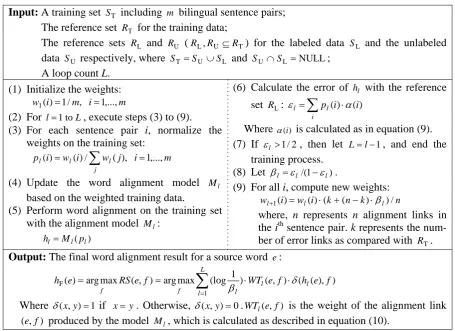
= ' ) , ' ( ) , ( ) | ( φ φ φ φ i i i i i e count e count e n(4) Figure 1 shows the semi-supervised AdaBoost algorithm for word alignment by using labeled and unlabeled data. Compared with the super-vised Adaboost algorithm, this semi-supersuper-vised AdaBoost algorithm mainly has five differences. Where count(φi,ei)describes the occurring
fre-quency of word ei aligned to φi target words in
the labeled data. Word Alignment Model
0
p and describe the fertility probabilities for . And and sum to 1. We estimate directly from the labeled data, which is shown in (5).
1 p
0
e p0 p1
0 p
The first is the word alignment model, which is taken as a learner in the boosting algorithm. The word alignment model is built using both the labeled data and the unlabeled data. With the labeled data, we train a supervised model by di-rectly estimating the parameters in the IBM model as described in section 3. With the unla-beled data, we train an unsupervised model using the same EM algorithm in Brown et al. (1993). Then we build an interpolation model by linearly interpolating these two word alignment models, which is shown in (8). This interpolated model is used as the model Ml described in figure 1.
Aligned Null Aligned p # # # 0 − = (5)
Where is the occurring frequency of the target words that have counterparts in the source language. is the occurring fre-quency of the target words that have no counter-parts in the source language.
Aligned #
Null
#
3.3 Distortion Probability
) ( Pr ) 1 ( ) ( Pr ) Pr( U
S a,f|e a,f|e
e | f a, ⋅ − + ⋅
=λ λ (8)
There are two kinds of distortion probability in model 4: one for head words and the other for non-head words. Both of the distortion probabili-ties describe the distribution of relative positions Thus, if we let
i
c j
j = − ρ
Δ1 and Δj>1= j−p(j),
the distortion probabilities for head words and non-head words are estimated in (6) and (7) with the labeled data, respectively.
Where and are the
trained supervised model and unsupervised model, respectively.
) (
PrS a,f|e PrU(a,f|e)
λ is an interpolation weight. We train the weight in equation (8) in the same way as described in Wu et al. (2005).
Pseudo Reference Set for Unlabeled Data
∑ ∑
∑
Δ − Δ − Δ = Δ ' 1 ' ', ' ' ' 1 , 1 1 1 ) , ( ) , ( ) (j jc
c j i i i i c j j c j j j d ρ ρ ρ ρ δ δ (6)
∑ ∑
∑
> Δ > > > > − Δ − Δ = Δ ' 1 ' ', ( ) ' ' ' 1 ) ( , 1 1 1 )) ( , ( )) ( , ( ) (j j p j
j p j j p j j j p j j j d δ δ (7)
Input: A training set ST including m bilingual sentence pairs; The reference set RT for the training data;
The reference sets and ( ) for the labeled data and the unlabeled data respectively, where
L
R RU RL,RU⊆RT SL
U
S ST =SU∪SL and SU∩SL =NULL; A loop count L.
(1) Initialize the weights:
m i
m i
w1()=1/ , =1,...,
(2) For l=1to L, execute steps (3) to (9).
(3) For each sentence pair i, normalize the weights on the training set:
∑
==
j l l
l i w i w j i m
p () ()/ ( ), 1,...,
(4) Update the word alignment model based on the weighted training data.
l
M
(5) Perform word alignment on the training set with the alignment model Ml:
) ( l
l
l M p
h =
(6) Calculate the error of with the reference
set :
l
h
L
R =
∑
⋅i l
l p (i) α(i)
ε
Where α(i) is calculated as in equation (9).
(7) If εl >1/2, then let , and end the training process.
1
− =l L
(8) Let βl =εl/(1−εl).
(9) For all i, compute new weights:
n k
n k i w i
wl+1()= l()⋅( +( − )⋅βl)/
where, n represents n alignment links in the ith sentence pair. k represents the num-ber of error links as compared with RT.
Output: The final word alignment result for a source word e:
∑
=
⋅ ⋅
=
= L
l
l l
l f
f
f e h f e WT f
e RS e
h
1
F ) ( , ) ( ( ), )
1 (log max arg ) , ( max arg )
( δ
β
Where δ(x,y)=1 if x=y. Otherwise, δ(x,y)=0. is the weight of the alignment link produced by the model , which is calculated as described in equation (10).
) , (e f WTl
) ,
[image:4.595.68.524.66.397.2](e f Ml
Figure 1. The Semi-Supervised Adaboost Algorithm for Word Alignment
target and target to source) as described in Och and Ney (2000). Thus, we get two sets of align-ment results and on the unlabeled data. Based on these two sets, we use a modified "re-fined" method (Och and Ney, 2000) to construct a pseudo reference set .
1
A A2
U R
(1) The intersection is added to the reference set .
2
1 A
A I= ∩
U R
(2) We add to if a) is satis-fied or both b) and c) are satissatis-fied.
2 1
) ,
(e f ∈A ∪A RU
a) Neither nor has an alignment in and is greater than a threshold
e f RU
) | (f e
p δ1.
∑
='
) ' , (
) , ( )
| (
f
f e count
f e count e
f p
Where is the occurring fre-quency of the alignment link in the bi-directional word alignment results.
) , (e f count
) , (e f
b) has a horizontal or a vertical neighbor that is already in .
) , (e f
U R
c) The set does not contain
alignments with both horizontal and ver-tical neighbors.
) , (
U e f
R ∪
Error of Word Aligner
The third is the calculation of the error of the individual word aligner on each round. For word alignment, a sentence pair is taken as a sample. Thus, we calculate the error rate of each sentence pair as described in (9), which is the same as de-scribed in Wu and Wang (2005).
| | | |
| |
2 1 ) (
R W
R W
S S
S S i
+ ∩ −
=
α (9)
Where represents the set of alignment links of a sentence pair i identified by the indi-vidual interpolated model on each round. is the reference alignment set for the sentence pair.
W S
R S
With the error rate of each sentence pair, we calculate the error of the word aligner on each round. Although we build a pseudo reference set for the unlabeled data, it contains alignment errors. Thus, the weighted sum of the error rates of sentence pairs in the labeled data instead of that in the entire training data is used as the error of the word aligner.
Weights Update for Sentence Pairs
The forth is the weight update for sentence pairs according to the error and the reference set. In a sentence pair, there are usually several word alignment links. Some are correct, and others may be incorrect. Thus, we update the weights according to the number of correct and incorrect alignment links as compared with the reference set, which is shown in step (9) in figure 1.
Weights for Word Alignment Links
The fifth is the weights used when we con-struct the final ensemble. Besides the weight
) / 1
log( βl , which is the confidence measure of
the word aligner, we also use the weight to measure the confidence of each alignment link produced by the model . The weight is calculated as shown in (10). Wu and Wang (2005) proved that adding this weight improved the word alignment results.
th l
) , (e f WTl
l
M
) , (e f WTl
∑
∑
+× =
' '
) , ' ( )
' , (
) , ( 2
) , (
e f
l
f e count f
e count
f e count f
e WT
(10)
Where is the occurring frequency of the alignment link in the word align-ment results of the training data produced by the model .
) , (e f count
) , (e f
l
M
4.2 Method 1
This method only uses the labeled data as train-ing data. Accordtrain-ing to the algorithm in figure 1, we obtain and . Thus, we only change the distribution of the labeled data. How-ever, we build an unsupervised model using the unlabeled data. On each round, we keep this un-supervised model unchanged, and we rebuild the supervised model by estimating the parameters as described in section 3 with the weighted train-ing data. Then we interpolate the supervised model and the unsupervised model to obtain an interpolated model as described in section 4.1. The interpolated model is used as the alignment model in figure 1. Thus, in this interpolated model, we use both the labeled and unlabeled data. On each round, we rebuild the interpolated model using the rebuilt supervised model and the unchanged unsupervised model. This interpo-lated model is used to align the training data.
L
T S
S = RT =RL
l
M
According to the reference set of the labeled data, we calculate the error of the word aligner on each round. According to the error and the
reference set, we update the weight of each sam-ple in the labeled data.
4.3 Method 2
This method uses both the labeled data and the unlabeled data as training data. Thus, we set
U L
T S S
S = ∪ and RT =RL ∪RU as described in
figure 1. With the labeled data, we build a super-vised model, which is kept unchanged on each round.2 With the weighted samples in the train-ing data, we rebuild the unsupervised model with EM algorithm on each round. Based on these two models, we built an interpolated model as de-scribed in section 4.1. The interpolated model is used as the alignment model in figure 1. On each round, we rebuild the interpolated model using the unchanged supervised model and the rebuilt unsupervised model. Then the interpo-lated model is used to align the training data.
l
M
Since the training data includes both labeled and unlabeled data, we need to build a pseudo reference set for the unlabeled data using the method described in section 4.1. According to the reference set of the labeled data, we cal-culate the error of the word aligner on each round. Then, according to the pseudo reference set and the reference set , we update the weight of each sentence pair in the unlabeled data and in the labeled data, respectively.
U R
L R
U
R RL
There are four main differences between Method 2 and Method 1.
(1) On each round, Method 2 changes the distri-bution of both the labeled data and the unla-beled data, while Method 1 only changes the distribution of the labeled data.
(2) Method 2 rebuilds the unsupervised model, while Method 1 rebuilds the supervised model.
(3) Method 2 uses the labeled data instead of the entire training data to estimate the error of the word aligner on each round.
(4) Method 2 uses an automatically built pseudo reference set to update the weights for the sentence pairs in the unlabeled data.
4.4 Combination
In the above two sections, we described two semi-supervised boosting methods for word alignment. Although we use interpolated models
2
for word alignment in both Method 1 and Method 2, the interpolated models are trained with different weighted data. Thus, they perform differently on word alignment. In order to further improve the word alignment results, we combine the results of the above two methods as described in (11).
)) , ( )
, ( (
max arg
) (
2 2 1
1 F
3,
f e RS f
e RS e
h
f
⋅ + ⋅
= λ λ
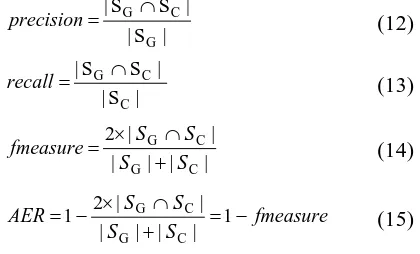
ods to calculate the precision, recall, f-measure, and alignment error rate (AER) are shown in equations (12), (13), (14), and (15). It can be seen that the higher the f-measure is, the lower the alignment error rate is.
| S |
| S S |
G C G∩ =
precision (12)
| S |
| S S |
C C G ∩ = recall
(11) (13)
| | | |
| |
2
C G
C G
S S
S S fmeasure
+ ∩ × =
Where is the combined hypothesis for word alignment. and are the two ensemble results as shown in figure 1 for Method 1 and Method 2, respectively.
) (
F 3, e h
) , (
1 e f
RS RS2(e,f)
1
λ and λ2
are the constant weights.
(14)
fmeasure S
S S S
AER = −
+ ∩ × −
= 1
| | | |
| |
2 1
C G
C G
(15)
5.3 Experimental Results
5
Experiments
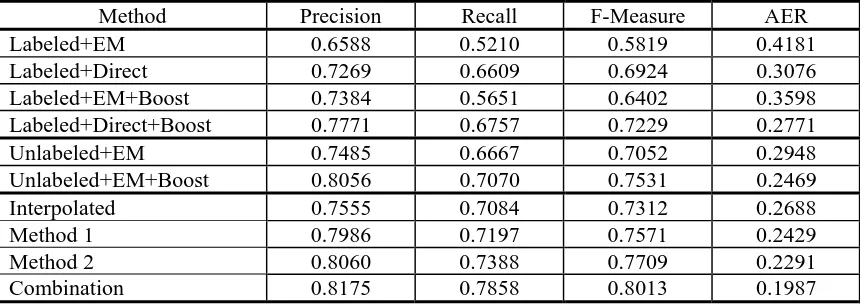
With the data in section 5.1, we get the wordalignment results shown in table 2. For all of the methods in this table, we perform bi-directional (source to target and target to source) word alignment, and obtain two alignment results on the testing set. Based on the two results, we get the "refined" combination as described in Och and Ney (2000). Thus, the results in table 2 are those of the "refined" combination. For EM training, we use the GIZA++ toolkit4.
In this paper, we take English to Chinese word alignment as a case study.
5.1 Data
We have two kinds of training data from general domain: Labeled Data (LD) and Unlabeled Data (UD). The Chinese sentences in the data are automatically segmented into words. The statis-tics for the data is shown in Table 1. The labeled data is manually word aligned, including 156,421 alignment links.
Data # Sentence Pairs
# English Words
Results of Supervised Methods
Using the labeled data, we use two methods to estimate the parameters in IBM model 4: one is to use the EM algorithm, and the other is to esti-mate the parameters directly from the labeled data as described in section 3. In table 2, the method "Labeled+EM" estimates the parameters with the EM algorithm, which is an unsupervised method without boosting. And the method "La-beled+Direct" estimates the parameters directly from the labeled data, which is a supervised method without boosting. "Labeled+EM+Boost" and "Labeled+Direct+Boost" represent the two supervised boosting methods for the above two parameter estimation methods.
[image:6.595.310.520.144.271.2]# Chinese Words LD 31,069 255,504 302,470 UD 329,350 4,682,103 4,480,034
Table 1. Statistics for Training Data
We use 1,000 sentence pairs as testing set, which are not included in LD or UD. The testing set is also manually word aligned, including 8,634 alignment links in the testing set3.
5.2 Evaluation Metrics
We use the same evaluation metrics as described in Wu et al. (2005), which is similar to those in (Och and Ney, 2000). The difference lies in that Wu et al. (2005) take all alignment links as sure links.
Our methods that directly estimate parameters in IBM model 4 are better than that using the EM algorithm. "Labeled+Direct" is better than "La-beled+EM", achieving a relative error rate reduc-tion of 22.97%. And "Labeled+Direct+Boost" is better than "Labeled+EM+Boost", achieving a relative error rate reduction of 22.98%. In addi-tion, the two boosting methods perform better than their corresponding methods without If we use to represent the set of alignment
links identified by the proposed method and to denote the reference alignment set, the
meth-G S
C S
3
For a non one-to-one link, if m source words are aligned to n target words, we take it as one alignment link instead of m∗n alignment links.
4
Method Precision Recall F-Measure AER
Labeled+EM 0.6588 0.5210 0.5819 0.4181
Labeled+Direct 0.7269 0.6609 0.6924 0.3076
Labeled+EM+Boost 0.7384 0.5651 0.6402 0.3598
Labeled+Direct+Boost 0.7771 0.6757 0.7229 0.2771
Unlabeled+EM 0.7485 0.6667 0.7052 0.2948
Unlabeled+EM+Boost 0.8056 0.7070 0.7531 0.2469
Interpolated 0.7555 0.7084 0.7312 0.2688
Method 1 0.7986 0.7197 0.7571 0.2429
Method 2 0.8060 0.7388 0.7709 0.2291
[image:7.595.83.513.71.223.2]Combination 0.8175 0.7858 0.8013 0.1987
Table 2. Word Alignment Results
boosting. For example, "Labeled+Direct+Boost" achieves an error rate reduction of 9.92% as compared with "Labeled+Direct".
Results of Unsupervised Methods
With the unlabeled data, we use the EM algo-rithm to estimate the parameters in the model. The method "Unlabeled+EM" represents an un-supervised method without boosting. And the method "Unlabeled+EM+Boost" uses the same unsupervised Adaboost algorithm as described in Wu and Wang (2005).
The boosting method "Unlabeled+EM+Boost" achieves a relative error rate reduction of 16.25% as compared with "Unlabeled+EM". In addition, the unsupervised boosting method "Unla-beled+EM+Boost" performs better than the su-pervised boosting method "Labeled+Direct+ Boost", achieving an error rate reduction of 10.90%. This is because the size of labeled data is too small to subject to data sparseness problem.
Results of Semi-Supervised Methods
By using both the labeled and the unlabeled data, we interpolate the models trained by "La-beled+Direct" and "Unlabeled+EM" to get an interpolated model. Here, we use "interpolated" to represent it. "Method 1" and "Method 2" rep-resent the semi-supervised boosting methods de-scribed in section 4.2 and section 4.3, respec-tively. "Combination" denotes the method de-scribed in section 4.4, which combines "Method 1" and "Method 2". Both of the weights λ1 and
2
λ in equation (11) are set to 0.5.
"Interpolated" performs better than the meth-ods using only labeled data or unlabeled data. It achieves relative error rate reductions of 12.61% and 8.82% as compared with "Labeled+Direct" and "Unlabeled+EM", respectively.
Using an interpolation model, the two semi-supervised boosting methods "Method 1" and
"Method 2" outperform the supervised boosting method "Labeled+Direct+Boost", achieving a relative error rate reduction of 12.34% and 17.32% respectively. In addition, the two semi-supervised boosting methods perform better than the unsupervised boosting method "Unlabeled+ EM+Boost". "Method 1" performs slightly better than "Unlabeled+EM+Boost". This is because we only change the distribution of the labeled data in "Method 1". "Method 2" achieves an er-ror rate reduction of 7.77% as compared with "Unlabeled+EM+Boost". This is because we use the interpolated model in our semi-supervised boosting method, while "Unlabeled+EM+Boost" only uses the unsupervised model.
Moreover, the combination of the two semi-supervised boosting methods further improves the results, achieving relative error rate reduc-tions of 18.20% and 13.27% as compared with "Method 1" and "Method 2", respectively. It also outperforms both the supervised boosting method "Labeled+Direct+Boost" and the unsu-pervised boosting method "Unlabeled+EM+ Boost", achieving relative error rate reductions of 28.29% and 19.52% respectively.
Summary of the Results
From the above result, it can be seen that all boosting methods perform better than their corre-sponding methods without boosting. The semi-supervised boosting methods outperform the su-pervised boosting method and the unsusu-pervised boosting method.
6
Conclusion and Future Work
and the unlabeled data. This interpolated model was employed as a learner in the algorithm. Then, we automatically built a pseudo reference for the unlabeled data, and calculated the error rate of each word aligner with the labeled data. Based on this algorithm, we investigated two methods for word alignment. In addition, we developed a method to combine the results of the above two semi-supervised boosting methods.
Experimental results indicate that our semi-supervised boosting method outperforms the un-supervised boosting method as described in Wu and Wang (2005), achieving a relative error rate reduction of 19.52%. And it also outperforms the supervised boosting method that only uses the labeled data, achieving a relative error rate re-duction of 28.29%. Experimental results also show that all boosting methods outperform their corresponding methods without boosting.
In the future, we will evaluate our method with an available standard testing set. And we will also evaluate the word alignment results in a machine translation system, to examine whether lower word alignment error rate will result in higher translation accuracy.
References
Yaser Al-Onaizan, Jan Curin, Michael Jahr, Kevin Knight, John Lafferty, Dan Melamed, Franz-Josef Och, David Purdy, Noah A. Smith, and David Yarowsky. 1999. Statistical Machine Translation Final Report. Johns Hopkins University Workshop.
Sugato Basu, Mikhail Bilenko, and Raymond J. Mooney. 2004. Probabilistic Framework for Semi-Supervised Clustering. In Proc. of the 10th ACM SIGKDD International Conference on Knowledge Discovery and Data Mining (KDD-2004), pages 59-68.
Avrim Blum and Tom Mitchell. 1998. Combing La-beled and UnlaLa-beled Data with Co-training. In
Proc. of the 11th Conference on Computational Learning Theory (COLT-1998), pages1-10.
Peter F. Brown, Stephen A. Della Pietra, Vincent J. Della Pietra, and Robert L. Mercer. 1993. The Mathematics of Statistical Machine Translation: Parameter Estimation. Computational Linguistics,
19(2): 263-311.
Colin Cherry and Dekang Lin. 2003. A Probability Model to Improve Word Alignment. In Proc. of the 41st Annual Meeting of the Association for Compu-tational Linguistics (ACL-2003), pages 88-95.
Michael Collins and Yoram Singer. 1999. Unsuper-vised Models for Named Entity Classification. In
Proc. of the Joint SIGDAT Conference on Empiri-cal Methods in Natural Language Processing and
Very Large Corpora (EMNLP/VLC-1999), pages 100-110.
Thomas G. Dietterich. 2000. Ensemble Methods in Machine Learning. In Proc. of the First Interna-tional Workshop on Multiple Classifier Systems (MCS-2000), pages 1-15.
Yoav Freund and Robert E. Schapire. 1996. Experi-ments with a New Boosting Algorithm. In Proc. of the 13th International Conference on Machine Learning (ICML-1996), pages 148-156.
Franz Josef Och and Hermann Ney. 2000. Improved Statistical Alignment Models. In Proc. of the 38th Annual Meeting of the Association for Computa-tional Linguistics (ACL-2000), pages 440-447.
Franz Josef Och and Hermann Ney. 2003. A System-atic Comparison of Various Statistical Alignment Models. Computational Linguistics, 29(1):19-51.
Thanh Phong Pham, Hwee Tou Ng, and Wee Sun Lee 2005. Word Sense Disambiguation with Semi-Supervised Learning. In Proc. of the 20th National Conference on Artificial Intelligence (AAAI 2005),
pages 1093-1098.
Anoop Sarkar. 2001. Applying Co-Training Methods to Statistical Parsing. In Proc. of the 2nd Meeting of the North American Association for Computational Linguistics( NAACL-2001), pages 175-182.
Joachims Thorsten. 1999. Transductive Inference for Text Classification Using Support Vector Ma-chines. In Proc. of the 16th International Confer-ence on Machine Learning (ICML-1999), pages 200-209.
Dekai Wu. 1997. Stochastic Inversion Transduction Grammars and Bilingual Parsing of Parallel Cor-pora. Computational Linguistics, 23(3): 377-403.
Hua Wu and Haifeng Wang. 2005. Boosting Statisti-cal Word Alignment. In Proc. of the 10th Machine Translation Summit, pages 313-320.
Hua Wu, Haifeng Wang, and Zhanyi Liu. 2005. Alignment Model Adaptation for Domain-Specific Word Alignment. In Proc. of the 43rd Annual Meet-ing of the Association for Computational LMeet-inguis- Linguis-tics (ACL-2005), pages 467-474.
David Yarowsky. 1995. Unsupervised Word Sense Disambiguation Rivaling Supervised Methods. In
Proc. of the 33rd Annual Meeting of the Association for Computational Linguistics (ACL-1995), pages 189-196.