X T A G - A G r a p h i c a l W o r k b e n c h
f o r D e v e l o p i n g T r e e - A d j o i n i n g G r a m m a r s *
P a t r i c k P a r o u b e k * * , Y v e s S c h a b e s a n d A r a v i n d K . J o s h iD e p a r t m e n t o f C o m p u t e r a n d I n f o r m a t i o n S c i e n c e U n i v e r s i t y o f P e n n s y l v a n i a
P h i l a d e l p h i a P A 1 9 1 0 4 - 6 3 8 9 U S A p a p / s c h a b e s / j o s h i @ l i n c . c i s . u p e n n . e d u
A b s t r a c t
We describe a workbench ( X T A G ) for the development of tree-adjoining grammars and their parsers, and dis- cuss some issues t h a t arise in the design of the graphical interface.
C o n t r a r y to string rewriting grammars generating trees, the elementary objects manipulated by a tree- adjoining g r a m m a r are extended trees (i.e. trees of depth one or more) which capture syntactic information of lex- ical items. T h e unique characteristics of tree-adjoining grammars, its elementary objects found in the ~ lexicon (extended trees) and the derivational history of derived trees (also a tree), require a specially crafted interface in which the perspective has Shifted from a string-based to a tree-based system. X T A G provides such a graphical interface in which the elementary objects are trees (or tree sets) and not symbols (or strings).
T h e kernel of X T A G is a predictive left to right parser for unification-based tree-adjoining grammar [Schabes, 1991]. X T A G includes a graphical editor for trees, a graphical tree printer, utilities for manipulating and displaying feature structures for unification-based tree- adjoining grammar, facilities for keeping track of the derivational history of TAG trees combined with adjoin- ing and substitution, a parser for unification based tree- adjoining grammars, utilities for defining grammars and lexicons for tree-adjoining grammars, a morphological recognizer for English (75 000 stems deriving 280 000 in- flected forms) and a tree-adjoining grammar for English that covers a large range of linguistic phenomena.
Considerations of portability, efficiency, homogeneity and ease of maintenance, lead us to the use of Common Lisp without its object language addition and to the use of the X Window interface to Common Lisp (CLX) for the implementation of X T A G .
X T A G without the large morphological and syntactic lexicons is public domain software. T h e large morpho- logical and syntactic lexicons can be obtained through an agreement with ACL's D a t a Collection Initiative.
*This work was partially supported by NSF grants DCR- 84-10413, ARO Grant DAAL03-87-0031, and DARPA Grant N0014-85-K0018.
**Visiting from the L aboratoire Informatique Th~orique et Programmation, Institut Blaise Pascal, 4 place Jussieu, 75252 PARIS Cedex 05, France.
X T A G runs under Common Lisp and X Window (CLX).
1 I n t r o d u c t i o n
Tree-adjoining grammar (TAG) [Joshi et al., 1975; Joshi, 1985; Joshi, 1987] and its lexicalized variant [Schabes et al., 1988; Schabes, 1990; Joshi and Schabes, 1991] are tree-rewriting systems in which the syntactic properties of words are encoded as tree structured-objects of ex- tended size. TAG trees can be combined with adjoining and substitution to form new derived trees. 1
Tree-adjoining grammar differs from more traditional tree-generating systems such as context-free grammar in two ways:
1. The objects combined in a tree-adjoining grammar (by adjoining and substitution) are trees and not strings. In this approach, the lexicon associates with a word the entire structure it selects (as shown in Figure 1) and not just a (non-terminal) symbol as in context-free grammars.
2. Unlike string-based systems such as context-free grammars, two objects are built when trees are com- bined: the resulting tree (the derived tree) and its derivational history (the derivation tree). 2
These two unique characteristics of tree-adjoining grammars, the elementary objects found in the lexicon (extended trees) and the distinction between derived tree and its derivational history (also a tree), require a spe- cially crafted interface in which the perspective must be shifted from a string-based to a tree-based system. 1We assume familiarity throughout the paper with the definition of TAGs. See the introduction by Joshi [1987] for an introduction to tree-adjoining grammar. We refer the reader to Joshi [1985], Joshi [1987], Kroch and Joshi [1985], Abeill~ et al. [1990a], Abeill~ [1988] and to Joshi and Schabes [1991] for more information on the linguistic characteristics of TAG such as its lexicalization and factoring recursion out of dependencies.
s
NP N P o $ V P
(0~1) D ~ N (/~1) V SI*NA
J
I
boy thi n k s
NPo$ VP
V NPI$ PP2
S
take P NP2 NP0$ VP
into N 2 V NPI$
I
I
account saw
Figure 1: Elementary trees found in a tree-adjoining grammar lexicon
XTA G provides such a graphical interface in which the elementary objects are trees (or tree sets) and not sym- bols (or strings of symbols).
Skeletons of such workbenches have been previously realized on Symbolics machines [Schabes, 1989; Schif- ferer, 1988]. Although they provided some insights on the architectural design of a TAG workbench, they were never expanded to a full fledged natural language envi- ronment because of inherent limitations (such as their lack of portability).
X T A G runs under Common Lisp [Steele, 1990] and it uses the Common LISP X Interface (CLX) to access the graphical primitives defined by the X l l protocol. XTAG is portable across machines and Common Lisp compilers. T h e kernel of XTA G is a predictive left to right parser for unification-based tree-adjoining grammar [Schabes, 1991]. T h e system includes the following components and features:
• Graphical edition of trees. T h e graphical display of a tree is the only representation of a tree accessible to the user. Some of the operations that can be performed graphically on trees are:
- Add and edit nodes.
- Copy, paste, move or delete subtrees.
- Combine two trees with adjunction or substitu- tion. These operations keep track of the deriva- tional history and u p d a t e attributes stated in form of feature structures as defined in the framework of unification-based tree-adjoining grammar [Vijay-Shanker and Joshi, 1988]. - View the derivational history of a derived tree
and its components (elementary trees). • A tree display module for efficient and aesthetic for-
m a t t i n g of a tree based on a new tree display algo-
r i t h m [Chalnick, 1989]. T h e algorithm is an im- provement of the ones developed by R.eingold and Tolford [1981] and, Lee [1987]. It guarantees in lin- ear time that tress which are structural mirror im- ages of on another are drawn such that their dis- plays are reflections of one another while achieving minimum width of the tree.
• Capabilities for grouping trees into sets which can be linked to a file. This is particularly useful since lexicalized TAGs organize trees into tree-families which capture all variations of a predicative lexical item for a given subcategorization frame.
• Utilities for editing and processing equations for unification based tree-adjoining grammar [Vijay- Shanker and ]oshi, 1988; Schabes, 1990].
• A predictive left to right parser for unification-based tree-adjoining grammar [Schabes, 1991].
• Utilities for defining a grammar (set of trees, set of tree families, set of lexicons) which the parser uses. • Morphological lexicons for English [Karp et al.,
1992]
• A tree-adjoining grammar for English that covers a large range of linguistic phenomena.
2 X T A G C o m p o n e n t s
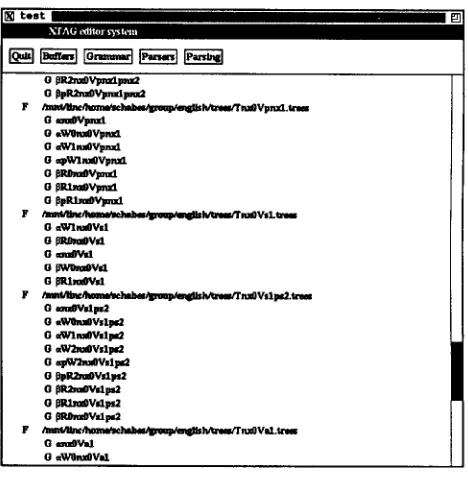
T h e communication with the user is centralized around the interface manager window (See Figure 2) which gives the user control over the different modules of XTAG.
t e s t I
Q P p ~
F ~ ~ h a ~ u t r M O V p n X L ~
O eV,~x~Vpm~ 0 ,~V'I MOVpnxl O Q W l m ~ V p n ~ .
F /mm,M~ ~ I m ~ s ~ a ~ n ~ w ~ ham,w~r m,OvsLm,m
0 ~Vl,tdVsl O pR0s~Vsl 0 com0~l
O !~v~umDVd G M i m J V s l
F ~ w ~ e ] ' , s J N a ~ n m l ~ s ~ l J s h , S n w ~ n ~ 0 V s l p ~ . t r e m
@ eW0~0Vslp~
o epnmOWlp=~ O =Whu~Vsll~2
0 [ ~ V s l l ~ 2
o l~L~,~ov~a p ~ 0 II~1~V~I~2 0 l~t~m~tt~p~
F ~ ~ } I s ~ J p n ~ m l ~ n . ~ 0 Val./re~ O ao , ~/a l
O aW0nx~Va].
Figure 2: Manager Window.
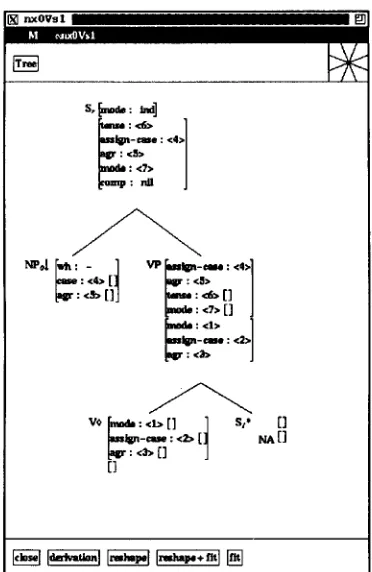
[image:2.612.79.284.56.282.2] [image:2.612.326.560.390.631.2]A tree editor for a tree contained in one of the tree buffer contained in the window can be called up by click- ing over its tree name. Each tree editor m a n a g e s one tree and as m a n y tree editors as needed can run concurrently. For example, Figure 2 holds a set of files (such as T n x 0 V s l . t r e e s ) 3 which each contain trees (such as a n x 0 V s l ) . W h e n this tree is selected for editing, the window shown in Figure 3 is displayed. Files can be handled independently or in group, in which case they form a tree family (flag F next to a buffer name).
: <'> I ["p" -" <~' (]] i " " : ~ [] I ~,o,~ : <:,> [] j
V~
<~, [] []
Figure 3: A tree-editing window for the tree a n x 0 V s l . All the editing and visualizing operations are per- formed through this window (see Figure 3). Some of t h e m are:
• Add and edit nodes.
• Copy, paste, move or delete subtrees.
• Combine two trees with adjunction or substitu- tion. These operations keep track of the deriva- tional history and u p d a t e a t t r i b u t e s stated in f o r m of feature structures as defined in the framework of unification-based tree-adjoining g r a m m a r [Vijay- Shanker and Joshi, 1988].
• View the derivational history of a derived tree and its components (elementary trees).
• Display and edit feature structures. • Postscript printing of the tree.
3The particular conventions for the tree and family names reflect the structure of the trees and they can be ignored by the reader.
XTAG
uses a centralized clipboard for all binary op- erations on trees (all operations are either u n a r y or bi- nary). These operations (such as paste, adjoin or substi- tute) are always performed between the tree contained inXTAG's
clipboard and the current tree. T h e contents of the clipboard can be displayed in a special view-only window.T h e request to view the derivational history of a tree result of a combining operation triggers the opening of a view-only window which displays the associated deriva- tion tree. Each node in a derivation tree is mouse- sensitively linked to an e l e m e n t a r y tree.
Since the derivational history of a derived tree depends on the elementary trees which were used to build it, inconsistency in the information displayed to the user could arise if the user a t t e m p t s to modify an elementary tree which is being used in a derivation. This p r o b l e m is solved by ensuring that, whenever a modifying operation is requested, full consistency is maintained between all the views. For instance, editing a tree used in a deriva- tion tree will break the link between those two. Thus consistency is maintained between the derived tree and the derivation tree.
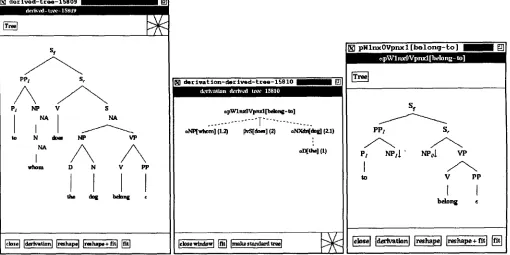
Figure 4 shows an example of a derived tree (leftmost window) with its derivation tree window (middle win- dow) and an elementary tree participating in its deriva- tion (rightmost window).
As is shown in Figure 3, the tree display module handles the bracketed display of feature structures (in unification-based TAG, each node is associated two fea- ture structures: top and b o t t o m , see Vijay-Shanker and Joshi [1988] for more details). T h e tree f o r m a t t i n g al- g o r i t h m guarantees t h a t trees t h a t are structural mirror images of on a n o t h e r are drawn such t h a t their displays are reflections of one another [Chalnick, 1989]. A unifi- cation module handles the u p d a t i n g of feature structures for T A G trees.
X T A G
includes a predictive left to right parser for unification-based tree-adjoining g r a m m a r [Schabes, 1991]. T h e parser is integrated intoX T A G
and deriva- tions are displayed by the interface as illustrated in Fig- ure 4. T h e parser achieves anO(G~n6)-time
worst case behavior,O(G2n4)-time
for u n a m b i g u o u s g r a m m a r s and linear time for a large class of g r a m m a r s . T h e parser uses the following two-pass parsing s t r a t e g y (originally defined for lexicalized g r a m m a r s [Schabeset al.,
1988]) which improves its p e r f o r m a n c e in practice [Schabes and Joshi, 1990]:• In the first step the parser will select, the set of structures corresponding to each word in the sen- tence. Each s t r u c t u r e can be considered as encoding a set of 'rules'.
[image:3.612.116.302.179.465.2]PP/
~ N
NA
I
Sr
V $
d ~ NP VP
D N V PP
I I I
~ [~--~ [~--~ 1~---~--~ ~]
,a~[vn~m] {1.21 I~'[d~] (21 ~¢~Ia~l {zl) a~[t~ l {l}
Sir
PPz
Pt NPI~ '
I
Sr
r~0~ w,
V P P
I
I
~ ~ Ir~shap e+ftt] [ ]
Figure 4: left, a derived tree, middle, its derivation, right, an elementary tree participating in the derivation.
T h e first step enables the parser to select a relevant subset of the entire grammar, since only the structures associated with the words in the input string are selected for the parser. T h e number of structures filtered during this pass depends on the nature of the input string and on characteristics of the grammar such as the number of structures, the number of lexical entries, the degree of lexical ambiguity, and the languages it defines. In the second step, since the structures selected during the first step encode the morphological value of their words (and therefore their position in the input string), the parser is able to use non-local bottom-up information to guide its search. T h e encoding of the value of the anchor of each structure constrains the way the structures can be combined. This information is particularly useful for a top-down component of the parser [Schabes and Joshi,
1990].
X T A G provides all the utilities required for designing a lexicalized TAG structured as in Schabes et al. [1988]. All the syntactic concepts of lexicalized TAG (such as the grouping of the trees in tree families which represents the possible variants on a basic subcategorization frame) are accessible through mouse-sensitive items. Also, all the operations required to build a grammar (such as load trees, define tree families, load syntactic and morpho- logical lexicon) can be predefined with a macro-like lan- guage whose instructions can be loaded from a file (See Figure 5).
T h e grammar writer has also the option to manually test a derivation by simulating adjoining or substitution of trees that are associated with words defined in the lexicon.
T h e grammar consists of a morphological English an-
alyzer and a syntactic lexicon, which is the domain of structural choice, subcategorization and selectional in- formation. Lexical items are defined by the tree struc- ture or the set of tree structures they select.
(defgrammar demol (: start-symbol "S"
:start-feature "<mode> = ind") (:tree-files "lex" "modifiers"
(:type "trees")) ( : f amily-f iles
"TnxOV" "TnxOVa" "TnxOVnxl" "TnxOVdnl" "TnxOVnxlpnx2" "TnxOVpnxl" "TnxOVsl" (:type "trees"))
(:lexicon-files "lexicon" (:type "lex")) (:example-files "examples" (:type "ex")))
Figure 5: An example of instructions for loading and defining a grammar.
The morphological lexicons for English [Karp el al.,
1992] were built with P C - K I M M O ' s implementation of two-level morphology [Antworth, 1990] and with the 1979 edition of Collins English Dictionary. T h e y com- prise 75 000 stems deriving 280 000 inflected forms.
X T A G also comes with a tree-adjoining grammar for English [Abeill@ et al., 1990a] which covers a large range of linguistic phenomena.
[image:4.612.59.569.62.317.2]domain of locality is that features imposed by a clausal lexical item can be stated directly on the subject node as well as on the object node. These features need not be percolated through the VP node as in context-free formalisms.
When a word can have several structures, correspond- ing to different meanings, it is treated as several lexical items with different entries in the syntactic lexicon. Mor- phologically, such items can have the same category and the same entry in the morphological lexicon 4. Examples of syntactic entries follow: 5
I N D E X : c u t
ENTRY: NP0 c u t into NP1
P0S: NP0 V P1 NPI
FS : # i n v - , # p a s s - DEF: make a n i n c i s i o n i n .
INDEX: cut
ENTRY: NP0 cut down (NPI) POS: NP0 V PL (NPI) FS: #pass+
DEF: consume less; reduce.
EX: "The city must cut its expenses down.' INDEX:
ENTRY: POS: FS: DEF:
a c c u s e
N P O a c c u s e NPI (of NP2)
NPO V NPI (P2 NP2)
#invl-, #dat-, #inv2-, #pass1+, #pass2-
say that somebody is guilty (of).
INDEX: ENTRY: POS:
FS:
DEF: EX:
f a c e
NPO f a c e away (from NP1)
NPO V PL (P1 NP1) # i n v - , # p a s s -
l o o k i n t h e o p p o s i t e d i r e c t i o n ( f r o m ) . My house faces away from the ocean.
3 T h e c h o i c e o f a g r a p h i c a l p a c k a g e : X W i n d o w a n d C L X
T h e choice of a graphical package was motivated by con- siderations of portability, efficiency, homogeneity and ease of maintenance. X T A G was built using Common Lisp and its X Window interface CLX.
We chose this rather low level approach to realize the interface as opposed to the use of a higher-level toolkit for graphic interface design because the rare tools avail- able which were fulfilling our requirements for portabil- ity, homogeneity and ease of maintenance were still un- der development at the beginning of the design of X T A G. T h e first package we considered was Express Window. It a t t r a c t e d our attention because it has precisely been created to run programs developed on the Symbolics ma- chine in other C o m m o n Lisp environments. It is an im- plementation of most of the Flavors and graphic prim- itives of the Symbolics system respectively in terms of the Common Lisp Object System (CLOS) [Keene, 1988] primitives and CLX [Scheifler and Lamott, 1989]. We 4The lexical entries below have been simplified for the purpose of exposition.
5Syntactic lexicons can be stated in various forms. In the following examples, a tree family is associated with each string of part of speeches (POS).
did not use it mainly because it was known to work only with the P C L version from Xerox Parc (we want to re- main as compatible as possible between the different di- alects of Common Lisp), and was not robust enough.
Although W I N T E R P has many interesting points for our purpose, we did not choose it because we wanted to have a complete and efficient (i.e. a compiler) Com- mon Lisp implementation. W I N T E R P is an interpre- tive, interactive environment for rapid prototyping and application writing using the OSF Motif toolkit [Young, 1990]. It uses a mini-lisp interpreter (called XLISP; it is not available as a compiler) to glue together various C- implemented primitive operations (Xlib [Nye, 1988] and Xtk [Asente and Swick, 1990]) in a Smalltalk-like [Gold- berg, 1983] object system (widgets are a first class type). W I N T E R P has no copyright restrictions.
Initially we were a t t r a c t e d by G A R N E T [Meyers et al., 1990], mainly because it is advertised as look-and-feel independent and because it is implemented using only Common Lisp and CLX (but not CLOS, nor any existing X toolkit such as Xtk or Motif). T h e system is composed of two parts: (1) a toolkit offering objects (prototype instance model [Lieberman, 1986], constraints, (2) and an automatic run-time maintenance of properties of the graphic objects based on a semantic network. The dif- ferent behavior of the interface components is specified by binding high level interactors objects to the graphic objects. An interface builder tool (Lapidary) allows the drawing of the graphic aspects of an interface. How- ever we did not use G A R N E T because the version at the time of the design of X T A G was very large and slow, and still subject to changes of design. Furthermore, an- other reason for not choosing G A R N E T was the fact t h a t Carnegie Mellon University retained the copyrights, slowing the distribution.
PICASSO [Schank et al., 1990], a more recent pack- age from Berkeley University, offers similar functionali- ties shared by other non C o m m o n Lisp based applica- tion frameworks like InterViews [Linton et al., 1989], MacApp [Schmuker, 1986] and Smalltalk [Goldberg, 1983], b u t is freely distributed. It is an object-oriented system implemented in Common Lisp, CLX and CLOS. With each type of PICASSO object is associated a CLOS class, the instances of which have different graphic and interactive properties. T h e widgets implementing those properties are automatically created during the creation of a PICASSO object. Unlike the two previous sys- tems, the PICASSO objects may be shared in an ex- ternal database common to different applications (per- sistent classes) when this is enabled, PICASSO requires the use of the database m a n a g e m e n t system INGRES [Charness and Rowe, 1989]. PICASSO was not available as a released package at the time the implementation of X T A G started.
4 P r o g r a m m i n g c o n s i d e r a t i o n s
graphic object of XTAG (whatever its complexity as a contact is) without having to resort to a different proce- dure oriented implementation for simpler objects as was done in InterViews with the painter objects [Linton et
al., 1989].
T h e programming difficulties we have encountered deal with re-synchronizing XTAG with the server during a transfer of control between contacts (the active con- tact is the one containing the cursor). These difficulties stem from the asynchronous nature of the communica- tion protocol of X and from the large number of events mouse motion may generate when the cursor is moved over closely located windows. T h e fact that windows may be positioned anywhere and stacked in any order (overlapping windows) makes the handling of those tran- sitions a non trivial task. A careful choice of the event- masks attached to the windows is by itself insufficient to solve the problem. To limit the number of queries made to the server, we use extensive caching of graphic prop- erties. T h e structures implementing the contacts con- tain fields that duplicate server information. T h e y are updated when the graphic properties of the object they describe are changed. We found this strategy to improve the performance noticeably. This feature can easily be turned off, in case a particular X-terminai or workstation would provide hardware support for caching.
While we put a lot of attention on issue of portabil- ity, we did not worry about look independence, limiting the user possibilities in this domain to geometric dimen- sion parameterization and font selection by means of a configuration file and a few menus.
Our current implementation uses the twin window manager, but another window manager could also be used. We have found the need for multi-font string sup- port for X T A G because the tree names and node labels require a mix of at least two or three fonts (ascii sym- bols and greek symbols such as c~, fl and e, and a font for subscripts). We could have used a font which contains all the characters may use the same font as the normal differ from those only by their location to the writing line), but we preferred to define a multi-font composed of several existing fonts (which can be customized by the user) for portability purposes and to leave open the way for future extensions.
In order to be able to scroll over the trees when they are too big to be displayed in a window, every tree editor window is associated with an eight direction touch-pad (inspired from the mover of InterViews [Linton et al.,
1989]).
T h e nodes displayed in the window of a tree editor are not sensitive to the presence of the cursor, they re- act only to mouse b u t t o n clicks. During earlier versions of X T A G we highlighted the visited node with a border, but this required too much overhead because of the nu- merous cursor motions over the tree window which occur during editing.
T h e text editing task we had to implement fall into two classes:
• short line editing requiring multi-fonts (e.g. edition of node names);
• text editing not requiring multi-fonts (e.g. multi- line comments, unification equations).
For the former, we implemented all the editing func- tions ourselves because they do not require much pro- cessing and multi-font support was unavailable. For the latter, we used system calls to an external editor (emacs in our case).
Concerning the programming task, we would have liked to have available tools to help us write an X ap- plication in Common Lisp at a level slightly higher than the one of the CLX interface without going up to the level of elaborate toolkits like G A R N E T or PICASSO which implies the use of a complex infra-structure, per- haps something like an incremental or graded toolkit.
Our next developments effort will be concerned with introducing parallelism in the interface (actors), adding new features like an undo mechanism (using the Item list data structure proposed by Dannenberg [1990]), and extending XTAG for handling meta-rules [Becker, 1990] and Synchronous TAGs [Shieber and Schabes, 1990b] which are used for the purpose of automatic trans- lation [Abeill~ et ai., 1990b] and semantic interpreta- tion [Shieber and Schabes, 1990a; Shieber and Schabes, 1991].
5 R e q u i r e m e n t s f o r R u n n i n g X T A G
Version 0.93 of X T A G is available as pub/xtagO. 93.tar.Z
by anonymous ftp to linc.cis.upenn.edu (130.91.6.8). 6
X T A G requires:
• A machine running UNIX and X l l R 4 . 7
• A Common Lisp compiler which supports the latest definition of C o m m o n Lisp [Steele, 1990]. Although
X T A G should run under a variety of lisp compil- ers, it has only been tested with LUCID Common Lisp 4.0 and Allegro Common Lisp 4.0.1. A version running under KCL is currently under development. • Common Lisp X Interface (CLX) version 4 or
higher .s
X T A G has been tested on UNIX based machines (R4.4) (SPARC station 1, SPARC station SLC, HP BOBCATs series 9000 and SUN 4 also with NCD X- terminals) running X l l R 4 and CLX with Lucid Com- mon Lisp (4.0) and Allegro Common Lisp (4.0.1). 6 C o n c l u s i o n
We described a workbench for the development of tree- adjoining grammars and their parsers and discussed some issues that arise in the design of the graphic in- terface.
The unique characteristics of tree-adjoining gram- mars, its elementary objects found in the lexicon (ex- tended trees) and the derivational history of derived 6Newer versions of the system are copied into the same directory as they become available.
rPrevious releases of X will not work with XTAG. X11R4 is free software available from MIT.
trees (also a tree), require a specially crafted interface in which the perspective is shifted from a string-based
to a tree-based system. X T A G provides such a work-
bench.
The kernel of XTA G is a predictive left to right parser
for unification-based tree-adjoining grammar [Schabes,
1991]. XTAG includes a graphical editor for trees, a
graphical tree printer based on a new algorithm, utili- ties for manipulating and displaying feature structures for unification-based tree-adjoining grammar, facilities for keeping track of the derivational history of TAG trees combined with adjoining and substitution, a parser for unification based tree-adjoining grammars, utilities for defining grammars and lexicons for tree-adjoining gram- mars, a morphological recognizer for English (75 000 stems deriving 280 000 inflected forms) and a tree- adjoining grammar for English that covers a large range of linguistic phenomena.
X T A G without the large morphological and syntactic lexicons is public domain software. The large morpho- logical and syntactic lexicons can be obtained through an agreement with ACL's Data Collection Initiative.
X T A G runs under Common Lisp and X Window (CLX).
A c k n o w l e d g m e n t s
Many people contributed to the development of XTAG.
We are especially grateful to Mark Liberman for his help with the extraction of morphological and syntactic information available in the data collected by the ACL's Data Collection Initiative.
We have benefitted from discussions with Evan Antworth, Lauri Karttunen, Anthony Kroch, Fernando Pereira, Stuart Shieber and Annie Zaenen.
Anne Abeille, Kathleen Bishop, Sharon Cote, Beat-
rice Daille, Jason Frank, Caroline Heycock, Beth A n n
Hockey, Megan Moser, Sabine Petillon and Raffaella Zanuttini contributed to the design of the English and French TAG grammars.
The morphological lexicons for English were built by Daniel Karp.
Patrick Martin automated the acquisition of some of syntactic lexicons with the use of on-line dictionaries.
We would like to thank Jeff Aaronson, Tilman Becker, Mark Foster, Bob Frank, David Magerman, Philip Resnik, Steven Shapiro, Martin Zaidel and Ira Winston for their help and suggestions.
R e f e r e n c e s
[Abeill~ et al., 1990a] Anne AbeiU~, Kath-
leen M. Bishop, Sharon Cote, and Yves Schabes. A lexicalized tree adjoining grammar for English. Tech- nical Report MS-CIS-90-24, Department of Computer and Information Science, University of Pennsylvania, 1990.
[Abeill~ et al., 1990b] Anne Abeill~, Yves Schabes, and
Aravind K. Joshi. Using lexicalized tree adjoining
grammars for machine translation. In Proceedings of
the 13 ~h International Conference on Computational
Linguistics (COLING'90), Helsinki, 1990.
[Abeilld, 1988] Anne Abeill& A lexicalized tree adjoin- ing grammar for French: the general framework. Tech- nical Report MS-CIS-88-64, University of Pennsylva- nia, 1988.
[Antworth, 1990] Evan L. Antworth. PC-KIMMO: a
two-level processor for morphological analysis. Sum- mer Institute of Linguistics, 1990.
[Asente and Swick, 1990] P. J. Asente and R. R. Swick. X Window System Toolkit. Digital Press, 1990.
[Becket, 1990] T. Becket. Meta-rules on tree adjoining
grammars. In Proceedings of the 1st International
Workshop on Tree Adjoining Grammars, Dagstuhl Castle, FRG, August 1990.
[Chalnick, 1989] Andrew Chalnick. Mirror image dis- play of n-ary trees. Unpublished manuscript, Univer- sity of Pennsylvania, 1989.
[Charness and Rowe, 1989] D. Charness and L. Rowe. CLING/SQL - Common Lisp to INGRES/SQL in- terface. Technical report, U.C. Berkeley, Computer Science Division, 1989.
[Dannenberg, 1990] R. B. Dannenberg. A structure for efficient update, incremental redislay and undo in
graphical editors. Graphical Editors, Software Prac-
tice and Experience, 20(2), February 1990.
[Goldberg, 1983] A. Goldberg. Smalltalk-80: The Inter-
active Programming Environment. Addison Wesley, 1983.
[Joshi and Schabes, 1991] Aravind K. Joshi and Yves
Schabes. Tree-adjoining grammars and lexicalized
grammars. In Maurice Nivat and Andreas Podel-
ski, editors, Definability and Recognizability of Sets of
Trees. Elsevier, 1991. Forthcoming.
[Joshi et al., 1975] Aravind K. Joshi, L. S. Levy, and
M. Takahashi. Tree adjunct grammars. Journal of
Computer and System Sciences, 10(1), 1975.
[Joshi, 1985] Aravind K. Joshi. How much context-
sensitivity is necessary for characterizing struc-
tural descriptions--Tree Adjoining Grammars. In
D. Dowty, L. Karttunen, and A. Zwicky, editors, Natu-
ral Language Processing--Theoretical, Computational and Psychological Perspectives. Cambridge University Press, New York, 1985.
[Joshi, 1987] Aravind K. Joshi. An Introduction to Tree Adjoining Grammars. In A. Manaster-Ramer, editor, Mathematics of Language. John Benjamins, Amster- dam, 1987.
[Karp et al., 1992] Daniel Karp, Yves Schabes, and
Martin Zaidel. Wide coverage morphological lexicons
for English. Submitted to the 14 th International Con-
ference on Computational Linguistics (COLING'92), 1992.
[Keene, 1988] S. Keene. Object-Oriented Programming
in Common Lisp. Addison-Wesley, 1988.
of Computer and Information Science, University of Pennsylvania, April 1985.
[Lee, 1987] Albert Lee. Performance oriented tree-
display package. University of Pennsylvania Senior Thesis, 1987.
[Lieberman, 1986] H. Lieberman. Using prototypical ob- jects to implement shared behavior in object oriented
systems. In A CM Conference on Object-Oriented Pro-
gramming Systems Languages and Applications, 1986.
[Linton et al., 1989] M. A. Linton, J. M. Vlissides, and
P. R. Calder. Composing user interfaces with inter-
views. IEEE Computer, February 1989.
[Meyers et al., 1990] B. A. Meyers, D. Giuse, B. Dan-
nenberg, and V. B. Zanden. The garnet toolkit refer- ence manuals: Support for highly-interactive, graphi- cal user interfaces in lisp. Technical Report CMU-CS- 90-117, Carnegie Mellon University, 1990.
[Nye, 1988] A. Nye. Xlib Progamming Manual (Vol. 1),
Xlib Reference Manual (Vol. P). O'Reilly and Asso- ciates, 1988.
[Reingold and Tolford, 1981] E.M. Reingold
and John S. Tolford. Tidier drawing of trees. IEEE
Transactions on Software Engineering, SE-7:223-228, 1981.
[Schabes and Joshi, 1990] Yves Schabes and Aravind K. Joshi. Parsing with lexicalized tree adjoining gram-
mar. In Masaru Tomita, editor, Current Issues in
Parsing Technologies. Kluwer Accadernic Publishers, 1990.
[Schabes et al., 1988] Yves Schabes, Anne Abeill~, and
Aravind K. Joshi. Parsing strategies with 'lexicalized' grammars: Application to tree adjoining grammars. In Proceedings of the 12 ~h International Conference on
Computational Linguistics (COLING'88), Budapest, Hungary, August 1988.
[Schabes, 1989] Yves Schabes. TAG system user manual for Symbolics machines, 1989.
[Schabes, 1990] Yves Schabes. Mathematical and Com-
putational Aspects of Lexicalized Grammars. PhD the- sis, University of Pennsylvania, Philadelphia, PA, Au- gust 1990. Available as technical report (MS-CIS-90- 48, LINC LAB179) from the Department of Computer Science.
[Schabes, 1991] Yves Schabes. The valid prefix property and left to right parsing of tree-adjoining grammar. In Proceedings of the second International Workshop on Parsing Technologies, Cancun, Mexico, February 1991.
[Schank et al., 1990] P. Sehank, J. Konstan, C. Liu,
A . R . , S. Seitz, and B. Smith. Picasso reference
manual. Technical report, University of California, Berkeley, 1990.
[Scheifler and Lamott, 1989] W. Seheifler,
R. and O. Lamott. Clx - common lisp x interface. Technical report, Texas Instruments, 1989.
ISchifferer, 19881 Klaus Schifferer. TAGDevENV eine Werkbank fiir TAGs. Technical report, KI - Labor
am Lehrstuhl fiir Informatik, Universit~ des Saarlan- des, June 1988.
[Schmuker, 1986] K. J. Schmuker. Mac-app: An appli-
cation framework. Byte, August 1986.
[Shieber and Schabes, 1990a] Stuart Shieber and Yves Schabes. Generation and synchronous tree adjoining
grammars. In Proceedings of the fifth International
Workshop on Natural Language Generation, Pitts- burgh, 1990.
[Shieber and Schabes, 1990b] Stuart Shieber and Yves Schabes. Synchronous tree adjoining grammars. In Proceedings of the 13 th International Conference on Computational Linguistics (COLING'90), Helsinki, 1990.
[Shieber and Schabes, 1991] Stuart Shieber and Yves Schabes. Generation and synchronous tree adjoin-
ing grammars. Computational Intelligence, 4(7), 1991.
forthcoming.
[Steele, 1990] Guy L. Jr. Steele, editor. Common LISP-
the Language. Digital Press, second edition, 1990. [Vijay-Shanker and Joshi, 1988] K. Vijay-Shanker and
Aravind K. Joshi. Feature structure based tree ad-
joining grammars. In Proceedings of the 12 th In-
ternational Conference on Computational Linguistics (COLING'88), Budapest, August 1988.
[Young, 1990] D. A. Young. OSF/MOTIF Reference