Adi Palm
University of Passau
1. Introduction
Many TAG-based systems employ a particular tree adjoining grammar to generate the intended structures of the set of sentences they aim to describe. However, in most cases, the underlying set of elementary trees is more or less hand-made or maybe derived from a given tree data-base. We present a formal framework that allow to specify tree adjoining grammars by logical formulae. Based on this formalism we can check whether a given specification is TAG-consistent or whether a given TAG meets some particular properties. In addition, we sketch a method that generates a TAG from a given logical specification. As formal foundation, we employ a particular version of modal hybrid logic to specify the properties of T/D-trees. Such trees structurally combine a derived TAG-treeT and its associated derivation treeD. Finally, we sketch a labeled tableau calculus that constructs a set of tree automata representing the elementary trees of the specified TAG and a special tree automaton for the corresponding derivation trees.
In literature, we find some approaches specifying TAGs, or more generally, mildly context-sensitive grammar formalisms, that gradually vary in their underlying framework. Commonly, either starts with a logical description of recognizable sets of trees (Thatcher and Wright, 1968). However, they differ in their method of leaving the context-free paradigm. The approach mentioned in (Morawietz and M¨onnich, 2001) and (Michaelis, M¨onnich and Morawietz, 2000) uses a ‘lifting’ function that encodes a TAG into a regular tree grammar. In (Rogers, 1999) (and related works) we find a logical description of TAGs that is based on a 3-dimensional view of trees. The important issue of this approach is to combine the derived TAG-tree and its derivation tree to a single 3-dimensional structure. Similarly, we also consider the derived TAG-tree and its derivation tree employ so-called T/D-trees. However we only associate the nodes of the derived tree with the corresponding node in the derivation tree. Consequently, all nodes of the same instance of an elementary tree refer to the same corresponding node in the derived tree. Therefore, we can specify structural properties of the derived TAG-tree and of the derivation tree at the same time. Using the links to the derivation tree, we can identify nodes in the TAG tree that belong to the same instance of some elementary tree. In contrast to the other approaches mentioned above which encode the TAG-tree into other kind of structures, we keep the original derived TAG tree as a structural unit. Consequently, we can directly access the nodes and the structural properties of the TAG tree without employing a particular projection function or any other special coding issues.
In essence, our formalism employs modal hybrid logic that combines the simplicity of modal logic and the expressivity of classical logic. The use of so-called nominals in hybrid logic offer explicit references to certain tree nodes which is (directly) possible in modal approaches. We introduce the hybrid language HLTAGthat specifies properties of the combined structure of derived TAG-trees and their derivation trees. Using this language we specify a number of TAG axioms which establish a notion of TAG-consistency. Further, we briefly illustrate a formalism that constructs a number of tree automata representing the underlying TAG for a given TAG-consistent HLTAGformula.
2. A Hybrid Language for TAGs and their Derivations
Our formalism considers pairs of trees called T/D-trees as introduced in (Palm, 2000) whereT represents a derived TAG-tree andDdenotes the corresponding derivation tree. In general, a derived TAG treeT= (t, Vt)is made up of akt-tree domaint⊆ {1, . . . , kt}∗forkt>0and a labeling functionVt:t→Pow(Pt)decorating tree nodes with a set of propositions ofPt. The set of propositionsVt(n)of some nodenmay be viewed as the label ofn. Likewise, a derivation treeD= (d, Vd)is made up of akd-tree domaind⊆ {1, . . . , kd}∗for somekd >0 and a labeling functionVd:d→Pow(Pd). In addition, each T/D-tree includes the total linking functionτ:t→d that associates each node in the derived TAG treeT with the corresponding instance of its elementary tree in the derivation treeD.
∗
An extended version can be found athttp://www.phil.uni-passau.de/linguistik/palm/papers/
c
2002 Adi Palm. Proceedings of the Sixth International Workshop on Tree Adjoining Grammar and Related Frameworks
S
A
: 1
B
: 2
α
A
A
B
B
[image:2.595.145.456.81.203.2] [image:2.595.170.429.245.395.2]β
1β
2... ...
... ...
... ...
...... ......
...... ......
... ...
... ...
...... ......
...... ...... ......
... ...
... ...
...... ......
...... ... ...
... ...
... ......
...... ......
...... ...... ...
... ...
... ......
...... ......
...
Figure 1: Sample TAG with the initial treeαand two auxiliary treesβ1andβ
β
1β
2α
S
A
A
B
B
... ...
... ......
... ...
... ...
... ...
... ......
...... ......
......
... ...
... ...
...... ......
...... ...... ......
... ...
... ...
...... ......
...... ... ...
... ...
... ......
...... ......
... ... ...
... ...
...... ......
...... ...
... ...
... ...
... ...
... ...
... ...
... . . . . . . . . . . . . . . ......
...... ...............
... ...
... ...
... ...
... ...
... ... ... . . .
...... ......
......... ... ......
...... ...
...... ......
......
... ...
... ...
Figure 2: Resulting T/D-tree after adjoiningβ1andβ2inα
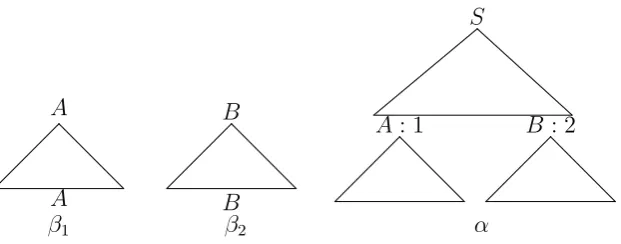
The correspondence between either trees works straightforwardly. By the treeT we represented the derived TAG tree which results from an initial tree after adjoining and substituting auxiliary trees. By the derivation treeD we graphically represent these operations. Each children position of some nodeninDrepresents a certain place of adjunction (or substitution) in the elementary tree represented byn. For instance, in Figure 1, the elementary treeαincludes two nodes where we can adjoin another tree; we uniquely associate these nodes with the numbers 1 and 2, respectively . Now if we adjoinβ2at the second node, this instance ofβ2in the derivation tree becomes
the second childn.2 of the nodenrepresenting the corresponding instanceα. Once we adjoined the treeβ1 at
the first position,nobtains its first childn.1representing this instance ofβ1. Obviously, we associated each node
of the corresponding instances of α, β1 andβ2 in the derived TAG-tree with the nodesn, n.1 andn.2 in the
derivation tree, respectively. Figure 2 shows the resulting T/D-tree. Note that for our formalism we assume that we can only adjoin at the inner nodes of an elementary tree, i.e. there is no adjunction at the root or at some leaves. This restriction ensures that the parent of the root and the children of the foot are nodes of the tree at which the adjunction took place.
For the formal foundation of our TAG-specification language we employ hybrid modal logic HL (Blackburn and Tzakova, 1998), (Blackburn and Tzakova, 1999), (Blackburn, 2000a; Blackburn, 2000b). This formalism ex-tends modal (or temporal) logic with particular propositions called nominals which enable references to particular nodes (or terms) in a model. Further, there is an implemented tableau-based prover (Blackburn, Burchard and Walter, 2001) which is partially based on (Tzakova, 1999). Compared with classical logic we prefer modal and hybrid approaches since they allow more compact proofs and specifications.
symbolsNom. Altogether, we obtain the hybrid language HLTAG(Pt,Pd,Nom)which is defined as:
ϕ ::= p|i|i:ϕ| ¬ϕ|ϕ∧ϕ|#rϕ|3ϕ| ♥ϕ
where1≤r≤k(withk=max{kt, kd}),p∈ Pt∪ Pddenotes a propositional constant andi∈ NT /Da nominal. Further, we can define the operators∨,→,↔and2in the standard way. In addition, we define the next-operator referring to some child by#ϕ≡#1ϕ∨. . .∨#kϕand its dual universal counterpart by~ϕ≡ ¬#¬ϕ.
For the semantics of hybrid logic, we consider, in general, Kripke-structures which are, for the case of HLTAG, T/D-trees. Besides the structural information a T/D-tree associates each tree node of either tree with sets of constant propositions fromPT andPD, respectively. In addition, we require a nominal denotation functiong:Nom → (t∪d)evaluating the nominals. We interpret a given HLTAG(Pt,Pd,Nom)formulaϕat some noden ∈ ∪dof a treeT /Dfor a nominal denotation functiong:Nom →t∪dwheregis only necessary for formulae including nominals. For the nodenwe assume that we know whether it is a member oftord.
T /D, n|=p iff n∈Vt(p)∪Vd(p), forp∈ PT∪ PD T /D, n|=¬ϕ iff T/D, n6|=ϕ
T /D, n|=ϕ∧ψ iff T /D, n|=ϕand T /D, n|=ψ
T /D, n|=#rϕ iff T /D, n.r|=ϕ,1≤r≤kwherek=max{kt, kd}
T /D, n|=3ϕ iff T /D, n.a|=ϕfor somea∈ {1, . . . , k}∗wherek=max{kt, kd} T /D, n|=♥ϕ iff T /D, τ(n)|=ϕ
A T/D-tree satisfies the formulaϕifϕholds for the root ofT. The link operator♥is self-dual, i.e.♥ϕ≡ ¬♥¬ϕ. For the nominal expressions, we define the semantics as follows:
T /D, n, g|=i iff g(n) =i T /D, n, g|=i:ϕ iff T /D, n0, g|=ϕ
andg(n0) =i
A nominal uniquely denotes a certain tree node where we do not explicitly distinguish the elements ofT andD. The statementiis true if and only if the nominalidenotes the node under consideration. In contrast, ini:ϕwe refer to the node denoted byiwhich does not depend on the node considered currently. We say a T/D-treeT /D satisfies the (nominal) formula ϕat the noden ∈ t∪d, writtenT /D, n |= ϕ, if there is a nominal denotation g:Nom →(t∪d)such thatT /D, n, g |=ϕis true. Similarly,T /Dsatisfiesϕ, writtenT /D |=ϕif there is a nominal denotationgsuch thatT /D,roott, g|=ϕwhere roottdenotes the root of the derived TAG treeT. Hence T /D |=ϕ∧2ϕstates thatϕmust apply to all nodes of the derived TAG tree,T /D|=♥ϕstates thatϕapplies to the root of the derivation tree andT /D|=♥(ϕ∧2ϕ)states thatϕapplies to all nodes of the derivation tree. Finally, a HLTAGformulaϕis satisfiable if and only if there is aT /D−treeand a nominal denotationgsuch that ϕsatisfiesT /Dbyg.
Note that employing nominal propositions increases the expressivity of the former language. For instance, we can define the until-operator “untilϕis trueψmust apply” or the unique existence operator31ϕwhich are not
expressible in ordinary modal logic (Blackburn and Tzakova, 1999).
until(ϕ, ψ) ≡ 3(ϕ∧i)∧2(3i→ψ)
31ϕ ≡ 3(i∧ϕ)∧2(ϕ→i)
n
2n
1m
1=
m
2 [image:4.595.207.387.83.159.2].. ..
... ...
... ...
...... ......
... ...
...... ...
... ... ... ... ... ... ... ... ......
... ...
... ...
... ... . . . . . . . .........
... ...
...... ...... ...
Figure 3: T/D-tree:n1andn2are internal nodes of the same elementary represented bym1andm2.
until operator, or byi∧2¬iwe can demand that the underlying modal reachability relation is irreflexive. Either of these properties fails to be expressible by means of propositional modal logic. On the other hand, we can specify the standard translation from hybrid logic to classical first-order logic. Therefore hybrid logic cannot be stronger than first-order logic. Moreover, as shown in (Schlingloff, 1992; Palm, 1997) the expressive power of the first-order logic for trees and the temporal logic for trees is identical. Since we can formulate the until-operator by means of hybrid logic, we obviously reach the expressivity of the temporal logic and the first logic on trees. However, the more crucial aspect of our formalism is the link operator ♥which allows to identify particular sets of tree nodes in the derived tree by referring to the same node in the derivation tree. Consequently, HLTAGdescribes first-order definable sets of derivation trees; the expressivity for the derived tree obviously depends on the properties of linking functionτ. Next we discuss some restrictions onτleading to tree adjoining grammars.
3. TAG Axioms for HLTAG
Obviously, by the language HLTAGwe can describe derived TAG trees and their corresponding derivation trees in an appropriate manner. However, so far it is unclear, what the necessary properties of aT /Dtree are in order to describe valid TAG-trees and their derivations. Likewise, we want to know whether a given HLTAGformulaϕis TAG-satisfiable, i.e. whether the set ofT /Dsatisfyingϕrepresents a certain TAG. The answer to either question is the set of TAG axioms for the language HLTAG. Hence, a T/D-tree would be TAG generated if and only if it meets these axioms, and a HLTAG-formulaϕis TAG-satisfiable if and only if it is consistent with these axioms, i.e.ϕand the axioms are satisfiable.
Before we turn to the axioms in detail, we examine the construction and the structural properties of a T/D-tree by a given TAG derivation. For simplification purposes we put some restriction on the kind of TAGs considered here. At first, we restrict our formalism to the adjunction operation and ignore substitution. Nevertheless it is possible to simulate a substitution by an adjunction. Further, we assume that nodes, where adjunction is possible, are marked by the special auxiliary proposition adj and, correspondingly, all non-adjunction nodes must fail adj. Moreover, an adjunction node must be an inner node of an elementary tree, i.e. it cannot be the root or some leaf. As a consequence, we obtain only TAG trees where an adjoined tree is completely surrounded by the elementary tree it was adjoined to. This leads to the following lemma:
Lemma 3.1
LetT /D = h(t, vt),(d, Vd), τibe a TAG-generated T/D-tree andn1, n2 ∈ t,m1, m2 ∈ dwithm1 = τ(n1),
m2=τ(n2)andn2=n1.rfor some1≤r≤kt. Then exactly one of the following cases must be true:
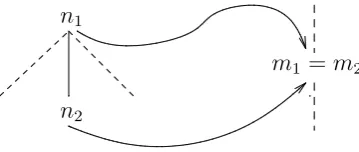
1. m1=m2
2. m1.s=m2, for some1≤s≤kd
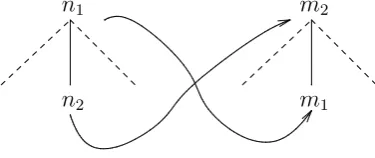
3. m1=m2.s, for some1≤s≤kd
This lemma considers the properties of a pair of immediately dominating nodesn1andn2in the derived TAG
tree. In the first case, both nodes belong to the same instance of an elementary tree. Therefore, they are linked to the same node in the derivation tree, as illustrated in Figure 3. The second casen2is the root of an adjoined tree.
m
2m
1n
1n
2 ... . . . . . ...... ... ... ... . . . . . . . . . . . . . . . . . . . . . . . . . . . . . . . . . . . . . . . . . . . . . . . . . . . . . . . . . . . . . . . . . . . . . . . . . . . . . . . . . . . . . . . . . . . . . . . . . . . . . . . . . . . . . . . . . . . . . . . . . . . . . . . . . . . . . . . . . . . . . . . . . . . . . . . . . . . . . . . . . . . . . . . . . . . . . . . . . . . . . . . . . . . . . . . . . . . . . . . . . . . . . . . . . . . . . . . . . . . . . . . . . . . . . . . . . . . . . . . . . . . . . . . .. ... ... ... ... ...... ... ... ... ...... ... ... .. ... ... ... ... ...... ... ... ... ...... ... ...Figure 4: T/D-tree:n2is the root node of the elementary represented bym2
n
2n
1m
1m
2 .. ... ... ... ... ...... ... ... ...... ... ... ... .. ... ... ... ... ...... ... ... ...... ... ... ... ...... ......... ... ... ... ... ... ... ... ... ... ... . . . . ...... ...... ...... ...... ...... ...... ...... ... ... ... ... . . . . . . . . . . . . . .Figure 5: T/D-tree:n1is the foot node of the adjoined elementary tree represented bym1
In the third case,n1is the foot node of an adjoined tree and, by assumption, each of its children must be a node of
the tree where the adjunction took place. Consequently,m1must be a child ofm2, see Figure 5. Finally, due to
above assumptions, no other case is possible.
Now we turn to the TAG axioms of HLTAGwhich ensure that a given formula describes a TAG. For the general tree axioms we refer to the similar modal tree logic as presented for example in (Blackburn, Meyer-Viol and de Rijke, 1996). However, the more interesting issue are the TAG axioms. They should ensure that HLTAGformulae only describe TAG-generated T/D-trees. For simplification, we introduce two auxiliary propositions foot and root that mark the corresponding nodes of an adjoined elementary tree. The TAG-axioms standing below assert the correct distribution of the auxiliary propositions root and foot and the correct linking between the derived and the derivation tree.
(D1) Troot:root∧ ♥Droot (associating the root nodes) (D2) (i∧root∧ ♥k∧j: (root∧ ♥k))→j:i (unique root)
(D3) (i∧foot∧ ♥k∧j: (foot∧ ♥k))→j:i (unique foot) (D4) (i∧ ♥k∧j: (root∧ ♥k))→j: (i∨3i) (root domination)
(D5) #rroot↔#r♥i∧ ♥#i (link properties of the root)
(D6) foot↔ ♥i∧~♥#i (link properties of the root)
(D7) ¬foot∧#r¬root↔ ♥i∧#r♥i (link properties of the inner nodes)
Obviously, due to Lemma 3.1 and the properties of a TAG derivation, every T/D-tree that is generated by a given TAG must meet these axioms. Thus, these axioms are sound with respect to tree adjoining grammars. However, the opposite direction is less obvious. It states that every T/D-tree satisfying these axioms must be generated by a tree adjoining grammar. Next we describe a tree-extraction formalism that establishes this:
1. We arbitrarily select a leaf of the derivation tree with some nominalkand, further, we consider all nodes in the derived tree that are linked withk.
2. By the axioms (D2) and (D3) there must be a unique root and foot and by (D4) all nodes the are linked withk are weakly dominated by the the root. In addition, sincekhas no child, no other tree was adjoined. Therefore, due to (D5), (D6) and (D7) all nodes that are linked withkdefine a coherent tree section in the treet.
3. We extract the tree section as identified previously, and we replace it by a single adjunction node that is linked with the parent ofk.
4. We removekin the derivation tree
5. We repeat the steps above until a single node in the derivation tree remains.
6. Due to (D1) the remaining structure defines the underlying initial tree of that TAG-tree. The trees we extracted above are the corresponding elementary trees.
This formalism illustrates how to construct a TAG for any given t/d-tree satisfying the axioms (D1) to (D7) such that the resulting TAG generates the given T/D-tree. In general, we obtain that a T/D-tree is TAG generated, if and only if it meets these axioms at every node of the derived tree.
Moreover this formalism can be extendedtin the following way. So far we know that every HLTAGformula that is consistent with the TAG axioms (D1) to (D7) specifies a set of trees where each member is generated by a certain TAG. We briefly sketch a method that constructs a corresponding TAG for a given TAG-consistent HLTAG formula. Therefore, we combine the above extraction formalism with an ordinary method of constructing tree models, especially tree automata, from a given modal tree description. The desired result are two linked tree-automaton for the derived tree and the derivation tree. Instead of linking to certain tree nodes of the derivation tree, we employ links to the states of the corresponding tree automaton. Then we can apply a slightly modified version of the extraction method to these tree automata. Instead of extracting trees, this modified version considers subtree automata. The final result is a (finite) set of tree automata where each of them represents a set of initial trees. In addition, the resulting automaton for the derivation tree expresses possible adjunction operations for these automata.
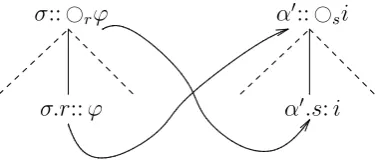
In order to construct these automata, we can employ, for instance, well-known labeled tableau methods as described in (Gor´e, 1999), which were adopted for our purposes. The overall goal is to construct a set of simple tree automata representing the initial trees of the TAG described and another special tree automaton representing the corresponding derivation trees. Using labeled formulae in the tableau, we can indicate the node and the tree the formulae considered must apply to. A crucial part of the tableau system concerns the construction of therth successor of some node by the formula#rϕ:
(#r)
α, σ::#rϕ
α, σ::♥i α, σ::♥#si α, σ::♥i α, σ.r::ϕ α.s, σ.r::ϕ α0, σ.r::ϕ α, σ.r::♥i α.s, σ.r::♥i α0, σ.r::♥#si α, σ::¬foot α, σ.r::root α, σ::foot α, σ.r::¬root
σ.r
::
ϕ
σ
::
#
rϕ
α
::
i
[image:7.595.212.383.133.210.2] [image:7.595.202.393.351.435.2] [image:7.595.204.392.575.655.2].. .. ... ... ... ... ...... ...... ... ... ...... ... ... ... ... ... ... ... ... ... ...... ... ... ... ... ... . . . . . . ......... ... ... ...... ......... ... ... ..
Figure 6: tableau rule for#rϕ: inner nodes
α.s
::
i
α
::
#
si
σ
::
#
rϕ
σ.r
::
ϕ
... . . . . . ... ... ... ... ... ... ... ... ... ... .. ... ... . . . . . . . . . . . . . . . . . . . . . . . . . . . . . . . . . . . . . . . . . . . . . . . . . . . . . . . . . . . . . . . . . . . . . . . . . . . . . . . . . . . . . . . . . . . . . . . . . . . . . . . . . . . . . . . . . . . . . . . . . . . . . . . . . . . . . . . . . . . . .. ... ... ... ... ...... ... ...... ... ... ...... .. ... ... ... ... ...... ... ...... ... ... ......
Figure 7: tableau rule for#rϕ: root node
σ.r
::
ϕ
σ
::
#
rϕ
α
0.s
:
i
α
0::
#
si
.. ... ... ... ... ...... ... ... ...... ... ...... .. ... ... ... ... ...... ... ... ...... ... ...... ...... ......... ... ... ... ... ... ... ... ... ... ... . . . . ...... ...... ...... ...... ...... ...... ...... ... ... ... ... . . . . . . . . . . . . . .
Most other rules of this labeled tableau calculus are more or less straightforward or result from the require-ments of the TAG axioms. To obtain tree automata from the tableau, we define classes of equivalent labels including the same set of formulae:
α, σ≈α0, σ0iff{ϕ|α, σ::ϕ}={ϕ|α0, σ0::ϕ}
Obviously, the number of such equivalence classes is finite, since the number of occurring subformulae is finite as well. Every class defines some state of a tree automaton, and the immediate dominance relation leads to the state transition relation. Accordingly, we can extract the tree automaton for each elementary treeαby selecting the states including the labelα. Then a gap in the immediate dominance relation indicates an adjunction node which must be handled correspondingly. Eventually, we also obtain a tree automaton for the derivation tree.
4. Conclusions
Specifying sets of trees beyond context-free grammars requires additional structural information. For the TAG-approach presented here, we combined the derived tree and the derivation tree leading to so-called T/D-trees. While the derived tree actually is the object of consideration, the derivation tree serves as a kind of storage for the required additional information. The linking function from the derived tree to the derivation tree combines the TAG tree nodes sharing the same instance of an elementary tree. Therefore we can access the underlying elementary trees and, consequently, we can decide whether a tree is TAG-generated.
For the formal description we employed hybrid logic which provides sufficient expressivity to specify TAG axioms and further constraints on TAGs. On the other hand, the modal foundation of hybrid logic, offers simple formulations that are easier to handle than classical logic. The result is a simple proof system for TAGs, which can be used to verify certain formal properties for a given TAG or, as we have sketched briefly, to construct a TAG from a given formal specification
An open question, so far, is the expressive power of our formalism. Obviously, it is possible to specify sets of T/D-trees that fall out of the scope of TAGs. For instance, it is possible specify complete binary trees. Nevertheless, such a specification would violate the TAG axioms.
References
Blackburn, P. 2000a. Internalizing Labelled Deduction. Journal of Logic and Computation, 10(1):137–168.
Blackburn, P. 2000b. Representation, Reasoning, and Relational Structures: a Hybrid Logic Manifesto. Logic Journal of the
IGPL, 8(3):339–365.
Blackburn, P., A. Burchard and S. Walter. 2001. Hydra: a tableaux-based prover for basic hybrid logic. In C. Areces and M. de Rijke, editors, Proceedings of Methods for Modalities 2, Amsterdam, The Netherlands, November.
Blackburn, P., W. Meyer-Viol and M. de Rijke. 1996. A Proof System for Finite Trees. In H. Kleine B¨uning, editor, Computer
Science Logic, LNCS, vol. 1092. Springer Verlag, pages 86–105.
Blackburn, P. and J. Seligman. 1995. Hybrid Languages. Logic Journal of Logic, Language and Information, 4(1):251–272. Blackburn, P. and J. Seligman. 1997. What are Hybrid Languages. In M. Kracht, H. Wansing and M. Zakharyshev, editors,
Advances in Modal Logic ’96. CSLI Publications, Stanford University.
Blackburn, P. and M. Tzakova. 1998. Hybrid Completeness. Logic Journal of the IGPL, 6(4):625–650.
Blackburn, P. and M. Tzakova. 1999. Hybrid Languages and Temporal Logic. Logic Journal of the IGPL, 7(1):27–54. Gor´e, R. 1999. Tableau Methods for Modal and Temporal Logic. In M. D’Augustino, D. Gabbay, R. H¨ahnle and J. Posegga,
editors, Handbook of Tableau Methods. Kluwer, Dordrecht, pages 297–396.
Michaelis, J., U. M¨onnich and F. Morawietz. 2000. Derivational Minimalism in Two Regular and Logical Steps. In
Proceed-ings of TAG+5, Paris, pages 163–170.
Morawietz, F. and U. M¨onnich. 2001. A Model-Theoretic Description of Tree Adjoining Grammars. In Formal Grammar
Conference/MOL Conference, Helsinki, Electronical Notes in Theoretical Computer Science, vol. 53. Elsevier Science.
Palm, A. 1997. Transforming Tree Constraints into Rules of Grammars. DISKI, volume 173. St. Augustin: infix-Verlag. Palm, A. 2000. Structure Sharing in Tree-Adjoining Grammars. In Proceedings of TAG+5.
Rogers, J. 1999. Generalized Tree-Adjoining Grammars. In Proceedings of 6th Meeting on Mathemathics of Language
(MOL6).
Schlingloff, B.-H. 1992. Expressive Completeness of Temporal Logic for Trees. Journal of Applied Non-Classical Logics, 2:157–180.
Thatcher, J.W. and J.B. Wright. 1968. Generalized Finite Automata Theory with an Application to Decision Porblems of Second-Order Logic. Mathematical System Theory, 2:57–81.
Tzakova, M. 1999. Tableaux calculi for hybrid logics. In N. Murray, editor, Conference on Tableaux Calculi and Related