BEHAVIORAL BIASES AND RATIONAL DECISION MAKING PROCESS: STRUCTURAL EQUATION
MODELING APPROACH,
1
Mohamed BACHISSE
1
PhD candidate
,
Laboratory of Management Sciences, University Mohammed V of Rabat,
2
Laboratory of Management Sciences
ARTICLE INFO ABSTRACT
Awarded by two Nobel Prize winners in economics, behavioral finance proponents claim considerable consequences of behavioral biases on the investment policies of stock market players. By administering a questionnaire, the main purpose of t
relationship between the biases in our study (Overconfidence, Herding, loss aversion, disposition effect, anchoring, over
impact on the rat
adopting the Partial Least Squares (PLS) approach, using Smart the empirical data collected from a panel of financial professionals in the
results confirm the assumptions made beforehand and testify that these behavioral biases have a significant negative influence on the rationality of decision making process of the Moroccan portfolio managers.
Copyright © 2018, Mohamed BACHISSE and Mohammed HASSAINATE
License, which permits unrestricted use, distribution, and
INTRODUCTION
The multiplicity of anomalies in the financial markets, the bursting of speculative bubbles and the volatility of transactions remain a major challenge for the proponents of the theory of financial market efficiency. The latter relies heavily on its corollary which is reflected in the assumption of rationality of agents stating that investors would be in full possession of various strategies and follow specific procedural logic to achieve the optimal decision. An abundant literature has emerged to undermine the postulate of the thesis of efficiency, in this case, investors make errors of judgment, suffer interpersonal influences, inefficiencies and shepherd phenomena contagion, which are obviously justified by the economic fundamentals (H. SIMON 1947, GROSSMAN STIGLITZ 1980, ORLEAN 2001). However, it is only after the advent of behavioral finance that this questioning began to take hold (KAHNEMAN, SMITH 2002, SHILLER 2003, STRACCA, 2004) notably in front of a full
of finance with his own academic journal (Journal of behavioral finance, 2003).
*Corresponding author: Mohamed BACHISSE
PhD candidate, Laboratory of Management Sciences, University Mohammed V of Rabat, PB: 554, Agdal, Rabat, Morocco
DOI:https://doi.org/10.24941/ijcr.31087.06.2018
ISSN: 0975-833X
Article History:
Received 29th March, 2018
Received in revised form 26th April, 2018
Accepted 19th May, 2018
Published online 30th June, 2018
Citation: Mohamed BACHISSE and Mohammed HASSAINATE
modeling approach, Moroccan stock market”, International Journal of Current Research
Key words:
Behavioral bias,
Rational decision-making, Process, Portfolio managers,
Casablanca Stock Exchange.
RESEARCH ARTICLE
BEHAVIORAL BIASES AND RATIONAL DECISION MAKING PROCESS: STRUCTURAL EQUATION
MODELING APPROACH, MOROCCAN STOCK MARKET
Mohamed BACHISSE and
2Mohammed HASSAINATE
Laboratory of Management Sciences, University Mohammed V of Rabat,
PB: 554, Agdal, Rabat, Morocco
Laboratory of Management Sciences, Professor at the Mohammed V University, Rabat, Morocco
ABSTRACT
Awarded by two Nobel Prize winners in economics, behavioral finance proponents claim considerable consequences of behavioral biases on the investment policies of stock market players. By administering a questionnaire, the main purpose of the study is to empirically prove the relationship between the biases in our study (Overconfidence, Herding, loss aversion, disposition effect, anchoring, over-reaction to information and under-reaction to information) and their behavioral impact on the rationality of the decision-making process. Structural Equation Modeling (SEM), adopting the Partial Least Squares (PLS) approach, using Smart PLS 3.0 software, was conducted on the empirical data collected from a panel of financial professionals in the
results confirm the assumptions made beforehand and testify that these behavioral biases have a significant negative influence on the rationality of decision making process of the Moroccan portfolio managers.
Mohammed HASSAINATE. This is an open access article distributed under and reproduction in any medium, provided the original work is properly
The multiplicity of anomalies in the financial markets, the bursting of speculative bubbles and the volatility of transactions remain a major challenge for the proponents of the financial market efficiency. The latter relies heavily on its corollary which is reflected in the assumption of rationality of agents stating that investors would be in full possession of various strategies and follow specific procedural An abundant literature has emerged to undermine the postulate of the thesis of efficiency, in this case, investors make errors of judgment, suffer interpersonal influences, inefficiencies and shepherd iously justified by the economic fundamentals (H. SIMON 1947, GROSSMAN and STIGLITZ 1980, ORLEAN 2001). However, it is only after the advent of behavioral finance that this questioning began to take hold (KAHNEMAN, SMITH 2002, SHILLER 2003, tably in front of a full-fledged discipline of finance with his own academic journal (Journal of
Mohamed BACHISSE
Laboratory of Management Sciences, University Agdal, Rabat, Morocco
.06.2018
Behavioral finance has emerged from the psychological and financial integration, proclaiming that psychology plays an important role in the financial decision proposing to reconsider the axioms of rational decision. Two of
were awarded the Nobel Prize in Economics: (SMITH KANHEMAN, 2002) and (THALER, 2017). They believe that investors are subject to behavioral biases and distortions lead to lack of self-control, being too confident about their abiliti distorting information, overreacting or following the crowd without thinking. In this article, we seek to better understand the human behaviors that govern the dynamics of the Moroccan stock market by elucidating the impact of behavioral biases (Overconfidence, herding, anchoring, disposition effect, loss aversion, over and under reaction to information) on the rationality of the investment decisions of a panel of financial professionals with the help of a questionnaire developed and administered to a sample of portfolio managers.
Conceptual model and research hypothesis
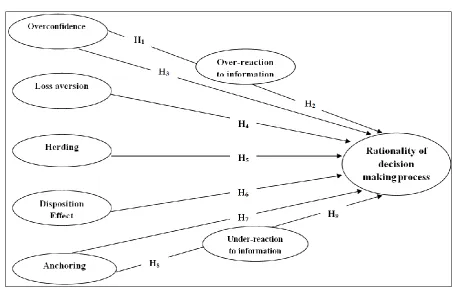
In order to elucidate the influence of behavioral biases on the rationality of the decision-making process, our study presents the following conceptual model highlighting the endogeno and exogenous variables of our model.
International Journal of Current Research
Vol. 10, Issue, 06, pp.70756-70761, June, 2018
Mohamed BACHISSE and Mohammed HASSAINATE. 2018. “Behavioral biases and rational decision making process: structural equation
International Journal of Current Research, 10, (06), 70756-70761.
BEHAVIORAL BIASES AND RATIONAL DECISION MAKING PROCESS: STRUCTURAL EQUATION
MOROCCAN STOCK MARKET
Mohammed HASSAINATE
Laboratory of Management Sciences, University Mohammed V of Rabat,
Mohammed V University, Rabat, Morocco
Awarded by two Nobel Prize winners in economics, behavioral finance proponents claim considerable consequences of behavioral biases on the investment policies of stock market players. he study is to empirically prove the relationship between the biases in our study (Overconfidence, Herding, loss aversion, disposition reaction to information) and their behavioral making process. Structural Equation Modeling (SEM), PLS 3.0 software, was conducted on the empirical data collected from a panel of financial professionals in the Moroccan stock market. Our results confirm the assumptions made beforehand and testify that these behavioral biases have a significant negative influence on the rationality of decision making process of the Moroccan portfolio
under the Creative Commons Attribution properly cited.
Behavioral finance has emerged from the psychological and financial integration, proclaiming that psychology plays an important role in the financial decision proposing to reconsider the axioms of rational decision. Two of its fervent followers were awarded the Nobel Prize in Economics: (SMITH and KANHEMAN, 2002) and (THALER, 2017). They believe that investors are subject to behavioral biases and distortions lead to control, being too confident about their abilities, distorting information, overreacting or following the crowd In this article, we seek to better understand the human behaviors that govern the dynamics of the Moroccan stock market by elucidating the impact of behavioral biases nfidence, herding, anchoring, disposition effect, loss aversion, over and under reaction to information) on the rationality of the investment decisions of a panel of financial professionals with the help of a questionnaire developed and
ample of portfolio managers.
Conceptual model and research hypothesis
In order to elucidate the influence of behavioral biases on the making process, our study presents the following conceptual model highlighting the endogenous and exogenous variables of our model.
OF CURRENT RESEARCH
Our theoretical construct is formalized in the form of the following research hypotheses that will be tested empirically by our model.
H1: Overconfidence has a significant positive effect on
over-reaction to information.
H2: Over-reaction to information is negatively correlated with
the rationality of decision-making process.
H2': Over-reaction to information has a mediating effect
between overconfidence and rationality of decision-making process.
H3: Overconfidence negatively affects the rationality of
decision-making process.
H4: Loss aversion has a significant negative effect on
rationality of decision-making process.
H5: Herding is negatively associated with the rationality of
decision-making process.
H6: The disposition effect negatively influences the rationality
of decision-making process.
H7: Anchoring is negatively correlated with the rationality of
decision-making process.
H8: Anchoring has a significant positive effect on the
under-reaction to information.
H9: Under-reaction to information is negatively associated with
the rationality of decision-making process.
H9’: Under-reaction to information has a mediating effect
between the anchoring and the rationality of decision-making process.
MATERIALS AND METHODS
The main objective of our research is to elucidate how the rationality of decision-making process and the behavioral biases of our study are related. Based on a Structural Equation Model (SEM), adopting a Partial Least Squares (PLS)
approach, using SmartPLS 3.0 software, an analysis of the causal paths of latent variables was conducted; to highlight the
impact of these biases on the rationality of financial decisions of portfolio managers operating in Casablanca Stock Exchange. Thanks to the interviews carried out in the exploratory qualitative phase, we have been able to develop a questionnaire which represents the most common instrument empirically exploited for the study of biases (DEBONDT, 1998, BENARTZI, KAHNEMAN and THALER, 1999, BIAIS, 2005, GLASER and WEBER, 2007). This questionnaire associates items for each latent variable and evaluates each proposal according to the LIKERT scale in 7 scoring points ranging from "Strongly disagree" to "Totally agree". These items were inspired to a large extent by the opinions collected during the semi-directive interviews as well as by the theoretical review and empirical literature. A convenience sampling was used with a panel of financial professionals responsible for a portfolio of securities domiciled on the Casablanca Stock Exchange, these portfolio managers operate in brokerage firms, management and insurance companies as well as investment banks. We mainly focused on investigating portfolio managers and traders because according to (MANGOT, 2005) these two profiles bear the psychological bias of the profession, especially since many researchers have already looked into these two profiles, (HEISLER 1994, ODEAN 1999). Before administering our questionnaire, we launched a pilot survey with market finance and behavioral approach professionals to test its feasibility. After this test, we came out with several remarks and corrections taken into consideration in the final questionnaire of our research. 90 questionnaires were administered electronically to our sample, after two months of systematic reminders, 74 questionnaires were returned completed and only 68 turned out to be exploitable. To explore the correlations between the different latent variables and check the validity of the items, an exploratory factor analysis (EFA) was conducted with SPSS 21.0. This was followed by a confirmatory analysis (CFA) to ensure the reliability of the scales of measurement and the quality of conceptual adjustment of the constructs in our model.
[image:2.595.69.525.48.337.2]Source : Made by the authors
The hypothesis test was carried out using Structural Equation Modeling to bring out the causal relationships between the different latent variables of our model. Confirmatory analysis and structural equation modeling were conducted using Smart PLS 3.0.
RESULTS
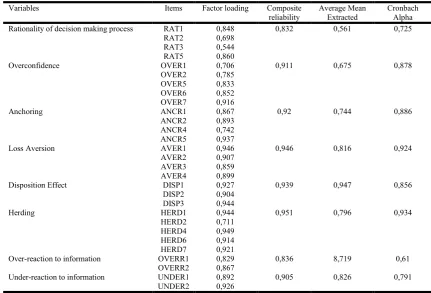
Based on the SEM literature, convergent validity can be confirmed by examining CRONBACH's alpha, composite reliability, and average extracted variance. The results in Table N°1 indicate that the items in each variable are statistically significant in the measure of their respective constructs with a factor loading of at least 0.7, the composite reliability of each variable is at its lowest 0.832 exceeding the acceptance threshold of 0.7 (HAIR, 1998). The average variance extracted from each variable is greater than 0.5. These results show that the measurement model has an adequate convergent validity. Discriminant validity is defined as the degree to which a set of elements can differentiate a construct from other constructs. (SOSIK, 2009) also advise to verify the discriminant validity by ensuring that the shared variance between latent constructs (measured by correlations between constructs) is less than the variance shared by a construct with its items (measured by the square root the average variance extracted). (FORNELL and LARECKER, 1981) suggested a criterion for examining discriminant validity which is shown in the table below. As shown in Table N°2, the diagonal elements are the square roots of the average variance extracted and the numbers below represent the correlation between the variables. Discriminant validity can be assumed if the diagonal elements are higher than other non-diagonal elements in their respective rows and columns. Indeed, the results in the correlation matrix shown in Table N°2 ensure that the discriminant validity is confirmed.
This means that the shared variance between the elements of each construct is greater than the variance shared with other constructs (COMPEAU, 1999). To evaluate the predictive relevance of the model, R² and cross-validated redundancy were used. The R² value indicates the amount of variance of the endogenous variable explained by the exogenous variables. The results in table N°3 show that 93.1% of rationality of decision-making process is explained by the exogenous variables of our model. The under-reaction to information and the over-reaction to information are explained at 79.4% and 19.5% respectively. According to the guidelines suggested by (COHEN, 1988) a predictive relevance ( R²) above 26% is considered substantial, which is the case of rationality and under-reaction to information; R² between 19% and 33% is considered low but acceptable according to (FALK and MILLER 1992), which is the case of the endogenous variable over-reaction to information. Following the suggestion of (FORNELL and CHA, 1994) the predictive power of a model can be pronounced only if the values of the crossed validated redundancy (obtained thanks to the "Blindfolding" method on SmartPLS 3.0) are greater than 0 if not, the predictive power cannot be confirmed. From the results in Table N°3, the values of cross validated redundancy of our endogenous variables are 0.487; 0.625 and 0.110. These results support the claim that the model has an adequate predictive quality. Unlike LISREL-SEM, PLS-SEM only has one measure of goodness of fit that has been defined as the overall adjustment measure by (TENENHAUS, 2005). This measure is the geometric mean of the mean variances extracted and the average of the R² for the endogenous variables as indicated in the following formula.
GoF = √ ²
[image:3.595.80.512.80.373.2]In our case, the value of the goodness of fit of our model is 0.68, which reveals a high quality of adjustment according to
Table 1. Analysis of convergent validity
Variables Items Factor loading Composite
reliability
Average Mean Extracted
Cronbach Alpha Rationality of decision making process RAT1 0,848 0,832 0,561 0,725
RAT2 0,698 RAT3 0,544 RAT5 0,860
Overconfidence OVER1 0,706 0,911 0,675 0,878
OVER2 0,785 OVER5 0,833 OVER6 0,852 OVER7 0,916
Anchoring ANCR1 0,867 0,92 0,744 0,886
ANCR2 0,893 ANCR4 0,742 ANCR5 0,937
Loss Aversion AVER1 0,946 0,946 0,816 0,924
AVER2 0,907 AVER3 0,859 AVER4 0,899
Disposition Effect DISP1 0,927 0,939 0,947 0,856
DISP2 0,904 DISP3 0,944
Herding HERD1 0,944 0,951 0,796 0,934
HERD2 0,711 HERD4 0,949 HERD6 0,914 HERD7 0,921
Over-reaction to information OVERR1 0,829 0,836 8,719 0,61
OVERR2 0,867
Under-reaction to information UNDER1 0,892 0,905 0,826 0,791 UNDER2 0,926
the basic values suggested by (WETSELS, 2009). These results attest to an adequate level of overall validity of our PLS model. After that the validity and reliability of our construct has been established, the next step is to test the hypotheses of the study by running a PLS Algorithm and a Bootstrapping Algorithm in SmartPLS 3.0. The results are shown in Table N°4. As illustrated in Table N°4, we accepted 6 hypotheses and rejected 3 using the significance level of 0.05 as a reference. The results show that almost all the behavioral biases: heuristics, herding or cognitive biases that are part of the prospect theory have a significant negative effect on the rationality of the decision-making process of the portfolio managers, except loss aversion which derogates from this conclusion (Hypothesis rejected). For stock anomalies, over-reaction to information has a negative influence on rationality (β = -0.194, value T = 3.219, P value = 0.01), while we have rejected the hypothesis related to the under-reaction to the information (β = -0.042, value T = 0.326, value P = 0.744). To test the mediation effect of over-reaction to information between overconfidence and decision-making rationality, the PLS Bootstrapping algorithm was
conducted to estimate the direct and indirect effect between these variables. The results obtained in Table N°5 confirm that overconfidence directly and indirectly significantly affects the rationality of decision-making process with (β = -0.291, value T = 2.660 P value = 0.008) and (β = -0.079, T value = 2.031, P value = 0.043) respectively. These results thus illustrate the total mediation of over-reaction to information. There is no need to test the hypothesis H9' which mediates under-reaction
to information since the indirect hypothesis between anchoring and rationality of the decision-making process have been rejected, hence the effect mediator of the under-reaction to information is rejected.
DISCUSSION, LIMITS AND CONCLUSIONS
[image:4.595.54.544.77.167.2]Referring to the results of our Structural Equation Modeling, we were able to confirm most of the hypotheses developed during our exploratory theoretical conceptual introspection. All the more so, according to the tests of hypothesis and path Table 2. Correlations and discriminant analysis (Fornell and Larcker criterion)
Constructs 1-ANCR 2-AVER 3-DISP 4-OVER 5-HERD 6-RAT 7-UNDER 8-OVERR
1- Anchoring 0,934
2- Loss Aversion 0,863 0,904
3- Disposition effect -0,873 -0,876 0,925
4- Overconfidence -0,780 -0,873 0,839 0,872
5- Herding -0,925 -0,957 0,887 0,821 0,933
6- Rationality of decision making process 0,799 0,749 -0,853 -0,905 -0,921 0,903
7- Under-reaction to information -0,891 -0,906 0,825 0,809 0,892 -0,816 0,909
8- Over-reaction to information -0,627 -0,531 0,381 0,407 0,508 -0,489 0,381 0,848
[image:4.595.138.460.213.265.2]Source : Results of SmartPLS3
Table 3. Predictive relevance of the model
Endogenous variables R² of latent endogenous variables
Cross validated redundancy Rationality of decision making process 0,931 0,487
Under-reaction to information 0,794 0,625
Over-reaction to information 0,195 0,110
Source : Results of SmartPLS 3.0
Table 4. Results of hypotheses testing
N° Hyp. Hypotheses Coefficient Standard error T Valeur P Valeur Status
H1 Overconfidence Over-reaction to information 0,407 0,143 2,851 0,005 Accepted H2 Over-reaction to information Rationality of decision
making process
-0194 0,060 3,219 0,001 Accepted
H3 Overconfidence Rationality of decision making process -0,291 0,080 2,660 0,008 Accepted H4 Loss Aversion Rationality of decision making process 0,445 0,115 2,964 0,003 Rejected H5 Herding Rationality of decision making process -0,710 0,148 4,783 0,000 Accepted H6 Disposition effect Rationality of decision making process -0,323 0,113 2,864 0,004 Accepted H7 Anchoring Rationality of decision making process -0,808 0,146 5,550 0,000 Accepted H8 Anchoring Under-reaction to information -0,891 0,018 49,152 0,000 Rejected H9 Under-reaction to information Rationality of decision
making process
0,042 0,127 0,326 0,744 Rejected
Significance level: P<0, 05 Source: Results of Smart PLS 3.0
Table 5. Mediation effect of over-reaction to information (Total mediation)
H2’ hypotheses Coefficient Standard error T Valeur P Valeur Status
Indirect effect with mediator
Overconfidence Over-reaction to information 0,407 0,143 2,851 0,005 Accepted Over-reaction to information Rationality of
decision making process
-0194 0,060 3,219 0,001 Accepted
Overconfidence Rationality of decision making process
-0,079 0,039 2,031 0,043 Accepted
Direct effect with mediator
Overconfidence Rationality of decision making process
-0,291 0,080 2,660 0,008 Accepted
[image:4.595.58.554.310.429.2] [image:4.595.44.558.478.557.2]coefficients, it turned out that the behavioral biases being part of our study excepting loss aversion and under-reaction to the information (hypothesis rejected) have a significant negative impact on rationality of decision-making process of the portfolio managers operating in the Casablanca Stock Exchange. Our results go hand in hand with the theoretical assumptions of (TVERSKY and KANHEMAN, 1974) and the results of (GERVAIS and ODEAN, 2001) which attest that investors have a certain number of strategic simplifications that skew their acuity of information processing thereby prejudicing the rationality of their financial decisions. Therefore, is it a question of evoking the irrationality of the investors operating in the Casablanca Stock Exchange and undermining at the same time the thesis of the efficiency of the financial markets or would it be more judicious to speak of limited rationality conferred with an argument belonging to (SIMON, 1982, 1991), who suggested that the tendency of psychological anticipation is the foundation of limited rational behavior. Our study could have gained in relevance if we had gone through more in detail in the financial decision-making process of the portfolio managers, in order to focus on the exact phase where the behavioral biases act, in addition to this, studying the interrelation between the biases could have been interesting by assuming their interdependence. This issue could be the subject of future research given the burgeoning expansion of behavioral finance among academics and practitioners alike, and the extent to which human behavior is affecting the dynamics of financial markets. The results of this study may be useful for individual investors, financial brokers, financial managers and other financial decision-makers to improve their cognitive thinking process and make more rational decisions.
Conflict of interest statement: Authorscertify that they have NO affiliations with or involvement in any organization or entity with any financial interest (such as honoraria; educational grants; participation in speakers’ bureaus; membership, employment, consultancies, stock ownership, or other equity interest; and expert testimony or patent-licensing arrangements), or non-financial interest (such as personal or professional relationships, affiliations, knowledge or beliefs) in the subject matter or materials discussed in this manuscript.
Funding statement
Authors certify that they use their own means for funding and need NO assistance.
REFERENCES
Anderson, A., Henker, J., and Owen, S. 2005. Limit Order Trading Behavior and Individual Investor Performance.
The Journal of Behavioral Finance, 6 (2), 71– 89.
Barberis N. Thaler R. 2002. A Survey of Behavioral Finance. NBER Working Paper No. W9222
Barraud C. 2010. De l’efficience des marchés financiers à la finance comportementale. Analyse financière n° 35, avril-mai-juin.
Broihanne M. H., Merli M. et Roger P. 2004. Finance comportementale, Economica, Paris.
Chin W.W. 1998. The partial least squares approach to structural equation modeling. In G. A. Marcoulides, Modern methods for business research (pp. 295-336). Mahwah, NJ: Lawrence Erlbaum.
Chin W.W., Peterson R.A., Brown S.P. 2008. Structural equation modeling in marketing: Some practical
reminders, Journal of Marketing Theory and Practice,
Vol. 16, N°4, pp 287-298.
Daniel, K., Hirshleifer A. 1998. Investor Psychology and
Security Market Under- and Overreactions. Journal of
Finance, 53 (6), 1839–1885.
DeBondt W., Thaler R. 1985. Does the Stock Market Overreact? Journal of Finance Vol.40. 793–805.
DeBondt, W. F. M. and Thaler, R. H. 1995. Financial Decision-Making in Markets and Firms: A Behavioral Perspective. Handbooks in Operations Research and Management Science
Fornell C, Larcker DF. 1981. Evaluating structural equation models with unobservable variables and measurement error. Journal of Marketing Research; 18:39–50.
Fornell, C., and Bookstein, F. 1982. Two Structural Equation Models: LISREL and PLS Applied to Consumer Exit-Voice Theory, Journal of Marketing Research, 19, 440-452.
Gervais S. et Odean T. 2001. Learning to be overconfident. Review of Financial Studies, vol. 14, p. 1-27.
Grinblatt, M. and Han, B. 2001. The disposition effect and momentum. Working Paper. University of California, Los Angeles, CA
Grossman S.J. et Stiglitz J.E. 1980. On the impossibility of
informationally efficient markets. American Economic
Review, vol. 70, nº 3, p. 393-408.
Hair, J. F., Black, B., Babin, B., Andersion, R. E. and Tatham, R. L. 1998. Multivariate data analysis. Prentice-Hall, International, Inc.
Hirshleifer, D. and Ying, G. 2001 On the Survival of Overconfident Traders in a Competitive Securities Market.
Journal of Financial Markets, 73-84.
Hwang, S. and Salmon, M. 2004. Market Stress and Herding. Journal of Empirical Finance, 585-616.
Kahneman, D. and Tversky, A. 1992. Advances in Prospect Theory: Cumulative Representation of Uncertainty.
Journal of Risk and Uncertainty, 297-323
Kahneman, D., Tversky, A. 1979. Prospect theory: an analysis of decision under risk, Econometrica, 47(2), pp. 63-91
Lee, S. Y., Poon, W. Y. and Bentler, P. 1990 A Three-stage Estimation Procedure for Structural Equation Models with Polytomous Variables, Psychometrika, 45-51.
Mangot M. 2008. Les comportements en bourse : 6 erreurs psychologiques qui coûtent chers ; Gualino éditeur, Paris.
Mignon V. 1998. Marchés financiers et modélisation des rentabilités boursières, Paris, Economica
Miller D. T. et Ross M. 1975. Self-Serving Biases in the Attribution of Causality: Fact or Fiction ?. Psychology Bulletin, 82, 213-225.
Muth J.F. 1961. Rational expectations and the theory of price movements. Econometrica, vol. 29, p. 315-335.
Odean T. 1998. Are investors reluctant to realize their losses ?.
Journal of Finance, Vol. 53, n°5, p.1775-1798.
Olsen R.A. 1996. Implications of Herding Behavior for earnings Estimation, Risk Assessment, and Stock returns. Financial Analysts Journal
Shefrin H. 2000. Beyond Greed and Fear: Understanding Behavioral Finance and the Psychology of Investing, Boston, Harvard Business School Press.
Shefrin, H. 2007. Behavioral Corporate Finance. Decisions that Create Value, McGrawHill/Irwin: New York
Shleifer A. et Summers L. 1990. The noise-trader approach to
finance. Journal of Economic Perspectives, vol. 4, nº 2, p.
Simon H.A. 1955. A behavioral model of rational choice.
Quarterly Journal of Economics, vol. 69, p. 99-118
Statman, M., Thorley, S. and Vorkink, K. 2006. Investor overconfidence and trading volume. Review of Financial Studies, 19(4), pp. 1531-1565.
Weber, E.U., Hsee, C.K. 2000. Culture and individual judgment and decision making. Applied Psychology, 49 (1), 32–61.
Weinstein, D., Kline, R. 2002. “Resistance of Personal Risk Perceptions to Debiasing Interventions”, in Th. Gilovich, D. Griffin and D. Kahneman, Heuristics and Biases: The Psychology of Intuitive Judgment, Cambridge, UK: Cambridge University Press