
organic papers
o978
Richard Gilardiet al. C8H2N6O12 DOI: 10.1107/S1600536802013739 Acta Cryst.(2002). E58, o978±o980 Acta Crystallographica Section EStructure Reports
Online
ISSN 1600-5368
1,2,3,4,5,7-Hexanitrocubane
Richard Gilardi,a* Ray J. Butcherband Mao-Xi Zhangc
aLaboratory for the Structure of Matter, Naval
Research Laboratory, Washington DC 20375, USA,bDepartment of Chemistry, Howard University, Washington DC 20059, USA, and cDepartment of Chemistry, University of
Chicago, Chicago IL 60637, USA
Correspondence e-mail: [email protected]
Key indicators Single-crystal X-ray study
T= 295 K
Mean(C±C) = 0.002 AÊ Disorder in main residue
Rfactor = 0.046
wRfactor = 0.136
Data-to-parameter ratio = 10.5
For details of how these key indicators were automatically derived from the article, see http://journals.iucr.org/e.
#2002 International Union of Crystallography Printed in Great Britain ± all rights reserved
The hexanitrocubane structure, C8H2N6O12, reported herein,
is one of the last in the series of nitrocubanes, ranging from mono- to octanitrocubane. In this molecule, the H atoms participate in short hydrogen-bonding contacts to the nitro O atoms in adjoining molecules [2.50 (1) AÊ], thus linking mol-ecules into a two-dimensional sheet in the bc plane. In addition, the O O contacts in hexanitrocubane are shorter than van der Waals contact distances. The shortest of these [2.766 (3) AÊ] involve the O atoms of one of the attached nitro groups. These contacts involve molecules in an extended two-dimensional sheet parallel to theabplane.
Comment
Nitrocubanes have long been sought after as powerful, shock-insensitive, high-density explosives (Eaton, 1992). In these compounds are combined the energy associated with the highly strained cubane skeleton (Eaton, 1992) with that associated with polynitrated compounds. One of the more interesting stories in organic synthesis in recent years has been the long (ca20 years) development of methods (Eatonet al., 2000) to make octanitrocubane (Zhanget al., 2000), the `holy grail' of the energetic materials community. Theoretical predictions (Alster et al., 1981) had indicated that this compound would have one of the highest densities observed in compounds containing only C, H, N and O. In this search, the structures of 1,4-dinitro (Eaton et al., 1984), 1,3,5-trinitro-(Eaton et al., 1993), 1,3,5,7-tetranitro- (Eaton et al., 1993), 1,2,3,5,7-pentanitro- (Lukin et al., 1997), 1,2,3,4,5,6,8-hepta-nitro- (Zhanget al., 2000), and 1,2,3,4,5,6,7,8-octanitrocubane (Zhanget al., 2000) have been reported. However, to date the structure of the simplest member of this series, nitrocubane, is only now being reported (Butcher & Gilardi, 2002).
The structure of 1,2,3,4,5,7-hexanitrocubane, (I), is reported herein; previously the structure of its acetonitrile solvate had been reported (Lukin et al., 1997). Pure hexanitrocubane crystallizes in the orthorhombic space groupPnmawith four
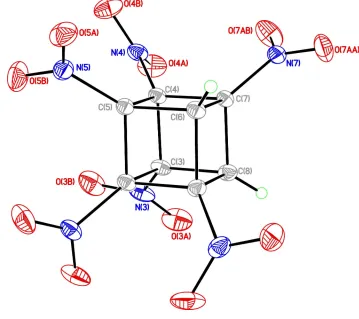
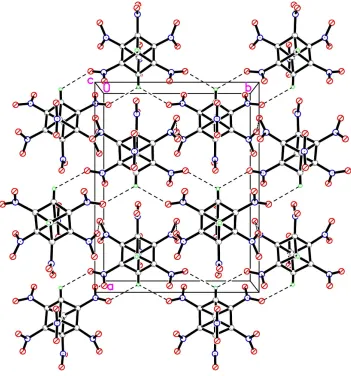
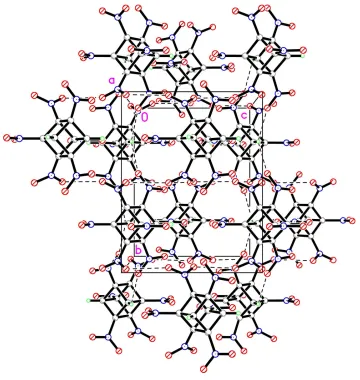
molecules in the unit cell and thus the molecule has crystal-lographically imposed mirror symmetry passing through atoms C3, N3, O3A, O3B, C5, N5, O5A, O5B, C6, H6, C8, and H8. Positions C4Aand C7A, generated by the mirror plane, correspond to positions C2 and C1 in the conventional cubane numbering scheme. In hexanitrocubane, the CÐC bond lengths average 1.565 (6) AÊ, which is somewhat longer than the average found in all cubane structures, but well within the normal range (Butcher et al., 1995). The nitro O atoms attached to N7 are disordered over two positions, with occu-pancies of 0.600 (4) and 0.400 (4), which is not unusual for such moieties. As the number of nitro substituents increase, H atoms attached to the cubane skeleton become increasingly acidic (Lukin et al., 1997), and thus participate in stronger hydrogen-bonding interactions than is commonly observed for hydrocarbon H atoms. In this instance, H6 participates in short hydrogen-bonding contacts to O7AB in two adjoining mol-ecules (2.501 AÊ), thus linking molmol-ecules into a two-dimen-sional sheet in theabplane, as shown in Fig. 2. In addition, just as is the case in pentanitrocubane (Lukin et al., 1997), heptanitrocubane (Zhang et al., 2000), and octanitrocubane (Zhang et al., 2000), several O O contacts in hexanitro-cubane are shorter than the van der Waals contact distance of 3.04 AÊ (Rowland & Taylor, 1996). The shortest of these, 2.766 AÊ, involve the O atoms of the nitro group attached to C4. In hexanitrocubane, the nitro groups attached to C4 (and C4A which is related to C4 by the crystallographic mirror plane) are the only nitro groups that areorthoto three other nitro groups. These contacts are between the molecules that lie in an extended two-dimensional sheet parallel to thebcplane, as shown in Fig. 3.
Density is of critical importance to the performance of an explosive. The overall packing in hexanitrocubane described above leads to a density of 1.931 Mg mÿ3at 294 K. While this
is less than that observed for pentanitrocubane (1.959 Mg mÿ3; Lukin et al., 1997), heptanitrocubane
(2.028 Mg mÿ3; Zhang et al., 2000), and octanitrocubane
(1.979 Mg mÿ3; Zhanget al., 2000), this is still an impressive
value for a compound containing only C, H, N, and O, and is
Acta Cryst.(2002). E58, o978±o980 Richard Gilardiet al. C8H2N6O12
o979
organic papers
Figure 1
Displacement ellipsoid plot (50% probability level) of the title molecule, showing the atomic labeling scheme.
Figure 2
The molecules of (I) linking into a two-dimensional sheet in theabplane through short hydrogen-bonding contacts to C7 in adjoining molecules.
Figure 3
organic papers
o980
Richard Gilardiet al. C8H2N6O12 Acta Cryst.(2002). E58, o978±o980much higher than the value previously observed for its acetonitrile solvate (1.676 Mg mÿ3; Lukin et al., 1997). The
metrical parameters found for this unsolvated structure of hexanitrocubane are very similar to those found for the acetonitrile solvate (Lukinet al., 1997).
Experimental
The preparation of hexanitrobenzene has been reported previously (Lukin et al., 1997). Solvent-free crystals were grown by slow evaporation from a mixed HNO3/H2SO4solution at 313 K.
Crystal data
C8H2N6O12
Mr= 374.16 Orthorhombic,Pnma a= 13.936 (2) AÊ
b= 10.8870 (19) AÊ
c= 8.4833 (14) AÊ
V= 1287.1 (4) AÊ3
Z= 4
Dx= 1.931 Mg mÿ3
MoKradiation Cell parameters from 4545
re¯ections
= 2.8±28.3
= 0.19 mmÿ1
T= 295 (2) K Plate, orange 0.740.290.11 mm
Data collection
BrukerP4/CCD diffractometer
!scans
Absorption correction: multi-scan (Bruker, 2001)
Tmin= 0.819,Tmax= 0.962
9511 measured re¯ections 1655 independent re¯ections
1202 re¯ections withI> 2(I)
Rint= 0.026
max= 28.3
h=ÿ18!18
k=ÿ14!14
l=ÿ11!9
Re®nement
Re®nement onF2
R[F2> 2(F2)] = 0.046
wR(F2) = 0.136
S= 1.03 1655 re¯ections 157 parameters
All H-atom parameters re®ned
w= 1/[2(F
o2) + (0.0747P)2 + 0.3718P]
whereP= (Fo2+ 2Fc2)/3 (/)max< 0.001
max= 0.35 e AÊÿ3
min=ÿ0.24 e AÊÿ3
All H atoms were initially located in a difference Fourier map and re®ned isotropically. The nitro O atoms attached to N7 are disordered over two positions, with occupancies of 0.600 (4) and 0.400 (4), as is commonly found for such moieties.
Data collection:SMART(Bruker, 2001); cell re®nement:SMART; data reduction: SAINT (Bruker, 2001); program(s) used to solve structure: SHELXTL (Sheldrick, 1997); program(s) used to re®ne structure:SHELXTL; molecular graphics:SHELXTL; software used to prepare material for publication:SHELXTL.
The authors acknowledge the ®nancial support from the Of®ce of Naval Research, Mechanics Division. RJB wishes to acknowledge the ASEE/Navy Summer Faculty Research Program for support during the summer of 2002.
References
Alster, J., Sandus, O., Genter, R., Slagg, N., Ritchie, J. P., Dewar, M. & J. S. (1981). Working Group Meeting on High-Energy Molecules, Hilton Head, SC, USA, 28±29 April.
Bruker (2001).SMART(Version 5.624) andSAINT(Version 6.04). Bruker AXS Inc., Madison, Wisconsin, USA.
Butcher, R. J., Bashir-Hashemi, A. & Gilardi, R. (1995).J. Chem. Crystallogr.
25, 661±670.
Butcher, R. J. & Gilardi, R. (2002). In preparation.
Eaton, P. E. (1992).Angew. Chem. Int. Ed. Engl.31, 1421±1436.
Eaton, P. E., Gilardi, R. & Zhang, M.-X. (2000).Adv. Mater.12, 1143±1148. Eaton, P. E., Ravi Shankar, B. K., Price, G. D., Pluth, J. J., Gilbert, E. E., Alster,
J. & Sandus, O. (1984).J. Org. Chem.49, 185±186.
Eaton, P. E., Yusheng Xiong, Y. & Gilardi, R. (1993).J. Am. Chem. Soc.115, 10195±10202.
Lukin, K. A., Li, J., Eaton, P. E., Kanomata, N., Hain, J., Punzalan, E. & Gilardi, R. (1997).J. Am. Chem. Soc.119, 9591±9602.
Rowland, R. S. & Taylor, R. (1996).J. Phys. Chem.100, 7384±7391. Sheldrick, G. M. (1997).SHELXTL.Version 5.10. Bruker AXS Inc., Madison
Wisconsin USA.
Zhang, M.-X., Eaton, P. E. & Gilardi, R. (2000).Angew. Chem. Int. Ed. Engl.
supporting information
sup-1
Acta Cryst. (2002). E58, o978–o980
supporting information
Acta Cryst. (2002). E58, o978–o980 [doi:10.1107/S1600536802013739]
1,2,3,4,5,7-Hexanitrocubane
Richard Gilardi, Ray J. Butcher and Mao-Xi Zhang
S1. Comment
Nitrocubanes have long been sought after as powerful, shock-insensitive, high-density explosives (Eaton, 1992). In these
compounds are combined the energy associated with the highly strained cubane skeleton (Eaton, 1992) with that
associated with polynitrated compounds. One of the more interesting stories in organic synthesis in recent years has been
the long (ca 20 years) development of methods (Eaton at al., 2000) to make octanitrocubane (Zhang et al., 2000), the
`holy grail′ of the energetic materials community. Theoretical predictions (Alster et al., 1981) had indicated that this
compound would have one of the highest densities observed in compounds containing only C, H, N and O. In this search,
the structures of 1,4-dinitro (Eaton et al., 1984), 1,3,5-trinitro- (Eaton et al., 1993), 1,3,5,7-tetranitro- (Eaton et al., 1993),
1,2,3,5,7-pentanitro- (Lukin et al., 1997), 1,2,3,4,5,6,8-heptanitro- (Zhang et al., 2000), and
1,2,3,4,5,6,7,8-octanitro-cubane (Zhang et al., 2000) have been reported. However, to date the structure of the simplest member of this series,
nitrocubane, is only now being reported (Butcher & Gilardi, 2002).
The structure of 1,2,3,4,5,7-hexanitrocubane, (I), is reported herein; previously the structure of its acetonitrile solvate
was reported (Lukin et al., 1997). Pure hexanitrocubane crystallizes in the orthorhombic space group Pnma with four
molecules in the unit cell, thus the molecule has crystallographically imposed mirror symmetry, which passes through
atoms C3, N3, O3A, O3B, C5, N5, O5A, O5B, C6, H6, C8, and H8. Positions C4A and C7A, generated by the mirror
plane, correspond to positions C2 and C1 in the conventional cubane numbering scheme. In hexanitrocubane, the C—C
bond lengths average 1.565 (6) Å, which is somewhat longer than the average found in all cubane structures, but well
within the normal range (Butcher et al., 1995). The nitro O atomd attached to N7 are disordered over two positions, with
occupancies of 0.600 (4) and 0.400 (4), which is not unusual for such moieties. As the number of nitro substituents
increase, H atoms attached to the cubane skeleton become increasingly acidic (Lukin et al., 1997), and thus participate in
stronger hydrogen-bonding interactions than is commonly observed for hydrocarbon H atoms. In this instance, both H6
and H8 participate in short hydrogen-bonding contacts to O7AB in adjoining molecules (2.501 Å), thus linking molecules
into a two-dimensional sheet in the bc plane, as shown in Fig. 1. In addition, just as is the case in pentanitrocubane (Lukin
et al., 1997), heptanitrocubane (Zhang et al., 2000), and octanitrocubane (Zhang et al., 2000), several O···O contacts in hexanitrocubane are shorter than the van der Waals contact distance of 3.04 Å (Rowland & Taylor, 1996). The shortest of
these, 2.766 Å, involve the O atoms of the nitro group attached to C4. In hexanitrocubane, the nitro groups attached to C4
(and C4A which is related to C4 by the crystallographic mirror plane) are the only nitro groups that are ortho to three
other nitro groups. These contacts are between the molecules that lie in an extended two-dimensional sheet parallel to the
ab plane, as shown in Fig. 2.
Density is of critical importance to the performance of an explosive. The overall packing in hexanitrocubane described
above leads to a density of 1.931 Mg m−3 at 294 K. While this is less than that observed for pentanitrocubane (1.959 Mg
m−3; Lukin et al., 1997), heptanitrocubane (2.028 Mg m−3; Zhang et al., 2000), and octanitrocubane (1.979 Mg m−3;
supporting information
sup-2
Acta Cryst. (2002). E58, o978–o980
than the value previously observed for its acetonitrile solvate (1.676 Mg m−3; Lukin et al., 1997). The metrical parameters
found for this unsolvated structure of hexanitrocubane are very similar to those found for the acetonitrile solvate (Lukin
et al., 1997).
S2. Experimental
The preparation of hexanitrobenzene has been reported previously (Lukin et al., 1997). Solvent-free crytals were grown
by slow evaporation from a mixed HNO3/H2SO4 solution at 313 K.
S3. Refinement
All H atoms were initially located in a difference Fourier map and refined isotropically. The nitro O atoms attached to N7
[image:5.610.122.481.233.552.2]are disordered over two positions, with occupancies of 0.600 (4) and 0.400 (4), as is commonly found for such moieties.
Figure 1
supporting information
sup-3
[image:6.610.130.481.71.447.2]Acta Cryst. (2002). E58, o978–o980 Figure 2
The molecules of (I) linking into a two-dimensional sheet in the bc plane through short hydrogen-bonding contacts to C7
supporting information
sup-4
[image:7.610.126.486.68.448.2]Acta Cryst. (2002). E58, o978–o980 Figure 3
Short O···O contacts from the C4 nitro group linking up molecules in an extended two-dimensional sheet parallel to the
ab plane.
(I)
Crystal data
C8H2N6O12 Mr = 374.16
Orthorhombic, Pnma
a = 13.936 (2) Å
b = 10.8870 (19) Å
c = 8.4833 (14) Å
V = 1287.1 (4) Å3 Z = 4
F(000) = 752
Dx = 1.931 Mg m−3
Mo Kα radiation, λ = 0.71073 Å Cell parameters from 4545 reflections
θ = 2.8–28.3°
µ = 0.19 mm−1 T = 295 K Plate, orange
0.74 × 0.29 × 0.11 mm
Data collection
Bruker P4/CCD diffractometer
Radiation source: fine-focus sealed tube Graphite monochromator
ω scans
Absorption correction: multi-scan (Bruker, 2001)
supporting information
sup-5
Acta Cryst. (2002). E58, o978–o980
9511 measured reflections 1655 independent reflections 1202 reflections with I > 2σ(I)
Rint = 0.026
θmax = 28.3°, θmin = 2.8°
h = −18→18
k = −14→14
l = −11→9
Refinement
Refinement on F2
Least-squares matrix: full
R[F2 > 2σ(F2)] = 0.046 wR(F2) = 0.136 S = 1.03 1655 reflections 157 parameters 0 restraints
Primary atom site location: structure-invariant direct methods
Secondary atom site location: difference Fourier map
Hydrogen site location: inferred from neighbouring sites
All H-atom parameters refined
w = 1/[σ2(F
o2) + (0.0747P)2 + 0.3718P]
where P = (Fo2 + 2Fc2)/3
(Δ/σ)max < 0.001
Δρmax = 0.35 e Å−3
Δρmin = −0.24 e Å−3
Special details
Geometry. All e.s.d.'s (except the e.s.d. in the dihedral angle between two l.s. planes) are estimated using the full covariance matrix. The cell e.s.d.'s are taken into account individually in the estimation of e.s.d.'s in distances, angles and torsion angles; correlations between e.s.d.'s in cell parameters are only used when they are defined by crystal symmetry. An approximate (isotropic) treatment of cell e.s.d.'s is used for estimating e.s.d.'s involving l.s. planes.
Refinement. Refinement of F2 against ALL reflections. The weighted R-factor wR and goodness of fit S are based on F2,
conventional R-factors R are based on F, with F set to zero for negative F2. The threshold expression of F2 > σ(F2) is used
only for calculating R-factors(gt) etc. and is not relevant to the choice of reflections for refinement. R-factors based on F2
are statistically about twice as large as those based on F, and R- factors based on ALL data will be even larger.
Fractional atomic coordinates and isotropic or equivalent isotropic displacement parameters (Å2)
x y z Uiso*/Ueq Occ. (<1)
C3 0.33820 (19) 0.2500 1.0939 (3) 0.0356 (5)
N3 0.3347 (2) 0.2500 1.2689 (3) 0.0518 (7)
O3A 0.4094 (2) 0.2500 1.3397 (3) 0.0794 (8)
O3B 0.2542 (2) 0.2500 1.3251 (3) 0.0773 (8)
C4 0.29000 (12) 0.14906 (14) 0.98930 (18) 0.0323 (4)
N4 0.24031 (12) 0.03958 (13) 1.05379 (18) 0.0427 (4)
O4A 0.27462 (14) −0.00370 (15) 1.17313 (19) 0.0716 (5)
O4B 0.17065 (13) 0.00225 (15) 0.9865 (2) 0.0725 (5)
C5 0.24530 (16) 0.2500 0.8802 (3) 0.0315 (5)
N5 0.14369 (16) 0.2500 0.8305 (3) 0.0452 (6)
O5A 0.12710 (16) 0.2500 0.6895 (3) 0.0625 (6)
O5B 0.08567 (15) 0.2500 0.9385 (3) 0.0760 (8)
C6 0.33648 (18) 0.2500 0.7732 (3) 0.0325 (5)
H6 0.336 (2) 0.2500 0.658 (3) 0.045 (7)*
C7 0.38139 (12) 0.14914 (14) 0.88278 (18) 0.0329 (4)
N7 0.43102 (11) 0.03600 (15) 0.8312 (2) 0.0438 (4)
O7AA 0.4809 (6) 0.0462 (8) 0.7150 (7) 0.0646 (16) 0.60
O7AB 0.4202 (5) −0.0520 (6) 0.9158 (7) 0.0768 (17) 0.60
O7BA 0.5027 (10) 0.0394 (12) 0.7631 (17) 0.121 (5) 0.40
O7BB 0.3923 (6) −0.0640 (8) 0.8610 (9) 0.0605 (18) 0.40
supporting information
sup-6
Acta Cryst. (2002). E58, o978–o980
H8 0.4926 (19) 0.2500 1.021 (3) 0.042 (8)*
Atomic displacement parameters (Å2)
U11 U22 U33 U12 U13 U23
C3 0.0498 (14) 0.0238 (11) 0.0332 (11) 0.000 −0.0025 (10) 0.000
N3 0.092 (2) 0.0281 (11) 0.0351 (11) 0.000 −0.0040 (14) 0.000
O3A 0.117 (2) 0.0733 (17) 0.0480 (11) 0.000 −0.0317 (14) 0.000
O3B 0.111 (2) 0.0656 (16) 0.0549 (13) 0.000 0.0323 (14) 0.000
C4 0.0395 (9) 0.0229 (8) 0.0345 (7) 0.0000 (6) 0.0022 (7) −0.0006 (6)
N4 0.0555 (10) 0.0282 (7) 0.0446 (8) −0.0059 (7) 0.0095 (7) −0.0016 (6)
O4A 0.1071 (14) 0.0452 (9) 0.0623 (9) −0.0093 (9) −0.0083 (9) 0.0233 (8)
O4B 0.0769 (12) 0.0621 (10) 0.0784 (11) −0.0336 (9) −0.0040 (9) 0.0073 (9)
C5 0.0329 (12) 0.0247 (11) 0.0369 (11) 0.000 −0.0004 (10) 0.000
N5 0.0376 (12) 0.0329 (11) 0.0650 (14) 0.000 −0.0057 (11) 0.000
O5A 0.0580 (13) 0.0601 (14) 0.0694 (14) 0.000 −0.0271 (11) 0.000
O5B 0.0426 (12) 0.0911 (19) 0.0943 (18) 0.000 0.0200 (13) 0.000
C6 0.0373 (13) 0.0277 (11) 0.0326 (10) 0.000 0.0003 (10) 0.000
C7 0.0333 (8) 0.0266 (8) 0.0388 (8) 0.0023 (6) −0.0005 (7) −0.0020 (6)
N7 0.0370 (9) 0.0352 (8) 0.0593 (10) 0.0051 (7) −0.0041 (7) −0.0106 (7)
O7AA 0.061 (4) 0.061 (3) 0.0717 (18) 0.012 (3) 0.029 (2) −0.0052 (17)
O7AB 0.110 (5) 0.038 (2) 0.083 (3) 0.030 (3) 0.005 (2) 0.011 (2)
O7BA 0.053 (5) 0.060 (6) 0.251 (15) −0.012 (4) 0.060 (8) −0.062 (8)
O7BB 0.069 (4) 0.030 (2) 0.082 (5) 0.003 (3) 0.021 (3) 0.001 (3)
C8 0.0380 (14) 0.0276 (11) 0.0433 (12) 0.000 −0.0080 (11) 0.000
Geometric parameters (Å, º)
C3—N3 1.486 (3) N5—O5A 1.218 (3)
C3—C8 1.550 (4) N5—O5B 1.222 (3)
C3—C4 1.564 (2) C6—C7i 1.569 (2)
C3—C4i 1.564 (2) C6—C7 1.569 (2)
N3—O3A 1.202 (4) C6—H6 0.98 (3)
N3—O3B 1.218 (4) C7—N7 1.479 (2)
C4—N4 1.483 (2) C7—C8 1.572 (2)
C4—C7 1.562 (2) N7—O7BA 1.155 (14)
C4—C5 1.566 (2) N7—O7AB 1.206 (7)
N4—O4B 1.197 (2) N7—O7AA 1.211 (7)
N4—O4A 1.215 (2) N7—O7BB 1.241 (9)
C5—N5 1.478 (3) C8—C7i 1.572 (2)
C5—C6 1.562 (3) C8—H8 0.92 (3)
C5—C4i 1.566 (2)
N3—C3—C8 126.8 (2) C5—C6—C7 88.85 (13)
N3—C3—C4 123.56 (14) C7i—C6—C7 88.82 (16)
C8—C3—C4 91.57 (14) C5—C6—H6 125.3 (17)
N3—C3—C4i 123.56 (14) C7i—C6—H6 126.5 (9)
supporting information
sup-7
Acta Cryst. (2002). E58, o978–o980
C4—C3—C4i 89.27 (17) N7—C7—C4 123.51 (14)
O3A—N3—O3B 127.0 (3) N7—C7—C6 126.46 (14)
O3A—N3—C3 118.1 (3) C4—C7—C6 91.03 (13)
O3B—N3—C3 114.9 (3) N7—C7—C8 123.57 (14)
N4—C4—C7 126.49 (13) C4—C7—C8 90.84 (14)
N4—C4—C3 123.77 (14) C6—C7—C8 91.25 (12)
C7—C4—C3 88.72 (14) O7BA—N7—O7AB 115.6 (8)
N4—C4—C5 126.60 (15) O7BA—N7—O7AA 25.0 (9)
C7—C4—C5 88.97 (13) O7AB—N7—O7AA 129.0 (5)
C3—C4—C5 90.75 (12) O7BA—N7—O7BB 120.4 (8)
O4B—N4—O4A 125.80 (17) O7AB—N7—O7BB 29.3 (4)
O4B—N4—C4 118.39 (16) O7AA—N7—O7BB 119.7 (6)
O4A—N4—C4 115.81 (16) O7BA—N7—C7 121.7 (7)
N5—C5—C6 127.9 (2) O7AB—N7—C7 115.3 (4)
N5—C5—C4i 123.35 (13) O7AA—N7—C7 115.6 (4)
C6—C5—C4i 91.14 (13) O7BB—N7—C7 117.9 (5)
N5—C5—C4 123.35 (13) C3—C8—C7 88.86 (15)
C6—C5—C4 91.14 (13) C3—C8—C7i 88.86 (15)
C4i—C5—C4 89.14 (16) C7—C8—C7i 88.63 (17)
O5A—N5—O5B 127.6 (3) C3—C8—H8 127.9 (17)
O5A—N5—C5 117.5 (2) C7—C8—H8 125.2 (9)
O5B—N5—C5 114.9 (2) C7i—C8—H8 125.2 (9)
C5—C6—C7i 88.85 (13)
C8—C3—N3—O3A 0.000 (1) C4—C5—C6—C7 −0.16 (11)
C4—C3—N3—O3A 122.53 (19) N4—C4—C7—N7 0.2 (3)
C4i—C3—N3—O3A −122.53 (19) C3—C4—C7—N7 132.63 (15)
C8—C3—N3—O3B 180.0 C5—C4—C7—N7 −136.60 (15)
C4—C3—N3—O3B −57.47 (19) N4—C4—C7—C6 136.61 (16)
C4i—C3—N3—O3B 57.47 (19) C3—C4—C7—C6 −90.93 (12)
N3—C3—C4—N4 −3.4 (3) C5—C4—C7—C6 −0.16 (11)
C8—C3—C4—N4 134.15 (16) N4—C4—C7—C8 −132.13 (16)
C4i—C3—C4—N4 −134.30 (13) C3—C4—C7—C8 0.33 (12)
N3—C3—C4—C7 −137.9 (2) C5—C4—C7—C8 91.10 (12)
C8—C3—C4—C7 −0.33 (12) C5—C6—C7—N7 134.57 (16)
C4i—C3—C4—C7 91.22 (14) C7i—C6—C7—N7 −136.56 (13)
N3—C3—C4—C5 133.2 (2) C5—C6—C7—C4 0.16 (12)
C8—C3—C4—C5 −89.29 (14) C7i—C6—C7—C4 89.04 (13)
C4i—C3—C4—C5 2.26 (17) C5—C6—C7—C8 −90.70 (14)
C7—C4—N4—O4B −98.4 (2) C7i—C6—C7—C8 −1.83 (17)
C3—C4—N4—O4B 144.17 (19) C4—C7—N7—O7BA −173.7 (8)
C5—C4—N4—O4B 23.1 (3) C6—C7—N7—O7BA 65.2 (9)
C7—C4—N4—O4A 82.3 (2) C8—C7—N7—O7BA −56.3 (9)
C3—C4—N4—O4A −35.2 (2) C4—C7—N7—O7AB −25.1 (4)
C5—C4—N4—O4A −156.29 (17) C6—C7—N7—O7AB −146.2 (3)
N4—C4—C5—N5 1.9 (3) C8—C7—N7—O7AB 92.3 (4)
C7—C4—C5—N5 138.61 (18) C4—C7—N7—O7AA 158.6 (4)
supporting information
sup-8
Acta Cryst. (2002). E58, o978–o980
N4—C4—C5—C6 −136.53 (16) C8—C7—N7—O7AA −84.0 (5)
C7—C4—C5—C6 0.16 (12) C4—C7—N7—O7BB 7.6 (4)
C3—C4—C5—C6 88.87 (14) C6—C7—N7—O7BB −113.5 (4)
N4—C4—C5—C4i 132.34 (12) C8—C7—N7—O7BB 125.0 (4)
C7—C4—C5—C4i −90.97 (13) N3—C3—C8—C7 135.67 (8)
C3—C4—C5—C4i −2.26 (17) C4—C3—C8—C7 0.33 (12)
C6—C5—N5—O5A 0.0 C4i—C3—C8—C7 −88.98 (12)
C4i—C5—N5—O5A 122.84 (16) N3—C3—C8—C7i −135.67 (8)
C4—C5—N5—O5A −122.84 (16) C4—C3—C8—C7i 88.98 (12)
C6—C5—N5—O5B 180.0 C4i—C3—C8—C7i −0.33 (12)
C4i—C5—N5—O5B −57.16 (16) N7—C7—C8—C3 −132.58 (16)
C4—C5—N5—O5B 57.16 (16) C4—C7—C8—C3 −0.33 (12)
N5—C5—C6—C7i 135.58 (8) C6—C7—C8—C3 90.72 (14)
C4i—C5—C6—C7i 0.16 (11) N7—C7—C8—C7i 138.53 (13)
C4—C5—C6—C7i −89.00 (11) C4—C7—C8—C7i −89.22 (14)
N5—C5—C6—C7 −135.58 (8) C6—C7—C8—C7i 1.83 (17)
C4i—C5—C6—C7 89.00 (11)
![Crystal structure, Hirshfeld surface analysis and PIXEL calculations of a 1:1 epimeric mixture of 3 [(4 nitrobenzylidene)amino] 2(R,S) (4 nitrophenyl) 5(S) (propan 2 yl)imidazolidin 4 one](data:image/gif;base64,R0lGODlhAQABAIAAAP///wAAACH5BAEAAAAALAAAAAABAAEAAAICRAEAOw==)