1 Information retention and overload in first-time hearing aid users: an interactive
1
multimedia educational solution 2
Melanie Ferguson PhD1,2, Marian Brandreth MSc1, William Brassington MSc3, Heather 3
Wharrad PhD4 4
5
1NIHR Nottingham Hearing Biomedical Research Unit, Nottingham University Hospitals 6
NHS Trust, Nottingham UK 7
2NIHR Nottingham Hearing Biomedical Research Unit, Otology and Hearing Research 8
Group, Division on Clinical Neuroscience, University of Nottingham UK 9
10
3Nottingham Audiology Service, Nottingham University Hospitals NHS Trust, 11
4Faculty of Medicine and Health Sciences, University of Nottingham, Nottingham UK 12
13
Corresponding author: 14
Melanie Ferguson 15
NIHR Nottingham Hearing Biomedical Research Unit 16
113 The Ropewalk 17
Nottingham, UK 18
NG1 5DU 19
20
Tel: (+44)115 8232619 21
Fax: (+44)115 8232615 22
23
Email: [email protected] 24
2 Abstract
31
Purpose: To assess the effect of an educational intervention, based on the concept of reusable 32
learning objects (RLOs), on knowledge of hearing aids and communication in first-time 33
hearing aid users. 34
Method: A randomized controlled trial of hearing aid users, where one arm received the 35
educational intervention and the other arm acted as a control group. RLOs were delivered 36
through DVD for TV and PC, and online. Knowledge of both practical and psychosocial 37
aspects of hearing aids and communication was assessed using a free-recall method at six-38
weeks post-fitting. 39
Results: Knowledge of both practical and psychosocial knowledge was significantly higher in 40
those who received the RLOs compared to the control group. Large effect sizes indicated 41
these differences are clinically significant. 42
Conclusion: An educational intervention to supplement clinical practice results in improved 43
knowledge in first-time hearing aid users. 44
3 Introduction
46
If you are an audiologist reading this, how confident are you that all the information and 47
advice that you offer your first-time hearing aid patients is understood, absorbed and then 48
acted upon once they leave the comfort of your clinic room? 49
It has been reported that around half (51%) of first-time hearing aid users have difficulties 50
using their hearing aids (AoHL, 2011). For example, between 60-80% of first-time hearing 51
aid users do not know how to use the telephone with their hearing aids and need further 52
instruction (Goggins & Day, 2009; Vuorialho, Karinen, & Sorri, 2006). This is reflected in a 53
statement from a typical first-time hearing aid user: “You get a lot of information….by the 54
time you get home you’ve forgotten most of it” (AoHL, 2011). The problem of information 55
overload and retention is not unique to hearing aid users. It has been suggested that between 56
40-80% of information given verbally in clinical appointments is forgotten afterwards 57
(Kessels, 2003). A study of hearing aid users showed that of the information delivered at the 58
hearing aid fitting appointment, a more optimistic figure of 25% is forgotten one month later 59
(Reese & Smith, 2006). However, this study used a multiple-choice method of assessment 60
that may have artificially inflated the amount of information recalled. Using a free-recall 61
method of assessment El-Molla et al. (2012) showed that around half (49.6%) of the 62
information delivered was recalled in first-time hearing aid users (62.9% of practical and 63
34.3% of psychosocial information). 64
To address this problem, delivery of high quality written information is recommended as 65
good clinical practice (AoHL, 2011; NHS Scotland, 2009). It is common for hearing aid users 66
to receive a hearing aid-specific manufacturer’s user guide, however, two studies have 67
reported that these user guides are not optimal in terms of content, design and readability 68
(Brooke, Isherwood, Herbert, Raynor, & Knapp, 2012; Caposecco, Hickson, & Meyer, 2014). 69
4 patient is not the same as educating the patient and increasing their knowledge base
71
(Boothroyd, 2007). Constructivist learning theory suggests that interaction with learning 72
materials promotes learning, and the greater the interactivity, the greater the learning (Zhang, 73
Zhou, Briggs, & Nunamaker, 2006). Studies of education in hearing aid users as part of their 74
(re)habilitation include communication programmes delivered in group or individual settings 75
(Beynon, Thornton, & Poole, 1997; Hickson, Worrall, & Scarinci, 2007), remote programmes 76
home-delivered by videotapes (Kramer, Allessie, Dondorp, Zekveld, & Kapteyn, 2005), 77
written materials supported by telephone follow-up calls (Lundberg, Andersson, & Lunner, 78
2011) and online educational and rehabilitation programmes (Thorén, Öberg, Wänström, 79
Andersson, & Lunner, 2013). 80
Development of the educational intervention 81
The concept of reusable learning objects (RLOs) have been used in elearning environments. 82
RLOs are short, highly visual, chunks of interactive multimedia learning that illustrate 83
concepts to support a specific learning goal, enable engagement with the learning materials 84
by activities, can be replayed as often as is required, and include a self-assessment element 85
that enables test of mastery of the content (Windle, McCormick, Dandrea, & Wharrad, 2010). 86
We have developed an educational programme underpinned by pedagogical principles and 87
learning theory and consisting of RLOs for first-time hearing aid users (Ferguson, Brandreth, 88
Leighton, Brassington, & Wharrad, in review). Each RLO has specific learning outcomes, 89
includes reinforcement of good behaviours and explains the consequences of poor 90
behaviours, with an interactive multiple-choice quiz at the end. The RLOs include video 91
clips, illustrations, animations, photos, sounds and testimonials, and all are subtitled. 92
Seven RLOs were designed using a participatory approach including audiologists and hearing 93
aid users (Brandreth, Leighton, Wharrad, & Ferguson, 2013) to ensure the RLOs met the 94
5 1) Getting to know your hearing aids (embed video link here) (9m 33s)
96
2) How to insert hearing aids (embed video link here) (4m 34s) 97
3) What to expect when wearing hearing aids (embed video link here) (6m 48s) 98
4) Adapting to wearing hearing aids (embed video link here) (9m 35s) 99
5) Communication tactics (embed video link here) (11m 52s) 100
6) Using the phone and other devices (embed video link here) (5m 36s) 101
7) Hearing aid care and troubleshooting (embed video link here) (7m 55s) 102
There was also a short introduction (2m 52s), and the total duration of the RLOs was 58.7 103
minutes. 104
The aim of this paper was to assess the effect of the RLOs on knowledge of hearing aids and 105
communication in first-time hearing aid users, six weeks post-fitting. 106
Evaluation of RLOs 107
The effectiveness of the RLOs were investigated in a randomized controlled trial (RCT) of 108
203 first-time hearing aid users. These were recruited from Nottingham Audiology Services 109
as part of their standard clinical management, which comprised hearing aid fitting to the 110
NAL-NL1 prescription, verification with probe tube measurements, then hearing aid 111
orientation including provision of the manufacturer’s fitting guide and counselling. Outcome 112
measures included hearing aid benefit, practical hearing aid skills, participation restrictions, 113
well-being, and feedback on the RLOs assessed six-weeks post-hearing aid fitting (see 114
Ferguson et al., in review). The study was approved by the Nottingham Research Ethics 115
Committee and Nottingham University Hospital’s Trust Research and Development 116
6 The single centre, prospective RCT had two arms: (i) the intervention group received the 118
RLOs as part of their standard clinical management at the hearing aid fitting (RLO+, n=103), 119
(ii) the control group received standard clinical management only (RLO-, n=100). 120
(Participants in the intervention group chose one of four RLO delivery methods: (i) 121
interactive DVD for television (50.6%), (ii) interactive DVD for PC (15.2%), (iii) interactive 122
RLOs via the internet (32.9%, (iv) autoplay DVD for television with no interactivity for 123
participants who did not have remote controls (1.3%). Standard clinical management 124
included hearing aid fitting including probe-tube microphone verification, hearing aid 125
orientation, issue of hearing aid manufacturer’s guide, and counselling. 126
The 20-item, free recall hearing aid and communication knowledge questionnaire (El-Molla, 127
et al., 2012) assessed knowledge of practical (n=12) and psychosocial (n=8) aspects of 128
hearing aids and communication in 141 participants (see Table 1 for demographics). )..The 129
reduced number was due to non-attenders at evaluation (n=32) and a delay in starting to use 130
the knowledge questionnaire due to early piloting (n=30). Composite scores were calculated 131
as the mean of the practical items and psychosocial items. For each item there was a range of 132
possible answers with one mark for each correct answer (max=2 or 3) resulting in a 133
percentage score. For example, the question “How frequently, and when, does the tubing 134
need to replaced in the earmould?” had the answers (1) every 4-6 months, and (2) when the 135
tubing becomes worn or damaged (e.g. yellow, hard, or split). One point was given for each 136
correct answer. Effect sizes (Cohen’s d), categorized as small (0.2), moderate (0.5) and large 137
(0.8), were 0.94, 0.88, and 0.65 for total score and composite scores for practical and 138
psychosocial scales respectively. 139
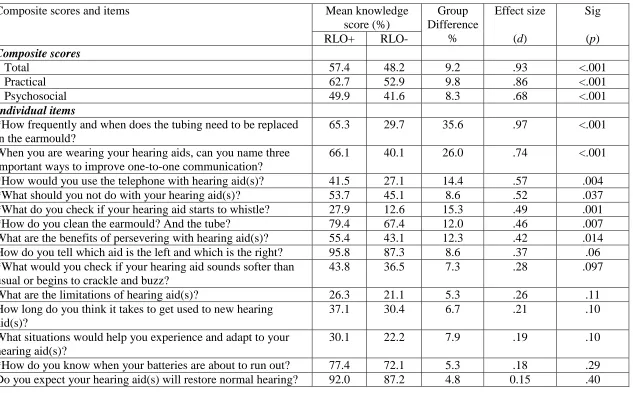
Composite scores were significantly better in the RLO+ group (p<0.001), with generally 140
7 100%. There was no difference in age, hearing threshold or gender between the groups
142
(p>0.05). ANOVA showed no significant effects of age, gender or hearing threshold on the 143
composite scores (p>0.05). 144
A multivariate analysis of variance (Wilks’ Lamda, λ) of the items showed the RLO+ group 145
had significantly better scores (p<.001). Table 2 shows the post hoc t-tests for the 14 items 146
with a between-group difference >3%, which included both practical (n=8/12) and 147
psychosocial (n=6/8) items. 148
Benefits of RLOs for first-time hearing aid users 149
Knowledge about hearing aids and communication was suboptimal in first-time users, and 150
poorer for the psychosocial compared to practical composite scores. There was, however, 151
significantly higher practical and psychosocial knowledge in the intervention group compared 152
to the control group. The effect sizes for the composite scoreswere generally large, 153
suggesting the improvements were clinically significant. It is not clear whether (i) the RLOs 154
provided additional information that the audiologist did not have time to deliver in the one-155
hour fitting appointment, (ii) the information was delivered and the RLOs served as reminder 156
to participants who might have otherwise have experienced poor information recall or 157
information overload, or (iii) a combination of both. However, the results suggest that the 158
knowledge showing the largest gains from RLO use is that which is not always given by the 159
audiologist due to time constraints and the requirement to ensure the basics are addressed. 160
For the absolute essentials (e.g. how to use the battery, where to go to get advice, and the 161
need to acclimatise to the hearing aid), there was almost no difference (<3%) between the two 162
groups. Similar results were seen for basic hearing aid handling skills (hearing aid/battery 163
insertion and removal), which were generally good with no group difference (Ferguson et al., 164
8 group whereas there was no group difference for hearing aid benefits, suggesting that
166
audiologists may focus more on the benefits rather than the limitations of hearing aids. 167
But does this improvement in knowledge transfer to improved outcome measures? Results 168
from the current study presented elsewhere suggest that RLOs do provide benefits to hearing 169
aid users (Ferguson, et al., in review). In the RLO+ group, practical earmould cleaning and 170
telephone skills were significantly better, and hearing aid use was significantly greater in 171
challenging listening situations, such as having a conversation in a group as well as in 172
suboptimal users. The vast majority of users reported the RLOs were highly useful, improved 173
their confidence to discuss hearing aids and communicate with others, and were preferable to 174
written materials. Importantly, around half the users watched the RLOs 2+ times and 20% 175
watched them 3+ times, with some watching the RLOs as many as seven times, suggesting 176
the RLOs were used to manage their hearing loss, hearing aids and communication. This was 177
supported by post-evaluation focus groups. 178
It should be noted that the participants in this research were younger and had less hearing loss 179
than typical hearing aid users from this clinic. It is possible that the impact of the RLOs on a 180
typical older, more impaired population would be different. Finally, the RLOs have 181
undergone further improvement based on participant feedback, are now branded as C2Hear, 182
and have been commercially available since November 2014. Further development and 183
evaluation is planned to tailor C2Hear to individuals using mobile technologies for hearing 184
aid users, as well as develop and evaluate RLOs for communication partners and non-185
audiological healthcare professionals. 186
There is clearly a gap in adult (re)habilitation for an effective intervention to enhance 187
9 adopt this educational intervention to supplement their clinical practice, as this was the
189
ultimate goal of this research. 190
Acknowledgements 191
We would like to thank research team members Holly Thomas, James Henderson and 192
Michael Taylor, the audiologists at Nottingham Audiology Service who recruited the 193
participants, and our patient and public involvement panel. 194
Conflicts of interest and source of funding: This paper presents independent research 195
funded by the National Institute for Health Research (NIHR) under its Research for Patient 196
Benefit (RfPB) Programme (Grant Reference Number PB-PG-0909-20294). The views 197
expressed are those of the authors and not necessarily those of the NHS, the NIHR or the 198
Department of Health. The Nottingham University Hospitals NHS Trust and University of 199
Nottingham will receive a small proportion of any royalties from the sale of the C2Hear 200
RLOs. There will be no payment made to any individual member of the research team. 201
202
10 Table 2. Mean age and better ear average hearing thresholds (octave frequencies between 0.25-4 kHz), gender and hearing aid fits for the
intervention (RLO+; n=62) and control groups (RLO-; n=77) who completed the knowledge questionnaire
RLO+ RLO-
Mean age (SD) years 68.1 (7.4) 67.3 (9.3)
Mean better ear average(0.25-4 kHz) (SD) dB HL 32.7 (7.6) 31.4 (9.3)
Gender (male: female) % 41:21 (66.%:34%) 49:30 (62%:38%
11 Table 1. Mean percentage knowledge scores for the composite and individual items for the intervention (RLO+) and control (RLO-) groups, the mean difference between groups and effect size (Cohen’s d). *indicates ‘practical’ questions.
Composite scores and items Mean knowledge
score (%)
Group Difference
%
Effect size (d)
Sig (p)
RLO+ RLO-
Composite scores
Total 57.4 48.2 9.2 .93 <.001
Practical 62.7 52.9 9.8 .86 <.001
Psychosocial 49.9 41.6 8.3 .68 <.001
Individual items
*How frequently and when does the tubing need to be replaced in the earmould?
65.3 29.7 35.6 .97 <.001
When you are wearing your hearing aids, can you name three important ways to improve one-to-one communication?
66.1 40.1 26.0 .74 <.001
*How would you use the telephone with hearing aid(s)? 41.5 27.1 14.4 .57 .004 *What should you not do with your hearing aid(s)? 53.7 45.1 8.6 .52 .037 *What do you check if your hearing aid starts to whistle? 27.9 12.6 15.3 .49 .001
*How do you clean the earmould? And the tube? 79.4 67.4 12.0 .46 .007
What are the benefits of persevering with hearing aid(s)? 55.4 43.1 12.3 .42 .014 How do you tell which aid is the left and which is the right? 95.8 87.3 8.6 .37 .06 *What would you check if your hearing aid sounds softer than
usual or begins to crackle and buzz?
43.8 36.5 7.3 .28 .097
What are the limitations of hearing aid(s)? 26.3 21.1 5.3 .26 .11
How long do you think it takes to get used to new hearing aid(s)?
37.1 30.4 6.7 .21 .10
What situations would help you experience and adapt to your hearing aid(s)?
30.1 22.2 7.9 .19 .10
13 References
Action on Hearing Loss. (2011). Hear me out: Audiology services in Scotland - services provided, patients' experience and needs. In RNID (Ed.), (pp. 1-83). London. Beynon, G. J., Thornton, F. L., & Poole, C. (1997). A randomized, controlled trial of the
efficacy of a communication course for first time hearing aid users. British Journal of Audiology, 31(5), 345-351.
Boothroyd, A. (2007). Adult aural Rehabilitation: What is it and does it work? Trends in Amplification, 11(2), 63-71.
Brandreth, M., Leighton, P., Wharrad, H., & Ferguson, M. (2013). Development of interactive video tutorials to educate first-time hearing aid users: a participatory approach. International Journal of Audiology, 52(4), 273.
Brooke, R. E., Isherwood, S., Herbert, N. C., Raynor, D. K., & Knapp, P. (2012). Hearing Aid Instruction Booklets: employing usability-testing to determine effectiveness. American Journal of Audiology, 12(2), 206-214.
Caposecco, A., Hickson, L., & Meyer, C. (2014). Hearing aid user guides: Suitability for older adults. International Journal of Audiology, 53(S1), S43-S51.
El-Molla, F., Smith, Z., Henshaw, H., & Ferguson, M. (2012, November). Retention of rehabilitation information by first-time hearing aid users with and without interactive patient information. Paper presented at the meeting of the British Academy of
Audiology, Manchester.
14 Goggins, S., & Day, J. (2009). Pilot study: Efficacy of recalling adult hearing-aid users for
ressessment after three years within a publicly funded audiology service. International Journal of Audiology, 48, 204-210.
Hickson, L., Worrall, L., & Scarinci, N. (2007). A randomized controlled trial evaluating the active communication education program for older people with hearing impairment. Ear and Hearing, 28(2).
Kessels, R. P. (2003). Patients' memory for medical information. Journal of the Royal Society of Medicine, 96(5), 219-222.
Kramer, S. E., Allessie, G. H. M., Dondorp, A. W., Zekveld, A. A., & Kapteyn, T. S. (2005). A home education program for older adults with hearing impairment and their
significant others: A randomized trial evaluating short- and long-term effects. International Journal of Audiology, 44(5), 255-264.
Lundberg, M., Andersson, G., & Lunner, T. (2011). A randomized, controlled trial of the short-term effects of complementing an educational program for hearing aid users with telephone consultations. Journal of the American Academy of Audiology, 22(10), 654-662.
Reese, J. L., & Smith, S. L. (2006). Recall of hearing aid orientation content by first-time hearing aid users. Seminars in Hearing, 27(4), 337-344.
NHS Scotland. (2009). Quality Standards for Adult Hearing Rehabilitation. Retrieved 16th December 2014, from
http://www.scotland.gov.uk/Resource/Doc/270517/0080557.pdf
15 Vuorialho, A., Karinen, P., & Sorri, M. (2006). Counselling of hearing aid users is highly
cost-effective. European Archives of Oto-rhino-laryngology, 263(11), 988. Windle, R. J., McCormick, D., Dandrea, J., & Wharrad, H. (2010). The characteristics of
reusable learning objects that enhance learning: A case-study in health-science education. British Journal of Educational Technology, 42(5), 811-823.