Shape Models for Image
Segmentation in Microscopy
A dissertation submitted to the University of Dublin for the degree of Doctor of Philosophy
Kangyu Pan
Trinity College Dublin, September 2013
ii
This thesis presents three model driven segmentation algorithms for extracting different types of microscopic objects based on prior shape information of the objects. The development of these algorithms is motivated by the demands of image processing for facilitating the neurological study of memory formation [46] and the investigation of a novel muscle regeneration technique [40]. This thesis has been divided into three parts, and each part proposes a shape model for segmenting the different image objects in different applications. These models are intended to be designed as fully automatic, however in order to achieve better results for the data in different scenarios some parameters in the models require user intervention.
The first part presents a novel Gaussian mixture shape modelling algorithm for protein particle detection and analysis in the images delivered from the biological study of memory formation. The biological study investigates the roles of the different types of proteins in the protein synthesis governing the formation of long-term-memory. The investigation is based on the colocalization analysis of different proteins in the living specimen which are stained with different fluorescent markers and are imaged separately by using a confocal microscope. However, some protein particles are clustered in the observed images. In order to detect the candidate particles in each cluster-spot (cluster of particles) that has a merged appearance in the images, the outlined shape modelling algorithm fits the intensity profile of each spot of the protein particles (some are cluster-spots) with a 2-D Gaussian mixture model (GMM). The new GMM approach not only estimates the number of candidate particles in a cluster spot, but also parametrizes the shape characteristics of the particles for the later co-localization analysis. Since the optimization process for the parameters of the GMMs is intractable, a novel error-based split-and-merge expectation-maximization (eSMEM) algorithm (as part of the shape modelling algorithm) is applied to estimate the parameters of the mixture components of the model as well as the number of components. The shape modelling algorithm is completed by adding a pre-processing stage that overcomes scanning-noise and background luminance problems from the acquired image data. During the pre-process, a contrast threshold is defined by the user in order to have a initial rough segmentation of the separate spots in the image. The separated spots are then parameterized by the GMMs automatically. After shape modelling of the particles, the usefulness of the results to the biological analysis is demonstrated by showing how the shape models are used to perform data analysis and co-localization analysis on the protein particles in the images.
ii
the irregular luminance of the synapses and the presence of the ‘out-of-focus’ synaptic features. These are caused by the defect of the fluorescent staining process and the physical limit of the confocal microscope. A Bayesian model is outlined for the segmentation by incorporating the ‘sharpness’ information of the objects, the global intensity histogram, and the inter-slice intensity behaviour. The ‘sharpness’ information is assumed to be luminance invariant and is derived by the high frequency content of the image in the wavelet domain. The global intensity histogram is used to separate the potential object and the background noise. The inter-slice intensity information is the intensity profile across the slices of the image stack at the same pixel site of every slice. The Bayesian segmentation is optimized automatically by using the graph-cut method. Since the determination of out-of-focus synaptic features is subjective, the weights of the likelihoods and the prior in the model are user interactive in order to achieve better segmentation of the 3D synaptic shape.
I hereby declare that this thesis has not been submitted as an exercise for a degree at this or any other University and that it is entirely my own work.
I agree that the Library may lend or copy this thesis upon request.
Signed,
Kangyu Pan
Acknowledgments
I would like to thank my supervisors, Prof. Anil Kokaram and Prof. Frank Boland for their time, advice and patience. Gratitude must also go to my co-supervisor, Dr. David Corrigan, for all the help and advice he has given, in particular when reviewing my publications and thesis. Thanks must also go to all past and present members of the SIGMEDIA group and the staff in Electronic and Electrical Engineering in Trinity College who have assisted me in my work. I would also like to thank Jens Hillebrand, Prof. Mani Ramaswami and Michael J. Higgins for providing the image data and biological information in this work. This work was funded in part by the Science Foundation Ireland (08/IN.1/12112). Thanks to everyone involved for their foresight. Finally, I would like to thank my family and friends. In particular to my parents, for all their encouragement, understanding and support they given me.
Contents v
List of Acronyms viii
1 Introduction 1
1.1 Spot Analysis . . . 2
1.2 3-D Shape Reconstruction . . . 2
1.3 Segmentation of Overlapped Objects . . . 3
1.4 Thesis Outline . . . 4
1.5 Publications . . . 5
2 Image Segmentation in Microscopy: A Review 7 2.1 A Review of Segmentation Techniques in Microscopy . . . 7
2.1.1 Thresholding . . . 8
2.1.2 Watershed Segmentation . . . 9
2.1.3 Data Clustering . . . 11
2.1.4 Machine Learning Classifiers . . . 13
2.1.5 Active Contours . . . 17
2.1.6 Template Matching . . . 20
2.1.7 Geometrical Shape Models . . . 20
2.1.8 Discussion . . . 23
2.2 Problems addressed in this Work . . . 25
2.2.1 Confocal Fluorescent Microscopy . . . 25
2.2.2 Scope for New Algorithms . . . 28
3 GMM Shape Modelling for Spot Detection 31 3.1 Introduction to the Biology . . . 31
3.2 Introduction to Analysis . . . 33
3.3 EM Algorithm for GMM Parameter Estimation . . . 36
3.3.1 Likelihood . . . 36
3.3.2 Hidden Variable . . . 37
CONTENTS vi
3.3.3 Parameter Estimation . . . 38
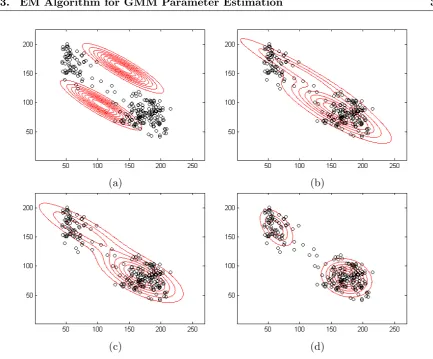
3.3.4 Limitation of the EM Algorithm . . . 39
3.4 The SMEM Algorithm . . . 40
3.4.1 Basic Split and Merge . . . 40
3.4.2 Modified Merge . . . 41
3.4.3 Modified Split . . . 41
3.4.4 Merge and Split Criteria . . . 43
3.4.5 Discussion . . . 44
3.5 The eSMEM Algorithm for Shape Modelling . . . 46
3.5.1 EM Algorithm for Shape Modelling . . . 46
3.5.2 Initialization of the GMM . . . 48
3.5.3 Split and Merge Operation . . . 49
3.5.4 Error Distribution . . . 50
3.5.5 Error-based Split Method . . . 51
3.5.6 Split and Merge Criteria for shape modelling . . . 56
3.5.7 eSMEM Modeling Process . . . 58
3.6 Conclusion . . . 61
4 Spotnick: a practical eSMEM shape modelling tool 63 4.1 Pre-processing Stage . . . 64
4.1.1 Noise Reduction . . . 65
4.1.2 Spot Segmentation . . . 65
4.1.3 Local Background Subtraction . . . 71
4.2 Shape Modelling Results . . . 72
4.2.1 Ground-truth Evaluation on Synthetic Samples . . . 73
4.2.2 Comparison with the Zhanget al. SMEM algorithm [99] . . . 83
4.3 Results on Real Data . . . 91
4.4 Data Analysis . . . 98
4.4.1 Parameter Registration and Statistics . . . 102
4.4.2 Co-localization Analysis . . . 102
4.5 Conclusion . . . 106
5 Synapcut: a wavelet-based Bayesian framework for synapse segmentation 109 5.1 Introduction . . . 110
5.1.1 Challenges in Synapse Segmentation . . . 112
5.1.2 Scope of the Segmentation Model . . . 112
5.2 Bayesian Segmentation Model . . . 114
5.3 Likelihoods . . . 116
5.3.2 Global Intensity Likelihood . . . 122
5.3.3 Inter-slice Intensity Likelihood . . . 125
5.4 Smoothness Frame Prior . . . 127
5.5 Graph-cuts Optimization . . . 129
5.5.1 Graph-cut Model . . . 132
5.5.2 Graph-cut Segmentation . . . 132
5.6 Segmentation Results . . . 134
5.7 Conclusion . . . 136
6 Cellsnake: an active contour model for cell/fibre segmentation 141 6.1 Biological Background . . . 142
6.2 Active Contour . . . 147
6.2.1 Numerical Solution . . . 148
6.2.2 A Review of the Existing Conditional ForcesFcon . . . 149
6.2.3 Discussion . . . 151
6.3 Pre-processing . . . 153
6.4 Cellsnake . . . 155
6.4.1 Environment ForcesFenv . . . 156
6.4.2 Cellular ModuleFcell . . . 160
6.4.3 Practical Modifications . . . 166
6.4.4 Combining the Forces . . . 170
6.4.5 Cellsnake and the Merge scheme . . . 172
6.5 Segmentation Results . . . 173
6.6 Conclusion . . . 177
7 Conclusion 185 7.1 Microscopic Image Segmentation . . . 185
7.2 Spot Detection and Analysis . . . 186
7.3 3-D Shape Reconstruction . . . 187
7.4 Segmentation of Overlapped Objects . . . 188
7.5 Future Work . . . 190
A Protein Synthesis and Regulation in Neuron Cells 193
B Spotnick Graphical-User-Interface (GUI) 195
List of Acronyms
AAM Active Appearance Model
AC Active Contour
ASM Active Shape Model
DGMM Dynamic Gaussian Mixture Model
DoG Difference of Gaussian
DTCWT Dual-Tree Complex Wavelet Transform
DWT Discrete Wavelet Transform
eSMEM error-based Split and Merge Expectation Maximization
EM Expectation Maximization
GMM Gaussian Mixture Model
GVF Gradient Vector Flow
LoG Laplacian of Gaussian
LSE Least Square Error
LTM Long Term Memory
mRNA messenger Ribonucleic Acid
mRNP messenger Ribonucleotide Protein
MAP Maximum A Posteriori
MRF Markov Random Fields
PDF Probability Density Function
PSF Point Spread Function
RNA Ribonucleic Acid
ROI Region of Interest
SMEM Split and Merge Expectation Maximization
SVM Support Vector Machine
VFC Vector Field Convolution
1
Introduction
Since the first microscope was developed in 1590, microscopy has steadily improved and found increased use in biological research and clinical medicine as well as in many other fields. Mi-croscopic imaging provides visualization of a broad range of biological and inorganic specimens at micro- to nano- scale levels, and enables researchers to investigate the detailed insights into the complex relationships that exist within the objects too small to be seen with the naked eye. Nowadays, the images observed by the microscopes are converted into digital data for easier storage, analysis or processing prior to display and interpretation.
As the amount of image data collected from various microscopic objects is ever-increasing, image processing has steadily become an indispensable part in microscopy because of the po-tential for large scale statistical evaluation on the acquired data. This is in addition to classical manual screening by eye. Among the different aspects of image processing, segmentation is a fundamental task for detecting and extracting the objects of interest from the observed images for further investigation. Considering the importance of segmentation as the first step in many image analysis applications, a great variety of segmentation algorithms have been proposed for a wide range of microscopic images. These algorithms are highly specific to the needs of various applications involved with different microscopic objects, such as molecules, nuclei, cells or other histological structures. The various image segmentation techniques can be categorized into the image driven approaches that are solely based on the image features, and the model driven approaches that incorporate certain patterns of the objects of interest.
The image driven approaches are usually simple and have higher robustness for the different applications with simple objects. Conversely, the model driven approaches tend to be more
elaborate and case specific, and usually incorporate with a-priori shape information to segment the specific complex image objects. The goals in this thesis are to extract the specific microscopic objects in the different applications. Since the image objects have different complex shapes and the segmentation in each application is based on a-priori shape information of the corresponding objects, a novel shape model is designed to segment the objects in each task by incorporating the corresponding shape information.
The development of these shape models is motivated by investigations on the neurological study of memory formation [46] and the muscle regeneration [40]. The work may be divided into three parts:
1. The extraction and colocalization analysis of protein particles
2. The 3-D shape reconstruction of neuron synapses
3. The segmentation of overlapped muscle fibres/cells
1.1
Spot Analysis
The brain creates long term memory by synthesising certain proteins at stimulated synapses. Different types of proteins are involved in the synthesis process. The study of memory formation in [46] investigates the characteristics of the different proteins by considering the distribution of each type of protein in the neuron synapses and the colocalization of the different types of proteins. The different proteins in the living specimen are stained with different fluorescent markers and are imaged separately using a confocal microscope. A gray-scale image is generated for each type of protein, and the images of the different markers from the same specimen are registered to each other. The image processing task is to detect and measure the protein particles in each image and then analyze the relative separation of particles from each other across the two images (colocalization analysis). The difficulty of this task is that some protein particles are clustered and cause large and irregular spot appearance in the resultant image. In order to detect the ‘merged’ particles and estimate the overlapped shape for the further colocalization analysis, a Gaussian mixture model (GMM) is used to fit the intensity profile of each cluster spot and identify the individual particles by the components of the mixture model. Also, since the shapes of the particles are parameterized by the GMMs, the model parameters are used directly in the colocalization analysis.
1.2
3-D Shape Reconstruction
1.3. Segmentation of Overlapped Objects 3
stack of the serially scanned images. The goal is to reconstruct the 3-D shape of the synapses from the observed image stack generated by a confocal microscope. This is a challenging problem because of the irregular luminance of the synapses and the presence of features that are out of focus. These are caused by the defect in fluorescent staining process and the physical limit of the confocal microscope. A Bayesian model is introduced for the segmentation which incorporates the ‘sharpness’ information of the objects, the global intensity histogram, and the inter-slice intensity information. The ‘sharpness’ information is assumed to be luminance invariant and is derived by the high frequency content of the image in the wavelet domain. The global intensity histogram is used to separate the potential object from the background noise. The inter-slice intensity information is the intensity profile across the slices of the image stack at the same pixel site of every slice. The sharpness and the intensity information give rise to three different likelihood terms in the model. Also, the model employs a prior that is constrained by the ‘frame’ of the synapse. The frame can be considered as the skeleton of the winding synapses. Since the synapses are connected in some patterns, the idea of the frame prior is to enhance the connections of the synapses which are not considered in the likelihood terms. Finally, the Bayesian segmentation is optimized using the graph-cut method.
1.3
Segmentation of Overlapped Objects
ROI. The key is the development of specifically purposed novel forces to constrain the growth of the ACs and recover the occluded parts of the candidates in the overlap region. Finally, a merge scheme is developed for determining and merging the ACs that belong to the same fibre. The shapes of the cells/fibres in the overlapped object are then estimated by the resultant merged shape of the ACs.
1.4
Thesis Outline
A brief summary of each chapter is as follows.
Chapter 2 Image Segmentation in Microscopy: A Review
This chapter gives a brief overview of various image segmentation techniques proposed in the pre-vious work in microscopy. The techniques are categorized as either image driven approaches or model driven approaches. The image driven approaches include image thresholding, watershed segmentation and data clustering. The model based approaches consist of template matching, classification models, active contours and geometric shape models. This is followed by a dis-cussion about the scope of the algorithms introduced in this work and the motivation from the previous work. Also, a brief description of the confocal fluorescent microscopy is presented to show how the images concerned in this work are generated.
Chapter 3 GMM Shape modelling for spot detection modelling
This chapter provides a brief introduction to the biological background of the memory formation, and outlines the novel application of GMMs for fitting the intensity profile of spots in a given image in order to detect protein particles. Since the GMMs are optimized using a split-and-merge expectation maximization (SMEM) algorithm, a brief review and discussion of the previous SMEM algorithms are presented. This is followed by the introduction of a novel error-based SMEM (eSMEM) algorithm that is customized for the GMMs in shape modelling.
Chapter 4 Spotnick: a practical eSMEM shape modelling tool
1.5. Publications 5
Chapter 5 Synapcut: a wavelet-based Bayesian framework for synapses seg-mentation
This chapter presents the novel Bayesian model for segmenting 3D synaptic objects from a given image stack. A detailed description of the likelihood terms and the shape prior is presented. Summaries of the segmentation results and a discussion of the future improvement are also presented.
Chapter 6 Cellsnake: an active contour model for cell/fibre segmentation
This chapter outlines the new active contour mode (Cellsnake) for shape estimation of the overlapped cell/fibre objects in order to detect the objects from the combined appearance in the microscope images. The chapter details the energy forces of the model derived from the a priori shape information are presented. The segmentation results the synthetic data and real data are presented and are discussed in the final section.
Chapter 7 Conclusions
This final chapter assesses the contributions of the research and outlines some possible improve-ments and idea for future work.
1.5
Publications
Portions of the work described in this thesis have appeared in the following publications:
[78] K. Pan, J. Hillebrand, M. Ramaswami, and A. Kokaram. Gaussian mixtures for intensity modelling of spots in microscopy. In International Symposium on Biomedical Imaging (ISBI’10), pages 121 - 124, Rotterdam, Netherlands, February 2010.
[77] K. Pan, J. Hillebrand, M. Ramaswami, and A. Kokaram. Gaussian mixture models for spots in microscopy using a new split/merge em algorithm. In IEEE International Con-ference on Image Processing (ICIP’10), pages 3645 - 3648, Hong Kong, China, October 2010.
[46] J. Hillebrand, K. Pan, A. Kokaram, S. Barbee, R. Parker, and M. Ramaswami. The me31b dead-box helicase localizes to postsynaptic foci and regulates expression of a camkii reporter mrna in dendrites of drosophila olfactory projection neurons. In Frontiers in Neural Circuits, 4(00121), 2010.
2
Image Segmentation in Microscopy: A Review
Microscopy is the technical field of using microscopes to view samples and objects that cannot be seen with the naked eye. Microscopic imaging enables the scientists to observe cells and molecular dynamics within the living cell at micro- to nano- scales, and allow them to acquire static images of the structures of interest in two or three dimensions in a living specimen and can also record time-lapse image sequences to study molecular transport or transformation within the cell and in the extracellular substance. As the imaging techniques in microscopy are ever-improving, image processing, as an integral part of microscopy, is increasingly important to the fields of medicine and scientific research for analysing the observed data for further image understanding. One of the popular strategies in microscopic image processing is image segmentation for extracting the objects of interest (i.e. molecules, cellular subunits, whole cells, tissues or organs). This task is made difficult because of the adverse environment in which the pictures are acquired. Typically images are corrupted by noise, blur and uneven contrast. Hence many image segmentation techniques developed for microscopy applications tend to focus on particular objects of interest. This chapter presents a brief overview of the existing techniques for microscopic image segmentation, and also includes a discussion of the tasks addressed in this work and the outlined shape analysis solution motivated by the previous techniques.
2.1
A Review of Segmentation Techniques in Microscopy
Microscopic imaging provides visualization of a wide range of biological and inorganic speci-mens at micro- to nano- scale levels, and enables researchers to investigate the detailed insights
into the complex relationships that exist within living cells. However, with an ever-increasing amount of multi-dimensional image data of various microscopic objects in biomedical research and clinical medicine, quantitative interpretation of the data becomes complex, time-consuming and possible subjective due to different visual interpretations of different researchers. Conse-quently, microscopic image processing is an indispensable part of microscopy which allows large scale statistical evaluation on the acquired image data in addition to classical eye screening qualitative valuation, and extracts the valuable information for further biological analysis.
Image segmentation is the fundamental process for the analyses in microscopic images which provide important information for further image understanding by extracting the sub-cellular particles, nuclei, cells or histological structures from stained tissues with different markers with an adequate accuracy. However, the segmentation process is challenging due to not only the large variations of the features (size, shape, orientation or texture) in the desired objects in different applications, but also the co-existence of unwanted objects, and variations in back-ground luminance. In many image analysis applications, segmentation is often the first and the most difficult step. Due to its importance, a great variety of segmentation algorithms have been proposed for a wide range of applications. Also, the publications are wide-spread in literature: microscopy, biomedical engineering, biomedical imaging, bioinformatics and pattern recognition (some of them are reviewed in this section).
The task of segmentation in microscopic images refers to the process of finding the regions (boundaries and area) of the desired objects with an adequate accuracy from the images of stained specimens with different markers. The considered papers study different image types from the prostate, breast, blood, bone marrow, cervix, esophagus and lymphatic-system obtained with different markers, e.g., DAPI, immunodetection of lamin A/C, hematoxylin and eosin, Papanicolaou stain.
In general, the various segmentation algorithms can be categorized as image driven or model driven. Image driven approaches operate directly on the image pixels and detects objects solely based on the image features. This includes image thresholding, watershed segmentation and data clustering. Conversely, model based approaches assume that objects in an image are present in a certain pattern. A list of models generally used for image segmentation are template matching, classifications models, active contours and geometric shape models.
The following sections present a brief overview of the existing techniques in different ap-plications and the publications in a categorized order. Because almost all proposed techniques combine at least two image processing methods, the techniques are grouped based on the rele-vant/critical image processing method which distinguishes them from other approaches.
2.1.1 Thresholding
2.1. A Review of Segmentation Techniques in Microscopy 9
(a) (b) (c) (d)
Figure 2.1: The idea and the result of the SCT algorithm (a) plot of the number of voxels with an intensity greater than or equal to the given threshold in a typical image stack of an MRC5
cell nucleus with fluorescently tagged PML; (b) an image of nuclei in MRC5 primary fibroblasts
(‘red’ for SC35 protein, ‘green’ PML protein in ); (c) segmentation produced by applying the SCT algorithm to each colour channel of (b); (d) segmentations produced by applying Otsu’s
algorithm to each colour channel of (b). (Reproduced from [84])
[75], Ridler and Calvard’s iterative-selection method [83] and Kittler and Illingworth’s minimum-error-thresholding method [55]. To find the optimum threshold, Otsu suggested minimizing the weighted sum of within-class variances of the foreground and background pixels, which is equivalent to maximizing the scatter between the classes. Ridler and Calvard’s iterative-selection method is an iterative version of Otsu’s method. In each iteration, a new threshold is established using the average of the foreground and background class means. The iterations terminate when the change in the repeatedly updated threshold becomes sufficiently small. In Kittler and Illingworth’s minimum-error-thresholding method, each class of the pixels is characterized by a conditional Gaussian probability density functions, and the optimum threshold is yielded by minimizing the total mis-classification error.
Microscopy images are rarely so simple and noise-free that a single threshold would be robust. Hence a number of adaptive thresholding schemes have been developed. In [59], a multi-thresholding scheme was employed to extract sub-cellular structures by assuming that there were three different classes of features in the image. Barrera et al [7] performed spot detection by applying locally adaptive thresholding to cope with irregular illumination across the image. Russel et al [84] segmented sub-cellular structures by a simpler adaptive thresholding technique. In this technique the threshold is increased until the area of detected objects reaches a steady state (see Fig. 2.1).
2.1.2 Watershed Segmentation
(a) (b) (c)
Figure 2.2: Illustration of the Wavelet-based segmentation in [49] (a) Source images with the localization of single molecules in green areas. (b) The lo-lo band at level 2 of the wavelet transform. (c) The results of wavelet segmentation. (Reproduced from [49])
better separation of objects which share a boundary. Typically, the watershed algorithm is used to segment a relief function related to the image (typically gradient magnitude). The watershed works by iteratively ‘flooding’ the relief function (started from the local minima) and identifies the segments by keeping track of the different connected regions.
Izeddin et al [1] improved the performance of watershed segmentation for this problem by applying it to the 2nd level wavelet decomposition of the image (see Fig. 2.2).
However, the direct application of the basic watershed algorithm generally leads to over-segmentation due to noise and other local irregularities of the gradient. There are three ap-proaches capable of reducing this problem. The first option is to pre-process the image. The second one is to merge adjacent regions according to some criteria after the use of watershed. The last approach is the marker-controlled watershed algorithm where the local minima (the markers) are firstly eliminated based on particular criteria before the ‘flooding’.
Cheng and Rajapaksein [24] proposed a marker-controlled watershed algorithm for separating the clustered nuclei in fluorescence microscopy cellular images (see Fig. 2.3), where the undesired regional minima are removed by using an adaptive H-minima transform. In [24], the regions of clustered nuclei are firstly detected by using an active contour model. A set markers for separating the clustered nuclei are initialized by the minima of the inverse inner distance map of each of the region. The adaptive H-minima technique uses the original H-minima transform [88] to eliminate the unwanted markers.
In [51], Jeong et al. proposed a hybrid of the marker-controlled and region merging ap-proaches. In this method, an technique using ultimate erosion (iteratively erode a figure to get a skeleton) is proposed for detecting the markers for the clustered nuclei. Also, Jeong et al. introduced a stepwise merging strategy to merge the over-segmented fragments from the watershed algorithm into an isolated nuclei (see Fig. 2.4).
2.1. A Review of Segmentation Techniques in Microscopy 11
(a) (b) (c) (d) (e)
Figure 2.3: Illustration of the marker-controlled watershed algorithm in [24] (a) An example of the clustered nuclei. (b) The inverse inner distance map generated after segmentation of the
cluster shape. (c) the grey spots show the local minima of (b). (d) The shape markers in white
obtained from adaptive H-minima transform. (e) The results of the watershed segmentation.
(Reproduced from [24])
(a) (b) (c)
Figure 2.4: Illustration of the nuclei classification based watershed segmentation in [51](a) Image of leucocyte nuclei. (b) Over-segmentation after watershed segmentation. (c) Final results after stepwise-merging strategy. (Reproduced from [51])
another image (the mask). The algorithm begins from the peaks in the marker image, where the peaks are forced to spread out, or dilate to fit within the mask image. The spreading process continues until the image values stop changing. The desired markers for the watershed approach are assigned by the regional maxima extracted by subtracting the marker image from the mask image. Since the morphological reconstruction technique extract the regional maxima rather than the local maxima, the unwanted markers are hence eliminated.
2.1.3 Data Clustering
(a) (b) (c)
[image:23.595.130.499.94.360.2](d) (e) (f)
Figure 2.5: Illustration of the texture-based k-means clustering segmentation in [35] (a) RGB image of the glands. (b) Feature map of the gray-scale version of (a). (c) Segmented image of (b) by using k-means clustering. (d) Feature map of the variance density image of (a). (e) Segmented
image of (d) by using k-means clustering. (f ) The boundaries are found by combining (c) and
(e). The original image (a) overlaid with the estimated segmentation boundaries (Reproduced from [35])
K-means clusteringis a method of cluster analysis which aims to partition n observations into k clusters in which each observation belongs to the cluster with the nearest mean. This results in a partitioning of the data space into Voronoi regions. In [35], Farjamet al. segmented the gland components (stroma, lumen, nuclei) in the prostate tissue images by grouping the roughness texture features for each object using the k-means clustering (see Fig. 2.5).
Fuzzy c-means clustering allows each point to have a degree of belonging to clusters, as in fuzzy logic, rather than membership completely to just one cluster. Thus, points on the edge of a cluster, may be in the cluster to a lesser degree than points in the centre of cluster. In [26], a cluster analysis based on the fuzzy c-means algorithm is performed by Colantonio et al. on the HSV colour feature of the original RGB image of lymphatic tumours to provide a rough automatic segmentation of the clustered cells (see Fig. 2.6).
2.1. A Review of Segmentation Techniques in Microscopy 13
(a) (b) (c)
Figure 2.6: Illustration of the segmentation using fuzzy clustering and neural discrimination in [26](a) The image of the lymphatic tumours. (b) Labelling of the connected regions identified during fuzzy clustering. (c) Identified contours of each cell based on (b). (Reproduced from [26])
et al. integrated the mean-shift algorithm with a single-pass voting approach to automatically locate the geometric centres of the overlapped cells in breast tissue images.
Gaussian mixture modelsare among the most statistically mature methods for clustering, where the distribution of each cluster is fit to a mixture of Gaussian densities. The parameters of the GMMs are usually optimized using the expectation-maximization (EM) algorithm. This is an iterative method for finding maximum likelihood or maximum a posteriori (MAP) estimates of parameters in statistical models and is proposed by Dempster in [32]. In [8], Begelman et al. proposed a prostate tissue segmentation algorithm that uses a GMM to group the colour features of different objects (stroma, nuclei, and prostate glands) by fitting the GMM to the colour distribution. Each Gaussian in the GMM is assumed to represent one object type, and the GMM is optimized by the EM algorithm. Usually, the GMM is an image driven technique in the sense that it operates in a feature space derived from the image. However it can be used instead as a model for shape fitting in which case the GMM surface is used as the function fit for some observed shape or volume. The dynamic Gaussian mixture model (DGMM) introduced by Xiong
et al. in [92] is a good example. The DGMM is proposed for cell tracking in time-lapse image sequence (Fig. 2.7(a)&(b)). Each cell image is firstly thresholded in order to extract the feature points in the cells, and then a GMM is fitted to the clusters of the feature points (Fig. 2.7(c)) so that each component of the GMM informs the position and shape of the corresponding cell. The modelling of the cellular shape is actually GMM clustering of the feature points (extracted by thresholding) of the objects (Fig. 2.7(c)). The optimization of the model parameters is implemented with the EM algorithm.
2.1.4 Machine Learning Classifiers
Ultimately, image segmentation is achieved by classifying pixels according to the probability that they belong to certain image classes. Hence many classifiers can be used in this application. The popular frameworks used previously in microscope image processing include SVMs (Support Vectyor Machines), Neural Networks and general Bayesian frameworks for classification.
(a) (b) (c)
Figure 2.7: Gaussian mixture modelling for cell tracking in time-lapse image sequence((a) and (b) are two adjacent frames in a time-lapse image sequence. The spots labelled with 2 and 3 in the (a) are split into the spots 2a&2b and 3a&3b respectively in the next frame (b) of an image sequence. (c) shows that the GMM is estimated from the elliptical clusters of the feature points
after thresholding a given cell image.) (Reproduced from [92])
Learning. The reader is directed to excellent texts by Duda et al. [34] and Murphy [70] that describe these techniques in detail. For the purposes of this thesis it is sufficient to note that the SVM in its simplest form is a linear binary classifier while Neural networks are used for non-linear multiclass classification. In both cases the idea is to define a discrimination boundary between classes in the relevant feature space. The first step in classification is typically to estimate the parameters of the classifier using labelled training data. Segmentation is achieved by estimation of the class membership at each pixel or patch site.
A hybrid colour SVM is proposed by Lebrun et al. in [57]. Given a multi-channel image with more than two classes of different objects, each class is associated with a SVM classifier. By subjecting a colour feature to the SVMs, the output of each SVM for every pixel is mapped to a posterior probability by applying a sigmoid function. Then, the pixel probability image for each class (Fig. 2.8(d)-(f) for three different classes) is generated for the segmentation using watershed algorithm, and the segmentation result is shown in Fig. 2.8(c).
In addition, the SVM is often used to identify the phases or grades of the detected objects. For instance, the cell cycle phase identification system proposed by Wanget al. in [91] uses an online updating SVM to identify the cell cycle phase of the cell detected by watershed segmentation. Also, the morphological features of the gland objects detected by the active contour analysis proposed by Naik et al. in [72] are subjected to a SVM algorithm to identify the intermediate Gleason grades of the given prostate histology image.
2.1. A Review of Segmentation Techniques in Microscopy 15
(a) (b) (c)
[image:26.595.89.541.88.372.2](d) (e) (f)
Figure 2.8: Illustration of the SVM probability based watershed segmentation in [57] (a) Orig-inal image. (b) Expert segmentation: background (blue), cytoplasm (green), nucleus (red). (c) Results of watershed segmentation. Pixel probabilities estimation of background (d), cytoplasm
(e) and nucleus (f ). (Reproduced from [57])
network is proposed by Colantonio et al. in [26] to identify the classes of touching objects in lymphatic tumours images in order to isolating and define the boundaries of the objects.
Bayesian segmentation is a statistically based classification method, and is a convenient way of taking a priori information into consideration when inference is made from images. Assuming that there are say 2 segments to be estimated in the image, the problem is posed as that of estimating a segmentation label at each pixel site. That label takes on one of two values in this case say 0,1. In a Bayesian fashion, the problem is to maximise p(L|I) over the image space I and that is written p(L|I) ∝ p(I|L)p(L). Prior information typically about spatial smoothness is injected as p(L) and the image appearance given each label L is modelled by defining p(I|L), the likelihood. See [36] for more details about Bayesian segmentation.
In [71], a Bayesian classifier is applied by Naiket al. to extract the low-level information of the target objects for the gland and nuclei segmentation. The Bayesian classifier estimates the likelihood of each pixel belonging to an object of interest (lumen, cytoplasm or nuclei) based on the RGB intensity. The likelihood image for each class of object is then used to detect the nuclei and to find the boundary of the gland objects.
us-(a) (b) (c) (d)
Figure 2.9: Illustration of two-stage graph-cut segmentation model in [31] (a) Original image. (b) Foreground (white) and background (black) markers. (c) Background segmentation. (d) Separation of the isolated cells in the clusters (Reproduced from [31])
ing any number of optimization methods. The most powerful of these is the graph-cut technique first proposed in [42]. That technique is guaranteed to yield the optimal solution in the case of two class labelling but a number of extensions have been developed for multi-class problems since then e.g. [15]. In [31], a two-stage graph-cut model is introduced by Danˇeket al. to segment the clustered cell nuclei (see Fig. 2.9). The first stage of the model is a background segmentation (Fig. 2.9(c)). Voxels with very high probability of being foreground or background are located and separated by a boundary with a minimal geodesic length. Also, a bi-level histogram analysis is applied to define the background/foreground markers (Fig. 2.9(b)) when the intensities of the voxels are below the background threshold or above the foreground threshold. The second stage is to split the isolated cells from the obtained clusters by combining image gradient infor-mation and a priori knowledge about the shape of the nuclei. The voxels are associated with a probability value derived from the Euclidean distance of the voxels to the nearest peak, and are separated by the minimum cut of the graph-cut model (Fig. 2.9(d)).
2.1. A Review of Segmentation Techniques in Microscopy 17
(a) (b)
Figure 2.10: Illustration of the Viterbi search-based dual active contour model in [4] (a) Cell nucleus with inner and outer contours (circles). (b) Discretization of the search space. (Repro-duced from [4])
2.1.5 Active Contours
Active contours (ACs) are shape-based model driven approaches which are considered as the state-of-the-art in medical image segmentation and have recently been used for the segmentation of biological images. Unlike all of the methods examined so far, Active Contours explicitly model the shape contour, rather than implicitly as the boundary of some segmentation of the image. An AC (also called snake) is a deformable spline influenced by constraint and image forces that pull it towards object boundaries. The principle of ACs is to search for a curve in the image where the weighted sum of internal (constraint) energy and potential energy (image force) is minimum. The internal energy is defined by the curve itself in such a way as to keep the contour smooth during deformation. The potential energy is computed from the image data to move the curve toward an object boundary or other desired feature within an image.
In [4], a Viterbi search-based dual active contour model is introduced by Bamford and Lovell for cell nucleus segmentation in stained cervical cell images. The approach of the model is to use use inner and outer contours (Fig. 2.10(a)) which are required to lie within and outside the object of interest, respectively, as opposed to near the final solution. A driving force pushes the contours towards each other which enables each contour to overcome local minima in the image. The process is halted when both contours meet. The globally minimum energy contour is firstly defined by using the Viterbi algorithm in the discrete search space (Fig. 2.10(b)) between the inner and outer contours. The final smooth boundary is found by attracting the ACs to the defined globally minimum energy contour.
Figure 2.11: Segmentation results for the cytoplasm and nucleus by using the colour GVF active contour model (Reproduced from [96])
the contour outward from the nucleus centre detected on initialization.
A colour gradient vector flow (GVF) active contour model is proposed by Yanget al. in [96] for cell segmentation in colour images. The given RGB image is firstly converted to the LUV colour space which is more perceptually uniform for the Euclidean metrics and distances. The colour GVF is generated by the changing rates in the directions of the eigenvectors of the matrices created by the 2nd derivatives of the L, U, V channels. In order to obtain a robust estimation of the initial locations of the nucleus and cytoplasm of cells without being affected by outliers (the objects without interest), a statistically robust matching criteria is incorporated with the active contour model to classify the objects before the evolution process of the snake. This classification is based on a minimum distance estimator that minimizes the integral squared error (L2E) between a Gaussian model of the residual and the true density function of the
residual. The segmentation results are shown in Fig. 2.11.
In [68], Mosaligantiet al. introduced a variational region-based active contour for density-based segmentation of multicellular structure (Fig. 2.12(a)). This model uses a level-set method based on the Mumford-Shah energy functional but replaces the scalar constants that approximate the foreground and background intensities with distinct and constant cellular densities. The cellular densities (Fig. 2.12(b)) are estimated using 2-point correlation functions computed on classified cell images. The segmentation results of the level-set formulation are given in Fig. 2.12(c).
On the other hand, some AC algorithms use reference images to incorporate the shape information of the target objects in constraining the AC deformation. An AC model using reference shape prior is introduced by Foulonneau et al. in [38]. In this AC model, the shape of reference object is firstly encoded by a shape descriptor defined by the Legendre moments derived from the inner region of the object. The shape descriptor is then subjected to a density function of mixture of Gaussians and gives rise to a shape prior energy. The evolution equation for the AC is derived from the minimization of the shape prior energy using a shape derivative framework. The segmentation results of objects with occlusions are shown in Fig. 2.13.
The idea of using reference object shapes is also adopted by two other popular active models, the active shape model (ASM) and the active appearance model (AAM) developed by Cootes
2.1. A Review of Segmentation Techniques in Microscopy 19
[image:30.595.154.473.381.646.2](a) (b) (c)
Figure 2.12: Segmentation results of the density-based level-set formulation in [68](a) A optical section of the zebrafish embryo ear. Note the variable density of cells. (b) Colour-coded density map of cell regions. (c) Two-class segmentation of the image using the density-based level-set
formulation. (Reproduced from [68])
Figure 2.13: Segmentation results for the letters featuring large occlusions. First two row: a set of reference shapes used with the reference AC model. Third row: original images with letters featuring occlusions. Forth row: initialization. Fifth row: final result with the shape constraint.
(a) (b) (c) (d)
Figure 2.14: The spot identification process. (a) A vignette image containing a spot. (b) The Laplacian image of (a). (c) Template of desired boundary. (d) The 2D cross-correlation of (b) and (c). (Reproduced from [19])
iteratively deform to fit to an example of the object in a new image. The shape of ASM is represented by a set of points and is constrained by the point distribution model when fitting to the target object. The shape of ASM varies only in ways seen in a training set of labelled examples. AAMs are developed based on the ASMs by incorporating the appearance constraint derived from the texture across the target object. The AMM uses all the information in the image region covered by the target object, rather than just that near modelled edges, and the model parameters are estimated by minimizing the difference between the synthesised model and the image.
2.1.6 Template Matching
Template matching is a simple and effective method when the target objects have uniform shape appearance in the image. The template can be a fixed model that estimated from the appearance of the objects or is calculated from a number of manually selected training objects. The estimated object template is matched against the given image using normalized cross-correlation, and the positions of the objects are then identified by the local maxima (above a particular threshold value) in the resultant cross-correlation image.
In [19], a spot finding system based on template matching is proposed by Buhler et al. for the DNA microarray images (see Fig. 2.14), where the spots in the DNA sequences are detected by matching a boundary template (modelled by a circular filter) to the edge map of the image (estimated via Laplacian of Gaussian method). An alternative correlation matching algorithm is introduced by Broekeet al. to the vesicle tracking system in [18] for cellular traffic in a living cell (see Fig. 2.15). Each vesicle in the time-lapse images is tracked by matching the associated appearance models derived from the local intensity histogram of the vesicle in the first frame.
2.1.7 Geometrical Shape Models
2.1. A Review of Segmentation Techniques in Microscopy 21
(a) (b)
[image:32.595.167.504.92.371.2](c) (d)
Figure 2.15: An example of the appearance model used for tracking (a) a highlighted vesicle at frame 1; (b) the appearance model of the highlighted vesicle in (a); (c) the same highlighted vesicle at frame 2; (d) the appearance model of the highlighted vesicle in (c) (Reproduced from [18])
geometrical shape models to simulate the prior shape information in mathematical terms for fitting the shapes of target objects in various applications. These models can tolerate certain variance in the object shapes, and are capable of regenerating an appropriate approximation of the modelled objects. For instance, the dynamic Gaussian mixture model (DGMM) proposed by Xiong et al. in [92] is a parametric shape model that fits the shape of each cell with a Gaussian distribution.
Alternatively, a doughnut shape model is proposed by Sarderet al. in [85] for modelling and detecting the hollow spots in a noisy microarray image. As shown in Fig. 2.16, the doughnut shape model is built by a parametric circular outer periphery with an elliptical centre hole. The model parameters are estimated from the information of the target spot and are optimized by using Gibbs sampling method.
(a)
(b)
(c)
Figure 2.16: Doughnut shape modelling for gene signal estimation. (a)Intensity image of a single hollow spot; (b)a schematic view of a oligonucleotide-based microarray spot; (c)a simulated spot-image with purified information after the shape modelling with a doughnut shape that has circular
outer periphery with an elliptical centre hole (Reproduced from [85])
Figure 2.17: Results of the ellipse-fit cell splitting algorithm in [3]. (Reproduced from [3])
fragments that belong to the same cell are grouped by matching the properties of the ellipses fitted to each fragment. The splitting results are shown in Fig. 2.17.
2.1. A Review of Segmentation Techniques in Microscopy 23
(a) (b) (c)
Figure 2.18: Results of the hyper-quadric model-based nuclei segmentation in [28] (a) Original image clump of nuclei. (b) Ground-truth segmentation. (c) Results of the segmentation model.
(Reproduced from [28])
belong to the same nucleus. The grouping process is using a neighbourhood function defined over the boundary segments of the clump. The search space of the neighbourhood is expressed as an assignment matrix with an appropriate cost function to ensure local and neighbourhood consistency. Each possible configuration of a nucleus defines a path (the boundary) and the path with least overall error is selected for final segmentation. The segmentation results are shown in Fig. 2.18.
In [52], ellipsoidal models are proposed by Jung and Kim to parameterize the contours of the nuclei in the watershed-based segmentation of clustered nuclei in cervical and breast cell images. The image of clustered nuclei is firstly transformed to an inverse distance map. The makers for the watershed algorithm are then extracted as the minima in the inverse distance map by using the H-minima transform, where the all minima whose depth is lower than or equal to a given h-value are suppressed. In order to estimate the optimal h-value, a size-invariant segmentation distortion evaluation function is applied to the segmentation algorithm. The idea is to associate an ellipsoidal model to each clustered nucleus detected by particularh-value, and the ellipsoidal model is an implicit second-order polynomial computed from the partial original boundaries belong to the nucleus. The segmentation distortion evaluation function is a measure of the fitting residual between the resultant ellipse and the actual boundaries, and the optimal
h-value is estimated by minimizing the function. In addition, the jagged contour problem by the watershed can be alleviated since the nuclei are described by the parameterized ellipsoidal models. The segmentation results are shown in Fig. 2.19.
2.1.8 Discussion
(a) (b) (c)
Figure 2.19: Segmentation results of the ellipsoidal model-based watershed algorithm in [52]
(a) Original cervical and breast cell images with clustered nuclei. (b) Segmentation results of
the watershed-method. (c) Contour adjustment by the parameterized ellipsoidal models. (Repro-duced from [52])
Watershed segmentation can isolate the objects that are clustered in the image but it leads to over-segmentation which usually needs post-processing to solve the problem. Also, the seg-mented regions can lack smoothness due to the image noise and the discrete nature of image.
Clustering based segmentation attempts to identify similar groups of pixels based on selected characteristics, and provides some statistics that can yield information about the ability of each variable to differentiate the segments. However, the quality of the final solution depends largely on the initial set of clusters, and especially the manual selection of the number of clusters. An inappropriate choice of that number may yield poor results, and automated estimation can be difficult when the clusters are less distinguishable from each other.
2.2. Problems addressed in this Work 25
and noise problem, however, the objects they are fitting require similar shapes to the training samples.
Correlation matching is a simple and effective shape based method for detecting the objects with uniform shape appearance, but it fails for objects that have variant shapes or change shapes in noisy environment.
Geometrical shape fitting tends to use the geometrical properties as a priori knowledge. The shape models can tolerate certain variance in the object shapes, and are capable to regenerate an appropriate approximation of the modelled objects. Also, the shape models are potentially invariant to the luminance, orientation and scale of the objects. The drawback of this approach is that there is no particular formulation and it is fully customized for the specific objects in different applications.
As described in the previous sections, image driven approaches are generally simple and can be applied to a wide class of problems. However, they provide little specific information for the segmented objects in situations where the shape characteristics of the objects of interests are well understood. On the other hand, model driven approaches can be used to obtain the shape parameters of the objects of interest which can be useful for further shape analysis. But the downsides are that the model driven approaches typically generalize poorly and are more difficult to optimize.
2.2
Problems addressed in this Work
There are three tasks in this work. The first one is to extract spot objects in the given pair of registered protein molecule images (Fig. 2.20) and measure the colocalization of the spots across the two images. The second is to segment 3D synaptic objects from a given image stack where each slice of the stack is an observation of the object at a particular depth in the brain tissue (Fig. 2.21). The last task is to segment the overlapped muscle fibre/cell objects in the skeletal muscle images (Fig. 2.22).
The images for these tasks are observed from confocal microscopes, where the target objects are stained with different fluorescent markers before the scanning. An overview of how these images are generated using confocal fluorescent microscopy is firstly given in the following sec-tion. It is then followed by a discussion of how the proposed solution in this work is related to the existing techniques.
2.2.1 Confocal Fluorescent Microscopy
Figure 2.20: Typical registered fluorescent microscopical images with different types of spot-like proteins in each image. (The left is a gray-scale image of stained Me31B protein particles. The right a gray-scale image of CaMKII (another type of protein). These two images are registered
from the same specimen but the two different types of proteins are stained with different markers in the scanning.)
[image:37.595.95.531.471.686.2]2.2. Problems addressed in this Work 27
Figure 2.22: Typical skeletal muscle image with overlapped muscle fibres/cells. The left image has a manually segmented fibres/cells. The right is a gray-scale cell-body image of the muscle fibres/cells.
fluorescence, which allows for rapid and non-invasive scanning of three-dimensional structures.
Fluorescence Microscopy: A fluorescence microscope is an optical microscope that uses fluorescence reflection and absorption to study properties of organic or inorganic substances. In fluorescence microscopy, a sample is illuminated with light of a wavelength which excites fluorescence in the sample. The fluoresced light, which is usually at a longer wavelength than the illumination, is then imaged through a microscope objective. Two filters are normally used in this technique; an illumination (or excitation) filter which ensures the illumination is near monochromatic and at the correct wavelength, and a second emission (or barrier) filter which ensures none of the excitation light source reaches the detector.
The specimen is firstly stained with fluorophores and is then illuminated with light of a spe-cific wavelength (or wavelengths) which is absorbed by the fluorophores, causing them to emit light of longer wavelengths (i.e. a different colour than the absorbed light). The illumination light is separated from the much weaker emitted fluorescence through the use of a spectral emis-sion filter. Typical components of a fluorescence microscope are a light source (xenon arc lamp or mercury-vapor lamp), the excitation filter, the dichroic mirror (or dichroic beamsplitter), and the emission filter (see Fig. 2.23). The filters and the dichroic mirror are chosen to match the spectral excitation and emission characteristics of the fluorophore used to label the specimen. In this manner, the distribution of a single fluorophore (colour) is imaged at a time. Multi-colour images of several types of fluorophores must be composed by combining several single-colour images.
Figure 2.23: Illustration of the fluorescent confocal microscopy. (The light emitted from the laser is firstly absorbed by the fluorescent markers stained in the specimen. The light with different
wavelength is then re-emitted from the specimen and is received by the detector for the imaging
process.)
that is very close to the focal plane can be detected.
In confocal scanning microscopy, the sample is scanned by laser light and the emitted fluores-cence after excitation is collected onto a photo-detector. As shown in Fig. 2.23, an aperture with a particular pinhole size is positioned in the image plane in front of the detector at a position confocal with the in-focus plane. Light emanating from the in-focus plane passes through the aperture to the detector, while artefactual emission from any out-of-focus planes (the regions above or below the focal plane) is away from the detection pinhole and hence is excluded from reaching the detector. It is this ability of the confocal microscopy that reduces the out-of-focus blur, and this confocal effect is controlled by the size of the pinhole.
To obtain a full image, the point of light is moved across the specimen by scanning mirrors. The emitted/reflected light passing through the detector pinhole is transformed into electrical signals by a photomultiplier and displayed on a computer monitor.
2.2.2 Scope for New Algorithms
2.2. Problems addressed in this Work 29
investigated with the use of an elliptical bounding curve [52] and dynamic Gaussian mixture models [92]. The work presented in this thesis continues along similar lines by using 2D GMMs to fit the intensity profile of segmented spot regions in the image. The key difference to previous work however, is that the GMM is used as a functional fit to that profile and not to some features extracted from the profile as in [52]. The resulting parameterization allows each Gaussian in the mixture to capture the size and position of each constituent particle in the spot. Using GMMs for fitting in this way allows measurement despite partial occlusion of particles in each cluster. The size of each particle is related to the variance of each Gaussian and the position is taken as the location of the mode of the Gaussian. Co-localisation analysis can then proceed using these measurements. The details of this measurement process is described inChapter 3andChapter 4.
3-D shape reconstruction: The second task is to segment the in-focus synaptic structures in stained confocal microscopy image stacks (as shown in Fig. 2.21) when a degree of out-of-focus detail is still present in each image of the stack. Due to the out-of-focus problem, the boundaries of the synaptic structures are difficult to define in the images. The goal of this task is to distin-guish the in-focus synaptic features from the out-of-focus features. However, the segmentation becomes complicated when the luminance of the synaptic object is irregular. This is due to the defect of the fluorescent staining, where the markers are distributed unevenly over the synapses. To solve this problem, the brightness information needs to be combined with the sharpness in-formation which is invariant to the luminance. Neither the AC model or the geometrical model is appropriate as the shape of synapses is too complex. The watershed algorithm may be a solution, but the major concern is over-segmentation which requires a second step for region merging, or makes use of specific markers [24,51,90] which have been either manually defined by the user or determined automatically with morphological operators. Moreover, the watershed algorithm does not give a nice shape definition for the segmented objects. Instead, since the decision of detecting the in-focus features is based on the sharpness of the features, the lumi-nance of each feature across the slices, and the connectivity properties of the synaptic structure, a Bayesian inference model seems suitable to integrate the different information and segment the object. Furthermore, the method for extracting the sharpness information is informed by the work of Izeddin et al. [49], where the molecules are detected by the contrast at particular wavelet scale. Details are presented in Chapter 5.
The problem is to design a method capable of resolving the fibres in the bundle at the same time as counting the nuclei associated with each fibre. Fibres tend to overlap only in a section along their length. So the problem can be refined into that of extending a detected fibre region across these ”junctions” onto the continuation of the same fibre on the other side of the junction. Because the goal is to count the number of cells and fibres in each overlap region which differ by the number of nuclei, the interest of the segmentation is to find the approximate shape of each cell/fibre candidate that ‘covers’ the right nuclei, rather than getting the exact shapes of the objects.
3
GMM Shape Modelling for Spot Detection
1
The formation of various memories require the presence of different specific messenger cleotide protein (mRNP) in the neuron cells, where a mRNP is formed by the messenger ribonu-cleic acid (mRNA) bound by some protein particles. The development of fluorescent proteins and high resolution fluorescence imaging allow the biologists to locate the different mRNPs in a living specimen by the co-localization of the differently labelled specific protein markers. How-ever, the quantitative interpretation of the labelled proteins is still heavily reliant on manual evaluation. In order to facilitate these studies, a new algorithmic solution is introduced in this chapter for spot detection and co-localization analysis in microscopy. The presented method is robust to substantial uncertainties in spot finding caused by variation in the positions and sizes of spots and by the presence of artefacts and background noise in the images observed from confocal microscopes. The method is capable of processing large numbers of spots automatically and effectively. Before getting into the detail of the spot detection method, a brief biological background of this work is given.
3.1
Introduction to the Biology
As shown in Fig. 3.1, a neuron cell has a main body and a dendrite that branches out from the main body. The main body contains the nucleus of the cell and the dendrite consists of the synapses (the tips). The neuron cells stimulate each other through the connected synapses in order to induce different brain activities. The formation of long-term memory (LTM) and the
1
This work is presented in part in [46, 77, 78]
Figure 3.1: Neuron Cell Memory formation is modulated by protein synthesis, i.e. mRNA translation, at the stimulated synapses (red) of neuron cell.
underlying persistent synaptic changes, at cellular level, are designated by protein synthesis at stimulated synapses (in red) of the neuron cells (Fig. 3.1). The protein synthesis is ‘regulated’ by binding some repressing proteins (the repressors) to the messenger ribonucleic acid (mRNA) that is emitted from the nucleus. The repressors effectively act as switches for protein synthesis. The ideas of protein synthesis and the synthesis regulation are given in Appendix A.
The repressing proteins are important in the formation of memory. However, the composi-tion and characteristics of the different proteins are still poorly understood in mature nervous systems. The research topic explored in this collaboration is the investigation of the roles of different repressing proteins in memory formation and focuses on the Me31B protein. This protein is found to be essential for different stages of the translational regulation of mRNAs in Drosophila (fruit flies) [6]. The biological study of the Me31B protein considers not only the distribution of the protein particles in the RNA granules (clusters of mRNAs, repressors and other proteins) located at synapses, but also the connection with other proteins involved in memory formation. The connection is derived from observing co-localization of the Me31B protein particles with particles of other types in the RNA granules.
3.2. Introduction to Analysis 33
Figure 3.2: Drosophila neuronal RNA-Granules (The left is an image of a Drosophila head, the middle shows a neuron cell from the Drosophila brain, and the right shows an image of the double-stained particles
in RNA granules at a synapse of the neuron cell.)
(Fig. 3.3(b)&(c)) for the different types of proteins are registered at the same time by detecting the light with the corresponding wavelengths. This means the two images have no offset, and a pixel ~x in one image is projected from the same actual location as the pixel ~x in the other image. Hence, co-localization analysis of the different proteins can rely on the positions of the protein particles in the images. The image shown in Fig. 3.3(a) is a superimposed image formed by assigning the gray-scale images of Me31B and CaMKII (one of other types) to the red and green channels respectively.
3.2
Introduction to Analysis
The analysis of the distribution and co-localization of the specific proteins requires the detection of the protein particles in the observed images and the parameterized geometric characteristics (locations and shapes) of the detected particles. As shown in Fig. 3.3, the images contain a huge amount of spots of varying shapes associated with the protein particles. Some small spots with regular shapes correspond to individual protein particles. Large and irregular spots are formed by the merged appearance of clusters of particles (cluster spots). The manual detection and measurement of the particles are impractical for such innumerable irregular spot shapes. Instead, an image processing tool that can automatically analyse large amount of particles is preferable. However, the detection and parametrization are complicated by the presence of cluster spots. The difficulty of analysing the particles inside the clusters is that the amount and sizes of the cluster candidates can not be easily determined from the ‘merged’ appearance in the image. Moreover, the actual particles are arranged in a 3D structure, and due to the physical limit of the confocal microscope, the objects projected into the 2D image may not only be the actual object at the imaging ‘depth’ in the specimen, but also the objects located at lower depths. The objects at lower depths can appear smaller than the usual minimum particle size and hence the clusters may contain a greater number of particles than expected simply from their appearance.
(a)
(b)
[image:45.595.87.529.105.513.2](c)
Figure 3.3: Images of double-stained particles of two different types of proteins. (a) a gray-scale image of stained Me31B particles that assigned to the red channel of (c); (b) a gray-scale image of CaMKII (one of other types of protein) in the RNA granules that assigned to the green channel of (c); (c) an
RGB image of double-stained particles which is generated assigning the gray-scale images (a&b) of two
different proteins respectively to the red and green channels. The images are scanned by a Zeiss LSM 510 confocal microscope.
3.2. Introduction to Analysis 35
=⇒
Figure 3.4: Brightness profile of image sample. (The left image is an observed image of the Me31B protein in a test sample shown in Fig. 3.3(b). A zoom-in of the image consists of a cluster of the protein
particles is given in the middle, and the corresponding brightness profile in shown on the right.)
mixture model (GMM) to the intensity profileI of a given particle cluster as follows:
I(~x) = M X
m=1
αmN(~x|~µm,Σm) (3.1)
where I(~x) is the intensity value at pixel site~x = (h, k) in the image. αm is the mixing weight of themth component of GMM which has 2D Gaussian distributionN(~x|~µ
m,Σm) with mean~µm and covariance Σm. Also, the mixing weightα is normalized so that PM
m=1αm = 1.
Accordingly, each spot (both the single particles and clusters) in the given image is pa-rameterized by a GMM with parameters Θ = {M, α1, ..., αM, θ1, ..., θM}, where M is the num-ber the components in the GMM which represents the amount of the cluster candidates, and
θm ={µ~m,Σm} the parameter set of the mth component where ~µm and Σm record the location and shape characteristics of the particle.
The GMM shape modelling approach is essentially a function fitting approach. As the spot detection and parametrization problems become a shape modelling problem, the locations and the sizes of the particles of both channels are then analysed by estimating the parameters Θ of the corresponding GMMs. This enables the analysis of colocalization of particles across the red and green channels of a given double-stained image.
![Figure 2.5: Illustration of the texture-based k-means clustering segmentation in [35] (a) RGBimage of the glands](https://thumb-us.123doks.com/thumbv2/123dok_us/1546587.699566/23.595.130.499.94.360/figure-illustration-texture-based-clustering-segmentation-rgbimage-glands.webp)
![Figure 2.8: Illustration of the SVM probability based watershed segmentation in [57] (a) Orig-inal image](https://thumb-us.123doks.com/thumbv2/123dok_us/1546587.699566/26.595.89.541.88.372/figure-illustration-probability-based-watershed-segmentation-orig-image.webp)
![Figure 2.12: Segmentation results of the density-based level-set formulation in [68] (a) A opticalsection of the zebrafish embryo ear](https://thumb-us.123doks.com/thumbv2/123dok_us/1546587.699566/30.595.154.473.381.646/figure-segmentation-results-density-formulation-opticalsection-zebrash-embryo.webp)
![Figure 2.15: An example of the appearance model used for tracking (a) a highlighted vesicle atframe 1; (b) the appearance model of the highlighted vesicle in (a); (c) the same highlighted vesicleat frame 2; (d) the appearance model of the highlighted vesicle in (c) (Reproduced from [18])](https://thumb-us.123doks.com/thumbv2/123dok_us/1546587.699566/32.595.167.504.92.371/appearance-highlighted-appearance-highlighted-highlighted-appearance-highlighted-reproduced.webp)
 Original cervical and breast cell images with clustered nuclei](https://thumb-us.123doks.com/thumbv2/123dok_us/1546587.699566/35.595.87.542.82.308/figure-segmentation-ellipsoidal-watershed-algorithm-original-cervical-clustered.webp)