Enhancing PTB Universal Dependencies for
Grammar-Based Surface Realization
David King and Michael White
Department of Linguistics The Ohio State University Columbus, OH 43210, USA
[email protected],[email protected]
Abstract
Grammar-based surface realizers require inputs compatible with their reversible, constraint-based grammars, including a proper representation of unbounded de-pendencies and coordination. In this pa-per, we report on progress towards creat-ing realizer inputs along the lines of those used in the first surface realization shared task that satisfy this requirement. To do so, we augment the Universal Dependen-cies that result from running the Stanford Dependency Converter on the Penn Tree-bank with the unbounded and coordina-tion dependencies in the CCGbank, since only the latter takes the Penn Treebank’s trace information into account. An evalu-ation against gold standard dependencies shows that the enhanced dependencies have greatly enhanced recall with mod-erate precision. We conclude with a dis-cussion of the implications of the work for a second realization shared task.
1 Introduction
Surface realization systems employing re-versible, broad coverage constraint-based gram-mars together with statistical ranking
A common thread in work on reversible, constraint-based grammars is emphasis on properly representing unbounded dependencies and coordination. For parsing, this emphasis has been shown to pay off in improved recall of unbounded dependencies (Rimell et al., 2009; Nguyen et al., 2012; Oepen et al., 2014). For re-alization, however, it remains an open question as to whether approaches based on constraint-based grammars can likewise yield an empiri-cal payoff, given the continuing lack of a com-mon input representation that adequately treats unbounded dependencies and coordination, as these grammars require.
With this issue in mind, White (2014) exper-imented with a version of the shallow SR-11 puts (created by Richard Johansson) which in-cluded extra dependencies for unbounded de-pendencies and coordination, yielding depen-dency graphs extending core dependepen-dency trees. Unlike the rewrite rules employed by Gardent and Narayan (2013), the extra dependencies were derived from the gold traces in the Penn Treebank (Marcus et al., 1993, PTB), which is necessary to adequately handle right node rais-ing and relativization. However, this version was still found to be incomplete, in particular because it was missing cases where the extra de-pendencies are encoded structurally in the PTB. Since then, Universal Dependencies (Nivre et al., 2016, UDs), which aim to represent syntactic dependencies similarly across lan-guages, have become increasingly prominent. Building on the enhanced Stanford dependen-cies for English (de Marneffe et al., 2013)— which were designed to properly represent un-bounded dependencies in dependency graphs— enhanced UDs for English have been partially implemented in the Stanford Dependency Con-verter (Schuster and Manning, 2016, SDC). The SDC transforms automatic or gold
PTB-style trees into UDs; unfortunately, however, it was not designed to take traces into account, and thus the treatment of unbounded dependen-cies and coordination is only heuristic. To ad-dress this impasse, in this paper we report on progress towards creating SR-11–style realizer inputs that are both based on enhanced UDs and which accurately represent unbounded depen-dencies and coordination. To do so, we aug-ment the UDs that result from running the SDC on the PTB with the dependencies in the CCG-bank (Hockenmaier and Steedman, 2007), since the latter includes lexicalized dependencies de-rived from gold PTB traces.
2 Background
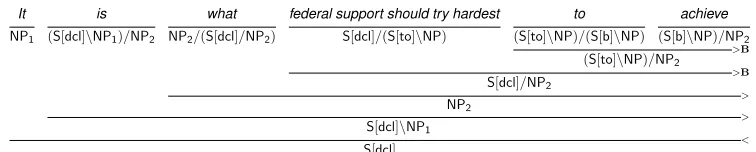
Figures 1–2 show an example where the CCG-bank preserves the information provided by the trace in a free relative clause along with a cru-cial structurally encoded dependency. In Fig-ure 1 (left), the unbounded dependency between
whatandachieveis annotated via a trace in the PTB. Figure 1 (right) shows the SDC output for the sentence. While the SDC manages to capture the unbounded dependency in this case,
what is not recognized as the head of the free relative clause and there is no direct dependency from the copula towhat, contrary to de Marn-effe et al.’s (2013) specifications. The inade-quacy of the representation here—which is es-sentially the same as the SR-11 representation for the sentence—has serious implications for realization, as it will be difficult for any realizer to determine thatwhatshould appear at the start of the free relative clause rather than following
( (S
(NP-SBJ (PRP It) ) (VP (VBZ is)
(SBAR-PRD
(WHNP-1 (WP what) ) (S
(NP-SBJ-2 (JJ federal) (NN support) ) (VP (MD should)
(VP (VB try)
(ADVP-MNR (RBS hardest) ) (S
(NP-SBJ (-NONE- *-2) ) (VP (TO to)
(VP (VB achieve)
(NP (-NONE- *T*-1) ))))))))) (. .) ))
It is what federal support should try hardest to achieve .
nsubj
root dobj
amod nsubj nsubj
aux ccomp
advmod mark xcomp punct
dobj
[image:3.612.98.533.98.239.2]acl:relcl
Figure 1:Left: An example of PTB annotation of a free relative clause (wsj 2412.80); note the co-indexation between the trace*T*-1andWHNP-1. Right: Automatic SDC output of the gold annotated PTB structure treatstryas the head of the copula’s complement and has no direct dependency from the copula towhat, contrary to de Marneffe et al.’s (2013) specifications. Dashed lines show new (below) and deleted (above) dependencies in this work.
It is what federal support should try hardest to achieve
NP1 (S[dcl]\NP1)/NP2 NP2/(S[dcl]/NP2) S[dcl]/(S[to]\NP) (S[to]\NP)/(S[b]\NP) (S[b]\NP)/NP2 >B
(S[to]\NP)/NP2
>B
S[dcl]/NP2
>
NP2
>
S[dcl]\NP1
<
S[dcl]
Figure 2: Abbreviated CCGbank derivation showing how PTB trace information is preserved via NP co-indexation; composition operations enable the missing object ofachieveto be passed up to where its role can be filled bywhat.
a structural dependency between what and is
along with the unbounded dependency between
whatandachieve. (More commonly, the SDC captures the structural dependency but not the unbounded one, especially in right node raising and object relatives.)
3 Using the CCGbank to Augment PTB Universal Dependencies
Unlike UDs, CCGbank dependencies are nu-meric and depend on the lexical category of the functor (e.g.whatfills the second argument of the category for achieve in Figure 2). To de-termine UD labels, we employ a maxent clas-sifier taking information from CCGbank as
in-put. Comparing the CCGbank and SDC output, the classifier is trained where their dependen-cies overlap and predicts both a label and head-dependent direction. Features used are functor and argument categories; functor and argument tokens; functor and argument POS tags; and functor and argument relative directionality.
[image:3.612.117.495.312.388.2]All items Without CCG gaps
exact SDC 51 51
System 82** 86**
unlabeled SDC 57 57
[image:4.612.94.300.98.150.2]System 86** 91**
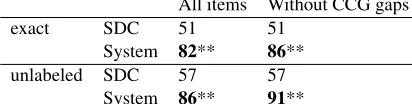
Table 1:Results from Rimell et al’s (2009) dev set (Wall Street Journal portion). ** – p<0.01
All items Without CCG gaps
exact SDC 42 44
System 68*** 70***
unlabeled SDC 50 52
System 75*** 78***
Table 2:Results from Rimell et al’s (2009) test set (Wall Street Journal portion). *** – p≤0.0001
in right node raising), (ii) CCGbank unbounded dependency annotations, and (iii) underspeci-fied SDCdeprelations (i.e. instances where the SDC cannot determine the appropriate depen-dency relation). In each case, the maxent clas-sifier is used to predict UD labels for the CCG-bank dependencies in question. Predictions are only added to the corpus if there is no
(non-dep) SDC dependency already present. In ad-dition,ccompandcsubjrelations that co-occur with free relatives are remapped to make the relative the head of the clause. Finally, struc-tural changes for coordination and compound-ing along SR-11 lines are carried out.
4 Evaluation
The system’s recall was evaluated on Rimell et al.’s (2009) unbounded dependency corpus, a hand-curated corpus with gold annotations for constructions including object free relatives, right node raising, subject extraction, and object extraction. During the creation of CCGbank, some problematic sentences involving gapping were left out of the CCGbank. As a result, we evaluate the system using four different criteria: with and without the skipped CCG sentences,
and with both exact and unlabeled matches. Ta-bles 1 and 2 show significant improvements across the board over the SDC.
Precision was evaluated by manually exam-ining 401 predictions from the system’s output to see whether the proposed edits adhered to UD specifications. Precision from the converter is 70% for exact label matches and 91% for unla-beled matches.
5 Discussion and Future Work
We have adapted and extended White’s (2014) CCG induction algorithm to work with the aug-mented UDs that our system produces. White’s algorithm assumed CCG phrases are only rarely projected from a dependent rather than a head— e.g., where an NP is projected from a deter-miner, which is a dependent of the head noun— and thus could be easily handled by handcrafted lexical entries. Since such cases are very com-mon in UDs, the algorithm needed to be ex-tended to induce such categories automatically. Once this was done, the algorithm yielded com-plete derivations in most cases (approx. 94%). In particular, derivations were induced that cap-tured all but one of the extra dependencies in Table 1 that appear in the CCGbank dev section, and realization experiments with the UD-based representations are underway.
Acknowledgments
We thank Marie-Catherine de Marneffe, Micha Elsner, the OSU Clippers group and the anony-mous reviewers for helpful feedback. This work was supported in part by NSF grant 1319318.
References
Yoav Artzi and Luke Zettlemoyer. 2013. Weakly supervised learning of semantic parsers for map-ping instructions to actions. TACL, 1:49–62. Anja Belz, Michael White, Dominic Espinosa,
Eric Kow, Deirdre Hogan, and Amanda Stent. 2011. The first surface realisation shared task: Overview and evaluation results. InProc. ENLG. Marie-Catherine de Marneffe, Miriam Connor, Na-talia Silveira, Samuel R Bowman, Timothy Dozat, and Christopher D Manning. 2013. More Constructions, More Genres: Extending Stanford Dependencies. InProc. DepLing 2013.
Claire Gardent and Shashi Narayan. 2013. Gener-ating elliptic coordination. InProceedings of the 14th European Workshop on Natural Language Generation, pages 40–50.
Julia Hockenmaier and Mark Steedman. 2007. CCGbank: A Corpus of CCG Derivations and Dependency Structures Extracted from the Penn Treebank. Computational Linguistics, 33(3):355–396.
Tom Kwiatkowski, Luke Zettlemoyer, Sharon Gold-water, and Mark Steedman. 2011. Lexical gener-alization in CCG grammar induction for seman-tic parsing. In Proceedings of the Conference on Empirical Methods in Natural Language Pro-cessing, pages 1512–1523.
Mitchell P. Marcus, Mary Ann Marcinkiewicz, and Beatrice Santorini. 1993. Building a large an-notated corpus of English: The Penn Treebank.
Computational linguistics, 19(2):313–330. Shashi Narayan and Claire Gardent. 2012. Error
mining with suspicion trees: Seeing the forest for the trees. InProc. COLING.
Luan Nguyen, Marten Van Schijndel, and William Schuler. 2012. Accurate unbounded dependency
recovery using generalized categorial grammars. In Proceedings of COLING 2012, pages 2125– 2140.
Joakim Nivre, Marie-Catherine de Marneffe, Filip Ginter, Yoav Goldberg, Jan Hajiˇc, Christopher Manning, Ryan McDonald, Slav Petrov, Sampo Pyysalo, Natalia Silveira, et al. 2016. Univer-sal dependencies v1: A multilingual treebank col-lection. InProceedings of the 10th International Conference on Language Resources and Evalua-tion (LREC 2016).
Stephan Oepen, Marco Kuhlmann, Yusuke Miyao, Daniel Zeman, Dan Flickinger, Jan Hajic, An-gelina Ivanova, and Yi Zhang. 2014. Semeval 2014 task 8: Broad-coverage semantic depen-dency parsing. In Proceedings of the 8th Inter-national Workshop on Semantic Evaluation (Se-mEval 2014), pages 63–72.
Laura Rimell, Stephen Clark, and Mark Steed-man. 2009. Unbounded Dependency Recov-ery for Parser Evaluation. InProceedings of the 2009 Conference on Empirical Methods in Nat-ural Language Processing: Volume 2-Volume 2, pages 813–821.
Sebastian Schuster and Christopher D. Manning. 2016. Enhanced english universal dependencies: An improved representation for natural language understanding tasks. InProceedings of the Tenth International Conference on Language Resources and Evaluation (LREC 2016).
Mark Steedman and Jason Baldridge. 2011. Combinatory Categorial Grammar. Non-Transformational Syntax: Formal and Explicit Models of Grammar. Wiley-Blackwell.
Mark Steedman. 2000. The syntactic process. MIT Press, Cambridge, MA, USA.