Learning non-concatenative morphology
Michelle A. Fullwood Dept. of Linguistics and Philosophy Massachusetts Institute of Technology
Timothy J. O’Donnell
Dept. of Brain and Cognitive Sciences Massachusetts Institute of Technology
Abstract
Recent work in computational psycholin-guistics shows that morpheme lexica can be acquired in an unsupervised man-ner from a corpus of words by select-ing the lexicon that best balances pro-ductivity and reuse (e.g. Goldwater et al. (2009) and others). In this paper, we extend such work to the problem of acquiring non-concatenative morphology, proposing a simple model of morphology that can handle both concatenative and non-concatenative morphology and apply-ing Bayesian inference on two datasets of Arabic and English verbs to acquire lex-ica. We show that our approach success-fully extracts the non-contiguous triliteral root from Arabic verb stems.
1 Introduction
What are the basic structure-building operations that enable the creative use of language, and how do children exposed to a language acquire the in-ventory of primitive units which are used to form new expressions? In the case of word forma-tion, recent work in computational psycholinguis-tics has shown how an inventory of morphemes can be acquired by selecting a lexicon that best balances the ability of individual sound sequences to combine productively against the reusability of those sequences (e.g., Brent (1999), Goldwater et al. (2009), Feldman et al. (2009), O’Donnell et al. (2011), Lee et al. (2011).) However, this work has focused almost exclusively on one kind of structure-building operation: concatenation. The languages of the world, however, exhibit a variety of other, non-concatenative word-formation pro-cesses (Spencer, 1991).
Famously, the predominant mode of Semitic word formation is non-concatenative. For exam-ple, the following Arabic words, all related to
the concept of writing, share no contiguous se-quences of segments (i.e., phones), but they do share a discontinuous subsequence √ktb, which has been traditionally analyzed as an independent morpheme, termed the “root”.
kataba “he wrote” kutiba “it was written” yaktubu “he writes” ka:tib “writer” kita:b “book” kutub “books” maktab “office”
Table 1: List of Arabic words with root√ktb
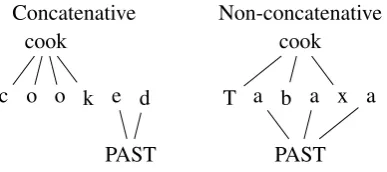
Many Arabic words appear to be constructed via a process of interleaving segments from dif-ferent morphemes, as opposed to concatenation.
Concatenative cook
PAST c o o k e d
Non-concatenative cook
PAST T a b a x a
Figure 1: Schematic of concatenative vs non-concatenative morphology
Such non-concatenative morphology is perva-sive in the world’s languages. Even English, whose morphology is fundamentally concatena-tive, displays pockets of non-concatenative behav-ior, for example in the irregular past tenses (see Table 2).
In these words, the stem vowels undergo ablaut changing between tenses. This cannot be han-dled in a purely concatenative framework unless we consider these words listed exceptions. How-ever, such irregulars do show limited
[image:1.595.321.515.475.561.2]bite /bajt/ bit /bIt/ sing /sIN/ sang /sæN/ give /gIv/ gave /gejv/ feel /fil/ felt /fElt/
Table 2: Examples of English irregular verbs
ity (see Albright and Hayes (2003), Prasada and Pinker (1993), Bybee and Slobin (1982), Bybee and Moder (1983), Ambridge (2010)), and in other languages such stem changing processes are fully productive.
In Semitic, it is clear that non-concatenative word formation is productive. Borrowings from other languages are modified to fit the avail-able non-concatenative templates. This has also been tested psycholinguistically: Berman (2003), for instance, shows that Hebrew-speaking pre-schoolers can productively form novel verbs out of nouns and adjectives, a process that requires the ability to extract roots and apply them to existing verbal templates.
Any model of word formation, therefore, needs to be capable of generalizing to both concatenative and non-concatenative morphological systems. In this paper, we propose a computational model of word formation which is capable of capturing both types of morphology, and explore its ramifications for morphological segmentation.
We apply Bayesian inference on a small cor-pus of Arabic and English words to learn the mor-phemes that comprise them, successfully learning the Arabic root with great accuracy, but less suc-cessfully English verbal inflectional suffixes. We then examine the shortcomings of the model and propose further directions.
2 Arabic Verbal Morphology
In this paper, we focus on Arabic verbal stem mor-phology. The Arabic verbal stem is built from the interleaving of a consonantal root and a vo-calism that conveys voice (active/passive) and as-pect (perfect/imperfect). The stem can then un-dergo further derivational prefixation or infixation. To this stem inflectional affixes indicating the sub-ject’s person, number and gender are then added. In the present work, we focus on stem morphol-ogy, leaving inflectional morphology to future ex-tensions of the model.
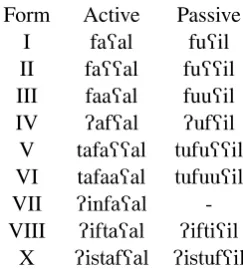
There are nine common forms of the Arabic ver-bal stem, also known by the Hebrew
grammati-cal termbinyan. In Table 3, √fQl represents the triconsonantal root. Only the perfect forms are given.
Form Active Passive I faQal fuQil II faQQal fuQQil III faaQal fuuQil
IV PafQal PufQil
V tafaQQal tufuQQil VI tafaaQal tufuuQil
VII PinfaQal
-VIII PiftaQal PiftiQil
X PistafQal PistufQil
Table 3: List of common Arabic verbal binyanim
Each of these forms has traditionally been asso-ciated with a particular semantics. For example, Form II verbs are generally causatives of Form I verbs, as is kattab“to cause to write” (c.f. katab “to write”). However, as is commonly the case with derivational morphology, these semantic as-sociations are not completely regular: many forms have been lexicalized with alternative or more spe-cific meanings.
2.1 Theoretical accounts
The traditional Arab grammarians’ account of the Arabic verb was as follows: each form was asso-ciated with a template with slots labelled C1, C2
and C3, traditionally represented with the
conso-nants√fQl, as described above. The actual root consonants were slotted into these gaps. Thus the template of the Form VIII active perfect verb stem was taC1aC2C2aC3. This, combined with the
tri-consonantal root, made up the verbal stem.
Template t a C1 a C2C2 a C3
[image:2.595.334.501.572.615.2]Root f Q l
Figure 2: Traditional analysis of Arabic Form V verb
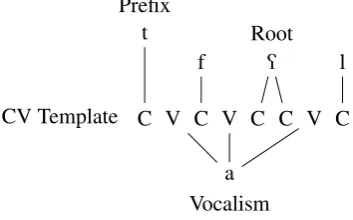
now comprised of C(onsonant) and V(owel) slots. Rules governing the spreading of segments en-sured that consonants and vowels appeared in the correct positions within a template.
Under McCarthy’s model, the analysis for [tafaQQal] would be as follows:
CV Template C V C V C C V C Prefix
t Root
f Q l
[image:3.595.93.270.159.269.2]Vocalism a
Figure 3: McCarthy analysis of Arabic Form V verb
While increasing the number of morphemes as-sociated with each verb, the McCarthy approach economized on the variety of such units in the lex-icon. The inventory of CV templates was limited; there were three vocalisms corresponding to active and passive voice intersecting with perfect and im-perfect aspect; and only four derivational prefixes (/P/,/n/,/t/,/st/), one of which became an infix via morphophonological rule in Form VIII.1
We adopt a middle ground between the tradi-tional Arab grammarians’ description of the ver-bal stem and McCarthy’s analysis as our starting point. We describe this approach in the next sec-tion.
3 The Approach
Our initial model of morphology adopts Mc-Carthy’s notion of an abstract template, but coa-lesces the prefixes and infixes with the vocalism into what we term the “residue.” Each stem is thus composed of two morphemes: the root and the residue, and their interleaving is dictated by a template with slots for root and residue segments. For example,Piktatab = - - - r - - r - r (template) + ktb (root) +Pitaa(residue), where r indicates a root segment and - a residue segment.
The residue may be of length 0, effectively mak-ing the word consist of a smak-ingle morpheme. Con-catenative morphology may be modelled in this
1Other theories of Arabic morphology that reject the
ex-istence of the root are also extant in the literature; see e.g. (Bat-El, 1994) for a stem modification and vowel overwriting approach.
framework by grouping all the root segments to-gether, for example cooked[kukt] = r r r - (tem-plate) + kuk (root) + t (residue).
The template, root and residue are each drawn from a separate sub-lexicon, modeled using tools from Bayesian non-parametric statistics (see Sec-tion 4). These tools put a prior distribuSec-tion on the lexica that biases them in favour of reusing exist-ing frequent forms and small lexica by promotexist-ing maximal sharing of morphemes.
When applied to data, we derive a segmentation for each word into a root and a residue.
4 Model
Following earlier work on Bayesian lexicon learn-ing (e.g. Goldwater et al. (2009), we use a distri-bution over lexical items known as the Pitman–Yor Process (PYP) (Pitman and Yor, 1995). LetGbe a distribution over primitive phonological elements of the lexicon (e.g., words, roots, residues, tem-plates, morphemes, etc.). The behavior of PYP processPYP(a, b, G)with base measureGand pa-rametersaandbcan be described as follows. The first time we sample fromPYP(a, b, G)a new lex-ical item will be sampled usingG. On subsequent samples fromPYP(a, b, G), we either reuse an ex-isting lexical itemiwith probability ni−a
N+b, where
Nis the number of lexical items sampled so far,ni
is the number of times that lexical itemihas been used in the past, and0 ≤a ≤ 1andb > −aare parameters of the model. Alternatively, we sample a new lexical item with probability aKN++bb, where K is the number of times anewlexical item was sampled in the past from the underlying distribu-tionG. Notice that this process induces a rich-get-richer scheme for sampling from the process. The more a particular lexical item has been reused, the more likely it is to be reused in the future. The Pitman–Yor process also produces a bias towards smaller, more compact lexica.
In our model, we maintain three sublexica for templates (LTp), roots (LRt), and residues (LRs)
each drawn from a Pitman–Yor process with its own hyperparameters.
LX ∼PYP(aX, bX, GX) (1)
template. Our templates are strings in{Rt,Rs}∗
indicating for each position in a word whether that position is part of the word’s root (Rt) or residue (Rs). These templates themselves are drawn from a base measureGTp which is defined as follows.
To add a new template to the template lexicon first draw a length for that template,K, from a Poisson distribution.
K∼POISSON(5) (2)
We then sample a template of length K by drawing a Bernoulli random variable ti for each
positioni∈1..Kis a root or residue position.
ti ∼BERNOULLI(θ) (3)
The base measure over templates, GTp, is
de-fined as the concatenation of theti’s.
The base distributions over roots and residues, GRtandGRs, are drawn in the following manner.
Having drawn a template,T we know the lengths of the root,KRt, and residueKRt. For each
posi-tion in the root or residueriwherei∈1..KRt/Rs,
we sample a phone from a uniform distribution over phones.
ri ∼UNIFORM(|alphabet|) (4)
5 Inference
Inference was performed via Metropolis–Hastings sampling. The sampler was initialized by assign-ing a random template to each word in the trainassign-ing corpus. The algorithm then sampled a new tem-plate, root, and residue for each word in the corpus in turn. The proposal distribution over templates for our sampler considered all templates currently in use by another word, as well as a randomly gen-erated template from the prior. Samples from this proposal distribution were corrected into the true distribution using the Metropolis–Hastings crite-rion.
6 Related work
The approach of this paper builds on previ-ous work on Bayesian lexicon learning start-ing with Goldwater et al. (2009). However, to our knowledge, this approach has not been applied to non-concatenative morphological seg-mentation. Where it has been applied to Arabic (e.g. Lee et al. (2011)), it has been applied to un-vowelled text, since standard Arabic orthography
drops short vowels. However, this has the effect of reducing the problem mostly to one of concatena-tive morphology.
Non-concatenative morphology has been ap-proached computationally via other research, however. Kataja and Koskenniemi (1988) first showed that Semitic roots and patterns could be described using regular languages. This insight was subsequently computationally implemented using finite state methods by Beesley (1991) and others. Roark and Sproat (2007) present a model of both concatenative and non-concatenative mor-phology based on the operation of composition that is similar to the one we describe above.
The narrower problem of isolating roots from Semitic words, for instance as a precursor to in-formation retrieval, has also received much atten-tion. Existing approaches appear to be mostly rule-based or dictionary-based (see Al-Shawakfa et al. (2010) for a recent survey).
7 Experiments
We applied the morphological model and infer-ence procedure described in Sections 4 and 5 to two datasets of Arabic and English.
7.1 Data
The Arabic corpus for this experiment consisted of verbal stems taken from the verb concordance of the Quranic Arabic Corpus (Dukes, 2011). All possible active, passive, perfect and imperfect fully-vowelled verbal stems for Forms I–X, ex-cluding the relatively rare Form IX, were gener-ated. We used this corpus rather than a lexicon as our starting point to obtain a list of relatively high frequency verbs.
This list of stems was then filtered in two ways: first, only triconsonantal “strong” roots were con-sidered. The so-called “weak” roots of Arabic ei-ther include a vowel or semi-vowel, or a doubled consonant. These undergo segmental changes in various environments, which cannot be handled by our current generative model.
Secondly, the list was filtered through the Buck-walter stem lexicon (BuckBuck-walter, 2002) to obtain only stems that were licit according to the Buck-walter morphological analyzer.
The English corpus was constructed along sim-ilar lines. All verb forms related to the 299 most frequent lemmas in the Penn Treebank (Marcus et al., 1999) were used, excluding auxiliaries such as mightorshould. Each lemma thus had up to five verbal forms associated with it: the bare form (for-get), the third person singular present (forgets), the gerund (forgetting), past tense (forgot), and past participle (forgotten).
This resulted in 1549 verbal forms, compris-ing 295 unique roots, 108 residues, and 55 tem-plates. CELEX (Baayen et al., 1995) pronuncia-tions for these words were supplied to the sampler in CELEX’s DISC transliteration.
Deriving a gold standard analysis for English verbs was less straightforward than in the Arabic case. The following convention was used: The root was any subsequence of segments shared by all the forms related to the same lemma. Thus, for the example lemma offorget, the correct template, root and residue were deemed to be:
forget f@gEt r r r - r f@gt E forgets f@gEts r r r - r - f@gt Es forgot f@gQt r r r - r f@gt Q forgetting f@gEtIN r r r - r - - f@gt EIN forgotten f@gQtH r r r - r - f@gt QH
Table 4: Correct analyses under the root/residue model for the lemmaforget
37 templates were concatenative, and 18 non-concatenative. The latter were necessary to ac-commodate 46 irregular lemmas associated with 254 forms.
7.2 Results and Discussion
We ran 10 instances of the sampler for 200 sweeps through the data. For the Arabic training set, this number of sweeps typically resulted in the sam-pler finding a local mode of the posterior, making few further changes to the state during longer runs. An identical experimental set-up was used for En-glish. Evaluation was performed on the final state of each sampler instance.
The correctness of the sampler’s output was measured in terms of the accuracy of the tem-plates it predicted for each word. The word-level accuracy indicates the number of words that had their entire template correctly sampled, while the segment-level accuracy metric gives partial credit by considering the average number of correct bits
r -r -r
r -- r - r
r -r -- r
r - -r -r
- -r -r -r
- -r -r -- r
- -r -- --r
-r
- - -r -r
-r
- - -- --r
-r -r
0 20 40 60 80 100
Accurac
[image:5.595.312.515.61.341.2]y
Figure 4: Unweighted accuracy with which each template was sampled
[image:5.595.77.287.359.426.2](r versus -) in each sampled template.
Table 5 shows the average accuracy of the 10 samples, weighted by each sample’s joint proba-bility.
Accuracy Word-level Segment-level
Arabic 92.3% 98.2%
English 43.9% 85.3%
Table 5: Average weighted accuracy of samples
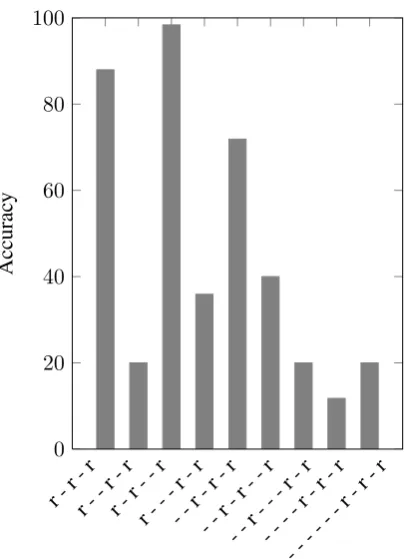
Arabic Analyses Figure 4 shows the average unweighted accuracy with which each of the 9 Arabic templates was sampled.
Figure 4 reveals an effect of both the rarity and the length of each template. For instance, the per-formance on template r - - r - r (second bar from left) is exceptionally low, but this is the result of there being only one instance of this template in the training set: Euwqib, the passive form of the Form III verb of root Eqb, in the Buckwalter transliteration.2 In addition, the longer the word,
2This is an artifact of Arabic orthography and the
the poorer the performance of the model. This is likely the result of the difficulty of searching over the space of templates for longer forms. Since the number of potential templates increases exponen-tially with the length of the form, finding the cor-rect template becomes increasingly difficult. This problem can likely be addressed in future mod-els by adopting an analysis similar to McCarthy’s whereby the residue is further subdivided into vo-calism, prefixes and infixes. Note that even in such long forms, however, the letters belonging to the root were generally isolated in one of the two mor-phemes.
English Analyses The English experiment yielded poorer results than the Arabic dataset. The statistics of the datasets reveal the cause of the failure of the English model: the English dataset had several times more residues and templates than the Arabic dataset did, thus lacking as much uniform structure. Nevertheless, the relatively high segment-level accuracy shows that the model tended to find templates that were only incorrect in 1 or 2 positions.
The dominant pattern of errors was in the di-rection of overgeneralization of the concatenative templates to the irregular forms. Out of the 254 words related to a lemma with an irregular past form, 241 received incorrect templates, 232 of which were concatenative, often correctly splitting off the regular suffix where there was one. For example,sing andsingingwere parsed assing+∅ andsing+ing, whilesungwas parsed as a separate root. Note that under an analysis of English ir-regulars as separate memorized lexical items, the sampler behaved correctly in such cases.
However, out of 1295 words related to perfectly regular lemmas, the sampler determined 628 tem-plates incorrectly. Out of these, 325 were given concatenative templates, but with too much or too little segmental material allocated to the suffix. For example, the wordinvertwas analyzed as in-ver+t, with its other forms following suit as in-ver+ted, inver+ting and inver+ts. This is likely due to subregularities in the word corpus: with many words ending with -t, this analysis becomes more attractive.
The remaining 303 regular verbs were given non-concatenative templates. For instance, iden-tifywas split up intodfyandienti. No consistent pattern could be discerned from these cases.
8 Conclusion
We have proposed a model of morpheme-lexicon learning that is capable of handling concatena-tive and non-concatenaconcatena-tive morphology up to the level of two morphemes. We have seen that Bayesian inference on this model with an Ara-bic dataset of verbal stems successfully learns the non-contiguous root and residue as morphemes.
In future work, we intend to extend our sim-plified model of morphology to McCarthy’s com-plete model by adding concatenative prefixation and suffixation processes and segment-spreading rules. Besides being capable of handling the in-flectional aspects of Arabic morphology, we an-ticipate that this extension will improve the per-formance of the model on Arabic verbal stems as well, since the number of non-concatenative templates that have to be learned will decrease. For example, the template for the Form V verb [tafaQQal] can be reduced to that for the Form II verb [faQQal] plus an additional prefix.
We also anticipate that the performance on En-glish will be vastly improved, since the dominant mode of word formation in English is concate-native, while the small number of irregular past tenses and plurals that undergo ablaut can be han-dled using the non-concatenative architecture of the model. This would also be more in line with native speakers’ intuitions and linguistic analyses of English morphology.
Acknowledgments
Parts of the sampler code were written by Pe-ter Graff. We would also like to thank Adam Albright and audiences at the MIT Phonology Circle and the Northeast Computational Phonol-ogy Workshop (NECPhon) for feedback on this project. This material is based upon work sup-ported by the National Science Foundation Gradu-ate Research Fellowship Program under Grant No. 1122374.
References
Emad Al-Shawakfa, Amer Al-Badarneh, Safwan Shat-nawi, Khaleel Al-Rabab’ah, and Basel Bani-Ismail. 2010. A comparison study of some Arabic root find-ing algorithms. Journal of the American Society for Information Science and Technology, 61(5):1015– 1024.
Adam Albright and Bruce Hayes. 2003. Rules
computa-tional/experimental study. Cognition, 90(2):119– 161.
Ben Ambridge. 2010. Children’s judgments of regular and irregular novel past–tense forms: New data on
the English past–tense debate. Developmental
Psy-chology, In Press.
Harald R. Baayen, Richard Piepenbrock, and Leon
Gu-likers. 1995. The CELEX Lexical Database.
Re-lease 2 (CD-ROM). Linguistic Data Consortium, University of Pennsylvania, Philadelphia, Pennsyl-vania.
Outi Bat-El. 1994. Stem modification and cluster
transfer in Modern Hebrew. Natural Language and
Linguistic Theory, 12:571–593.
Kenneth R. Beesley. 1991. Computer analysis of
Arabic morphology: A two-level approach with de-tours. In Bernard Comrie and Mushira Eid, editors,
Perspectives on Arabic Linguistics III: Papers from the Third Annual Symposium on Arabic Linguistics, pages 155–172. John Benjamins. Read originally at the Third Annual Symposium on Arabic Linguistics, University of Utah, Salt Lake City, Utah, 3-4 March 1989.
Ruth A. Berman. 2003. Children’s lexical
innova-tions. In Joseph Shimron, editor,Language Process-ing and Acquisition in Languages of Semitic, Root-based, Morphology, pages 243–292. John Ben-jamins.
Michael R. Brent. 1999. Speech segmentation
and word discovery: A computational perspective.
Trends in Cognitive Sciences, 3(8):294–301, Au-gust.
Tim Buckwalter. 2002. Buckwalter Arabic
mor-phological analyzer version 1.0. Technical Report LDC2002L49, Linguistic Data Consortium.
Joan L. Bybee and Carol Lynn Moder. 1983. Mor-phological classes as natural categories. Language, 59(2):251–270, June.
Joan L. Bybee and Daniel I. Slobin. 1982. Rules and schemas in the development and use of the English past tense. Language, 58(2):265–289.
Kais Dukes. 2011. Quranic Arabic Corpus.
http://corpus.quran.com/.
Naomi H. Feldman, Thomas L. Griffiths, and James L.
Morgan. 2009. Learning phonetic categories by
learning a lexicon. In Proceedings of the 31st
An-nual Meeting of the Cognitive Science Society.
John Anton Goldsmith. 1976. Autosegmental
Phonol-ogy. Ph.D. thesis, Massachusetts Institute of Tech-nology.
Sharon Goldwater, Thomas L. Griffiths, and Mark Johnson. 2009. A Bayesian framework for word
segmentation: Exploring the effects of context.
Cognition, 112:21–54.
Laura Kataja and Kimmo Koskenniemi. 1988. Finite-state description of Semitic morphology: a case
study of Ancient Akkadian. InProceedings of the
12th conference on Computational linguistics - Vol-ume 1, COLING ’88, pages 313–315, Stroudsburg, PA, USA. Association for Computational Linguis-tics.
Yoong Keok Lee, Aria Haghighi, and Regina
Barzi-lay. 2011. Modeling syntactic context improves
morphological segmentation. InProceedings of the
Conference on Natural Language Learning.
Mitchell P. Marcus, Beatrice Santorini, Mary Ann Marcinkiewicz, and Ann Taylor. 1999. Treebank 3 technical report. Technical report, Linguistic Data Consortium, Philadelphia.
John J. McCarthy. 1979. Formal Problems in Semitic
Phonology and Morphology. Ph.D. thesis, Mas-sachusetts Institute of Technology.
John J. McCarthy. 1981. A prosodic theory of noncon-catenative morphology. Linguistic Inquiry, 12:373– 418.
Timothy J. O’Donnell, Jesse Snedeker, Joshua B. Tenenbaum, and Noah D. Goodman. 2011.
Pro-ductivity and reuse in language. InProceedings of
the 33rd Annual Conference of the Cognitive Science Society.
Jim Pitman and Marc Yor. 1995. The two-parameter Poisson–Dirichlet distribution derived from a sta-ble subordinator. Technical report, Department of Statistics University of California, Berkeley.
Sandeep Prasada and Steven Pinker. 1993. Generalisa-tion of regular and irregular morphological patterns.
Language and Cognitive Processes, 8(1):1–56.
Brian Roark and Richard Sproat. 2007.
Computa-tional Approaches to Morphology and Syntax. Ox-ford University Press.
Andrew Spencer. 1991. Morphological Theory.