Precision of a Parabolic Optimum Calculated from Noisy
Biological Data, and Implications for Quantitative
Optimization of Biventricular Pacemakers
(Cardiac Resynchronization Therapy)
Darrel P. Francis
International Centre for Circulatory Health, National Heart and Lung Institute,
Imperial College London, London, United Kingdom E-mail: [email protected]
Received August 26, 2011; revised November 9, 2011; accepted November 17, 2011
Abstract
In patients with heart failure and disordered intracardiac conduction of activation, doctors implant a biven- tricular pacemaker (“cardiac resynchronization therapy”, CRT) to allow adjustment of the relative timings of activation of parts of the heart. The process of selecting the pacemaker timings that maximize cardiac func-tion is called “optimizafunc-tion”. Although optimizafunc-tion—more than any other clinical assessment—needs to be precise, it is not yet conventional to report the standard error of the optimum alongside its value in clinical practice, nor even in research, because no method is available to calculate precision from one optimization dataset. Moreover, as long as the determinants of precision remain unknown, they will remain unconsidered, preventing candidate haemodynamic variables from being screened for suitability for use in optimization. This manuscript derives algebraically a clinically-applicable method to calculate the precision of the
opti-mum value of x arising from fitting noisy biological measurements of y (such as blood flow or pressure)
ob-tained at a series of known values of x (such as atrioventricular or interventricular delay) to a quadratic curve.
A formula for uncertainty in the optimum value of x is obtained, in terms of the amount of scatter
(irrepro-ducibility) of y, the intensity of its curvature with respect to x, the width of the range and number of values of
x tested, the number of replicate measurements made at each value of x, and the position of the optimum
within the tested range. The ratio of scatter to curvature is found to be the overwhelming practical determi-nant of precision of the optimum. The new formulae have three uses. First, they are a basic science for any-one desiring time-efficient, reliable optimization protocols. Second, asking for the precision of every re-ported optimum may expose optimization methods whose precision is unacceptable. Third, evaluating preci-sion quantitatively will help clinicians decide whether an apparent change in optimum between successive visits is real and not just noise.
Keywords: Cardiac, Pacemaker, Parabolic, Haemodynamics
1. Introduction
Plato, Apology of Socrates, 38a
Every year, ~100,000 cardiac resynchronization pace- makers are being implanted into patients with heart fail- ure, because they deliver substantial symptomatic and survival benefits [1-3] by altering intracardiac timings. After implantation, the process of determining which ti- mings to programme is described as “optimization” [4-6].
Responses of physiological variables to changes in pace- maker settings fit well to a parabola in the vicinity of the optimum [6,7]. Curve-fitting to calculate a clinical opti- mum has the advantage of permitting interpolation to settings which were not directly tested, and also avoids the problem that simply “picking the highest” leads to illusory optima, illusory increments in physiology from optimization, and illusory changes in optimum over time [8].
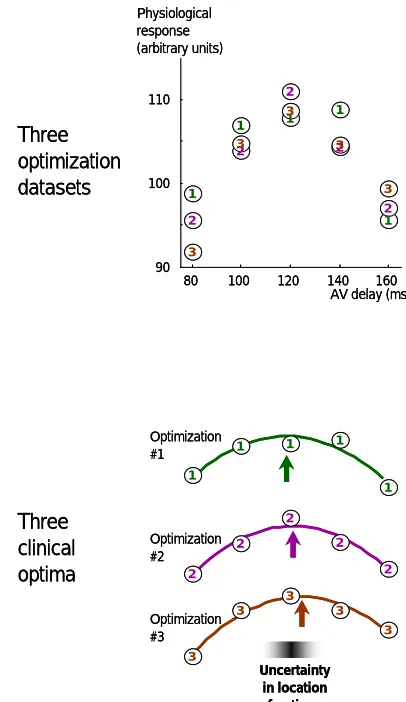
tain noise which can sometimes be substantial in com-parison to the underlying signal, and which prevents the true underlying optimum being identified precisely even with curve fitting (Figure 1). The impact of such noise
can be reduced by averaging multiple measurements, but this consumes resources such as time in a clinical envi- ronment or battery power if the measurements are con- ducted by the implanted device. It is therefore important to be able to calculate the precision of an optimum so that resource usage can be planned to be appropriate to achieve the clinically-required precision.
As well as needing to know how many replicates are required, doctors planning an optimization protocol also need guidance regarding what range of settings to cover during testing, and how coarsely or finely. Widening the
range or making finer-grained measurements (i.e. at
more closely-spaced intervals) increase the cost of the optimization process, and so are only justified if there is a clinically-valuable increase in precision of the opti- mum.
Finally, doctors caring for patients from day to day need to know the uncertainty of the optimum obtained this clinical optimization process. Without this know- ledge, it is impossible to interpret apparent differences in optimum within an individual patient between one as-sessment method and another, or over time [8,9] or after an operation or a heart attack.
This paper derives a simple formula for the uncer-tainty of the parabolically-defined optimal setting of a pacemaker, and presents practical implications for pro-tocol design and for medical practice.
2. Description of Method
2.1. Physiological Measurements with Noise
The pacemaker setting may be adjusted over a wide ran- ge of values. Within individual patients, clinical infor- mation provides a priori a constrained range which con- tains all biologically plausible locations of the optimum for that patient. During the optimization procedure, the clinician acquires a series of pairs of values of the pace- maker setting and the corresponding physiological mea- surement. The first value, the pacemaker setting, has negligible uncertainty because it is programmed digitally. However the second value, the measured physiological variable, is not perfectly reproducible and therefore has an element of uncertainty.
Some choices of physiological variable, such as blood pressure, permit automatic acquisition, while others, such as Doppler velocity-time integral, typically require hu- man involvement for each measurement. In practice the protocol is often to make more than one replicate mea- surement at each setting, and then to summarize the data
80 100 120 140 160 90
100 110
1
1 1
1
1
2 2
2
2
2
3 3
3 3
3
1
1 1 1
1
2 2
2 2
2
3
3 3 3
3 Optimization
#1
Optimization #2
Optimization #3 Three
optimization datasets
Three clinical optima
Uncertainty in location of optimum
AV delay (ms) Physiological
response (arbitrary units)
80 100 120 140 160 90
100 110
1
1 1
1
1
2 2
2
2
2
3 3
3 3
3
1
1 1 1
1
2 2
2 2
2
3
3 3 3
3 Optimization
#1
Optimization #2
Optimization #3 Three
optimization datasets
Three clinical optima
Uncertainty in location of optimum
AV delay (ms) Physiological
response (arbitrary units)
Figure 1. Sketch showing how noise in the measured data creates uncertainty in the optimum. Note: If there is enough time to conduct many optimizations, they can be analyzed separately to provide separate estimates of the optimum, so the uncertainty in the optimum can be observed. The upper panel sketches 3 optimization datasets in one simulated patient. All 3 datasets are plotted on the same graph and labeled “1” to “3”. The lower panel shows the 3 individual interpolated optima obtained by curve fitting with a parab-ola. This paper provides a method of calculating the uncer-tainty in a clinically-obtained optimum, without having to conduct several independent optimizations.
for each setting by the mean of the raw measurements at that setting.
Let the optimization protocol try S different values xi of the pacemaker setting, evenly spaced at intervals of x.
Let the averaged physiological measurements represent-ing each settrepresent-ing be denoted yi, each of which is the mean of R replicate raw measurements. The observed data yi during clinical testing are composed of an underlying value yund,i and an error component εR.
,
und R
i i
y y
[image:2.595.316.519.79.430.2]
of yund,i and normally distributed, with its standard devia-tion for a single raw measurement being 1 and, by the central limit theorem, the standard deviation for the error εR of the average of R replicates being
1
R
R
.
2.2. The Optimization Process
The best-fit parabola, Axi2 + Bxi + C, to the observed data is defined by the standard least-squares method, to minimize the squared deviation between the observations
yi and the parabola. The clinical optimum from that fitted parabola is –B/2A, which will differ from the true opti-mum OptTrue by an amount whose standard deviation can be calculated as follows. The best-fit parabola is defined by having A, B and C values that minimize the squared
error
2
2i i i
F
Ax Bx C y .This is achieved by setting all the partial derivatives of
F with respect to A, B and C to zero:
2 2 2 2 2 0 2 0 2 0i i i i
i i i
i i i
F A Ax Bx C y x
F B Ax Bx C y xi
F C Ax Bx C y
2 i i i i iTherefore
4 3 2
3 2
2 1
i i i
i i i
i i
A x B x C x x y
A x B x C x x y
A x B x C y
These can be solved for A, B and C as follows:
2 2 2 4 2 4 22 , 4 2 2
i i i i i i
i i i i i i i
i i i
S x y x y
A
S x x
2
x y x y x
B C
x S x x
x y3. Results
3.1. The Clinical Optimum
The clinician will choose as optimal the pacemaker set-ting which corresponds to the middle of the fitted parab-
ola, i.e. ˆ 2 opt B x A
. In terms of the clinical data xi and yi,
this clinical optimum is
2
2 42 2 2
ˆ
2 2
i i opt
i i i i
x S x
x
S x x y x y
For simplicity, and without loss of generality, a coor-dinate system for x can be chosen that makes 0 the centre of the range of settings tested during optimization. This symmetrical arrangement of xi values provides the fol-lowing convenient identities:
2 2
3 4 4 2
0, 1 1 12,
0, 1 3 7 1 240
i i
i i
x x x S S S
x x x S S S S
Applying these substitutions permits the clinical opti-mum to be described as follows:
2 2
2 2 2
2 4
ˆ
5 1 60
i i opt
i i
S x x y
x
S x y x
yi. (1)
If yi is augmented by any constant k, the numerator is unchanged because
i i i i i i i
x y k x y k x x y
. Thedenomi-nator is also unchanged because it is augmented by
2
2 25 S 1 x
k60k
xi
which is
2 2
2 2 60 1
5 1
12
k x S S
kS S x 0.
Therefore without loss of generality the observed val-ues yi may be defined in terms of the underlying quad-ratic curvature coefficient Aund, the true optimum xopt, and the noise component εR as follows:
2,
i und i opt R i
y A x x
2 , 2 2 , 2 2 2 , 2 1 12i und i opt R i
und i opt i opt R i
und und opt R i
y A x x
A x x x S x
S S
A x A S x
2 ,3 2 2
, 2 2 , 2 1 6
i i i und i opt R i
und i opt i opt i i R i opt und i R i
x y x A x x
A x x x x x x
S S
x A x x
2 2 2 ,4 3 2 2 2
,
2 2 2
4 2 2
2 ,
2
1 3 7 1
240 12
i i i und i opt R i
und i opt i opt i i R i
und opt
i R i
x y x A x x
A x x x x x x
S S S S S
A x x x
x
3.2. Expression for the Clinical Optimum
i
.
2
2 2 2
,
2 2 2
2 2 2 2 4 2 2 2
, ,
2
2 2 2
,
ˆ
1
2 4
6
1 1 3 7
5 1 60
12 240 12
1
2 4 2
12 opt
opt und i R i
und und opt R i und opt i R i
opt und i R i
x
S S
S x x A x x
S S S S S S S
S x A x A Sx A x x x x
S S
S x x A x x
21
2 2 2
2 2 2 4 2
, ,
2 2
4 2 2
,
2 2 2 2 2 2
4 4 2
, ,
1 1 3 7
5 1 60 60
12 240
1 4
2 4
3
5 1 1 1 3 7 5 1 60
12 4
und R i und i R i
und opt i R i
R i i R i
und und
S S S S S
S x A x A x x
S S S
A x x S x x
S S S S S S S x
x x x
A A
2 2 2 2
4
,
2 2 2 2
4 2 , , , 2 2 2 , ,
2 2 4 2 2
1 4 2 4
3 ˆ
1 4 5 1 60
3 6 1 15 180 1 4 1
opt i R i
und opt
R i i R i
und und
opt i R i
und
4
R i i
und und
S S S S x
x x x
A x
S S S S x
x x
A A
x x
A x S S
x
A x S S A x S S S
R i
3.3. Imprecision of the Clinical Optimum
It can be seen from this that the clinically observed opti- mum ˆxopt differs from the underlying optimum xopt because of two types of error, which affect the numerator and denominator respectively. The component in the numerator is a simple additive error. The impact of the denominator error, however, scales with xopt.
In clinical situations where the errors are large in com-parison with the degree of curvature that is manifested, the entire denominator of this formula falls near (or be- yond) zero and behavior of the expression becomes strongly nonlinear. In such a situation there is almost no useful information about the underlying optimum avai- lable from the acquired data. Clinically this can be con- sidered likely whenever the information content (or in- traclass correlation coefficient) is low [8].
In most situations of well-designed optimization pro- tocols, however, the error is not large compared with the curvature of the signal, which makes it possible to pro- vide a closed-form expression for the imprecision of the optimum.
To do this, the variance of the numerator is first shown
to be
, 2 2 1 2 2 2 22 2 2 2 2
1 2
6 1
6 3
1 R 1 R
i R i und
S S
und i und
Var x
A x S S
i
A x S S A x S S
Likewise the variance of the denominator is
, 2 2 2 ,4 2 2
2 2
,
2 2 2
2
2 4 2 2
15 4
180
1 4
15 1 12
1 4
180
1 4 R
R i und
i R i und
R i und
und
Var
A x S S
x
A x S S S
S i
Var
A x S S S
A x S S S
By the binomial expansion, 1/(1−z) = 1 + z + z2 + z3
which can be approximated with 1 + z as long as the magnitude of z is well below 1. Thus as long as we can make the following assumption:
2 4 2 1 2 4 180 2
R
und
A x S S S (2), and as long as the numerator and denominator errors are not large, a linear approximation can be used for the va-riance of ˆxopt as follows:
2
2 2 2
2
2 4 2 2
2 2
2
2 2 2 2
3 ˆ
1 180
1 4
3 4 180
1 4
R
2
R
R
opt und opt
und
opt und
Var x
A x S S
x
A x S S S
S x
A x S S S
The standard error of the clinical optimum, being the square root of this, is therefore
2 2
2 60 3 1
4 ˆ
1 R
opt
opt und
x x S
SE x
A x S S
.
3.4. Contributory Factors to Imprecision of the Clinical Optimum
In general the optimization protocol may have multiple replicates, i.e. R 1, in order to reduce the effect of noise.
1
R
so that in terms of the fundamental
bio-logical characteristics, the standard error of the clinical optimum is
R
12 2
2
ˆ
3 1 1 60
4 1
opt
opt
und
SE x
x
A S x
R S x S
(3)
This formulation highlights the 4 contributory factors to imprecision of the optimum clearly. First, the impreci-sion of the clinical optimum falls with the square root of
, the number of individual physiological measure-ments made. Since making additional measuremeasure-ments ei-ther consumes scarce time in a clinical environment, or battery power if conducted automatically by the pace-maker, having knowledge of this tradeoff between num-ber of measurements and imprecision may be helpful.
S R
Second, by observing that the second term is almost the reciprocal of the width of the range of settings tested, , it can be seen that the wider the range tested, the more precise the optimum. In practice this is limited
by loss of fit to the parabola for settings far from the op- timum. However, within the range over which behaviour is parabolic, this analysis suggests it is desirable to cover a wide range rather than to focus exclusively on the very close vicinity of the optimum.
S 1
Third, biology sets an lower limit on 1
und
A
. While
measurement error can be reduced by choosing meas-urement techniques with smaller instrument noise, even-tually almost all the variability between replicates is genuine biological variation between heart beats, which places a lower boundary on 1. Meanwhile Aund is a manifestation of dependence of physiology upon changes in pacemaker setting, and is determined by the patient’s own biological characteristics. For ideal measurement modalities, where the equipment contributes no noise, all the variability is biological, and may well be similar across different modalities. For example, measures of pressure and flow, although fundamentally different and having distinct units, may change proportionally with the same constant of proportionality in response to both sig-nal (change in pacemaker setting) and noise (spontane-
ous biological variability). Thus 1
und
A
may have a bio-
logically-imposed lower limit within an individual pa-tient which cannot be improved upon by the clinician.
The final term can be neglected if the optimum is very close to the centre of the tested range, i.e.
1 2
opt
S
x x. However, it rises as xopt rises. For
rapid interpretation by non-mathematicians it may be useful to develop a dimensionless variable E, represent-ing how far the true optimum is away from the centre of the tested range, running from 0 when xopt= 0, to 1 when
1 2
opt
S x x.
Reworking Equation (3) to use this, and introducing W
=
S 1
x, the width of the range of settings tested, gives:
1
2 2 2 2
1
3 1 1
ˆ 1 15
4 1
opt
und
S S
SE x E
W A S
R S S
(4) This formula is only valid when the condition de- scribed above in (2) is satisfied. That condition, the bare minimum number of raw measurements needed before the standard error of the optimum can be validly esti-mated, can be approximated in this simplified way:
1
2
2
180
und
R S
W A
If exceeds the above formula by (for example) more than 5-fold, the uncertainty of the optimum is
iden-tified reliably using Equation (4). If exceeds by
only a small margin, Equation (4) will underestimate the observed scatter between repeat optimizations. Finally, if
RS does not even exceed the right hand side, the dataset is so poor in information content that it should be dis-carded, and the protocol redesigned.
R S
R S
In practice the doctor does not know the underlying values of 1 and Aund but instead assesses them from clinical measurements: ˆ1 and Aˆ respectively.
Figure 2 summarizes all the relevant variables in a
format convenient for visual appreciation. It shows the steps necessary to gauge the uncertainty of the optimum.
The expressions can be applied to any unit of “pace-maker setting”, and any unit of “physiological response”. Typically pacemaker settings (atrioventricular and inter-ventricular delay) are expressed in either milliseconds or seconds. Physiological response may be based on flow, for which suitable units might be true flow rates (e.g. ml/min, L/min) or expressed per beat (ml/beat), or as a peak instantaneous flow rate, or as an average velocity (cm/min or m/min) or peak velocity, or velocity-time integral (cm/beat). Alternatively physiological response may be pressure (e.g. mmHg) as a systolic, mean, or pulse pressure, or a value derived from pressure such as intraventricular peak first derivative of pressure (dp/dtmax). In principle uncalibrated physiological response vari-ables and even those of unknown physical unit may be used, as long as it is reasonable to believe they vary ap-proximately linearly with cardiac performance.
Any physical units may be used to express scatter 1
and width W but, once they are decided, the units that must be used to express curvature Aund are [scatter]/ [width]2.
3.5. Simplified Expression for Rapid Appreciation
In practice the number of settings tested is usually fairly large, e.g. S 6, and E does not exceed 1. Thus to explain the implications of the formula to a non-mathe- matician protocol designer, it may be sufficient to use the following simplified approximation. First check that
1
2
2
ˆ
180 ˆ
R S
W A
, otherwise redesign the experiment,
with more replicates or with a variable which has a sma- ller ˆ1 Aˆ ratio. Second:
ˆ ~ 3 1 1 2opt
und
SE x E
A W R S
15 (6)
The left factor contains 3 variables known precisely
from the experimental design. The right factor contains 3 variables that must be estimated from observations in the patient.
3.6. Examples of Application to Existing Protocols
3.6.1. Example 1. Atrioventricular Delay Optimization
In a published study [10] of clinical optimization in 15 patients, there were S = 6 atrioventricular delay settings tested, and R = 6 replicate measurements. The width of the spectrum of settings covered was W = 0.200 − 0.040
s = 0.160 s. The observed scatter between individual re-
plicate measurements was ˆ1= 3.9 mmHg. The
ob-served curvature was Aˆ = 1194 mmHg·s–2. With these
observed data, 1
2
2
ˆ ˆ W A
180 was 2.9, which RS
com-fortably exceeded.
For an optimum lying near the middle of the tested range,
E ≈ 0, so
ˆ 3 1 5 3.90.200 1194
6 6 35
opt
SE x
≈ 0.005
s. For optima half-way to the edge of the tested spectrum,
ˆoptSE x is almost double, at 0.010 s. For optima at the
edge of the tested spectrum, is almost 4-fold
higher than at the middle of the range,
i.e. ≈ 0.019 s. ˆoptSE x
Pacemakers only permit quantized values to be pro-grammed, for example in steps of 0.010 s. For optima lying near the centre of the tested range in that study, the optimization procedure can be seen to be sufficient to identify the optimum for clinical purposes. However, for optima at the edge of the tested range, the protocol would need to be adjusted to maintain that level of optimization precision. The most generically effective step to achieve this would be to conduct more replicate measurements.
3.6.2. Example 2. Interventricular Delay Optimization
In the same study, [10] optimization of interventricular delay was also examined. There were again S = 6 settings tested, and R = 6 replicate measurements. The width of the spectrum of settings covered was W = 0.120 s. Ob-
served measurement scatter 1 mmHg. Curva-
ture was measured to be Aund = 67 mmHg·s–2. The bare minimum number of measurements needed
ˆ 3.9
1
2
2
ˆ
180 ˆ
W A
is ~2900, which RS falls far below. This
signals that application of Equation (4) will likely sub-stantially underestimate the true standard error of the optimum.
80 100 120 140 160
90 100 110 1 1 1 1 1 2 2 2 2 2 3 3 3 3 3
AV delay (ms) Physiological
response (mmHg)
Curvature
Coefficient of AV delay2in curve fit A = 0.0083 mmHg ms-2
1
Measurement scatter
Extremeness
Standard deviation of multiple replicate measurements at one setting
How far out the optimum is from the middle of the tested range
E ≈0 Extremeness
1 1
= 2.5 mmHg
80 100 120 140 160
Width Settings
Replicates
S = 5
W = 120 ms
R = 3
3 variables
set by protocol design 3 variablesmeasured experimentally
0
3 variables set by protocol design
0.9ms4 1 15 1 ˆ ˆ 1 1 1 3 ˆ 2 2 2 2 1 E S S A S S W S R x SE opt
2 2ˆ ˆ 180 1 A W SR
Step 1. To exclude grossly inadequate optimizations, check that In this case, 15 >> 0.08, which is very satisfactory.
Step 2. Calculate standard error of optimum
80 100 120 140 160
90 100 110 1 1 1 1 1 2 2 2 2 2 3 3 3 3 3
AV delay (ms) Physiological
response (mmHg)
Coefficient of AV delay2in curve fit A = 0.0083 mmHg ms-2
Curvature 1
Measurement scatter ExtremenessStandard deviation of multiple replicate measurements at one setting
How far out the optimum is from the middle of the tested range
E ≈0 Extremeness
1 1
= 2.5 mmHg 3 variables
measured experimentally
0
80 100 120 140 160
Width Settings
Replicates
S = 5
W = 120 ms
R = 3
2 2ˆ ˆ 180 1 A W S
R
Step 1. To exclude grossly inadequate optimizations, check that In this case, 15 >> 0.08, which is very satisfactory.
Step 2. Calculate standard error of optimum
0.9ms [image:7.595.100.503.70.372.2]4 1 15 1 ˆ ˆ 1 1 1 3 ˆ 2 2 2 2 1 E S S A S S W S R x SE opt
Figure 2. Illustration of the 6 variables that affect precision of the optimum. Note: Three are set by the design of the protocol and are therefore under the control of the clinician (within reason) and three are measured experimentally and depend on biology and on the physiological variable chosen for monitoring. Step 1 highlights the necessity for performing enough repli-cate measurements before attempting to calculate a standard error.
for an optimum lying in the middle of the tested range,
Equation (4) provides > ~0.118 s. For optima
at the edge of the tested spectrum, is 4-fold
higher, i.e. > ~0.422 ms. These lower limits on the stan-dard error are so large that the 95% confidence intervals
(1.96 standard errors) dwarf the entire spectrum of
clinically plausible settings.
ˆoptSE x
ˆoptSE x
This analysis shows that interventricular delay opti-mization conducted in this way in such patients is unre-liable. Interventricular delay optimization protocols recommending a few (or even just one) measurement at each setting will never work. Biological variability has an ineradicable lower limit which can only be overcome by repetitions so numerous as to be unrealistic for man-ual methods such as echocardiography, and challenging even for automatable haemodynamic approaches.
The curious silence of the world literature on the ele-mentary question of blinded test-retest reproducibility of interventricular delay optimization is a dog that didn’t bark [11].
3.7. Examples of Application in Protocol Design
A doctor designing an optimization protocol can use this
formula to ensure that the protocol delivers a clinically- satisfactory degree of precision. Suppose the protocol needs to deliver optimization within 0.010 s on 95% of occasions, i.e. SE x
ˆopt needs to be 0.005 s. Rewriting Equation (4), we see that the number of replicate meas-urements required is:
1
2
2 2
2
3 2
1 1 1
3 1
4 ˆopt und
S S
R E
A
S S W SE x S
15
(7). A simplified form of the relationship, for easy appre-ciation by non-mathematicians, is shown below:
1
2
2
3 1
~ 1
ˆopt und
R E
S W SE x A
15
Three of the variables are handled easily. The protocol designer can choose how many settings to test (S, e.g. 6), and the width covered (W, e.g. 0.160 s) and can arrange from physiological knowledge that the optimum will lie in the middle 50% of the spectrum of tested settings, i.e.
E< 1/2.
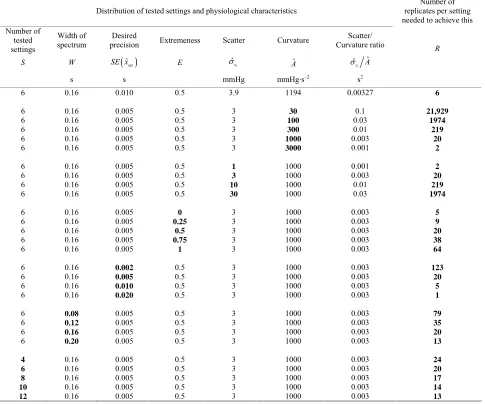
[image:8.595.57.542.266.670.2]for each proposed optimization variable. This requires only a few minutes per subject.
Table 1 shows how this ratio, and other variables,
af-fect the number of replicates needed, R, to achieve the desired optimization precision.
Although mathematically the tested range W, the
re-quired precision , and the scatter-to-curvature
ratio
ˆopt SE x
1
The many haemodynamic variables that are affected by AV delay appear to be initially change proportionally [12] which suggests that Aund may be approximately the same proportion of the baseline value of each variable. The protocol designer desiring small ˆ1 Aˆ should therefore favour the variable whose scatter
1 ˆ
is the
smallest proportion of its baseline value.
ˆ
ˆ A each have the same impact on the number
of replicates required, in clinical practice
1 ˆ
ˆ A has by
4. Limitations
far the greatest range of possible values, and the design process should therefore focus on ensuring that this is small, if the optimization protocol is to be practical.
Although it is convenient to describe optimization re-sponses with a parabola, the true underlying shape may
Table 1. Impact of physiology (scatter, curvature and extremeness) and protocol design (number of tested settings, width of spectrum) on the number of replicates needed for optimization of a desired level of precision.
Distribution of tested settings and physiological characteristics replicates per setting Number of
needed to achieve this Number of
tested settings
Width of
spectrum precision Desired Extremeness Scatter Curvature Curvature ratio Scatter/
S W SE x
ˆopt E ˆ1 Aˆ 1ˆ ˆ A
R
s s mmHg mmHg·s–2 s2
6
6 6 6 6 6
6 6 6 6
6 6 6 6 6
6 6 6 6
6 6 6 6
4 6 8 10 12
0.16
0.16 0.16 0.16 0.16 0.16
0.16 0.16 0.16 0.16
0.16 0.16 0.16 0.16 0.16
0.16 0.16 0.16 0.16
0.08 0.12 0.16 0.20
0.16 0.16 0.16 0.16 0.16
0.010
0.005 0.005 0.005 0.005 0.005
0.005 0.005 0.005 0.005
0.005 0.005 0.005 0.005 0.005
0.002 0.005 0.010 0.020
0.005 0.005 0.005 0.005
0.005 0.005 0.005 0.005 0.005
0.5
0.5 0.5 0.5 0.5 0.5
0.5 0.5 0.5 0.5
0 0.25
0.5 0.75
1
0.5 0.5 0.5 0.5
0.5 0.5 0.5 0.5
0.5 0.5 0.5 0.5 0.5
3.9
3 3 3 3 3
1 3 10 30
3 3 3 3 3
3 3 3 3
3 3 3 3
3 3 3 3 3
1194
30 100 300 1000 3000
1000 1000 1000 1000
1000 1000 1000 1000 1000
1000 1000 1000 1000
1000 1000 1000 1000
1000 1000 1000 1000 1000
0.00327
0.1 0.03 0.01 0.003 0.001
0.001 0.003 0.01 0.03
0.003 0.003 0.003 0.003 0.003
0.003 0.003 0.003 0.003
0.003 0.003 0.003 0.003
0.003 0.003 0.003 0.003 0.003
6
21,929 1974
219 20
2
2 20 219 1974
5 9 20 38 64
123 20
5 1
79 35 20 13
24 20 17 14 13
be more complex. For example, where intrinsic (or even just fusion) conduction becomes active as AV delay is lengthened, the data points may deviate upwards from the parabolic trend, and so fitting to a parabola may bias the fitted AV delay optimum toward higher values. Nev-ertheless, the principles in this manuscript would still hold true. Moreover, in the close vicinity of the optimum, which is relevant to precise optimization, curvature may be closer to parabolic.
Merely applying formulae will not make optima more precise. Only selecting a physiological variable of suita-bly low
1
ˆ
ˆ A ratio, and taking time to conduct
enough measurements (shown in Equation (7)), can im-prove precision. Lack of interest in scatter and curvature in a doctor conducting optimization is as uninspiring as lack of interest in wings and engines in an aircraft pilot.
5. Conclusions
The practical implications may be summarized from in-spection of each factor in Equation (6) in turn. To obtain precise clinical optima:
most importantly, either commit enough resources to
obtain enough measurements, or do not embark on optimization;
cover a wide range of pacemaker settings while
re-maining within the parabolic region of the response curve;
choose a physiological variable with as narrow a
random variability (in relation to its sensitivity to pacemaker setting change) as possible; and
if possible, design the spectrum of settings tested so that the true optimum will lie near its middle rather than at an extreme.
Clinicians treating patients and scientists designing and conducting studies have not had simple, quick me- thods to establish the uncertainty in planned or actual optimization procedures. As a result, patients may be undergoing apparent optimization procedures that are in fact worsening the programming of their pacemaker. Moreover without methods for recognizing unreliable optimizations, clinicians finding the optimum appearing to change every 1 or 2 years may feel compelled to carry out worthless optimization procedures more frequently, [8] which wastes clinical resources and may be harmful to patients.
The results in this paper permit easy quantification of uncertainty of the optimum of a cardiac resynchroniza-tion therapy pacemaker. They help patients gain the best physiological benefit, help doctors design protocols that deliver efficient and reliable optimization, and assist in distinguishing genuine change in patient physiology over time, versus random noise.
An unexamined optimization is not worth doing.
6. Acknowledgements
The author is supported by a Senior Research Fellowship (FS/10/038) from the British Heart Foundation.
7. References
[1] W. T. Abraham, W. G. Fisher and A. L. Smith, “Cardiac Resynchronization in Chronic Heart Failure,” New Eng-land Journal of Medicine, Vol. 346, 2002, pp. 1845-1853.
doi:10.1056/NEJMoa013168
[2] A. Kyriacou, P. A. Pabari, and D. P. Francis, “Cardiac Resynchronization Therapy Is Certainly Cardiac Therapy, But How Much Resynchronization and How Much Atrioventricular Delay Optimization?” Heart Failure Re-views, 2011, Article in Press.
doi:10.1007/s10741-011-9271-1
[3] J. G. Cleland, J. C. Daubert, E. Erdmann, N. Freemantle, D. Gras, L. Kappenberger and L. Tavazzi, “Cardiac Re-synchronization-Heart Failure (CARE-HF) Study Inves-tigators. The Effect of Cardiac Resynchronization on Morbidity and Mortality in Heart Failure,” New England Journal of Medicine,Vol. 352, No. 15, 2005, pp. 1539- 1549. doi:10.1056/NEJMoa050496
[4] A. Auricchio, C. Stellbrink, S. Sack, M. Block, J. Vogt, P. Bakker, C. Huth, F. Schöndube, U. Wolfhard, D. Böcker, O. Krahnefeld and H. Kirkels, “Pacing Therapies In Congestive Heart Failure (PATH-CHF) Study Group. Long-Term Clinical Effect of Hemodynamically Opti-mized Cardiac Resynchronization Therapy in Patients With Heart Failure and Ven-Tricular Conduction Delay,” Journal of the American College of Cardiology,Vol. 39, No. 12, 2002, pp. 2026-2033.
doi:10.1016/S0735-1097(02)01895-8
[5] M. D. Bogaard, P. A. Doevendans, G. E. Leenders, P. Loh, R. N. Hauer, H. van Wessel and M. Meine, “Can Optimization of Pacing Settings Compensate for a Non- Optimal Left Ventricular Pacing Site?” Europace, Vol. 12, No. 9, 2010, pp. 1262-1269.
doi:10.1093/europace/euq167
[6] I. E. van Geldorp, T. Delhaas, B. Hermans, K. Vernooy, B. Broers, J. Klimusina, F. Regoli, F. F. Faletra, T. Moc-cetti, B. Gerritse, R. Cornelussen, J. Settels, H. J. Crijns, A. Auricchio and F. W. Prinzen, “Comparison of a Non- Invasive Arterial Pulse Contour Technique and Echo Doppler Aorta Velocity-Time Integral on Stroke Volume Changes in Optimization of Cardiac Resynchronization Therapy,” Europace, Vol. 13, No. 1, 2011, pp. 87-95.
doi:10.1093/europace/euq348
doi:10.1016/j.ijcard.2007.08.004
[8] P. A. Pabari, K. Willson, B. Stegemann, I. E. van Geldorp, A. Kyriacou, M. Moraldo, J. Mayet, A. D. Hughes and D. P. Francis, “When Is an Optimization Not an Optimiza-tion? Evaluation of Clinical Impli-Cations of Information Content (Signal-to-Noise Ratio) in Optimization of Car-diac Resynchronization Therapy, and How to Measure and Maximize It,” Heart Failure Reviews, Vol. 16, No. 3, 2011, pp. 277-290. doi:10.1007/s10741-010-9203-5
[9] W. T. Abraham, D. Gras, C. M. Yu, L. Guzzo and M. S. Gupta, “Rationale and Design of A Randomized Clinical Trial to Assess the Safety and Efficacy of Frequent Opti-mization of Cardiac Resynchronization Therapy: The Frequent Optimization Study Using the Quickopt Method (FREEDOM) Trial,” American Heart Journal, Vol. 159, No. 6, 2010, pp. 944-948. doi:10.1016/j.ahj.2010.02.034
[10] Z. I. Whinnett, J. E. R. Davies, K. Willson, C. H. Manisty, A. C. Chow, R. A. Foale, D. W. Davies, A. D. Hughes, J.
Mayet and D. P. Francis, “Haemodynamic Effects of Changes in AV and VV Delay in Cardiac Resynchroniza-tion Therapy Show a Consistent Pattern: Analysis of Shape, Magnitude and Relative Importance of AV and VV Delay,” Heart, Vol. 92, 2006, pp. 1628-1634.
doi:10.1136/hrt.2005.080721
[11] A. C. Doyle, “The Curious Incident of the Dog in the Night-Time,” Strand Magazine, Vol. 4, No. 4, 1892, pp. 645-660.
http://www.archive.org/download/StrandMagazine24/ Strand24_text.pdf