Adversarial Learning for Neural Dialogue Generation
Jiwei Li1, Will Monroe1, Tianlin Shi1, S´ebastien Jean2, Alan Ritter3 and Dan Jurafsky1 1Stanford University, Stanford, CA, USA
2New York University, NY, USA 3Ohio State University, OH, USA
jiweil,wmonroe4,tianlins,[email protected] [email protected]
Abstract
In this paper, drawing intuition from the Turing test, we propose using adversar-ial training for open-domain dadversar-ialogue gen-eration: the system is trained to pro-duce sequences that are indistinguish-able from human-generated dialogue ut-terances. We cast the task as a rein-forcement learning (RL) problem where we jointly train two systems, a generative model to produce response sequences, and a discriminator—analagous to the human evaluator in the Turing test— to distinguish between the human-generated dialogues and the machine-generated ones. The out-puts from the discriminator are then used as rewards for the generative model, push-ing the system to generate dialogues that mostly resemble human dialogues.
In addition to adversarial training we de-scribe a model for adversarialevaluation
that uses success in fooling an adversary as a dialogue evaluation metric, while avoid-ing a number of potential pitfalls. Ex-perimental results on several metrics, in-cluding adversarial evaluation, demonstrate that the adversarially-trained system gener-ates higher-quality responses than previous baselines.
1 Introduction
Open domain dialogue generation (Ritter et al., 2011;Sordoni et al.,2015;Xu et al.,2016;Wen et al.,2016;Li et al.,2016b;Serban et al.,2016c, 2017) aims at generating meaningful and coher-ent dialogue responses given the dialogue history. Prior systems, e.g., phrase-based machine trans-lation systems (Ritter et al.,2011;Sordoni et al., 2015) or end-to-end neural systems (Shang et al.,
2015;Vinyals and Le,2015;Li et al.,2016a;Yao et al.,2015;Luan et al.,2016) approximate such a goal by predicting the next dialogue utterance given the dialogue history using the maximum likelihood estimation (MLE) objective. Despite its success, this over-simplified training objective leads to prob-lems: responses are dull, generic (Sordoni et al., 2015;Serban et al.,2016a;Li et al.,2016a), repeti-tive, and short-sighted (Li et al.,2016d).
Solutions to these problems require answering a few fundamental questions: what are the cru-cial aspects that characterize an ideal conversation, how can we quantitatively measure them, and how can we incorporate them into a machine learning system? For example,Li et al.(2016d) manually define three ideal dialogue properties (ease of an-swering, informativeness and coherence) and use a reinforcement-learning framework to train the model to generate highly rewarded responses.Yu et al.(2016b) use keyword retrieval confidence as a reward. However, it is widely acknowledged that manually defined reward functions can’t possibly cover all crucial aspects and can lead to suboptimal generated utterances.
A good dialogue model should generate utter-ances indistinguishable from human dialogues. Such a goal suggests a training objective resem-bling the idea of the Turing test (Turing, 1950). We borrow the idea of adversarial training (Good-fellow et al., 2014;Denton et al., 2015) in com-puter vision, in which we jointly train two mod-els, a generator (a neural SEQ2SEQmodel) that
defines the probability of generating a dialogue se-quence, and a discriminator that labels dialogues as human-generated or machine-generated. This discriminator is analogous to the evaluator in the Turing test. We cast the task as a reinforcement learning problem, in which the quality of machine-generated utterances is measured by its ability to fool the discriminator into believing that it is a
human-generated one. The output from the dis-criminator is used as a reward to the generator, pushing it to generate utterances indistinguishable from human-generated dialogues.
The idea of a Turing test—employing an evalu-ator to distinguish machine-generated texts from human-generated ones—can be applied not only to training but also testing, where it goes by the name of adversarial evaluation. Adversarial evalua-tion was first employed inBowman et al.(2016) to evaluate sentence generation quality, and prelimi-narily studied for dialogue generation byKannan and Vinyals(2016). In this paper, we discuss poten-tial pitfalls of adversarial evaluations and necessary steps to avoid them and make evaluation reliable.
Experimental results demonstrate that our ap-proach produces more interactive, interesting, and non-repetitive responses than standard SEQ2SEQ
models trained using the MLE objective function.
2 Related Work
Dialogue generation Response generation for dialogue can be viewed as a source-to-target trans-duction problem.Ritter et al.(2011) frame the gen-eration problem as a machine translation problem. Sordoni et al.(2015) improved Ritter et al.’s sys-tem by rescoring the outputs of a phrasal MT-based conversation system with a neural model incorpo-rating prior context. Recent progress in SEQ2SEQ
models have inspired several efforts (Vinyals and Le,2015;Serban et al.,2016a,d;Luan et al.,2016) to build end-to-end conversational systems that first apply an encoder to map a message to a distributed vector representing its meaning and then generate a response from the vector.
Our work adapts the encoder-decoder model to RL training, and can thus be viewed as an exten-sion of Li et al. (2016d), but with more general RL rewards. Li et al.(2016d) simulate dialogues between two virtual agents, using policy gradient methods to reward sequences that display three useful conversational properties: informativity, co-herence, and ease of answering. Our work is also related to recent efforts to integrate the SEQ2SEQ
and reinforcement learning paradigms, drawing on the advantages of both (Wen et al., 2016). For example,Su et al.(2016) combine reinforcement learning with neural generation on tasks with real users.Asghar et al.(2016) train an end-to-end RL dialogue model using human users.
Dialogue quality is traditionally evaluated (Sor-doni et al.,2015, e.g.) using word-overlap metrics
such as BLEU and METEOR scores used for ma-chine translation. Some recent work (Liu et al., 2016) has started to look at more flexible and reli-able evaluation metrics such as human-rating pre-diction (Lowe et al.,2017) and next utterance clas-sification (Lowe et al.,2016).
Adversarial networks The idea of generative adversarial networks has enjoyed great success in computer vision (Radford et al.,2015;Chen et al., 2016a;Salimans et al.,2016). Training is formal-ized as a game in which the generative model is trained to generate outputs to fool the discrimina-tor; the technique has been successfully applied to image generation.
However, to the best of our knowledge, this idea has not achieved comparable success in NLP. This is due to the fact that unlike in vision, text gener-ation is discrete, which makes the error outputted from the discriminator hard to backpropagate to the generator. Some recent work has begun to ad-dress this issue:Lamb et al.(2016) propose provid-ing the discriminator with the intermediate hidden vectors of the generator rather than its sequence outputs. Such a strategy makes the system differen-tiable and achieves promising results in tasks like character-level language modeling and handwriting generation. Yu et al.(2016a) use policy gradient reinforcement learning to backpropagate the error from the discriminator, showing improvement in multiple generation tasks such as poem generation, speech language generation and music generation. Outside of sequence generation,Chen et al.(2016b) apply the idea of adversarial training to sentiment analysis andZhang et al.(2017) apply the idea to domain adaptation tasks.
Our work is distantly related to recent work that formalizes sequence generation as an action-taking problem in reinforcement learning.Ranzato et al. (2016) train RNN decoders in a SEQ2SEQmodel
using policy gradient to obtain competitive ma-chine translation results. Bahdanau et al. (2017) take this a step further by training an actor-critic RL model for machine translation. Also related is recent work (Shen et al.,2016;Wiseman and Rush, 2016) to address the issues of exposure bias and loss-evaluation mismatch in neural translation.
3 Adversarial Training for Dialogue Generation
learning model. The problem can be framed as fol-lows: given a dialogue historyxconsisting of a se-quence of dialogue utterances,1the model needs to
generate a responsey={y1, y2, ..., yT}. We view
the process of sentence generation as a sequence of actions that are taken according to a policy defined by an encoder-decoder recurrent neural network. 3.1 Adversarial REINFORCE
The adversarial REINFORCE algorithm consists of two components: a generative modelGand a discriminative modelD.
Generative model The generative modelG de-fines the policy that generates a responseygiven dialogue history x. It takes a form similar to SEQ2SEQmodels, which first map the source input
to a vector representation using a recurrent net and then compute the probability of generating each token in the target using a softmax function. Discriminative model The discriminative model D is a binary classifier that takes as input a se-quence of dialogue utterances{x, y}and outputs a label indicating whether the input is generated by humans or machines. The input dialogue is encoded into a vector representation using a hi-erarchical encoder (Li et al.,2015;Serban et al., 2016b),2 which is then fed to a 2-class softmax
function, returning the probability of the input dia-logue episode being a machine-generated diadia-logue (denoted Q−({x, y})) or a human-generated
dia-logue (denotedQ+({x, y})).
Policy Gradient Training The key idea of the system is to encourage the generator to generate utterances that are indistinguishable from human generated dialogues. We use policy gradient meth-ods to achieve such a goal, in which the score of current utterances being human-generated ones assigned by the discriminator (i.e., Q+({x, y})) is used as a reward for the generator, which is trained to maximize the expected reward of gener-ated utterance(s) using the REINFORCE algorithm (Williams,1992):
J(θ) =Ey∼p(y|x)(Q+({x, y})|θ) (1)
1We approximate the dialogue history using the concate-nation of two preceding utterances. We found that using more than 2 context utterances yields very tiny performance im-provements for SEQ2SEQmodels.
2To be specific, each utteranceporqis mapped to a vector representationhporhqusing LSTM (Hochreiter and Schmid-huber,1997). Another LSTM is put on sentence level, map-ping the context dialogue sequence to a single representation.
Given the input dialogue historyx, the bot gener-ates a dialogue utteranceyby sampling from the policy. The concatenation of the generated utter-anceyand the inputxis fed to the discriminator. The gradient of (1) is approximated using the like-lihood ratio trick (Williams, 1992;Glynn, 1990; Aleksandrov et al.,1968):
∇J(θ)≈[Q+({x, y})−b({x, y})] ∇logπ(y|x)
= [Q+({x, y})−b({x, y})] ∇X
t
logp(yt|x, y1:t−1) (2)
whereπ denotes the probability of the generated responses.b({x, y})denotes the baseline value to reduce the variance of the estimate while keeping it unbiased.3 The discriminator is simultaneously
updated with the human generated dialogue that contains dialogue historyxas a positive example and the machine-generated dialogue as a negative example.
3.2 Reward for Every Generation Step (REGS)
The REINFORCE algorithm described has the dis-advantage that the expectation of the reward is ap-proximated by only one sample, and the reward associated with this sample (i.e.,[Q+({x, y})− b({x, y})]in Eq(2)) is used for all actions (the gen-eration of each token) in the generated sequence. Suppose, for example, the input history iswhat’s your name, the human-generated response isI am John, and the machine-generated response isI don’t know. The vanilla REINFORCE model assigns the same negative reward to all tokens within the human-generated response (i.e., I, don’t, know), whereas proper credit assignment in training would give separate rewards, most likely a neutral reward for the tokenI, and negative rewards todon’tand
know. We call this reward for every generation step, abbreviatedREGS.
Rewards for intermediate steps or partially de-coded sequences are thus necessary. Unfortunately, the discriminator is trained to assign scores to fully
generated sequences, but not partially decoded ones. We propose two strategies for computing in-termediate step rewards by (1) using Monte Carlo (MC) search and (2) training a discriminator that is able to assign rewards to partially decoded se-quences.
In (1) Monte Carlo search, given a partially de-codedsP, the model keeps sampling tokens from
the distribution until the decoding finishes. Such a process is repeatedN (set to 5) times and theN generated sequences will share a common prefix sP. These N sequences are fed to the
discrimi-nator, the average score of which is used as a re-ward for the sP. A similar strategy is adopted in
Yu et al.(2016a). The downside of MC is that it requires repeating the sampling process for each prefix of each sequence and is thus significantly time-consuming.4
In (2), we directly train a discriminator that is able to assign rewards to both fully and partially decoded sequences. We break the generated se-quences into partial sese-quences, namely{y+
1:t}Nt=1Y+ and{y−
1:t}Nt=1Y− and use all instances in{y1:+t}Nt=1Y+ as positive examples and instances{y1:−t}NY−
t=1 as negative examples. The problem with such a strat-egy is that earlier actions in a sequence are shared among multiple training examples for the discrimi-nator (for example, tokeny1+is contained in all par-tially generated sequences, which results in overfit-ting. To mitigate this problem, we adopt a strategy similar to when training value networks inAlphaGo
(Silver et al.,2016), in which for each collection of subsequences ofY, we randomly sample only one example from {y+1:t}NY+
t=1 and one example from {y1:−t}NY−
t=1 , which are treated as positive and neg-ative examples to update the discriminator. Com-pared with the Monte Carlo search model, this strat-egy is significantly more time-effective, but comes with the weakness that the discriminator becomes less accurate after partially decoded sequences are added in as training examples. We find that the MC model performs better when training time is less of an issue.
For each partially-generated sequence Yt =
y1:t, the discriminator gives a classification score
4Consider one target sequence with length 20, we need to sample 5*20=100 full sequences to get rewards for all inter-mediate steps. Training one batch with 128 examples roughly takes roughly 1 min on a single GPU, which is computation-ally intractable considering the size of the dialogue data we have. We thus parallelize the sampling processes, distributing jobs across 8 GPUs.
Q+(x, Yt). We compute the baselineb(x, Yt)
us-ing a similar model to the vanilla REINFORCE model. This yields the following gradient to update the generator:
∇J(θ)≈X
t
(Q+(x, Yt)−b(x, Yt))
∇logp(yt|x, Y1:t−1) (3)
Comparing (3) with (2), we can see that the val-ues for rewards and baselines are different among generated tokens in the same response.
Teacher Forcing Practically, we find that updat-ing the generative model only usupdat-ing Eq.1 leads to unstable training for both vanilla Reinforce and REGS, with the perplexity value skyrocket-ing after trainskyrocket-ing the model for a few hours (even when the generator is initialized using a pre-trained SEQ2SEQmodel). The reason this happens is that
the generative model can only be indirectly exposed to the gold-standard target sequences through the reward passed back from the discriminator, and this reward is used to promote or discourage its (the generator’s) own generated sequences. Such a training strategy is fragile: once the generator (acci-dentally) deteriorates in some training batches and the discriminator consequently does an extremely good job in recognizing sequences from the gener-ator, the generator immediately gets lost. It knows that its generated sequences are bad based on the rewards outputted from the discriminator, but it does not know what sequences are good and how to push itself to generate these good sequences (the odds of generating a good response from random sampling are minute, due to the vast size of the space of possible sequences). Loss of the reward signal leads to a breakdown in the training process.
mod-Fornumber of training iterationsdo . Fori=1,D-stepsdo
. Sample (X,Y) from real data . SampleYˆ∼G(·|X)
. UpdateDusing(X, Y)as positive examples and
(X,Yˆ)as negative examples. . End
.
. Fori=1,G-stepsdo
. Sample (X,Y) from real data . SampleYˆ∼G(·|X)
. Compute Rewardrfor(X,Yˆ)usingD. . UpdateGon(X,Yˆ)using rewardr
. Teacher-Forcing: UpdateGon(X, Y)
[image:5.595.71.294.65.235.2]. End End
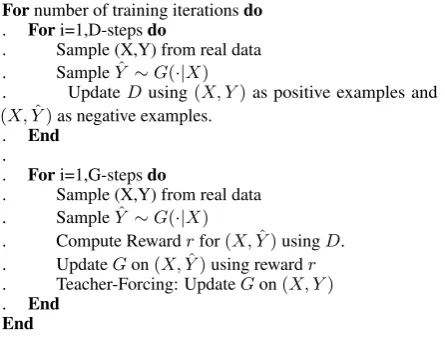
Figure 1: A brief review of the proposed adversarial reinforcement algorithm for training the generator G and discriminatorD. The reward r from the discriminatorDcan be computed using different strategies according to whether using REINFORCE or REGS. The update of the generatorGon(X,Yˆ) can be done by either using Eq.2or Eq.3. D-steps is set to 5 and G-steps is set to 1.
els, making the final training alternately update the SEQ2SEQmodel using the adversarial
objec-tive and the MLE objecobjec-tive. One can think of the professor-forcing model as a regularizer to regu-late the generator once it starts deviating from the training dataset.
We also propose another workaround, in which the discriminator first assigns a reward to a human generated example using its own model, and the generator then updates itself using this reward on the human generated example only if the reward is larger than the baseline value. Such a strategy has the advantage that different weights for model updates are assigned to different human generated examples (in the form of different reward values produced by the generator) and that human gen-erated examples are always associated with non-negative weights.
A sketch of the proposed model is shown in Figure1.
3.3 Training Details
We first pre-train the generative model by predict-ing target sequences given the dialogue history. We trained a SEQ2SEQ model (Sutskever et al.,
2014) with an attention mechanism (Bahdanau et al.,2015;Luong et al.,2015) on the OpenSubti-tles dataset. We followed protocols recommended
bySutskever et al.(2014), such as gradient clip-ping, mini-batch and learning rate decay. We also pre-train the discriminator. To generate negative examples, we decode part of the training data. Half of the negative examples are generated using beam-search with mutual information reranking as de-scribed inLi et al. (2016a), and the other half is generated from sampling.
For data processing, model training and decod-ing (both the proposed adversarial traindecod-ing model and the standard SEQ2SEQmodels), we employ
a few strategies that improve response quality, in-cluding: (2) Remove training examples with length of responses shorter than a threshold (set to 5). We find that this significantly improves the general re-sponse quality.5(2) Instead of using the same
learn-ing rate for all examples, uslearn-ing a weighted learnlearn-ing rate that considers the average tf-idf score for to-kens within the response. Such a strategy decreases the influence from dull and generic utterances.6 (3)
Penalizing intra-sibling ranking when doing beam search decoding to promote N-best list diversity as described inLi et al.(2016c). (4) Penalizing word types (stop words excluded) that have already been generated. Such a strategy dramatically decreases the rate of repetitive responses such asno. no. no. no. no.or contradictory responses such asI don’t like oranges but i like oranges.
4 Adversarial Evaluation
In this section, we discuss strategies for success-ful adversarial evaluation. Note that the proposed adversarial training and adversarial evaluation are separate procedures. They are independent of each other and share no common parameters.
The idea of adversarial evaluation, first proposed byBowman et al.(2016), is to train a discriminant function to separate generated and true sentences, in an attempt to evaluate the model’s sentence gen-eration capability. The idea has been preliminarily studied byKannan and Vinyals(2016) in the con-text of dialogue generation. Adversarial evaluation also resembles the idea of the Turing test, which
5To compensate for the loss of short responses, one can train a separate model using short sequences.
6We treat each sentence as a document. Stop words are removed. Learning rates are normalized within one batch. For example, supposet1,t2, ...,ti, ... ,tN denote the tf-idf scores for sentences within current batch andlrdenotes the original learning rate. The learning rate for sentence with indexiisN·lr· ti
P
i0ti0. To avoid exploding learning rates
requires a human evaluator to distinguish machine-generated texts from human-machine-generated ones. Since it is time-consuming and costly to ask a human to talk to a model and give judgements, we train a machine evaluator in place of the human evaluator to distinguish the human dialogues and machine dialogues, and we use it to measure the general quality of the generated responses.
Adversarial evaluation involves both training and testing. At training time, the evaluator is trained to label dialogues as machine-generated (negative) or human-generated (positive). At test time, the trained evaluator is evaluated on a held-out dataset. If the human-generated dialogues and machine-generated ones are indistinguishable, the model will achieve 50 percent accuracy at test time.
4.1 Adversarial Success
We define Adversarial Success (AdverSucfor short) to be the fraction of instances in which a model is capable of fooling the evaluator. AdverSucis the difference between 1 and the accuracy achieved by the evaluator. Higher values ofAdverSucfor a dialogue generation model are better.
4.2 Testing the Evaluator’s Ability
One caveat with the adversarial evaluation methods is that they are model-dependent. We approximate the human evaluator in the Turing test with an au-tomatic evaluator and assume that the evaluator is perfect: low accuracy of the discriminator should indicate high quality of the responses, since we interpret this to mean the generated responses are indistinguishable from the human ones. Unfor-tunately, there is another factor that can lead to low discriminative accuracy: a poor discriminative model. Consider a discriminator that always gives random labels or always gives the same label. Such an evaluator always yields a highAdverSucvalue of 0.5.Bowman et al.(2016) propose two different discriminator models separately usingunigram fea-tures andneuralfeatures. It is hard to tell which feature set is more reliable. The standard strategy of testing the model on a held-out development set is not suited to this case, since a model that overfits the development set is necessarily superior.
To deal with this issue, we propose setting up a few manually-invented situations to test the ability of the automatic evaluator. This is akin to setting up examinations to test the ability of the human evaluator in the Turing test. We report not only the
AdverSucvalues, but also the scores that the
evalu-ator achieves in these manually-designed test cases, indicating how much we can trust the reported Ad-verSuc. We develop scenarios in which we know in advance how a perfect evaluator should behave, and then compareAdverSucfrom a discriminative model with the gold-standardAdverSuc. Scenarios we design include:
• We use human-generated dialogues as both positive examples and negative examples. A perfect evaluator should give an AdverSuc
of 0.5 (accuracy 50%), which is the gold-standard result.
• We use machine-generated dialogues as both positive examples and negative examples. A perfect evaluator should give anAdverSucof 0.5(accuracy50%).
• We use original human-generated dialogues as positive examples and dialogues consisting of random utterances as negative examples. A perfect evaluator should give anAdverSucof 0(accuracy100%).
• We use original human-generated dialogues as positive examples and dialogues with re-sponses replaced by the utterances immedi-ately following the true responses. A perfect evaluation should give anAdverSucof0 (ac-curacy100%).
Theevaluator reliability error(ERE) is the average deviation of an evaluator’s adversarial error from the gold-standard error in the above tasks, with equal weight for each task. The smaller the error, the more reliable the evaluator is.
4.3 Machine-vs-Random Accuracy
Evaluator reliability error uses scenarios con-structed from human-generated dialogues to assess feature or hyper-parameter choice for the evaluator. Unfortunately, no machine-generated responses are involved in the ERE metric. The following exam-ple illustrates the serious weakness resulting from this strategy: as will be shown in the experiment section, when inputs are decoded using greedy or beam search models, most generation systems to date yield an adversarial success less than 10 per-cent (evaluator accuracy 90 perper-cent). But when using sampling for decoding, the adversarial suc-cess skyrockets to around 40 percent,7 only 10
percent less than what’s needed to pass the Turing test. A close look at the decoded sequences using sampling tells a different story: the responses from
Input tell me ... how long have you had this falling sickness ? Vanilla-MLE i ’m not a doctor .
Vanilla-Sample well everything you did was totally untrue . REINFORCE i don ’t know how long it ’s been . REGS Monte Carlo A few months, I guess .
Input so i had the doctors test sammy ’s response to conditioning . Vanilla-MLE sammy wrote the test sammy wrote the test .
Vanilla-Sample objects pick objects up objects objects objects objects objects REINFORCE i ’m not sure that ’s relevant .
REGS Monte Carlo so he took the pills . Input what are you going to do ?
Vanilla-MLE i ’m going to the movies . Vanilla-Sample get him outta here first ! REINFORCE i ’m going to get you .
REGS Monte Carlo i ’m going to get you a new car . Input they fear your power your intellect .
Vanilla-MLE you ’re the only one who knows what ’s going on .
Vanilla-Sample when they are conquered and you surrender they will control all of us . REINFORCE i ’m afraid i ’m not ready yet .
[image:7.595.75.527.60.263.2]REGS Monte Carlo i ’m not afraid of your power .
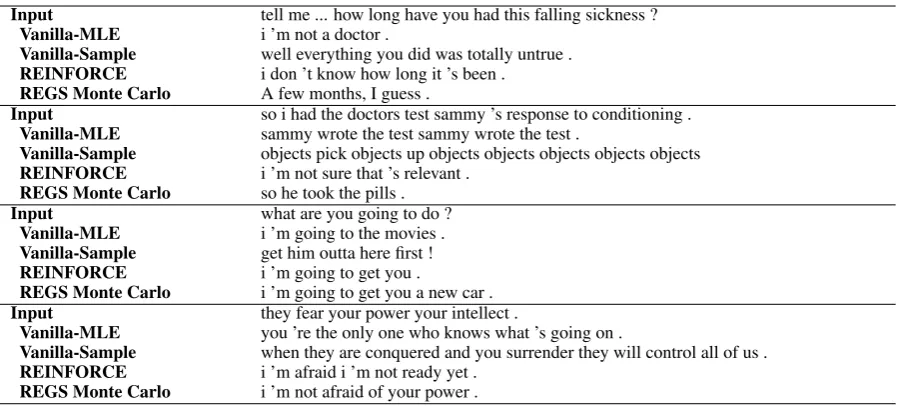
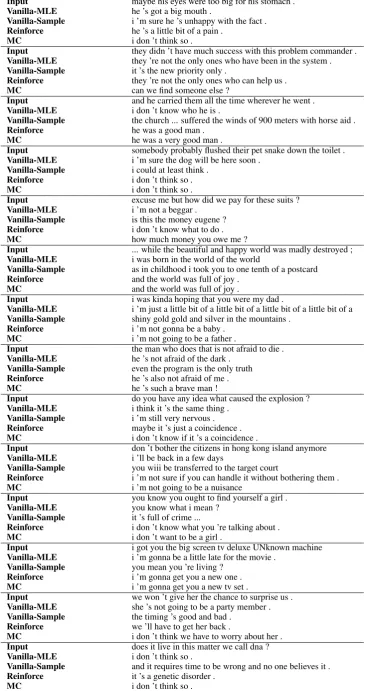
Table 1: Sampled responses from different models. More in Appendix Tables5and6.
sampling are sometimes incoherent, irrelevant or even ungrammatical.
We thus propose an additional sanity check, in which we report the accuracy of distinguishing be-tween machine-generated responses and randomly sampled responses (machine-vs-randomfor short). This resembles the N-choose-1 metric described inShao et al.(2017). Higher accuracy indicates that the generated responses are distinguishable from randomly sampled human responses, indicat-ing that the generative model is not foolindicat-ing the generator simply by introducing randomness. As we will show in Sec.5, using sampling results in highAdverSucvalues but lowmachine-vs-random
accuracy.
5 Experimental Results
In this section, we detail experimental results on adversarial success and human evaluation.
Setting ERE
SVM+Unigram 0.232
Concat Neural 0.209
Hierarchical Neural 0.193 SVM+Neural+multil-features 0.152
Table 2: ERE scores obtained by different models.
5.1 Adversarial Evaluation
ERE We first test adversarial evaluation models with different feature sets and model architectures for reliability, as measured by evaluator reliability error (ERE). We explore the following models: (1)
SVM+Unigram: SVM using unigram features.8 A 8Trained using the SVM-Light package (Joachims,2002).
multi-utterance dialogue (i.e., input messages and responses) is transformed to a unigram represen-tation; (2)Concat Neural: a neural classification model with a softmax function that takes as input the concatenation of representations of constituent dialogues sentences; (3) Hierarchical Neural: a hierarchical encoder with a structure similar to the discriminator used in the reinforcement; and (4)
SVM+Neural+multi-lex-features: a SVM model that uses the following features: unigrams, neural representations of dialogues obtained by the neural model trained using strategy (3),9the forward
like-lihoodlogp(t|s)and backward likelihoodp(s|t). ERE scores obtained by different models are re-ported in Table2. As can be seen, thehierarchical neural evaluator (model 3) is more reliable than simply concatenating the sentence-level represen-tations (model 2). Using the combination of neural features and lexicalized features yields the most reliable evaluator. For the rest of this section, we report results obtained by the Hierarchical Neu-ralsetting due to its end-to-end nature, despite its inferiority toSVM+Neural+multil-features.
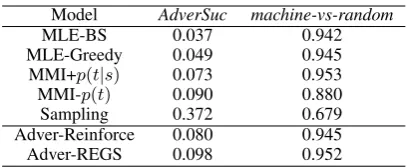
Table3presentsAdverSucvalues for different models, along withmachine-vs-randomaccuracy described in Section 4.3. Higher values of Adver-Sucandmachine-vs-randomare better.
Baselines we consider include standard SEQ2SEQmodels using greedy decoding ( MLE-greedy), beam-search (MLE+BS) and sampling, as well as the mutual information reranking model of Li et al.(2016a) with two algorithmic variations: (1) MMI+p(t|s), in which a large N-best list is first
Model AdverSuc machine-vs-random
MLE-BS 0.037 0.942
MLE-Greedy 0.049 0.945
MMI+p(t|s) 0.073 0.953
MMI-p(t) 0.090 0.880
Sampling 0.372 0.679
Adver-Reinforce 0.080 0.945
[image:8.595.79.283.60.144.2]Adver-REGS 0.098 0.952
Table 3:AdverSucandmachine-vs-randomscores achieved by different training/decoding strategies.
generated using a pre-trained SEQ2SEQmodel and
then reranked by the backward probabilityp(s|t) and (2) MMI−p(t), in which language model probability is penalized during decoding.
Results are shown in Table3. What first stands out is decoding using sampling (as discussed in Sec-tion 4.3), achieving a significantly higherAdverSuc
number than all the rest models. However, this does not indicate the superiority of the sampling decod-ing model, since themachine-vs-randomaccuracy is at the same time significantly lower. This means that sampled responses based on SEQ2SEQ
mod-els are not only hard for an evaluator to distinguish from real human responses, but also from randomly sampled responses. A similar, though much less extreme, effect is observed for MMI−p(t), which has anAdverSucvalue slightly higher than Adver-Reinforce, but a significantly lower machine-vs-randomscore.
By comparing different baselines, we find that MMI+p(t|s)is better thanMLE-greedy, which is in turn better thanMLE+BS. This result is in line with human-evaluation results fromLi et al. (2016a). The two proposed adversarial algorithms achieve better performance than the baselines. We expect this to be the case, since the adversarial algorithms are trained on an objective function more similar to the evaluation metric (i.e., adversarial success).
REGSperforms slightly better than the vanilla RE-INFORCE algorithm.
5.2 Human Evaluation
For human evaluation, we follow protocols de-fined inLi et al.(2016d), employing crowdsourced judges to evaluate a random sample of 200 items. We present both an input message and the gener-ated outputs to 3 judges and ask them to decide which of the two outputs is better (single-turn gen-eral quality). Ties are permitted. Identical strings are assigned the same score. We also present the judges withmulti-turnconversations simulated be-tween the two agents. Each conversation consists
Setting adver-win adver-lose tie
single-turn 0.62 0.18 0.20
multi-turn 0.72 0.10 0.18
Table 4: The gain from the proposed adversarial model over the mutual information system based on pairwise human judgments.
of 3 turns. Results are presented in Table4. We observe a significant quality improvement on both single-turn quality and multi-turn quality from the proposed adversarial model. It is worth noting that the reinforcement learning system described inLi et al.(2016d), which simulates conversations be-tween two bots and is trained based on manually designed reward functions, only improves multi-turn dialogue quality, while the model described in this paper improves both single-turn and multi-turn dialogue generation quality. This confirms that the reward adopted in adversarial training is more general, natural and effective in training dialogue systems.
6 Conclusion and Future Work
In this paper, drawing intuitions from the Turing test, we propose using an adversarial training ap-proach for response generation. We cast the model in the framework of reinforcement learning and train a generator based on the signal from a dis-criminator to generate response sequences indis-tinguishable from human-generated dialogues. We observe clear performance improvements on multi-ple metrics from the adversarial training strategy.
The adversarial training model should theo-retically benefit a variety of generation tasks in NLP. Unfortunately, in preliminary experiments applying the same training paradigm to machine translation, we did not observe a clear performance boost. We conjecture that this is because the adversarial training strategy is more beneficial to tasks in which there is a big discrepancy between the distributions of the generated sequences and the reference target sequences. In other words, the adversarial approach is more beneficial on tasks in which entropy of the targets is high. Exploring this relationship further is a focus of our future work.
[image:8.595.329.506.73.103.2]Mi-crosoft Research, as well as Sumit Chopra and Marc’Aurelio Ranzato from Facebook AI Research for helpful discussions and comments. Jiwei Li is supported by a Facebook Fellowship, which we gratefully acknowledge. This work is also partially supported by the NSF under award IIS-1514268, and the DARPA Communicating with Comput-ers (CwC) program under ARO prime contract no. W911NF- 15-1-0462, IIS-1464128. Any opinions, findings, and conclusions or recommendations ex-pressed in this material are those of the authors and do not necessarily reflect the views of DARPA, the NSF, or Facebook.
References
V. M. Aleksandrov, V. I. Sysoyev, and V. V. Shemeneva.
1968. Stochastic optimization. Engineering
Cyber-netics5:11–16.
Nabiha Asghar, Pasca Poupart, Jiang Xin, and Hang Li. 2016. Online sequence-to-sequence reinforcement learning for open-domain conversational agents. arXiv preprint arXiv:1612.03929.
Dzmitry Bahdanau, Philemon Brakel, Kelvin Xu, Anirudh Goyal, Ryan Lowe, Joelle Pineau, Aaron Courville, and Yoshua Bengio. 2017. An actor-critic
algorithm for sequence prediction. ICLR.
Dzmitry Bahdanau, Kyunghyun Cho, and Yoshua Ben-gio. 2015. Neural machine translation by jointly
learning to align and translate. InProc. of ICLR.
Samuel R Bowman, Luke Vilnis, Oriol Vinyals, An-drew M Dai, Rafal Jozefowicz, and Samy Ben-gio. 2016. Generating sentences from a continuous
space. CoNLL.
Xi Chen, Yan Duan, Rein Houthooft, John Schulman, Ilya Sutskever, and Pieter Abbeel. 2016a. Info-gan: Interpretable representation learning by infor-mation maximizing generative adversarial nets. In Advances In Neural Information Processing Systems. pages 2172–2180.
Xilun Chen, Ben Athiwaratkun, Yu Sun, Kilian Wein-berger, and Claire Cardie. 2016b. Adversarial deep averaging networks for cross-lingual sentiment
clas-sification.arXiv preprint arXiv:1606.01614.
Emily L Denton, Soumith Chintala, Rob Fergus, et al. 2015. Deep generative image models using a?
laplacian pyramid of adversarial networks. In
Ad-vances in neural information processing systems. pages 1486–1494.
Peter W Glynn. 1990. Likelihood ratio gradient
estima-tion for stochastic systems. Communications of the
ACM33(10):75–84.
Ian Goodfellow, Jean Pouget-Abadie, Mehdi Mirza, Bing Xu, David Warde-Farley, Sherjil Ozair, Aaron Courville, and Yoshua Bengio. 2014. Generative
ad-versarial nets. InAdvances in Neural Information
Processing Systems. pages 2672–2680.
Sepp Hochreiter and J¨urgen Schmidhuber. 1997. Long
short-term memory. Neural computation9(8):1735–
1780.
Thorsten Joachims. 2002. Learning to classify text
us-ing support vector machines: Methods, theory and algorithms. Kluwer Academic Publishers.
Anjuli Kannan and Oriol Vinyals. 2016. Adversarial
evaluation of dialogue models. InNIPS 2016
Work-shop on Adversarial Training.
Alex Lamb, Anirudh Goyal, Ying Zhang, Saizheng Zhang, Aaron Courville, and Yoshua Bengio. 2016. Professor forcing: A new algorithm for training
re-current networks. InAdvances In Neural
Informa-tion Processing Systems. pages 4601–4609.
Jiwei Li, Michel Galley, Chris Brockett, Jianfeng Gao, and Bill Dolan. 2016a. A diversity-promoting ob-jective function for neural conversation models. In Proc. of NAACL-HLT.
Jiwei Li, Michel Galley, Chris Brockett, Georgios
Sp-ithourakis, Jianfeng Gao, and Bill Dolan. 2016b. A
persona-based neural conversation model. In Pro-ceedings of the 54th Annual Meeting of the Asso-ciation for Computational Linguistics (Volume 1: Long Papers). Berlin, Germany, pages 994–1003.
http://www.aclweb.org/anthology/P16-1094.
Jiwei Li, Minh-Thang Luong, and Dan Jurafsky. 2015. A hierarchical neural autoencoder for paragraphs
and documents.ACL.
Jiwei Li, Will Monroe, and Dan Jurafsky. 2016c. A simple, fast diverse decoding algorithm for neural
generation.arXiv preprint arXiv:1611.08562.
Jiwei Li, Will Monroe, Alan Ritter, and Dan Jurafsky. 2016d. Deep reinforcement learning for dialogue
generation.EMNLP.
Chia-Wei Liu, Ryan Lowe, Iulian V Serban, Michael Noseworthy, Laurent Charlin, and Joelle Pineau. 2016. How NOT to evaluate your dialogue system: An empirical study of unsupervised evaluation
met-rics for dialogue response generation.EMNLP.
Ryan Lowe, Michael Noseworthy, Iulian Serban, Nico-las Angelard-Gontier, Yoshua Bengio, and Joelle Pineau. 2017. Towards an automatic turing test:
Learning to evaluate dialogue responses. ACL.
Ryan Lowe, Iulian V Serban, Mike Noseworthy, Lau-rent Charlin, and Joelle Pineau. 2016. On the evalu-ation of dialogue systems with next utterance
Yi Luan, Yangfeng Ji, and Mari Ostendorf. 2016.
LSTM based conversation models. arXiv preprint
arXiv:1603.09457.
Minh-Thang Luong, Hieu Pham, and Christopher D Manning. 2015. Effective approaches to
attention-based neural machine translation. ACL.
Alec Radford, Luke Metz, and Soumith Chintala. 2015. Unsupervised representation learning with deep
con-volutional generative adversarial networks. arXiv
preprint arXiv:1511.06434.
Marc’Aurelio Ranzato, Sumit Chopra, Michael Auli, and Wojciech Zaremba. 2016. Sequence level
train-ing with recurrent neural networks. ICLR.
Alan Ritter, Colin Cherry, and William B Dolan. 2011. Data-driven response generation in social media. In Proceedings of EMNLP 2011. pages 583–593. Tim Salimans, Ian Goodfellow, Wojciech Zaremba,
Vicki Cheung, Alec Radford, and Xi Chen. 2016.
Improved techniques for training gans. InAdvances
in Neural Information Processing Systems. pages 2226–2234.
Iulian V Serban, Alessandro Sordoni, Yoshua Bengio, Aaron Courville, and Joelle Pineau. 2016a. Build-ing end-to-end dialogue systems usBuild-ing generative
hi-erarchical neural network models. InProceedings of
AAAI.
Iulian V Serban, Alessandro Sordoni, Yoshua Bengio, Aaron Courville, and Joelle Pineau. 2016b. Build-ing end-to-end dialogue systems usBuild-ing generative
hi-erarchical neural network models. InProceedings of
the 30th AAAI Conference on Artificial Intelligence (AAAI-16).
Iulian Vlad Serban, Tim Klinger, Gerald Tesauro, Kartik Talamadupula, Bowen Zhou, Yoshua
Ben-gio, and Aaron Courville. 2016c.
Multiresolu-tion recurrent neural networks: An applicaMultiresolu-tion
to dialogue response generation. arXiv preprint
arXiv:1606.00776.
Iulian Vlad Serban, Ryan Lowe, Laurent Charlin, and Joelle Pineau. 2016d. Generative deep neural net-works for dialogue: A short review .
Iulian Vlad Serban, Alessandro Sordoni, Ryan Lowe, Laurent Charlin, Joelle Pineau, Aaron Courville, and Yoshua Bengio. 2017. A hierarchical latent variable encoder-decoder model for generating
dia-logues.AAAI.
Lifeng Shang, Zhengdong Lu, and Hang Li. 2015. Neu-ral responding machine for short-text conversation. InProceedings of ACL-IJCNLP. pages 1577–1586. Louis Shao, Stephan Gouws, Denny Britz, Anna
Goldie, Brian Strope, and Ray Kurzweil. 2017. Gen-erating long and diverse responses with neural
con-versational models.ICLR.
Shiqi Shen, Yong Cheng, Zhongjun He, Wei He, Hua Wu, Maosong Sun, and Yang Liu. 2016. Minimum
risk training for neural machine translation.ACL.
David Silver, Aja Huang, Chris J Maddison, Arthur Guez, Laurent Sifre, George Van Den Driessche, Ju-lian Schrittwieser, Ioannis Antonoglou, Veda Pan-neershelvam, Marc Lanctot, et al. 2016. Mastering the game of Go with deep neural networks and tree
search. Nature529(7587):484–489.
Alessandro Sordoni, Michel Galley, Michael Auli, Chris Brockett, Yangfeng Ji, Meg Mitchell, Jian-Yun Nie, Jianfeng Gao, and Bill Dolan. 2015. A neural network approach to context-sensitive
gener-ation of conversgener-ational responses. InProceedings of
NAACL-HLT.
Pei-Hao Su, Milica Gasic, Nikola Mrksic, Lina Rojas-Barahona, Stefan Ultes, David Vandyke, Tsung-Hsien Wen, and Steve Young. 2016. Continuously
learning neural dialogue management. arxiv.
Ilya Sutskever, Oriol Vinyals, and Quoc V Le. 2014. Sequence to sequence learning with neural networks. In Advances in neural information processing
sys-tems. pages 3104–3112.
Alan M Turing. 1950. Computing machinery and
intel-ligence. Mind59(236):433–460.
Oriol Vinyals and Quoc Le. 2015. A neural
conversa-tional model. InProceedings of ICML Deep
Learn-ing Workshop.
Tsung-Hsien Wen, Milica Gasic, Nikola Mrksic, Lina M Rojas-Barahona, Pei-Hao Su, Stefan Ultes, David Vandyke, and Steve Young. 2016. A network-based end-to-end trainable task-oriented dialogue
system. arXiv preprint arXiv:1604.04562.
Ronald J Williams. 1992. Simple statistical gradient-following algorithms for connectionist
reinforce-ment learning. Machine learning8(3-4):229–256.
Sam Wiseman and Alexander M Rush. 2016. Sequence-to-sequence learning as beam-search
optimization. ACL.
Zhen Xu, Bingquan Liu, Baoxun Wang, Chengjie
Sun, and Xiaolong Wang. 2016. Incorporating
loose-structured knowledge into LSTM with recall
gate for conversation modeling. arXiv preprint
arXiv:1605.05110.
Kaisheng Yao, Geoffrey Zweig, and Baolin Peng. 2015. Attention with intention for a neural network
conver-sation model. InNIPS workshop on Machine
Learn-ing for Spoken Language UnderstandLearn-ing and Inter-action.
Lantao Yu, Weinan Zhang, Jun Wang, and Yong Yu. 2016a. Seqgan: sequence generative
adver-sarial nets with policy gradient. arXiv preprint
Zhou Yu, Ziyu Xu, Alan W Black, and Alex I Rud-nicky. 2016b. Strategy and policy learning for
non-task-oriented conversational systems. In 17th
An-nual Meeting of the Special Interest Group on Dis-course and Dialogue. page 404.
Yuan Zhang, Regina Barzilay, and Tommi Jaakkola.
2017. Aspect-augmented adversarial
net-works for domain adaptation. arXiv preprint
Input maybe his eyes were too big for his stomach . Vanilla-MLE he ’s got a big mouth .
Vanilla-Sample i ’m sure he ’s unhappy with the fact . Reinforce he ’s a little bit of a pain .
MC i don ’t think so .
Input they didn ’t have much success with this problem commander . Vanilla-MLE they ’re not the only ones who have been in the system . Vanilla-Sample it ’s the new priority only .
Reinforce they ’re not the only ones who can help us .
MC can we find someone else ?
Input and he carried them all the time wherever he went . Vanilla-MLE i don ’t know who he is .
Vanilla-Sample the church ... suffered the winds of 900 meters with horse aid . Reinforce he was a good man .
MC he was a very good man .
Input somebody probably flushed their pet snake down the toilet . Vanilla-MLE i ’m sure the dog will be here soon .
Vanilla-Sample i could at least think . Reinforce i don ’t think so .
MC i don ’t think so .
Input excuse me but how did we pay for these suits ? Vanilla-MLE i ’m not a beggar .
Vanilla-Sample is this the money eugene ? Reinforce i don ’t know what to do .
MC how much money you owe me ?
Input ... while the beautiful and happy world was madly destroyed ; Vanilla-MLE i was born in the world of the world
Vanilla-Sample as in childhood i took you to one tenth of a postcard Reinforce and the world was full of joy .
MC and the world was full of joy .
Input i was kinda hoping that you were my dad .
Vanilla-MLE i ’m just a little bit of a little bit of a little bit of a little bit of a Vanilla-Sample shiny gold gold and silver in the mountains .
Reinforce i ’m not gonna be a baby .
MC i ’m not going to be a father .
Input the man who does that is not afraid to die . Vanilla-MLE he ’s not afraid of the dark .
Vanilla-Sample even the program is the only truth Reinforce he ’s also not afraid of me .
MC he ’s such a brave man !
Input do you have any idea what caused the explosion ? Vanilla-MLE i think it ’s the same thing .
Vanilla-Sample i ’m still very nervous . Reinforce maybe it ’s just a coincidence .
MC i don ’t know if it ’s a coincidence .
Input don ’t bother the citizens in hong kong island anymore Vanilla-MLE i ’ll be back in a few days
Vanilla-Sample you wiii be transferred to the target court
Reinforce i ’m not sure if you can handle it without bothering them .
MC i ’m not going to be a nuisance
Input you know you ought to find yourself a girl . Vanilla-MLE you know what i mean ?
Vanilla-Sample it ’s full of crime ...
Reinforce i don ’t know what you ’re talking about .
MC i don ’t want to be a girl .
Input i got you the big screen tv deluxe UNknown machine Vanilla-MLE i ’m gonna be a little late for the movie .
Vanilla-Sample you mean you ’re living ? Reinforce i ’m gonna get you a new one .
MC i ’m gonna get you a new tv set .
Input we won ’t give her the chance to surprise us . Vanilla-MLE she ’s not going to be a party member . Vanilla-Sample the timing ’s good and bad .
Reinforce we ’ll have to get her back .
MC i don ’t think we have to worry about her .
Input does it live in this matter we call dna ? Vanilla-MLE i don ’t think so .
Vanilla-Sample and it requires time to be wrong and no one believes it . Reinforce it ’s a genetic disorder .
[image:12.595.116.484.66.758.2]MC i don ’t think so .
Input i ’ll have to drive home . Vanilla-MLE i ’ll be back in a minute . Vanilla-Sample let ’s go for some fun . Reinforce i ’ll drive you home .
MC i don ’t have a car .
Input i had to work late and then i went for a walk . Vanilla-MLE i was in the middle of the road .
Vanilla-Sample my body was just pounding . Reinforce i was just trying to help you .
MC i was just trying to get a little sleep .
Input lots of cream lots of sugar . Vanilla-MLE i ’m gonna be in the kitchen . Vanilla-Sample was this gay or red ?
Reinforce i don ’t want to be a vegetable .
MC i ’m not a very good cook .
Input so they just let him go ?
Vanilla-MLE he ’s not gonna let them go through the motions . Vanilla-Sample they asked him whether we could go see ernesto ? Reinforce i don ’t know what to do .
MC he ’s not going to be here any longer .
Input you must not bomb this town . Vanilla-MLE you have to go back to the city . Vanilla-Sample the one is a multiple choice . Reinforce I think I have to .
MC I think I have to .
Input communism recently failed in eastern europe . Vanilla-MLE the war is not over .
Vanilla-Sample there are people who hope that in tokyo they won ’t risk losing their departing .
Reinforce and the people who are not the same .
MC the war is still going on .
Input you should stop in more often . Vanilla-MLE I don ’t think so .
Vanilla-Sample is it possible as old as you ?
Reinforce i ’m not going to be a burden on you .
MC i don ’t want to be a burden .
Input he couldn ’t have heard us . Vanilla-MLE he was in the middle of the night . Vanilla-Sample he should have been somewhere out here . Reinforce he ’s not a good guy .
MC he ’s got a lot of nerve.
Input that ’s our wake up call .
Vanilla-MLE we ’re gonna be late for the meeting . Vanilla-Sample c ’mon c ’mon let ’s get outta here . Reinforce i ’ll be right back .
MC we ’re gonna have to get to the station .
Input i had ’em when i started . Vanilla-MLE i ’m gonna get ’em .
Vanilla-Sample those weak rotten guys had me in a rush on a broken swoop . Reinforce i don ’t know what to do .
MC i was just a little bit nervous .
Input oatmeal delicious start into a new day Vanilla-MLE i ’ll be right back
Vanilla-Sample sure if you don ’t put it into the water Reinforce i ’m gonna be a little busy with the dishes .
[image:13.595.115.485.125.685.2]MC i ’m gonna make you a little dinner .