Investigating Unsupervised Learning
for Text Categorization Bootstrapping
Alfio Gliozzo and Carlo Strapparava ITC-irst
Istituto per la Ricerca Scientifica e Tecnologica I-38050 Trento, Italy
{gliozzo,strappa}@itc.it
Ido Dagan
Computer Science Department Bar Ilan University
Ramat Gan, Israel
Abstract
We propose a generalized bootstrapping algorithm in which categories are de-scribed by relevant seed features. Our method introduces two unsupervised steps that improve the initial categorization step of the bootstrapping scheme: (i) using La-tent Semantic space to obtain a general-ized similarity measure between instances and features, and (ii) the Gaussian Mixture algorithm, to obtain uniform classification probabilities for unlabeled examples. The algorithm was evaluated on two Text Cate-gorization tasks and obtained state-of-the-art performance using only the category names as initial seeds.
1 Introduction
Supervised classification is the task of assigning cat-egory labels, taken from a predefined set of cate-gories (classes), to instances in a data set. Within the classical supervised learning paradigm, the task is approached by providing a learning algorithm with a training data set of manually labeled examples. In practice it is not always easy to apply this schema to NLP tasks. For example supervised systems for Text Categorization (TC) require a large amount of hand labeled texts, while in many applicative cases it is quite difficult to collect the required amounts of hand labeled data. Unlabeled text collections, on the other hand, are in general easily available.
An alternative approach is to provide the neces-sary supervision by means of sets of “seeds” of in-tuitively relevant features. Adopting terminology
from computability theory, we refer to the stan-dard example-based supervision mode as
Exten-sional Learning (EL), as classes are being specified
by means of examples of their elements (their
ex-tension). Feature-based supervision is referred to as Intensional Learning (IL), as features may often be
perceived as describing the intension of a category, such as providing the name or prominent key terms for a category in text categorization.
The goal of this paper is to investigate additional principled unsupervised mechanisms within the ini-tial classification step, applied to the text catego-rization. In particular, (a) utilizing a Latent Se-mantic Space to obtain better similarity assessments between seeds and examples, and (b) applying a Gaussian Mixture (GM) algorithm, which provides a principled unsupervised estimation of classification probability. As shown in our experiments, incor-porating these steps consistently improved the ac-curacy of the initial categorization step, which in turn yielded a better final classifier thanks to the more accurate training set. Most importantly, we ob-tained comparable or better performance than previ-ous IL methods using only the category names as the seed features; other IL methods required collecting a larger number of seed terms, which turns out to be a somewhat tricky task.
Interesting results were revealed when compar-ing our IL method to a state-of-the-art extensional classifier, trained on manually labeled documents. The EL classifier required 70 (Reuters dataset) or 160 (Newsgroup dataset) documents per category to achieve the same performance that IL obtained using only the category names. These results suggest that IL may provide an appealing cost-effective alterna-tive when sub-optimal accuracy suffices, or when it is too costly or impractical to obtain sufficient la-beled training. Optimal combination of extensional and intensional supervision is raised as a challeng-ing topic for future research.
2 Bootstrapping for Text Categorization
The TC task is to assign category labels to docu-ments. In the IL setting, a categoryCi is described
by providing a set of relevant features, termed an
intensional description (ID), idci ⊆ V, where V
is the vocabulary. In addition a training corpus T = {t1, t2, . . . tn} of unlabeled texts is provided.
Evaluation is performed on a separate test corpus of labeled documents, to which standard evaluation metrics can be applied.
The approach of categorizing texts based on lists of keywords has been attempted rather rarely in the literature (McCallum and Nigam, 1999; Ko and Seo, 2000; Liu et al., 2004; Ko and Seo, 2004). Several names have been proposed for it – such as TC by
bootstrapping with keywords, unsupervised TC, TC by labelling words – where the proposed methods
fall (mostly) within the IL settings described here1.
It is possible to recognize a common structure of these works, based on a typical bootstrap schema (Yarowsky, 1995; Collins and Singer, 1999):
Step 1: Initial unsupervised categorization. This
step was approached by applying some similar-ity criterion between the initial category seed and each unlabeled document. Similarity may be determined as a binary criterion, consider-ing each seed keyword as a classification rule (McCallum and Nigam, 1999), or by applying an IR style vector similarity measure. The re-sult of this step is an initial categorization of (a subset of) the unlabeled documents. In (Ko and Seo, 2004) term similarity techniques were ex-ploited to expand the set of seed keywords, in order to improve the quality of the initial cate-gorization.
Step 2: Train a supervised classifier on the
ini-tially categorized set. The output of Step 1 is exploited to train an (extensional) su-pervised classifier. Different learning algo-rithms have been tested, including SVM, Naive Bayes, Nearest Neighbors, and Rocchio. Some works (McCallum and Nigam, 1999; Liu et al., 2004) performed an additional Expectation Maximization algorithm over the training data, but reported rather small incremental improve-ments that do not seem to justify the additional effort.
(McCallum and Nigam, 1999) reported catego-rization results close to human agreement on the same task. (Liu et al., 2004) and (Ko and Seo, 2004) contrasted their word-based TC algorithm with the performance of an extensional supervised algorithm, achieving comparable results, while in general somewhat lower. It should be noted that it has been more difficult to define a common evalua-tion framework for comparing IL algorithms for TC, due to the subjective selection of seed IDs and to the lack of common IL test sets (see Section 4).
1
3 Incorporating Unsupervised Learning into Bootstrap Schema
In this section we show how the core Step 1 of the IL scheme – the initial categorization – can be boosted by two unsupervised techniques. These techniques fit the IL setting and address major constraints of it. The first is exploiting a generalized similarity metric between category seeds (IDs) and instances, which is defined in a Latent Semantic space. Applying such unsupervised similarity enables to enhance the amount of information that is exploited from each seed feature, aiming to reduce the number of needed seeds. The second technique applies the unsuper-vised Gaussian Mixture algorithm, which maps sim-ilarity scores to a principled classification probabil-ity value. This step enables to obtain a uniform scale of classification scores across all categories, which is typically obtained only through calibration over labeled examples in extensional learning.
3.1 Similarity in Latent Semantic Space
As explained above, Step 1 of the IL scheme as-sesses a degree of “match” between the seed terms and a classified document. It is possible first to follow the intuitively appealing and principled ap-proach of (Liu et al., 2004), in which IDs (category seeds) and instances are represented by vectors in a usual IR-style Vector Space Model (VSM), and sim-ilarity is measured by the cosine function:
simvsm(idci, tj) = cos (id~ci, ~tj) (1)
whereid~ci ∈R
|V|andt~
j ∈R|V|are the vectorial
representations in the spaceR|V|respectively of the category IDidciand the instancetj, andV is the set
of all the features (the vocabulary).
However, representing seeds and instances in a standard feature space is severely affected in the IL setting by feature sparseness. In general IDs are composed by short lists of features, possibly just a single feature. Due to data sparseness, most in-stances do not contain any feature in common with any category’s ID, which makes the seeds irrelevant for most instances (documents in the text categoriza-tion case). Furthermore, applying direct matching only for a few seed terms is often too crude, as it ig-nores the identity of the other terms in the document. The above problems may be reduced by consid-ering some form of similarity in the feature space, as it enables to compare additional document terms
with the original seeds. As mentioned in Section 2, (Ko and Seo, 2004) expanded explicitly the orig-inal category IDs with more terms, using a con-crete query expansion scheme. We preferred using a generalized similarity measure based on represent-ing features and instances a Latent Semantic (LSI) space (Deerwester et al., 1990). The dimensions of the Latent Semantic space are the most explicative principal components of the feature-by-instance ma-trix that describes the unlabeled data set. In LSI both coherent features (i.e. features that often co-occur in the same instances) and coherent instances (i.e. instances that share coherent features) are rep-resented by similar vectors in the reduced dimen-sionality space. As a result, a document would be considered similar to a category ID if the seed terms and the document terms tend to co-occur overall in the given corpus.
The Latent Semantic Vectors for IDs and docu-ments were calculated by an empirically effective variation (self-reference omitted for anonymity) of the pseudo-document methodology to fold-in docu-ments, originally suggested in (Berry, 1992). The similarity functionsimlsiis computed by the cosine
metric, following formula 1, where id~ci andt~j are
replaced by their Latent Semantic vectors. As will be shown in section 4.2, using such non sparse rep-resentation allows to drastically reduce the number of seeds while improving significantly the recall of the initial categorization step.
3.2 The Gaussian Mixture Algorithm and the
initial classification step
Once having a similarity function between category IDs and instances, a simple strategy is to base the classification decision (of Step 1) directly on the obtained similarity values (as in (Liu et al., 2004), for example). Typically, IL works adopt in Step 1 a single-label classification approach, and classify each instance (document) to only one category. The chosen category is the one whose ID is most simi-lar to the classified instance amongst all categories, which does not require any threshold tuning over la-beled examples. The subsequent training in Step 2 yields a standard EL classifier, which can then be used to assign multiple categories to a document.
sim-ilarity value ranges is caused by variations in the number of seed terms per category and the levels of their generality and ambiguity. As a consequence, choosing the class with the highest absolute similar-ity value to the instance often leads to selecting a category whose similarity values tend to be gener-ally higher, while another category could have been more similar to the classified instance if normalized similarity values were used.
As a solution we propose using an algorithm based on unsupervised estimation of Gaussian Mix-tures (GM), which differentiates relevant and non-relevant category information using statistics from unlabeled instances. We recall that mixture mod-els have been widely used in pattern recognition and statistics to approximate probability distributions. In particular, a well-known nonparametric method for density estimation is the so-called Kernel Method (Silverman, 1986), which approximates an unknow density with a mixture of kernel functions, such as gaussians functions. Under mild regularity condi-tions of the unknown density function, it can be shown that mixtures of gaussians converge, in a sta-tistical sense, to any distribution.
More formally, letti ∈Tbe an instance described
by a vector of features~ti ∈ R|V| and letidci ⊂ V
be the ID of categoryCi; letsim(idci, tj) ∈ Rbe
a similarity function among instances and IDs, with the only expectation that it monotonically increases according to the “closeness” ofidci andtj (see
Sec-tion 3.1).
For each category Ci, GM induces a mapping
from the similarity scores between its ID and any instancetj,sim(idci, tj), into the probability ofCi
given the texttj,P(Ci|tj). To achieve this goal GM
performs the following operations: (i) it computes the set Si = {sim(idci, tj)|tj ∈ T} of the
sim-ilarity scores between the ID idci of the category
Ci and all the instances tj in the unlabeled
train-ing set T; (ii) it induces from the empirical distri-bution of values inSi a Gaussian Mixture distribu-tion which is composed of two “hypothetic” distri-butionsCiandCi, which are assumed to describe re-spectively the distributions of similarity scores for positive and negative examples; and (iii) it estimates the conditional probability P(Ci|sim(idci, tj)) by
applying the Bayes theorem on the distributions Ci
andCi. These steps are explained in more detail be-low.
The core idea of the algorithm is in step (ii). Since
we do not have labeled training examples we can only obtain the set Si which includes the
similar-ity scores for all examples together, both positive and negative. We assume, however, that similar-ity scores that correspond to positive examples are drawn from one distribution, P(sim(idci, tj)|Ci),
while the similarity scores that correspond to neg-ative examples are drawn from another distribution, P(sim(idci, tj)|Ci). The observed distribution of
similarity values inSi is thus assumed to be a mix-ture of the above two distributions, which are recov-ered by the GM estimation.
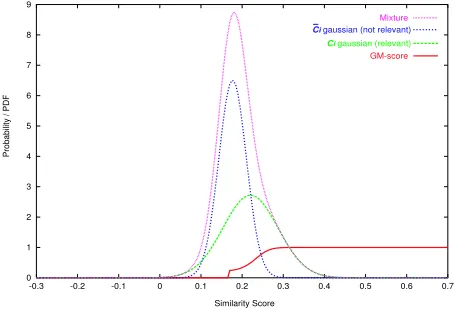
Figure 1 illustrates the mapping induced by GM from the empirical mixture distribution: dotted lines describe the Probability Density Functions (PDFs) estimated by GM forCi,Ci, and their mixture from
the empirical distribution (Si) (in step (ii)). The continuous line is the mapping induced in step (iii) of the algorithm from similarity scores between stances and IDs (x axis) to the probability of the in-stance to belong to the category (y axis).
0 1 2 3 4 5 6 7 8 9
-0.3 -0.2 -0.1 0 0.1 0.2 0.3 0.4 0.5 0.6 0.7
GM-score Ci gaussian (relevant) Ci gaussian (not relevant)
Mixture
Similarity Score
[image:4.612.313.540.340.495.2]Probability / PDF
Figure 1: Mapping induced by GM for the category
rec.motorcycles in the 20newsgroups data set.
The probabilistic mapping estimated in step (iii) for a categoryCi given an instancetj is computed
by applying Bayes rule:
P(Ci|tj) = P(Ci|sim(idci, tj)) = (2) = P(sim(idci,tj)|Ci)P(Ci)
P(sim(idci,tj)|Ci)P(Ci)+P(sim(Ci,tj)|Ci)P(Ci)
where P(sim(idci, tj)|Ci) is the value of
the P DF of Ci at the point sim(idci, tj),
P(sim(idci, tj)|Ci)is the value of theP DFofCiat
CiandP(Ci)is the area of the distributionCi. The
mean and variance parameters of the two distribu-tionsCi andCi, used to evaluate equation 2, are esti-mated by the rather simple application of the Expec-tation Maximization (EM) algorithm for Gaussian Mixtures, as summarized in (Gliozzo et al., 2004).
Finally, following the single-labeled categoriza-tion setting of Step 1 in the IL scheme, the most likely category is assigned to each instance, that is, argmaxCiP(Ci|tj).
3.3 Summary of the Bootstrapping Algorithm
step 1.a: Latent Semantic Space. Instances and
Intensional Descriptions of categories (the seeds) are represented by vectors in Latent Semantic space. As an option, the algorithm can work with the classi-cal Vector Space Model using the original feature space. Similarity scores between IDs and instances are computed by the Cosine measure.
step 1.b: GM. The mapping functions P(Ci|tj)
for each category, conditioned on instances tj, are
induced by the GM algorithm. To that end, an Ex-pectation Maximization algorithm estimates the pa-rameters of the two component distributions of the observed mixture, which correspond to the distribu-tions of similarity values for positive and negative examples. As an option, the GM mapping can be avoided.
step 1.c: Categorization. Each instance
is classified to the most probable category -argmaxCiP(Ci|tj).
step 2: Bootstrapping an extensional classifier.
An EL classifier (SVM) is trained on the set of la-beled instances resulting from step 1.c.
4 Evaluation
4.1 Intensional Text Categorization Datasets
Even though some typical data sets have been used in the TC literature (Sebastiani, 2002), the datasets used for IL learning were not standard. Often there is not sufficient clarity regarding details such as the exact version of the corpus used and the training/test splitting. Furthermore, the choice of categories was often not standard: (Ko and Seo, 2004) omitted 4 categories from the 20-Newsgroup dataset, while (Liu et al., 2004) evaluated their method on 4 sepa-rate subsets of the 20-Newsgroups, each containing
only 4-5 categories. Such issues make it rather diffi-cult to compare thoroughly different techniques, yet we have conducted several comparisons in Subsec-tion 4.5 below. In the remainder of this SubsecSubsec-tion we clearly state the corpora used in our experiments and the pre-processing steps performed on them.
20newsgroups. The 20 Newsgroups data set is
a collection of newsgroup documents, partitioned (nearly) evenly across 20 different newsgroups. As suggested in the dataset Web site2, we used the “bydate” version: the corpus (18941 documents) is sorted by date and divided in advance into a training (60%) set and a chronologically follow-ing test set (40%) (so there is no randomness in train/test set selection), it does not include cross-posts (duplicates), and (more importantly) does not include non-textual newsgroup-identifying headers which often help classification (Xref, Newsgroups, Path, Followup-To, Date).
We will first report results using initial seeds for the category ID’s, which were selected using only the words in the category names, with some trivial transformations (i.e. cryptography#n
for the category sci.crypt, x-windows#n
for the category comp.windows.x). We also tried to avoid “overlapping” seeds, i.e. for the categories rec.sport.baseball
and rec.sport.hockey the seeds are only
{baseball#n} and {hockey#n}
respec-tively and not {sport#n, baseball#n} and
{sport#n, hockey#n}3.
Reuters-10. We used the top 10 categories
(Reuters-10) in the Reuters-21578 collection Apt`e split4. The complete Reuters collection includes 12,902 documents for 90 categories, with a fixed splitting between training and test data (70/30%). Both the Apt`e and Apt`e-10 splits are often used in TC tasks, as surveyed in (Sebastiani, 2002). To obtain the Reuters-10
2
The collection is available at
www.ai.mit.edu/people/jrennie/20Newsgroups.
3
One could propose as a guideline for seed selection those seeds that maximize their distances in the LSI vec-tor space model. On this perspective the LSI vectors built from {sport#n, baseball#n} and {sport#n,
hockey#n} are closer than the vectors that represent
{baseball#n}and {hockey#n}. It may be noticed that
this is a reason for the slight initial performance decrease in the learning curve in Figure 2 below.
4
available at
Apt`e split we selected the 10 most frequent cate-gories: Earn, Acquisition, Money-fx, Grain, Crude, Trade, Interest,
Ship, Wheat and Corn. The final data set
includes 9296 documents. The initial seeds are only the words appearing in the category names.
Pre-processing. In both data sets we tagged the
texts for part-of-speech and represented the docu-ments by the frequency of each pos-tagged lemma, considering only nouns, verbs, adjectives, and ad-verbs. We induced the Latent Semantic Space from the training part5 and consider the first 400
dimen-sions.
4.2 The impact of LSI similarity and GM on IL
performance
In this section we evaluate the incremental impact of LSI similarity and the GM algorithm on IL per-formance. When avoiding both techniques the algo-rithm uses the simple cosine-based method over the original feature space, which can be considered as a baseline (similar to the method of (Liu et al., 2004)). We report first results using only the names of the categories as initial seeds.
Table 1 displays the F1 measure for the 20news-groups and Reuters data sets, with and without LSI and with and without GM. The performance figures show the incremental benefit of both LSI and GM. In particular, when starting with just initial seeds and do not exploit the LSI similarity mechanism, then the performance is heavily penalized.
As mentioned above, the bootstrapping step of the algorithm (Step 2) exploits the initially classified in-stances to train a supervised text categorization clas-sifier based on Support Vector Machines. It is worth-while noting that the increment of performance after bootstrapping is generally higher when GM and LSI are incorporated, thanks to the higher quality of the initial categorization which was used for training.
4.3 Learning curves for the number of seeds
This experiment evaluates accuracy change as a function of the number of initial seeds. The
ex-5
From a machine learning point of view, we could run the LSA on the full corpus (i.e. training and test), the LSA being a completely unsupervised technique (i.e. it does not take into ac-count the data annotation). However, from an applicative point of view it is much more sensible to have the LSA built on the training part only. If we run the LSA on the full corpus, the performance figures increase in about 4 points.
Reuters 20 Newsgroups
LSI GM F1 F1
no no 0.38 0.25
+ bootstrap 0.42 0.28
no yes 0.41 0.30
+ bootstrap 0.46 0.34
yes no 0.46 0.50
+ bootstrap 0.47 0.53
yes yes 0.58 0.60
[image:6.612.318.533.52.157.2]+ bootstrap 0.74 0.65
Table 1: Impact of LSI vector space and GM
0.2 0.25 0.3 0.35 0.4 0.45 0.5 0.55 0.6 0.65
1 5 10 15 20
F1
number of seeds (1 means only the category names)
LSI VSM
Classical VSM
Figure 2: Learning curves on initial seeds for 20 newsgroups, LSI and Classical VSM (no LSI)
periment was performed for the 20 newsgroups cor-pus using both the LSI and the Classical vector space model. Additional seeds, beyond the cate-gory names, were identified by two lexicographers. For each category, the lexicographers were provided with a list of 100 seeds produced by the LSI similar-ity function applied to the category name (one list of 100 candidate terms for each category). From these lists the lexicographers selected the words that were judged as significantly related to the respective cat-egory, picking a mean of 40 seeds per category.
[image:6.612.317.540.199.370.2]indicative for the intensional meaning of the cate-gory, and therefore adding more terms introduces additional noise. Further research is needed to find out whether other methods for selecting additional seed terms might yield incremental improvements. The current results, though, emphasize the bene-fit of utilizing LSI and GM. These techniques ob-tain state-of-the-art performance (see comparisons in Section 4.5) using only the category names as seeds, allowing us to skip the quite tricky phase of collecting manually a larger number of seeds.
4.4 Extensional vs. Intensional Learning
A major point of comparison between IL and EL is the amount of supervision effort required to obtain a certain level of performance. To this end we trained a supervised classifier based on Support Vector Ma-chines, and draw its learning curves as a function of percentage of the training set size (Figure 3). In the case of 20newsgroups, to achieve the 65% F1 performance of IL the supervised settings requires about 3200 documents (about 160 texts per gory), while our IL method requires only the cate-gory name. Reuters-10 is an easier corpus, there-fore EL achieves rather rapidly a high performance. But even here using just the category name is equal on average to labeling 70 documents per-category (700 in total). These results suggest that IL may pro-vide an appealing cost-effective alternative in prac-tical settings when sub-optimal accuracy suffices, or when it is too costly or impractical to obtain suffi-cient amounts of labeled training sets.
It should also be stressed that when using the complete labeled training corpus state-of-the-art EL outperforms our best IL performance. This result deviates from the flavor of previous IL literature, which reported almost comparable performance rel-ative to EL. As mentioned earlier, the method of (Ko and Seo, 2004) (as we understand it) utilizes labeled examples for feature selection, and therefore cannot be compared with our strict IL setting. As for the results in (Liu et al., 2004), we conjecture that their comparable performance for IL and EL may not be sufficiently general, for several reasons: the easier classification task (4 subsets of 20-Newsgroups of 4-5 categories each); the use of the usually weaker Naive-Bayes as the EL device; the use of cluster-ing as an aid for selectcluster-ing the seed terms from the 20-Newsgroup subsets, which might not scale up well when applied to a large number of categories
of varying size.
0.1 0.2 0.3 0.4 0.5 0.6 0.7 0.8 0.9 1
0 0.1 0.2 0.3 0.4 0.5 0.6 0.7 0.8 0.9 1
F1
Percentage of training
20 Newsgroups Reuters
[image:7.612.316.540.81.252.2]3200 docs 700 docs
Figure 3: Extensional learning curves on as percent-age of the training set.
4.5 Comparisons with other algorithms
As mentioned earlier it is not easy to conduct a thor-ough comparison with other algorithms in the litera-ture. Most IL data sets used for training and evalua-tion are either not available (McCallum and Nigam, 1999) or are composed by somewhat arbitrary sub-sets of a standard data set. Another crucial aspect is the particular choice of the seed terms selected to compose an ID, which affects significantly the over-all performance of the algorithm.
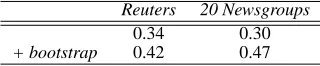
As a baseline system, we implemented a rule based approach in the spirit of (McCallum and Nigam, 1999). It is based on two steps. First, all the documents in the unlabeled training corpus con-taining at least one word in common with one and only one category ID are assigned to the respective class. Second, a supervised classifier based on SVM is trained on the labeled examples. Finally, the su-pervised classifier is used to perform the final cate-gorization step on the test corpus. Table 2 reports the F1 measure of our replication of this method, us-ing the category name as seed, which is substantially lower than the performance of the method we pre-sented in this paper.
Reuters 20 Newsgroups
0.34 0.30
+ bootstrap 0.42 0.47
[image:7.612.346.506.643.676.2]We also tried to replicate two of the non-standard data sets used in (Liu et al., 2004)6. Table 3 displays the performance of our approach in comparison to the results reported in (Liu et al., 2004). Follow-ing the evaluation metric adopted in that paper we report here accuracy instead of F1. For each data set (Liu et al., 2004) reported several results vary-ing the number of seed words (from 5 to 30), as well as varying some heuristic thresholds, so in the ta-ble we report their best results. Notably, our method obtained comparable accuracy by using just the cat-egory name as ID for each class instead of multiple seed terms. This result suggests that our method en-ables to avoid the somewhat fuzzy process of col-lecting manually a substantial number of additional seed words.
Our IDs per cat. Liu et al. IDs per cat.
REC 0.94 1 0.95 5
TALK 0.80 1 0.80 20
Table 3: Accuracy on 4 “REC” and 4 “TALK” news-groups categories
5 Conclusions
We presented a general bootstrapping algorithm for Intensional Learning. The algorithm can be applied to any categorization problem in which categories are described by initial sets of discriminative fea-tures and an unlabeled training data set is provided. Our algorithm utilizes a generalized similarity mea-sure based on Latent Semantic Spaces and a Gaus-sian Mixture algorithm as a principled method to scale similarity scores into probabilities. Both tech-niques address inherent limitations of the IL setting, and leverage unsupervised information from an un-labeled corpus.
We applied and evaluated our algorithm on some text categorization tasks and showed the contribu-tion of the two techniques. In particular, we obtain, for the first time, competitive performance using only the category names as initial seeds. This mini-mal information per category, when exploited by the IL algorithm, is shown to be equivalent to labeling about 70-160 training documents per-category for state of the art extensional learning. Future work is
6
We used sequential splitting (70/30) rather than random splitting and did not apply any feature selection. This setting might be somewhat more difficult than the original one.
needed to investigate optimal procedures for collect-ing seed features and to find out whether additional seeds might still contribute to better performance. Furthermore, it may be very interesting to explore optimal combinations of intensional and extensional supervision, provided by the user in the forms of seed features and labeled examples.
Acknowledgments
This work was developed under the collaboration ITC-irst/University of Haifa.
References
M. Berry. 1992. Large-scale sparse singular value com-putations. International Journal of Supercomputer Applications, 6(1):13–49.
M. Collins and Y. Singer. 1999. Unsupervised models for named entity classification. In Proc. of EMNLP99, College Park, MD, USA.
S. Deerwester, S. Dumais, G. Furnas, T. Landauer, and R. Harshman. 1990. Indexing by latent semantic anal-ysis. Journal of the American Society of Information Science.
A. Gliozzo, C. Strapparava, and I. Dagan. 2004. Unsu-pervised and suUnsu-pervised exploitation of semantic do-mains in lexical disambiguation. Computer Speech and Language, 18:275–299.
Y. Ko and J. Seo. 2000. Automatic text categorization by unsupervised learning. In Proc. of COLING’2000.
Y. Ko and J. Seo. 2004. Learning with unlabeled data for text categorization using bootstrapping abd fea-ture projection techniques. In Proc. of the ACL-04, Barcelona, Spain, July.
B. Liu, X. Li, W. S. Lee, and P. S. Yu. 2004. Text clas-sification by labeling words. In Proc. of AAAI-04, San Jose, July.
A. McCallum and K. Nigam. 1999. Text classification by bootstrapping with keywords, em and shrinkage. In ACL99 - Workshop for Unsupervised Learning in Nat-ural Language Processing.
F. Sebastiani. 2002. Machine learning in automated text categorization. ACM Computing Surveys, 34(1):1–47.
B. W. Silverman. 1986. Density Estimation for Statistics and Data Analysis. Chapman and Hall.