Proceedings of the 2019 Conference on Empirical Methods in Natural Language Processing 738
Neural Cross-Lingual Event Detection with Minimal Parallel Resources
Jian Liu12∗, Yubo Chen1∗, Kang Liu12, Jun Zhao12
1National Laboratory of Pattern Recognition, Institute of Automation
Chinese Academy of Sciences, Beijing, 100190, China
2University of Chinese Academy of Sciences
{jian.liu, yubo.chen, kliu, jzhao}@nlpr.ia.ac.cn
Abstract
The scarcity in annotated data poses a great challenge for event detection (ED). Cross-lingual ED aims to tackle this challenge by transferring knowledge between different lan-guages to boost performance. However, pre-vious cross-lingual methods for ED demon-strated a heavy dependency on parallel re-sources, which might limit their applicability. In this paper, we propose a new method for cross-lingual ED, demonstrating a minimal de-pendency on parallel resources. Specifically, to construct a lexical mapping between differ-ent languages, we devise a context-dependdiffer-ent translation method; to treat the word order dif-ference problem, we propose a shared syntac-tic order event detector for multilingual co-training. The efficiency of our method is studied through extensive experiments on two standard datasets. Empirical results indicate that our method is effective in 1) perform-ing cross-lperform-ingual transfer concernperform-ing differ-ent directions and 2) tackling the extremely annotation-poor scenario.
1 Introduction
Event detection (ED) is a crucial natural language processing problem that aims to identify event triggers in texts (Ahn, 2006;Nguyen and Grish-man,2015). For example, in the sentence: “A man diedwhen a tankfiredon the hotel”, ED requires a system to identify two event triggers, died and fired, along with their typesDieandAttack.
Generally, training an ED system requires to obtain a considerably large amount of labeled data. However, owing to the complexity and high costs of annotation, existing event resources are scarce and unbalanced across languages (Hsi et al.,2016), which prevents us from building an ED system in languages with insufficient train-ing data. Cross-ltrain-ingual ED (Ji, 2009; Chen and
∗
Equal contribution.
Ji, 2009; Zhu et al., 2014; Hsi et al., 2016; Liu et al., 2018a) aims to tackle this challenge by transferring knowledge cross languages to boost performance. However, previous cross-lingual ED methods rely on either high-performance machine translation (MT) systems trained on large num-bers of parallel sentences or manually aligned doc-uments to achieve a decent performance — the required parallel resources may only exist for a small fraction of language pairs (Koehn et al.,
2007), which greatly limits the applicability of these methods.
In this paper, we propose a new simple but ef-fective method for cross-lingual ED, which can overcome the data scarcity problem in annotation-poor languages by jointly training with resources in other languages. Compared with previous methods, our approach demonstrates a minimal dependency on parallel resources, which may fit with language pairs that do not have large bitexts. To achieve cross-lingual transfer, two chal-lenges exist: 1) how to build lexical mappings between different languages, and 2) how to han-dle the word order difference problem (Xie et al.,
2018). For the first challenge, previous studies (Guo et al., 2015;Ni et al.,2017;Mayhew et al.,
event), and “the house caughtfire” (which evokes anNAevent) should be translated as different Chi-nese words “开火(open fire)” and “着火(be on fire)” respectively. But in previous lexical map-ping methods, the “fired” is always having the same transferred representation irrespective of its contexts. This problem might introduce noise for cross-lingual ED.
To address the above issues, in this paper, we devise a content-dependent lexical mapping method for cross-lingual ED. Similar to (Xie et al.,
2018), for each source word, we first project it into a shared embedding space, but instead of adopt-ing a deterministic word-to-word translation, we retrieve different translation candidates by look-ing for its nearest neighbors, and we then adopt a context-aware selective attention mechanism to rank these candidates to find the best-suited trans-lation. Compared with previous methods, our ap-proach can obtain content-dependent translations for each word in the source training data, which may be more suitable for cross-lingual ED.
Considering the word order difference, to our best knowledge, (Xie et al., 2018) is the only work which adopted a self-attention mechanism (Vaswani et al., 2017) to tackle this problem (in cross-lingual NER). Difference with them, we propose a shared syntactic order event detector for cross-lingual ED, which explores the syntactic similarity of resources in different languages and circumvents the word order difference problem in performing multilingual co-training.
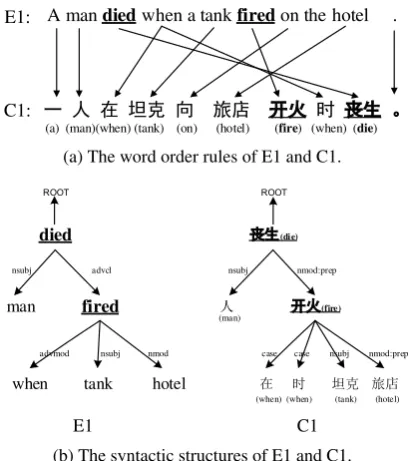
To illustrate our motivation, consider an En-glish example E1 and its parallel Chinese trans-lation C1 in Figure 1. As shown, E1 and C1 have rather different word orders (Figure1a), but they share a similar syntactic structure which cap-tures enough generality for identifying event trig-gers (Figure1b). This observation motivates us to explore the syntactic similarity to achieve multi-lingual co-training. To achieve this goal, we pro-pose a shared syntactic order event detector based on Graph Convolutional Networks (GCNs) (Kipf and Welling,2016), which can provide each word a contextual feature based on its immediate neigh-bors in the syntactic graph irrespective of its orig-inal position in the sentence. This decoder allows us to train a model on multilingual resources effec-tively, which circumvents the word order different problem.
To estimate our method, we have conducted
A man died when a tank fired on the hotel .
一 人 在 坦克 向 旅店 开火 时 丧生 。
E1:
(a) (man)(when) (tank) (on) (hotel) (fire) (when) (die)
C1:
(a) The word order rules of E1 and C1.
died
fired
man
when tank hotel
ROOT
nsubj
nsubj advcl
advmod nmod case
丧生(die)
开火(fire)
人
在 坦克 旅店
ROOT
nsubj
nsubj nmod:prep
case nmod:prep
时
(when) (when) (tank) (hotel) (man)
E1 C1
[image:2.595.315.520.61.292.2](b) The syntactic structures of E1 and C1.
Figure 1: The comparison of word orders and syntactic structures of an annotated English sentence E1 and its parallel Chinese sentence C1.
extensive experiments on two standard datasets, using English, Chinese, and Spanish as experi-mental languages respectively. The experimen-tal results demonstrate that: 1) our model can perform cross-lingual transfer between different language pairs. Especially, the improvement in Chinese ED is large, with an absolute 3.8% in F1 over the monolingual approaches. 2) Our model is robust in the extreme annotation-poor scenario where a language has very limited train-ing data, which demonstrates a definite advan-tage over previous monolingual models. Addi-tionally, compared with MT-based methods, our model achieves competitive results but requires much less parallel resource.
This paper is organized as follows: Section 2
briefly introduces the task description and termi-nologies used in ED; Section 3elaborates details of our approach; Section4 reports on our exper-imental results and other analysis; Section 5 re-views related work; Section6concludes the paper and illustrates future work.
2 Task Description
In ACE, 1) an event mention refers to a phrase/sentence within which an event is de-scribed. 2)Event triggerrefers to a specific word in an event mention which is considered the most representative of the event. Each event trigger has a certain type corresponding to the event mention. 3)Event argumentsare participants of the event.
With these definitions, the goal of ED is to locate event triggers and categorize their types. For example, in sentence “The old man died in the hospital”, ED requires a system to detect a Die event along with the event trigger died. The detection of event arguments The old man (role=Person) andhospital(role=Place) is not involved in the ED task.
Following previous work (Nguyen and Grish-man, 2015; Liu et al., 2016), we formulate ED as a token-level multi-class classification task. Namely, given a sentence, we treat every token in it as a trigger candidate, and we aim to classify each candidate into one of 34 categories (33event types defined in ACE in addition to anNAtype in-dicating “not an event trigger”).
3 Methodology
This study focuses on cross-lingual ED, which aims to transfer knowledge from a source guage with abundant labeled data to a target lan-guage with insufficient training data.
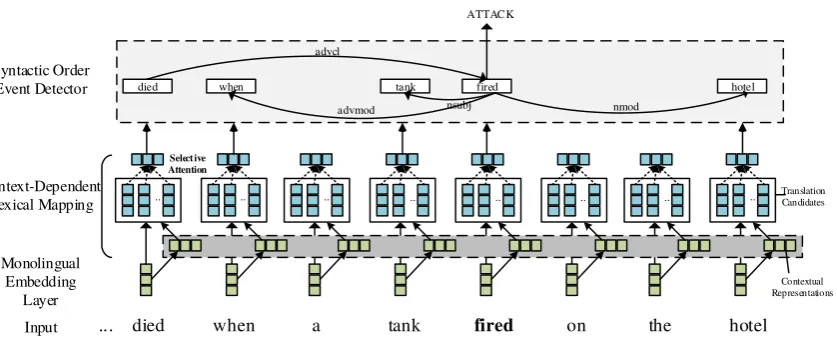
Figure 2 visualizes the overall architecture of our model, which consists of three main compo-nents: (1) Monolingual embedding layer, which transforms each token into a continuous vec-tor representation. (2) Context-dependent lexical mapping, which maps each word in the source guage to its best-suited translation in the target lan-guage, by examining its contextual representation and imposing a selective attention over different translation candidates. (3) Shared syntactic order event detector, which employs a Graph Convolu-tional Networks (GCNs) to explore syntactic sim-ilarity of resources of different languages, in order to achieve multilingual co-training.
For the sake of convenience, in the following il-lustrations, we assume the source language is En-glish and the target language is Chinese, and we use an English sentences={w1,w2,. . .,wn}to illustrate our idea.
3.1 Monolingual Embedding Layer
In the monolingual embedding layer, each word is assigned to a distributed vector as its represen-tation. Specifically, we first train English/Chinese word embeddings on the corresponding Wikipedia dumps via Skip-gram model (Mikolov et al.,2013) with a dimensional size d= 300. And then we transform each token into its word embedding as its vectorized feature representation.
In this way,sis transformed into an embedding matrixEs = [x1,x2, . . . , xn]T, where xi ∈ Rd indicates the word embedding of the tokenwi.
3.2 Context-Dependent Lexical Mapping
For each tokenwiins, context-dependent lexical mapping aims to search for its best-suited word translation according to its contextual representa-tion. This process involves: 1) learning multi-lingual alignment, 2) retrieving translation candi-dates, and 3) ranking translation words via a selec-tive attention mechanism.
3.2.1 Learning Multilingual Alignment
Let X and Y be the English and Chinese em-bedding spaces. In order to achieve multilingual alignment, we learn a mappingW ∈ Rd×d from X toY via a seed dictionary with a size ofm, by optimizing:
W∗ = arg min
W∈Md(R)
||W Xdic−Ydic||F (1)
whereMd(R)is the space ofd×dmatrices;Xdic, Ydic ∈ Rd×m are two matrices containing the aligned embeddings of words in the seed dictio-nary;|| · ||F indicates the Frobenius norm. To get a closed form solution, following (Xing et al.,2015;
Lample et al., 2018), we impose an orthogonal-ity constraint onW(i.e.,W WT=WTW=I), and in this way, the optimized solution of W corre-sponds to the singular value decomposition (SVD) ofYdicXdicT , i.e.,
W∗= arg min
W∈Od(R)
||W Xdic−Ydic||F =U VT (2)
whereUΣVT =SVD(YdicXdicT ).
3.2.2 Retrieving Translation Candidates
advcl
advmod
ATTACK
... died when a tank fired on the hotel
fired
when tank hotel
died
nsubj nmod
Contextual Representations
Input
..
Syntactic Order Event Detector
Context-Dependent Lexical Mapping
Monolingual Embedding
Layer
.. .. .. .. .. .. .. TranslationCandidates
[image:4.595.94.513.60.229.2]Selective Attention
Figure 2: The overview architecture of our model. The figure illustrates the process of performing cross-lingual transfer for an English sentence “A man died when a tank fired on the hotel” into Chinese and using the shared syntactic order event detector to predict the event type for the word “fired”.
ofwi and a Chinese wordy in the aligned space, we adopt the cross-domain similarity local scaling (CSLS) metric (Lample et al.,2018):
CSLS(W xi,y) =2cos(W xi,y)
−rY(W xi)−rX(y)
(3)
where y denotes the (Chinese) word em-bedding of y; rY(W xi) indicates the mean cosine similarity between W xi and its K neighbors in Y, which is defined as: rY(W xi) = K1 Py0∈N
Y(W xi)cos(W xi,y
0)
where NY(W xi) denotes the neighborhood associate withW xi inY. In our method, forwi, we takeJ Chinese words which have the smallest CSLSs as its translation candidates. We denote by T(wi) the set of translation candidates for wi, whereT(wi)
j indicates thejth element ofT(wi).
3.2.3 Content-Aware Selective Attention
Finally, for each tokenwi, we perform a context-aware selective attention mechanism to weigh each translation candidate in T(wi) and get the best-suited translation for it.
Learning Contextual Representation. We
employ the self-attention mechanism (Vaswani et al., 2017) to learn context representation of wi. Specifically, given Es = [x1, x2, . . . , xn]T, we use different single-layer neural networks to learn queriesQ, keys K, valuesV respectively. For example, Q = tanh(EsWm +bm), where Wm ∈ Rd×d andb ∈ Rd are parameter matrix and bias respectively. Then, we compute a
self-attention matrix by computing:
Cs= softmax(
QKT
√
d )V (4)
= [c1,c2, . . . ,cn]T (5)
wheredindicates the word embedding dimension. We takecias the contextual representation ofwi.
Learning Selective Attention. For each token wi, after obtaining its translation candidates list T(wi)and contextual representationci, we impose a selective attention mechanism to automatically weigh each candidate. Specifically, the weight of thejth candidateT(wi)
j is computed as:
αj =
exp(mj)
PJ
i=1exp(mi)
(6)
wheremj measures the semantic relatedness ofci andT(wi)
j , which is computed by:
mj = tanh([ci;yj(wi)]Wr+br) (7)
where [;] indicates the concatenation operations; y(wi)
j denotes the Chinese word embedding of T(wi)
j ; Wr ∈ Rd
×1 and b
r ∈ R are parameter matrix and bias respectively. Finally, we select the candidate which has the maximal attention weight as the best-suited translation forwi, which is de-noted byw0i. In this way, the original sentence s is transfer into a Chinese word sequencest={w10, w02,. . .,w0n}with a same length.
3.3 Shared Syntactic Order Event Detector
as a corrupted sentences from Chinese, which could introduce noise for multilingual co-training. We tackle this problem by proposing a Graph Convolutional Neural Networks (GCNs) (Kipf and Welling,2016) based syntactic order event detec-tor, which provides each word with a feature vec-tor based on its immediate neighbors in the syn-tactic graph irrespective of its position in the sen-tence. This allows our model to train with the translated datatand the other labeled data in Chi-nese indiscriminately.
3.3.1 Extracting Graph Convolution Feature
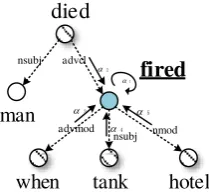
Specifically, for each token wi, our model com-putes a graph convolution feature vector based on its immediate neighbors in the syntactic graph. Figure 3 illustrates the process of extracting the feature for “fired”.
LetN(wi)denote the set of neighbors ofwi in the syntactic graph, andL(wi, v)indicate the la-bel of the dependency arc (wi→v) (For example, L(“fired”, “hotel”) = nmod in the example in Fig-ure3). The original GCNs compute a graph con-volution vector forwiat (k+1)th layer by:
hkw+1i =g( X v∈N(wi)
(WLk(w
i,v)h
k
v) +bkL(wi,v))
(8)
where g denotes the ReLU function; WLk(w
i,v)
and bkL(w
i,v) are parameters of the dependency label L(wi, v) in the kth layer. However, re-taining parameters for every dependency label is space-consuming and compute-intense (there are approximately 50 labels), in our model, we limit L(wi, v) to have only three types of labels 1) an original edge, 2) a self loop edge, and 3) an added inverse edge, as suggested in (Nguyen and Grish-man,2018). Additionally, since the generated syn-tactic parsing structures usually contain noise, we apply attention gates on the edges to weigh their individual importances:
αk(w
i,v)=σ(h
k
uULk(wi,v)+d k
L(wi,v)) (9)
whereσis the logistic sigmoid function. ULk(w
i,v)
anddk(w
i,v) are the weight matrix and the bias of the gate. With this gating mechanism, the final syntactic GCNs computation in our model is:
hku+1=g( X
v∈N(u)
αku,v(WLk(u,v)hkv) +bkL(u,v))
(10)
nmod
when tank hotel
fired
man advmod
nsubj died
advcl nsubj
1 2
3
4
[image:5.595.363.468.63.161.2]5
Figure 3: The illustration of using GCNs to compute the order-invariant feature for the word “fired”.
We set the initial vectorsh0wi forwias the Chi-nese word embedding ofw0i (its translated word), and we stack2layers of GCNs (i.e.,k= 2) to ob-tain the final feature forwi, denoted asfi.
3.4 Event Type Classification
Our model incorporates a logistic regression clas-sifier to predictwi’s event type. Specifically, we compute a prediction vector forwiby takingfias the input:
out= softmax(Wofi+bo) (11)
whereWo ∈ Rd×candbo ∈ Rcare parameters, andc is the total number of event types (i.e., 34 in this study). The probability oft-th class type is denoted asP(t|wi), which corresponds to thet-th element ofout.
3.5 Multilingual Co-Training
To enable multilingual co-training, we adopt the cross-entropy loss, and we use λ to balance the contribution of multilingual resources (which is set as0.7through a grid search):
J(Θ) =−λX
w0
e
logP(lw0
e|w
0
e)−
X
wc
logP(lwc|wc)
(12)
whereΘdenotes all the parameters in our model; w0e ranges over each token in the translated ex-amples andwcenumerate each token in the orig-inal Chinese training set; lw0
e andlwc denote the ground-truth event types of we0 and wc respec-tively. We adopt Adam rules (Kingma and Ba,
2014) to update our model’s parameters and add dropout layers to prevent over-fitting.
4 Experiments
4.1 Datasets and Evaluation
datasets which contain annotated documents in English and Chinese (The documents are not par-allel). For ACE English ED, we split the dataset to training/development/test set as suggested in (Li et al., 2013; Nguyen and Grishman, 2015). For ACE Chinese ED, we perform a 10-fold cross-validation as suggested in (Chen and Ji,2009;Lin et al.,2018). For TAC KBP 2017 English and Chi-nese, we use the official test sets for testing, and we split the remaining data with a ratio of9:1for training and developing. The bilingual dictionary is obtained from the MUSE project1with a size of 5k. The number of candidate translations J (in Section 3.2.2) is set as 3. We use the Stanford CoreNLP (Manning et al.,2014) to obtain syntac-tic trees for each language.
Precision (Pre.), Recall (Rec.), and F1-score (F1) are used as evaluation metrics, same as previ-ous ED studies to ensure compatibility. Significant tests (with p=0.05) were conducted using method described in (Yeh,2000).
4.2 Experimental Results
We conduct two groups of experiments to inves-tigate the ability of our model in 1) perform-ing cross-lperform-ingual transfer concernperform-ing different lan-guage directions, and 2) handling the annotation-poor scenario.
4.2.1 Cross-Lingual Transfer Concerning
Different Language Directions
We investigate both English-to-Chinese and Chinese-to-English transfers to investigate whether cross-lingual transfer is feasible con-cerning different language directions. In these experiments, we jointly train on the translated data with all the labeled data in target language.
We compare our cross-lingual approach (CL Trans) with our monolingual approach (Monolingual, which only uses the training data of the target language) and the existing state-of-the-art monolingual ED models ( Mono-lingual SOTA). In ACE ED, we take models proposed in (Nguyen and Grishman, 2015) and (Lin et al.,2018) as the SOTA English and Chi-nese ED systems respectively. In TAC KBP ED, we take the top systems reported in the official evaluation (Mitamura et al., 2017) as Monolin-gual SOTA. We also include a vanilla embedding 1https://github.com/facebookresearch/
MUSE
English-to-Chinese Chinese-to-English (a) ACE 2005
60.0 65.0 70.0 75.0
F-score (%) 63.3
70.4
63.2
69.9 67.5
72.3
64.7
71.2 Monolingual
Monolingual_SOTA CL_Trans(Ours)Embedding_Proj
English-to-Chinese Chinese-to-English (b) TAC KBP 2017
50.0 55.0 60.0
F-score (%) 51.7
54.6 50.6
55.7 55.1 56.9
[image:6.595.316.514.63.235.2]53.6 55.9
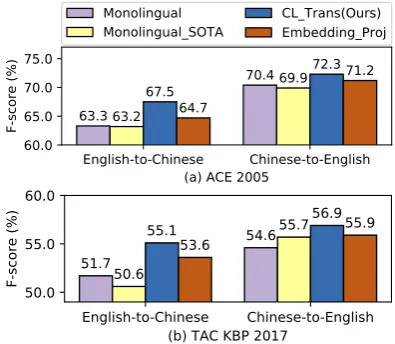
Figure 4: Experimental results on investigating cross-lingual transfer concerning different language direc-tions.
projection based method for comparison (denoted asEmbedding proj).
Figure4 summarizes the results. From the re-sults, 1) our cross-lingual approachCL Trans out-performs two monolingual systems (+2.95% on F1 on the average) and the vanilla embedding projection based method (+1.60%on F1), in the four evaluations. This justifies the effectiveness of our approach concerning cross-lingual in dif-ferent language directions. 2) Additionally, our cross-lingual approach is more effective for Chi-nese (+3.80%on F1) than for English (+2.10%on F1). This is understandable as the number of En-glish examples is much larger than that of Chinese examples (5,285 v.s. 2,710 in ACE 2005, and 24,979v.s. 10,630in TAC KBP 2017). 3) We obtain interesting findings by investigating each event type. For example, in TAC KBP 2017, the type of “contact/correspondence” has only167 samples in Chinese but 996 samples in English. By adopting cross-lingual training, our approach leads to an improvement of 15.3% (from 10.3% to25.6%) in Chinese ED for this type, compared with the monolingual approach. This proves that our method can handle the annotation sparseness problem in the target language.
4.2.2 Exploring the Annotation-Scarce
Scenario
Chinese.
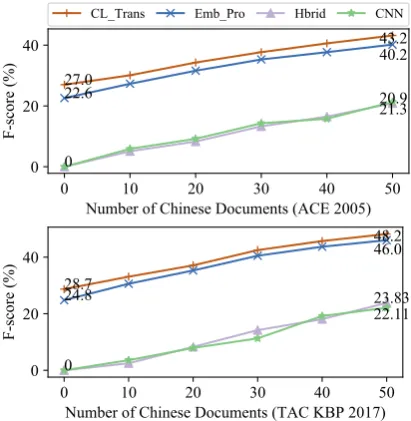
In Comparison to Monolingual ED Models. We first compare our cross-lingual approach with the existing monolingual ED models, including CNN (Nguyen and Grishman, 2015) which em-ploys Convolutional Neural Networks for the task and Hbrid (Feng et al., 2016) which combines CNN with Recurrent Neural Networks (RNN) for ED. Figure 5 presents the experimental results, where the number of the available Chinese doc-uments ranges from0to50.
0 10 20 30 40 50 Number of Chinese Documents (ACE 2005) 0
20 40
F-score (%)
0 27.0 22.6
43.2 40.2
20.9 21.3
CL_Trans Emb_Pro Hbrid CNN
0 10 20 30 40 50 Number of Chinese Documents (TAC KBP 2017) 0
20 40
F-score (%)
0 28.7 24.8
48.2 46.0
23.83 22.11
Figure 5: The comparison to monolingual ED models for Chinese ED in the annotation-poor scenario.
From the results, our approach demonstrates a definite advantage over monolingual ED mod-els in the annotation-poor scenario. Particularly, when there is no Chinese training document avail-able (i.e., in the unsupervised cross-lingual trans-fer scenario), our model achieves a performance of27.0%on F1 in ACE, and28.7%on F1 in TAC KBP, while supervised ED methods completely fail. Additionally, our approach can consistently outperform the embedding-projection method.
In Comparison to Cross-Lingual Models.We
next compare our model to the existing cross-lingual ED methods, including 1) LexMap (Hsi et al., 2016), which combines embedding pro-jection method with multilingual feature extrac-tion to perform cross-lingual ED, and 2) MTED (Zhu et al., 2014), which uses a MT system to translate the training examples in source language to obtain additional data for training. In our re-implementation, we employ OpenNMT (Klein et al.) as the translation model and we use
Open-Method Pre. Rec. F1
LexMap (2016) (5k dict.) 63.5 28.8 39.6 MTBased (50k sent.) 11.3 16.8 13.5 MTBased (200k sent.) 42.4 26.1 32.3 MTBased (400k sent.) 54.7 36.2 43.7
[image:7.595.311.521.63.139.2]CL Trans (5k dict.) 62.5 35.7 45.4
Table 1: The comparison to cross-lingual ED models for Chinese ED in ACE 2005. (50k sent.) means using
50k parallel sentences to train the MT system.
Subtitles (Lison and Tiedemann,2016) to train it. To ensure comparability of results, we use the set-ting of (Hsi et al.,2016) (i.e., using one-fold data (64 annotated documents) for training) to conduct the experiments.
Table 1 gives the results. From the results, 1) our method outperforms LexMap by a rather large margin (+5.8% on F1). The poor performance of LexMap might be attributed to its feature en-gineering process, which is often very difficult and requires expert knowledge. 2) Our model be-haves competitively to machine translation based method (which are trained on 400k parallel sen-tences) yet relies on much less parallel resources (a dictionary with a size of5k).
4.2.3 Ablation Study
We conduct ablation study to explore the effects of our different model components. We limit our study in the extremely annotation-poor scenario, that is, we assume there is no training data in the target language (Chinese).
Exploring Lexical Mapping Method. To
ex-plore our lexical mapping method, we compare the performance of several variant systems retrieving a different number of candidates (ranging from 1 to 5) and the embedding-projection method (Em-bedding proj). Note the system retrieving only one candidate actually takes the nearest Chinese neighbor as the word translation. The lexical map-ping in it is still context-independent. Table2 sum-marizes the results.
[image:7.595.76.282.223.434.2]ex-Method Pre. Rec. F1
Embbeding Proj 26.0 20.0 22.6
CL Trans (1 cand.) 31.2 21.4 25.4 CL Trans (2 cand.) 31.7 22.3 26.2 CL Trans (3 cand.) 32.0 23.4 27.0
[image:8.595.76.286.63.150.2]CL Trans (4 cand.) 30.7 23.6 26.7 CL Trans (5 cand.) 30.2 23.6 26.5
Table 2: Experimental results in exploring different lexical mapping methods.
Model Pre. Rec. F1
CL Trans MLP 20.3 16.3 18.1
CL Trans CNN 32.5 16.3 21.7
CL Trans Hbrid 30.4 17.6 22.3
CL Trans Self. 34.9 18.3 24.0
CL Trans GCN (ours) 32.0 23.4 27.0
CL Trans GCN Self 32.1 23.0 26.8
Table 3: Experimental results in exploring the shared syntactic order event detector.
tent. 2) Retrieving more translation candidates could consistently improve Recall. But when too many candidates (e.g.,5) are added, the Precision drops, which harms the overall F1 measure.
Exploring the Syntactic Order Event Detec-tor. We compare our syntactic order event tector (CL Trans GCN) with several event de-tectors, including 1) CL Trans MLP, which em-ploys a feed-forward network as event detector; 2) CL Trans CNN, which uses CNNs as the event detector; 3) CL Trans Hbrid, which use a hybrid network (Feng et al., 2016) for event detection. We also compared our model with several vari-ants including 4) CL Trans Self., which replaces the GCNs with a self-attention network, and 5) CL Trans GCN Self, which combines GCNs with a self-attention network. We train these models on the same translated English data. Table 3 shows the results.
From the results, 1) CL Trans MLP,
CL Trans CNN, and CL Trans Hbrid behave poorly, as expected. The reason might be that these models usually employ order-sensitive structures (e.g., CNNs) for ED, which would suffer the word order inconsistency problem when trained on the translated data. 2) CL Trans Self. yields relatively good performance. The reason might be that self-attention network could provide each word with a feature vector based on all the words of a sentence, which is also irrespective of the words’ positions in a sentence. This
English Chinese Translation Candidates
36,000 5.76, 98.8%, 2.53
people 人人人(people),人们(folk),青年人(youngs) died 死死死(die),死亡(death),死去(dying) every 每每每个个个(every),所有(all),都(all)
year 年年年(year),年代(years),年龄(age) from 以外(beyond),从从从(from),外(except)
[image:8.595.312.523.65.168.2]the 这(this),整个(total),完全(completely) flu 感染(inflection),流流流感感感(flu),疾病(disease)
Table 4: Translation candidates of each English word. Bold indicates the best-suited translation.
36,000 people died every year from the
flu 0.27
0.30 0.33 0.36 0.39 0.42
Figure 6: The learned attention weights. Darker color indicates higher weight.
could address the word order difference to some extent. 3) Our syntactic order event detector yields the best performance. While, we do not observe salient advantages by combining GCNs with a self-attention network (by comparing CL Trans GCN with CL Trans GCN Self).
4.3 Beyond English-Chinese Pair
We conduct additional experiments on Spanish to investigate cross-lingual transfer beyond English-Chinese transfer. The Spanish corpus is in TAC-KBP solely, with much smaller size and fewer publish evaluations. Experimental results demon-strate that, our model, without any modification, surpasses the best-reported Spanish system (42.8 (Mitamura et al.,2017) with F1 scores of 44.0 and 43.8 concerning EN→SP and CH→SP transfer. The value changes to 20.8 and 18.9 in zero trans-fer scenarios. This demonstrates that our approach is language-independent.
4.4 Case Study
We give a case study on the cross-lingual transfer process of a real example in ACE: “36,000 people diedevery year from the flu”. Table4and Figure
6gives the Chinese translation candidates and the learned attention weights respectively.
[image:8.595.314.511.216.272.2]neighbor of “from” and ”flu”, but our content-dependent lexical mapping method enable us to successfully obtain them as the translations.
The case study also poses several future direc-tions for this work. For example, one is how to address the one-to-many mapping between differ-ent languages. In the above example, the correct Chinese translation of “every year” should be one single word “每年”, not the combination of two words “每个(every)” and “年(year)”. This calls for more advanced lexical mapping methods.
5 Related Work
Event detection (ED) is a hot topic in natural lan-guage processing, which has attracted extensive attention in the past few years. Traditionally, the study of ED has focused on monolingual train-ing. The proposed models can be divided into feature-based methods which employ fine-grained features (Ahn,2006;Ji and Grishman,2008;Liao and Grishman, 2010;Hong et al.,2011;Li et al.,
2013;Li and Ji, 2014), and deep learning-based methods which employ neural networks to auto-matically learn features for the task (Chen et al.,
2015;Nguyen and Grishman,2015;Nguyen et al.,
2016;Liu et al.,2018b;Orr et al.,2018;Liu et al.,
2019). Usually, their performance is limited by the amount of labeled data in a specific language.
Cross-lingual ED attempts transfer knowledge between different languages to boost performance. To name a few, (Chen and Ji, 2009) used an En-glish detector to label events on parallel docu-ments to obtain additional data for boosting Chi-nese ED; (Zhu et al., 2014; Liu et al., 2018a) used machine translation to obtain additional la-beled data for training; (Hsi et al.,2016) combined the embedding-projection method with multilin-gual feature extraction for bilinmultilin-gual ED. Neverthe-less, the heavily dependency on parallel resources often limits the applicability of these methods.
Our study also relates to cross-lingual stud-ies in other applications (Guo et al., 2015; Ni et al., 2017; Mayhew et al., 2017; Xie et al.,
2018; Lample et al., 2018). These approaches adopted embedding projection based method to achieve cross-lingual transfer and achieved pros-ing results. However, since the lexical mapppros-ing in these methods is usually deterministic and ir-respective of contexts, they might not directly fit with cross-lingual ED, where the cross-lingual transfer should be context-dependent.
6 Conclusions and Future Work
In this paper, we propose a new cross-lingual ap-proach for event detection, which demonstrates a minimal dependency on parallel resources. Specifically, we propose a context-dependent lex-ical mapping method to obtain content-dependent translation, and we devise a shared syntactic order event detector to explore the syntactic similarity for multilingual co-training. Experiments demon-strate the effectiveness of our method.
Currently, as our approach is predicated on the availability of syntax trees of training examples, it might not fit with languages which lack syn-tactic parsers. In the future, we plan to investi-gate more language-independent patterns in cross-lingual transfer to circumvent this dependency.
Acknowledgments
This work is supported by the National Key R&D Program of China under Grant 2018YFB1005100,the National Natural Sci-ence Foundation of China (No.61533018), the National Natural Science Foundation of China (No.61806201) and the independent research project of National Laboratory of Pattern Recog-nition. This work is also supported by a grant from Ant Financial Services Group and the CCF-Tencent Open Research Fund. We would like to thank the anonymous reviewers for their valuable feedback.
References
David Ahn. 2006. The stages of event extraction. In
Proceedings of the Workshop on Annotating and Reasoning About Time and Events, ARTE ’06, pages 1–8, Stroudsburg, PA, USA. Association for Com-putational Linguistics.
Yubo Chen, Liheng Xu, Kang Liu, Daojian Zeng, and Jun Zhao. 2015. Event extraction via
dy-namic multi-pooling convolutional neural networks.
In Proceedings of the 53rd Annual Meeting of the Association for Computational Linguistics and the 7th International Joint Conference on Natural Lan-guage Processing (Volume 1: Long Papers), pages 167–176. Association for Computational Linguis-tics.
Xiaocheng Feng, Lifu Huang, Duyu Tang, Heng Ji, Bing Qin, and Ting Liu. 2016. A
language-independent neural network for event detection. In
Proceedings of the 54th Annual Meeting of the As-sociation for Computational Linguistics (Volume 2: Short Papers), pages 66–71, Berlin, Germany. Asso-ciation for Computational Linguistics.
Jiang Guo, Wanxiang Che, David Yarowsky, Haifeng Wang, and Ting Liu. 2015. Cross-lingual
depen-dency parsing based on distributed representations.
In Proceedings of the 53rd Annual Meeting of the Association for Computational Linguistics and the 7th International Joint Conference on Natural Lan-guage Processing (Volume 1: Long Papers), pages 1234–1244. Association for Computational Linguis-tics.
Yu Hong, Jianfeng Zhang, Bin Ma, Jianmin Yao, Guodong Zhou, and Qiaoming Zhu. 2011. Us-ing cross-entity inference to improve event extrac-tion. In Proceedings of the 49th Annual Meeting of the Association for Computational Linguistics: Human Language Technologies, pages 1127–1136, Portland, Oregon, USA. Association for Computa-tional Linguistics.
Andrew Hsi, Yiming Yang, Jaime Carbonell, and Ruochen Xu. 2016. Leveraging multilingual
train-ing for limited resource event extraction. In
Pro-ceedings of COLING 2016, the 26th International Conference on Computational Linguistics: Techni-cal Papers, pages 1201–1210. The COLING 2016 Organizing Committee.
Heng Ji. 2009. Cross-lingual predicate cluster acqui-sition to improve bilingual event extraction by
in-ductive learning. InProceedings of the Workshop
on Unsupervised and Minimally Supervised Learn-ing of Lexical Semantics, UMSLLS ’09, pages 27– 35, Stroudsburg, PA, USA. Association for Compu-tational Linguistics.
Heng Ji and Ralph Grishman. 2008.Refining event
ex-traction through cross-document inference. In
Pro-ceedings of ACL-08: HLT, pages 254–262, Colum-bus, Ohio. Association for Computational Linguis-tics.
Diederik P. Kingma and Jimmy Ba. 2014. Adam: A method for stochastic optimization. CoRR, abs/1412.6980.
Thomas N. Kipf and Max Welling. 2016. Semi-supervised classification with graph convolutional
networks.CoRR, abs/1609.02907.
G. Klein, Y. Kim, Y. Deng, J. Senellart, and A. M. Rush. OpenNMT: Open-Source Toolkit for Neural
Machine Translation.ArXiv e-prints.
Philipp Koehn, Hieu Hoang, Alexandra Birch, Chris Callison-Burch, Marcello Federico, Nicola Bertoldi, Brooke Cowan, Wade Shen, Christine Moran, Richard Zens, Chris Dyer, Ondˇrej Bojar, Alexandra
Constantin, and Evan Herbst. 2007. Moses: Open
source toolkit for statistical machine translation. In
Proceedings of the 45th Annual Meeting of the ACL on Interactive Poster and Demonstration Sessions, ACL ’07, pages 177–180, Stroudsburg, PA, USA. Association for Computational Linguistics.
Guillaume Lample, Alexis Conneau, Marc’Aurelio Ranzato, Ludovic Denoyer, and Herv´e J´egou. 2018.
Word translation without parallel data. In
Interna-tional Conference on Learning Representations.
Qi Li and Heng Ji. 2014. Incremental joint
extrac-tion of entity menextrac-tions and relaextrac-tions. In
Proceed-ings of the 52nd Annual Meeting of the Associa-tion for ComputaAssocia-tional Linguistics (Volume 1: Long Papers), pages 402–412. Association for Computa-tional Linguistics.
Qi Li, Heng Ji, and Liang Huang. 2013. Joint event extraction via structured prediction with global
fea-tures. InProceedings of the 51st Annual Meeting of
the Association for Computational Linguistics (Vol-ume 1: Long Papers), pages 73–82, Sofia, Bulgaria. Association for Computational Linguistics.
Shasha Liao and Ralph Grishman. 2010. Using doc-ument level cross-event inference to improve event
extraction. InProceedings of the 48th Annual
Meet-ing of the Association for Computational LMeet-inguis- Linguis-tics, pages 789–797. Association for Computational Linguistics.
Hongyu Lin, Yaojie Lu, Xianpei Han, and Le Sun. 2018. Nugget proposal networks for chinese event
detection. InProceedings of the 56th Annual
Meet-ing of the Association for Computational LMeet-inguistics (Volume 1: Long Papers), pages 1565–1574. Asso-ciation for Computational Linguistics.
Pierre Lison and J¨org Tiedemann. 2016. Opensub-titles2016: Extracting large parallel corpora from movie and tv subtitles. InLREC.
Jian Liu, Yubo Chen, and Kang Liu. 2019. Exploiting the Ground-Truth: An Adversarial Imitation Based Knowledge Distillation Approach for Event Detec-tion.Proceedings of the AAAI Conference on Artifi-cial Intelligence, 33(01):6754–6761.
Jian Liu, Yubo Chen, Kang Liu, and Jun Zhao. 2018a.
Event detection via gated multilingual attention
mechanism. Proceedings of the AAAI Conference
on Artificial Intelligence.
Shaobo Liu, Rui Cheng, Xiaoming Yu, and Xueqi Cheng. 2018b. Exploiting contextual information
via dynamic memory network for event detection.
In Proceedings of the 2018 Conference on Empiri-cal Methods in Natural Language Processing, pages 1030–1035. Association for Computational Linguis-tics.
Shulin Liu, Yubo Chen, Shizhu He, Kang Liu, and Jun Zhao. 2016. Leveraging framenet to improve
54th Annual Meeting of the Association for Compu-tational Linguistics (Volume 1: Long Papers), pages 2134–2143, Berlin, Germany. Association for Com-putational Linguistics.
Christopher D Manning, Mihai Surdeanu, John Bauer, Jenny Finkel, Steven J Bethard, and David Mc-Closky. 2014. The {Stanford} {CoreNLP}
Natu-ral Language Processing Toolkit. InAssociation for
Computational Linguistics (ACL) System Demon-strations, pages 55–60.
Stephen Mayhew, Chen-Tse Tsai, and Dan Roth. 2017.
Cheap translation for cross-lingual named entity
recognition. InProceedings of the 2017 Conference
on Empirical Methods in Natural Language Pro-cessing, pages 2536–2545, Copenhagen, Denmark. Association for Computational Linguistics.
Tomas Mikolov, Ilya Sutskever, Kai Chen, Greg Cor-rado, and Jeffrey Dean. 2013. Distributed represen-tations of words and phrases and their
composition-ality. InProceedings of the 26th International
Conference on Neural Information Processing Systems -Volume 2, NIPS’13, pages 3111–3119, USA. Curran Associates Inc.
Teruko Mitamura, Zhengzhong Liu, and Eduard H. Hovy. 2017. Events detection, coreference and se-quencing: What’s next? overview of the tac kbp 2017 event track. InTAC.
Thien Nguyen and Ralph Grishman. 2018. Graph con-volutional networks with argument-aware pooling for event detection. Proceedings of the AAAI Con-ference on Artificial Intelligence.
Thien Huu Nguyen, Kyunghyun Cho, and Ralph Gr-ishman. 2016. Joint event extraction via recurrent
neural networks. InProceedings of the 2016
Con-ference of the North American Chapter of the As-sociation for Computational Linguistics: Human Language Technologies, pages 300–309, San Diego, California. Association for Computational Linguis-tics.
Thien Huu Nguyen and Ralph Grishman. 2015. Event detection and domain adaptation with convolutional
neural networks. InProceedings of the 53rd Annual
Meeting of the Association for Computational Lin-guistics and the 7th International Joint Conference on Natural Language Processing (Volume 2: Short Papers), pages 365–371, Beijing, China. Associa-tion for ComputaAssocia-tional Linguistics.
Jian Ni, Georgiana Dinu, and Radu Florian. 2017.
Weakly supervised cross-lingual named entity recognition via effective annotation and
represen-tation projection. In Proceedings of the 55th
An-nual Meeting of the Association for Computational Linguistics (Volume 1: Long Papers), pages 1470– 1480. Association for Computational Linguistics.
Walker Orr, Prasad Tadepalli, and Xiaoli Fern. 2018.
Event detection with neural networks: A rigorous
empirical evaluation. In Proceedings of the 2018
Conference on Empirical Methods in Natural Lan-guage Processing, pages 999–1004, Brussels, Bel-gium. Association for Computational Linguistics.
Ashish Vaswani, Noam Shazeer, Niki Parmar, Jakob Uszkoreit, Llion Jones, Aidan N Gomez, Ł ukasz Kaiser, and Illia Polosukhin. 2017. Attention is all
you need. In I. Guyon, U. V. Luxburg, S. Bengio,
H. Wallach, R. Fergus, S. Vishwanathan, and R. Gar-nett, editors, Advances in Neural Information Pro-cessing Systems 30, pages 5998–6008. Curran As-sociates, Inc.
Jiateng Xie, Zhilin Yang, Graham Neubig, Noah A. Smith, and Jaime Carbonell. 2018. Neural cross-lingual named entity recognition with minimal
re-sources. InProceedings of the 2018 Conference on
Empirical Methods in Natural Language Process-ing, pages 369–379. Association for Computational Linguistics.
Chao Xing, Dong Wang, Chao Liu, and Yiye Lin. 2015.
Normalized word embedding and orthogonal
trans-form for bilingual word translation. In
Proceed-ings of the 2015 Conference of the North Ameri-can Chapter of the Association for Computational Linguistics: Human Language Technologies, pages 1006–1011. Association for Computational Linguis-tics.
Alexander Yeh. 2000. More accurate tests for the
sta-tistical significance of result differences. In
COL-ING 2000 Volume 2: The 18th International Confer-ence on Computational Linguistics.
Zhu Zhu, Shoushan Li, Guodong Zhou, and Rui Xia. 2014. Bilingual event extraction: a case study on
trigger type determination. InProceedings of the