Proceedings of the 2019 Conference on Empirical Methods in Natural Language Processing 6250
FewRel 2.0: Towards More Challenging Few-Shot Relation Classification
Tianyu Gao1, Xu Han1, Hao Zhu1,2, Zhiyuan Liu1∗, Peng Li3, Maosong Sun1, Jie Zhou3
1Department of Computer Science and Technology, Tsinghua University, Beijing, China 2Carnegie Mellon University, Pittsburgh, PA, USA
3Pattern Recognition Center, WeChat AI, Tencent Inc, China
{gty16,hanxu17}@mails.tsinghua.edu.cn,[email protected]
[email protected],[email protected] [email protected],[email protected]
Abstract
We present FewRel 2.0, a more challenging task to investigate two aspects of few-shot relation classification models: (1) Can they adapt to a new domain with only a hand-ful of instances? (2) Can they detect none-of-the-above (NOTA) relations? To construct FewRel 2.0, we build upon the FewRel dataset
(Han et al., 2018) by adding a new test set
in a quite different domain, and a NOTA re-lation choice. With the new dataset and ex-tensive experimental analysis, we found (1) that the state-of-the-art few-shot relation clsification models struggle on these two as-pects, and (2) that the commonly-used tech-niques for domain adaptation and NOTA de-tection still cannot handle the two challenges well. Our research calls for more attention and further efforts to these two real-world issues. All details and resources about the dataset and baselines are released athttps: //github.com/thunlp/fewrel.
1 Introduction
Few-shot learning, which requires models to han-dle new classification tasks with only a handful of training instances, has drawn much attention in recent years (Ravi and Larochelle,2017;Vinyals et al.,2016;Munkhdalai and Yu,2017;Snell et al., 2017). To advance this field in NLP, Han et al. (2018) propose FewRel, a large-scale dataset to explore few-shot learning in relation classification. Many efforts (Gao et al.,2019;Soares et al.,2019) have been devoted to the new task and some of the methods even exceed human performance1on FewRel. Based on the dataset FewRel, we pro-pose FewRel 2.0, a new task containing two real-world issues that FewRel ignores: (1) few-shot domain adaptation, and (2) few-shot none-of-the-above detection.
∗
Corresponding author
1https://thunlp.github.io/fewrel.html
5-Way
1-Shot 5-Way5-Shot 10-Way1-Shot 10-Way5-Shot 0
20 40 60 80 100
Accuracy (%)
Results on Few-Shot DA
Best on FewRel Best on Few-Shot DA
5-Way
1-Shot 5-Way5-Shot 0
20 40 60 80 100
Accuracy (%)
Results on Few-Shot NOTA
[image:1.595.309.516.227.331.2]Best on FewRel Best on 50% Few-Shot NOTA
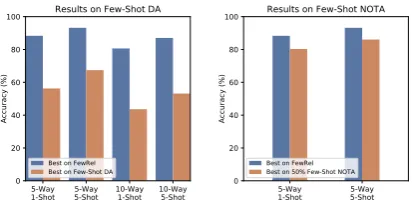
Figure 1: The comparison between the best results of the current models on FewRel, shot DA and few-shot NOTA. From the figures we can see that even the state-of-the-art models struggle on the new tasks.
Few-shot domain adaptation (few-shot DA) aims to evaluate the abilities of few-shot models to transfer across domains, which is crucial for real-world applications, since the test domains usually lack of annotations and could differ vastly from the training domains. To this end, we construct a new test set sharing great disparities with the orig-inal FewRel dataset, and carry out extensive ex-periments on the state-of-the-art few-shot models and commonly-used domain adaptation methods. Some prior experimental results in Figure1show that even the performance of the most effective methods on FewRel drops drastically on the new test set, proving that few-shot DA is challenging and requires further investigations.
Consider-Training Phase (Famous Person from Wikipedia)
Supp. Set
(A) date of birth Mark Twainwas born in1835.
(B) place of birth Elvis PresleyMemphis, Tennesseewas born in .
Query (A) or (B) orNOTA William Shakespeare passed
away at age 52 (around1616).
Test Phase (Biomedicine)
Supp. Set
(A) may treat RibavirinChronic Hepatitis Cremains essential to treatment.
(B) manifestation of
Boys with Prader-Willi syn-dromeoften haveundescended testicle.
Query (A)or (B) or NOTA
[image:2.595.80.284.62.219.2]Thiabendazole was effective in eradicating the strongy-loides infection.
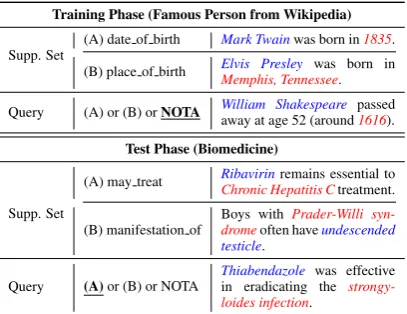
Table 1: An example for a 2-way 1-shot scenario, in-cluding both few-shot DA and few-shot NOTA. Dif-ferent colors indicate difDif-ferent entities, bluefor head entities, andredfor tail entities. For few-shot DA, in-stances in the training phase and test phase come from different domains. For few-shot NOTA, it requires models to detect the none-of-the-above (NOTA) rela-tion.
ing few-shot NOTA has not yet been widely ex-plored, we propose several solutions based on the state-of-the-art few-shot models and evaluate them with few-shot NOTA setting. Figure1shows that though achieving promising results, there is still a room of improvements for few-shot NOTA.
In the following sections, we first describe the two newly-added challenges in FewRel 2.0, then introduce possible directions for addressing these two issues, and finally present results and observa-tions from our experiments.
2 FewRel 2.0
Formulation forN-WayK-Shot Setting The original FewRel task adopts the N-way K -shot setting. The whole dataset is divided into training, validation and test subsets, which have no intersection in relation types. Models are eval-uated with batches sampled from the test set, each of which consists of (R,S, x, r), where R =
{r1, r2, ..., rN}is the sampled relation set,r∈ R
is the correct relation label for the query x, and Sis the supporting set containingKinstances for each relation,
S ={(xjri, ri)},1≤i≤N,1≤j≤K. (1)
Models should predict the relation labely∈ Rfor the query instancexbased on the givenSandR. Both of the following two challenges are based on thisN-wayK-shot setting.
Few-Shot Domain Adaptation
Both the training and test sets of the original FewRel dataset are constructed by manually an-notating the distantly supervised (Bunescu and Mooney, 2007; Mintz et al., 2009) results on Wikipedia corpus and Wikidata (Vrandeˇci´c and Kr¨otzsch,2014) knowledge bases. In other words, they are from the same domain, yet in a real-world scenario, we might train models on one domain and perform few-shot learning on a different one. For example, we may train models on Wikipedia, which has large amounts of data and adequate an-notations, and then perform few-shot learning on some domains suffering data sparsity, like litera-ture, finance and medicine. Note that, not only do these corpora differ vastly from each other in morphology and syntax, but there are wide dis-parities between the relation sets defined on these domains as well, which makes transferring knowl-edge across different domains more challenging.
To explore few-shot DA, we construct a new test set by aligning PubMed2, a database contain-ing large amounts of biomedical literature, with UMLS 3, a large-scale knowledge base in the biomedical sciences. Then we let the annotators classify whether each instance we get from the distant supervision is correct. Every sentence is assigned to at least two annotators, and if their an-notation results do not agree with each other, the third annotator is assigned. In the end, we gather a valid dataset with 25 relations and 100 instances for each relation.
For few-shot DA, we adopt the original FewRel training set for training, and the newly-annotated dataset for test, as shown in Table1. Besides, we use SemEval-2010 task 8 dataset (Hendrickx et al., 2009) as the validation set, since both the corpora and the schema of SemEval-2010 task 8 are in dif-ferent domains from the original FewRel dataset and the newly-annotated test set.
Few-Shot None-of-the-Above Detection
In aN-wayK-shot, all queries are assumed to be in the given relation set, yet sentences expressing no specific relations or relations not in the given set should also be taken into consideration, for they make up the vast majority of text. This calls for the none-of-the-above (NOTA) relation, which
2
https://www.ncbi.nlm.nih.gov/pubmed/ 3UMLS represents the Unified Medical Language
Systemr, which is the trademark of U.S. National Library
indicates that the query instance does not express any of the given relations. Though it is common in some conventional classification tasks, where NOTA is usually regarded as an extra class, de-tecting NOTA could be hard in few-shot learning, because the given relation sets are not fixed so that the NOTA relation requires to cover a different se-mantic space each time. An example of NOTA is given in Table1.
We formalize few-shot NOTA based on the
N-way K-shot setting. For the query in-stance x, the correct relation label becomes
r ∈ {r1, r2, ..., rN,NOTA} rather than r ∈
{r1, r2, ..., rN}. We use the parameter NOTA rate
to describe the proportion of NOTA queries during the whole test phase. For example,0%NOTA rate means no queries are NOTA and50%NOTA rate means half of the queries have the labelNOTA.
The NOTA queries are sampled from those re-lations outside the givenN relations. To be more specific, denoting the whole test set asDtest, the
set containing all instances in the relation setRas DR and the NOTA rate as α, α of the query
in-stances (NOTA queries) are fromDtest\ DRand 1−αof the instances are fromDR.
Note that during the test phase, all the queries are from the test set, though models can sam-ple instances from the training set as supporting instances for NOTA relation (this method is de-scribed explicitly in Section4). Also note that to better demonstrate the effects of the NOTA rela-tion, we use the original FewRel dataset for few-shot NOTA, instead of the new test set, which can get rid of the influence of domain adaptation.
3 Approaches for Few-Shot DA
Many efforts have been devoted for domain adap-tation, like subspace mapping (Pan et al., 2010; Fernando et al., 2013), finding domain-invariant spaces (Baktashmotlagh et al.,2013;Ganin et al., 2016), feature augmentation (Blitzer et al.,2006) and minimax estimators (Provost and Fawcett, 2001). Among them, adversarial training ( Good-fellow et al.,2015;Ganin et al.,2016;Wang et al., 2018) has been proved to be efficient in finding domain-invariant features. It is a game process between an encoder and a discriminator, where the encoder tries to generate domain-invariant features while the discriminator tries to tell which domain the features are from.
Here we follow the adversarial training setting
inWang et al.(2018), where a two-layer percep-tron network is used as the discriminator. While training the few-shot learning task, we feed the sentence encoderE and the discriminatorDwith the corpora from the training domain and the test domain, and optimize the min-max game,
min θE
max θD
X
x∈C0
log[D(E(x))]0
+X x∈C1
log[D(E(x))]1,
(2)
where [·]i is thei-th element of the vector, C0 is the training corpus andC1is the test corpus.
4 Approaches for Few-Shot NOTA
A simple way to handle NOTA is to regard it as an extra class in the N-way K-shot setting. To be more specific, we can sample instances outside theN relations as the supporting data of NOTA, and perform the(N+ 1)-wayK-shot learning. As compared to the current methods ignoring NOTA, this approach does not bring much improvements, since the supporting data for NOTA actually be-long to several different relations and are scattered in the feature space, making it hard to perform classification.
To better address few-shot NOTA, we propose a model namedBERT-PAIRbased on the sequence classification model in BERT (Devlin et al.,2019). We pair each query instance with all the support-ing instances, concatenate each pair as one se-quence, and send the concatenated sequence to the BERT sequence classification model to get the score of the two instances expressing the same re-lation. Denote the BERT model asB, the query instance as x and the paired supporting instance asxjr(thej-th supporting instance for the relation r),B(x, xjr) outputs a two-element vector
corsponding to scores of the pair sharing the same re-lation and not sharing the same rere-lation. The prob-ability over each relation in the few-shot scenario, including NOTA, is addressed as follows,
p(y=r|x) = P exp(or)
r0∈Rexp(or0)
, r∈ R (3)
where y is the predicted label and R =
{r1, ..., rN,NOTA} is the relation set including
NOTA. For r ∈ {r1, ..., rN}, or is calculated by
averaging,
or =
1 K
K X
j=1
Model 5-Way 1-Shot 5-Way 5-Shot On 1.0 On 2.0 On 1.0 On 2.0
GNN (CNN) 66.23±0.75 27.94±0.03 81.28±0.62 29.33±0.11 Proto (CNN) 74.52±0.07 35.09±0.10 88.40±0.06 49.37±0.10 Proto-ADV (CNN) 70.28±0.15 42.21±0.09 84.63±0.07 58.71±0.06 Proto (BERT) 80.68±0.28 40.12±0.19 89.60±0.09 51.50±0.29 Proto-ADV (BERT) 73.35±0.95 41.90±0.44 82.30±0.53 54.74±0.22 BERT-PAIR 88.32±0.64 56.25±0.40 93.22±0.13 67.44±0.54
Model 10-Way 1-Shot 10-Way 5-Shot On 1.0 On 2.0 On 1.0 On 2.0
[image:4.595.137.464.63.287.2]GNN (CNN) 46.27±0.80 16.44±0.04 64.02±0.77 18.26±0.03 Proto (CNN) 62.38±0.06 22.98±0.05 80.45±0.08 35.22±0.06 Proto-ADV (CNN) 56.34±0.08 28.91±0.10 74.67±0.12 44.35±0.09 Proto (BERT) 71.48±0.15 26.45±0.10 82.89±0.11 36.93±0.01 Proto-ADV (BERT) 61.49±0.69 27.36±0.50 72.60±0.38 37.40±0.36 BERT-PAIR 80.63±0.17 43.64±0.46 87.02±0.12 53.17±0.09
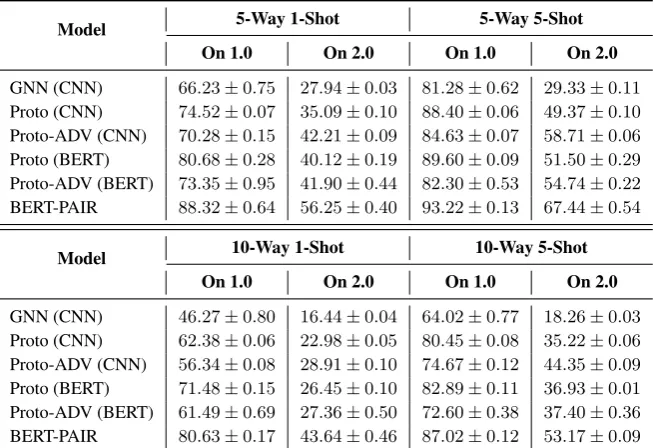
Table 2: Accuracies (%) on few-shot DA. “On 1.0” represents the results on the original FewRel dataset and “On 2.0” represents the results on the new test set. The models with “-ADV” use adversarial training described in Section3.
The score for NOTA oNOTA is calculated by the
equation,
oNOTA= min
r∈{r1,...,rN}
1 K
K X
j=1
[B(x, xjr)]0. (5)
Then we can treat NOTA the same as other rela-tions and optimize the model with the cross en-tropy loss, which is commonly-used in few-shot learning and other classification tasks.
5 Experiments
5.1 Baseline Models for Few-Shot Learning
We pick the two best models from the results in Han et al. (2018), GNN (Satorras and Estrach, 2018) and Prototypical Networks (Snell et al., 2017), as our baseline models. As for the en-coders, besides the CNN encoder used inHan et al. (2018), we also adopt BERT since it achieves the state-of-the-arts in multiple tasks (Devlin et al., 2019). For all models and encoders, we follow the parameter settings fromHan et al.(2018) and De-vlin et al.(2019).
5.2 Evaluation Results on Few-Shot DA
Table 2 demonstrates the evaluation results of few-shot DA on the existing FewRel test set and the new test set. Besides the baselines, we also evaluate Prototypical Networks with adversarial training described in Section3 and our proposed
0 10 20 30 40 50
NOTA Rate (%) 40
50 60 70 80 90
Accuracy (%)
5-Way 1-Shot
Proto(CNN)* Proto(CNN) Proto(BERT)* Proto(BERT) BERT-PAIR* BERT-PAIR
0 10 20 30 40 50
NOTA Rate (%) 50
60 70 80 90
Accuracy (%)
5-Way 5-Shot
Proto(CNN)* Proto(CNN) Proto(BERT)* Proto(BERT) BERT-PAIR* BERT-PAIR
Figure 2: 5-wayK-shot results under different NOTA rates. Models with * simply ignore the NOTA setting and assume all queries can be classified as one of the
Nrelations.
BERT-PAIR model in Section4. We get three ob-servations from the results:
(1) All few-shot models suffer dramatic perfor-mance falls when tested on a different domain.
(2) Adversarial training does improve the re-sults on the new test domain, yet still has large space for growth.
(3) BERT-PAIR outperforms all other few-shot models on both 1.0 and 2.0 test set.
Besides, to see where the growth boundary is, we split10relations,1,000instances out of the 2.0 test set and add them to the training set, then train and evaluate BERT-PAIR on the new data. We get
[image:4.595.309.517.358.456.2]Model 5-Way-1-Shot
0% NOTA 15% NOTA 30% NOTA 50% NOTA
Proto (CNN)* 74.52±0.07 62.18±0.22 53.38±0.14 37.26±0.04 Proto (CNN) 69.17±0.07 60.59±0.05 53.18±0.12 40.00±0.10 Proto (BERT)* 80.68±0.28 67.92±0.31 58.22±0.20 40.64±0.14 Proto (BERT) 81.65±0.97 70.02±0.23 61.08±0.28 45.94±0.50 BERT-PAIR* 88.32±0.64 73.60±0.51 63.00±0.47 43.99±0.09 BERT-PAIR 76.73±0.55 77.67±0.14 78.49±0.21 80.31±0.12
Model 5-Way-5-Shot
0% NOTA 15% NOTA 30% NOTA 50% NOTA
[image:5.595.145.457.63.289.2]Proto (CNN)* 88.40±0.06 73.64±0.11 62.95±0.12 44.20±0.05 Proto (CNN) 85.23±0.07 77.79±0.03 71.96±0.14 61.66±0.08 Proto (BERT)* 89.60±0.09 75.03±0.17 64.44±0.18 45.22±0.03 Proto (BERT) 88.74±0.83 83.79±0.44 81.17±0.48 75.21±0.52 BERT-PAIR* 93.22±0.13 77.58±0.42 66.41±0.24 46.58±0.09 BERT-PAIR 83.32±0.38 84.19±0.46 84.64±0.13 86.06±0.43
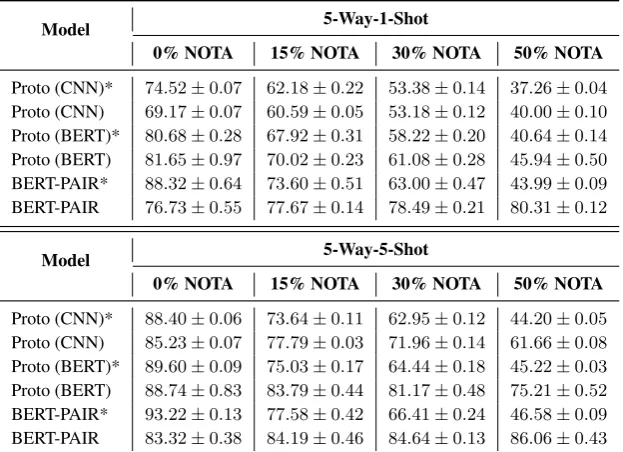
Table 3: Accuracies (%) on few-shot NOTA. Models with * simply ignore the NOTA setting and assume all queries can be classified as one of the given relations.
there is still a huge room for improvements.
5.3 Evaluation Results on Few-Shot NOTA
We evaluate Prototypical Networks with the naive NOTA solution described in Section4and BERT-PAIR under the NOTA setting. All models are trained given50%NOTA queries and tested under four different NOTA rates: 0%, 15%,30%,50%. To show how accuracy falls if ignoring the NOTA relation, we also demonstrate the results of models without considering NOTA (marked with * in Fig-ure 2). We demonstrate the evaluation results in Figure2. For detailed numbers of results on few-shot NOTA, please refer to Table3. From Figure2 we can conclude that:
(1) Treating NOTA as theN+ 1relation is ben-eficial for handling Few-Shot NOTA, though the results still fall fast when the NOTA rate increases. (2) BERT-PAIR works better under the NOTA setting for its binary-classification style model, and stays stable with rising NOTA rate.
(3) Though BERT-PAIR achieves promising re-sults, huge gaps still exist between the conven-tional (0%NOTA rate) and NOTA settings (gaps of 8 points for 5-way 1-shot and 7 points for 5-way 5-shot with50%NOTA rate), which calls for further research to address the challenge.
6 Conclusion
In this paper, we propose FewRel 2.0, a more chal-lenging few-shot relation classification task with
a new test set from the biomedical domain and the none-of-the-above setting. The purpose of the new task is to explore two aspects which are ignored in the previous work: few-shot domain adaptation (few-shot DA) and few-shot none-of-the-above detection (few-shot NOTA). Extensive experiments demonstrate that the existing state-of-the-art few-shot models struggle on the new task. We also point out some possible direc-tions to handle these two issues, implement sev-eral new models and evaluate them with the new task. Though achieving promising improvements, these commonly-used techniques are still not the satisfactory solutions for shot DA and few-shot NOTA, which requires further explorations in these two real-world challenges.
Acknowledgments
References
Mahsa Baktashmotlagh, Mehrtash T Harandi, Brian C Lovell, and Mathieu Salzmann. 2013. Unsupervised domain adaptation by domain invariant projection. InProceedings of ICCV, pages 769–776.
John Blitzer, Ryan McDonald, and Fernando Pereira. 2006. Domain adaptation with structural correspon-dence learning. InProceedings of EMNLP, pages 120–128.
Razvan Bunescu and Raymond Mooney. 2007. Learn-ing to extract relations from the web usLearn-ing minimal supervision. In Proceedings of ACL, pages 576– 583.
Jacob Devlin, Ming-Wei Chang, Kenton Lee, and Kristina Toutanova. 2019. Bert: Pre-training of deep bidirectional transformers for language understand-ing. In Proceedings of NAACL-HLT, pages 4171– 4186.
Basura Fernando, Amaury Habrard, Marc Sebban, and Tinne Tuytelaars. 2013. Unsupervised visual do-main adaptation using subspace alignment. In Pro-ceedings of ICCV, pages 2960–2967.
Yaroslav Ganin, Evgeniya Ustinova, Hana Ajakan, Pascal Germain, Hugo Larochelle, Franc¸ois Lavi-olette, Mario Marchand, and Victor Lempitsky. 2016. Domain-adversarial training of neural net-works. JMLR, 17(1):2096–2030.
Tianyu Gao, Xu Han, Zhiyuan Liu, and Maosong Sun. 2019. Hybrid attention-based prototypical networks for noisy few-shot relation classification. In Pro-ceedings of AAAI, pages 6407–6414.
Ian J Goodfellow, Jonathon Shlens, and Christian Szegedy. 2015. Explaining and harnessing adver-sarial examples. InICLR.
Xu Han, Hao Zhu, Pengfei Yu, Ziyun Wang, Yuan Yao, Zhiyuan Liu, and Maosong Sun. 2018. Fewrel: A large-scale supervised few-shot relation classifica-tion dataset with state-of-the-art evaluaclassifica-tion. In Pro-ceedings of EMNLP, pages 4803–4809.
Iris Hendrickx, Su Nam Kim, Zornitsa Kozareva, Preslav Nakov, Diarmuid ´O S´eaghdha, Sebastian Pad´o, Marco Pennacchiotti, Lorenza Romano, and Stan Szpakowicz. 2009. Semeval-2010 task 8: Multi-way classification of semantic relations be-tween pairs of nominals. InProceedings of SEW-2009, pages 94–99.
Mike Mintz, Steven Bills, Rion Snow, and Dan Juraf-sky. 2009. Distant supervision for relation extrac-tion without labeled data. In Proceedings of ACL-IJCNLP, pages 1003–1011.
Tsendsuren Munkhdalai and Hong Yu. 2017. Meta net-works. InProceedings of ICML, pages 2554–2563.
Sinno Jialin Pan, Ivor W Tsang, James T Kwok, and Qiang Yang. 2010. Domain adaptation via transfer component analysis. TNNLS, 22(2):199–210.
Foster Provost and Tom Fawcett. 2001. Robust classifi-cation for imprecise environments. ML, 42(3):203– 231.
Sachin Ravi and Hugo Larochelle. 2017. Optimization as a model for few-shot learning. InProceedings of ICLR.
Victor Garcia Satorras and Joan Bruna Estrach. 2018. Few-shot learning with graph neural networks. In
Proceedings of ICLR.
Jake Snell, Kevin Swersky, and Richard Zemel. 2017. Prototypical networks for few-shot learning. In Pro-ceedings of NIPS, pages 4077–4087.
Livio Baldini Soares, Nicholas FitzGerald, Jeffrey Ling, and Tom Kwiatkowski. 2019. Matching the blanks: Distributional similarity for relation learn-ing. InProceedings of ACL, pages 2895–2905.
Oriol Vinyals, Charles Blundell, Tim Lillicrap, Daan Wierstra, et al. 2016. Matching networks for one shot learning. InProceedings of NIPS, pages 3630– 3638.
Denny Vrandeˇci´c and Markus Kr¨otzsch. 2014. Wiki-data: a free collaborative knowledgebase. Commu-nications of the ACM, 57(10):78–85.