warwick.ac.uk/lib-publications
A Thesis Submitted for the Degree of PhD at the University of Warwick
Permanent WRAP URL:
http://wrap.warwick.ac.uk/79687
Copyright and reuse:
This thesis is made available online and is protected by original copyright.
Please scroll down to view the document itself.
Please refer to the repository record for this item for information to help you to cite it.
Our policy information is available from the repository home page.
Exploring Design Principles of Cellular
Information Processing
by
Song Feng
ThesisSubmitted to the University of Warwick in partial fulfilment of the requirements
for admission to the degree of
Doctor of Philosophy
School of Life Sciences
Contents
List of Tables vii
List of Figures viii
Acknowledgments x
Declarations xi
Abstract xiii
Glossary xv
Chapter 1 Introduction and background 1
1.1 Evolutionary Systems and Synthetic Biology . . . 1
1.2 Information processing in cells . . . 2
1.2.1 The structure: interconnected networks . . . 3
1.2.2 The dynamics: diverse information processing functions . . . 4
1.2.3 Design principles: the biochemical mechanisms . . . 7
1.3 Solutions in evolutionary landscapes . . . 10
1.4 The challenges . . . 12
1.5 Summary of contributions . . . 12
2.2 Materials and methods . . . 17
2.2.1 Representing network interactions: rule-based model . . . 17
2.2.2 Encoding network information: a binary string as a synthetic genome . . . 21
2.2.3 Modelling mutations . . . 26
2.2.4 Modelling evolutionary selective pressures . . . 28
2.2.5 Modelling evolutionary dynamics . . . 32
2.2.6 BioJazz configuration file . . . 34
2.2.7 Post-evolutionary pruning of evolved networks and mutational analysis . . . 35
2.3 Results . . . 35
2.4 Discussion . . . 43
Chapter 3 Protein sequestration emerges as a tuning point 49 3.1 Introduction . . . 49
3.2 Methods . . . 51
3.2.1 Evolutionary simulations . . . 51
3.2.2 Selection criteria for adaptive and ultrasensitive dynamics . . 53
3.2.3 Model for signalling cycle motif featuring enzyme sequestration 54 3.3 Results . . . 54
3.3.1 In silico evolved ultrasensitive networks display enzyme satu-ration, enzyme sequestsatu-ration, and allosteric regulation. . . 57
3.3.2 Selection for adaptive dynamics leads to networks employing differential enzyme sequestration . . . 61
3.3.3 Scaffolding protein enables ultrasensitivity and adaptive dy-namics in a single signalling cycle . . . 62
3.4 Discussion . . . 67
Chapter 4 Emergence and Design of Networks with Bistable Dynam-ics 71 4.1 Introduction . . . 71
4.2 Methods . . . 72
4.2.1 Evolutionary simulations . . . 72
4.2.2 Chemical reaction network toolbox . . . 72
4.3 Results . . . 73
4.3.1 Bistability emerges from previous evolutionary simulations . 73 4.3.2 Dissecting evolved bistable networks to obtain bistable units 74 4.3.3 Design of bistable networks without allosteric regulations . . 77
4.4 Discussion . . . 78
Chapter 5 Core signalling motif displaying multistability through multi-state enzymes 81 5.1 Introduction . . . 81
5.2 Methods . . . 84
5.2.1 Model for a futile signalling cycle with two-state kinase . . . 84
5.2.2 Analytical solutions . . . 85
5.2.3 Parameter sampling . . . 86
5.3 Results . . . 87
5.3.1 The futile signalling cycle with a two-state kinase is a bistable motif . . . 87
5.3.2 Conditions for bistability in the core motif are satisfied in a biologically plausible range . . . 89
5.3.4 Increasing the number of kinase states in the signalling cycle
leads to unbounded multistationarity . . . 96
5.3.5 Multistability enables complex state transitions . . . 96
5.3.6 Real biological systems display complex interactions leading to multi-state enzymes and potential for multistability . . . . 99
5.4 Discussion . . . 100
Chapter 6 Design Principles of Multistability in Signalling Networks105 6.1 Introduction . . . 105
6.2 Methods . . . 107
6.2.1 Reaction networks . . . 107
6.2.2 DSR graph . . . 107
6.2.3 Enumeration of small reaction networks . . . 108
6.3 Results . . . 109
6.3.1 Classifying reaction networks with 5 species and 5 reactions . 109 6.3.2 Comparison between different categories . . . 111
6.4 Discussion . . . 112
Chapter 7 Conclusion 113 7.1 Evolution in silico: as taught and as practiced . . . 113
7.2 Design principles: the contexts and the applicability . . . 115
7.3 Evolutionary innovations: what can we learn for engineering? . . . . 116
7.3.1 Retroactivity: functional roles in different contexts . . . 117
7.3.2 Cross-talks: is multistability a potential rescuer? . . . 118
7.3.3 Modularity or complexity: plasticity in response dynamics . . 119
Appendix A Manual of BioJazz 120 A.1 Introduction . . . 120
A.2.1 Download . . . 123
A.2.2 Installation . . . 123
A.2.3 Usage . . . 125
A.2.4 Scoring . . . 128
A.3 Example config file . . . 129
Appendix B Thermodynamic framework in ANC and BioJazz 137 B.1 Thermodynamic framework for modelling allosteric regulation . . . . 137
Appendix C Mathematical model of sequestration motif 139 C.1 Mathematical model of sequestration motif . . . 139
Appendix D CRNToolbox analysis 141 D.1 CRNToolbox analysis of the simplest bistable motif . . . 141
Appendix E Proof of Multistability in Allosteric Motif 149 E.1 A model for an allosteric kinase . . . 149
E.1.1 Model description . . . 149
E.1.2 Summary of results . . . 151
E.1.3 Positive steady states . . . 153
E.1.4 Necessary conditions for bistability . . . 156
E.1.5 Necessary and sufficient conditions for multistationarity . . . 157
E.1.6 Necessary and sufficient conditions in practice . . . 162
E.1.7 Describing the steady states . . . 165
E.1.8 Bifurcation plots withKtot andStot . . . 170
E.2 The core model fornallosteric kinase competing for the same substrate176 E.2.1 Model description . . . 176
E.2.2 Summary of results . . . 178
E.2.3 Positive steady states . . . 178
List of Tables
2.1 Details of structural and encodings implemented in the binary string 22 2.2 Parameter ranges used for thein silico evolution of signalling networks 25
5.1 Number of bistable parameter sets found by sampling parameters of the core motif . . . 91 5.2 Example parameter sets that enable bistable dynamics in the core
List of Figures
1.1 Three example response dynamics in signalling systems . . . 6
2.1 The “Genome” structure and scaling method . . . 20
2.2 Sample fitness functions . . . 31
2.3 Starting network structure for sample simulations . . . 36
2.4 Results from sample evolutionary simulations . . . 38
2.5 Sample evolved network structure and dynamics . . . 41
2.6 Searching the zero-order sensitivity . . . 44
3.1 Evolutionary simulation setup . . . 52
3.2 Analysis of evolved ultrasensitive networks . . . 55
3.3 Structure of all evolved ultrasensitive networks . . . 57
3.4 Enzyme sequestrationvs. enzyme saturation by substrate . . . 58
3.5 Analysis of evolved adaptive networks . . . 60
3.6 Designed signalling cycle motif and parameter space for adaptation and ultrasensitivity . . . 61
3.7 Parameter sampling of the signalling cycle in the phenotype space of ultrasensitivity and adaptation . . . 63
3.8 Two different parameter regimes for ultrasensitivity . . . 64
3.10 Modulation of response dynamics through altering affinity between
scaffold protein and enzymes . . . 68
4.1 Bistable networks emerged from evolutionary simulations . . . 74
4.2 Simplification of an example bistable network (Network 15) . . . 76
4.3 Designed bistable networks without allosteric regulations . . . 77
4.4 Simplification of designed bistable network (Network B2) . . . 78
5.1 Different signalling futile cycles . . . 88
5.2 Expanded signalling networks without detailed balance . . . 90
5.3 Parameter sets that allow for bistability, sampled in a biologically feasible range . . . 92
5.4 Schematic of minimal signalling motif displaying bistability . . . 93
5.5 Bifurcation plot of core bistable signalling motif . . . 95
5.6 Implementation of multistability by expanding the minimal bistable motif . . . 97
5.7 Multistability installs complex state transitions . . . 98
5.8 The bistable signalling motif in biological systems . . . 101
6.1 The schematic chart illustrating enumeration procedures . . . 108
Acknowledgments
Gratefully Acknowledges
University of Warwick and University of Exeter for 3 yrs funding. Very very grateful to Prof. Orkun Soyer.
Prof. Peter Swain, Dr. Elisenda Feliu and Dr. Julien Ollivier.
HPC server “Zeus” in University of Exeter, OSSLab computing server. In particular to my dearest family, my wife Xue Jiang , my parents and sister. OSSLab group members.
Discussions with Dr. Jin Yang, Prof. Vincent Danos, Prof. Carstern Wiuf. Support and encouragement from friends.
Inspiration from many scientists: Charles Darwin, Richard Feynman, etc. Enlightenment from the philosopher Wang Yangming.
This thesis was typeset with LATEX 2ε∗ by the author.
∗LATEX 2εis an extension of LATEX. LATEX is a collection of macros for TEX. TEX is a trademark
Declarations
I hereby declare that this dissertation entitled ”Exploring Design Principles of Cel-lular Information Processing” is an original work and has not been submitted for a degree or diploma or other qualification at any other University.
Chapter 1 introduces the main objects and the backgrounds for this study. This chapter provides information obtained from the literature as referenced to.
Chapter 2 explains the particular computational platform I constructed to evolve and simulate the signaling networks. Chapter 3 investigates the emerged mechanisms for ultrasensitive and adaptive networks as well as design of small net-work motif that could modulating different response dynamics based on principles discovered from evolutionary simulations. Chapter 2 and Chapter 3 are based on the following published papers respectively:
• “BioJazz: in silico evolution of cellular networks with unbounded complexity using rule-based modelling.”, Song Feng, Julien F. Olliver, Peter S. Swain, Orkun S. Soyer,Nucleic Acids Research, pp. 1-15. ISSN 0305-1048 (2015) Author contributions: S.F., J.F.O., P.S.S. and O.S.S. designed research; S.F. performed research (J.F.O implemented encoding of rule-based models, S.F. implemented evolutionary algorithm, I/O and carried out simulations); S.F. and O.S.S. analysed data; S.F., J.F.O., P.S.S. and O.S.S. wrote the paper.
• “Proteins sequestration as a tuning point in controlling response dynamics of signalling networks.”, Song Feng, Julien F. Olliver, Orkun S. Soyer, PLoS Comput. Biol. (Accepted)
Author contributions: S.F. and O.S.S. designed research; S.F. performed re-search; S.F. and O.S.S. analysed the data; S.F., J.F.O. and O.S.S. wrote the paper.
conditions (design principles) on multistable cellular networks. This chapter is based on unpublished data from work mainly by Song Feng and Orkun S. Soyer.
Chapter 5 is about detail investigation on one of the novel bistable motif discovered from evolved networks. Chapter 5 is based on the following working manuscript:
• “Core signalling motif displaying multistability through multi-state enzymes.”, Song Feng, Meritxell S´aez, Carstern Wiuf, Elisenda Feliu, Orkun S. Soyer, Submitted toProc. Natl. Acad. Sci. USA
Author contributions: S.F., C.W., E.F. and O.S.S. designed research; S.F., M.S.C. and E.F. performed research (S.F. and C.W. performed the numerical analysis, S.F., M.S.C. and E.F. performed analytical proofs); S.F., M.S.C., C.W., E.F. and O.S.S. analysed results; S.F., M.S.C., C.W., E.F. and O.S.S. wrote the manuscript.
Abstract
As a summary, this work attempts to explore and uncovered design principles of certain dynamics of cellular networks by combining evolutionin silico with rule-based modelling approach.
Biological systems exhibit complex dynamics, due to the complex interac-tions in the intra- and inter- cellular biochemical reaction networks. For instance, signalling networks are composed of many enzymes and scaffolding proteins which have combinatorial interactions. These complex systems often generate response dynamics that are essential for correct decision-makings in cells. Especially, these complex interactions are results of long term of evolutionary process. With such evo-lutionary complexity, systems biologists aim to decipher the structure and dynamics of signalling and regulatory networks underpinning cellular responses; synthetic bi-ologists can use this insight to alter existing networks or engineerde novoones. Both tasks will benefit from an understanding of which structural and dynamic features of networks can emerge from evolutionary processes, through which intermediary steps these arise, and whether they embody general design principles. As natural evolution at the level of network dynamics is difficult to study,in silico evolution of network models can provide important insights.
response dynamics. I verified this proposition by designing a generic model of a signalling cycle, featuring two enzymes and a sequestering (scaffold) protein. This simple system is capable of displaying both ultrasensitive and adaptive response dynamics, even more interestingly modulating the system switching between two response dynamics through perturbing the scaffold protein. These results show that enzyme sequestration can be exploited by evolution so to generate diverse response dynamics in signalling networks.
From evolutionary simulations towards ultrasensitivity, bistable dynamics emerged as an alternative solution. On one hand, inspired by such results I used the fitness function as an objective function combined with different constraints to design and optimise bistable signalling networks with completely new structure and mechanism. Studying designed bistable signalling network explicates how such bistable network can be experimentally implemented. On the other hand, from studying the evolved bistable networks allosteric enzymes catalysing futile cycles appear to be a new mechanism of bistability in signalling networks. Furthermore, one of the smallest bistable signalling motifs is derived. This motif is composed of one kinase protein with two distinct conformational states and one substrate sub-ject to phosphorylation by the kinase and auto-dephosphorylation reactions. The sufficient and necessary condition on parameters, with which the signalling motif dis-plays bistable response dynamics, is analytically defined. By expanding the systems with more kinases, unlimited multistability emerges with potentials of implementing complex logic gates and cell state transitions. Further exploring the discovered and natural signalling networks implies shared design patterns. Motivated by search-ing structural boundaries between monostationary and multistationary networks, I performed algorithmic searching of multistationary signalling networks intending to find the sufficient structural conditions for multistationarity in signalling networks.
Glossary
Bipartite graph a graph whose vertices can be divided into two disjoint sets. Bistability a dynamical system has two stable equilibrium states.
Cross-talk one or more components from one signalling pathway affects oth-ers.
CRNT chemical reaction network theory which models and studies the dynamical behaviour of chemical systems.
DSR graph directed species-reaction graph, a signed, labelled, directed bipar-tite graph derived from chemical reaction networks.
Futile cycle also known as substrate cycle, where two metabolic pathways run simultaneously in opposite directions and have no overall effect other than to dissipate energy in the form of heat.
Multistability a property of having multiple stable equilibrium points in the vec-tor space spanned by the states in a dynamical system.
Multistationarity the attribute of numerous systems to possess more than one stable states.
Ultrasensitivity an output response that is more sensitive to stimulus change than the hyperbolic Michaelis-Menten response.
Chapter 1
Introduction and background
1.1
Evolutionary Systems and Synthetic Biology
Biological systems are complex. The complexity derives from combinatorial interac-tions between the components, the building blocks of biological systems, in multiple scales [1–5]. For instance, complex interactions between amino acids give rise to complex energy landscapes which result diverse protein functions such as allosteric regulation and catalytic activities [2, 6–9]; interactions between multi-domain pro-teins compute signals from fluctuating environments into reliable cellular decisions [10, 11]; gene regulatory networks of protein-DNA interactions determine the pro-gression of cell fates [12–14]; and metabolic interactions at inter-cellular scale define the structure and dynamics of microbial communities [15–17]. All these complex in-teractions can not be understood without systematically investigating the dynamics of corresponding systems[11, 17–19].
the principles governing the complex dynamics of biological systems at different scales [23–26]. In parallel, following the idea of “What I cannot create, I do not understand.”, synthetic biologists dedicate to building de novo biological systems in hope of understanding them [15, 27–29]. In building large scale biosystems, com-putational predictions or theoretical guidance are tremendously helpful by reducing the searching space and directing the design [30–32]. Therefore, a computational approach is indispensable in understanding and mastering the design principles of biological systems.
Furthermore, the complexity of biological systems results from evolution [33]. The evolutionary innovations are embedded in genotype-phenotype mapping in bio-logical systems and they emerged by long time of tinkering and optimisation under fluctuating environments [34–37]. It is reasonable to investigate the design princi-ples in biological systems from an evolutionary perspective, not only because the studies makes no sense without evolutionary insights but also because that evolu-tionary studies enable us discover design principles that have not been found in natural systems yet. Even from a practical point of view, it is necessary to make accurate predictions about functional rules of proteins and the effects of modifying interactions between them so that they can improve control of natural biosystems and enable rational design ofde novo biosystems.
In this study, I combine computational modelling and an evolutionary ap-proach to explore design principles in one of the most important yet complicated phenomenon — the information processing in cells.
1.2
Information processing in cells
specific for information processing so that cells utilise it to transform extracellular signals into cellular output. Many interesting and essential physiological behaviours and responses are determined by the proper functioning of signalling system in cells [38].
An astonishing fact is that the signal transduction system does not simply transmit signals rather it integrates, process and encode different external signals so that it give rise to appropriate cellular responses that guarantee the cell adapt to fluctuating environments. These cellular responses are pivotal cellular decisions determined by the temporal and spatial dynamics of signal transduction system [11]. Therefore, in order to understand the complex regulations, understanding the underlying principles and biochemical mechanisms is a necessity.
1.2.1 The structure: interconnected networks
As naturally designed, signalling networks are composed of signalling proteins such as receptors, adaptor proteins, kinases, transcription factors and second messen-ger like calcium and nitric oxide. Signalling proteins usually adopt conformational changes to carry out binding interactions or enzymatic reactions and consequently affect the conformation and dynamics of proteins. These signals are detected, en-coded, integrated and transformed as perturbation at activity of transcription fac-tors, through which cell responses in form of altering gene expression or as modi-fication of molecular machines so that cell responses as, for instance, movements, neural action potential [10, 11, 38].
with various structures and domains.
1.2.2 The dynamics: diverse information processing functions
Different structures of biochemical reaction networks give rise to diverse functions that compute the input signals into different response dynamics [11]. There are many signalling dynamics discovered to be important and ubiquitous in biological systems, such as ultrasensitivity [40–45], adaptation [46–49], multistability [50–54], oscillation [55–58], pulsatile [59–61]. Among these signalling dynamics, ultrasensi-tivity, bistability and adaptation are the most fundamental dynamics in building more complex dynamical behaviour in cells [40, 62, 63].
Ultrasensitivity
response coefficient (R) calculated with the input level (I) and output level (O) as well as their changes respectively (∆I and ∆O):
R= lim
∆I→0
∆O/O
∆I/I =
dO/O
dI/I =
d lnO
d lnI (1.1)
The higher the value ofR, the higher the sensitivity.
Adaptation
Biological systems respond to input signals and regulate cellular states not just by amplifying signals but also by adapting to them [47]. Biochemical adaptation refers to the function that many signalling systems return to their pre-stimulated state after responding to a sustained stimulus (Figure 1.1B). A mathematical description for adaptation can be quantified with two characteristic terms: adaptive sensitivity (Asens) to the input perturbation and adaptive precision (Aprec) [65, 66], where the
sensitivity is defined as the maximum of response to the sustained input stimulus and can be calculated by (Figure 1.1B):
Asens =
! ! !
!(O(I∗1−−OI00))/I/O00 ! ! !
!, (1.2)
and the precision can be calculated by:
Aprec=
! ! !
!(O(I11−−OI00))/I/O00 ! ! ! ! −1 . (1.3)
A so called “perfect adaptation” emerges if the output response returns exactly to the pre-stimulated state (O1 =O0). Adaptation is commonly found in sensory
I O
(A) Ultrasensitivity
t I
t O
I0
I1
O0 O1
O∗
(B) Adaptation
I O
(C) Bistability
Figure 1.1: Three example response dynamics in signalling systems. Axes labelled with I represent level of input signal, the ones with O represent level of output response. (a) and (c) are showing the steady state plot of input signal and output response at steady states. (b) is showing the temporal dynamics with x-axis labelled withtrepresenting time,I0 andO0 represent pre-stimulus level of input signal and
output response,I1 and O1 represent respective levels after stimulus, O∗ represents
the level of output response with largest deviation from its pre-stimulus level.
Bistability
Other response dynamics
Beside the response dynamics discussed above, many other response dynamics are crucial for biological systems to make appropriate decisions under certain environ-ments. For instance, cells change their states according to the genetic program and environment in development, which requires complex transitions among many different states. Multistability, the ability of having multiple stable steady states in system dynamics, is the key player in such fate determinations. In addition, Biochemical oscillation is one the most important functions in many contexts like metabolism, signalling and development. Oscillations allow cells behaving periodi-cally, especially when exposed periodic signals, cells use oscillators to regulate their behaviours and better adapt the environments [79–82]. Besides circadian clocks, oscillation in signalling networks can also facilitate digital activation and dynam-ical control of cellular behaviour [83, 84]. With more interactions involved in the network, the system can potentially generate chaotic behaviour. Such chaotic be-haviours has been observed in many different cellular systems [11, 24, 85, 86].
1.2.3 Design principles: the biochemical mechanisms
By quantitative study on biological systems, some biochemical mechanisms were proposed to explain the interesting response dynamics in these systems. Such bio-chemical mechanisms were further formalised into design principles of corresponding response dynamics.
[87, 88, 91]. The ratio of different conformational states is determined by thermody-namic equilibrium. This model is a formalisation of allosteric regulation which was later found widely existing in biochemical systems and provide complex interactions between macro-molecules [88]. Comparably, another model was proposed to explain the allosteric regulation when subunits in the protein are not connected in such a way that conformational change of one induces similar change in the others [90]. In this model, all subunits are not necessarily displaying the same conformational state where substrate-binding at one subunit only slightly changes conformation of other subunits rather than propagates the conformational change to adjacent subunits. This model is called sequential model. Most allosteric effects can be explained by these two models. Both models postulate that allosteric protein exhibits in one of two distinct conformational states, tensed (T) or relaxed (R), and that these two states has different affinities and activities towards their substrates. However, the MWC model is more appropriate to explain the allosteric regulations in multi-domain proteins, since as a tightly connected entity, conformational propagation is inevitable in a folded protein. Meanwhile, treatment on the sequential model in large scale signalling networks is more complex by potentially introducing more parameters comparing to MWC model. Therefore, in this study I primarily use the MWC model to describe the allosteric regulation in signalling networks.
In the following reactions:
S + K−↽k1⇀−
k2 KS
k3
−→Sp+ K
Sp+ P
k4
−⇀
↽−
k5 PSp
k6
−→S+ P
(1.4)
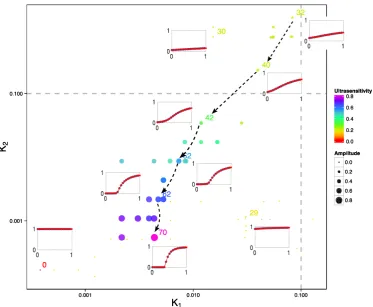
there are two parameters determining the saturation level of enzymes: K1= k1k2[+Stotk3]
and K2 = k4k5[S+totk6], whereStot is the total concentration of substrate. When K1 and
K2 become smaller, the enzymes (K and P) becomes more saturated by substrate
(S) and the system is consequently more ultrasensitive.
Build on the work of MWC model and zero-order sensitivity, more biochem-ical mechanisms for ultrasensitivity were discovered and studied, like signalling cas-cade (i.e. multiple steps of signalling cycles) [62], substrate competition[93, 94], sequestration[95–97], positive feedback[98–101]. In particular, studies showed that positive feedback either in signalling cycles or combined with signalling cascades can induce bistable response dynamics [62, 71, 72, 102, 103]. Also, mathematical proofs identified that positive feedback loops is necessary condition for generating bistability in chemical reaction networks [104, 105]. However, the positive feedback is not always manifest from the reactions displayed. As an example, double phos-phorylation in mitogen-activated protein kinase (MAPK) cascade endow the system capacity to generate bistability [53, 106]. Further studies on multisite phosphoryla-tion systems showed the complex structural condiphosphoryla-tions for multistaphosphoryla-tionarity.
elabo-rative searching all possible networks at small scale uncovered only two solutions: negative feedback loop with a buffering node and incoherent feedforward loop with a proportioner node [66].
Design principles for other more complex dynamics are also derived by study-ing interlinked positive and negative feedback loops as well as other complex interac-tions. The oscillatory response dynamics can be designed by implementing feedback loops with time delay [86]; multistability exists in the interlinked positive feedback loops and multi-domain histidine kinase systems [40, 50, 107, 108].
These mechanisms and principles are discovered by investigating recurring reaction patterns in cellular networks. The design principles requiring positive and negative feedback loops receive much appreciation with aid from computational and mathematical analysis. Especially, mathematical modelling played crucial roles in quantifying, deducing and formalising those mechanisms with verbally elaborating biochemical details. Therefore, I also take advantage of mathematical and compu-tational modelling as the tool to study the information processing in cells.
1.3
Solutions in evolutionary landscapes
characterise what design principles determine emergence of complex dynamics from evolution of signalling systems [117].
One approach would be systematic characterisation and comparison of com-ponents and their interactions in different species. This approach provides sub-stantial information of various large scale signalling networks, it provides important clues of differences in topology and dynamics as well. For instance, comparative analysis of different prokaryotic genomics showed that network structures and re-sponse dynamics are diversified in chemotactic systems of various species [118]. The conservation and variations discovered shed light on the origin and evolution of chemotactic system. It suggests that evolutionary study of networks with defined response dynamics could be substantially helpful. The conserved features in evolved networks are much prone to be design principles for the selected response dynamics. With such knowledge and information, an alternative approach could be apply-ing computational modellapply-ing and in silico evolution to forwardly understand the emergence properties of signalling networks and, more importantly, explore various design principles emerged from evolutionary processes. Previously, evolutionaryin silicoapproaches has been applied to metabolic networks, gene regulatory networks and signalling networks [36, 119–121][122]. These studies provide many insights about network evolution, like robustness, evolvability, complexity and modularity, however how those specific systems dynamics emerge from evolutionary processes is much unknown. Some attempts are made by evolutionary design of gene regulatory networks with oscillatory and bistable dynamics, both known and novel design pat-terns for bistable gene networks emerged [123], in which the novel design was later implemented experimentally [95].
biology [32, 125, 126]. Previous studies on complex response dynamics show that some of those information processing functions such as ultrasensitivity, adaptive response and bistability are important in achieving complex functions like oscillation, homeostasis, multistability [40, 62, 127–132]. In this thesis, I primarily focus on exploring design principles of those simple response dynamics in signalling networks, namely ultrasensitivity, adaptation, bistability.
1.4
The challenges
The information processing in cells integrates multiple inputs and produce multiple outputs. In between is the networks of interacting molecules, most of the molecules are proteins which consist of multiple domains and exhibit different conformational states. The complexity of information processing emerged from such combinatorial interactions in the networks.
One of the main obstacles is combinatorial complexity due to the exceedingly high number of micro-states that grows exponentially when increasing the number of molecules and interactions in the network [116]. Such combinatorial variety was normally ignored in previous evolution in silico studies. Another challenge is how to encode signalling network such that in silico evolution of the network is close to open-ended fashion, which means expansion of signalling networks in the evo-lutionary processes is, at least in theory, unbounded. In order to overcome both challenges, new approaches and methods need to be adopted and/or invented.
1.5
Summary of contributions
In my PhD study, I combined the evolutionaryin silico with rule-based modelling of cellular networks and applied this computational platform to explore evolutionary design principles of signalling networks.
cellu-lar networks. The computational platform is the first computational program that addresses both the multiple domain structure of proteins and theoreti-cally unbounded complexity of cellular networks in evolutionary process. The encoding of rule-based models into binary string is analogous to genome se-quences so that mutations are lessad hoc. I also implemented different fitness functions to evolve signalling networks toward desired response dynamics. Al-though the platform is still limited by the computational power when the networks become arbitrarily large and not completely abstraction of realistic biomolecular interactions such as spatial and geometric constraints, this is a step in the right direction towards the goal.
• By evolving signalling networks under selection pressures of ultrasensitive re-sponse and adaptive rere-sponse, I discovered the protein sequestration is evo-lutionarily conserved in both evolved ultrasensitive and adaptive networks. Based on the discovered mechanisms, I successfully designed a single signalling cycle with sequestrating proteins that could modulate the system dynamics between ultrasensitive response and adaptive response.
• From evolved ultrasensitive networks, bistability emerged as alternative so-lution for thresholds that are selected for. By analysing evolved bistable networks, I discovered a genre of novel biochemical networks that displaying bistability. Following the discovery, I devised algorithmic searching proce-dures to search the boundary between monostationarity and multistationarity in signalling networks.
Chapter 2
In silico
evolution with
unbounded complexity
2.1
Introduction
tool, called BioJazz, combines a rule-based modelling approach [156–158] with evo-lutionary simulation, allowing for evolution of cellular systems without any need for a priori limitations on the systems that can evolve. Thus, what is meant here by without limitations is that the structure, size and complexity of the system that is taken as an evolving entity (i.e. the modeled cellular system) is not bounded in any way (other than computational limitations). Rule-based modelling is per-fectly suited for this evolutionary approach, as it is developed in the first place to overcome the combinatorial complexity arising from accounting for all possible inter-actions in a given biological system [158, 159]. The rule-based modelling approach and the genome-like encoding of the network also allow biologically realistic muta-tional events to be modeled naturally. BioJazz has the ability to change and evolve networks with respect to both topology and biochemical parameters, by starting either from a designed networkde novo or from a partially or completely functional seed network.
I demonstrate the use of Biojazz by examining the evolution of network dy-namics for two sample cases, demonstrating evolution of network architectures for ultrasensitive and adaptive response dynamics. I also use these examples to demon-strate the effects of the parameters of the simulation algorithm on the performance and evolutionary space of such signalling networks.
2.2
Materials and methods
2.2.1 Representing network interactions: rule-based model
Rule-based approaches are developed for addressing the combinatorial complexity arising in modelling even the biological simplest reaction systems [158, 159] and, hence, are well suited to be combined with an evolutionary approach. Although several rule-based models are now available [156, 157, 161, 162], I choose to use the Allosteric Network Compiler (ANC) [156], because it systematically incorporates the allosteric and modular nature of proteins (note that the software structure of Bio-Jazz allows other rule-based models to be incorporated in subsequent developments). ANC is a stand-alone, rule-based compiler, which turns a high-level description of allosteric proteins into the corresponding set of biochemical equations by following mass-action kinetics.
ANC has been described previously [156]. In brief, it models proteins as multi-domain entities, where each domain is an allosteric unit that can adopt two general conformational states following the Monod-Wyman-Changeux (MWC) al-losteric model [87]. The two conformational states of each domain can be described as relaxed, “R”, and tense, “T”, and are assumed to have distinct free energies of folding as well as different binding and enzymatic characteristics. Indeed, the binding and catalytic activity of reactive sites within a domain are dependent on, and only on, the conformational state of that domain. Biochemically, domains are independent sub-units of a protein, comprising reactive sites such as catalytic or post-translational modification sites (as explained below). This choice is inspired by the structure and function of multi-domain proteins in nature. In most cases, signalling proteins are functionally modular and make use of distributed surface docking sites for recognition [163], which has been demonstrated for both natural [164, 165] and synthetic protein circuits [155, 166–169].
states of the domain that they bind. The transition between the R and T states is governed by the free energies of these states as well as any intermediate state between them (see Appendix B). ANC can thereby model a cellular network as a given set of proteins that comprise domains and that interact through binding and covalent modifications of reactive sites on those domains. Any of the domains can be allosteric, in which case, it would have distinctR and T states with associated allosteric rate constants, and modifications would result in altering the dynamics of theR-T transitions in the following manner:
k′RT =kRT N
"
i=1
(Γi)Φi (2.1)
k′T R=kT R N
"
i=1
(Γi)Φi (2.2)
wherekRT and kT R are the rate constant of switching betweenRstate and T state
without any allosteric modifier, kRT′ and k′T R are switching rate constants with modifiers accordingly, Γi denotes the effect of the ith modifier on the equilibrium
distribution between theR and T states, and the parameter Φi describing the
pro-portional effects of theith modifier on the R-T transitions. Detailed mathematical derivation can be found in Appendix B. As explained further below, in the Bio-Jazz implementation of ANC, thekRT,kT R, and Φvalues for each domain and the Γi values for different reactive sites on a given domain are free to evolve. Note
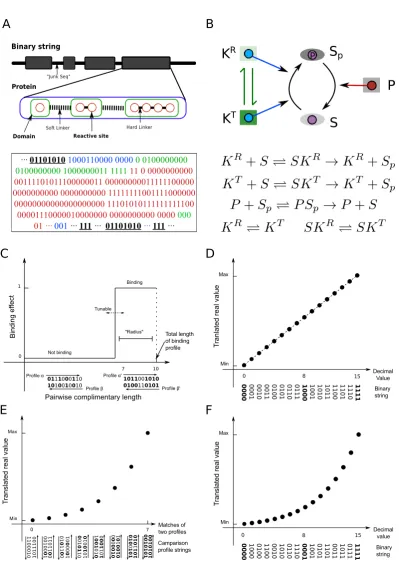
Figure 2.1: (Previous page continue) (C)Determination of binding between two reactive sites from a binary string segment (Methods). They-axis shows the binding effect; the x-axis shows complementary matches between two binding profiles. The threshold for binding, determining protein promiscuity, is user-defined. (D, E)
Scaling of the binary string encoding of parameters into real values. The y-axis corresponds to parameter values; the x-axis shows decimal values of the binary string. For different parameters (i.e. Φ, protein concentrations, and rate constants of the conformational transition), a linear (D) or logarithmic (E) scaling is used (Methods). (F) The scaling of the binary string encoding of parameters relating to binding-mediated reactions. They-axis corresponds to a kinetic rate value; the,
x-axis shows a comparison between strings encoding for binding parameters of two reactive sites as explained inMethods.
2.2.2 Encoding network information: a binary string as a synthetic genome
By describing the interaction rules as well as their allosteric effects, ANC allows modelling of a reaction network of arbitrary size and complexity. To evolve cellular networksin silico, one needs a method to store and mutate the corresponding protein interaction rules and parameters. In BioJazz, I encode the information in an ANC model as a binary string (Figure 2.1A). Using a set of translation rules, all the information required to build an ANC model can then be extracted from a given string (Figure 2.1C-F).
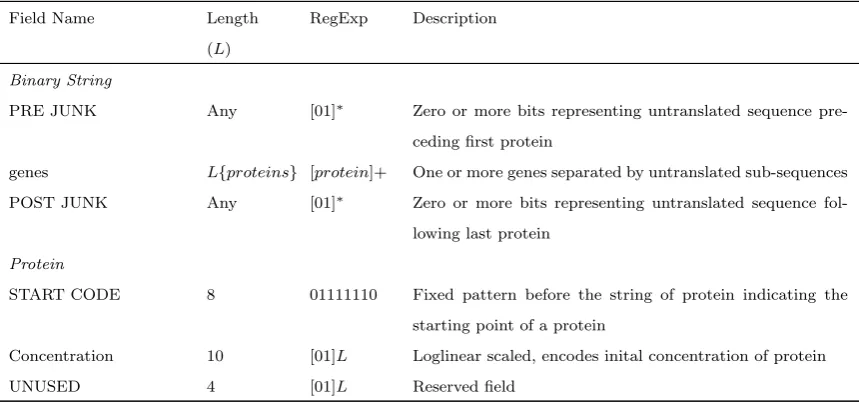
The structure of the binary string is similar to a natural genome, where “non-coding” sections separate sections encoding information. This division is im-plemented by using “start” and “stop” strings, and allows an increase in evolutionary innovations through mutations (see below). It is also possible to start evolutionary simulations from entirely random initial points (i.e. a randomly generated binary string). The coding sections of the binary string encode the structure, dynamics and interactions of proteins as explained in detail below and in Table 1. Thus, I can parse a given binary string and translate into an ANC model (Figure 2.1B).
2.1A). Each protein must contain at least one domain that contains at least one re-active site. There is no maximum limit to the number of domains and rere-active sites a protein can have. As explained above, domains may be allosteric units, and hence, each domain is preceded with an allosteric flag sequence. When the allostery flag is set, the domain will undergo conformational changes and these dynamics may be affected by biochemical reactions happening at its reactive sites (note that reactions happening on other domains would not have an allosteric effect on this domain, i.e. domains are distinct and independent entities). To distinguish between domains and reactive sites on the binary string, I use soft and hard linker sequences that are inserted between domains and reactive sites respectively (Figure 2.1A). Thus, the soft linker sequences indicate start of a new domain within a protein; hard linkers indicate the different reactive sites on a given domain whose conformational dynam-ics is potentially modulated (provided the domain is allosteric). This structure has the additional benefit that mutations that result in joining or separating of domains can be naturally implemented (seeMutations section below). Reactive sites within a domain can be either a binding or catalytic site, and their nature is encoded on the binary string as shown in Table 2.1.
Table 2.1: Details of structural and encodings implemented in the binary string
Field Name Length
(L)
RegExp Description
Binary String
PRE JUNK Any [01]∗ Zero or more bits representing untranslated sequence
pre-ceding first protein
genes L{proteins} [protein]+ One or more genes separated by untranslated sub-sequences
POST JUNK Any [01]∗ Zero or more bits representing untranslated sequence
fol-lowing last protein
Protein
START CODE 8 01111110 Fixed pattern before the string of protein indicating the
starting point of a protein
Concentration 10 [01]L Loglinear scaled, encodes inital concentration of protein
UNUSED 4 [01]L Reserved field
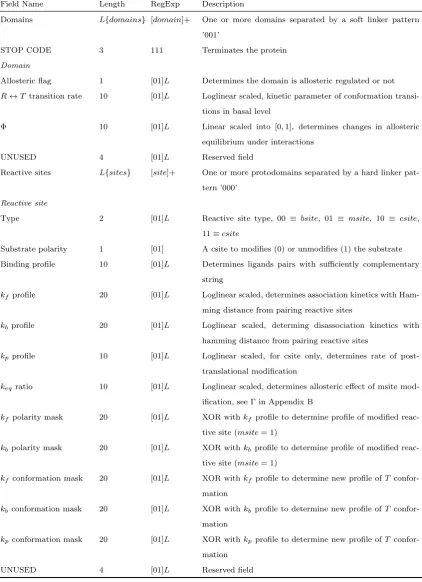
Table 2.1 – continued from previous page
Field Name Length RegExp Description
Domains L{domains} [domain]+ One or more domains separated by a soft linker pattern
’001’
STOP CODE 3 111 Terminates the protein
Domain
Allosteric flag 1 [01]L Determines the domain is allosteric regulated or not
R↔T transition rate 10 [01]L Loglinear scaled, kinetic parameter of conformation
transi-tions in basal level
Φ 10 [01]L Linear scaled into [0,1], determines changes in allosteric
equilibrium under interactions
UNUSED 4 [01]L Reserved field
Reactive sites L{sites} [site]+ One or more protodomains separated by a hard linker
pat-tern ’000’
Reactive site
Type 2 [01]L Reactive site type, 00 ≡ bsite, 01 ≡ msite, 10 ≡ csite,
11≡csite
Substrate polarity 1 [01] A csite to modifies (0) or unmodifies (1) the substrate
Binding profile 10 [01]L Determines ligands pairs with sufficiently complementary
string
kf profile 20 [01]L Loglinear scaled, determines association kinetics with
Ham-ming distance from pairing reactive sites
kbprofile 20 [01]L Loglinear scaled, determing disassociation kinetics with
hamming distance from pairing reactive sites
kpprofile 10 [01]L Loglinear scaled, for csite only, determines rate of
post-translational modification
keq ratio 10 [01]L Loglinear scaled, determines allosteric effect of msite
mod-ification, seeΓin Appendix B
kf polarity mask 20 [01]L XOR withkf profile to determine profile of modified
reac-tive site (msite= 1)
kbpolarity mask 20 [01]L XOR withkbprofile to determine profile of modified
reac-tive site (msite= 1)
kf conformation mask 20 [01]L XOR withkf profile to determine new profile ofT
confor-mation
kbconformation mask 20 [01]L XOR withkbprofile to determine new profile ofT
confor-mation
kpconformation mask 20 [01]L XOR withkpprofile to determine new profile ofT
confor-mation
UNUSED 4 [01]L Reserved field
Table 2.1 – continued from previous page
Field Name Length RegExp Description
In regular expression, the ’∗’ means ’zero or more’ and ’+’ means ’one or more’.
ANC intra-action fields: Intra-action fields are binary strings located at the beginning of each domain. They encode the parameters controlling the internal allosteric properties of the domain, namely the basal kinetic rates for the transitions between the R and T states (kRT and kT R from Equation B.3 and B.4) and the
parameterΦ(which is assumed to be the same for each of the different reactive sites of the domain and, as such, encoded once per domain). The switching rates are log linearly scaled into a real value (Figure 2.1F, Table 2.1); parameter Φ is linearly scaled into the interval [0,1] (Figure 2.1D, Table 2.1).
ANC interaction fields: Interaction fields are binary strings associated with the reaction sites in each domain. They encode how a change in the state of reaction site (binding or modification) will affect theR-T transition of that domain, i.e. they encode the parametersΓi described above. In addition, the binary string
encodes binding and rate profiles (described in the next section), as well as a site type for each reactive site. The available types arebinding,catalytic ormodification
sites (Table 2.1).
rate profiles, to determine the binding coefficients (Figure 2.1E, Table 2.1). Finally, reactive sites that are catalytic encode an additionalcatalytic rate profile. If one of the sites is a catalytic site and the other a modification site, the catalytic rate profile of the former is scaled log linearly into real value and is applied as the catalytic rate constant of the corresponding Michaelis-Menten kinetics. All the translated reaction rate constants are evolvable in biologically plausible parameter ranges (Table 2.2).
Table 2.2: Parameter ranges used for thein silico evolution of signalling networks
Parameters In silico Measure Reference
Concentration (µM) [10−3,103] [0.002,1.8] [139, 170–175]
Phosphorylation (s−1) [10−3,103] [0.17,8.87] [170–173]
Dephosphorylation (s−1) [10−3,103] [0.06,5.31] [170–173]
Auto-dephosphorylation (s−1) N/A [0.00097,0.0025] [170–173]
Binding membrane protein (s−1) [10−3,103] [0.0036,0.70] [170–173]
Unbinding membrane protein (s−1) [10−3,103] [0.00016,0.060] [170–173]
Protein association (µM−1·s−1) [10−3,103] [0.10,7.53] [170–173]
Protein disassociation (s−1) [10−2,102] [0.015,2.86] [170–173]
Basal conformational switching (s−1) [10−2,102] N/A N/A
Γ [10−2,102] N/A [156]
Φ [0,1] N/A [156]
Profile masks: In real proteins, the kinetic rates associated with each reac-tion (e.g. binding rate, catalytic rate, etc.) can be altered by the structural changes that the protein undergoes. To include such changes, the model should incorporate the possibility of alterations in the kinetic rates of each reactive site with the R-T
2.2.3 Modelling mutations
The use of rule-based modelling and encoding of such a model in a genome-like binary string allows us to implement most biologically feasible mutations easily. Currently, the possible mutations included in BioJazz are point mutations, protein duplication, protein deletion, domain duplication, domain deletion, domain joining, domain splitting and domain shuffling. Of these, mutations involving domains were to our knowledge not considered before [65, 120, 150], but are straightforward to include in the rule-based approach. The rate of occurrence of the different mutations is controlled by user-defined parameters. Users can also restrict BioJazz to mutate a subset of the network’s attributes including junk bits, linkers, binding profiles, allosteric flags, types of reactive site, etc. This flexibility is useful for example to “freeze” all or parts of a network and use BioJazz as a design tool rather than mimicking biological evolution.
Point mutation: Point mutations are implemented as flipping of specific bits in the binary string. A point mutation can alter any of the qualitative flags (explained above) or reaction parameters. Of particular note are mutations on hard and soft linkers, which can result in domain splitting and fusion respectively. The mutation algorithm parses the binary string and attempts a point mutation at each location: a bit is flipped if a randomly generated number in the interval [0,1] is smaller than a user-set probability (corresponding to a genome-wide point mutation rate).
coding section is duplicated, it is added to the end of the binary string. When a protein coding section is deleted, the binary string is shortened correspondingly. It is also possible that a protein is silenced by a point mutation at its “start” sequence.
Domain duplication/deletion: Bioinformatics analysis of genomes of ex-isting organisms reveals duplication patterns of domains in proteins, where the du-plication patterns show no dependence on the size of the domains involved [177]. Thus, BioJazz implements the domain duplication/deletion rate per protein. At each replication step, a randomly generated number in the interval [0,1] is gener-ated for each protein. If this number is smaller than a user-defined probability, a random fragment of the binary string is picked. This fragment is then either deleted or copied and the new copy is inserted at the end of the originally chosen one. Note that the randomly picked segment can contain many reactive sites or none.
Domain shuffling: BioJazz implements rearrangements between two protein-encoding sections of the binary string. The mutation rate leading to rearrangements is defined per protein. For each protein coding section of the binary string, a ran-dom number drawn from uniform distribution in the interval [0,1] is compared to a user-defined probability. If the random number is smaller, a fragment containing a certain number of reactive sites is randomly chosen. Then, another subsection of a protein coding section of the binary string is randomly selected, copied and fused with the first selected fragment. Note that this approach combines sets of intact reactive sites, which can correspond to an entire domain, part of a domain, or a sequence that covers multiple domains. Besides mimicking biological domain shuffling, shuffling is expected to create novel material for subsequent evolution.
continu-ous segment containing multiple reactive sites that possibly cross several genes is randomly selected. Then either deletion of segment or duplication of segment is randomly chosen and executed.
Horizontal gene transfer: BioJazz also has implementation of horizontal gene transfer (HGT). Since HGT occurs between different genomes in nature, this mutational operator is only implemented when using population based selection (see below). At the mutation step of each individual, the occurrence of HGT is determined by comparing a random number to a pre-defined probability (set by the user). If the random number is smaller than this probability, a continuous segment of string containing multiple reactive sites is randomly chosen and copied from the mutating individual. Then, another genome/individual is randomly selected and the copied segment is inserted into its genome at a randomly chosen site that is between any two reactive sites.
2.2.4 Modelling evolutionary selective pressures
To simulate evolution in silico, I need to model selective pressures experienced by the evolving cellular networks and so link the contribution of a networks function to the overallfitness of the organism. Fitness is an abstract concept, representing the reproductive success of an organism and might be most tractable for microbes where it could be approximated by growth rate [178]. In BioJazz, the fitness of networks can be defined by the user, such that networks can be evolved under biologically motivated or artificial selective pressures.
as illustrated in the results section for ultrasensitive dynamics (additional sample files are included in the BioJazz web site) and adaptive dynamics (Figure 2.2).
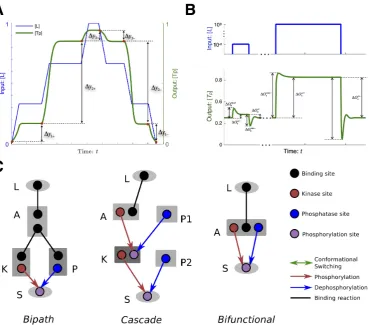
Ultrasensitivity fitness function: Currently the fitness function used to score the ability of a given signalling network to generate an ad hoc switch-like function to mimic the ultrasensitive signal-response relationship evaluated the response to a three-step ramp-up and three-step ramp-down signal profile as shown in Figure 2.2A. For each ramp-up in the signal, the system is simulated to steady state before the next ramp is applied. The scoring function considered both the amplitude of the response to middle steps in ramp-ups and ramp-downs (amplitude scoreSamp) and the difference of the response amplitudes between the middle steps
and the other two steps (ultrasensitivity score Sult). If ymin and ymax are defined
as the minimum and maximum values of the response during the interval from a change in the signal to steady-state, then the response amplitude for each of the signal ramp-ups (indicated with a ’+’ sign) and ramp-downs (indicated with a ’−’ sign) is calculated as:
∆yi+=yi+max−yi+min (2.3)
∆yi−=yi−max−yi−min (2.4)
where the subscripts denote the corresponding ramps in the input signal. With these measurements, the amplitude score (Samp) is given as the normalized amplitude of
the change in response to the second ramp-up and ramp-down signals:
Samp =
(∆y2++∆y2−)/2
ytotal
(2.5)
withytotal being the maximum possible response (i.e. the concentration difference
between a fully active and fully inactive output protein), and acts as a normalisation factor ensuringSamp to be between 0 and 1. In order to quantify the ultrasensitivity
second ramp-up/ramp-down signals, and the first choice/third choice. I first define the difference in the response to the different ramp-up and ramp-down signals as
Su1 = (∆y2++∆y2−)/(∆y1++∆y1−) and Su3 = (∆y2++∆y2−)/(∆y3++∆y3−).
Then I can derive the ultrasensitivity score (Sult) as:
Sult=
#
( Su1
ru+Su1 ·
( Su3
ru+Su3
)) (2.6)
where, ru is a user-defined scaling parameter that ensures the two ratios Su1 and
Su3 (and thus the ultrasensitivity score) is between 0 and 1. Besides the amplitude
and ultrasensitivity scores, I also define a complexity score (Scom). It is plausible to
assume that networks are under selection to minimize their energetic burden to the cell, and this score allows us to capture network complexity. The complexity score is given by:
Scom=
rc
rc+C
(2.7)
where C is the sum of the total number of rules, proteins, domains, and reactive sites in the ANC model and rc is a user-defined scaling parameter for scaling the
complexity score Scom between 0 and 1. Finally, the fitness function combines the
three scoring functions:
F = (Sωa
amp·Sultωu·Scomωc ) 1
ωa+ωu+ωc (2.8)
with theω∗being user-defined parameters that control the weightings of the different scores.
Simple adaptation fitness function (Figure 2.2B): The key aspects of adaptive response dynamics are that the system shows an initial response to the input (∆O+max/−̸= 0) that the steady state value of the output returns to its pre-input
Figure 2.2: Sample fitness functions for selection for networks with ultrasensitive or adaptive response dynamics. (A) The input signal (blue) used in the temporal simulations of the system for ultrasensitivity. Each ramp-up and ramp-down of the signal is introduced after the system reaches steady state. The corresponding system output over time is shown in green. The differences in steady state output between different signal levels, indicated as ∆y values on the plot, are used to calculate the amplitude and ultrasensitivity scores. (B) Illustration of the dynamics of input signal (blue) the output response (green) in simulations of the system for adaptive dynamics. The parameters in adaptive fitness function, ∆O+max/ and ∆O+ss/, are
labelled.
settle back to its original steady state: ∆Oss+/− ≈ 0. Therefore, the adaptation
fitnesswcan be configured as:
w=
$
∆O+max
C · K K+∆Oss− ·
$
∆O−max
C · K K+∆Oss−
(2.9)
whereCis a normalization factor to scale∆O+max/−and∆Oss+/−in to [0,1], andKis a
threshold parameter. By imposing such a selective pressure, it is possible to evolve an increased response sensitivity (∆Omax+/−) and reduced adaptive error (∆Oss+/−),
and so achieve networks with an adaptive response.
output via the Facile tool [180]. Stochastic simulation of the ANC model is also possible by customising the fitness scoring function.
2.2.5 Modelling evolutionary dynamics
Evolutionary dynamics arising from the emergence of mutant genotypes in a popu-lation and their subsequent change in frequency can be modeled in different ways. In particular, evolution could be approximated either by a random walk in which a single beneficial (or neutral) mutant can be fixed in the population before any other mutants can arise or as occurring in a population where multiple mutants can co-exist. The former is an appropriate model for evolutionary dynamics at low mutation rate and large population size limit [181]; the latter approach can give rise to evolutionary dynamics similar to that described by the concept of quasi-species [182].Both approaches are implemented in BioJazz.
Evolution as a random walk: Under very low mutation rates and in large populations, evolutionary dynamics can be approximated by a random walk in the genotype space. Then, a single genotype dominates the population and new mutants either get fixed or are lost rapidly under natural selection and/or genetic drift [183]. The probability of fixation for such rare mutants with a given fitness effect has been approximated by Kimura [181]. This approximation can be used to model evolution under a large population and low mutation rate scenario, where the calculated probability of fixation for a mutant generated from the wildtype genotype is used to replace the wildtype or not [184]. Biojazz implements this approach by starting simulations from a given genotype and using this genotype to generate a mutant genotype. The mutation is then accepted with probabilityαPf ix, wherePf ix
(fixation probability) is calculated from the fitness of the original (w) and mutant (w′) genotypes by the following equation:
Pf ix=
1−e−2s
withsbeing the selection coefficient and equal tos= w′w−w, andNeis the effective
population size (set in the range 105 ∼108, based on measurements for prokaryotes [185]). The coefficient α is used to tune (usually increase) the speed of simulation and is always chosen to make αPf ix < 1 for all mutations [184]. A newly
gener-ated mutant will be accepted if a random number (uniformly drawn from interval [0,1]) is smaller than αPf ix. Otherwise it is rejected. After acceptance of a given
mutant, that mutant replaces the original genotype and the simulation continues. If the mutant is rejected, a new mutant is generated from the original genotype. The evolutionary simulation is continued until a user defined fitness criterion or a specified number of mutations is reached.
Population based approach: Here I consider evolution dynamics in dis-crete generations of an asexual population of a fixed-size [181, 183]. In a fixed-size population, selection for the next generation is implemented by sampling genotypes according to their fitness scores. Assume that there are genotypesA1,A2, A3, . . .
with fitnessw1,w2,w3,. . . and frequenciesp1,p2,p3,. . . in the current population.
Then the expected proportion or frequency of Ai genotypes in the next generation
will be
p′i = piwi
p1w1+p2w2+· · ·
= piwi ¯
w (2.11)
The p′i is the propensity that genotype Ai is chosen for reproduction (with one
progeny) in each sampling. To implement these dynamics, I start with a homogenous population. At the beginning of each generation, individuals reproduce and mutate based on mutation rates by sequentially drawing and duplicating an individual and comparing the mutation rate with a random number r1 from [0,1]. If r1 is less
this vector. The individual that is selected for the next generation is determined by the index of the vector into which the random number falls. The sampling process continues until the number of individuals in the new generation reaches the defined population size.
Parallelization and choice of algorithms: Evolutionary simulations in BioJazz can be performed either on a single computer node, i.e. desktop workstation or laptop computer, or parallelly on several computer nodes in a computer cluster. If running parallelly on a cluster, the evolutionary algorithm of random walk style is implemented as setting each node running a single evolutionary program and several different simulations can be parallelly performed, while the population based approach is implemented by scoring several individuals parallelly on different nodes in a single simulation. Both approaches generate converged results from evolutionary simulations, however random walk style approach is much faster and requires less storage space, which might become a bottle neck when population based approach simulates too many generations before it converges.
2.2.6 BioJazz configuration file
BioJazz contains three key parts that are interlinked to each other: an encoding of an ANC model in the form of a binary string, evolutionary simulation of that binary string through mutations, and dynamic simulation of the ANC model and derivation of a fitness score. Many of the parameters governing the structure of these three parts and their inter linkage can be defined by the user, allowing for high customizability. These parameters are stored in a singleconfiguration file.
simulation of the ANC model (e.g. simulation time, numerical simulation error threshold), the scoring function (discussed below), and the output structure (e.g. frequency of output generation).
2.2.7 Post-evolutionary pruning of evolved networks and muta-tional analysis
It is possible that not all reactions in evolved networks are needed to achieve required function (as seen for example in previousin silicoevolution studies [143, 186]). Thus, I incorporated ways to prune evolved final networks or apply mutations on them for further functional analyses. This can be done readily by altering the string representation of evolved networks. BioJazz stores each of the evolving networks (in the case of population based approach to modelling evolution) and the primary evolving network (in the case of random walk approach to modelling evolution) at each generation of the simulation in two separate files. The user can choose to generate these files only in a BioJazz-compatible format or in additional formats readable in ANC, Facile, and MATLAB⃝R. Pruning and mutations can be done on these files and the resulting modified networks can be reanalysed. In the case of using BioJazz compatible files for such post-analysis, the user can make modifications on the string representation of the network and can also use existing subfunctions in the BioJazz source code. A detailed description and example of this approach is provided in BioJazz manual.
2.3
Results
This demonstrates selection for ultrasensitive response dynamics as described below. Note that the fitness function used and the associated analyses are provided as an example to illustrate the applicability of BioJazz. The user has complete flexibility over the choice of fitness functions and of the parameters in a given evolutionary simulation.
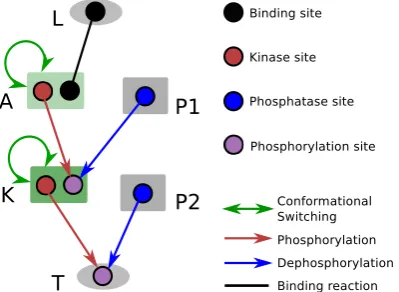
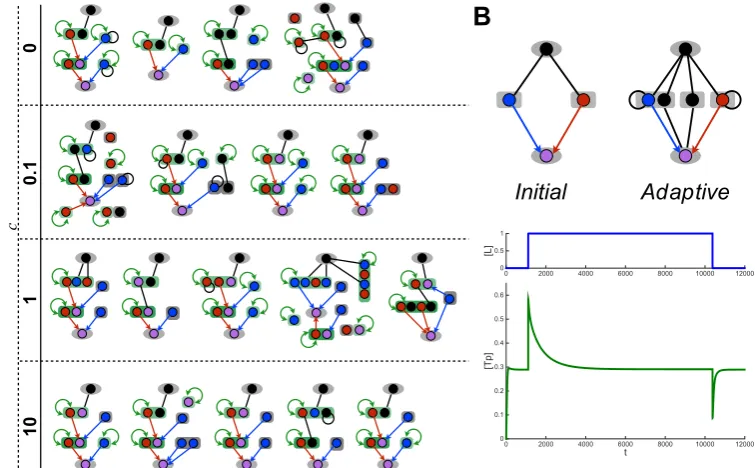
Figure 2.3: Schematic, showing the network structure used as the starting point for evolution for ultrasensitivity. The ligand (L) and the output protein (e.g. a transcription factor, T) are shaped as oval, while all other signalling proteins (e.g. a receptor/adaptor (A) protein, a kinase (K), or a phosphatase (P)) are shaped as rectangle. Black line represents binding reaction between two sites. Red arrows represent phosphorylation reactions between a kinase site (red) and a phosphory-lation site (purple). Blue arrows represent dephosphoryphosphory-lation reactions between a phosphatase site (blue) and a phosphorylation site. The green Coloured rectangle in-dicates a protein domain, whose conformational switching is allosterically regulated (also indicated by a self-pointing green line with arrows at both ends).
Ultrasensitivity is observed in many biological networks, and in particular in signalling networks implementing phosphorylation cycles [40, 43, 92, 139]. An ultrasensitive response is one where a change in the input generates a non-linear change in output, specifically signal levels and response levels at steady states gen-erate a sigmoidal curve [40, 92]. To evolve signalling networks capable of displaying ultrasensitive dynamics, I run simulations with selection under a particular fitness function.
of a receptor, a kinase, a phosphatase, and an output protein (Figure 2.3). The output protein was not allowed to duplicate or be deleted, but the rest of the network was free to evolve via all the mutations implemented in BioJazz (seeMethods). Note that the constrained structure of the model in this case reflects a user choice rather than a limitation and allows us to demonstrate the application of BioJazz to evolve signalling networks with ultrasensitive dynamics by fixing the input and output of the evolving system. It is also possible to include the ligand as part of the evolving entity, in which case I would be able to evolve new ligands and ligand-receptor interactions, provided that an appropriate fitness function is devised. For example, to study the coevolution between ligands and the response, one can easily cluster different proteins based on the tags and prefixes of protein names implemented in the source code.
Selecting for ultrasensitivity in the signalling network using the random-walk approach (see Methods), I ran evolutionary simulations by assuming a high population size and low mutation rate regime (seeMethods) and by using different complexity weightings ωc. In particular, I ran 5 simulations in parallel each for 4
different complexity weights: ωc = 0, 0.1, 1, 10. Each simulation is assigned to
a node in a computer cluster. I set a target fitness score of 0.8 and a maximal computation time of 120 hours per simulation. The simulations were terminated when either the target fitness score or simulation time was reached.
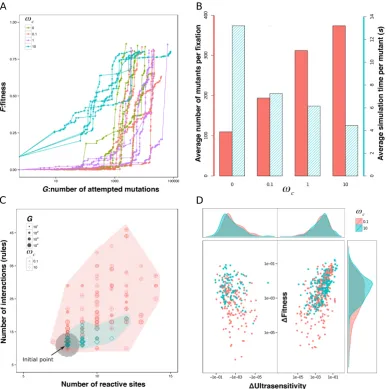
In all simulations, the fitness score increases over generations (Figure 2.4A) and I evolve an ultrasensitive network reaching at least a fitness score of 0.8. Analysing the evolutionary dynamics in these simulations, I find that fewer mu-tations were needed for simulations with ωc set to lower values (Figure 2.4B), i.e.
when the fitness penalty for complexity was low. The time required for evaluating the fitness of each mutant, however, was significantly larger with lower ωc. These
Figure 2.4: Results from sample evolutionary simulations. (A) The fitness score plotted against the total number of mutations sampled. Each curve depicts the results of a single evolutionary simulation, which is a biased random walk over the network space (Equation 2.10 in Methods). Each dot on each curve represents an accepted mutation (lines are to guide the eye). Distances along thex-axis between two dots indicate the number of mutations sampled between two accepted mutations. In all simulations, fitness increases with the number of mutations accepted, but in two simulations (one with ωc = 0 and one with ωc = 0.1) fitness fails to reach
the target level of 0.8 before the maximal simulation time of 120 hours is reached.