Proceedings of the 55th Annual Meeting of the Association for Computational Linguistics, pages 1821–1831 Vancouver, Canada, July 30 - August 4, 2017. c2017 Association for Computational Linguistics Proceedings of the 55th Annual Meeting of the Association for Computational Linguistics, pages 1821–1831
Vancouver, Canada, July 30 - August 4, 2017. c2017 Association for Computational Linguistics
Search-based Neural Structured Learning for
Sequential Question Answering
Mohit Iyyer∗
Department of Computer Science andUMIACS
University of Maryland, College Park [email protected]
Wen-tau Yih, Ming-Wei Chang
Microsoft Research Redmond, WA 98052
{scottyih,minchang}@microsoft.com
Abstract
Recent work in semantic parsing for ques-tion answering has focused on long and complicated questions, many of which would seem unnatural if asked in a normal conversation between two humans. In an ef-fort to explore a conversational QA setting, we present a more realistic task: answer-ing sequences of simple but inter-related questions. We collect a dataset of 6,066 question sequences that inquire about semi-structured tables from Wikipedia, with 17,553 question-answer pairs in total. To solve this sequential question answering task, we propose a novel dynamic neural semantic parsing framework trained using a weakly supervised reward-guided search. Our model effectively leverages the sequen-tial context to outperform state-of-the-art QA systems that are designed to answer highly complex questions.
1 Introduction
Semantic parsing, which maps natural language text to meaning representations in formal logic, has emerged as a key technical component for building question answering systems (Liang,2016). Once a natural language question has been mapped to a for-mal query, its answer can be retrieved by executing the query on a back-end structured database.
One of the main focuses of semantic parsing research is how to addresscompositionalityin lan-guage, and complicated questions have been specif-ically targeted in the design of a recently-released QA dataset (Pasupat and Liang,2015). Take for ex-ample the following question: “of those actresses who won a Tony after 1960, which one took the most amount of years after winning the Tony to ∗Work done during an internship at Microsoft Research
win an Oscar?” The corresponding logical form is highly compositional; in order to answer it, many sub-questions must be implicitly answered in the process (e.g.,“who won a Tony after 1960?”).
While we agree that semantic parsersshouldbe able to answer very complicated questions, in re-ality these questions are rarely issued by users.1
Because users can interact with a QA system re-peatedly, there is no need to assume a single-turn QA setting where the exactquestion intenthas to be captured with just one complex question. The same intent can be more naturally expressed through a sequence of simpler questions, as shown below:
1. What actresses won a Tony after 1960?
2. Of those, who later won an Oscar?
3. Who had the biggest gap between their two award wins?
Decomposing complicated intents into multiple re-lated but simpler questions is arguably a more ef-fective strategy to explore a topic of interest, and it reduces the cognitive burden on both the person who asks the question and the one who answers it.2
In this work, we study semantic parsing for answering sequences of simple related ques-tions. We collect a dataset of question sequences called SequentialQA (SQA; Section2)3by asking
crowdsourced workers to decompose complicated questions sampled from the WikiTableQuestions dataset (Pasupat and Liang, 2015) into multiple easier ones. SQA, which contains 6,066 question sequences with 17,553 total question-answer pairs, is to the best of our knowledge the first semantic parsing dataset for sequential question answering. Section3describes our novel dynamic neural se-mantic parsing framework (DynSP), a weakly
su-1For instance, there are only 3.75% questions with more than 15 words in WikiAnswers (Fader et al.,2014).
2Studies have shown increased sentence complexity links to longer reading times (Hale,2006;Levy,2008;Frank,2013).
3Available athttp://aka.ms/sqa
2010 Night Girl
Earth Fire breath
2011 2009
Elemental Aarok
First Appeared
Harmonia
Character
Teleporting Gates
Earth
Home World
Super strength 2007
Vyrga
Powers
Kathoon
XS speedSuper 2009
Dragonwing
1. Who are all of the super heroes?
2. Which of them come from Earth?
3. Of those, who appeared most recently? Original intent: What super hero from Earth appeared most recently?
[image:2.595.71.285.68.189.2]Legion of Super Heroes Post-Infinite Crisis
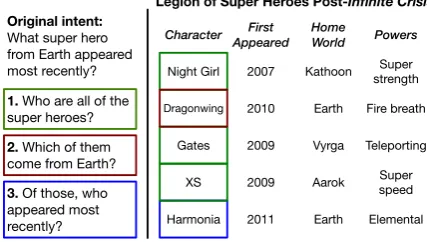
Figure 1: An example question sequence created from a compositional question intent. Workers must write questions whose answers are subsets of cells in the table.
pervised structured-output learning approach based on reward-guided search that is designed for solv-ing sequential QA. We demonstrate in Section4 thatDynSPachieves higher accuracies than exist-ing systems on SQA, and we offer a qualitative analysis of question types that our method answers effectively, as well as those on which it struggles.
2 A Dataset of Question Sequences
We collect the SequentialQA (SQA) dataset via crowdsourcing by leveraging WikiTableQues-tions (Pasupat and Liang,2015, henceforth WTQ), which contains highly compositional questions as-sociated with HTML tables from Wikipedia. Each crowdsourcing task contains a long, complex ques-tion originally from WTQ as the quesques-tionintent. The workers are asked to compose a sequence of simpler questions that lead to the final intent; an example of this process is shown in Figure1.
To simplify the task for workers, we only use questions from WTQ whose answers are cells in the table, which excludes those involving arithmetic and counting. We likewise also restrict the ques-tions our workers can write to those answerable by only table cells. These restrictions speed the an-notation process because workers can just click on the table to answer their question. They also allow us to collect answer coordinates (row and column in the table) as opposed to answer text, which re-moves many normalization issues for answer string matching in evaluation. Finally, we only use long questions that contain nine or more words as in-tents; shorter questions tend to be simpler and are thus less amenable to decomposition.
2.1 Properties of SQA
In total, we used 2,022 question intents from the train and test folds of the WTQ for decomposi-tion. We had three workers decompose each intent, resulting in 6,066 unique questions sequences con-taining 17,553 total question-answer pairs (for an average of 2.9 questions per sequence). We divide the dataset into train and test using the original WTQ folds, resulting in an 83/17 train/test split. Importantly, just like in WTQ, none of the tables in the test set are seen in the training set.
We identify three frequently-occurring question classes: column selection, subset selection, and
row selection.4 In column selection questions, the
answer is an entire column of the table; these ques-tions account for 23% of all quesques-tions in SQA. Sub-set and row selection are more complicated than column selection, as they usually contain corefer-ences to the previous question’s answer. In subset selections, the answer is a subset of the previous question’s answer; similarly, the answers to row selections occur in the same row(s) as the previous answer but in a different column. Subset selections make up 27% of SQA, while row selections are an additional 19%. The remaining 31% contains more complex combinations of these three types.
We also observe dramatic differences in the types of questions that are asked at each position of the sequence. For example, 51% of the first questions in the sequences are column selections (e.g., “what are all of the teams?”). This number dwindles to just 18% when we look at the second question of each sequence, which indicates that the collected sequences start with general questions and progress to more specific ones.
3 Dynamic Neural Semantic Parsing
The unique setting of SQA provides both opportu-nities and challenges. On the one hand, it contains short questions with less compositionality, which in theory should reduce the difficulty of the se-mantic parsing problem; on the other hand, the additional contextual dependencies of the preced-ing questions and their answers increase modelpreced-ing complexity. These observations lead us to pro-pose a dynamic neural semantic parsing framework (DynSP) trained using a reward-guided search
cedure for solving SQA.
Given a question (optionally along with previous questions and answers) and a table,DynSP formu-lates the semantic parsing problem as a state–action search problem. Each state represents a complete or partial parse, while each action corresponds to an operation to extend a parse. The goal during inference is to find an end state with the highest score as the predicted parse.
The quality of the induced semantic parse ob-viously depends on the scoring function. In our design, the score of a state is determined by the scores of actions taken from the initial state to the target state, which are predicted by differ-ent neural network modules based on action type. By leveraging a margin-based objective function, the model learning procedure resembles several structured-output learning algorithms such as struc-tured SVMs (Tsochantaridis et al.,2005), but can take either strong or weak supervision seamlessly. DynSPis inspired by STAGG, a search-based semantic parser (Yih et al.,2015), as well as the dy-namic neural module network (DNMN) ofAndreas et al.(2016). Much like STAGG,DynSPchains together different modules as search progresses; however, these modules are implemented as neural networks, which enables end-to-end training as in DNMN. The key difference betweenDynSPand DNMN is that inDynSPthe network structure of an example is not predetermined. Instead, different network structures are constructed dynamically as our learning procedure explores the state space. It is straightforward to answersequentialquestions using our framework: we allow the model to take the previous question and its answers as input, with a slightly modified action space to reflect a depen-dentsemantic parse. The same search / learning procedure is then able to effortlessly adapt to the new setting. In this section, we first describe the formal language underlyingDynSP, followed by the model formulation and learning algorithm.
3.1 Semantic parse language
Because tables are used as the data source to an-swer questions in SQA, we decide to form our semantic parses in an SQL-like language5. Our
parses consist of two parts: aselectstatement and conjunctions of zero or moreconditions.
5Our framework is not restricted to the formal language we use in this work. In addition, the structured query can be straightforwardly represented in other formal languages, such as the lambda DCS logic used in (Pasupat and Liang,2015).
Aselectstatement is associated with a column name, which is referred to as theanswercolumn. Conditions enforce additional constraints on which cells in the answer column can be chosen; a se-lect statement without any conditions indicates that an entire column of the table is the answer to the question. In particular, each condition con-tains a column name as theconditioncolumn and an operator with zero or more arguments. The operators in this work include: =,6=, >,≥, <,≤, arg min,arg max. A cell in the answer column
is only a legitimate answer if the cell of the cor-responding row in the condition column satisfies the constraint defined by the operator and its argu-ments. As a concrete example, suppose the data source is the same table in Fig.1. The semantic parse of the question “Which super heroes came from Earth and first appeared after 2009?” is “Se-lectCharacterWhere{Home World=Earth} ∧ {First Appeared >2009}” and the answers are
{Dragonwing, Harmonia}.
In order to handle thesequentialaspect of SQA, we extend the semantic parse language by adding a preamble statementsubsequent. Asubsequent
statement contains only conditions, as it essentially adds constraints to the semantic parse of the previ-ous question. For instance, if the follow-up ques-tion is “Which of them breathes fire?”, then the cor-responding semantic parse is “Subsequent Where
{Powers=Fire breath}”. The answer to this
ques-tion is {Dragonwing}, a subset of the previous answer.
3.2 Model formulation
We start introducing our model design by first defin-ing the state and action space. LetSbe the set of states andAthe set of all actions. A states ∈ S
is simply a sequence of variable length of actions
{a1, a2, a3,· · · , at}, where ai ∈ A. An empty
sequence, s0 = φ, is a special state used as the
starting point of search.
As mentioned earlier, a state represents a (partial) semantic parse ofonequestion. Each action is thus a legitimate operation that can be added togrow
the semantic parse. Our action space design is tied closely to the statements defined by our parse lan-guage; in particular, an actioninstanceis either a complete or partial statement, and action instances are grouped bytype. For example,selectand subse-quentoperations are two action types. Acondition
Id Type # Action instances A1 Select-column # columns A2 Cond-column # columns A3 Op-Equal (=) # rows A4 Op-NotEqual (6=) # rows
A5 Op-GT (>) # numbers / datetimes A6 Op-GE (≥) # numbers / datetimes A7 Op-LT (<) # numbers / datetimes A8 Op-LE (≤) # numbers / datetimes A9 Op-ArgMin # numbers / datetimes A10 Op-ArgMax # numbers / datetimes A11 Subsequent 1
A12 S-Cond-column # columns A13 S-Op-Equal (=) # rows A14 S-Op-NotEqual (6=) # rows
[image:4.595.76.282.58.273.2]A15 S-Op-GT (>) # numbers / datetimes A16 S-Op-GE (≥) # numbers / datetimes A17 S-Op-LT (<) # numbers / datetimes A18 S-Op-LE (≤) # numbers / datetimes A19 S-Op-ArgMin # numbers / datetimes A20 S-Op-ArgMax # numbers / datetimes Table 1: Types of actions and the number of action instances in each type. Numbers / datetimes are the mentions discovered in the question (plus the previous question if it is a subsequent condition).
(1) selection of the condition column, and (2) the comparison operator. The instances of each action type differ in their arguments (e.g., column names, or specific cells in a column). Because conditions in asubsequentparse rely on previous questions and answers, they belong to different action types from regular conditions. Table1summarizes the action space defined in this work.
Any state that represents a complete and legit-imate parse is an end state. Notice that search does not necessarily need to stop at an end state, because adding more actions (e.g., condition state-ments) can lead to another end state. Take the same example question from before: “Which su-per heroes came from Earth and first appeared after 2009?”. One action sequence that represents the parse is{(A1) select-columnCharacter, (A2)
cond-columnHome World, (A3) op-equalEarth,
(A2) cond-column First Appeared, (A5) op-gt 2009}.
Notice that many states represent semantically equivalent parses (e.g., those with the same ac-tions ordered differently, or states with repeated conditions). To prune the search space, we intro-duce the functionAct(s)⊂ A, which defines the actions that can be taken when given a states.
Bor-rowing the idea ofstagedstate generation in (Yih et al.,2015), we choose a default ordering of ac-tions based on their types, dictating that aselect
action must be picked first and that a
condition-A1 A2 A3...A10
s0
A2
A11 A12 A13...A20
[image:4.595.326.504.64.142.2]A12
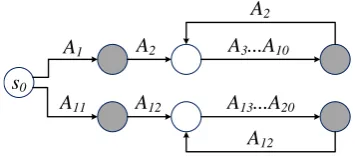
Figure 2: Possible action transitions based on their types (see Table1). Shaded circles are end states.
columnneeds to be determined before theoperator
is chosen. The full transition diagram is presented in Fig.2. Note that to implement this transition order, we only need to check the last action in the state. In addition, we also disallow adding dupli-cates of actions that already exist in the state.
We use beam search to find an end state with the highest score for inference. Letstbe a state
consisting of a sequence of actionsa1, a2,· · · , at.
The state value function V is defined recursively
as V(st) = V(st−1) +π(st−1, at), V(s0) = 0,
where thepolicyfunctionπ(s, a)scores an action a∈Act(s)given the current state.
3.3 Policy function
The intuition behind the policy function can be summarized as follows. Halfway through the con-struction of a semantic parse, the policy function measures the quality of an immediate action that can be taken next given the current state (i.e., the question and actions that have previously been cho-sen). To enable integrated, end-to-end learning, the policy function in our framework is parameterized using neural networks. Because each action type has very different semantics, we design different network structures (i.e., modules) accordingly.
Most of our network structures encourage learn-ing semantic matchlearn-ing functions between the words in the question and table (either the column names or cells). Here we illustrate the design using theselect-columnaction type (A1). Conceptually,
the corresponding module is a combination of vari-ous matching scores. LetWQbe the embeddings
of words in the question andWC be the
embed-dings of words in the target column name. The component matching functions are:
fmax = 1
|WC| X
wc∈WC
max
wq∈WQ
wTqwc
favg =
1
|WC| X
wc∈WC
wc
T
1
|WQ| X
wq∈WQ
Essentially, for each word in the column name,
fmaxfinds the highest matching question word and
outputs the average score. Conversely,favg simply
uses the average word vectors of the question and column name and returns their inner product. In another variant of favg, we replace the question
representation with the output of a bi-directional LSTM model. These matching component func-tions are combined by a 2-layer feed-forward neu-ral network, which outputs a scalar value as the action score. Details of the neural module design for other action types can be found in AppendixA.
3.4 Model learning
Because the state value functionV is defined
re-cursively as the sum of scores of actions in the se-quence, the goal of model optimization is to learn the parameters in the neural networks behind the policy function. Letθbe the collection of all the
model parameters. Then the state value function can be written as:Vθ(st) =Pti=1πθ(si−1, ai).
In a fully supervised setting where the correct se-mantic parse of each question is available, learning the policy function can be reduced to a sequence prediction problem. However, while having full supervision leads to a better semantic parser, col-lecting the correct parses requires a much more sophisticated UI design (Yih et al.,2016). In many scenarios, such as the one in the SQA dataset, it is often the case that only the answers to the questions are available. Adapting a learning algorithm to this
weaklysupervised setting is thus critical.
Generally speaking, weakly supervised semantic parsers operate on one assumption — a candidate semantic parse is treated as a correct one if it results in answers that are identical to the gold answers. Therefore, a straightforward modification of exist-ing structured learnexist-ing algorithms in our settexist-ing is to use any semantic parse found to evaluate to the correct answers during beam search as areference
parse, and then update the model parameters ac-cordingly. In practice, however, this approach is often problematic: the search space can grow enor-mously, and when coupled with poor model per-formance early during training, this leads to beams that contain no parses evaluating to the correct an-swer. As a result, learning becomes inefficient and takes a long time to converge.
In this work, we propose a conceptually simple learning algorithm for weakly supervised training that sidesteps the inefficient learning problem. Our
key insight is to conduct inference using a beam search procedure guided by anapproximate reward
function. The search procedure is executedtwice
for each training example, one for finding the best possible reference semantic parse and the other for finding the predicted semantic parse to update the model. Our framework is suitable for learning from either implicit or explicit supervision, and is detailed in a companion paper (Peng et al.,2017). Below we describe how we adapt it to the semantic parsing problem in this work.
Approximate reward LetA(s)be the answers
retrieved by executing the semantic parse repre-sented by state s, and letA∗ be the set of gold answers of a given question. We define thereward
R(s;A∗) =1[A(s) =A∗], or the accuracy of the
retrieved answers. We useR(s)as the abbreviation forR(s;A∗). A stateswithR(s) = 1is called a
goal state. Directly using this reward function in search of goal states can be difficult, as rewards of most states are 0. However, even when the an-swers from a semantic parse are not completely correct, some overlap with the gold answers can still hint that the state is close to a goal state, thus providing useful information to guide search. To formalize this idea, we define an approximated rewardR(s)˜ in this work using the Jaccard
coef-ficient (R(s) =˜ |A(s)∩A∗|/|A(s)∪A∗|). If s
is a goal state, then obviouslyR(s) =˜ R(s) = 1.
Also because our actions effectively add additional constraints to exclude some table cells, any suc-ceeding states ofs0withR(s˜ 0) = 0will also have 0
approximate reward and can be pruned from search immediately.
We use the approximate rewardR˜to guide our
beam search to find the reference parses (i.e., goal states). Some variations of the approximate reward can be used to make learning more efficient. For instance, we use the model score for tie-breaking, effectively making the approximate reward func-tion depend on the model parameters:
˜
Rθ(s) =|A(s)∩A∗|/|A(s)∪A∗|+Vθ(s), (1)
whereis a small constant. When a goal state is
not found, the state with the highest approximate reward can still be used as a surrogate reference.
Updating parameters The model parameters
are updated by first finding the mostviolatedstate
ˆ
sand then comparingsˆwith a reference states∗to
Algorithm 1Model parameter updates 1: forpick a labeled data(x, A∗)do 2: s∗ ←arg max
s∈E(x) ˜ R(s;A∗)
3: sˆ←arg max s∈E(x)
Vθ(s)−R(s;˜ A∗)
4: updateθby minimizingmax(L(s),0) 5: end for
intuition that the learning algorithm should make the state value function behave similarly to the re-ward. Formally, for every states, we would like the
value function to satisfy the following constraint:
Vθ(s∗)−Vθ(s)≥R(s∗)−R(s) (2)
R(s∗)−R(s) is thus the margin. As discussed
above, we use approximate reward function R˜θ
instead of the true reward. We want to update the model parametersθto make sure that the constraint
is satisfied. When the constraint is violated, the degree of violation can be written as:
L(s) =Vθ(s)−Vθ(s∗)−R˜θ(s) + ˜Rθ(s∗) (3)
In the algorithm, we want to find the state such that the corresponding constraint is most violated. Finding the most violated state is then equivalent to finding the state with the highest value ofVθ(s)−
˜
Rθ(s)as the other two terms are constant.
Algorithm 1 sketches the key steps of our method in each iteration. It first picks a training instance (x andy), where x represents the table
and the question, andyis the gold answer set. The
approximate reward function R˜ is defined by y,
whileE(x)is the set of end states for this instance.
Line2finds the best reference and Line3finds the most violated state, both relying on beam search for approximate inference. Line4 computes the gradient of the loss in Eq. (3), which is then used in backpropagation to update the model parameters.
4 Experiments
Since the questions in SQA are decomposed from those in WTQ, we compare our method,DynSP, to two existing semantic parsers designed for WTQ: (1) thefloating parser(FP) ofPasupat and Liang (2015), and (2) theneural programmer(NP) of Nee-lakantan et al.(2017). We describe below each system’s configurations in more detail and qualita-tively compare and contrast their performance on SQA.
Floating parser: The floating parser (Pasupat and Liang,2015) maps questions to logical forms and then executes them on the table to retrieve the answers. It was designed specifically for the WTQ task (achieving 37.0% accuracy on the WTQ test set) and differs from other semantic parsers by not anchoring predicates to tokens in the question, re-lying instead on typing constraints to reduce the search space. UsingFPas-is results in poor perfor-mance on SQA because the system is configured for questions with single answers, while SQA con-tains many questions with multiple-cell answers. We address this issue by removing a pruning hyper-parameter (tooManyValues) and features that add bias on the denotation size.
Neural programmer: The neural programmer
proposed byNeelakantan et al.(2017) has shown promising results on WTQ, achieving accuracies on par with those ofFP. Similar to our method,NP contains specialized neural modules that perform discrete operations such as argmax and argmin, and it is able to chain together multiple modules to answer a single question. However, module se-lection inNPis computed via soft attention (Cho et al.,2014), and information is propagated from one module to the next using a recurrent neural network. Since module selection is not tied to a pre-defined parse language likeDynSP, NP sim-ply runs for a fixed number of recurrent timesteps per question rather than growing a parse until it is complete.
Comparing the baseline systems: FPand NP
exemplify two very different paradigms for design-ing a semantic parsdesign-ing system to answer questions using structured data.FPis a feature-rich system that aims to output the correct semantic parse (in a logical parse language) for a given question. On the other hand, the end-to-end neural network of NPrelies on its modular architectures to output a probability distribution over cells in a table given a question. WhileNPcan learn more powerful neural matching functions between questions and tables thanFP’s simpler feature-based matching,NP can-not produce a complete, discrete semantic parse, which means that its actions can only be interpreted coarsely by looking at the order of the modules se-lected at each timestep.6 Furthermore,FP’s design
indirectly through an API, which is necessary if tables are large and stored in a backend database, whileNPrequires upfront access to the full tables to facilitate end-to-end model differentiability.7
Even though FPandNPare powerful systems designed for the more difficult, compositional ques-tions in WTQ, our method outperforms both sys-tems on SQA when we consider all questions within a sequence independently of each other (a fair comparison), demonstrating the power of our search-based semantic parsing framework. More interestingly, when we leverage the sequential in-formation by including thesubsequentaction, our method improves almost 3% in absolute accuracy. DynSPcombines the best parts of bothFPand NP. Given a question, we try to generate its correct semantic parse in a formal language that can be predefined by the choice of structured data source (e.g., SQL). However, we push the burden of fea-ture engineering to neural networks as inNP. Our framework is easier to extend to the sequential set-ting of SQA than either baseline system, requir-ing just the additional subsequent action. FP’s reliance on a hand-designed grammar necessitates extra rules that operate over partial tables from the previous question, which if added would blow up the search space. Meanwhile, modifyingNPto han-dle sequential QA is non-trivial due to soft module and answer selection; it is not immediately clear how to constrain predictions for one question based on the probability distribution over table cells from the previous question in the sequence.
To more fairly compareDynSPto the baseline systems, we also experiment with a “concatenated questions” setting, which allows the baselines to access sequential context. Here, we treat concate-nated question prefixes of a sequence as additional training examples, where a question prefix includes all questions prior to the current question in the se-quence.
For example, suppose the question sequence is:
1. what are all of the teams? 2. of those, which won championships?For the second question, in addi-tion to the original quesaddi-tion–answer pair, we add the concatenated question sequence“what are all of the teams? of those, which won championships?”
paired with the second question’s answer. We refer to these concatenated question baselines as FP+
andNP+.
7In fact,NPis restricted during training to only questions whose associated tables have fewer than a certain threshold of rows and columns due to computational constraints.
4.1 DynSPimplementation details
Unlike previous dynamic neural network frame-works (Andreas et al.,2016;Looks et al.,2017), where each example can have different but prede-terminedstructure,DynSPneeds to dynamically explores and constructs different neural network structures for each question. Therefore, we choose DyNet (Neubig et al.,2017) as our implementation platform for its flexibility in composing computa-tion graphs. We optimize our model parameters using standard stochastic gradient descent. The word embeddings are initialized with 100-d pre-trained GloVe vectors (Pennington et al.,2014) and fine-tuned during training with dropout rate 0.5. For follow-up questions, we choose uniformly at random to use either gold answers to the previous question or the model’s previous predictions.8 We
constrain the maximum length of actions to 3 for computational efficiency and set the beam size to 15 in our reported models, as accuracy gains are negligible with larger beam sizes. We train our model for 30 epochs, although the best model on the validation set is usually found within the first 20 epochs. Only CPU is used in model training, and each epoch in the beam size 15 setting takes about 30 minutes to complete.
4.2 Results & Analysis
Table2shows the results of the baseline systems as well as our method on SQA’s test set. For each system, we show both the overall accuracy, the sequence accuracy (the percentage of sequences for which every question was answered correctly), and the accuracy at each position in the sequence. Our method without any sequential information (DynSP) outperforms the standard baselines, and when thesubsequentaction is added (DynSP∗), we
improve both overall and sequence accuracy over the concatenated-question baselines.
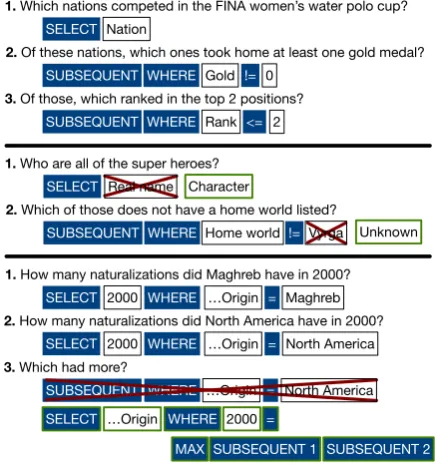
With that said, all of the systems struggle to answer all questions within a sequence correctly, despite the fact that each individual question is simpler on average than those in WTQ. Most of the errors made by our system are due to either semantic matching challenges or limitations of the underlying parse language. In the middle example of Figure3, the first question asks for a list of super heroes; from the model’s point of view,Real name
is a more relevant column thanCharacter, although the latter is correct. The second question also
Model All Seq Pos 1 Pos 2 Pos 3 FP 34.1 7.2 52.6 25.6 25.9
NP 39.4 10.8 58.9 35.9 24.6 DynSP 42.0 10.2 70.9 35.8 20.1
FP+ 33.2 7.7 51.4 22.2 22.3
NP+ 40.2 11.8 60.0 35.9 25.5
[image:8.595.307.525.66.299.2]DynSP∗ 44.7 12.8 70.4 41.1 23.6
Table 2: Accuracies of all systems on SQA; the models in the first half of the table treat questions independently, while those in the second half con-sider sequential context. Our method outperforms existing ones both in terms of overall accuracy as well as sequence accuracy.
tains a challenging matching problem where the unlisted home worlds referred to in the question are marked asUnknownin the table. Many of these matching issues are resolved by humans using com-mon sense, which for computers requires far more data than is available in SQA to learn.
Even when there are no tricky discrepancies be-tween question and table text, questions are often complex enough that their semantic parses cannot be expressed in our parse language. Although triv-ial on the surface, the final question in the bottom sequence of Figure3is one such example; the cor-rect semantic parse requires access to the answers of both the first and second question, actions that we have not currently implemented in our language due to concerns with the search space size. In-creasing the number of complex actions requires designing smarter optimization procedures, which we leave to future work.
5 Related Work
Previous work on conversational QA has focused on small, single-domain datasets. Perhaps most re-lated to our task is the context-dependent sentence analysis described in (Zettlemoyer and Collins, 2009), where conversations between customers and travel agents are mapped to logical forms after re-solving referential expressions. Another dataset of travel booking conversations is used byArtzi and Zettlemoyer(2011) to learn a semantic parser for complicated queries given user clarifications. More recently,Long et al.(2016) collect three con-textual semantic parsing datasets (from synthetic domains) that contain coreferences to entities and
1. Which nations competed in the FINA women’s water polo cup?
2. Of these nations, which ones took home at least one gold medal?
3. Of those, which ranked in the top 2 positions? SELECT Nation
SUBSEQUENT WHERE Gold != 0
SUBSEQUENT WHERE Rank <= 2
1. Who are all of the super heroes?
2. Which of those does not have a home world listed? SELECT
SUBSEQUENT WHERE != Character Real name
Home world Vyrga Unknown
1. How many naturalizations did Maghreb have in 2000?
2. How many naturalizations did North America have in 2000?
3. Which had more? SELECT 2000
SUBSEQUENT WHERE …Origin = North America WHERE …Origin = Maghreb
SELECT 2000 WHERE …Origin = North America
MAX SUBSEQUENT 1 SUBSEQUENT 2 SELECT …Origin WHERE 2000 =
Figure 3: Parses computed byDynSPfor three test sequences (actions in blue boxes, values from table in white boxes).Top: all three questions are parsed correctly.Middle: semantic matching errors cause the model to select incorrect columns and condi-tions.Bottom: The final question is unanswerable due to limitations of our parse language.
actions. We differentiate ourselves from these prior works in two significant ways: first, our dataset is not restricted to a particular domain, and second, a major goal of our work is to analyze the different types of sequence progressions people create when they are trying to express a complicated intent.
Complex, interactive QA tasks have also been proposed in the information retrieval community, where the data source is a corpus of newswire text (Kelly and Lin,2007). We also build on aspects of some existing interactive question-answering systems. For example, the system of Harabagiu et al.(2005) includes a module that predicts what a user will ask next given their current question.
non-probabilistic, margin-based objective function also helps avoid the need for empirical tricks to han-dle normalization and proper sampling, which are crucial when applying REINFORCE in practice.
6 Conclusion & Future Work
In this work we move towards a conversational, multi-turn QA scenario in which systems must rely on prior context to answer the user’s cur-rent question. To this end, we introduce SQA, a dataset that consists of 6,066 unique sequences of inter-related questions about Wikipedia tables, with 17,553 questions-answer pairs in total. To the best of our knowledge, SQA is the first semantic parsing dataset that addresses sequential question answering. We propose DynSP, a dynamic neu-ral semantic parsing framework, for solving SQA. By formulating semantic parsing as a state–action search problem, our method learns modular neu-ral network models through reward-guided search. DynSPoutperforms existing state-of-the-art sys-tems designed for answering complex questions when applied to SQA, and increases the gain after incorporating the subsequent actions.
In the future, we plan to investigate several in-teresting research questions triggered by this work. For instance, although our current formal language design covers most question types in SQA, it is nevertheless important to extend it further to make the semantic parser more robust (e.g., by includ-ing UNION or allowinclud-ing comparison of multiple previous answers). Practically, allowing a more complicated semantic parse structure—either by in-creasing the number of primitive statements or the length of the parse—poses serious computational challenges in both model learning and inference. Because of the dynamic nature of our framework, it is not trivial to leverage the computational capabili-ties of GPUs using minibatched training; we plan to investigate ways to take full advantage of modern computing machinery in the near future. Finally, better resolution of semantic matching errors is a top priority, and unsupervised learning from large external corpora is one way to make progress in this direction.
Acknowledgments
We thank the anonymous reviewers for their insight-ful comments. We are also grateinsight-ful to Panupong Pa-supat for his help in configuring the floating parser baseline, and to Arvind Neelakantan for his help
with the neural programmer model.
References
Jacob Andreas, Marcus Rohrbach, Trevor Darrell, and Dan Klein. 2016. Learning to compose neural net-works for question answering. InConference of the North American Chapter of the Association for Com-putational Linguistics.
Yoav Artzi and Luke Zettlemoyer. 2011. Bootstrap-ping semantic parsers from conversations. In Pro-ceedings of Empirical Methods in Natural Language Processing.
Kyunghyun Cho, Bart van Merrienboer, Caglar Gul-cehre, Fethi Bougares, Holger Schwenk, and Yoshua Bengio. 2014. Learning phrase representations using rnn encoder-decoder for statistical machine translation. In Proceedings of Empirical Methods in Natural Language Processing.
Anthony Fader, Luke Zettlemoyer, and Oren Etzioni. 2014. Open question answering over curated and ex-tracted knowledge bases. InProceedings of the 20th ACM SIGKDD international conference on Knowl-edge discovery and data mining. ACM, pages 1156– 1165.
Stefan L Frank. 2013. Uncertainty reduction as a mea-sure of cognitive load in sentence comprehension. Topics in Cognitive Science5(3).
John Hale. 2006. Uncertainty about the rest of the sen-tence. Cognitive Science30(4).
Sanda Harabagiu, Andrew Hickl, John Lehmann, and Dan Moldovan. 2005. Experiments with interactive question-answering. InProceedings of the Associa-tion for ComputaAssocia-tional Linguistics.
Diane Kelly and Jimmy Lin. 2007. Overview of the trec 2006 ciqa task. In ACM SIGIR Forum. ACM, volume 41, pages 107–116.
Roger Levy. 2008. Expectation-based syntactic com-prehension. Cognition106(3).
Chen Liang, Jonathan Berant, Quoc Le, Kenneth D. Forbus, and Ni Lao. 2017. Neural symbolic ma-chines: Learning semantic parsers on Freebase with weak supervision. InProceedings of the 55th An-nual Meeting of the Association for Computational Linguistics. Association for Computational Linguis-tics, Vancouver, Canada.
Percy Liang. 2016. Learning executable semantic parsers for natural language understanding. Commu-nications of the ACM59(9):68–76.
Moshe Looks, Marcello Herreshoff, DeLesley Hutchins, and Peter Norvig. 2017. Deep learning with dynamic computation graphs. In Proceed-ings of the International Conference on Learning Representations.
Arvind Neelakantan, Quoc Le, Martin Abadi, Andrew McCallum, and Dario Amodei. 2017. Learning a natural language interface with neural programmer. In Proceedings of the International Conference on Learning Representations.
Graham Neubig, Chris Dyer, Yoav Goldberg, Austin Matthews, Waleed Ammar, Antonios Anastasopou-los, Miguel Ballesteros, David Chiang, Daniel Cloth-iaux, Trevor Cohn, Kevin Duh, Manaal Faruqui, Cynthia Gan, Dan Garrette, Yangfeng Ji, Lingpeng Kong, Adhiguna Kuncoro, Gaurav Kumar, Chai-tanya Malaviya, Paul Michel, Yusuke Oda, Matthew Richardson, Naomi Saphra, Swabha Swayamdipta, and Pengcheng Yin. 2017. DyNet: The dy-namic neural network toolkit. arXiv preprint arXiv:1701.03980.
Panupong Pasupat and Percy Liang. 2015. Composi-tional semantic parsing on semi-structured tables. In Proceedings of the Association for Computational Linguistics.
Haoruo Peng, Ming-Wei Chang, and Wen-tau Yih. 2017. Maximum margin reward networks for learning from explicit and implicit supervision. Manuscript Submitted for Publication.
Jeffrey Pennington, Richard Socher, and Christopher Manning. 2014. GloVe: Global vectors for word representation. In Proceedings of Empirical Meth-ods in Natural Language Processing.
Ben Taskar, Carlos Guestrin, and Daphne Koller. 2004. Max-margin Markov networks. In Proceedings of Advances in Neural Information Processing Sys-tems.
Ioannis Tsochantaridis, Thorsten Joachims, Thomas Hofmann, and Yasemin Altun. 2005. Large mar-gin methods for structured and interdependent out-put variables. Journal of machine learning research 6(Sep):1453–1484.
Ronald J Williams. 1992. Simple statistical gradient-following algorithms for connectionist reinforce-ment learning. Machine learning8(3-4):229–256. Wen-tau Yih, Ming-Wei Chang, Xiaodong He, and
Jianfeng Gao. 2015. Semantic parsing via staged query graph generation: Question answering with knowledge base. In Annual Meeting of the Asso-ciation for Computational Linguistics (ACL). pages 1321–1331.
Wen-tau Yih, Matthew Richardson, Chris Meek, Ming-Wei Chang, and Jina Suh. 2016. The value of se-mantic parse labeling for knowledge base question answering. InAnnual Meeting of the Association for Computational Linguistics (ACL). Berlin, Germany, pages 201–206.
Luke Zettlemoyer and Michael Collins. 2009. Learn-ing context-dependent mappLearn-ings from sentences to logical form. InProceedings of the Association for Computational Linguistics.
A Action Neural Module Design
We describe here the neural module design for each action. As most actions try to match question text to column names or table entries, the neural net-work architectures are essentially various kinds of semantic similarity matching functions.
A1Select-column Conceptually, the
correspond-ing module is a combination of various matchcorrespond-ing scores. LetWQbe the embeddings of words in the
question andWC be the embeddings of words in
the target column name. The component matching functions are:
fmax = 1
|WC| X
wc∈WC
max
wq∈WQ
wTqwc
favg =
1
|WC| X
wc∈WC
wc
T
1
|WQ| X
wq∈WQ
wq
Essentially, for each word in the column name,
fmaxfinds the highest matching question word and
outputs the average score. Conversely,favg simply
uses the average word vectors of the question and column name and returns their inner product. In another variant offavg, we replace the question
rep-resentation with the output of a bidirectional LSTM model. These matching component functions are combined by a 2-layer feed-forward neural net-work, which outputs a scalar value as the action score.
A2Cond-column Because this action also tries
to find the correct column (but for conditions), we use the same matching scoring functions as inA1
module. However, a different 2-layer feed-forward neural network is used to combine the scores, as well as two binary features that indicate whether all the cells in this column are numeric values or not.
A3Op-Equal This action checks whether a
par-ticular column value matches the question text. Suppose the average of the word vectors of the particular cell iswxand the question word vectors
areWQ. Here the matching function is:
fmax= max wq∈WQ
A4Op-NotEqual The neural module for this
ac-tion extends the design forA3. It first uses amax
function similar tofmaxinA3to compare the
vec-tor of the negation word “not”, and the question words. This score is combined with thefmaxscore
inA3using a 2-layer feed-forward neural network
as the final module score.
A5-A8Op-GT, Op-GE, Op-LT, Op-LE The
ar-guments of these comparison operations are ex-tracted from question in advance. Therefore, the action modules just need to decide whether such relations are indeed used in the question. We take a simple strategy by initialing a special word vector that tries to capture the semantics of the relation. Take op-gt,greater than, for example. We use the average of the vectors of words likemore,greater
andlargerto initialize the special word vector, de-noted aswgt. Letwargbe the averaged vectors of
words within a [−2,+2]window centered at the
argument in the question. The inner product ofwgt
andwarg is then used as the scoring function.
A9-A10 Op-ArgMin, Op-ArgMax We handle
ArgMin and ArgMax similarly to the comparison operations. The difference is that we compare the special word vector to the averaged vector of all the question words, instead of a short subsequence of words.