April
1957
Division of labor in Scientific Digital Computer
Service Facilities
· .
.
l.
N. Caplan
Cam Profile Design With The Univac 120
· . . louis D. Grey
Supplementing Electronic Equipment With a Modern
Communications System
Use of a Computer for Certain Operations of
Classification
Monroe M. Koontz
Andrew D. Booth
Robots and Automata: A Short History -
Bibliography
· . . J. T. Culbertson
New Products and Ideas
Western Joint Computer Conference, los Angeles,
February 26-28, 1957 -
Program, Titles, and Abstracts
an
open letter to
The General Electric Company has announced the establishment of new facilities in Phoenix, Arizona for the development and manufac-ture of a full line of digital and analog, special afld general purpose computers and peripheral machines. It is intended to apply this equip. ment to a broader range of commercial and industrial problems than has been attempted previously by any single 'company.
Company management is supporting this objective by building up a strong activity in the general area of computer programming. Pro-posed machines will be simulated on currently available equipment, research in programming methods will be undertaken, and investiga· tion will be sponsored in information handling fields beyond engi· neering calculation and business data processing.
Programming will be done to support the application of ERMA, and other equipment under construction and in the logical design stage, to customer problems.
The Applications Section is operating a large IBM 704 installation, including peripheral tape equipment and auxiliary punch card machines. Analog and digital equipment of the most advanced sort will be added as available, and training in its application will be offered both within the Department and in cooperation with the appropriate schools of Arizona State College.
Phone collect WOodland 7·2001 f9r further details or send your reply in strict confidence.
*,7(t:o
SDar.q
J.GaoscH
COMPUTERS
AND
CYBERNETICS
•
ROBOTS
•
AUTOMATION
AUTOMATIC CONTROL
Vol. 6, No. 4
April, 1957
ESTABLISHED SEPTEMBER, 1951
ARTICLES AND PAPERS
Division of Labor
in Scientific Digital ComputerService Facilities
Cam Profile Design With the Univac
120Supplementing Electronic Equipment With a
Modern Communications System
Use of a Computer for Certain Operations of
Classification
Robots and Automata: A Short History
-Bibliography (Part 2)
NEW PRODUCTS AND IDEAS
REFERENCE INFORMATION
L. N. Caplan
Louis D. Grey
Monroe M. Koontz
Andrew D. Booth
James T. Culbertson
Western Joint Computer Conference, Los Angeles, February 26-28, 1957,
Program, Titles, and Abstracts
Association for Computing Machinery, Los Angeles Chapter, Meeting,
Los Angeles, March 1, 1957,
"New Computers: A Report from the
Manufacturer s", Progr
amSymposium on Systems for Information Retrieval, Western Reserve
University School of Library Science, Cleveland, Ohio, April
15-17, 1957,Program
FORUM
On
Glossaries and Malapropisms
The Editor's Notes
Index of Notices
Advertising Index
•.. Alston S. Householder
Editor: Edmund C. Berkeley Assistant Edi tors: Neil D. Macdonald., F. L. Walker Contributing Editors: Andrew D Booth, John W. Carr,III, Alston S. Householder Advisory Committee: Samuel B. Williams, Herbert F. Mitchell Jr., Howard T. Engstrom,
Alston S. Householder, H. Jefferson Mills, Jr.
Publisher: Berkeley Enterprises, Inc.
815 Washington Street, Newtonville 60, Mass. - Decatur 2-5453 or 2-3928
Advertising Representatives:
New York - Milton L. Kaye, 601 Madison Ave., New York 22, N.Y., Plaza 5-4680
San Francisco - W.A.Babcock, 60S Market St., San Francisco 5, Calif., Yukon 2-3954
6
10 12
18
20
8
25
30
31
33
6
6 46
Los Angeles - Wentworth F. Green, 439 So. Western Ave., Los Angeles 5, Calif., Dunki rk 7 -8135 f:l sewhere - the Pub1.isher
COMPUTERS AND AUlOMATIONis published monthly. Copyright, 195~ by Berkeley Enterprises, Inc.
Subsc'ription rate!!: in the Uni ted States - one year S5.50, two years $10.50; in Canada - one year $6.00, two years $11.00; elsewhere - one year S6.5e, two years $12.50
~tered as· second class matter at~_he~P_o_st~O_ff_i_c_e~,_N_e_w_~_o_r~k,~N_.Y_.~~~~~~~~~~~~
-TH·E
EDITOR'S NOTES
NEW PRODUCTS AND IDEAS
We take pleasure in putting into this issue of "Computers and Automation" brief accounts of two important new developments in the computer field, neither yet completed. They show again how un-limited this field is. One is an accwnt of Project STRETCH, in which the U.S. Atomic Energy Com-mission and International Business Machines Corp. are engaged. This machine will gulp a million pro-gram instructions a second. The other is an ac-COlmt of the Datamatic 1000, which is due to be
complete in the autumn. It will sort or merge 5000
items of 12 decimal digits per second. Both set new marks. We tried very hard to get a third fron-tier computer story, which has been described at recent computer meetings; we wrote letters and wired, but received no response to any of our re-quests.
To your editor, the computer field is still extraordinary. He started work upon graduating from college in 1930 in the a9tuarial department of a life insurance company as an actuarial clerk. For four years, his equipment consisted of large sheets of ruled paper for entering figures, tables of actuarial functions and formulas, and desk cal-culating machines, where to shift from one figure column to the next, you turned a handle. In the
13 years since 1944, the change has been tremend-ous. To mathematics with wings have been added arithmetic and calculation with wings.
It is a satisfaction to think of the important new products and ideas in the computer field which without any doubt will come into existence in the next 50 to 100 years:
- Machines that will recognize
- Machines that will play chess or other games at least as well as nine tenths of human players
- Machines that will handle 1&t'1guage as
intell~gently as sixty percent of hu-man beings
- Machines that will teach,supplement-ing and aidteach,supplement-ing the work of teachers in school
- Machines that will treat over ninety percent of cases of mental illness, and diagnose nearly a hundred per-cent of all cases of illness
- Machines that will calculate alternat-ive solutions to social and economic problems, and al ternative plans for the production of a whole society And more besides. There is no theoretical barr-ier to any of these machines.
WHO'S WHO IN THE COMPUTER FIELD, 1956-57
This extra number of "Computers and Auto-mation", 212 pages long, went to press on March
11. It contains 199 pages of entries, with about
61 entries per page, each showing name, address, and some information for about 12,000 computer people.
Please look at your entry in the directory, and please tell us of any revision needed. We ex-pect to print revisions in early issues of "Comput-ers and Automation".
THE COMPUTER DIRECTORY AND BUYERS' GUIDE, 1957
This regular number of "Computers and Auto-mation", the June issue, will contain as Part 1, a "Roster of Organizations in the Computer Field", and as Part 2, "Buyers' Guide to the Computer Field: Products and Services for Sale or Rent". For roster entry forms, see page 43 of the March issue.
The closing date for information to be pub-lished in the directory will be about April 30.
*--- * ---*
NEW PRODUCTS AND IDEAS
1. The Ds.tamatic 1000 Computer
2. The Project STRETCH Computer (IBM) 3. Programming With Soap (Symbolic
Op-timum Assembly Programming)
~
8 8
9
*
*
*
INDEX OF NOTICES
For Information on: See Page:
Adve rtising Index Advertising Rates and
Specifications Back Copies
Bulk Subscription Rates Manuscripts
Reader's Inquiry Form Special Issues
37,
see Mar.
see Mar.
46 44
40 32
issue
46
issue
STANDARDS THAT DETERMINE RELAY QUALlT!
the ideal relay iron
Only soft, pure iron assures proper release, even
after millions of operations. In service, many relays get progres-sively slower to release, until finally the armature hangs up permanently. Excessively "hard" magnetic relay iron often is to blame. But in all Automatic Electric relays, the mag-netic iron is so soft and pure that it saturates quickly, yet the flux dies out instantly. Even after millions of operations!
This improved relay iron is made and rolled to our own exacting
speci-AUTOMATIC
fica tions. Chemical analysis then makes certain that no magnetic ca-pabilities have been lost. Annealing is rigidly controlled, and grain size and temper carefully checked. Elon-gation, hardness, permeability, and density tests further safeguard this pampered material. Result: not the
ideal relay iron, but the most nearly perfect iron available.
This is no isolated example. Ex-haustive tests prove that all our raw material is equally fine. It's one of the many reasons why Automatic Electric relays enjoy far longer life.
ELECTRIC
...
·
·
·
·
·
·
·
·
·
·
...
Series SQPC Relay lor printed circuitry
applications. Write today for Bulletin RH-9. Automatic Electric Sales Corpora-tion, Chicago 7. In Canada: Automatic Electric Sales (Canada) Ltd., Toronto.
DIVISION OF LABOR IN SCIENTIFIC
DIGITAL COMPUTER SERVICE FACILITIES
L.N. Caplan 463 Irving St. Dayton 9,Ohio
The past five years have seen a '~opsy
like" growth of digital computer scientific service facilities in American industry. Since this growth has been so rapid, labor division has been done on an expediency basis rather than by planned organizational proced-ure. The result is an overlapping of techni-cal and semi-technitechni-cal skills in particular jobs within computer service organizations. With the shortage of highly skilled personnel that exists at the present time, efficient use of personnel is a serious problem.
Not much has been written about this par-ticular aspect of computer facility organiza-tion. The following theory of organization is a possible guide toward a solution of this problem.
An endeavor will be made to delineate the types of work to be done within the organ-ization, to estimate skills required for the work, and to assign specific job
classifica-tions. Thus, the company thinking of adding a digital computer facility will get at least a framework idea of what is required in the way of organization. Existing facilities may gain an idea or so for making better use of the personnel they now possess.
Problems brought to the computing facil-ity can usually be classified into three types. The division of labor will be made upon the basis of solution of these three types -- that is, the people called upon to solve problems of a certain type will be placed in a specific job classification. It should be noted that solution of any problem involves cooperation and exchange of information between job class-ifications. The work should be arranged so that employees of one job classification learn from the employees of another. There is noth-ing so conducive to labor turnover as assign-ing a specific function, such as machine cod-ing only, to members of the organization.
Job Classification for Problems of Type I
In all mathematical and engineering
prob-lems a good portion of the mathematics involved is simple algebraic and transcendental equation solution. Therefore, the solution of these equations is the first type problem to be con-sidered. If a range of variables is desired in combination with a large number of values for the coefficients of the equation, hand calculation (although possible) is now prohib-itive time wise; and the solutions of these equations are machine computation problems.
The skills required for the solution of this type of problem are: A working knowledge of algebra and trigonometry, coding knowledge of the machine being used, and a clever knack for machine logic.
In
solving these problems machine errors, errors in logic, and other simple numerical mistakes are invariably en-countered. Therefore, in addition to the skills listed above, the person solving theproblem must be able to diagnose trouble in the case of incorrect answers or failure of the problem in the machine. This calls for an exacting knowledge of the machine itself, as well as an analytic mind. The two latter features are no small part of the job.
Let us call the job classification for solving this type of problem, "Programmer".
Since even the latest computing machines can only add, subtract, multiply, and divide, if the equations given to the programmer con-tain functions of a variable, such as exponen-tial of X, root of X, sin X, etc., the pro-grammer must have available methods of using add, subtract, divide, and multiply to compute these functions. These methods are commonly
known in the trade as sub-routines. We shall leave the designing of the sub-routines to the second job classification.
Job Classification for Problems of Type II
Under problems of Type II consider:
Systems of algebraic or differential equations with variable coefficients.
Functions as log x, sin x, x lIn. eX.
These problems all have one thing in common when done on a computer. An approximating series or iterative procedure must be used. The solution of these problems requires all of the skills embodied in solving problems of Type I,plus a working knowledge of numer-ical analysis techniques. Consider evaluat-ing an integral. Will Simpson's Rule for solution furnish accurate enough ~nswers?
Perhaps it is necessary to start the solution with one method and later change tG another. Not only is there a difference of accuracy
in these methods, but there may be a large amount of machine time difference. Since machine time for the larger machines is estimated at costing between 4 and 12 dollars per minute, the method will make quite a dif-ference in the cost of solving large problems. The better the problem solver is acquainted with the machine itself, the better he is able to determine what numerical techniques to use with respect to accuracy of solution, economy of time, and trouble shooting pro-cedure in case of difficulties arising in machine solution.
Type II problem solvers are "Numerical Analysts". As mentioned previously, the ana-lyst must supply machine subroutines for eval-uating mathematical functions to the Pro-grammer. The Programmer is then able to use these routines in solving equations involv-ing these functions. Once the numerical an-alysis has been done on a problem (which means it has been reduced to algebraic' equations) the problem may be turned over to the pro-grammer.
Job Classification for Problems of Type III
Type III problems deal with the design of m~thematical models of physical systems, such as chemical processes, rockets, jet and airframe performance, and electronic servo-mechanisms. The mathematical model must be suitable for machine computation. Such a system may save building pilot models, since the experimentation is done mathematically by varying design parameters numerically in the machine. In some instances, control over the actual processes is desired through the use of a stored program digital computer*.
*See Fortune, April 21, 1956. The article
~ntitled "Automation" furnishes informa-tion about this type of problem.
7
-Type III problems differ from -Types I and II in that in the latter problems the equations were furnished by the person desiring solution.
It is assumed that the equations arose from problems that originated in Research and De-velopment. In this type problem the solver must help formulate the equations. His de-cisions are based upon his knowledge of what the machine can do. One might think that the physical system determines the formulation of the mathematical model, but this is not true. Consider a problem where maximization of a quantity is desired. It is the problem solver's decision as to whether linear programming or Lagrange mUltiplication method is most appro-priate. The design of physical systems is usually done by an engineering group. Such a group might include a chemical, electrical, mechanical engineer, and perhaps a physicist. If the problem is to be solved via mathemati-cal machine models, the group will have to include a person from the computer section. This person can be called a "Computer Appli-cations Consultant". In order to design a mathematical model for a physical system, the problem solver must be able to understand and communicate with the engineers working on the project. Therefore, a broad engineering back-ground is desired. In addition to having all the knowledge required to solve problems of Type I and II, the consultant must have an excellent knowledge of mathematical techniques, especially of recent developments. He should know which portions of the problem are best solved by analog machines rather than digital computers. Personality will playa large part in his job,as the consultant must be a team worker and be able to consult harmoniously with the engineering group.
After the model has been formed by the consultant, he turns this model over to the numerical analyst. The analyst having reform-ulated the model into algebraic equations turns the problem over to the programmers for coding. After the problem has been completely solved,
the consultant must help interpret the results for the engineering group.
There is one other position that must be included in the organizational setup. This is a "Machine Techniques Specialist" to prepare formats for machine input and output, design input and output methods, keep abreast of new techniques that may be used on the machine, and teach the how and what required to use the machine for problem solution. The job calls for a person who has grown up wi th com-puting machinery in the past five years rather than a mathematician. Often the company sup-plying the machine will furnish a machine techniques specialist for the first few months of installation.
NEW PRODUCTS AND IDEAS
THE DATAMATIC 1000 CO:Mi?UTER
Henry W. Schrimpf The Datamatic Corporation
Newton Highlands, Mass.
The first one of the Datamatic 19Q,0 computers made by t11e Datamatic Corporation, formed 1955 and jointly owned by Minneapolis-Honeywell Regu-lator Co. and Raytheon Mfg. Co., is more than 85% complete. It is scheduled to be delivered to the purchaser, Michigan Hospital Service, in the autumn. A summary of its main features follows (Note: "dd" means "decimal digits" and "dds" means "decimal digits per second"):
1. Input Convertor: receives source data in--':'--punch card form / reads twice, compares, edits, arranges, and delivers to a magnetic file unit / processes 9QO fully punched cards per minute / can accept the presence or absence of anyone of 12 punches in anyone of 80 columns of each punch card, so that each column of a punch card can con-vey anyone of 212 pieces of information / converts into binary codes in fours and sixes, giving a mach-ine word of 52 binary digits, which can be a set of 12 dd, or 11 dd and sign, or 8 alphanumeric char-acters, or anyone of many other choices with great flexibility .
2. Main Memory of Magnetic Tape: tape, 3 inches wide / 31 parallel recording channels / reels, 2700 feet long / maximum capacity of each reel, 37.2 million dd / reading and recording speed, 60, 000 dds / up to 100 magnetic tape file units can
be directly connected in a single system / up to 10 tapes can be scanned simultaneously / maximum searching rate, 600,000 dds.
3. Intermediate Memory of Input Register
Buf-~: magnetic cores / total capacity, 1488 dd / receives data at rate of 60, 000 dds / delivers data to high-speed memory at 420, 000 dds.
4. High-speed Memory of Magnetic Cores / 24,000 dd capacity / access in parallel/access
time for a machine word of 12 dd, 10 microseconds.
5. Operations in the Central Processor: addit-ions, 4000 per second / multiplicataddit-ions, 1000 per second./ speed of sorting machine words of 12 dd, 5000 per second, or 60, 000 dds / speed of merging machine words, 5000 per second, or 60, 000 dds / thus for business and commercial problems the machine can utilize fully the speed of the magnetic tapes.
6. Intermediate Memory of Output Register Buffers: magnetic cores / total cagacity, 1488 dd / receive data at 420, 000 dds / record on magnetic tape at 60,000 dds.
7. Output Converter: reads data from magnetic tape at 60, 000 dds / delivers 80 column punch cards at 100 per minute / prints either 150 or 900 lines per minute, of 120 characters each.
8. Checking, etc. Completely checked internally by a built-in checking system / has an extremely . versatile system of orders.
*---*
THE PROJECT STRETCH COMPUTER (IBM)
Nell D. Macdonald New York, N. Y.
The Los Alam'os Scientific Laboratory of the U. S. l\tomic Energy Commission contracted in
November 1956 with International Business Mach-ines Corp. for a computer 100 to 200 times as fast and as capacious as the most powerful commercial computers of the present day, such as the IBM 70.4 and 705. The name assigned to the new project was STRETCH.
be required to make one evaluation of a single de-sign. A present-day computer would take six mon-ths; the Project Stretch computer is expected to take a day.
Some of the main directions for pushing toward this increase of speed and capacity are: (1) the use of faster components coming out of laboratory work on scientific frontiers; (2) anticipation now of solv-ing certain problems within a few more years; (3) multiplexing equipment to gain concurrent operation, thus avoiding waiting by the central computing unit; and (4) more powerful instructions within the com-puter to reduce the number of steps in calculation.
Some information about the features that this computer will have is now available.
The Project Stretch computer will have a num-ber of main sections. One is an input-output sec-tion to maintain smooth swift communicasec-tion With the magnetic tape file units. A second section is an intermediate serial computer for editing the flow of input and output data. A third section is a cen-tral parallel computer to operate as fast as possible on the assembled calculating work of the problem. The machine word will be 12 to 15 decimal digits long.
The intermediate serial computer will operate in either binary notation or decimal notation, and in either fixed point or floating point arithmetic. It will perform addition in 2 or 3 microseconds, and multiplication in 5 to 15 microseconds. Logi-cal operations that are more comprehensive than are most of those in present day computers will be carried out in 2 microseconds. The speed of the intermediate serial computer will be 5 or 10 times the speed of the IBM 704 or 705.
The central parallel computer will consume a million or more instructions a second, which will be prepared for its consumption by the intermediate serial computer, which in its turn will use state-ments in mathematical and logical notation. In the central parallel computer, fixed-point addition and subtraction will take place in two tenths of a micro-second. Floating-point addition and subtraction will take place in six tenths qf a microsecond. Multiplication will take place in 1. 2 microseconds. Transfer over buses will take place in two tenths of a microsecond.
The types of memory and input-output devices will include present-day types such as: ferrite core memory, magnetic tapes, paper tapes, man-ual keyboards, typewriters, card readers, card
punchest and printers. New types will also be
in-cluded: a magnetic-disk randomly addressable memory capable of holding one million machine words and communicating at the rate of one word every four microseconds; and new magnetic tape units communicating at nearly the same speed. The total memory may per haps be one hundred million words.
The intermediate serial computer will have a high speed parallel memory of8192 words of 64 hits each. Its full cycle of operation will be two microseconds and it will read out a word in 8 tenths of a microsecond. The central parallel computer will have a high speed parallel memory of 512 words; its full cycle of operation will be half a microsecond.
The machine will have: automatic checking; a means for localizing and signaling errors; and in
several places, automatic correction of errors. Transistors in the machine will perform at a 10 megacycle repetition rate; these are coming out of IBM laboratories right no}\'o
*---~---*
PROGRAMl\1ING WITH SOAP
(SYMBOLIC OPTIMUM ASSEMBLY PROGRAMMING)
Lockheed Missiles Van Nuys, Calif.
Employees don't have to be computer experts to use giant "electronic brains" at the Van Nuys plant of the Lockheed Missile Systems division. The company announced on March 19 that they will have the opportunity to use its IBM 650 computers on a do-it-yourself basis to solve mathematical problems they encounter in their work. To qualify, all an employee has to do is take a 12-hour course in programming on company time. A knowledge of simple algebra is the only prerequisite for the course.
E. K. Fisher, head of the plant's mathematics and computer services department, said the new opportunity is aimed to help employees with mathe-matical problems too complex to be solved e~sily with desk computers and slide rules. It will also ease the work load of his professional programmers, who can spend more of their time on highly techni-cal problems. Fisher estimated that an employee can easily program and get in a day the answer to a problem which would take him a week to solve by usual means. Here's the way he will do it: First.
(cont'd on page 37)
-CAM PROFILE DESIGN WITH THE UNIVAC 120
Louis D. Grey
Remington Rand - Univac Division Norwalk, Conn.
A good portion of the work of the Univac Engineering Division at the-South Norwalk Lab-oratory of the Sperry Rand Corporation concerns itself with the design of cams for various input and output devices. These cams are now produced by a well integrated process which consists of mathematical analysis of the cam profile require-ments, construction and evaluation of mathemati-cal functions which embody these requirements with the aid of the Univac 1.20, and the produc-tion of a paper tape from the punched card out-put of the comout-puter for the purpose of guiding an automatic cam cutting machine. This process has resulted in a savings of days over the tedious process of mechanically drawing the cam radii and having the cam cut on a human con-trolled machine. In this paper we describe the problems_encountered in the design of a cam profile and illustrate the uses of the Univac 120 in solving this problem. Accordingly, we begin with a description of the Univac 120.
The Univac 120 is a punched card computer using 90 column Remington-Rand cards and capable of handling alphabetic or numeric data. It con-sists of an electronic computing unit and a sensing and punching unit operating at a maximum speed of 150 cards per minute. Data is processed according to a plugboard program consisting of 40 triple address steps having the following format:
1. First value (VI) ... any input-constant or storage value 2. Process (V2) .... addition, subtraction,
multiplication, division 3. Second val ue (V2) •.•.. any input-constant
or storage value 4. Result (R) •.... any intermediate-output storage except one used for Vi or V2
5. Plus result branching 6. Minus result branching
Additional steps are obtainable through the use of any" or all of the 96 selectors. Special instructions are available for releasing'values in storage for punching into the card, sorting cards into two groups, clearing storages, trans-ferring selectors, etc. The basic word length is 10 decimal digits with a 22 decimal digit accumulator. Gate vacuum tube trigger circuits are used with bi-quinary coding. Cold cathode gas tubes are used for storage with a slightly different type of bi-quinary coding. Process time including an automatic inverse-process zero check averages 10 milliseconds for addition and subtraction and 50 milliseconds for
multi-plication and division. At maximum speed 325 milliseconds of computing time are available. If the computation takes longer, the sensing-punching unit automatically waits until the com-putation is completed. There are three types of storage, as follows:
A. Intermediate-output storage; 12 units of 10 decimal digits each, including sign; or a total of 120 decimal digits.
B. 108 (even) or 216 (odd) decimal digits of plugboard constants, which may be grouped into values of 10 digits maximum.
C. 120 digits (maximum of 90 or anyone card) of card input, which may be grouped into values of 10 digits maximum.
Branching is fully flexible and takes place on a plus or minus result.
U5E OF '!HE UNIVAC 120 1N CAM DESIGN
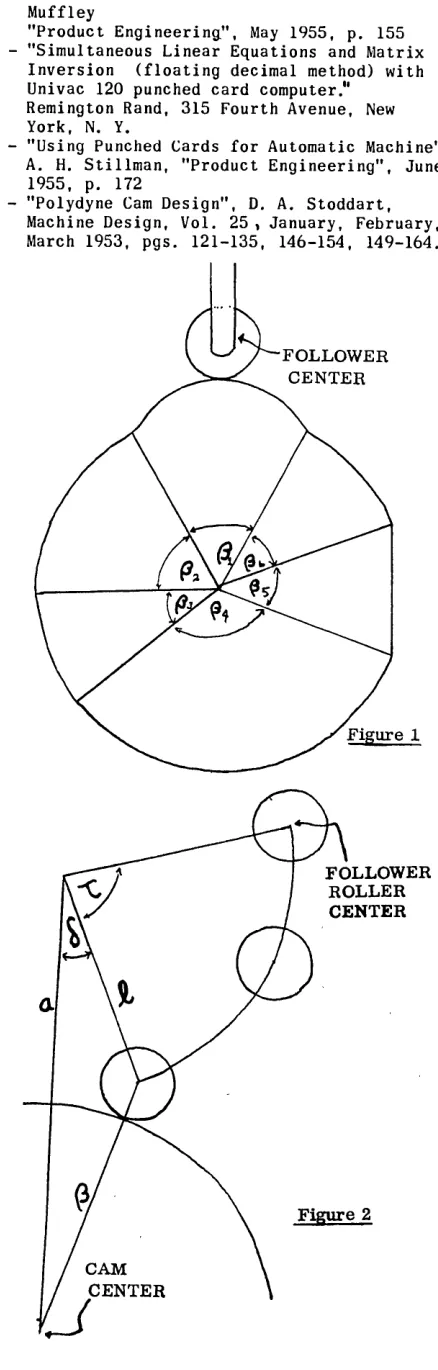
A cam is a device for imparting motion through another device called a follower which is always in contact with the cam. Motion is achieved by varying the lengths of the radii measured from the center of rotation of the cam. The follower cen-ter may be constrained to move along the radius of a cam in which case the motion is said to be radial or along the arc of a circle in which case we speak of non-radial motion. These moti~ns are illustrated in Figures 1 & 2.
The cam profile. consists of a series of smooth curves which incorporate the dynamic char-acteristics of the system and which have identical displacements, velocities and accelerations at the point where any two curves are joined. Well known curves used in the design of cam profiles qre the harmonic and cycloidal curves(l). In general, however, a profile can always be obtained in the form of a series of polynomials each of whose degree is one less than the number of conditions the polynomial must incorporate. Thus suppose that a polynomial in 9 is to have given displace-ment, velocity, acceleration and rate of change of acceleration characteristics at Q ~ 0 and at 9
=
~/. We shall suppose the follower center to have radial motion since the results need very little modification for non-radial motion.Let
t'Cp=
Ao
(~J
+A,{:J'
-I-A"
(:,r
-I-A3
(~.r+
Aq
(~.Y
-I-As
(;S
+
A,( :,)
with {Co) : C.
{"(o) -= <=s
{ Cr,)
:::. Ca...{" (PI)
=-
C,
{' (c)
=
C 3{hI
(0)
= C7{' (t,)
=c:::"
~~~
(r,) :.
CsImposing the above conditions leads to a system of eight simultaneous linear equations which are then solved to determine the A's.
These equations are conveniently solved on the Univac 120 by employing a routine(3) based on the method of direct elimination featuring floating point decimal arithmetic and good for matrices up to (15x15). If desired the system of equations can be solved for various sets of constants. For an ill x ill matrix (m~15) the total number of cards involved is
~ m (m + 1) On + 2n}
where n is the number of columns of constants that the equations are to be solved for. The computer time necessary to solve these m sets of equations is
J2 m (m +
n
(m t 2n) Average card speedThe average card speed is dependent upon the elements of the coefficient matrix. Having solved these equations, what is then desired is the eval uation ,of the resul ting polynomial at small intervals, say ~o. This gives the radii of the cam measured about an axis of rotation through the center of the cam. The polynomial is conveniently evaluated on the Univac 120 by using Horner's algorithm. Thus for
{(G)
=
Ao(~.)""'
+A.(~,)-'+
.... +
A_
J'
=
~
-~o p~
{ea+
'
=
e
{~ + A~+,,
t
'C 0,') ••.• 1m-IWhicnIequires ~ additions and m multiplications to get f(G). Permanent charts of radii for vari-ous angles can be made up if a curve is used'fre-quently. The results are produced in the form of punched cards. Information is then taken off the card and either tabulated on special drawing paper enabling a draftsman to construct a drawing of the cam profile or converted in the form of a paper tape by means of the Remington Rand Card-to-Tape Converter (Model 318). The resulting paper tape output is then fed into an automatic machine tool which cuts a cam having the specified profile. It has been found that cams of high quality can be produced by this process cheaper and faster than had previously been possible.
BffiLIOGRAPHY-1 - "Plate Cam Design", M. Kloomok and R. V. Muffley,
"Product Engineering", February 1955, p. 156
2. ,... "Plate Cam Design", M. Kloomok and R. V.
11
-Muffley
"Product Engineering", May 1955, p. 155 3 - "Simultaneous Linear Equations and Matrix
Inversion (floating decimal method) with Univac 120 punched card computer~
Remington Rand, 315 Fourth Avenue, New York, N. Y.
4 - "Using Punched Cards for Automatic Machine'~ A. H. Stillman, "Product Engineering", June 1955, p. 172
5 - "Polydyne Cam Design", D. A. Stoddart, Machine Design, Vol. 25) January, February, March 1953, pgs. 121-135, 146-154, 149-164.
FOLLOWER
0..
[image:11.594.317.536.32.717.2]SUPPLEMENTING ELECTRONIC EQUIPMENT
WITH A MODERN COMMUNICATIONS SYSTEM
Monroe M. Koontz Inland Steel
Co.
East Chicago, Ind.
ffieprin'ted by permission from "N. A. C. A. Bulletin", vol. 38, no. 5, Jan. 1957, published by the National ~ssociation of Cost Accountants, New York, N.Y.>
The paperwork structure upon which con-trol is based today does not have the physi-cal attributes needed in the transition to an eight hundred billion dollar economy in 1957. Growth of such magnitude means continued de-centralization and the accompanying increase in producing units. Each of these must be able to communicate to·produce efficiently. Overhead costs will increase geometrical.ly unless the basis-paperwork-of our present control technique is eliminated in large:chunks. It is intended, in this article, to relate the new array of office machines with the elements of control, to outline a broad perspective for improving their application, and to suggest changes in emphasis, with regard to office automation, which may be desirable to avoid what might be called a plateau of development,
i. e., the limitation of development to a fixed level.
In approaching automati~n of the office, many experts, busily applying well advanced knowledge in organization .management and trad-itional communication techniques, seem to have over looked the startling .poss ibi Ii ty that (ilys-ical communication facilities now in general use have become so old, technologically speak-ing, that they must be on the verge of super-annuation. Paradoxically - because the line of
progress for management, itself, lies in de-centralization--the best commercial potential of information processing system may lie in centralization or semi-centralization of com-munications and data processing. Decentrali-zation of industry puts a strain on over-all
control and also places a premium upon control at production locations. This dual need can be served. The executive span of control can be extended considerably by new electronic communications, and the massive ability of cen-tralized electronic systems to boil down rou-tines full of detail can be put to use at all levels.
Limited Means of Control
Limits the EconomY's Growth Potential
Our thinking should not be burdened by undue emphasis upon tradition either in de-vices or organization. Current and forth-coming developments will be best adapted to use in terms of their inherent characteris-tics, and these will impose a need for organ-izational as well as technical changes. The concept most vital to future planning is the analogy between sensory functions of the individual and what might be possible in the office. In the light of this concept, exist-ing organization concepts will metamorphose extensively. (After the change, the game of organizational chess may be resumed.) There is urgency. here. If communications are not given a new structure with a specific goal of tremendous acceleration, economical use of high-speed computers will be hampered and predicted business growth may achieve less than optimum results, and might outrun our ability to control it with paper, with par-tial stagnation following.
The central problem is that the span of business control is circumscribed substantially by paperwork. Accountants and managers know this well and admit it reluctantly. To reduce the burden of necessary detail by electronic communication and processing will augment the talents of our limited supply of managers and analysts, thus elevating the ceiling over new business growth.
organization, in itself a control tool. Organ-ization in turn encouraged prolific growth,
be-cause it lifted the limitations of single man-agement from the application of new technology potentials. By 1900, more than organization itself was needed. The size and expanded log-istics of business were getting beyond the personal grasp of the management representa-tive. The medium to supplement-and in turn to constitute--his control was paperwork: reports, charts, and a body of clerks to produce them.
The industrial accountant emerged simul-taneously to help decision makers screen vital facts. Paperwork tools,~hile not exclusive to the industrial accountant, do largely charac-terize his activity, because they include or-ganization charts, the card of accounts, and
the structure of reports to management. The accountant is traditionally oriented to paper-work and, in some situations, new paperpaper-work is
the only way to get control. However, it has natural limitations. These are time factors
(in terms of both cost and delay) for prepa-ration and transmission, plus a relatively moderate space for filing. Until the last few years, the volume and complexity of busi-ness had not progressed sufficiently for these limitations to hurt the operation, but the
in-exorabl~ establishment of mUltiple new communi-cation lines-paper vehicles for information-each time a new center of activity was set up, finally began to take its toll.
The Essence of Control Is Immediate Reaction
It is a real dilemma. Communication fa-cility must be improved for continued busine~
growth but, in the natural limitations of paperwork, will not change. The best we can hope for, without a basic divorcement of com-munications from paper, is to palliate the effects by simplification. However, the Amer-ican economy of 1975 can be commensurately profitable only if the controllers of busin~
go back to true fundamentals to achieve the controls they are seeking. Basically, these fundamentals, long pushed out of sight, re-semble in nature the original control endeav-ors of an owner of a business. On the current day scene, they take form as electronosensors, or the extension by mechanical and electronic facilities of human sight, hearing, and mem-ory, all interacting instantaneously to rele-gate details and synthesize action. All of the necessary facilities with which to enact this concept of control are on the market to-daY,and a combination of these with superior potentials can be 'cheaper, more reliable, and more effective within a given business unit than anything based upon messengers, pneumatic
13
-tubes, or medium distance wire transmission, such as telephone and telegraph extensions. These substitute facilities will be considered in greater detail and the use of true electrono-sensors will be explained. First, however, we need to restore to our consciousness the orig-inal model of control appraisal and action as it existed in the sole owner of the one-time typical small enterprise.
The successful, if archaic proprietor, ~
a data originating, processing and control system within himself. His shop contains most of the elements of the business- fixtures and inven-tory, a drawer or two containing his purchase and sales slips, and the hidden strongbox or stocking containing the rest of his net worth. His brain serves at once as:
1. The reporting system which corresponds to input in a modern machine installa-tion.
2. The data processing center containing sorting and merging abilities, pro-grams for economical purchasing, pay-ment of bills, and preparation of tax returns.
3. The reporting system which corresponds to output, as it is popularly termed today.
4. The evaluation system, which recogn~es
situations and generates action to stop pilferage, control waste, and develop policy based upon sales, cost and oper-ating experience.
From this oversimplification, several secondary considerations will place in per-spective the unsound claims that a multiply-ing vqriety of parallel, inadequate, and, for the most part, excessively costly developments in current management reporting and control technology will solve our problem. These secondary considerations emphasize the instan-taneous character of the original sole-owner control. We might visualize him talking to another or, by extension, we might imagine any number of proprietors or data originating and processing centers "talking" to each other. In the sole proprietor's bio-mechanical system,
1. There is visual contact with input. 2. There is auditory or hearing ~ontact
wi th input.
3. Communication is instantaneous. 4. Processing capacity depends upon the
size and speed of the memory.
5. Reports are drawn directly from mem-ory for the most part, rather than being transcribed to paper for tedious and delayed perusal.
6. Action may ,be taken quickly without paperwork.
Computers and Automation
correction is poor in the rest.
8. The element of top managerial surveil-lance may intervene at any time in every component of the system.
Expensive (and Doubtful) Developments in Data Transmission
The quest for ways in which to utilize advanced equipment for better control communi-cations goes on actively but not always effec-tively or along economical lines. Hundreds of engineers and management consultants across the country have been sinking millions of dollars into adapting known telephonic and telegraphic methods, along with paper tape or punched card originating equipment, to computer input. How-ever, most of these devices lack vision, hearing, and instantaneousness in varying combinations or altogether. Furthermore, they really increase paperwork because they require paper to bridge from one to another, and this, in turn, im-poses need for more hardware. The hardware, itself, has generated further input errors from compound circuitry and relays which sometimes fail. When errors occur, paper tapes impose exceptional difficulty in locating the point in question. A large insurance company indi-cates that it has discontinued paper tape
transmission, for this reason, to return to cards. One supplier has announced a machine, or rather a number of machines circuited to-gether, to produce cards and reports at vari-ous production points, but this system lacks vision and instantaneousness ,and, to couple it with logical (computing) ability, messengers will have to be hired to pick up the cards at each unit. Such a device, which cannot poss-ibly be used full-time on a decentralized basis, rents for more per month than the wages of an average clerk.
There are other still more expensive ways to communicate. Even these, because communi-, cation to a data evaluation center is so vital to control, have been pressed into service. One such means is represented by pneumatic tubes, which cost up to several hundred dollars per installed lineal foot. They are all but inflexible, once set, and fixed charges for a substantial installation will equal the wages of a number of people. They also lack sound, which must be supplied by telephone auxilaries,
and they lack the visual component altogether. Being built to transport physically full-scale paperwork, with its clerical preparation and timelag straits, they have relatively low transmission capacities.
Computers, Magnetic Storage - and the In pu t Problem
Moreover, communications must tend to
some point, or points, of collection and eval-uation. Hence, at this juncture, the data pro-cessing facility should be considered, i. e., how to use communicated data for comprehension and reaction. On a warship, this facility is a group of men and technological nerves to all quarters, termed a combat information center. In a plant, it is designated, variably, after many decades of progressive decentralization, as an office, whether mill, accounting, pro-duction control, shipping, or some other de-scriptive adjective. Superintendence of these offices has been centralized in waves as the spreading out process has caused them to be-come identifiably functionalized and, in this process, establishment or expansion of a staff function has coincided with each new wave. In all cases there is an input, mostly of paper-work. Communication channels are plant mail,
telephone, pneumatic tubes, and conferences. In a few recent cases, paper tape is the medium. And, like the old telephone company advertise-ment, es~ablishment of one new instrument where ten existed before required ten new lines of liaison, except that the lines have been lines of paper with clerks at both ends.
Electronic computers have entered this scene and are operating successfully in spite of the paperwork load at the input end but, so far, the most effective applications have been integrations of master data, which avoided a new flood of reports coming in. The latter are better absorbed into an integrated system over the time needed to redesign the basis of origination. Detailed liaison is needed all the way to the source in this endeavor. Once the paperwork has been adapted to the purpose, it can be readily filtered by a junior clerk with a keypunch machine so that the computer may be set up to handle the data. Data punch-ing on this ,basis is duplication of effort, again using paper, but the costs are more than overcome by some integration in processing. Thus, the computer is no problem as far as its internal operation is concerned but, in draw-ing more paper through the door of the machine room, the communication problem is accentuated. And the key-punch group becomes packed tighter than office standards permit.
In the light of these factors the present and potential economics of computers must be considered. What processing problems do they solve? Like the sole proprietor, they com-municate rapidly internally. They have sub-stantial processing capacity. Reports may be drawn directly from memory with moderate and ever-improving speed for management action. The problem of error correction now lies
of production reports from two adjacent units, for example, means that the computer can auto-matically produce inventory data between units and, usually, more than half of the external repetitiveness in data origination can be elim-inated. If production data be stored in a ran-dom access magnetic file, even the inventory reports can be eliminated, for all inventory data is available instantaneously and visually to anyone who has an interrogating connection between his office and the magnetic storage unit. If production orders were mechanized upon receipt, the external input concerning each order from each production process could be reduced about 65 per cent. l
Random access on the foregoing terms is a key point here. Announcements, since this paper began in preparation, have been most sig-nificant in terms of opening up the large ran-dom access memory capacity to provide memory characteristics like those of the sole propri-etor. It appears that the economy of magnetic storage is already getting to a point at which it will appear cheaper than cards on many jobs, but caution in applying it is still needed. Still other recently announced developments
are similarly indicative. One laboratory has a two-ended cathode ray tube with a metallic grid for permanent storage, capable of hold-ing one million bits on a square-inch-screen. Its speed is great because one end reads while the other end writes,and the screen is so small. Such a development in production would render obsolete discs and drums as to speed, space requirements, and capacity, and even this would ultimately be excelled. Nuclear physicists chat about the ideal as calculation and perhaps stor-age in a matrix of differentially chargeable molecules. Not only would computers built on such principles exceed by a factor of thous-ands anything available today; they would be ridiculously compact for their capacity, and possibly inexpensive after perfection of the necessary manufacturing processes. The upshot is that commercial memories will, in the near future, be capable of relegating the detailed input of the business to storage for reference by the computing component as needed, just as in the sole proprietor's mind. But the tool will be expanded to the proportions of the
economy as we know it, and it will be more capacious, more speedy and potentially less erroneous than the proprietor ever was. That is fine. However, its very instantaneousness is also silly if messengers are coming in eight to twenty-four hours late with the input.
IBased on a survey of two production centers made for purposes of this discussion. The percentage will vary depending upon the sys-tem and the degree of integration.
There is little purpose in not glvlng large scale instant storage an input when the event occurs, and this is the strongest argument against large centralized computer facilities until communication facilities can be improved.
Another factor of uselessness, i.e., ir-relevance of advantages of speed and capacity, inheres in any lack of accuracy in input as long as computers are expensive. With an I. B. M. 650, for example, input may range up to a maximum of over 900,000 digits per hour. Even if only'three of these are wrong'enough
to stop the machine and it takes only two min-utes to correct each one, 10 per cent of the capacity has been lost. On larger machines this item is so important that some installa-tions have a machine scheduler (the 705 does over 40,000 logical operations per second) to enforce nondelaying procedures. If an error stops the machine more than a very few minutes, the memory must be dumped by the hapless oper-ator so that the next person in line may get to his problem. The price of delay is over $150 per hour.
These considerations reinforce the need for development of reliable, inexpensive,
plant-wide data recording and transmission systems, which can provide audio and visual contact with low origination error ratio. It appears that such systems also may be the key to decentralization of memory elements of a unifiable computer complex in various loca-tions. For example, if a number of memory devices can be hooked electronically into central, their distance from the unit is
mere-ly the length of the connection, and distance does not occasion the delays of traditional input-output via paper linkages. It is the instantaneous merging of plant-wide data that matters. Nevertheless, the best commercial use of a computer installation currently implies centralization because:
1. Personnel acquainted with the interaction of computer and commercial systems are too scarce and too expens i ve to Its pread thin" •
2. The new category of communications-data originating control expert which will have to be brought into existence in the manufacturing establishment does not ex-ist, although materials are available to start training.
3. A large memory is not yet adequately adaptable to decentralization, which would remove it from the computing unit and the master file systems. A large magnetic memory is needed for paperwork elimination, rather than simplification, and elimination occurs when master files are integrated. Presently applied com-munications are not adequate, either in
-Computers and Automation
terms of facilities or personnel, to as-sure high-speed integration of decentral-ized memory components with the presently developed heart of the system, i.e., cards, tapes, and programs.
4. Integration of related master data simul-taneously reduces input error ratios and reduces the need for duplicating data from external sources.
5. The reduction of external input gained by centralized integration would reduce the load on the communication system, rendering it more effective for a given outlay.
6. Concentration of data improves computer payoff and builds necessary knowledge of techniques in the organization. The loading of a medium-size machine must be effected rapidly to justify the econ-omy of larger equipment. Cost per cal-culation on a loaded 705 would be less than 10 per cent of that on a loaded 650, in terms of rental alone. 7. Larger capacity units handle greatly
more complex logistical and research problems, which provide greater payoffs than straight commercial applications, to supplant today's generally unsophis-ticated analyses.
8. Complaints already have been heard that all of the fastest computers available cannot handle computer demand, either in terms of volume {this is on a nation-al basis} or in terms of problem com-plexity • . ftdvancement of the art is cer-tain to bring more demands.
A Proposal for Control Communications by Monitored Television
The limitations in data transmission and input, along with other limitations which have just been described, would be discouraging, were it not that modern components are
avail-able to'develop a reporting system lower in cost than any complex of traditional paperwork adapted to 50-year-old communications technol-ogy to ease its burden. Such a system can command the economy of integration in a high-speed processing organization, provide channels for extremely heavy volumes of transmission, and provide audio-visual contacts among many points. The proposal involves television cam-eras for data transmission. They may be
ob-tained for prices under $1,000 per unit, ranging up to two or three times that amount for units having combinations of remotely
con-trolled multiple turret lenses, sound, and weather protection components.
Scanning tube developments in recent months already have reduced prices. The in-dustry, by means of printed circuits, other
innovations, and volume demand for industrial applications, undou'btedly could cut prices 50 per cent in coming years. Units may be port-able. They require no programming as in the case of tape or card punching gadgetry_ Co-axial connections from cameras to monitors at about a dollar a foot would
pe'
far shorter and cheaper than multiple-circuited mechanical data originators wired to messenger service or connected all the way to central. Reli-ability of camera operation is superior and maintenance simple. If an unusual mainten-ance problem occurs, another unit may be plugged in while repairs are made.In contrast to tape-punching equipment, which costs $2,000 to $4,000 per originator
and receiver, a variety of forms can be trans-mitted by camera without programming, thus rendering floor da'ta simi taneous ly adaptable to local use and data transmission within reasonable limits. The need for originators would be greatly condensed. If a number of stations are multiplexed to the monitor, ml-tiplexing is electronic and visually instan-taneous, whereas older devices multiplex me-chanically and far more slowly. These charac-teristics are vital to high-speed, high volume data origination and processing, and also re-store the opportunity for visual management surveillance of operations.
A description of what should happen to data will make the proposal concrete. Most readers will have observed that data
origina-tion is only a part-time job for many produc-tion recording clerks, although they are writ-ing their reports in slow longhand. Because of this fact, a semi-centralized monitoring station {which would also really be a decen-tralized outpost of machine accounting}, should be able to handle in practical fashion the data from ten or more points in the plant. For ex-ample, a common work situation at present is a recording 60 per cent to waiting 40 per cent ratio. Based upon the survey referred to in a
previous paragraph, 65 per cent of the data formerly ~andwritten at all points would be in computer room master files - in the integrated system- and this would cut the data originating factor required for each point to 20 per cent at the monitor. At the monitor, the usual three-for-one speed advantage of keyed over handwritten data would apply, thus reducing the data origination time for each point moni-tored to an average of 6 2/3 per cent. This estimate is conservative, because it has not been factored further to adjust for better skilled personnel,or the enhancement of speed which occurs in the contemplated range of
work time, and now done in the computer.
It is seen that data relaying and visual switching from the monitors will depend upon a type of control communications personnel generally new to industry. To obtain the necessary accuracy for unimpeded volume of external input to the computer, it also is probable that these persons would perform every entry twice to obtain verification on the spot before triggering their transmissions. However, except for salary levels, these per-sons would cost nothing if their work were loaded properly. They would offset equiva-lent personnel otherwise employed in the ma-chine room. Training of monitor personnel would correspond to that of, say, railroad
telegraphers or nautical radiomen, and would cover data origination and control techniques, operating practices at points scanned in the local complex, and, to some extent, the com-puter programs for processing its particular data. The personnel would service, in re-verse, any data from the central unit requested for local analysis or control purposes. It is likely that the data transmission component of carrier waves from monitors would preferably use key punching equipment or an adaptation. So far, it is better than other types of
de-vices in reliability of operation. Monitors further would need policy enforced control or disciplinary procedures 9ver the stations under their observation.
Completed entry and verification of weights, counts, and simple order ,indicia would be signalled from monitor to camera by a green light, advising the material handler that production has been recorded. From the monitor to the computer, a private micro-wave transmission system (these units also contain the camera multiplexing circuits) can be en-gineered economically for all but small plants. Simultaneous visual and data transmission on
one carrier beam is obtainable either by "band splitting," which is using parts of the trans-mitter's wave band for different channels, or by use of extra transmitters. Thus, manage-ment could get visual contact, with one or more points per transmitter, without inter-rupting flow of data to the processing machine.
A transmitting-receiving combination with the necessary multiplexing system reportedly is available for $30,000 or less, although elaborate units cost more. If ultra-high frequencies (up to 10,000 megacycles are available) are used, signals may be beamed thirty miles with ridiculously low power-less than 10 watts -and by using only moder-ately high towers. The plant roof is often high enough to mount the antenna without con-structing a tower. The high frequencies lie outside the range of static for all practical
17
-purposes. Compared with this medium, pneumatic tubes are poor. With the latter, coverage of a few points over a maximum range of 1000 feet may cost over $100,000 and have lower trans-mission capacity. The wavelength of a 10.000 megacycle frequency is about l~ inches. Trans-mitting-receiving antennas are "dishes" as small as a few inches in diameter and precisely aimed at each other.
Incoming data at the processing location would be recorded either on film (tapes) or go directly to random access storage. The data, although verified, might be occasionally erron-eous, but a small residue of error can be cor-rected to some extent by the processing machine because of the integration of the system. Stock checks on the production floor would be minimized, compared with the present-day situ-ation.
Most day-to-day reports to management, reduced by the programming of the system to exceptions, would be drawn from the process-ing machine in summary, and visual form only. Details would be fed out to operations visu-ally for the most part, by a system of inquiry units. Data required for historical compari-sons could be merged gradually into index or percentage figures. It is availability of figures such as these, now in relatively mea-ger supply throughout industry, that helps/ the operating team to pull together for the best of the over-all enterprise.
Fully detailed data would be dumped periodically out of memory as needed for audit, or for permanent and minimized cost, financial, and inventory records.
Some Problems in Applicable Equipment and Methods
The television industry has concentrated on home receivers. As a consequence, all pro-ducers of equipment are largely standardized for a 525 line vidicon scanner, which cannot legibly transmit small print on many current business forms. This can be overcome by op-tical systems feeding smaller areas into the scanner or by redesign of the form to provide smaller volume of somewhat larger print- in the transmission. Another- tube called-an image orthocon develops 750 lines for the screen, but it costs about $1,250 compared to about $280 for the vidicon. There is no question that finer scanners can be engineered for higher prices and that all prices will de-crease over a period of time. Of course, the vidicon should be adequate for most purposes, although finer equip~nt is theoretically de-sirable for, say, fine photo-copy work if the data system develops around that particular