MPQA 3.0: An Entity/Event-Level Sentiment Corpus
Lingjia Deng
Intelligent Systems Program
University of Pittsburgh [email protected]
Janyce Wiebe
Intelligent Systems Program Department of Computer Science
University of Pittsburgh [email protected]
Abstract
This paper presents an annotation scheme for adding entity and event target annotations to the MPQA corpus, a rich span-annotated opin-ion corpus. The new corpus promises to be a valuable new resource for developing sys-tems for entity/event-level sentiment analysis. Such systems, in turn, would be valuable in NLP applications such as Automatic Question Answering. We introduce the idea of entity and event targets (eTargets), describe the an-notation scheme, and present the results of an agreement study.
1 Introduction
Much work in sentiment analysis and opinion min-ing is at the document level (Pang et al., 2002; Turney, 2002). There is increasing interest in more fine-grained levels - sentence-level (Yu and Hatzivassiloglou, 2003; McDonald et al., 2007), phrase-level (Choi and Cardie, 2008), aspect-level (Hu and Liu, 2004; Titov and McDonald, 2008), etc. We specifically address sentiments toward en-tities and events (i.e., eTargets) expressed in data such as blogs, newswire, and editorials. A system that could recognize sentiments toward entities and events would be valuable in an application such as Automatic Question Answering, to support answer-ing questions such as “Toward whom/what isX neg-ative/positive?” “Who is negative/positive toward
X?” (Stoyanov et al., 2005). Or, to augment an automatic wikification system (Ratinov et al., 2011) – in addition to relationships such as spouse and
parents, the system could include information about
whom or what the subject supports or opposes. A re-cent NIST evaluation – The Knowledge Base Popu-lation (KBP) Sentiment track1— aims at using
cor-pora to collect information regarding sentiments ex-pressed toward or by named entities.
Annotated corpora of reviews (e.g., (Hu and Liu, 2004; Titov and McDonald, 2008)), widely used in NLP, often include target annotations. Such targets are often aspects or features of products or services, and as such are somewhat limited.2
Recently, to create the Sentiment Treebank (Socher et al., 2013), researchers crowdsourced an-notations of movie review data and then overlaid the annotations onto syntax trees. Thus, the tar-gets are not limited to aspects of products/services. However, annotators were asked to annotate small and then increasingly larger segments of the sen-tence. Thus, the annotations are mixed in the de-gree to which context was considered when making the judgements. Previously, we (Deng et al., 2013) annotated a corpus of non-review data with senti-ments toward entities, but only for those that partic-ipate in certain types of events. In all of the above corpora, the only sentiments considered are those of the writer, excluding sentiments attributed to other entities.
The MPQA opinion annotated corpus (Wiebe et al., 2005; Wilson, 2007) is entirely span-based, and contains no eTarget annotations. However, it pro-vides an infrastructure for sentiment annotation that is not provided by other sentiment NLP corpora, and
1http://www.nist.gov/tac/2014/KBP/Sentiment/index.html 2For example, as stated in SemEval-2014: “We annotate only aspect terms naming particular aspects.”
is much more varied in topic, genre, and publication source. This paper addresses adding eTarget annota-tions to the MPQA corpus; we believe that the result will be a valuable new resource for the community.
2 From MPQA 2.0 to MPQA 3.0
To create MPQA 3.0, entity-target and event-target (eTarget) annotations are added to the MPQA 2.0 annotations.3 The MPQA annotations consist of
private states, which are states of sources holding
attitudes toward targets. In the MPQA 2.0 anno-tations, the top-level annotations are direct subjec-tive (DS) and objective speech event annotations. DS annotations are for private states, and objec-tive speech event annotations are for objecobjec-tive state-ments attributed to a source. An important property of sources is that they are nested, reflecting the fact that private states and speech events are often em-bedded in one another.
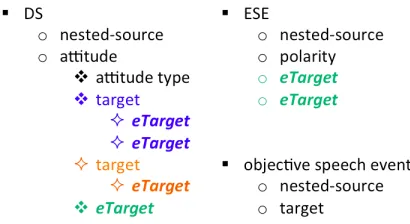
As shown in Figure 1, one DS may contain links to multipleattitudeannotations, meaning that all of the attitudes share the same nested source. The atti-tudes differ from one another in their attitude types, polarities, and/or targets. There are several types of attitudes included in MPQA 2.0 (Wilson, 2007; So-masundaran et al., 2007), including sentiment and arguing. This work focuses on sentiments, which are defined in (Wilson, 2007) as positive and nega-tive evaluations, emotions, and judgements.
MPQA 2.0 also containsexpressive subjective el-ement (ESE) annotations, which pinpoint specific expressions used to express subjectivity (Wiebe et al., 2005). An ESE also has a nested-source an-notation. Since we focus on sentiments, we only consider ESEs whose polarity is positive or negative (excluding those marked neutral).
The target-span annotations in MPQA 2.0 are linked to from the attitudes. More than one target may be linked to from an attitude, but most atti-tudes have only one target. The MPQA 2.0 anno-tators identified the main/most important target(s) they perceive in the sentence. If there is no target, the target-span annotation is “none”. However, there are many other eTargets to be identified. First, while ESE annotations have nested sources, they do not have any target annotations. Second, there are many
[image:2.612.323.528.60.172.2]3Available at http://mpqa.cs.pitt.edu
Figure 1: Structure in MPQA 3.0.
more targets that may be marked than the major ones identified in MPQA 2.0. In Figure 1, the eTargets are what we add in MPQA 3.0. We identify the blue (or-ange) eTargets that are in the span of a blue (or(or-ange) target in MPQA 2.0. We also identify the green eTar-gets that are not in the scope of any target.
Since our priority was to add eTargets to senti-ments, no eTargets have yet been added to objective speech events, as shown in Figure 1.
To create MPQA 3.0, the corpus is first parsed, andpotentialeTarget annotations are automatically created from the heads of NPs and VPs. The annota-tors then consider each sentiment attitude and each polar ESE, and decide for each which eTargets to add. By adding eTargets to the existing annotations, the information in MPQA 2.0 is retained. Before presenting the scheme, we first give some examples.
2.1 Examples
For each example, a subset of the annotations are shown. The phrase in blue is an attitude span, the phrase in red is a target span, the tokens in yellow are the eTargets which are newly annotated in MPQA 3.0. The underlined phrases are ESE spans. Each example is followed by the MPQA structure of the annotations.
to-ward the insult event. And, the nested source isw, imam.
Ex(1) When the Imam issued the fatwa against Salman Rushdie for insulting the Prophet...
DS: issued the fatwa
nested-source: w, imam
attitude: issued the fatwa against
attitude-type: sentiment-negative target: Salman...insult...Prophet
eTarget: Rushdie, insulting We find two eTargets in the target-span: “Rushdie” himself plus his act of “insulting.”
In the same sentence, there is another negative at-titude, insulting, as shown in Ex(2). The source is
Salman Rushdieand the target isthe Prophet. Note that the span covering this event is the target span of the attitude in Ex(1) — the private state of Ex(2) is nested in the private state of Ex(1). Thus, the com-plete interpretation of the negative attitude in Ex(2) is: according to the writer, the Imam is negative toward Rushdie insulting the Prophet. The nested source isw, Imam, Rushdie.
Ex(2) When the Imam issued the fatwa against Salman Rushdie forinsulting the
Prophet ...
DS: insulting
nested-source: w, imam, rushdie
attitude: insulting
attitude-type: sentiment-negative target: the Prophet
eTarget: Prophet
We add an eTarget for the Prophet, anchored to the head “Prophet.” Interestingly, “Prophet” is an eTarget for w,Iman,Rushdie (i.e., Rushdie is nega-tive toward the Prophet), but not for w,Imam (i.e., the Imam is not negative toward the Prophet).
In the following example, the target span is short. Ex(3) He is therefore planning to
trigger wars ...
DS: (entire sentence)
nested-source: w
attitude: planning to trigger wars
attitude-type: sentiment-negative target: He
eTarget: He
eTarget: planning, trigger, wars
“He” is George W. Bush; this article appeared in the early 2000s. The writer is negative toward Bush because (the writer claims) he is planning to trig-ger wars. As shown in the example, the MPQA 2.0 target span is only “He,” for which we do create an eTarget. But there are three additional eTargets, which are not included in the target span. The writer is negative toward Bush planning to trigger wars; we make sense of this by inferring that the writer is neg-ative toward the idea of triggering wars and thus to-ward war itself.
Ex(4) Three leading international organ-isations warned jointly Thursday that
the international fight against terror-ism should not be a pretext for the
violation of human rights.
DS: warned
nested-source: w, threeint
attitude: warned
attitude-type: sentiment-negative target: the international ... rights
eTarget:be, pretext, violation
ESE: pretext
nested-source: w, threeint
polarity: negative
eTarget: pretext
“pre-text” is identified as a negative ESE annotation in the MPQA 2.0 supports this as well.
There is a difference between ESE and attitude eTarget annotations. Since ESE annotations pin-point specific wording used to express subjectivity, ESE eTargets are annotated more narrowly than atti-tude eTargets. For ESEs, the eTargets are the entities and events that are directly evaluated by the expres-sion, while, for attitudes, the eTargets include all en-tities and events toward which the attitude holds (as we saw in the examples above). For example:
Ex(5) ... because the hard-line wing in the US administration comprising Vice President Dick Cheney ...
DS: (entire sentence)
nested-source: w
attitude: hard-line
attitude-type: sentiment-negative target: wing in the .. Dick Cheney
eTarget: wing, Cheney
ESE: hard-line wing
nested-source: w
polarity: negative
eTarget: wing
The ESE has only one eTarget, “wing,” while the attitude has two: “wing” and “Cheney.”
2.2 MPQA 3.0 Annotation Scheme
AneTargetis an entity or event that is the target of a sentiment (identified in MPQA 2.0 by a sentiment attitude or polar ESE span). The eTarget annotation is anchored to the head word of the NP or VP that refers to the entity or event, and hasthree slots: id
(unique within the document),isNegated(yesorno), and type (entity or event; note that event includes both states and events). TheisNegated = yesoption is for the case where the eTarget is the negation of the event referred to by the head word, for example, when the source is positive toward someone not do-ing somethdo-ing.
Anattitudehas one or more target-span annota-tions in MPQA 2.0. We provide two slots for thekth target annotation. k-targetSpan shows the kth tar-get span. k-eTarget-linkis to be filled with a list of ids of eTargets whose text anchors are within thekth
target span. An additional slotnew-eTarget-linkis to be filled with a list of ids of other eTargets.
Each eTarget of an ESEhas two slots, one for the eTarget id, and one for an attribute,isReferedInSpan
(yes, orno). The value isyesif the eTarget is referred to in the ESE span.
3 Agreement Study
We developed the manual via iterative annotation, discussion, and revision. Once the manual was de-veloped, we participated in an agreement study.
For the formal agreement study, one document was randomly selected from each of the four topics of the OPQA subset (Stoyanov et al., 2005) of the MPQA corpus. They were not any of the documents used to develop the manual. We then independently annotated the four documents. There are 292 eTar-gets in the four documents in total.
To evaluate the results, the same agreement mea-sure is used for both attitude and ESE eTargets. Given an attitude or ESE, let set A be the set of eTargets annotated by annotatorX, and setBbe the set of eTargets annotated by annotatorY. Following (Wilson and Wiebe, 2003; Johansson and Moschitti, 2013), which treat each setA andB in turn as the gold-standard, we calculate the average F-measure, denotedagr(A, B). Theagr(A, B)is 0.82 on aver-age over the four documents, showing good agree-ment:agr(A, B) = (|A∩B|/|B|+|A∩B|/|A|)/2.
4 Disagreement Analysis
One issue is whether an attitude toward an entity or event is indeed communicated in the sentence. Con-sider this sentence: “PresidentMugabe’sreelection
has beenpraised byOAU.” TheOAUis positive to-ward “reelection,” which is an eTarget both annota-tors mark. The question is whether it is also commu-nicated in this sentence that the OAU is also positive toward “Mugabe.” X did not mark Mugabe as an eTarget, whereasY did. During the subsequent dis-cussion,Xnow agrees that it should be marked. In general, X was using what we now consider to be a too conservative policy. Overall, 29% of all dis-agreements are of this type of borderline case.
intensities4. When there are new eTargets which are
not in any target span, annotator X splits the new eTargets into different attitudes based on the inten-sity, while annotatorY adds the new eTargets to all the attitudes regardless of intensity. Later the an-notators discuss to decide which attitude each new eTarget should be linked to in the final version.
31% of the disagreements are caused by negli-gence, meaning an annotator realized, during later discussion, that she should have included an eTarget when she saw that the other annotator had included it.
The remaining disagreements are due to annotator mistakes such as filling in the wrong id.
5 Current Corpus
The current corpus consists of 70 documents, in-cluding the subset of the documents in MPQA 2.0 that come from English-language sources (i.e., that are not translations) and a subset of the OPQA sub-set in MPQA 2.0. A subsub-set contains consensus an-notations of X andY and the rest were annotated by Y. The 70 documents have 1,029 ESEs, 1,287 attitudes, and 1,213 target spans of attitudes (exclud-ing the target span that are marked as “none”) from MPQA 2.0; they have 4,459 eTargets in total. We added 1,366 eTargets to the ESEs and 1,608 eTar-gets to the target spans. We added 1,485 eTareTar-gets which are not in any target span.
6 An Example
In this section, we present an example from the OPQA subset (Stoyanov et al., 2005) to demonstrate how eTargets could help to automatically answer a question. There are opinion and fact questions for each document in the OPQA subset. The sentence below is annotated in MPQA 2.0 to answer the ques-tion, “Is the US Annual Human Rights Report re-ceived with universal approval around the world?” Here the writer is negative toward the report.
It is due to this hegemony, which the United States wants to maintain, that its State Department makes an assessment of the human rights situation in different
4In MPQA 2.0, an attitude is marked with an intensity (low, medium, or high) representing the intensity.
countries and prepares a report on their violations all over the world.
The annotations in MPQA 2.0: S1:hwriter-US, positive, hegemonyi S2:hwriter, negative, the United Statesi ESE1:hwriter, negative, N/Ai
First, it is possible for a state-of-the-art system to be trained to recognize the sentiment S1, by the
maintaining phrase and syntax information. But it would be difficult to find S2. There is no direct sen-timent modifying the US, nor is there any sensen-timent or ESE annotation towardmaintainorhegemonyin MPQA 2.0. Now, in MPQA 3.0, we add the eTarget of the ESE1, so that it becomes hwriter, negative, hegemonyi. This is a critical step, because the com-plete ESE bridges the two sentiments together.
Second, even though we have the two sentiments and the ESE, there is still a gap betweenthe United States in the sentence and report in the question. One of the eTargets we add is “report.” It is more feasible for a co-reference system to recognize re-port in both the sentence and the question as the same thing, than recognizing thatthe United States
andreportrefer to the same concept.
Third, in this sentence, according to the newly added eTargets, the system knows the writer is nega-tive toward boththe United StatesandState Depart-ment. When building a knowledge base about the human rights report, this reveals that the two entities have the same stance toward this topic, even without any world knowledge.
7 Conclusion
This paper presents an annotation scheme for adding entity and event target annotations to the MPQA cor-pus. A subset of MPQA has already been annotated according to the new scheme. We believe that the corpus will be a valuable new resource for develop-ing entity/event-level sentiment analysis systems to facilitate NLP applications such as Automatic Ques-tion Answering.
References
Yejin Choi and Claire Cardie. 2008. Learning with com-positional semantics as structural inference for subsen-tential sentiment analysis. InProceedings of the Con-ference on Empirical Methods in Natural Language Processing, pages 793–801. Association for Compu-tational Linguistics.
Lingjia Deng, Yoonjung Choi, and Janyce Wiebe. 2013. Benefactive/malefactive event and writer attitude an-notation. InACL (2), pages 120–125.
Minqing Hu and Bing Liu. 2004. Mining and summa-rizing customer reviews. In Proceedings of the tenth ACM SIGKDD international conference on Knowl-edge discovery and data mining, pages 168–177. ACM.
Richard Johansson and Alessandro Moschitti. 2013. Relational features in fine-grained opinion analysis. Computational Linguistics, 39(3):473–509.
Ryan McDonald, Kerry Hannan, Tyler Neylon, Mike Wells, and Jeff Reynar. 2007. Structured mod-els for fine-to-coarse sentiment analysis. In Annual Meeting-Association For Computational Linguistics, volume 45, page 432. Citeseer.
Bo Pang, Lillian Lee, and Shivakumar Vaithyanathan. 2002. Thumbs up?: sentiment classification using ma-chine learning techniques. InProceedings of the ACL-02 conference on Empirical methods in natural lan-guage processing-Volume 10, pages 79–86. Associa-tion for ComputaAssocia-tional Linguistics.
Lev Ratinov, Dan Roth, Doug Downey, and Mike An-derson. 2011. Local and global algorithms for dis-ambiguation to wikipedia. InProceedings of the 49th Annual Meeting of the Association for Computational Linguistics: Human Language Technologies-Volume 1, pages 1375–1384. Association for Computational Linguistics.
Richard Socher, Alex Perelygin, Jean Y Wu, Jason Chuang, Christopher D Manning, Andrew Y Ng, and Christopher Potts. 2013. Recursive deep models for semantic compositionality over a sentiment treebank. InProceedings of the Conference on Empirical Meth-ods in Natural Language Processing (EMNLP), pages 1631–1642. Citeseer.
Swapna Somasundaran, Theresa Wilson, Janyce Wiebe, and Veselin Stoyanov. 2007. Qa with attitude: Ex-ploiting opinion type analysis for improving question answering in on-line discussions and the news. In In-ternational Conference on Weblogs and Social Media, Boulder, CO.
Veselin Stoyanov, Claire Cardie, and Janyce Wiebe. 2005. Multi-Perspective Question Answering us-ing the OpQA corpus. In Proceedings of the Hu-man Language Technologies Conference/Conference
on Empirical Methods in Natural Language Process-ing (HLT/EMNLP-2005), pages 923–930, Vancouver, Canada.
Ivan Titov and Ryan T McDonald. 2008. A joint model of text and aspect ratings for sentiment summarization. InACL, volume 8, pages 308–316. Citeseer.
Peter D Turney. 2002. Thumbs up or thumbs down?: semantic orientation applied to unsupervised classifi-cation of reviews. InProceedings of the 40th annual meeting on association for computational linguistics, pages 417–424. Association for Computational Lin-guistics.
Janyce Wiebe, Theresa Wilson, and Claire Cardie. 2005. Annotating expressions of opinions and emotions in language ann. Language Resources and Evaluation, 39(2/3):164–210.
Theresa Wilson and Janyce Wiebe. 2003. Annotating opinions in the world press. InProceedings of the 4th ACL SIGdial Workshop on Discourse and Dialogue (SIGdial-03), pages 13–22.
Theresa Wilson. 2007. Fine-grained Subjectivity and Sentiment Analysis: Recognizing the Intensity, Polar-ity, and Attitudes of private states. Ph.D. thesis, Intel-ligent Systems Program, University of Pittsburgh. Hong Yu and Vasileios Hatzivassiloglou. 2003. Towards