3941
©IJRASET: All Rights are Reserved
Smart Helmet
N L Lokhande1, P R Bhole2, M L Patel3
1,2,3Department of Electronics & Telecommunication, KBC North Maharashtra University, Jalgaon
Abstract— The main objective of this paper is to build a safety system which is integrated with the smart helmet and intelligent bike to reduce the probability of two-wheeler accidents and drunk drive cases. The Limit switch checks if the person wearing the helmet or not. Alcohol Sensors detect the alcoholic content in riders’ breath. If the rider is not wearing the helmet or if there is any alcohol content found in rider’s breath, the bike remains off. The bike will start until the rider wears the helmet and if there is no alcoholic content present .As the bikers in our country are increasing, the road mishaps are also increasing day by day, due to which many casualties, most of them are caused due to most common negligence of not wearing the helmets, and also many deaths occur due to lack of prompt Medical attention needed by the injured person. This motivates us to think about making a system which ensures the safety of biker, by making it necessary to wear helmet, as per government guidelines, also to get proper and Prompt medical attention, after meeting with an accident.
Keywords - Helmet, Alcohol, GSM, GPS, Bluetooth
I. INTRODUCTION
There is an alarming increase in the morbidity and mortality due to two wheeler road traffic accidents. This has been a matter of great concern globally. In India, it is estimated that one accident takes place every 2 minutes. Data from the National Crime Records Bureau indicates that deaths and injuries related to road traffic accident has increased two and four fold respectively during the period of 1991-2005. Reportedly 98,254 persons were killed in 2005 on Indian roads. The occupants and riders of two wheeler vehicles are among the majority to be affected in road traffic accidents. Two wheeler accidents have also been shown to have maximum case fatality in accidents. Despite of the safety rules made by the government, many riders fail to abide by them. The riders in India often bypass the prime rule of wearing the helmet while riding bike. This leads to fatal injuries to the rider in case of accidents. Apart from manual checking, there needs to be a system that could enforce this rule upon the riders and hence prevent them from bypassing it. One of the prime reasons that leads to accidents is drunk and drive. Due to drinking and driving two wheeler riders often get into accidents. Almost 70 prevented if the rider stop consuming alcohol before riding. The people involved in the accidents need to be taken care of and immediately taken to the emergency room. But there is a lag in handling the aftermath of road accidents in the country. The nearby police station needs to be notified immediately about the accidents so that they can be taken to the hospitals immediately.
The monitoring of physiological signals using wearable devices is increasingly becoming a prerequisite for the assessment of the state of body and mind in natural environments. This has been facilitated by small-scale analogue and digital integrated circuit technology, together with on-chip processing power for dealing with movement induced artifacts in bio potentials, which are present when performing daily activities. Physiological signals recorded in real life tend to be notoriously weak and with a low signal to- noise ratio (SNR). To this end, an amplifier with a high common mode rejection ratio is required; such high quality bio appliers are typically integrated into the analogue front end of large stationary devices. Because of the many leads and electrodes required, such devices are well suited for clinical environments, where patients are normally stationary, so that the noise level is relatively low.
Nowadays helmets have been made obligatory in Maharashtra kingdom. Traffic accidents in India have increased yr. via year. As in step with section 129 of motor cars act, 1988 makes it required for every person using a two-wheeler to put on defensive headgear following to standards of the BIS (bureau of Indian requirements). In India drunken drive case is a criminal offence of the motor vehicle act 1939. Which states that the motorcycle rider will get punish. In Lifestyles bike rider without problems get escaped from regulation there are the many predominant motives us for observe this undertaking.
The usage of maps require common stops navigators distract the biker's interest and now not secure to be operated on to move. Motorcyclists want get admission to maps much like absolutely everyone else, but counting on a touch-display screen GPS, cell phone, or whipping out a paper map isn't pretty as secure whilst there's not anything protective the motive force from the outdoor world.
II. LITERATUREREVIEW
A. Smart Helmet Using GSM and GPS Technology:
3942
©IJRASET: All Rights are Reserved
that is an accident. Whenever the accident will occur then accident spot will be note down and information will send out on the noted mobile number.
The major disadvantage of this project is they are not using any display device for showing the current status. Also the cost of helmet is still high since helmet is designed for only one purpose.
The Author has discussed safety and security of the bikers against road accident. Smart helmet has special idea which makes motorcycle driving safety than before, this is implemented using GSM and GPs technology. Other advantages of this project is to measure the alcohol level of the drunken people who is riding the bike. Whenever the alcohol level crosses the predefined value, the alarm starts and get notification about the drunken driver. The author have also discussed about the accident detector and the sensor will active the GPS and find the location and further SMS will send to ambulance or family members. As they have used microcontroller for controlling their overall operation due to that the project will might be fail to upgrade newer versions.
B. Helmet using GSM and GPS Technology for Accident Detection and Reporting System:
According to the author this project is specially developed as to improve the safety of the motorcycle’s rider. The objective of this project is to study and understand the concept of RF transmitter and RF receiver circuit. The project uses ARM7, GSM and GPS module. The project also uses buzzer for indication purpose. This project is only concentrated on only one specific purpose that is an accident. Whenever the accident will occur then accident spot will be note down and information will send out on the noted mobile number. The major disadvantage of this project is they are not using any display device for showing the current one purpose.
C. Microcontroller based Smart Wear for Driver Safety
In this paper author has discussed on the speed of the vehicle. In this application the project will be monitoring the areas in which the vehicle will be passing. On entering any cautionary areas like schools, the speed of the vehicle will be controlled to a predefined limit. He worked on the phenomenon of speed of vehicle along with some security factor. LCD is used for showing the various types of messages after wearing the helmet.
The author has worked only on the phenomenon of accident which is generally happens due to drunk and drive. But as we know that the accident in the area is not happens only due to consuming alcohol but also other parameters are also responsible.
D. Smart Helmet
In this paper the prime objective of author is to force the rider to wear the helmet throughout. Considering the increasing number of motorcycle riders in our country and the number of accident happening each year. In this competitive world one of the survey says that the death tolls due to motor bike accidents are increasing day by day out of which most of these casualties occurs because of the absence of helmet. Traffic police cannot cover remote roads of city. That’s why over primary target is to make the usage of the helmet for two wheelers “compulsory” .Thus no one other than the owner himself ,who doesn’t have “password” which would have been created by the owner, can use the bike. In this author has proposed the feature that the bike will not start unless the helmet is not worn by the rider .The other this module basically deals with the checksum of rider if he is wearing the helmet or not on first place to achieve this ultrasonic sensor is been used .based on this the signal are been sent to the next module voice recognition module use for authentication purpose. Arduino is also used in this project which is an open source tool for making computer that can sense and control more of physical world than your desktop computer. Hence they have use ultrasonic sensor it is very expensive and the microcontroller is been used it may have major drawback in future as it is not able cope up with highly updated world in future.
III.COMPONENTS
A. Transmitter Circuit
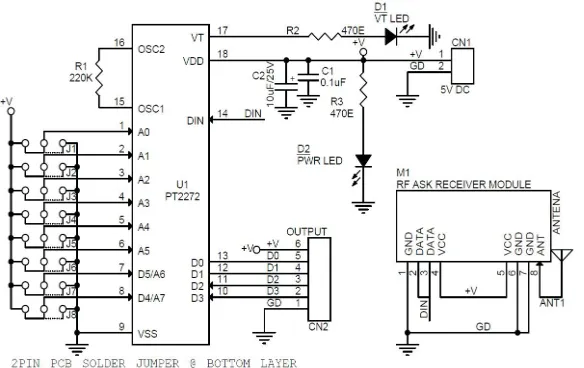
PT2262 is a remote control encoder paired with PT2272 utilizing CMOS technology. Its encode data and address pins into a serial coded waveform suitable for RF modulation. Circuit uses 8 bits of tri-state address pins providing up to 6561 address codes, thereby, drastically reducing any code collision and unauthorized code scanning possibilities.
PT2262 encodes the code address and data set into special waveform and outputs it to the DOUT when TE is pulled to low. The wave is fed to RF modulator (ASK RF TX Module) for transmission. The transmitted radio frequency is received by RF demodulator (ASK RF RX Module) and reshaped to special waveform. PT2272 is then used to decode the waveform and set the corresponding output pins. coding and decoding function.
3943
©IJRASET: All Rights are Reserved
[image:3.595.142.456.149.300.2]PT2272 decodes the waveform received and fed in to the DIN pin. The waveform is decoded into code word that contains the address, data and sync bits. The decoded address bits are compared with the address set at the address input pins. If both address match for 2 consecutive code words, PT2272 drives the data output pins whose corresponding data bits is the decoded to be a 1 bit, and the V T output - to high state.
[image:3.595.153.445.328.512.2]Fig. 1 Transmitter circuit diagram
Fig. 2 Transmitter circuit diagram
C. Bluetooth
Technology essentially works by using short-range wireless communication technology to connect two devices together. This eliminates the need for cables or wires. Bluetooth allows you to listen to music your from your mobile phone, tablet or iPad through wireless headphones.
D. Alcohol Sensor MQ3
This module is made using Alcohol Gas Sensor MQ3. It is a low cost semiconductor sensor which can detect the presence of alcohol gases at concentrations from 0.05 mg/L to 10 mg/L. The sensitive material used for this sensor is SnO2, whose conductivity is lower in clean air. Its conductivity increases as the concentration of alcohol gases increases. It has high sensitivity to alcohol and has a good resistance to disturbances due to smoke, vapor and gasoline. This module provides both digital and analog outputs. MQ3 alcohol sensor module can be easily interfaced with Microcontrollers, Arduino Boards, Raspberry Pi etc.
3944
[image:4.595.206.388.265.361.2]©IJRASET: All Rights are Reserved
Fig. 3 Alcohol sensor
This alcohol sensor is suitable for detecting alcohol concentration on your breath, just like your common Breathalyzer. It has a high sensitivity and fast response time. Sensor provides an analog resistive output based on alcohol concentration. The drive circuit is very simple, all it needs is one resistor. A simple interface could be a 0-3.3V ADC.
E. Limit Switch
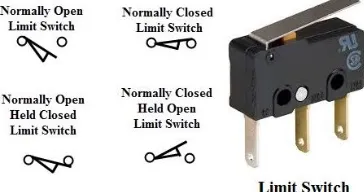
The control schemes of a limit switch are shown in above figure, in which four varieties of limit switches are presented.
Some switches are operated by the presence of an object or by the absence of objects or by the motion of machine instead of human hand operation. These switches are called as limit switches.
These switches consist of a bumper type of arm actuated by an object. When this bumper arm is actuated, it causes the switch contacts to change position.
IV.RESULTS
Nowadays, most cases of accidents area unit by motor bikes. The severities of those accidents are increased because of the absence of helmet or by the usage of alcoholic drinks. In our project we have a tendency to develop an electronic smart helmet system that efficiently checks the wearing of helmet and drunken driving. By implementing this system a safe 2 wheeler journey is possible which would decrease the head injuries throughout accidents caused from the absence of helmet and additionally reduce the accident rate due to drunken driving. We have a tendency to introduce advanced sensors techniques and radio frequency wireless communications are included in this project to make it a good one. Our system efficiently checks the wearing of helmet and drunken driving. By implementing this system a safe 2 wheeler journey is possible which would decrease the head injuries during accidents and also reduce the accident rate because of drunken driving.
V. CONCLUSIONS
This paper is very useful in day to day life and adds extra safety while riding the bike. It is like a virtual traffic police inspector that is the Limit switch checking time to time if the helmet is still on or not. The main advantage of this project is that you don’t have to pay fine in latter case; it’s just your bike which is going to be switched off. Use of this project makes ones bike secure at crucial times, especially Use of this project makes ones bike secure at crucial times, especially when one is away from the bike and someone is Trying to steal it or in other words if there are any chances of Theft that can occur.
VI.FUTURESCOPE
We can use solar panel for helmet power supply and this same power supply can be used for charging our mobile. In future we have a tendency to construct an intelligent system of compact size. Light dimmer sensors can be used to dim the light automatically when light from other vehicles fall on it. Government should enforce laws to install such system in each two wheelers. We can implement various
3945
©IJRASET: All Rights are Reserved
REFERENCES
[1] Sayan Tapadar, Shinjini Ray, Himadri Nath Saha, Arnab Kumar Saha, Robin Karlose, “Accident and alcohol detection in bluetooth enabled smart helmets for motorbikes”, IEEE 8th Annual Computing and Communication Workshop and Conference (CCWC), 2018
[2] P. Ahuja and K. Bhavsar, "Microcontroller Based Smart Helmet Using GSM & GPRS," 2018 2nd International Conference on Trends in Electronics and Informatics (ICOEI), Tirunelveli, 2018, pp. 1-9.
[3] G. Sasikala, K. Padol, A. A. Katekar and S. Dhanasekaran, "Safeguarding of motorcyclists through helmet recognition," 2015 International Conference on Smart Technologies and Management for Computing, Communication, Controls, Energy and Materials (ICSTM), Chennai, 2015, pp. 609-612. [4] D. K. P. Gudavalli, B. S. Rani and C. V. Sagar, "Helmet operated smart E-bike," 2017 IEEE International Conference on Intelligent Techniques in
Control, Optimization and Signal Processing (INCOS), Srivilliputhur, 2017, pp. 1-5.
[5] Sudharsana Vijayan , Vineed T Govind, “Alcohol detection using smart helmet system”, International Journal of Emerging Technology in Computer Science & Electronics (IJETCSE), Volume 8 Issue 1, April-2014.
[6] Sonali Kotkar, Neekita Matkar, “Smart helmet for alcohol detection and accident avoidance”, International Journal of Advance Engineering and Research Development, Volume 4, Issue 3, March -2017.