Proceedings of the Shared Task on Cross-Framework Meaning Representation Parsing at the 2019 CoNLL, pages 86–94 86
SJTU at MRP 2019: A Transition-Based Multi-Task Parser for
Cross-Framework Meaning Representation Parsing
Hongxiao Bai1,2,3, Hai Zhao1,2,3,∗
1Department of Computer Science and Engineering, Shanghai Jiao Tong University 2Key Laboratory of Shanghai Education Commission for Intelligent Interaction
and Cognitive Engineering, Shanghai Jiao Tong University, Shanghai, China
3MoE Key Lab of Artificial Intelligence, AI Institute, Shanghai Jiao Tong University [email protected], [email protected]
Abstract
This paper describes the system of our team
SJTUfor our participation in the CoNLL 2019 Shared Task: Cross-Framework Meaning Rep-resentation Parsing. The goal of the task is to advance data-driven parsing into graph-structured representations of sentence mean-ing. This task includes five meaning represen-tation frameworks: DM, PSD, EDS, UCCA, and AMR. These frameworks have different properties and structures. To tackle all the frameworks in one model, it is needed to find out the commonality of them. In our work, we define a set of the transition actions to once-for-all tackle all the frameworks and train a transition-based model to parse the meaning representation. The adopted multi-task model also can allow learning for one framework to benefit the others. In the final official evalu-ation of the shared task, our system achieves 42%F1unified MRP metric score.
1 Introduction
Semantic understanding of texts is very important in Natural Language Processing (NLP), in which, Meaning Representation Parsing (MRP) attracts attentions of many researchers. This task is to en-code a sentence into a semantic graph, which usu-ally is directed. Compared with dependency pars-ing (Ma and Zhao, 2012;Li et al., 2018a; Zhou and Zhao,2019) or semantic role labeling (Zhao et al.,2009a,b;Li et al.,2018b;Guan et al.,2019), this task is much harder since its representation is a graph which may incorporate both syntactical and semantic information. These general graphs are more expressive and arguably more adequate tar-get structures for sentence-level analysis beyond
∗
Corresponding author. This paper was partially sup-ported by National Key Research and Development Program of China (No. 2017YFB0304100) and Key Projects of Na-tional Natural Science Foundation of China (No. U1836222 and No. 61733011).
shallow syntax and in particular for representa-tions of the semantic structure. Many works have shown that these meaning representations are ben-eficial to other tasks such as machine translation and abstractive summarization. However, there are several types of meaning representations with different definitions, structures, and abstractions, which hinder the applications.
The CoNLL 2019 Shared Task (Oepen et al.,
2019) combines formally and linguistically dif-ferent meaning representation in graph form on a uniform training and evaluation setup for the first time. This task includes five MRP frame-works: DM, PSD, EDS, UCCA, and AMR. These frameworks have different anchoring types, i.e., the tightness of correspondence between graph nodes and sentence tokens with different abstrac-tions. The nodes in DM and PSD are all the sur-face tokens in the sentences. In EDS and UCCA, the anchoring is flexible so that arbitrary parts of the sentence (e.g. sub-token or multi-token se-quences) may be node anchors, as well as mul-tiple nodes anchored to overlapping sub-strings. Further, AMR has even no anchoring but with the strongest expressive ability.
For each of these frameworks, the common methods for their parsing are transition-based method and graph-based method. The former parses sentences by making a sequence of transi-tion actransi-tions according to the present state which usually consists of a stack, a buffer, and a pro-cessed edge set, while the latter gets nodes first and predicts the edges between these nodes.
TUPA (Transition-based UCCA Parser) ( Hersh-covich et al., 2017, 2018) in terms of neural networks, which is powerful in a lot of NLP tasks (Cai and Zhao,2016;Zhang et al.,2016;Qin et al.,2016;Vaswani et al.,2017;Cai et al.,2017;
Wang et al.,2017;Qin et al.,2017;Bai and Zhao,
2018; He et al., 2018; Cai et al., 2018; Zhang and Zhao,2018;Zhang et al.,2018a,b;Zhu et al.,
2018;Huang and Zhao,2018;Li et al.,2018c;Wu et al.,2018;Zhang et al.,2019;Xiao et al.,2019). Neural networks can encode the texts into a dense representation. We put the parsing job of all the frameworks to one model and use a multi-task set-ting to jointly train the system. In the final official evaluation of the shared task, our system achieves 42%F1unified MRP metric score.
The rest of this paper is organized as follows. Section 2 introduces these frameworks. Section 3 shows our model. Section 4 gives the settings of our model and test results.
2 Framework Schemes
This shared task considers five meaning represen-tation frameworks. In this section, we briefly in-troduce these frameworks and figure out the traits of these frameworks.
2.1 DM and PSD
DELPH-IN MRS Bi-Lexical
Dependen-cies (DM) (Ivanova et al., 2012) and Prague Semantic Dependencies (PSD) (Hajiˇc et al.,
2012;Miyao et al.,2014) use bi-lexical semantic dependencies to represent the meaning with different annotations. Graph nodes in DM and PSD correspond to surface tokens, and graphs are neither fully connected nor rooted trees, that is, some tokens from the underlying sentence remain structurally isolated, and for some nodes, there are multiple incoming edges.
2.2 EDS
Elementary Dependency Structures (EDS) (Oepen and Lønning,2006) is a variable-free semantic de-pendency graph, where graph nodes correspond to logical predictions and edges to labeled argument positions. The variable-free feature makes these graphs quite similar to Abstract Meaning Repre-sentation (AMR). Nodes in EDS are in principle independent of surface lexical units, but for each node, there is an explicit and many-to-many an-choring onto sub-strings of the underlying
sen-tence.
2.3 UCCA
Universal Conceptual Cognitive Annota-tion (UCCA) (Abend and Rappoport, 2013) targets to a more semantic way rather than only syntactically and can be extended to cross-linguistic settings. UCCA representations are directed acyclic graphs (DAGs), where termi-nal nodes correspond to the text tokens and non-terminal nodes to semantic units with more abstract meanings. Edges are labeled, indicating the role of a child in the relation. UCCA enable reentrancy to allow a node to participate in several semantic relations.
2.4 AMR
Abstract Meaning Representation (AMR) ( Ba-narescu et al.,2013) tries to abstract out all the se-mantic information from the sentences. The AMR graphs are rooted directed graphs, in which both nodes and edges are labeled, and reentrancy is also allowed. AMR declines to make explicit how el-ements of the graph correspond to the surface ut-terance and the nodes are abstract. So similar to EDS, it is also needed to generate nodes from se-mantic information, but AMR is harder since even no anchor is available. AMR graphs quite gener-ally appear to be more abstractive compared to the other frameworks.
2.5 Framework Summary
DM PSD EDS UCCA AMR
Node Labels • • • - •
Node Properties • • • - •
Node Anchoring • • • •
-Generated Node - - • ◦ •
Edge Attributes - - - •
-Table 1: Framework properties. Generated node means the nodes in the graph are not the superficial tokens and
◦means in UCCA they are empty non-terminal nodes.
Action Current State Resulting State Description
1 Drop [σ|s0, b0|β, A] [σ|s0, β, A] drop the word that does not convey any semantics (the first element of the buffer) 2 New(c) [σ|s0, b0|β, A] [σ|s0, c|b0|β, A] generate a new nodecand push it into the
buffer
3 Add [σ|s0, b0|β, A] [σ|s0, o|b0|β, A] generate a non-terminal node for UCCA and push it into the buffer
4 Left(r) [σ|s0, b0|β, A] [σ|s0, b0|β, A∪s0
r
←−b0] make left-arc with labelr(edge label) 5 Right(r) [σ|s0, b0|β, A] [σ|s0, b0|β, A∪s0
r −
→b0] make right-arc with labelr(edge label) 6 Swap [σ|s1|s0, β, A] [σ|s0, s1|β, A] swap the top two nodes in stack and then
put the top one in the buffer
7 Shift [σ|s0, b0|β, A] [σ|s0|b0, β, A] shift the first node of the buffer to the stack
[image:3.595.74.526.61.256.2]8 Reduce [σ|s0, b0|β, A] [σ, b0|β, A] if the top node of the stack is processed, pop it from stack
Table 2: The transition system. σis the stack ands0is the top element of the stack. β is the buffer andb0is the first element of the buffer.Ais the set containing all processed edges. The[σ|s0, b0|β, A]denotes one state of the transition procedure. For initialization, theσandAare empty andβcontains all tokens in the sentence (for AMR, only words that can be aligned to the graph are kept).
3 Model Description
For the joint learning task, we select a multi-task transition-based model. Following we will de-scribe the transition set, the model, and the train-ing/inference.
3.1 Transition Set
For a transition-based system, a transition action set is needed, and an oracle is also needed to gen-erate gold-standard actions during training. We define the transition set to cover all meaning rep-resentation frameworks then these tasks can be learned consistently. Our transition system has a stack, a buffer, and a set of processed edges. Given a sentence consisting of a sequence of to-kenst0, t1,· · ·, tn, we put all these tokens to the
buffer as initialization. During training, an oracle will generate a gold-standard action sequence, and during inference, the model will predict the action sequence and recover it to a graph. Table2 sum-marizes all the actions. In these actions, actions 4, 5, 6, 7, 8 are used by all the frameworks, actions 1, 2 are used by EDS and AMR, action 3 is used by UCCA. If one action is not used by the framework, then the oracle will not generate this action for it, and during inference, the action is only selected from the legal actions for task-specified classifiers.
3.2 Model
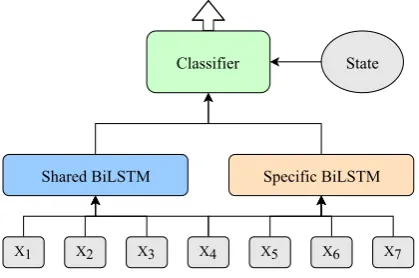
Figure 1 depicts our model. x1, x2,· · · , xi
de-notes the input tokens. Our model architecture
X1
Shared BiLSTM Specific BiLSTM
X2 X3 X4 X5 X6 X7
[image:3.595.312.522.333.472.2]Classifier State
Figure 1: Model overview.
are concatenated and sent to the BiLSTMs as in-put. These embeddings and pre-trained models are tuned during training.
Besides the neural model, we also add hand-made features to the classifier. We use features representing the existing node labels related to the top four stack elements and the first three buffer el-ements. We also use the last three actions taken by the parser, and if there are less than three actions before, use zero embeddings instead. For all these features, we use vector embeddings to represent them, that is, node labels and transition actions are embedded to vectors. All these embeddings are initialized randomly. These features embeddings are concatenated as a feature vector for the state.
The final hidden state vectors of shared and spe-cific BiLSTMs and the feature vector of the state are concatenated and fed as input to the action classifiers. The training is done with an oracle that yields the set of all optimal transitions at a given state. The actual transition performed in training is the one with the highest score given by the clas-sifier, which is trained to maximize the sum of log-likelihoods of all optimal transitions at each step.
In addition to the main model, we also apply two classifiers for property prediction of DM and PSD. The classifier is an MLP and the input is the concatenated output vectors of each token from shared and specific BiLSTM since the nodes are one-to-one corresponding to the tokens in the sen-tence.
3.3 Training and Inference Procedures
The training and test data have companion data processed by UDPipe (Straka, 2018). For all the input sentences, we use the tokenization, lemma, POS tagging, dependency parsing, and anchor in-formation results from UDPipe data. Then the an-chors of the output graphs are directly obtained from the UDPipe data. For EDS and AMR, the an-chors are derived from the first token in the buffer. Since AMR has no anchoring between nodes and texts, so we use the alignments generated from JAMR (Flanigan et al.,2014) and the tokens and nodes which have no alignments are discarded. Then the oracle can generate an action sequence for AMR during training. We also do pre-process on AMR and EDS graphs by expanding the node properties of graphs in the two frameworks, that is, the property key is seen as edge label and property value is seen as node label. We collect these edge
labels and convert these nodes and edges to prop-erties. For DM and PSD, theposnode property is fromXPOSin UDPipe data, and the frame prop-erty are predicted by additional classifiers. UCCA has edge attributeremoteto reflect the reentrancy and we neglect the edge attribute in our transition system for convenience. So we add the attribute remote to the later predicted edges that link the used nodes. For node labels, we use the lemma corresponding to the token in the sentences as node label for DM and PSD, and we generate node label for EDS and AMR in theNewaction.
During training, an oracle is used to generate action sequences. We use a dynamic oracle which outputs a set of optimal transitions from a given state, and from the resulting state, the gold stan-dard graph is still reachable. For example, for EDS and AMR, if the first element of the buffer is a to-ken and it has aligned unprocessed nodes, then a node with small id is generated by the New and put to the buffer. For UCCA, if the top node in the stack connects to a non-terminal node which is not generated yet, then theAdd this non-terminal node. If this token has no aligned nodes remain-ing, then theDropis applied. If the top element of the stack and the first element of the buffer are nodes and the node in the buffer is the child of an unprocessed edge, then theRightaction is applied. Similarly, we have theLeft action. If the top ele-ment of the stack has no unprocessed edges, then theReduceis applied. If the stack is empty and the buffer has elements, then theShiftis applied. If no other actions can be found, then we do theSwap action.
For inference, after the action sequence is pre-dicted, we can generate a graph from this se-quence. However, this graph may not conform to the graph rules of the respective framework. So we prune the generated graph. The pruning method includes: deleting the repeated nodes and edges, deleting the nodes containing empty labels of EDS and AMR, deleting the edges attached to the deleted nodes.
4 Experiments and Results
4.1 Data settings
de-tops labels properties anchors edges attributes all rank base all
all MRP 52.7 42.8 32.1 54.7 29.5 0.2 43.0 10 45.3
lpps MRP 60.2 44.3 24.9 56.0 30.8 0.1 45.1 10 50.6
all MRP DM 47.8 56.5 34.7 70.2 31.4 0.0 43.2 11 42.7
lpps MRP DM 61.2 55.8 33.1 70.4 27.9 0.0 41.9 11 39.5
all MRP PSD 48.4 60.7 39.0 72.8 23.4 0.0 47.6 11 52.7
lpps MRP PSD 53.3 60.6 40.5 72.7 24.8 0.0 48.8 11 54.5
all MRP EDS 32.6 53.1 52.8 64.8 40.5 0.0 53.2 8 74.0
lpps MRP EDS 43.2 53.6 40.0 67.8 43.2 0.0 55.3 8 74.8
all MRP UCCA 81.8 0.0 0.0 66.0 19.4 0.8 32.7 9 23.7
lpps MRP UCCA 75.6 0.0 0.0 69.3 23.4 0.7 35.3 9 41.0
all MRP AMR 53.2 43.8 34.1 0.0 33.0 0.0 38.5 9 33.8
[image:5.595.75.531.62.244.2]lpps MRP AMR 67.7 51.4 10.8 0.0 34.8 0.0 44.1 9 43.4
Table 3: Test results.F1(%)scores for tops, labels, properties, anchors, edges, attributes, and all unified score. MRP is the results of all frameworks and others are for specific frameworks. For the test data, “all” denotes all test data and “lpps” denotes the 100 sentences inThe Little Prince.basedenotes the results of TUPA baseline.
labeled F labeled M labeled rank unlabeled F unlabeled M unlabeled rank
all DM 37.9 (56.2) 1.7 (7.2) 11 41.6 (64.3) 1.8 (8.5) 12
lpps DM 33.5 (55.7) 0.0 (14.0) 11 37.8 (64.7) 0.0 (17.0) 12
all PSD 34.0 (50.1) 2.2 (8.6) 12 45.9 (66.0) 4.1 (22.0) 12
[image:5.595.76.520.301.370.2]lpps PSD 35.9 (55.3) 0.0 (15.0) 12 45.7 (68.8) 0.0 (27.0) 12
Table 4: SDP results for DM and PSD. F denotesF1(%)score and M denotes exact match score(%). The scores in the brackets are from TUPA baseline.
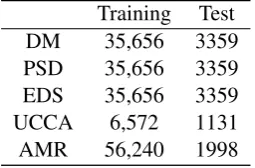
termined, we train our system on all the training data. The shared task also evaluates the system on the 100 annotated sentences fromThe Little Prince which denote as “lpps” in the Results section.
Training Test
DM 35,656 3359
PSD 35,656 3359
EDS 35,656 3359
UCCA 6,572 1131
AMR 56,240 1998
Table 5: Number of sentences of each framework in training set and test set.
4.2 Model Settings
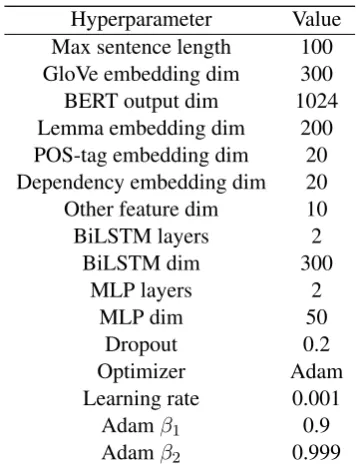
We implement our model with PyTorch1and tuned on the development set. During inference, we use greedy decoding to get the action sequence. Ta-ble6shows the hyperparameter settings. The op-timizer is Adam (Kingma and Ba, 2015). The dropout is applied to the embeddings, the outputs of BiLSTMs, and the outputs of the first MLP
lay-1https://pytorch.org/
ers. If the length of one sentence is larger than the max length, then the exceeding tokens are dis-carded. Other features denote the node labels in the stack and buffer, and the previous actions in-troduced in Section3.2.
4.3 Results
The evaluation is blindly conducted. The MRP score results are shown in Table3. For framework specified metric, the SDP results for DM and PSD are reported in Table4, the EDM results for EDS are reported in Table7, and the SMATCH results for AMR are reported in Table9. Table3also con-tains the comparison results with the TUPA base-line (Hershcovich and Arviv,2019). For some of the frameworks, our model is better than the TUPA baseline.
4.4 Analysis
[image:5.595.118.246.491.575.2]Hyperparameter Value
Max sentence length 100
GloVe embedding dim 300
BERT output dim 1024
Lemma embedding dim 200
POS-tag embedding dim 20
Dependency embedding dim 20
Other feature dim 10
BiLSTM layers 2
BiLSTM dim 300
MLP layers 2
MLP dim 50
Dropout 0.2
Optimizer Adam
Learning rate 0.001
Adamβ1 0.9
[image:6.595.91.271.60.294.2]Adamβ2 0.999
Table 6: Model hyperparameters.
all lpps
tops 28.8 40.5
names 50.6 52.8
arguments 34.7 35.5
properties 53.5 40.0
all 43.5 (65.6) 44.9 (66.0)
[image:6.595.312.518.61.186.2]rank 8 8
Table 7: EDMF1(%)results for EDS. The scores in the brackets are from TUPA baseline.
node label, edge label, node property, and edge attribute. Whereas we have actions to generate nodes (NewandAdd) and the node or edge label is predicted when the node or the edge is generated. However, our set does not have actions for node properties and edge attributes, which has been in-troduced in Section 3.3. The motivation for de-signing our transition set is to use fewer actions to parse a sentence.
For the results, we find the MRP metric may be imperfect for every framework. For example, the MRP results for UCCA of ours and the base-line are comparative, whereas, for the UCCA task-specific metric, ours (Table8) are much lower than TUPA. That is, a better MRP result may not reflect a better task-specific result. This is due to some items calculated by MRP that are not in UCCA graphs such as labels and properties, and the edge overlapping search methods are different. The gap comes from our transition set, which is not well suitable for UCCA, and this is mainly due to that
all lpps
labeled primary 4.7 5.6
labeled remote 0.6 1.6
labeled all 4.5 (22.4) 5.5 (28.4)
labeled rank 9 9
unlabeled primary 6.5 7.7
unlabeled remote 1.1 3.3
unlabeled all 6.3 (27.1) 7.5 (33.1)
unlabeled rank 9 9
Table 8: UCCAF1(%)results. The scores in the brack-ets are from TUPA baseline.
all lpps
F1 37.3 (32.8) 41.1 (41.1)
rank 9 9
Table 9: SMATCHF1(%)results for AMR. SMATCH is the specific evaluation metric for AMR. The scores in the brackets are from TUPA baseline.
Ours TUPA
P R F P R F
MRP 46.0 43.0 43.0 39.0 57.0 45.3
DM 36.0 53.0 43.2 31.0 69.0 42.7
PSD 48.0 48.0 47.6 45.0 63.0 52.7
EDS 75.0 41.0 53.2 74.0 74.0 74.0
UCCA 31.0 35.0 32.7 17.0 38.0 23.7
[image:6.595.341.492.235.278.2]AMR 40.0 37.0 38.5 29.0 41.0 33.8
Table 10: Precision, Recall, andF1score comparisons on all MRP results.
we generate non-terminal node separately whereas TUPA directly generates edges attached to the non-terminal nodes, and our method may even il-legally connect two terminal nodes. Other frame-works have the same issue such as DM. These task-specific metrics pay more attention to edges and have a different overlapping search method compared with MRP metric, which is more sim-ilar to the AMR specific metric SMATCH.
Only for AMR, our MRP results and SMATCH results are both better, which may be due to the separateNewaction and expanding the properties as nodes.
[image:6.595.308.525.337.448.2]our model misses too much nodes and edges. This is due to that the new node action and the separate property classifiers can bring better element pre-diction. Fewer actions also make the prediction more accurate. However, the design of the oracle and the training may have flaws, so some tokens are dropped and some edges are not predicted out, which makes the low recall. Our parser tends to predict a smaller graph, so for some frameworks which tend to have bigger graphs, such as PSD and EDS, the MRP results of our parser are worse.
5 Conclusion
In this paper, we describe our transition-based multi-task parsing system for the CoNLL 2019 Shared Task: Cross-Framework Meaning Repre-sentation Parsing. In our system, we integrate all the frameworks into one transition-based neural model using shared features, and we focus more on unified overall MRP metric results. The results of the blind test show that our system achieves 42% F1 unified MRP metric score. Compared with baseline TUPA, our parser has higher preci-sion but lower recall, for future work, we will op-timize our transition set and oracle for better per-formance.
References
Omri Abend and Ari Rappoport. 2013. Universal con-ceptual cognitive annotation (UCCA). In Proceed-ings of the 51st Annual Meeting of the Associa-tion for ComputaAssocia-tional Linguistics (ACL) (Volume 1: Long Papers), pages 228–238, Sofia, Bulgaria.
Hongxiao Bai and Hai Zhao. 2018. Deep enhanced representation for implicit discourse relation recog-nition. In Proceedings of the 27th International Conference on Computational Linguistics (COL-ING), pages 571–583, Santa Fe, New Mexico, USA.
Laura Banarescu, Claire Bonial, Shu Cai, Madalina Georgescu, Kira Griffitt, Ulf Hermjakob, Kevin Knight, Philipp Koehn, Martha Palmer, and Nathan Schneider. 2013. Abstract meaning representation for sembanking. InProceedings of the 7th Linguis-tic Annotation Workshop and Interoperability with Discourse, pages 178–186, Sofia, Bulgaria.
Deng Cai and Hai Zhao. 2016. Neural Word Segmen-tation Learning for Chinese. InProceedings of the 54th Annual Meeting of the Association for Compu-tational Linguistics (ACL), pages 409–420, Berlin, Germany.
Deng Cai, Hai Zhao, Zhisong Zhang, Yuan Xin, Yongjian Wu, and Feiyue Huang. 2017. Fast and
accurate neural word segmentation for Chinese. In
Proceedings of the 55th Annual Meeting of the As-sociation for Computational Linguistics (ACL) (Vol-ume 2: Short Papers), pages 608–615, Vancouver, Canada.
Jiaxun Cai, Shexia He, Zuchao Li, and Hai Zhao. 2018. A full end-to-end semantic role labeler, syntactic-agnostic over syntactic-aware? In Proceedings of the 27th International Conference on Computational Linguistics (COLING), pages 2753–2765, Santa Fe, New Mexico, USA.
Jacob Devlin, Ming-Wei Chang, Kenton Lee, and Kristina Toutanova. 2019. BERT: Pre-training of deep bidirectional transformers for language under-standing. InProceedings of the 2019 Conference of the North American Chapter of the Association for Computational Linguistics: Human Language Technologies (NAACL:HLT), Volume 1 (Long and Short Papers), pages 4171–4186, Minneapolis, Min-nesota.
Jeffrey Flanigan, Sam Thomson, Jaime Carbonell, Chris Dyer, and Noah A. Smith. 2014. A discrim-inative graph-based parser for the abstract mean-ing representation. InProceedings of the 52nd An-nual Meeting of the Association for Computational Linguistics (ACL) (Volume 1: Long Papers), pages 1426–1436, Baltimore, Maryland.
Chaoyu Guan, Yuhao Cheng, and Hai Zhao. 2019. Se-mantic role labeling with associated memory net-work. In Proceedings of the 2019 Conference of the North American Chapter of the Association for Computational Linguistics: Human Language Technologies (NAACL:HLT), Volume 1 (Long and Short Papers), pages 3361–3371, Minneapolis, Min-nesota.
Jan Hajiˇc, Eva Hajiˇcov´a, Jarmila Panevov´a, Petr Sgall, Ondˇrej Bojar, Silvie Cinkov´a, Eva Fuˇc´ıkov´a, Marie Mikulov´a, Petr Pajas, Jan Popelka, Jiˇr´ı Semeck´y, Jana ˇSindlerov´a, Jan ˇStˇep´anek, Josef Toman, Zdeˇnka Ureˇsov´a, and Zdenˇek ˇZabokrtsk´y. 2012. Announcing Prague Czech-English depen-dency treebank 2.0. InProceedings of the Eighth In-ternational Conference on Language Resources and Evaluation (LREC-2012), pages 3153–3160, Istan-bul, Turkey.
Shexia He, Zuchao Li, Hai Zhao, and Hongxiao Bai. 2018. Syntax for semantic role labeling, to be, or not to be. InProceedings of the 56th Annual Meet-ing of the Association for Computational LMeet-inguistics (ACL) (Volume 1: Long Papers), pages 2061–2071, Melbourne, Australia.
Daniel Hershcovich, Omri Abend, and Ari Rappoport. 2018. Multitask parsing across semantic represen-tations. In Proceedings of the 56th Annual Meet-ing of the Association for Computational LMeet-inguis- Linguis-tics (ACL) (Volume 1: Long Papers), pages 373–385, Melbourne, Australia.
Daniel Hershcovich and Ofir Arviv. 2019. TUPA at MRP 2019. A multi-task baseline system. In Pro-ceedings of the Shared Task on Cross-Framework Meaning Representation Parsing at the 2019 Con-ference on Natural Language Learning, pages 27– 38, Hong Kong, China.
Sepp Hochreiter and J¨urgen Schmidhuber. 1997. Long Short-Term Memory. Neural computation, 9(8):1735–1780.
Yafang Huang and Hai Zhao. 2018. Chinese pinyin aided IME, input what you have not keystroked yet. In Proceedings of the 2018 Conference on Empirical Methods in Natural Language Processing (EMNLP), pages 2923–2929, Brussels, Belgium.
Angelina Ivanova, Stephan Oepen, Lilja Øvrelid, and Dan Flickinger. 2012. Who did what to whom? a contrastive study of syntacto-semantic dependen-cies. InProceedings of the Sixth Linguistic Annota-tion Workshop, pages 2–11, Jeju, Republic of Korea.
Diederik P Kingma and Jimmy Ba. 2015. Adam: A method for stochastic optimization. InProceedings of the International Conference on Learning Repre-sentations (ICLR), San Diego, CA.
Zuchao Li, Jiaxun Cai, Shexia He, and Hai Zhao. 2018a. Seq2seq dependency parsing. In Pro-ceedings of the 27th International Conference on Computational Linguistics (COLING), pages 3203– 3214, Santa Fe, New Mexico, USA.
Zuchao Li, Shexia He, Jiaxun Cai, Zhuosheng Zhang, Hai Zhao, Gongshen Liu, Linlin Li, and Luo Si. 2018b. A unified syntax-aware framework for semantic role labeling. In Proceedings of the 2018 Conference on Empirical Methods in Natural Language Processing (EMNLP), pages 2401–2411, Brussels, Belgium.
Zuchao Li, Shexia He, Zhuosheng Zhang, and Hai Zhao. 2018c. Joint learning of POS and dependen-cies for multilingual universal dependency parsing. In Proceedings of the CoNLL 2018 Shared Task: Multilingual Parsing from Raw Text to Universal Dependencies, pages 65–73, Brussels, Belgium.
Xuezhe Ma and Hai Zhao. 2012. Fourth-order depen-dency parsing. InProceedings of COLING 2012: Posters, pages 785–796, Mumbai, India.
Yusuke Miyao, Stephan Oepen, and Daniel Zeman. 2014. In-house: An ensemble of pre-existing off-the-shelf parsers. InProceedings of the 8th Interna-tional Workshop on Semantic Evaluation (SemEval 2014), pages 335–340, Dublin, Ireland.
Stephan Oepen, Omri Abend, Jan Hajiˇc, Daniel Her-shcovich, Marco Kuhlmann, Tim O’Gorman, and Nianwen Xue. 2019. MRP 2019. Cross-framework Meaning Representation Parsing. InProceedings of the Shared Task on Cross-Framework Meaning Rep-resentation Parsing at the 2019 Conference on Nat-ural Language Learning, pages 1–26, Hong Kong, China.
Stephan Oepen and Jan Tore Lønning. 2006. Discriminant-based MRS banking. InProceedings of the Fifth International Conference on Language Resources and Evaluation (LREC’06), Genoa, Italy.
Jeffrey Pennington, Richard Socher, and Christopher Manning. 2014. Glove: Global vectors for word representation. In Proceedings of the 2014 Con-ference on Empirical Methods in Natural Language Processing (EMNLP), pages 1532–1543, Doha, Qatar.
Lianhui Qin, Zhisong Zhang, and Hai Zhao. 2016. A stacking gated neural architecture for implicit dis-course relation classification. InProceedings of the 2016 Conference on Empirical Methods in Natural Language Processing (EMNLP), pages 2263–2270, Austin, Texas.
Lianhui Qin, Zhisong Zhang, Hai Zhao, Zhiting Hu, and Eric Xing. 2017. Adversarial connective-exploiting networks for implicit discourse relation classification. In Proceedings of the 55th Annual Meeting of the Association for Computational Lin-guistics (ACL) (Volume 1: Long Papers), pages 1006–1017, Vancouver, Canada.
Milan Straka. 2018. UDPipe 2.0 prototype at CoNLL 2018 UD shared task. InProceedings of the CoNLL 2018 Shared Task: Multilingual Parsing from Raw Text to Universal Dependencies, pages 197–207, Brussels, Belgium.
Ashish Vaswani, Noam Shazeer, Niki Parmar, Jakob Uszkoreit, Llion Jones, Aidan N Gomez, Ł ukasz Kaiser, and Illia Polosukhin. 2017. Attention is all you need. InAdvances in Neural Information Pro-cessing Systems (NIPS) 30, pages 5998–6008.
Hao Wang, Hai Zhao, and Zhisong Zhang. 2017. A transition-based system for universal dependency parsing. InProceedings of the CoNLL 2017 Shared Task: Multilingual Parsing from Raw Text to Uni-versal Dependencies, pages 191–197, Vancouver, Canada.
Yingting Wu, Hai Zhao, and Jia-Jun Tong. 2018. Mul-tilingual universal dependency parsing from raw text with low-resource language enhancement. In Pro-ceedings of the CoNLL 2018 Shared Task: Multilin-gual Parsing from Raw Text to Universal Dependen-cies, pages 74–80, Brussels, Belgium.
for Computational Linguistics (ACL), pages 3090– 3097, Florence, Italy.
Zhisong Zhang, Hai Zhao, and Lianhui Qin. 2016. Probabilistic graph-based dependency parsing with convolutional neural network. InProceedings of the 54th Annual Meeting of the Association for Com-putational Linguistics (ACL), pages 1382–1392, Berlin, Germany.
Zhuosheng Zhang, Yafang Huang, and Hai Zhao. 2018a. Subword-augmented embedding for cloze reading comprehension. InProceedings of the 27th International Conference on Computational Lin-guistics (COLING), pages 1802–1814, Santa Fe, New Mexico, USA.
Zhuosheng Zhang, Yafang Huang, and Hai Zhao. 2019. Open vocabulary learning for neural Chinese pinyin IME. In Proceedings of the 57th Annual Meet-ing of the Association for Computational LMeet-inguistics (ACL), pages 1584–1594, Florence, Italy.
Zhuosheng Zhang, Jiangtong Li, Pengfei Zhu, Hai Zhao, and Gongshen Liu. 2018b. Modeling multi-turn conversation with deep utterance aggregation. InProceedings of the 27th International Conference on Computational Linguistics (COLING), pages 3740–3752, Santa Fe, New Mexico, USA.
Zhuosheng Zhang and Hai Zhao. 2018. One-shot learning for question-answering in Gaokao history challenge. InProceedings of the 27th International Conference on Computational Linguistics (COL-ING), pages 449–461, Santa Fe, New Mexico, USA.
Hai Zhao, Wenliang Chen, Jun’ichi Kazama, Kiyotaka Uchimoto, and Kentaro Torisawa. 2009a. Multi-lingual dependency learning: Exploiting rich fea-tures for tagging syntactic and semantic dependen-cies. In Proceedings of the Thirteenth Confer-ence on Computational Natural Language Learning (CoNLL 2009): Shared Task, pages 61–66, Boulder, Colorado.
Hai Zhao, Wenliang Chen, and Chunyu Kit. 2009b. Se-mantic dependency parsing of NomBank and Prop-Bank: An efficient integrated approach via a large-scale feature selection. InProceedings of the 2009 Conference on Empirical Methods in Natural Lan-guage Processing (EMNLP), pages 30–39, Singa-pore.
Junru Zhou and Hai Zhao. 2019. Head-driven phrase structure grammar parsing on Penn treebank. In
Proceedings of the 57th Annual Meeting of the Asso-ciation for Computational Linguistics (ACL), pages 2396–2408, Florence, Italy.