Scaling Up: The Challenges of eHealth Systems in
Developing Countries
Lazarus Kwao1, Richard Millham2, James Ben Hayfron-Acquah3, Joseph Kobina Panford 4
1
Ghana Baptist University College, Kumasi
2
Durban University of Technology, South Africa
3, 4
Dept. Of Computer Science, KNUST, Kumasi, Ghana
Abstract: Clinicians want a very useful, portable, and handy tool to use in their practice, which improves workflow and becomes a convenient connectivity channel for applications and information resources. Mobile devices respond to this need by allowing physicians anywhere and anytime, but there are few guidelines to help decide on the acquisition and implementation of large-scale technology in healthcare systems. Upon review of the literature on eHealth, a critical question is raised: why has eHealth projects not been scaled-up across several developing countries? Although research has established that eHealth tools have the potential to affect the healthcare outcomes positively. Using the case of Mobile Technology for Community Health (MOTECH) in Ghana, a theoretical model is used to appraise the critical factors affecting the scalability of eHealth systems. This study focused on the problems from medical officers, community health nurses, volunteers and beneficiary patients’ perspective and tried to bring out the issues that are fundamental in rolling out a successful eHealth solution to the public. The study did not focus only on the technological aspect, but also on the behavioural aspect of eHealth technology, in which the Technology Acceptance Model (TAM) was extended to appreciate the challenges. The model identified technical support, resistance to change and financial constraints as the main obstacles to the adoption and scalability of eHealth systems. The research contributes to the literature by identifying important areas where results can have a positive effect or can be used by health policymakers in Ghana and other developing countries. This can help them understand their concerns and weaknesses when planning the adoption and implementation of m-health systems.
Keywords: Scalability, eHealth, Developing Countries, Ghana Health Service.
I. INTRODUCTION
Many studies have shown that the integration of eHealth technology in the healthcare process promotes better health communication, improve the decision-making process of healthcare professionals (and patients), improve access to quality healthcare information and facilitate direct communication to under-served areas where this was not possible before (1). According to Speciale & Freytsis (2) and Obasola, Mabawonku, & Lagunju, (3), Information Communication Technology (ICT), especially mobile phones, can help patients and health professionals overcome institutional barriers by reducing travel time to consult specialists. (4; 5), thus effectively increasing the number of available healthcare options. Vandelanotte et al. (6), examined the impact of mobile health interventions in low and middle-income countries, found that there is growing evidence of the effectiveness of mobile health interventions, particularly in improving patient compliance, appointment meeting, data collection and support networks for health workers; however, the quantity and quality of the evidence are still limited in many aspects. Despite numerous studies and research demonstrating the emerging need for these kinds of services and the recognized potential of national health authorities in several different countries, mobile applications are not yet widely used in the health sector as a standard way of providing health services to patients, health professionals and to the administration of health-related information. Although challenges in the context of eHealth have been studied, for example, by (7; 8; 9; 10), more evidence is needed in a country-application context.
II. PROPOSEDRESEARCHMODEL
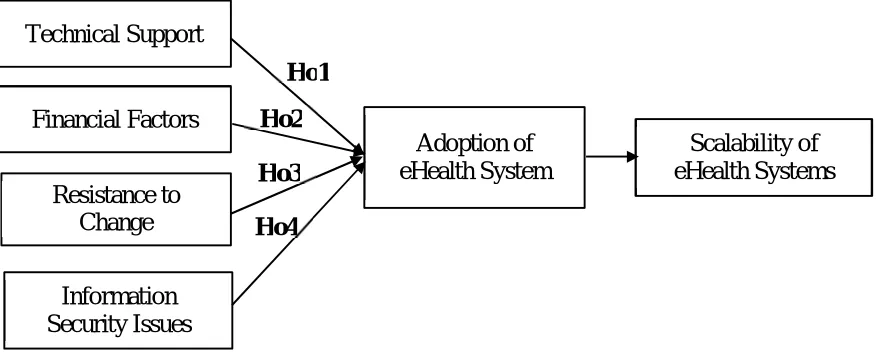
[image:2.612.42.481.155.333.2]The proposed research model to be tested in this study is not a replica of the Technology Acceptance (TAM) Model in Figure 1. In this model, four variables were incorporated into the original TAM model, Technical Support, Financial Factors, Resistance to Change and Information Security issues. This research hypothesized the four variables as determinants of adoption and Scalability of eHealth Systems. The proposed variables and hypotheses are supported by previous literature (17).
Figure 1: Author’s model (2019)
III. STUDYHYPOTHESES
1) H01: There is no significant impact of technical support on eHealth scalability in Ghana.
2) H02: There is no significant impact of financial factors on the scalability of eHealth in Ghana.
3) H03: There is no significant impact of the resistance to change on the scalability of eHealth in Ghana.
4) H04: There is no significant impact of information security issues on eHealth scalability in Ghana.
IV. METHODSANDPROCEDURES
A case study design was used to determine factors associated with adoption and scalability of eHealth system. It was used because the study described a contemporary phenomenon within a real-life context.
V. STUDYPOPULATION
The population for the collection of data for the research was 217 from administration record. Specifically, the medical officers, community health nurses, volunteers and beneficiary patients of their respective units. The Kassena-Nankana West and Awutu Senya District were chosen as the case study since these districts serve as the trailblazer for the piloting of these eHealth projects in Ghana.
VI. SAMPLINGTECHNIQUE
The adoption of Slovin’s sampling techniques helped the researcher to select a sample devoid of biases and sampling errors. The sample size was calculated using the standard formula for the estimated sample size as follows:
=
1 + ( )
[Where n=sample size, N=Sample frame (217) and α=margin of error (0.05) or 95% Confidence level]
This is equal to
217÷1+217(0.05)2
217÷1+217(0.0025)
217÷1+0.5425
217÷1.5425
= 140.1
Technical Support
Financial Factors
Resistance to
Change
Information
Security Issues
Adoption of
eHealth System
Scalability of
eHealth Systems
Ho1
Ho2
Ho3
VII. DATACOLLECTIONTECHNIQUES/METHODS
In soliciting for information for this study, a methodological triangulation approach was used involving questionnaires, personal observations and interviews. This research is conducted in the following stages:
1) Stage 1: The quantitative approach includes a questionnaire developed based on literature review and was refined with results and information collected from observational studies. Questionnaires for the respondents were provided with close-ended questions that made quantification of the data collected easy. The questionnaire sort of soliciting responses to the objectives of this study. The researcher undertook personal observation through the hospital's environment to understand their work processes, challenges, the education given to eHealth administrators and users, among others. Interview solved the problem of a misunderstanding of questions in the questionnaires. This is because; the interviewer was present to explain any question that the interviewee did not understand.
2) Stage 2: A team comprising, two individuals; the researcher, and the staffs of the district conducted the field data collection on the study. The staffs of the district were chosen based on their knowledge in eHealth (MOTECH) due to their constant use of the system. The team members were given the required orientation to be able to understand the rationale of the research. After written and verbal consents were obtained from authorities of institutions, and individuals involved in the study, the team started with the data collection process, which lasted for 14 days.
3) Stage 3: The data collection tools were pre-tested for its validity and reliability of the questionnaire, eliminating any uncertainty, and making appropriate changes according to respondents’ suggestions. Questionnaires for the study were pre-tested with ten staff at Kassena-Nankana West, which shares similar characteristics with the study area.
a) Validation: To test for survey clarity and coherency, a macro review covering all research components was performed by academic reviewers - from Kwame Nkrumah University of Science and Technology (KNUST) - specialized in business, information technology and statistics. Therefore, some items were added based on their recommendations, while some others were modified. The survey was reviewed by a total of (7) academic reviewers, and the overall percentage of response was 100%.
b) Reliability: To test the survey reliability, Cronbach Alpha (α) analysis was used to measure internal consistency. A minimum acceptable level (Alpha ≥ 0.65) was suggested and adopted by (Revelle &Zinbarg, 2009). Results show that overall Cronbach
Alpha (α) =equaled (97.83), and the results of Cronbach Alpha (α) are shown in Table (1).
TABLE(1)RELIABILITYOFSURVEYDIMENSIONS
Number Variable Alpha
1 The adoption of eHealth .869 2 Technical Support .781 3 Financial factors .710 4 Employees perception .674 5 Information Security issues .722 6 All Surveys and Documentations 0.89
4) Stage 4: Since the study involves human participants, ethical clearance was therefore necessary. Ethical clearances for the study were sought from the regulatory bodies and the two-district health directorates. The nature, purpose and procedure of the study were explained to each respondent. Respondents were given the opportunity to respond or refuse to answer the questionnaires. Respondents were assured of confidentiality and anonymity before the interview sessions.
VIII. STATISTICALANALYSES
To determine statistical significance, the researcher used a suitable statistical treatment for each question and hypothesis depending on the following tests:
A. Cronbach Alpha (α) was used to test Reliability.
B. Arithmetic Means and Standard Deviations to answer the study questions.
C. The T-test and the ANOVA table were used to measure the impact of the user characteristics on the usage level
D. Simple Linear and Multiple Regression analysis with (F) test
= 5−1
3 =
4
3= 1.33
= −
The Low degree is less than 2.33; The Average degree is from 2.33 – 3.66, The High degree is from 3.67 and above.
IX. RESULTSANDHYPOTHESESTESTING
ANOVA was used to determine statistical significance between the independent factors and scalability of eHealth in Ghana. The results were:
Table (2): The results show the differences between the independent factors and scalability of eHealth projects or systems in Ghana using ANOVA
Mode Sum of Squares Mean Square F Sig. Technical support 3.257 3.257 6.824 .011(a) Financial factors 3.165 3.165 6.610 .013(a) Resistance to Change 1.4414 1.444 2.839 .097(a) Information security issues .488 .488 .929 .339(a)
1) Predictors: (Constant), Technical Support, Financial factors, Resistance to Change and Information Security Issues 2) Dependent Variable: scalability of eHealth, * The impact is significant at level (α≤ 0.0 1)
In Table (2), It is apparent that the absolute value of F calculated (6.824) which is more than F tabulated at level (α ≤ 0.01). This indicates Ho1 is valid. Therefore, there is a significant statistical impact of technical support on the scalability of eHealth in Ghana. In the table (2), the absolute value of F calculated (6.610) is more than F tabulated at level (α≤ 0.01). This indicates that (Ho2) is valid. Therefore, there is a significant statistical impact of financial factors on eHealth scalability in Ghana, also, on the same table (2) it is observed that the absolute value of F calculated (2.839) which is less than F tabulated at level (α≤ 0.01), indicates that (Ho3)
is valid. Therefore, there is no significant statistical impact of the resistance to change on eHealth scalability in Ghana. Finally, by looking at Table (2) It is evident that absolute value of F calculated (.929) which is less than F tabulated at level (α≤ 0.01), indicates that (Ho4) is valid. Therefore, there is no significant statistical impact of information security issues on eHealth scalability in Ghana.
X. COEFFICIENTOFDETERMINATION
Table (3): coefficient between independent factors and the adoption of eHealth
Model R R Square Adjusted R Square Std. The error of the Estimate
Technical Support .324(a) .105 .090 .69081
Financial Factors .320(a) .102 .087 .69195
Resistance to Change .216(a) .047 .030 .71307 Information security issues .126(a) .016 -.001 .72454
a) Predictors: (Constant), technical support, financial factors, Resistance to Change and Information security issues
[image:4.612.85.529.219.293.2] [image:4.612.62.545.474.550.2]XI. DISCUSSIONS
This result of the study was summarised to answer the critical research questions
A. Identifying Technical Support which Encourages or limit the Adoption and Scalability of eHealth in Ghana.
Table (4): level of importance for the first-factor technological support
Items Means STD level of
importance
level of importance Lack of adequate IT staff 2.13 0.77 1 Medium Issues with interoperability and appropriate infrastructure to
support eHealth initiatives to scale
1.83 0.64 2 Medium
Concerns about a lack of management support from vendors for upgrading and maintaining the system
1.73 0.63 3 Medium
Lack of expertise to select, contract for, and use an e-Health 1.43 0.56 4 Low
In table (4), it is noticeable that means ranged from (1.43 - 2.13) The highest mean was for “level 1” with means of (2.13) and STD (0.77). The lowest mean was for “level 4” with means of (1.43) and STD (0.56). All mean levels were above medium except the level (4) which was the lowest. The outcome of the paper indicates that majority of the respondents the health facilities lacks adequate IT skills and had no interoperability and infrastructure support. This result corresponds to that obtained by (18; 19), which confirmed that adequate IT staff and appropriate infrastructure to support eHealth initiatives have a significant impact in scaling eHealth applications. In the same vein, (20; 21) in their research on the challenge of health professionals using IT to manage patients, they found that health professionals with management support facilitates adoption because of factors, such as strategic alignment, resource allocation, and supportive behaviors for the use of new technologies such as eHealth technology applications.
B. Exploring the impact of financial factors on eHealth adoption in Ghana
Table (5): level of importance for the economic impact (financial)
Items Means STD level of
importance
level of importance The capital needed to procure and implement an eHealth 2.60 0.62 1 Medium I am not certain about the return on investment (ROI) from
an eHealth
2.20 0.84 2 Medium
Excessive rising cost of maintaining an eHealth system 1.73 0.63 3 Medium
[image:5.612.59.558.153.276.2] [image:5.612.55.564.439.529.2]C. Exploring the Impact of Resistance change on eHealth adoption in Ghana.
Table (6): level of importance for the change resistance
Items Means STD Level of
importance
Level of importance Resistance to implementation from physicians 2.47 0.81 1 Medium Resistance to implementation from other providers 2.23 0.77 2 Medium Disruption in clinical care during implementation 1.57 0.56 3 Low
In the table (6) it is noticeable that means ranged from (1.57-2.47), the highest mean was for “level 1” with means of (2.47) and STD (0.81), The lowest mean was for the “level 3” with means of (1.57) and STD (0.56). All mean levels were above medium except for level (3) which was the lowest.
This finding corresponds with (32; 33; 34) who stated that Healthcare’s strong resistance to change would slow adoption of innovative eHealth. Widespread use of m-health requires behavioural changes of actors who want to protect their interests. The challenge will be even greater for eHealth innovators, because the improvements that eHealth can offer, such as patient care and more attention to prevention, will include a break in the way health care is delivered. To succeed, eHealth innovators must manoeuvre through culturally conservative, highly regulated and fragmented, often monopolistic systems that often offer contradictory incentives.
D. Exploring the impact of information security issues on eHealth adoption in Ghana.
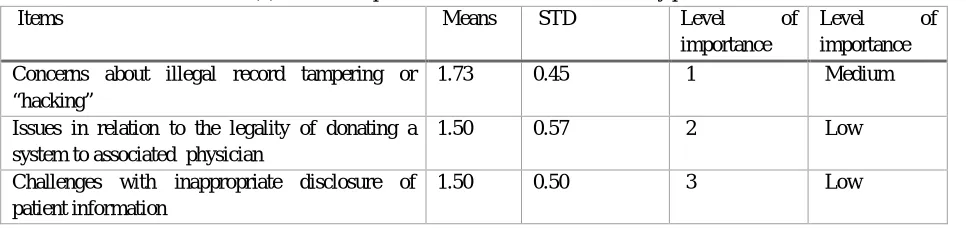
Table (7): level of importance for the information security problems
Items Means STD Level of
importance
Level of importance Concerns about illegal record tampering or
“hacking”
1.73 0.45 1 Medium
Issues in relation to the legality of donating a system to associated physician
1.50 0.57 2 Low
Challenges with inappropriate disclosure of patient information
1.50 0.50 3 Low
Looking at the table (7) the means ranged (1.73), the highest means were for “level 3” with means of (1.73) and STD (0.45), the lowest mean was for the “level 2” with means of (1.50) and STD (0.50). All mean levels were above medium except for levels (1 and 2) which were the lowest. A few respondents showed concerned about the confidentiality of their health information, while others were unconcerned about security breaches. Those who were concerned expressed worry about hackers tampering with their sensitive medical information. Nevertheless, the others who were not bothered felt hackers would find little worth in their private information because they felt insignificant in society or lacked employment for which the leak of sensitive information would be a threat. Although respondents’ perception of information security was not observed as a severe barrier to eHealth scalability, IT professionals are much concerned about the security and confidentiality of the sensitive data transferred through these technologies, as well as potential device theft as agreed by (35; 18).
XII. SUMMARY
[image:6.612.69.552.365.479.2]This tendency of resistance to change is much more severe in developing countries where computer anxiety is very high, and health workers perceive eHealth systems as interfering with clinical workflow, reducing productivity, and introducing disruptive changes to the workplace, therefore creating a potential security challenge (36). This happens because, most pre-implementation assessments failed to include the health professionals’ attitude (readiness) which might be also a determining factor for the success of the implemented eHealth System (37; 38)
In summary, this result is consistent with other published literature (39; 40; 41; 42), which stated that the scaling up of an intervention is not an isolated process, a deeper understanding of the context and the presence of strong value propositions can help design stronger business models that are able to scale beyond the pilot phase and realize their full potential. Its failure or success is closely related to a complex range of contextual factors, such as the organization's will, financial involvement, regulation, donor environment (including whether donors coordinate their efforts or act isolated) (43; 31) and technical support.
XIII. CONCLUSION
The results obtained by the statistical analysis of the correlation coefficient for the hypothesis test to determine the degree of relationship between the variables indicate the significant positive correlation between the eHealth-dependent variable and the independent variables of the hypothesis of the study (see table 2). These findings are consistent with the results of other published studies (44; 45; 46; 31) that indicate that financial factors, resistance to change and technical support are the main barriers that limit the scalability of mobile health systems. Although the results agree that resistance to change and information security issues are not one of the major barriers to the scalability of mobile health systems, the R-squares test statistics of 0.47 and 0.16 respectively shows an indication of further research into the two factors as agreed by (47; 48).
XIV. RECOMMENDATIONS
Disruption of the traditional health system is not an easy process. However, eHealth is being adopted in emerging markets where the need is huge. This study is useful for policymakers and researchers who face implementation problems in the global health field. This study recommends: simplifying interventions; training future leaders of "expansion"; build and incentivize an implementation workforce; reach and involve the beneficiary communities, especially the poorest ones; apply the most effective information technology diffusion techniques for scaling up eHealth projects at the right time and at the right place.
XV. ACKNOWLEDGEMENTS
The Ghana Health Service and the two districts for allowing us to do this study and providing the user list.
REFERENCES
[1] Improving community health worker performance through automated SMS. DeRenzi, B, et al. 2012, In Proceedings of the Fifth International Conference on Information and Comm.
[2] mHealth for midwives: A call to action. Speciale, A. M. and Freytsis, M. 2013, Journal of Midwifery & Women’s Health, 58(1), pp. 76-82.
[3] A review of E-health interventions for maternal and child health in sub-Sahara Africa. Obasola, O. I., Mabawonku, I. and Lagunju, I. 2015, Maternal and child health journal, 19(8), pp. 1813-1824.
[4] Designing and implementing E-health Applications in the UK's National Health Service. Bower, D. J., et al. 2005, Journal of health communication 10(8), pp. 733-750.
[5] Kwao, Lazarus. Information Security in Healthcare systems of the Accra Metropolitan Health Directorate. Accra- : University of Ghana, 2010.
[6] Past, present, and future of eHealth and mHealth research to improve physical activity and dietary behaviors. Vandelanotte, C., et al. 2016, Journal of Nutrition Education and Behavior, 48(3), pp. 219–228.e1. https://doi.org/10.1016/j.jneb.2015.12.006.
[7] Development and validation of an instrument to measure user perceived service quality of mHealth. Akter, S., D’Ambra, J. and Ray, P. 2013, Information & Management, 50(4), pp. 181-195.
[8] mHealth for Health Information Systems in Low- and Middle-Income Countries: Challenges and Opportunities in Data Quality, Privacy, and Security. Wambugu, S. and Villella, C. 2016, Oladipo Akinpelumi, Courtesy of Photoshare. .
[9] Nhavoto, J. A. Integration of Mobile Technologies with Routine Healthcare Services in Mozambique. s.l. : Doctoral dissertation, Örebro University, 2017. [10] Mobile Technology for Community Health in Ghana: what happens when technical functionality threatens the effectiveness of digital health programs?
LeFevre, A. E., et al. 2017, BMC medical informatics and decision making, 17(1), p. 27.
[11] Does supervision improve health worker productivity? Evidence from the Upper East Region of Ghana. Frimpong, J. A., et al. 2011, Tropical Medicine & International Health, 16(10), pp. 1225-1233.
[12] Ghana’s Ensure Mothers and Babies Regular Access to Care (EMBRACE) program. Kikuchi, K., et al. 2015, study protocol for a cluster randomized controlled trial. Trials, 16(1), p. 22.
[13] The architecture of a software system for supporting community-based primary health care with mobile technology: the mobile technology for community health (MoTeCH) initiative in Ghana. MacLeod, B., et al. 1, s.l. : Online Journal of Public Health Informatics, 2012, Vol. 4.
[14] Scaling Up mHealth: Where Is the Evidence? Tomlinson, M., et al. 2013, PLoS Medicine, 10(2), p. e1001382. https://doi.org/10.1371/journal.pmed.1001382. [15] Mobile health (mHealth) approaches and lessons for increased performance and retention of community health workers in low-and middle-income countries: a
[16] mHealth adoption in low-resource environments: a review of the use of mobile healthcare in developing countries. Chib, A., van Velthoven, M. H. and Car, J. 2015, Journal of health communication, 20(1), pp. 4-34.
[17] User acceptance of information technology. Venkatesh, V., et al. s.l. : Toward a unified view. MIS Quart, 2003, Vol. 27. 425-478.
[18] Barriers and facilitators to online portal use among patients and caregivers in a safety net health care system: a qualitative study. Tieu, L., et al. 12, s.l. : Journal of medical Internet research, 2015, Vol. 17.
[19] Consumer acceptance and use of information technology: extending the unified theory of acceptance and use of technology. Venkatesh, V., Thong, J. Y. and Xu, X. 157-178, s.l. : MIS Quarterly, 2012, Vol. 36.
[20] Factors affecting sustainable adoption of e-health technology in developing countries: an exploratory survey of Nigerian hospitals from the perspective of healthcare professionals. Zayyad, M. A. and Toycan, M. e4436, s.l. : PeerJ, 2018, Vol. 6.
[21] Dzimiera, Alexandra. Consumer’s acceptance of Mobile Health Technologies in Germany. s.l. : Universidade Católica Portuguesa Doctoral dissertation, 2017. [22] The Abuja declaration: ten years on. : World health organization. WHO. Geneva : World Health Organization, 2011. 53.
[23] Ghana, SEND. 2018 budget: SEND Ghana’s assessment points out 'serious concerns'. Myjoyonline.com. [Online] Myjoyonline.com, 17 November 2017. [Cited: 23 May 2018.] https://www.myjoyonline.com/news/2017/November-17th/2018-budget-send-ghanas-assessment-points-out-serious-concerns.php. [24] Financing health care in Ghana: are Ghanaians willing to pay higher taxes for better health care? Findings from Afrobarometer. . Adisah-Atta, I. 90, s.l. : Social
Sciences, 2017, Vol. 6(3).
[25] Quality of health care in Ghana: mapping of interventions and the way forward. Escribano-Ferrer, B., et al. 4, s.l. : Ghana medical journal, 2016, Vol. 50, pp. 238-247.
[26] Emerging issues in public health: a perspective on Ghana’s healthcare expenditure, policies and outcomes. Adua, E., et al. 3, s.l. : EPMA Journal, 2017, Vols. 8 (197-206).
[27] Trading Economics. Ghana - Health expenditure, public (% of GDP). https://tradingeconomics.com. [Online] Trading Economics, 2014. [Cited: 29 May 2018.]
https://tradingeconomics.com/ghana/health-expenditure-public-percent-of-gdp-wb-data.html.
[28] mHealth: New Horizons for Health through Mobile Technologies: Based on the findings of the second global survey on eHealth (Vol. 3). WHO. 2011, Global Observatory for eHealth series, World Health Organization. .
[29] "Who bears the cost of ‘informal mhealth’? Health-workers’ mobile phone practices and associated political-moral economies of care in Ghana and Malawi.". Hampshire, Kate, et al. no. 1 (34-42), s.l. : Health policy and planning, 2016, Vol. 32.
[30] "Public Health Expenditure and Health Status in Ghana.". Boachie, Micheal Kofi and Ramu, K. No. 66371, s.l. : Munich Personal RePEc Archive, 2015. [31] "What are the barriers to scaling up health interventions in low and middle income countries? A qualitative study of academic leaders in implementation
science.". Yamey, Gavin. 11, s.l. : Globalization and health 8, 2012, Vol. no. 1. [32] Unit, E. I. and Cooper, P. W. Emerging mHealth: Paths for growth. s.l. : PwC, 2014.
[33] Alimchandani, Deepa. mHealth: Current Opportunities and Challenges. Rx Communications The Prescription for Quality. [Online] Rx Communications. [Cited: 29 May 2018.] https://www.rxcomms.com/health-economics-news/mhealth-current-opportunities-challenges/.
[34] Sensmeier, Joyce. Vision of how Informatics Enables a Transformed Health System. s.l. : Nursing Knowledge: Big Data Research for Transforming University of Minnesota, School of Nursing, Center for Nursing Informatics, 2013.
[35] m-Health adoption by healthcare professionals: a systematic review. Gagnon, M. P., et al. 212-220, s.l. : Journal of the American Medical Informatics Association, 2015, Vol. 23(1).
[36] Health Professionals’ readiness to implement electronic medical record system at three hospitals in Ethiopia: a cross sectional study. Biruk, Senafekesh , et al. 2014, BMC Med Inform Decis Mak, p. 14(1): 1.
[37] A literature review on attitudes of health professionals towards health information systems: from e-Health to m-Health. Sezgin, E. and Yıldırım, S. Ö. 2014, Procedia Technology, pp. 16, 1317-1326.
[38] Personality, attitudes, and intentions: Predicting initial adoption of information security behavior. Shropshire, J., Warkentin, M. and Sharma, S. 2015, Computers & Security, pp. 49, 177-191.
[39] Using data envelopment analysis to measure the extent of technical efficiency of public health centres in Ghana. Akazili, J., et al. 8(1), s.l. : BMC international health and human rights,, 2008, Vol. 11.
[40] Using cell phones to collect postpartum hemorrhage outcome data in rural Ghana. Andreatta, P., et al. 113(2), s.l. : International Journal of Gynecology & Obstetric, 2011, Vols. 148-151.
[41] Implementation science. Madon, T, et al. s.l. : Science, 2007, Vols. 318:1728–29.
[42] The science of large-scale change in global health. McCannon, CJ, Berwick, D and Massoud, MR. 16.1937, s.l. : JAMA, 2007, Vols. 298:1937–39. [43] Architecture amidst anarchy: global health's quest for governance. Fidler, David. s.l. : 1 Global Health Governance, 2007.
[44] The Ghana essential health interventions program: a plausibility trial of the impact of health systems strengthening on maternal & child survival. Awoonor-Williams, J. K., et al. 2, s.l. : BMC Health Services Research, 2013, Vol. 13. S3.
[45] A brief outline of the use of new technologies for treating substance use disorders in the European Union. Quaglio, G., et al. 17, s.l. : European addiction research, 2017, Vol. 23(4).
[46] "Patient monitoring in mobile health: opportunities and challenges.". Mohammadzadeh, Niloofar and Safdari, Reza. no. 1 : 57, s.l. : Medical Archives, 2014, Vol. 68.
[47] Barriers to adoption of information technology in healthcare. Christodoulakis, Christina, Azin, Asgarian and Steve, Easterbrook. 2016.
[48] How change management can prevent the failure of information systems implementation among Malaysian government hospitals? ChePa, Noraziah, Jasin, Noorhayati Md and Bakar, Nur Azzah Abu. s.l. : In AIP Conference Proceedings, 2017. vol. 1891, no. 1, p. 020037. AIP Pub.
[49] MobileMed: a PDA-based mobile clinical information system. Choi, J., et al. 2006, IEEE Transactions on Information Technology in Biomedicine, 10(3), pp. 627-635.
[50] The promise and perils of mHealth in developing countries. Chib, A. 2013, Mobile Media & Communication, 1(1), pp. 69-75.
[51] Applying a framework for assessing the health system challenges to scaling up mHealth in South Africa. Leon, N., Schneider, H. and Daviaud, E. 2012, BMC medical informatics and decision making, 12(1), p. 123
[52] Grafting Information Infrastructure: Mobile Phone‐based Health Information System Implementations in India and Malawi. Sanner, T. A. 2015.
[53] mHealth: a passing fad or here to stay. Telemedicine and E-health services, policies and applications: Advancements and developments, . Househ, M., et al. 2012, pp. 151-173.
[54] A usability study of a mobile health application for rural Ghanaian midwives. Vélez, O., et al. 2014, Journal of midwifery & women’s health, 59(2), pp. 184-191.
[55] GSMA. The Mobile Economy. [Online] 12 May 2018. https://www.gsmaintelligence.com/research/?file=061ad2d2417d6ed1ab002da0dbc9ce22&download. [56] ITU. ICT Facts & Figures. The world in 2015. ICT Facts & Figures 2015. [Online] 12 May 2018.
http://www.itu.int/en/ITU-D/Statistics/Documents/facts/ICTFactsFigures2015.pdf.
[58] mHealth for Development: The opportunity of Mobile Technology for Healthcare in the Depeloping World. Vital Wave Consulting. 2009, Washington, D.C. and Berkshire UK: UN Foundation-Vodafone Foundation Partnership.
[59] User acceptance of computer technology: a comparison of two theoretical models. Davis, F. D., Bagozzi, R. P. and Warshaw, P. R. 1989, Management science, 35(8), pp. 982-1003.
[60] Morton, M. E. Use and acceptance of an electronic health record: factors affecting physician attitudes. s.l. : Drexel University, 2008.
[61] Factors influencing health information technology adoption in Thailand's community health centers: Applying the UTAUT model. Kijsanayotin, B., Pannarunothai, S. and Speedie, S. M. 2009, International journal of medical informatics, 78(6),, pp. 404-416.
[62] Information systems and healthcare XVI: physician adoption of electronic medical records: applying the UTAUT model in a healthcare context. Hennington, A. and Janz, B. D. 2007, Communications of the Association for Information Systems, 19(1), p. 5
[63] Mobile computing acceptance factors in the healthcare industry: A structural equation model. Wu, J. H., Wang, S. C. and Lin, L. M. 2007, International journal of medical informatics, 76(1), pp. 66-77.
[64] Integrating TTF and UTAUT to explain mobile banking user adoption. Zhou, T., Lu, Y. and Wang, B. 2010, Computers in human behavior, 26(4), pp. 760-767. [65] Factors influencing intention to use e-government services among citizens in Malaysia. Lean, O. K., et al. 2009, International Journal of Information
Management, 29(6), pp. 458-475.
[66] Information technology acceptance by individual professionals: A model comparison approach. Chau, P. Y. K. and Hu, P. J. 2001, Decision Sciences, 32(4), pp. 699-719.
[67] Investigating healthcare professionals' decisions to accept telemedicine technology: An empirical test of competing theories. Chau, P. Y. K., Hu, & and J., P. 2002, Information & Management, 39(4), pp. 297-311.
[68] Examining the technology acceptance model using physician acceptance of telemedicine technology. Hu, P. J., et al. 1999, Journal of Management Information Systems, 16(2), pp. 91-112.
[69] Development of a Health Information Technology Acceptance Model Using Consumers’ Health Behavior Intention. Kim, J. and Park, H. A. 2012, Journal of medical Internet research;14(5), p. e133.
[70] User acceptance of information technology: system characteristics, user perceptions and behavioral impacts. Davis, FD. 1993, Int J Man Mach Stud 1993 Mar; 38(3), pp. 475-487. [CrossRef].
[71] Attitudes, satisfaction and usage: factors contributing to each in the acceptance of information technology. Al-Gahtani, S. S. and King, M. 1999, Behaviour & Information Technology, 18(4), pp. 277-297.
[72] Kondrat, J. Understanding asymmetries in ict acceptance at individual use in Poland: the UTAUT2 theory combined with attitude, privacy risk, perceived security. s.l. : NOVA Information Management School, Doctoral dissertation, 2017.