http://www.scirp.org/journal/msce ISSN Online: 2327-6053 ISSN Print: 2327-6045
DOI: 10.4236/msce.2017.512005 Dec. 27, 2017 52 Journal of Materials Science and Chemical Engineering
Copper and Nitrogen Co-Doping Effect on
Visible-Light Responsive Photocatalysis of
Plasma-Nitrided Copper-Doped
Titanium Oxide Film
Ken-Ichi Hirota, Masahiko Maeda
College of Engineering, Kanazawa Institute of Technology, Ishikawa, Japan
Abstract
In order to clarify the visible-light responsive photocatalysis of TiO2 co-doped with Cu and N atoms, plasma-nitridation was taken place to Cu-doped TiO2 film. Cu-doped TiO2 films were prepared by dip-coating method and they were nitrided by nitrogen plasma in the plasma-enhanced CVD system. Cu-doped TiO2 films before and after plasma-nitridation show similar X-ray diffraction peaks of anatase TiO2. XPS analysis reveals that the ionic states of Ti and Cu in the Cu-doped TiO2 films are Ti4+ and Cu+, respectively. After ni-trogen plasma treatment, oxygen atoms are released by substitution of nitro-gen atoms in the TiO2 matrix, so that Cu+ is oxidized to generate Cu2+ and at the same time oxygen vacancy is formed. The absorption edge of both Cu-doped and plasma-nitrided Cu-doped TiO2 did red shift. Visible-light responsive photocatalytic activity of the Cu-doped TiO2 film degraded after nitrogen plasma treatment.
Keywords
Sol-Gel, Cu-Doped Titania, Plasma-Nitridation, Photocatalysis
1. Introduction
Titanium dioxide (TiO2) is well known as chemically stable and harmless ma-terial, and has been applied widely in various fields such as photocatalysts [1] [2] [3], dye-sensitized solar cells [4] [5] [6], water splitting [3] [7], and so on. In re-cent years, it has been received a great deal of attention especially as an envi-ronmental purification materials, because of its photocatalytic decomposition of
How to cite this paper: Hirota, K.-I. and Maeda, M. (2017) Copper and Nitrogen Co-Doping Effect on Visible-Light Respon-sive Photocatalysis of Plasma-Nitrided Cop-per-Doped Titanium Oxide Film. Journal of Materials Science and Chemical Engineering, 5, 52-62.
https://doi.org/10.4236/msce.2017.512005
Received: November 30, 2017 Accepted: December 24, 2017 Published: December 27, 2017
Copyright © 2017 by authors and Scientific Research Publishing Inc. This work is licensed under the Creative Commons Attribution International License (CC BY 4.0).
DOI: 10.4236/msce.2017.512005 53 Journal of Materials Science and Chemical Engineering persistent organic pollutants, and photo-induced hydrophilicity [8] [9] [10] [11]. Various utilizations such as antibacterial, antipollution and deodorization have been attained. Because of these unique photocatalytic properties, application of the TiO2 will spread increasingly from now on. However, ultraviolet-light irradi-ation is necessary to fulfill its photocatalytic functions, so the TiO2 photocatalyst is holding many problems including a limitation of application range and utili-zation efficiency of light. In order to improve the photocatalytic efficiency and to expand the application range, development of the visible-light responsive pho-tocatalyst is demanded.
Visible-light responsive photocatalysts have been studied extensively using various kinds of approach. Among them, doping of transition metal cations or non-metal anions into the TiO2 lattice has shown promising results in improving the visible-light response of TiO2 photocatalysts [12]-[18].
This paper describes the effect of plasma-nitridation on visible-light respon-sive photocatalysis of Cu-doped TiO2 films. The nitrogen atoms introduced into the Cu-doped TiO2 matrix by plasma-nitridation substitute to the oxygen sites, and oxygen atoms release from the TiO2 matrix. As a result, Cu2+ in CuO in-creases due to oxidation of Cu+ in Cu
2O. At the same time, oxygen vacancies are formed. The visible-light response of photocatalysis is observed in the Cu-doped TiO2 film, however, it degrades after nitrogen-plasma treatment. It is considered that the both Cu2+ and oxygen vacancy act as recombination center of electrons and holes.
2. Experimental
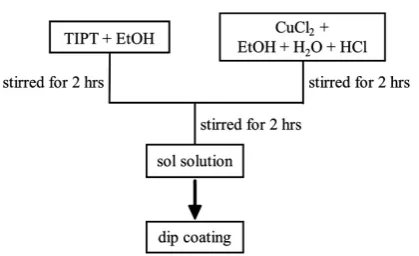
The Cu-doped TiO2 films were prepared by dip-coating using sol solution mixed titanium tetraisopropoxide, ethanol, hydrochloric acid, water, and metallic salt. The procedure of preparation of the sol solution was as follows; the mixture of titanium tetraisopropoxide (TTIP) and ethanol (C2H5OH) was stirred for 2 hours, and copper (II) chloride dihydrate (CuCl2∙2H2O) was dissolved in the mixture of C2H5OH, deionized water (H2O), and hydrochloric acid (HCl) and also stirred for 2 hours, after then both solutions were mixed and stirred for more 2 hours. The ratio of each reagent was TTIP:C2H5OH:H2O:HCl = 1:5:5:0.4, and 2 mol% of metallic salt against TTIP was added in case of deposition for the Cu-doped TiO2 films. The flow of preparation of the sol solution is shown in Figure 1. In the sol-gel reaction using TTIP as a raw material, TiO2 is formed by a hydrolysis reaction and a condensation-polymerization reaction as shown in Equations (1) and (2). In the case of doping Cu atoms, it is taken into TiO2 in the monovalent or divalent oxidation state during the sol-gel reaction.
(
3 7)
4 2( )
4 3 7Ti OC H +4H O→Ti OH +4C H OH (1)
( )
4 2 2Ti OH
→
TiO
+
H O
(2)DOI: 10.4236/msce.2017.512005 54 Journal of Materials Science and Chemical Engineering Figure 1. The flow of preparation of the sol solution.
repeated three times and then post-annealed at 500˚C for 30 min. Withdrawal speed was 2 mm/sec.
After post-annealing, film thickness was about 200 nm. All heat treatments were carried out under nitrogen ambient. Figure 2 shows the capacitance coupled plasma-enhanced CVD equipment which uses a high frequency of 13.56 MHz. In this work, nitrogen gas was used for the plasma-nitridation. Flow rate of nitrogen gas was kept constant of 100 sccm. RF power, substrate temperature, and gas pressure were 100 W, 350˚C, and 133 Pa, respectively. Plasma-nitridation was carried out for the sol-gel derived Cu-doped TiO2 films after post-annealing. Characterizations of the deposited films were carried out by Atomic force mi-croscopy (AFM; Shimazu SPM-9700), X-ray diffraction (XRD; RIGAKU RINT-2100, CuKα X-ray source operating at 30 kV and 20 mA), X-ray photoe-lectron spectroscopy (XPS; PHI ESCA-1600, AlKα X-ray source operating at 400 W), and optical absorption spectroscopy (UV-Vis; Ocean Optics USB2000), re-spectively.
Photocatalytic activities of the Cu-doped TiO2 films deposited on quartz sub-strate before and after plasma-nitridation were evaluated by pigment degrada-tion measurement. The fluorescent light with UV-cut filter (<420 nm) was used for visible-light sources. The degradation rate of metylene blue as a pigment was evaluated by measuring the changes in absorbance of 654 nm using UV-Vis spectrometer. The films were soaked in the 1 mmol/L metylene blue solution for 60 min, and then the samples were dried in the dark after the metylene blue on the back surface was wiped off. The absorbance at 654 nm was measured every 15 min visible-light irradiation.
3. Results and Discussion
3.1. Depth Profile of Nitrogen Atoms
DOI: 10.4236/msce.2017.512005 55 Journal of Materials Science and Chemical Engineering Figure 2. Schematic of the capacitance coupled plasma-enhanced CVD equipment.
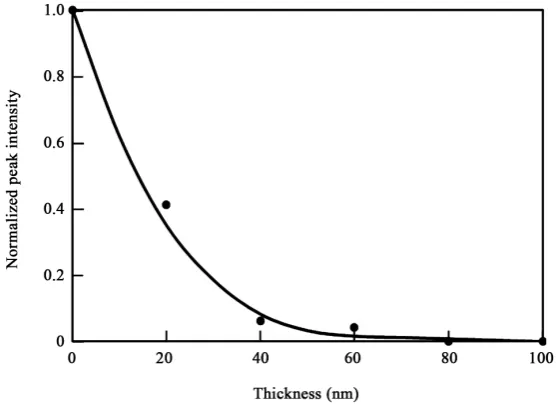
Figure 3. Depth profile of nitrogen atoms in plasma-nitrided Cu-doped TiO2 film.
structure of the plasma-nitrided film becomes dense after post-annealing at 500˚C for 30 min.
3.2. Structural Evaluation of the Films
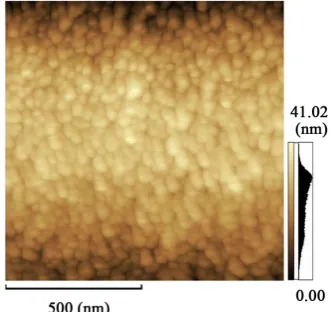
DOI: 10.4236/msce.2017.512005 56 Journal of Materials Science and Chemical Engineering Figure 4. Surface morphology of the Cu-doped TiO2 film.
Figure 5. X-ray diffraction patterns for the non-doped, Cu-doped, and plas-ma-nitrided Cu-doped TiO2 films.
The film composition was analyzed by XPS. The XPS spectra of Ti2p, O1s, and Cu2p electrons of the Cu-doped TiO2 film are shown in Figure 6. Ti2p3/2 and Ti2p1/2 electrons have peaks at binding energies of 458.7 eV and 464.3 eV, respectively, which implies that the ionic state of titanium is Ti4+ [19]. The prominent sharp O1s peak at 529.9 eV is associated with the oxygen of TiO2 [20]. The Cu2p3/2 peak at 932.2 and Cu2p1/2 peak at 952.1 eV are both assigned to Cu+ [20].
The XPS spectra of the plasma-nitrided Cu-doped TiO2 film are shown in Figure 7. Ti2p signals are hardly changed compared with those of the Cu-doped TiO2 film, however, O1s of N-O bonds at 531.3 eV, and N1s of Ti-N bonds at 397.1 eV are observed [15].
Moreover, two peaks at 934.5 eV (Cu2p3/2) and 954.7 eV (Cu2p1/2), assigned to Cu2+ are obviously observed as shown in Figure 6(d) [20].
DOI: 10.4236/msce.2017.512005 57 Journal of Materials Science and Chemical Engineering
[image:6.595.223.523.60.227.2](a) (b) (c)
Figure 6. The XPS spectra of (a) Ti2p; (b) O1s; and (c) Cu2p electrons of Cu-doped TiO2 film.
(a) (b)
(c) (d)
Figure 7. The XPS spectra of (a) Ti2p; (b) O1s; (c) N1s; and (d) Cu2p electrons of plas-ma-nitrided Cu-doped TiO2 film.
[image:6.595.254.492.273.614.2]DOI: 10.4236/msce.2017.512005 58 Journal of Materials Science and Chemical Engineering
3.3. Visible-Light Responsive Photocatalysis
Figure 8 shows transmission spectra of non-doped TiO2, Cu-doped TiO2, and plasma-nitrided Cu-doped TiO2 films, respectively. The absorption edges of Cu-doped TiO2 and plasma-nitrided Cu-doped TiO2 films do red shift compared with that of non-doped TiO2 film. Slightly large red shift is observed with the plasma-nitrided Cu-doped TiO2 film.
Bandgap energies of TiO2, Cu2O, and CuO are 3.2, 2.1, and 1.76 eV, respec-tively [21]. So, visible-light absorption of the Cu-doped TiO2 is due to Cu2O exist in the film. In case of the plasma-nitrided Cu-doped TiO2, oxidation state of a part of Cu2O changes to CuO, and in addition, bandgap of TiO2 decreases be-cause of replacement of O atoms with N atoms in the TiO2 matrix, as a result visible-light absorption enhances compared with the Cu-doped TiO2.
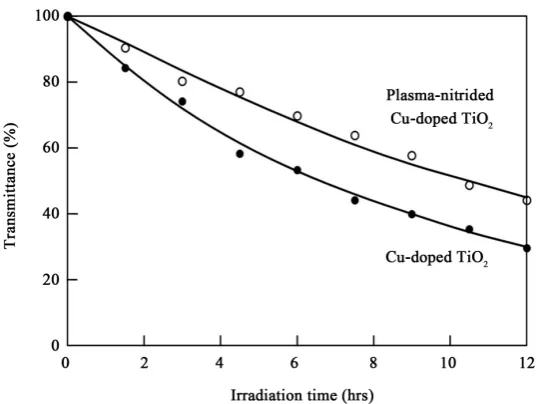
The visible-light responsive photocatalysis was evaluated by measuring de-gradation of metylene blue using UV-Vis spectroscopy. Figure 9 shows the transmittance of metylene blue solution at 654 nm as a function of visible-light irradiation time. The transmittance decreases exponentially with increase of the irradiation time in both cases of the Cu-doped TiO2 and plasma-nitrided Cu-doped TiO2 films.
Assuming that the decomposition reaction of methylene blue is the first-order reaction, the natural logarithm of the transmittance ratio, i.e. absorbance, before and after irradiation as a function of the irradiation time is shown in Figure 10. In both cases, linear relationship is shown and the rate constant that is calculated by the gradient of the linear line of the plasma-nitrided Cu-doped TiO2 film de-creases to about 60% of the Cu-doped TiO2 film.
[image:7.595.241.503.495.693.2]Conduction band edges of TiO2, Cu2O, and CuO are 0.21, 0.75, and −0.50 V (vs. NHE), respectively [21]. In the Cu-doped TiO2, excited electrons into the conduction band of Cu2O by visible-light irradiation diffuse to the conduction
DOI: 10.4236/msce.2017.512005 59 Journal of Materials Science and Chemical Engineering Figure 9. Transmittance of metylene blue solution at 654 nm as a function of visible-light irradiation time.
Figure 10. Natural logarithm of the absorbance ratio before and after visible-light irradi-ation as a function of the irradiirradi-ation time.
band of the TiO2, the visible- light responsive photocatalysis is observed. In case of the plasma-nitrided Cu-doped TiO2, however, it is considered that impurity level of CuO formed in the bandgap of the TiO2, and oxygen vacancy due to break of Ti-O bonds by plasma-treatment act as recombination center. As a re-sult, photocatalytic activity degrades.
[image:8.595.236.509.316.510.2]DOI: 10.4236/msce.2017.512005 60 Journal of Materials Science and Chemical Engineering
4. Conclusions
Copper and nitrogen co-doping effect on visible-light responsive photocatalysis of plasma-nitrided copper-doped titanium oxide film was investigated.
Cu exists as Cu2O in the nearly stoichiometric TiO2 matrices, and the crystal-linity of TiO2 is hardly affected by Cu doping. The absorption edge of the Cu-doped TiO2 film did red shift compared with that of non-doped TiO2 film, it is due to Cu2O with bandgap of 2.1 eV. When the Cu-doped TiO2 film was treated in nitrogen plasma, oxidation state of a part of Cu2O changes to CuO, and in addition, bandgap of TiO2 decreases because of replacement of O atoms with N atoms in the TiO2 matrix, as a result, visible-light absorption enhances compared with the Cu-doped TiO2. The visible-light responsive photocatalysis of the Cu-doped TiO2 film is due to excited electrons to the conduction band of Cu2O by visible-light irradiation diffuse to conduction band of TiO2. In the plasma-nitrided Cu-doped TiO2, it is considered that both the Cu2+ formed by oxidation of Cu+ and oxygen vacancy act as recombination centers, as a result, photocatalytic activity degrades.
In this study, it is found that oxygen atoms were released from TiO2 in the plasma-nitridation process of the Cu-doped TiO2, and leads to formation of im-purity level and oxygen vacancy, as a result, the photocatalytic activity degraded. In order to suppress release of oxygen atoms, it is considered that using of mixed gas plasma of oxygen and nitrogen gases is effective.
Acknowledgements
The authors would like to thank Mrs. Yaoyama T and Watanabe T for their ex-perimental assistance.
References
[1] Rashidi, S., Nikazar, M., Yazdi, A.V. and Fazaeli, R.J. (2014) Optimized Photocata-lytic Degradation of Reactive Blue 2 by TiO2/UV Process. Environmental Science and Health, Part A, 49, 452-462. https://doi.org/10.1080/10934529.2014.854685
[2] Lin, H., Huang, C.P., Li, W., Ni, C., Shah, S.I. and Tseng, Y.H. (2006) Size Depen-dency of Nanocrystalline TiO2 on its Optical Property and Photocatalytic Reactivity Exemplified by 2-Chlorophenol. Applied Catalysis B Environmental, 68, 1-11.
https://doi.org/10.1016/j.apcatb.2006.07.018
[3] Ni, M., Leung, M.K.H., Leung, D.Y.C. and Sumathy, K. (2007) A Review and Recent Developments in Photocatalytic Water-Splitting Using TiO2 for Hydrogen Produc-tion. Renewable and Sustainable Energy Review, 11, 401-425.
https://doi.org/10.1016/j.rser.2005.01.009
[4] O’Regan B. and Grätzel, M. (1991) A Low-Cost, High-Efficiency Solar Cell Based on Dye-Sensitized Colloidal TiO2 films. Nature, 353, 737-740.
https://doi.org/10.1038/353737a0
[5] Kim, D.H., Seong, W.M., Park, I.J., Yoo, E.S., Shin, S.S., Kim, J.S., Jung, H.S., Lee, S. and Hong, K.S. (2013) Anatase TiO2 Nanorod-Decoration for Highly Efficient Photoenergy Conversion. Nanoscale, 5, 11725-11732.
DOI: 10.4236/msce.2017.512005 61 Journal of Materials Science and Chemical Engineering
[6] Kuzmych, O., Nonomura, K., Johansson, E.M.J., Nyberg, T., Hagfeldt, A. and Skompska, M. (2012) Defect Minimization and Morphology Optimization in TiO2 Nanotube Thin Films, Grown on Transparent Conducting Substrate, for Dye Syn-thesized Solar Cell Application. Thin Solid Films, 522, 71-78.
https://doi.org/10.1016/j.tsf.2012.09.011
[7] Fujishima, A. and Honda, K. (1972) Electrochemical Photolysis of Water at a Semi-conductor Electrode. Nature, 238, 37-38. https://doi.org/10.1038/238037a0 [8] Li, L., Wei, L., Yuexiang, Z., Biying, Z. and Youchang, X. (2005) Phosphor-Doped
Titania - A Novel Photocatalyst Active in Visible Light. Chemistry Letters, 34, 284-285. https://doi.org/10.1246/cl.2005.284
[9] Shannon, M.A., Bohn, P.W., Elimelech, M., Georgiadis, J.G., Marĩas, B.J. and Mayes, A.M. (2008) Science and Technology for Water Purification in the Coming Decades. Nature, 452, 301-310. https://doi.org/10.1038/nature06599
[10] Zhang, T., Zhang, X., Ng, J., Yang, H., Liu, J. and Sun, D.D. (2.11) Fabrication of Magnetic Cryptomelane-Type Manganese Oxide Nanowires for Water Treatment.
Chemical Communications, 47, 1890-1892.
https://doi.org/10.1039/C0CC03265D
[11] Wang, R., Hashimoto, K., Fujishima, A., Chikumi, M., Kojima, E., Kitamura, A., Shimohigoshi, M. and Watanabe, T. (1977) Light-Induced Amphiphilic Surfaces.
Nature, 388, 431-432. https://doi.org/10.1038/41233
[12] Colón, G., Maicu, M., Hidalgo, M.C. and Navío, J.A. (2006) Cu-Doped TiO2 Sys-tems with Improved Photocatalytic Activity. Applied Catalysis B: Environmental, 67, 41-51. https://doi.org/10.1016/j.apcatb.2006.03.019
[13] Nakano, T., Kogoshi, S. and Katayama, N. (2015) Cu-Supported TiO2 with High Visible-Light Photocatalytic Activity Prepared Using Cupric Acetate. e-Journal of Surface Science and Nanotechnology, 13, 143-146.
https://doi.org/10.1380/ejssnt.2015.143
[14] Zhou, J., Takeuchi, M., Ray, A.K., Anpo, M. and Zhao, X. (2007) Enhancement of Photocatalytic Activity of P25 TiO2 by Vanadium-Ion Implantation under Visible Light Irradiation. Journal of Colloid and Interface Science, 311, 497-501.
https://doi.org/10.1016/j.jcis.2007.03.007
[15] Asahi, R., Morikawa, T., Ohwaki, T., Aoki, T. and Taga, Y. (2001) Visible-Light Photocatalysis in Nitrogen-Doped Titanium Oxides. Science, 293, 269-271.
https://doi.org/10.1126/science.1061051
[16] Zhang, J.L., Wu, Y.M., Xing, M.Y., Lenghari, S.A.K. and Sajjad, S. (2010) Develop-ment of Modified N Doped TiO2 Photocatalyst with Metals, Nonmetals and Metal Oxides. Energy Environmental Science, 3, 715-726.
https://doi.org/10.1039/b927575d
[17] Ohno, T., Mitsui, T. and Matsumura, M. (2003) Photocatalytic Activity of S-Doped TiO2 Photocatalyst under Visible Light. Chemistry Letters, 32, 364-365.
https://doi.org/10.1246/cl.2003.364
[18] Murakami, Y., Kasahara, B. and Nosaka, Y. (2007) Photoelectrochemical Properties of the Sulfur-Doped TiO2 Film Electrodes: Characterization of the Doped States by Means of the Photocurrent Measurements. Chemistry Letters, 36, 330-331.
https://doi.org/10.1246/cl.2007.330
[19] Pham T.D. and Lee, B.K. (2014) Cu Doped TiO2/GF for Photocatalytic Disinfection of Escherichia coli in bioaerosols under Visible Light Irradiation: Application and Mechanism. Applied Surface Science, 296, 15-23.
DOI: 10.4236/msce.2017.512005 62 Journal of Materials Science and Chemical Engineering
[20] Sreekantan, S., Zaki, S.M., Lai, C.W. and Tzu, T.W. (2014) Copper-Incorporated Titania Nanotubes for Effective Lead Ion Removal. Materials Science in Semicon-ductor Processing, 26, 620-631.https://doi.org/10.1016/j.mssp.2014.05.034