Weaknesses in the
manufacturing strategy: a
case study
Author: Harmen Denekamp Date: August 2017
Supervisors:
Marne Schu MSc. (Company A) Casper Vos (Company A)
Table of contents
1 Introduction ... 5
1.1 Research motivation ... 5
1.2 Problem identification ... 5
1.3 Research aim ... 5
1.4 Academic relevance ... 6
1.5 Thesis outline ... 6
2 Research design ... 6
2.1 Research questions ... 6
2.2 Research approach and methods ... 7
2.3 Validity and reliability ... 9
3 Theoretical background ... 10
3.1 Introduction ... 10
3.2 Definition and context ... 10
3.3 Manufacturing strategy content ... 11
3.4 Manufacturing strategy criteria ... 12
4 Identification of critical decision areas of the manufacturing strategy ... 12
5 Planning and control ... 14
5.1 Introduction ... 14
5.2 Weaknesses of planning and control ... 14
5.3 Issues resulting from the weaknesses of planning and control ... 15
5.4 Theory on issues ... 16
5.5 Implications for the manufacturing strategy ... 18
5.6 Discussion ... 20
6 Vertical integration ... 20
6.1 Introduction ... 20
6.2 Weaknesses of the vertical integration strategy ... 21
6.3 Issues resulting from the weaknesses of the vertical integration strategy ... 22
6.4 Theory on issues ... 22
6.5 Recommendations for the manufacturing strategy ... 24
6.6 Discussion ... 31
7 New product introduction ... 31
7.1 Introduction ... 31
7.2 Weaknesses of the new product introduction strategy ... 32
7.4 Theory on issues ... 33
7.5 Implications for the manufacturing strategy ... 35
7.6 Discussion ... 37
8 Conclusion ... 38
9 Limitations and future research ... 41
9.1 Limitations of research ... 41
9.2 Recommendations for future research ... 41
Executive summary
Using their manufacturing strategy, Company A has been unable to turn the tide on increasingly poor financial and operational performance in the past 10 years. Problem is that it is unknown what the weaknesses of the current manufacturing strategy are and that there is uncertainty about how the manufacturing strategy can be improved to address the weaknesses and experienced issues. The goal of this research is to identify the weaknesses and give recommendations for the new
manufacturing strategy, to improve operational performance. Based on this, the main research question is: how can the weaknesses in the current manufacturing strategy be addressed in the new manufacturing strategy?
To answer this question, several steps have been taken. First, the decision areas to be addressed by the manufacturing strategy and the characteristics of a strong manufacturing strategy have been identified through a literature review. Second, interviews with managers and experts of most departments have been held to identify the most critical decisions areas, and weaknesses and issues within these decision areas. Third, recommendations that address the weaknesses and issues have been given, based on applying literature to this case. The results of this research are summarized in Figure 14, 15 and 16 for respectively Planning and Control, Vertical Integration, and New Product Introduction.
For Planning and Control, recommendations have been made by creating a simplified model of the current method and comparing it with the reference model from theory (Q7). The first
recommendation is to use historical data to improve the product configuration. The second is to reject orders or renegotiate lead-times to enable better control of the workload for critical
resources. The third is to do MRP after the design phase, purchasing only a few long lead-time parts before the design phase, to improve the bill of materials. The fourth is to use Project Requirements Planning for more custom orders, taking into account lead-time variation of parts, to protect the assembly schedule from delays. The fifth is to enhance shop floor scheduling by tracking parts, to improve the supply of parts to assembly. It also helps to improve the accuracy of estimated production times, basing it on historical data. The final recommendation is to thoroughly evaluate the current planning method and implement the integrated solution from theory.
For the Vertical Integration, an overall vertical structure is recommended, which is to outsource production functions and focus on assembly and design. To make decisions of which production functions should be outsourced, a decision model has been proposed. If implemented, it should lead to a better vertical structure and better overall business performance.
For the New Product Introduction, the recommendations have been linked more to experienced issues. To address the issue of selling products during their development, it has been recommended to create a mission statement and a set of objectives through discussion. These should be clearly communicated, agreed upon by everyone and finally ways to keep each other accountable should be established. This prevents the setting of wrong priorities. To address the issue of DFMA execution, it has been recommended to find out where exactly execution fails, to then take appropriate
lead to a higher quality, higher delivery reliability and more production efficiency of new products in the future.
1
I
NTRODUCTION
1.1
R
ESEARCH MOTIVATIONCompany A’s sales went down from 146 million in 2007 to 99 million in 2015. In 2015, losses have been around 20 million, which is high considering 99 million in revenues, declining each year. These financial numbers have been putting pressure on managers to improve the results. One way they want to do this is through creating a new manufacturing strategy. Marne Schu, the operational excellence manager, is one of the people who are responsible for creating this new manufacturing strategy. He wanted someone who would look at it, to give recommendations from an outsider perspective; without the bias resulting from internal experience. The goal of this research is thus to give recommendations for the new manufacturing strategy.
1.2
P
ROBLEM IDENTIFICATIONThe financial performance has been poor the past years, worsening every year. Operational performance is also underperforming on quality, delivery reliability and efficiency measures,
compared to other Company A locations. Poor operational performance underlies the poor financial performance. Quality issues of new products during assembly have led to high rework costs and late deliveries. Low production efficiency has led to losses, as competitors set the market prices and Company A must choose either losing customers or making losses. Long and variable lead-times have led to low delivery reliability. These three examples show how poor operational performance has led to poor financial performance, and Company A’s managers must find a way to turn the tide.
The manufacturing strategy is supposed to lead the company to strong operational results, but it has failed, seeing the poor operational results. That is why Company A’s managers view the
manufacturing strategy as one major way to turn the tide. However, there are two problems. First, they do not know the weaknesses of the current manufacturing strategy. Connected to this problem is that there is uncertainty of how the weaknesses should be addressed in the new manufacturing strategy. On some areas, there is a discussion of what idea is the best, such as the assembly layout. On other areas, there are no ideas at all, such as how to improve the planning method. The second problem is thus uncertainty of how the new manufacturing strategy should address the experienced issues and underlying weaknesses. This research addresses these three problems, helping to turn the tide by providing insight in the weaknesses of the current manufacturing strategy and giving
recommendations for the new manufacturing strategy. Or put as the main research question:
How can the weaknesses in the current manufacturing strategy be addressed in the new manufacturing strategy?
1.3
R
ESEARCH AIMThe aim of this research is to answer the main research question. Thus, first to identify the issues and underlying weaknesses in the manufacturing strategy. Then, to give recommendations of how these weaknesses can be addressed in the new manufacturing strategy. The deliverable is this report, in which the issues and weaknesses are identified and recommendations are given. The practical relevance is twofold.
bottom-up perspective, as root causes are not only on a strategic level, but can be in the details as well. Second, the recommendations of how the weaknesses can be addressed can be used in the creation of the new manufacturing strategy. A stronger manufacturing strategy should not only be able to address a variety of current issues, but also prevent future issues.
1.4
A
CADEMIC RELEVANCEThis research has a more practical focus, meaning that contributing to academic literature not a primary goal. However, this research does aim to contribute to academic literature. Because this research is a case study, the in-depth information gathered about the company can spark new research directions. The information gathered is twofold: identify manufacturing strategy weaknesses and identify issues that have resulted from these weaknesses.
Research has already been done on the implementation of manufacturing strategy and its impact on performance. (Thun, 2008; Rho et al., 2001) These focus on the importance of certain characteristics of manufacturing strategies and their impact on performance. For example, Rho et al. (2001) found that consistency plays a more important role than strategy or implementation in discriminating the superior from the inferior performance groups. However, I haven’t been able to find research that
focuses on the weaknesses and issues of existing manufacturing strategies and their implementation.
This research identifies some weaknesses and the issues that result from them. Future research can focus on finding patterns or common weaknesses and issues, for which this research provides a starting point. By finding these patterns and common weaknesses and issues, they could be addressed by either new research, consultancy firms or even government. Tackling the common weaknesses and issues could then lead to improved overall business performance.
1.5
T
HESIS OUTLINEThis thesis starts with the research design, with a description of research questions, the research approach and methods of gathering data. Then, the theoretical background answers two knowledge questions that are the basis for the rest of the research. The middle part of the research is divided in two: vertical integration and new product introduction, each with the same structure. These are the two parts of the manufacturing strategy that are analyzed. First, the weaknesses of the respective part of the manufacturing strategy are identified. Second, the issues that have resulted from the weaknesses in the manufacturing strategy are identified. Then, theory that addresses the identified issues is stated. Finally, recommendations that address the identified issues are stated, based on the theory on the issues. After these two main parts, the conclusion, limitations and future research are discussed.
2
R
ESEARCH DESIGN
2.1
R
ESEARCH QUESTIONSQ1.What decision areas should be addressed by the manufacturing strategy?
Because of the limited time-span of this research, not all decision areas can be assessed. For that reason, an analysis is made to identify the most critical decision areas, in terms of criticality of issues. The rest of the research will focus on three of the most critical decision areas.
Q2.On which decision area are the most critical issues experienced?
To be able to identify weaknesses, a comparison has to be made with a strong manufacturing strategy. The characteristics of a strong manufacturing strategy can be compared with the current manufacturing strategy, leading to the identification of weaknesses. Therefore, the second step is to define the characteristics of a strong manufacturing strategy.
Q3.What are characteristics of a strong manufacturing strategy?
Once three decision areas are chosen and characteristics of a strong manufacturing strategy are known, the decision areas can be assessed along these characteristics for each of the decision areas.
Q4.What are weaknesses in the decision areas of the manufacturing strategy?
Once the weaknesses are known, issues that result from these weaknesses can be identified.
Q5.What issues are experienced in the decision areas, as a result of weaknesses in the manufacturing strategy?
Before making recommendations, it is important to look at theory that addresses the identified issues. Peer-reviewed research is a reliable source on which the recommendations can be based.
Q6.What does theory suggest about the identified issues?
The final step is to apply the theory to Company A, resulting in a set of recommendations founded in theory.
Q7.How can Company A address the identified issues using their manufacturing strategy?
The main research question can now be answered to complete the cycle. The conclusion reflects on how the weaknesses can be addressed in the new manufacturing strategy by the recommendations that result from Q7.
2.2
R
ESEARCH APPROACH AND METHODSThe research questions are here translated in practical research steps. The methods to gather the data needed to answer the research questions are discussed for each research step.
Step 2: identification of weaknesses and issues. This step answers Q2, Q4 and Q5. The identification of weaknesses in the manufacturing strategy, and the resulting issues, is done through interviews. Each of the decision areas is evaluated for issues. Based on the issues mentioned in interviews, a selection is made of the three most critical decision areas (Q2). Q4 to Q7 will be answered for each of these three decision areas. First, the characteristics of a strong manufacturing strategy are criteria which will be assessed for these decision areas (Q4). Then, issues resulting from the weaknesses will be identified, based on the same interviews (Q5). The results of this step are a selection of three most critical decision areas, a set of weaknesses and the resulting issues for these decision areas.
Knowledge on past decision making in Company A is not well documented, which is a weakness most managers are aware of. Most knowledge is in the heads of the managers and experts that have been involved in decision making. For that reason, interviews are the source of data needed to identify weaknesses and issues of the manufacturing strategy.
The interviews are semi-structured, which means that they follow a set of questions, but can diverge to other topics when considered relevant. To identify the weaknesses and issues on the various decision areas, SIPOC is applied. SIPOC stands for Supplier Input Process Output Customer and is a tool used in the Six Sigma methodology (Saxena, 2005). SIPOC is commonly used during the define phase of a process improvement project, because it aids in understanding the purpose and scope of a process. Exactly this understanding of the purpose and scope of a process is the reason why it is applied here. To identify weaknesses and issues, the process has to be understood. It helps to identify relations between the different issues and seeing the bigger picture. Additionally, it improves the reliability, by hearing stories from all different perspectives. The SIPOC analysis is performed for each part of the supply chain, covering the different decision areas that are part of the manufacturing strategy. In the questions, “your part” refers to the part the manager is responsible for. The questions are as follows:
1. Who are the suppliers to your part in the supply chain? (S) 2. What are the inputs to your part in the supply chain? (I)
3. Could you give a summary of what your department does as part of the supply chain? (P) 4. What are the outputs of your part in the supply chain? (O)
5. Who are the users of the output of your part in the supply chain? (C)
6. What issues do you currently experience? This can be on either of the five SIPOC parts.
The interview protocol is the same as the questions above, with an introduction included. The participants are selected based on the business process of Company A, where for each part of the overall business process, the manager is interviewed. Additionally, the director and operations manager, who are head of the organization, can give valuable insights over the entire spectrum. The managers are assumed to have the best ability to answer the questions, because they are
responsible for decision making, management and collaboration of their areas of responsibility. Issues can also be better understood by managers, because their experience with the context of issues and their connection with other parts in the supply chain. In addition, some experts are interviewed to verify statements by managers and give more in-depth info where needed. These experts are also long-time employees, who have worked in different levels of the organization, which makes their perspective even more valuable. The people interviewed are stated in the table below (Table 1). The interviews took between 30 and 90 minutes.
Director Operations manager
Marketing manager Sales manager
Industrialization expert and manager Operational buying manager
Assembly manager Operational excellence manager
[image:10.595.73.522.72.116.2]Planning manager Engineering expert and manager
Table 1. Interviewees within Company A.
Step 3: theory on issues. This step answers Q6. As explained before, it is important to look at what theory suggests about the identified issues. Academic literature can give valuable insights on how the issues can be addressed by the manufacturing strategy. It increases the quality of the
recommendations. For that reason, a literature review is applied. This step is similar to step 1, except for different search terms. The applicability of articles to this research is an important criterion during the literature review.
Step 4: recommendations for the manufacturing strategy. This step answers Q7 and the main research question. A set of recommendations are made, based on theory, that address the weaknesses. These recommendations are not step-by-step action plans for resolving all issues, because it is unrealistic to attempt to solve these major issues in a 10-week project. The
recommendations highlight points of attention that should be considered when formulating the new manufacturing strategy. The method is logical reasoning to formulate recommendations based on theory and conversation with relevant managers to validate these recommendations. The reason for these conversations is that they know better how theory applies to Company A, because they know more about Company A. Additionally, their expertise and opinion can bring valuable additions to the recommendations. The results of this step are recommendations and a conclusion for each decision area. This conclusion is a reflection on how the recommendations address the weaknesses in the respective decision area, answering the main research question.
2.3
V
ALIDITY AND RELIABILITYPeople are subjective and therefore biased. For that reason, there is a risk of internal validity issues for the results that are based on interviews. Not much data is available within Company A to validate claims in interviews. For example, the planning manager could be biased that his own department has no issues, but supply chain is simply too unreliable in meeting due dates. His assessment could be false. Maybe he does not see that the planning method makes it impossible for supply chain to deliver on time. The risk is that the wrong conclusions are drawn, that the issues identified lie somewhere else. This is addressed by interviewing a manager from every department, from sales to assembly. By doing this, claims can be verified by managers with a different perspective, increasing internal validity. However, if a company-wide bias exists, this will result in internal validity issues, which is a risk.
The identification of weaknesses and issues has a low external validity, because these are only obtained from and for Company A. The issues might, and probably do, exist at other companies however. The recommendations are based on academic literature that does have external validity in general. Therefore, companies with similar issues might benefit from the recommendations in this research. However, this should be considered for each individual case. Thus, there is some external validity regarding the recommendations, when linked to the issues.
within Company A. They are more able to discern temporary and long-term issues. They know how it was before certain issues emerged. Additionally, my own logic helps to discern between temporary and long-term issues.
3
T
HEORETICAL BACKGROUND
3.1
I
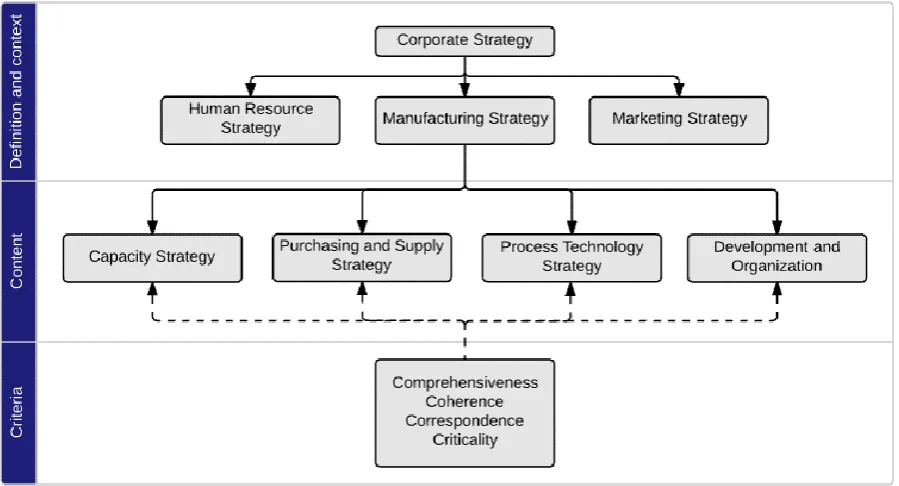
NTRODUCTION [image:11.595.74.524.319.562.2]The aim of this chapter is to help understand the concept of manufacturing strategy and answer two research questions, of which the overview can be seen in Figure 1. First, the definition and context of manufacturing strategy help to understand the concept and place it in the bigger picture. Then, the first research question is answered: what decision areas should be addressed by the manufacturing strategy? These decision areas give structure to the rest of the research, because research questions 4 to 7 will be answered for three of these decision areas. Finally, the third research question is answered: what are characteristics of a strong manufacturing strategy? Each decision area is evaluated along these criteria.
Figure 1. Theoretical background overview.
3.2
D
EFINITION AND CONTEXTSkinner (1969) was the first to coin the term “manufacturing strategy” in his breakthrough article “manufacturing – the missing link in corporate strategy.” He argued that manufacturing strategy is vital in business performance on the long term. He advocated the concept of a focused factory, which focuses on a limited set of tasks and excels at these. The concept of a focused factory has proven to remain valid. For example, Bozarth et al. (2009), found that all types supply chain complexity negatively impacts manufacturing plant performance. The scientific field has evolved from this initial concept. Currently, Nigel Slack is one of the major authors on the subject. Slack and Lewis (2011, p. 22) stated the following definition: “Operations strategy is the total pattern of
Operations strategy and manufacturing strategy are used interchangeably and are the same in scientific literature: Slack and Lewis (2011) use operations and Hayes and Wheelwright (1984) use manufacturing. In this research, manufacturing strategy is used, because it is used by Company A.
To further clarify what a manufacturing strategy is, it helps to view it in its context. Manufacturing strategy contributes to business competitiveness through its role as a functional strategy. This means that it provides a strategic orientation within its function, which is manufacturing in this case. As will be elaborated in the next paragraph, this function consists of several decision areas. This is shown in Figure 1.
3.3
M
ANUFACTURING STRATEGY CONTENTSlack and Lewis (2011) developed a set of four decision areas to be addressed by a manufacturing strategy, or in other words: the content of the manufacturing strategy. The definitions for each area by Slack and Lewis (2011) are first stated, then some additional clarification is given.
(1) Capacity strategy: “how capacity and facilities in general should be configured.” (p.269) The capacity strategy consists of strategic-, medium-term, and short-term capacity decisions. Strategic (or long-term) decisions are on a year to months scale, concerning facilities and process technology. Medium-term decisions are on a month to weeks scale, concerning aggregate number of people and degree of subcontracted resources. Short-term decisions are on a week to hours or even minutes scale, concerning the provision of individual staff within the operation and loading of individual facilities, which is the planning of a company.
(2) Purchasing and supply strategy: “how operations relate to its interconnected network of other operations, the entire supply chain.” (p.269) It includes considering the position of the company in this network to understand how the dynamic forces in the network will affect them, and to decide what role they wish to play in the network. The first part is to decide what to make and what to buy, which is commonly called the vertical integration strategy. The second part is to decide how is bought, what kind of relations and contracts are established and how these suppliers are managed, including supply risk management. This is commonly called the procurement strategy.
(3) Process technology strategy: “the choice and development of the systems, machines and
processes that act directly or indirectly on transformed resources to convert them into finished products and services. ” (p.269) Slack (2013) distinguishes between three types of process technology: material-processing technology, information-processing technology and customer-processing technology. For each of these types, the available technologies must be identified and their strategic value has to be determined, considering the feasibility, acceptability, and vulnerability of the technology.
3.4
M
ANUFACTURING STRATEGY CRITERIASlack and Lewis (2011) developed a set of four requirements for a good manufacturing strategy. These can be applied to assess the quality of an existing manufacturing strategy. It helps to identify weaknesses and their type. Knowing the type of weakness is useful, because measures to improve a manufacturing strategy need to be different for different types of weaknesses.
(1) Comprehensiveness: companies can fail by not noticing the potential impact of, for example, process technology. Alignment is only complete when all decision areas are considered. A decision area is a weakness of comprehensiveness when it has not been receiving adequate attention, in terms of analysis and thorough decision making. A decision area creates no weakness in
comprehensiveness when it has been thoroughly analyzed and decisions have received adequate attention.
(2) Coherence: when the choices made in each decision area do not pull the operation in different directions. A weakness of coherence occurs when decisions made in different areas are working against each other. If such inconsistencies are identified, there is a weakness of coherence.
(3) Correspondence: strategies pursued in each decision area should reflect the true priority of each performance objective. Every decision is a trade-off and thereby each decision reflects a priority. If decisions are found that set different priorities, compared to the manufacturing mission, there is a weakness of correspondence.
(4) Criticality: identification of the most important decision areas regarding the performance
objectives. Critical decision areas should receive appropriate attention. If a decision area is crucial to one of the performance objectives, and it has not received much attention (see comprehensiveness), there is a weakness of criticality. The difference with comprehensiveness is that for critical decision areas, more elaborate analysis and decision making is required. Thus, a decision area that is critical for quality, can be a weakness of criticality without being a weakness of comprehensiveness.
4
I
DENTIFICATION OF CRITICAL DECISION AREAS OF THE MANUFACTURING
STRATEGY
on the most critical issues that are being recognized. It is reasonable to assume that the most pressing and critical issues are being recognized by at least some managers.
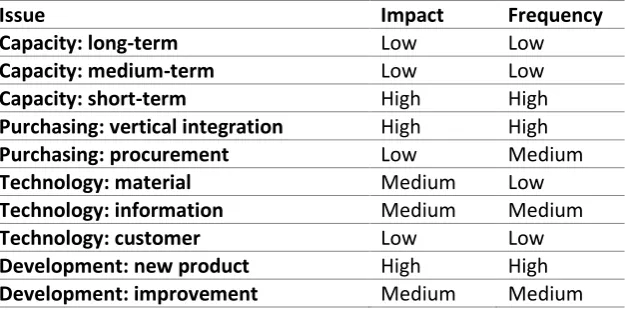
Issue Impact Frequency
Capacity: long-term Low Low
Capacity: medium-term Low Low
Capacity: short-term High High
Purchasing: vertical integration High High
Purchasing: procurement Low Medium
Technology: material Medium Low
Technology: information Medium Medium
Technology: customer Low Low
Development: new product High High
[image:14.595.78.391.109.264.2]Development: improvement Medium Medium
Table 2. Identification of critical decision areas.
As described by Slack and Lewis (2011), each decision consists of a few sub-areas. Each of the decision sub-areas will now be evaluated for these two criteria.
Capacity strategy. (1) The long-term capacity strategy concerns facilities and process technology. Current facilities are rather new and more than sufficient for current activities, nobody debated this. Process technology, regarding capacity, has not been mentioned in interviews. Thus, no critical issues and few mentions. (2) The mid-term capacity strategy concerns the number of people and their skills. An issue mentioned here was the lack of engineers, which has been addressed by opening new vacancies. There is consensus that the number of people and their skill is adequate. Thus, low impact and it had few mentions. (3) The short-term capacity strategy concerns planning and control. This has been frequently brought up by a variety of managers. Some issues mentioned were that planning is often not met, leading to delivery reliability and unfavorable sequencing for engineers. Additionally, design changes often happen in a later stage, which the current planning and control cannot cope with. Because delivery reliability is the second highest priority and planning is critical in this regard, this has a high impact. It has also been frequently mentioned.
Purchasing and supply strategy. (1) Vertical integration has been mentioned frequently. The issues were mentioned to be doing too many activities, some of which put a high pressure on costs. The activities were mentioned to be too many to manage, leading to inefficiencies and the surfacing of many smaller issues. The impact on costs and resulting inefficiencies and issues make this a critical area, thus high impact. (2) Procurement has been mentioned twice, but only in positive light: a new procurement strategy is in the making. No critical issues were mentioned.
Process technology strategy. (1) Material processing technology was mentioned once by a
manufacturing expert. He stated that most technology is old and no plan exists on what will happen once machinery breaks down, possibly shutting down important functions in case of failure. It is currently not producing any critical performance issues, but might in the future, depending on how it will be handled. Thus, medium impact. (2) Information processing technology has been mentioned by the operational excellence manager and planning manager. They state that there is a lack of monitoring of the production processes. Real production times are not available, which makes planning less reliable. Furthermore, improvement efforts and root cause analyses are hampered by the lack of data. The impact is less reliable planning and difficulties with addressing issues, which can be considered medium impact. (3) Customer processing technology is not important for Company A
Development and organization strategy. (1) New product introduction has been mentioned in more than half of the interviews. Issues mentioned were manufacturability issues and delivery issues in new products. If this trend continuous with other new products, it is thought to be a threat to the future of Company A. Because of the criticality for quality and delivery reliability, it has a high impact. (2) Strategic improvement has been mentioned a few times. Issues were mostly that the number of improvement programs and changes have been creating instability in the past years. This is a significant issue, but does not directly have a high impact on quality, delivery reliability or performance. Thus, medium impact and medium frequency.
The results are summarized in Table 2. The most impactful and frequent issues were found to be planning and control, vertical integration, and new product introduction. Therefore, these will be addressed in this research. The order in which they are discussed is the same order as the parts are described in theory by Slack and Lewis (2011), which is applied in the table as well.
5
P
LANNING AND CONTROL
5.1
I
NTRODUCTIONPlanning and control is part of the capacity strategy, which is one of the four decision areas stated by Slack and Lewis (2011). More specifically, the short-term capacity strategy is the planning and control. First, weaknesses of the current planning and control systems are identified. Based on these weaknesses, issues that result from a poor manufacturing strategy are identified. Next, theory is found that applies to the identified issues. Finally, the theory is applied and recommendations are made to improve the manufacturing strategy. The main result of this chapter are recommendations to improve the current planning and control systems, achieving a better fit with the current product portfolio.
5.2
W
EAKNESSES OF PLANNING AND CONTROL(1) Comprehensiveness. A decision has been made to use Baan 4.0, including the MRP II planning method. The planning method has not changed in over 10 years, while many other aspects of the business and markets have changed. Some minor improvements have been made, such as a central meeting to discuss interventions, in case of delays of projects. However, given the many issues experienced, as will be elaborated in the next paragraph, a more thorough analysis and
improvement seems necessary. This thorough re-evaluation has not taken place. For that reason, I conclude that there is a weakness of comprehensiveness.
(2) Coherence. MRPII is a commonly used planning method for ATO, being suitable for that type of production. Company A has been taking more ETO orders over the past years, increasing the number of engineers whom design directly for customers. Meanwhile, the planning method stayed the same. A planning method that struggles with ETO, which is explained more in the next paragraph. It is not necessarily pulling the organization in different directions, but changes in the product portfolio have not been addressed in this decision area, holding the organization back. Therefore, there is a slight weakness of coherence.
expensive of delivery reliability. By over-stating lead-time towards customers, a higher delivery reliability can be achieved. This is a trade-off, but currently the balance seems to prioritize cost over delivery reliability. This is not in line with the overall manufacturing objectives, thus a weakness of correspondence.
(4) Criticality. As will be explained in the next paragraph, the planning and control systems have a high impact on delivery reliability. Given that delivery reliability is the second highest priority and a weakness of comprehensiveness has been identified, there is automatically a weakness of criticality.
5.3
I
SSUES RESULTING FROM THE WEAKNESSES OF PLANNING AND CONTROLDelivery reliability is crucial for the customers of Company A. Without switchgear, operations cannot perform, which could lead to entire factories not being able to start production. Additionally, it is not possible to simply buy other switchgear, due to the custom and complex nature of these systems and long lead-time. Planning and control are important for delivery reliability, as will become clear from the identification of issues below.
The first issue is unreliable lead-time promises. According to the marketing manager and the planning manager, demand is unpredictable and fluctuates strongly, which means the workload does as well. Meanwhile the quotations manager stated that they base their lead-time promises on fixed lead-times, as stated in a lead-time sheet. Therefore, lead-times promised by quotations are often impossible to meet. To be able to give more reliable lead-time estimates, a few things should be known: current workload, forecast of expected workload, and capacity availability. Because no data is gathered on the shop floor of the progress, current workload is harder to estimate accurately. Furthermore, Company A is currently unable to forecast expected workload. The only thing that is known is capacity availability. However, there are difficulties estimating how much capacity is really needed. That is why that lead-times are fixed, with a few exceptions for heavily customized projects, resulting in poor delivery performance even before the order enters the business.
The second issue contributes to the first issue, which is inaccurate time estimates. The building blocks planning works with, such as production, assembly and design times, are inaccurate, according to the planning manager. When new processes are introduced, an estimation is made of the time they take, by executing the process once. According to the operational excellence manager, these estimates are optimistic. Because of many smaller issues, such as having to search for the right tools, real production times are higher than the estimated times. The processes are not monitored in any way, so there is no data available to improve the accuracy of the time estimates. This
contributes to a less accurate and reliable planning, leading to delivery issues.
The third issue is the inability of the control system to deal with design changes. According to the order management manager, customers often change requirements over the time of the
manufacture of the product, which is a requisite for success in the ETO business. This is a source of extra revenue and is a requirement of customers. Design changes imply that the project goes back to the drawing table, new components might have to be bought or made, and planning must change accordingly. According to the order management manager, due dates are not changed, leading to delays. A weekly meeting with about 10 staff members is organized, which usually takes about 4 to 6 hours, to discuss how the planning should change when a project deviates from the plan.
The final issue is missing parts during assembly. When only a minor component is missing, the entire project must be halted. Sequencing must change and the lost time cannot be caught up with, because for the next day, other projects are planned. Missing materials is a complex problem, originating from a variety of issues. The product configuration tool allows faulty configurations and frequently produces incomplete bills of materials. This is caused by errors in the underlying data, which is a top priority for Company A to solve. Another reason is that purchasing is done before the design is finished, while the bill of materials changes after design. In this process, errors are created in the bill of materials and wrong parts are ordered.
5.4
T
HEORY ON ISSUESMRPII was found to not be a good fit for the ETO sector, based on 30 industrial case studies
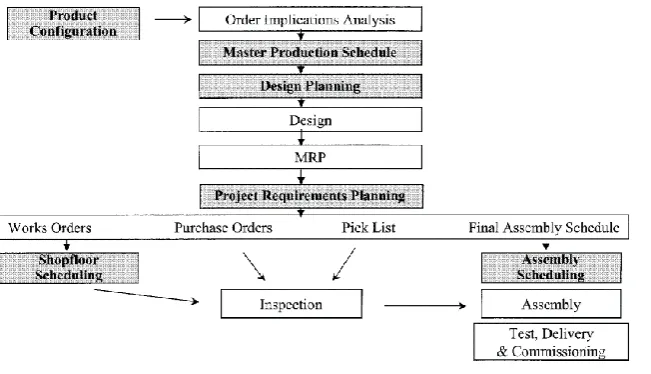
(Bertrand and Muntslag 1993, Little 1995). Some reasons mentioned are the design function as part of the process and the presence of custom products and components. For that reason, Little et al. (2000) created a new reference model (Figure 2) that does fit ETO. The purpose of this model is to assist companies in reviewing their planning method, to find what changes are necessary to improve the method, to address key business needs. The reference model follows the MRPII format and adds or changes some sub-processes, which are marked in grey. They view the effective execution of these sub-processes as critical to good performance in the ETO sector.
The purpose of such reference models is to assist company management in a review of their
planning and scheduling processes. This will enable the examination of a firm’s current approach to
[image:17.595.77.403.416.603.2]see how well this supports its key business needs, and what changes are necessary to improve planning and scheduling information systems alignment to meet these key needs.
Figure 2. Outline ETO reference model. Little et al., 2000.
The added sub-processes are grey in Figure 3. Now, each of these will be discussed in more detail.
(1) Product configuration defines the parts that need planning for purchasing or manufacturing. Companies frequently struggle with creating a reliable product configuration. Omissions,
inaccuracies or errors in the initial product specification lead to rework and late parts, thus delay. More severe errors in the product configuration can lead to products that are impossible to make and wrong cost estimations. It is important that historical data is used for the product configuration. Reuse of existing solutions and former bids should be applied wherever possible, to increase
omitting the need for custom design, decreasing cost and lead-time whilst improving the reliability of the product configuration.
(2) Order implication analysis is the assessment of potential load imposed upon critical resources. It must be made before order acceptance, so that the factory is not overloaded, which would lead to delay. The identification of the implications for the workload of new orders is vital to keep control of the workload and to maintain delivery dates. The order implication analysis done with the master production schedule, or in other words: a new function of the master production schedule in this proposed reference model.
(3) Design planning must be carefully controlled. It can take longer than the actual manufacture, having a large impact on the lead-time and delivery reliability. First, the design capacity must be measured and the workload must be monitored. Depending on the design functions, this should be broken down in sub-functions. The difficulty lies with the variables that impact design capacity: available labor hours, utilization, efficiency and skills. However, through monitoring, the design capacity can be determined using historical data. Most design tasks are a slight variation of existing techniques, components and systems. The novel element is comparatively small, thus it is possible to associate estimated times to those elements performed before. Many companies have moved away from detailed customized, but use modular design instead, which only requires minor modifications that can be done in under one week. According to the paper, one company that offered modular products with a high degree of customization overstated the quoted time by 33%, thereby ensuring on-time delivery.
(4) Project requirements planning is required instead of material requirements planning when lead-times for certain parts depend on existing work load. Especially when resources are scarce, which frequently is the case for customized parts, it is important for a new order to consider existing workload and a forecast of capacity availability. If this is not done, parts will often be late, leading to project delays. Every order is regarded as a project and scheduled on a forward scheduling basis. Thereby, a likely completion date is established. Then the customer is provided with the final due date.
(5) Shop floor scheduling must be coordinated to support final assembly schedule. It consists of a schedule for the manufacture of components, sub-assemblies and major assemblies. If only one minor component is late, the entire final assembly is delayed. Projects will be in different production stages, where delay can lead to conflicts. Because many parts are custom, estimated production times can differ or other issues can surface, frequently leading to these delays. Shop floor scheduling should react to these conflicts. By monitoring all different parts on the shop floor, conflicts can be noticed up front, so that scheduling can prevent issues further down the chain.
(6) The Final Assembly Schedule is a schedule of operations and parts required to complete a product for a customer in an assemble to order (ATO) environment. The assembly scheduling is vulnerable to missing parts. ETO companies have found to frequently struggle with missing only a minor part, causing delay of the entire project.
The paper ends with the proposal of an integrated effort, as shown in Figure 3. The purpose is to improve delivery reliability by proposing a process of integrated planning and execution. The key driver of this process is the Final Assembly Schedule. It starts at the order enquire stage, taking into account the current workload and capacity availability at design, production and assembly
Figure 3. Integrated planning approach. Little et al., 2000.
5.5
I
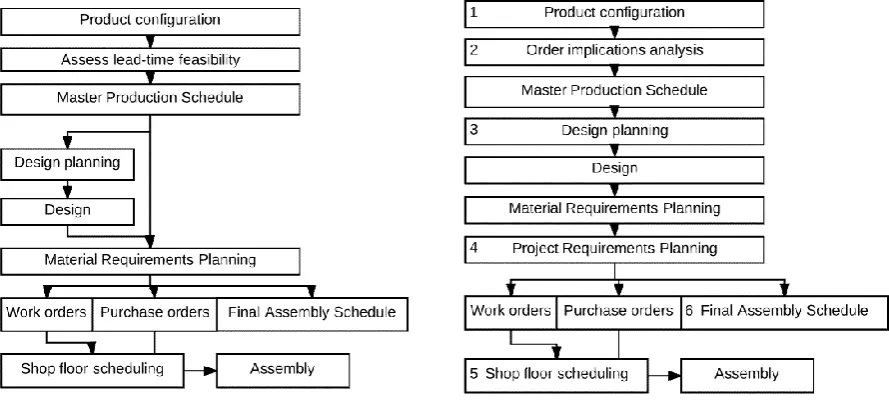
MPLICATIONS FOR THE MANUFACTURING STRATEGYRecommendations will be based on a comparison between the current situation and the reference model from theory. This is exactly what the reference model was made for. In Figure 4 the current planning method of Company A and the proposed planning model are shown. The current model is based on an explanation by someone from the planning department, whose responsibility is the planning itself for a set of products. It has been simplified in a similar fashion as the reference model from theory, using the same terminology for the same parts. That way, comparison is made easier.
Figure 4. Current planning model and proposed planning model.
Based on a comparison with the reference model from theory, a new planning model is proposed. Each of the changes is marked with a number in Figure 4. Every proposed change will now be discussed, where the numbering corresponds to the numbering in Figure 4.
[image:19.595.76.521.396.598.2]the reliability of the product configuration. This is the first recommendation for Company A. To use past projects to improve the configuration tool. Bit by bit, faults in the tool can be fixed. Additionally, custom designs can be added in the tool as standards, to increase variety in the product offering. Because these designs have already been made and manufactured, these are more reliable, cost less time and are cheaper than custom design. This is discussed in the chapter of new product
introduction, called the shifting strategy.
Once an order is accepted by the customer, the planning department assesses the feasibility of the lead-time of the order. In case the lead-time is not feasible, the planning tries to reschedule other projects to make space, depending on priority. This corresponds to the first issue from paragraph 5.2, the unreliable lead-times. Delays are communicated to customers via order management. This is similar to the (2)order implications analysis. Engineers frequently have a too high workload, leading to delays. Theory states that the order implications analysis should function as a regulating valve, accepting or rejecting orders. Company A currently does not reject orders at this stage, but accepts the delays. Therefore, projects are late even before the order enters the company, causing low delivery reliability. Furthermore, it also threats other projects planning, because workload becomes too high for critical resources. The recommendation is to keep better control of the workload, to reject orders or negotiate due dates at this stage, based on the order implications analysis. Planning and order management should be involved in this process. Order management communicates with customers, while planning performs the order implications analysis.
In the reference model, (3) design planning and design itself are done before the MRP. Within Company A, work orders and purchase orders are placed concurrently with the design phase. Because some parts have long lead-time, which can be purchased before the design phase, it is important to place these purchase orders as quickly as possible, to reduce the total lead-time. However, design changes have frequently led to incomplete or errors in the bill of materials. These errors were only encountered during assembly, leading to project delay. Another issue is that some designed parts sometimes have a longer lead-time than expected. Because of this, some parts are simply not there yet when assembly starts as scheduled. I recommend that certain parts are marked as long lead-time, which are the only parts purchased before design is complete. Then, the complete MRP is created once design is finished. The result should be a more complete and error-free bill of materials and a more complete MRP, causing less issues for the assembly schedule.
Company A only uses a MRP, while a (4)Project Requirements Planning fits some orders better. Theory states that standard lead-times are often a problem, especially for custom designed parts. As explained before, some parts are simply not at assembly when needed, causing delays in the
assembly schedule. I recommend that a Project Requirements Planning is applied for orders that involve more customization. An exact distinction of when to use this should be determined by the planning department themselves.
(5) Shop floor scheduling is difficult for Company A. Because parts and processes are not tracked or monitored, it is difficult to keep track of them. Missing parts is often only discovered during
assembly. I recommend creating an information system where the shop floor scheduling is
the real production times, which solves the issue of inaccurate time estimations, the second issue from paragraph 5.2.
The (6) Final Assembly Schedule is central in the integrated solution proposed in theory, where the goal is to enable adherence to the assembly scheduling by back-scheduling. The issues mentioned in theory, such as missing minor parts during assembly, causing major delays, has also been identified at Company A. Therefore, I recommend the current planning method is evaluated and this
integrated solution from theory is implemented. How this will work in detail depends on the information systems used. This is too detailed and complex to discuss in detail here. I recommend that planning experts dive into this to reshape their planning method. The implementation of the integrated solution from theory requires the implementation of the recommendations from this paragraph, as they are all building blocks that play a role in the integrated solution.
5.6
D
ISCUSSIONThe weaknesses of comprehensiveness and criticality was that the planning and control have received a lack of attention. The reference model from theory has been compared with the current planning model, based on which changes to the planning model have been proposed. If Company A chooses to implement the recommendations, and further details the new planning model, this can be considered a thorough analysis and re-evaluation. Then, planning receives the attention it ought to receive, solving the weaknesses of both comprehensiveness and criticality for the planning. The focus has been on planning, thus the issue of coping with design changes has not been addressed. To entirely solve the weaknesses, the control systems should also be re-evaluated thoroughly.
The weakness of coherence was a misalignment between the planning method and the product portfolio. It has been shown that the current planning method does not fit engineer-to-order products, and a new planning method has been proposed to solve this problem. If Company A chooses to implement the recommendations, the weakness of coherence is solved.
The weakness of correspondence was giving cost a higher priority than delivery reliability by aiming at high utilization, at the cost of delivery reliability. By adding the order implications analysis, the workload is monitored more closely, and projects can be rejected, resulting in a lower utilization but higher delivery reliability. By applying project requirements planning where necessary, the lead-time variation is being accounted for, improving delivery reliability. These two recommendations give a higher priority to delivery reliability relative to cost. Thus, if Company A chooses to implement these recommendations, the weakness of correspondence is solved.
6
V
ERTICAL INTEGRATION
6.1
I
NTRODUCTIONrecommendations are made to improve the manufacturing strategy. The main result of this chapter is a recommendation for the overall vertical structure and a decision-making model for individual decisions.
6.2
W
EAKNESSES OF THE VERTICAL INTEGRATION STRATEGYThe weaknesses are identified for the vertical integration decision area, based on the four criteria from the theoretical framework (Slack and Lewis, 2011).
(1) Comprehensiveness. Vertical integration decisions have been made bottom-up. Surprisingly, there are no documented analyses on these strategic decisions. Production managers have in the past determined what they ought necessary to do in-house, have discussed this with management, which then led to investment. The result is a highly integrated structure, which means many activities are done in-house. More specifically, Company A does almost everything, from product design to parts production to assembly. Some parts are purchased, such as sheet metal and a few more technical parts. No plan exists that states what the vertical structure should be in the future. From the interviews, I concluded that there is no consensus between managers on what should be the vertical structure, except that the current structure consists of too many activities. For example, one manager said that they should focus on assembly and custom order engineering because the market demands more custom products, while another said they should stop custom order engineering because it is not profitable, and focus on assembly only. A decision on what should be the future vertical structure has yet to be made, thus comprehensiveness is a weakness.
(2) Coherence. The current vertical structure has emerged over the years and business processes have emerged together with it, creating a fit. The highly integrated structure has recently been pulled in a different direction, by outsourcing R&D to an Company A location in Austria. Thereby, some of the advantages of the highly integrated structure have been lost, such as manufacturing knowledge at R&D, which yields advantages through design for manufacturing and assembly. When a decision is made on what the vertical structure should be, outsourcing R&D could suddenly be coherent with strategy. For example, when the new strategy would be to focus on assembly only. Therefore, weaknesses of coherence should be re-evaluated after making vertical integration decisions.
(3) Correspondence. By keeping production in-house, quality can be monitored and controlled closely. Delivery reliability can also be increased by keeping production in-house, by having full control over the scheduling and planning. Cost-wise it is often cheaper to outsource. Because the priorities in order of importance are quality, delivery reliability and cost, the decision to keep most activities in-house is in line with the priorities. However, this depends on the ability of in-house production to deliver higher quality and delivery reliability, which should be determined for each individual case. In general, there is no weakness of correspondence, but there might be for individual cases where outsourcing would increase quality and delivery reliability.
6.3
I
SSUES RESULTING FROM THE WEAKNESSES OF THE VERTICAL INTEGRATION STRATEGY I concluded that there are weaknesses in both comprehensiveness and criticality in the vertical integration strategy. A lack of attention to the vertical structure decisions, especially when considering the high impact on costs, have led to a poor vertical structure.The first issue is too expensive production processes. Capital intensive production processes require high capital investments. Economies of scale are important to minimize the cost. Maximizing utility is important, because the high investments in capital need to be earned back, which is a general rule for all capital-intensive processes (e.g. blast furnaces). Stable demand, or demand smoothing, is necessary to maximize utility. Company A have several production processes that fall in this
category: casting, sheet metal modification, copper modification, and metal coating. Company A has relatively low volumes and thus low scale when compared with competition, but even more when compared with companies that specialize in one of these processes. Company A thus cannot achieve economies of scale. Furthermore, demand consists of few large orders, resulting in a highly variable demand. That is another reason why Company A cannot achieve high utilization. Specialized
suppliers can do these processes cheaper, because they do have economies of scale and can reduce demand variability by pooling the demand for many different customers, leading to a higher
utilization. That is why buying instead of making can significantly reduce costs.
The second issue is that Company A tries to do too many activities. The concept of a focused factory, which focuses on a few tasks and excels at these, has been discussed in the theoretical background. It applies here: Company A performs so many activities, that the organization becomes too complex to manage efficiently. The firefighting culture, which has been discussed in the introduction, is partially caused by the complexity. According to the operational excellence manager, it is difficult to find root causes and structurally resolve issues due to the complexity. A complaint frequently
mentioned is that many improvement activities and changes have been implemented in the past few years. However, these only further destabilized the company, instead of improving things. The number of activities, and resulting complexity, make it more difficult to improve or change something, because if somewhere in the organization a change is made, it often causes issues somewhere else.
6.4
T
HEORY ON ISSUESThe issue identified is a poor vertical structure, which has been further elaborated in the previous section. The question then is: what would be a better structure? A recommendation should be made that addresses this question. Theory is the basis for the recommendations, as explained in the research design chapter. This theoretical section consists of two theories: “a typology of engineer
-to-order companies” (Hicks et al., 2001) and “make or buy: three pillars of sound decision making.”
(Schwarting and Weissbarth, 2011) The first theory describes different existing vertical structures of engineer-to-order companies, and their differences on several criteria. This theory helps
6.4.1 Typology of engineer-to-order companies
The order fulfillment strategy is vital for the vertical structure. An engineer-to-order company consists of other activities than a make-to-stock company. Hicks et al. (2001) created a typology of engineer-to-order companies in the UK, consisting of four types: (1) vertically integrated; (2) design and assembly; (3) design and contract; (4) project management. This theoretical section focuses on (1) vertically integrated and (2) design and assembly, because Company A is primarily a custom design, manufacturing and assembly location. The main difference is that vertically integrated companies do everything from design to delivery, where design and assembly companies buy the components and focus on design and assembly. Hicks et a. (2001) describe the types along a set of criteria. Table 3 is a summary of the paper.
(1) Vertically integrated Criteria (2) Design and assembly
Design; manufacturing; assembly
Core capabilities
Design; assembly
Stable volume Demand Unstable volume
Maximum potential added value Added value Value adding assembly; critical high value-added production in-house
Leverage through modularity and commonality
Supplier relations
Share product and process knowledge through supplier relationships; leverage depends on volume, value, alternative suppliers, switching costs, customer preferences
Design for manufacturing and assembly; design leads to technical specifications of components
Design Potential loss of design for manufacturing; design leads to functional specifications of components
Capital intensive; high
overheads; low utilization leads to low return on capital
[image:24.595.71.529.591.749.2]Economic Lower capital investments and overhead
Table 3. Summary of “a typology of engineer-to-order companies in the UK” (Hicks et al. 2001).
6.4.2 Make or buy: three pillars of sound decision making
This section is based on an article published by Strategy&, a subsidiary of PWC, called “Make or buy:
three pillars of sound decision making.” (Schwarting and Weissbarth, 2011) I chose this paper, because I found it to be more practically applicable and comprehensive than the peer-reviewed literature I found on this topic. Given their experience with assisting companies with make or buy decisions and worldwide reputation, their publication can be considered as somewhat reliable at least. The publication is summarized in Table 4, Table 5 and Table 6.
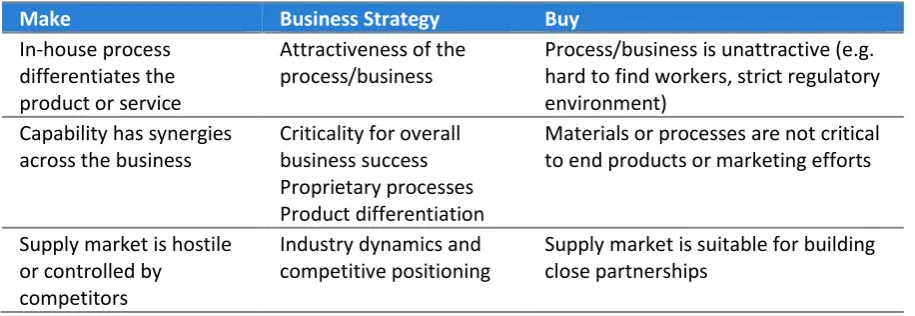
Make Business Strategy Buy
In-house process differentiates the product or service
Attractiveness of the process/business
Process/business is unattractive (e.g. hard to find workers, strict regulatory environment)
Capability has synergies across the business
Criticality for overall business success Proprietary processes Product differentiation
Materials or processes are not critical to end products or marketing efforts
Supply market is hostile or controlled by
competitors
Industry dynamics and competitive positioning
Need to “pus the
technology or capability
envelope”
Dynamics of the
technology or capability Rate of change
Risk to core capabilities
[image:25.595.76.512.72.126.2]Suppliers are willing and able to meet innovation needs
Table 4. Strategic factors for the make or buy decision making. Schwarting and Weissbarth, 2011.
Make Risks Buy
Few or no alternative sources of supply
Holdup risks Holdup risk is low or
sufficiently managed through contract of broader business relationship
High supply market risks Availability of
alternative sources and switching costs
Low switching costs and easily accessible alternative sources of supply
Imperative to couple supply and usage (real-time/short lead time) for quick response or quality
Transportation risks Lead times
Supply disruptions
Uncoupling the supply chain as little impact
Sensitive intellectual property involved in process/product
Intellectual property protection
[image:25.595.70.525.150.331.2]No sensitive intellectual property involved
Table 5. Risk factors for the make or buy decision making. Schwarting and Weissbarth, 2011.
Make Economic factors Buy
Internal cost advantage cost parity, high quality
Relative economic and operating performance advantage (Scale and utilization; Efficiency; Reliability; Factor costs; Quality)
Suppliers have lower costs or better quality
Significant recent investment in process technology that cannot be recovered
Capital requirements Major new investments are
required
Investments meet required return on invested capital
Financial returns Suppliers have lower ROI
targets
Company has strong, defensible skills base
Level of skills and expertise Insufficient or weak in-house skills/capabilities; skills are difficult to acquire
Table 6. Economic factors for the make or buy decision making. Schwarting and Weissbarth, 2011.
6.5
R
ECOMMENDATIONS FOR THE MANUFACTURING STRATEGY [image:25.595.73.528.356.577.2]6.5.1 Overall vertical structure
Each criterion from the paper by Hicks et al. (2001) is hereunder applied to the case of Company A. For each criterion, a conclusion is drawn on whether (1) vertically integrated or (2) design and assembly is more suitable. The current structure of Company A is more towards being vertically integrated, with some production processes being in-house. Still, some components are being bought, such as sheet metal.
Core capability – The core capability of Company A is nonexistent, according to a variety of people: from the marketing manager to the operational excellence manager. The technical knowledge of employees throughout the entire organization has been mentioned as a strength, but Company A does not distinguish themselves from competitors in the market in any way. Some old, yet stable, products yield some profits. All other products have yield losses. Core capabilities could be created by focusing on a few activities and excelling at these. If focusing on all activities simultaneously, it is nearly impossible to create core capabilities. You cannot excel at all activities simultaneously, especially if you are behind. Type (2) design and assembly is therefore recommended as the better option on this criterion.
Demand – The demand of Company A mainly consists of few, large projects. This means that volumes are unstable, consisting of high peaks for the various products. Because Company A is a small player in the market and competitors push the price down, Company A can only pick up the left-overs, as explained by the marketing manager. They cannot compete for more standard orders, thus pick up the mainly highly custom and large projects. Type (1) vertically integrated requires stable volume for the high capital investments in manufacturing to be economically viable, which was a part of the vertical integration issue identified in paragraph 5.3 and explained by Hicks et al. (2001). Type (2) design and assembly is therefore recommended as the better option on this criterion.
Added value – Higher added value is an advantage of type (1). Prerequisite is the ability to add value, which is something Company A is struggling with. In addition to type (2) design and assembly, type (1) includes production as well. No thorough financial analysis is available that states the added value of the production processes, however due to reasons mentioned before in the identification of issues (paragraph 5.3), it appears that Company A is not able to add value higher than the
transformation costs with their production processes. Some exceptions might exist, that some processes do add value or are a core capability. This should be determined for each production process. The recommendation here is not either type (1) or type (2), but the recommendation is to determine the added value of each production process individually, keeping the ones that add value. In addition, it is recommended that production capabilities which are vital to success, which are a core capability, are kept in-house. That is a modified version of type (2), where some high value adding and core production processes are kept in-house.
Design – Within the business unit, design consists of two separate aspects: new product design and customization of products (or engineering) for individual orders. New product design is the task of R&D, currently located in Austria and Dubai, which are other Company A locations. New product design is done on a global level, because Company A plans to produce the same products on different locations in the future, to access more markets. According to Hicks et al. (2001), an advantage of type (1) is to have better manufacturing knowledge at R&D. This advantage is non-existent for Company A, because R&D is not in Hengelo anymore. Therefore, neither type (1) nor type (2) is preferred in this regard. Customization of existing products for individual orders is done by the Custom Order Engineering department in Hengelo. For them, it is important to have manufacturing knowledge, which is currently very accessible. When outsourcing these production processes, a solution needs to be found of how this knowledge will be retained. Possibly through strategic supplier relations, where customized designs are discussed with suppliers and
manufacturing knowledge is kept up-to-date through training. Type (1) is thus preferred in this regard and when moving to type (2), measures need to be taken.
Economic – high capital investments, unstable demand and a lack of economies of scale lead to relatively low utilization and low return on capital. The demand is unstable, because Company A has very small revenue compared to the total market. Orders are thus always large for Company A, and can value up to 2 million per order. Furthermore, Company A picks up “the breadcrumbs” as stated
by the marketing manager. These breadcrumbs are out of the ordinary, often larger and more customized, not fitting within the standard portfolio of competitors. As explained in the problem identification section, specialized suppliers can achieve more economies of scale and higher utilization, achieving a higher return on capital, thus producing cheaper. Outsourcing production should therefore reduce costs, except when highly custom parts are required. In that case, flexible and small-scale production capabilities in-house could be cheaper. However, in general I recommend type (2) design and assembly.
I conclude that a modified version of the type (2) design and assembly is the better option for Company A. Challenges in retaining manufacturing knowledge and building strategic supplier relations do not seem to weigh up to the advantages. The most important advantage of type (2) is cost, due to purchasing instead of producing. Another advantage is a focus on fewer activities, leading to less complexity and probably increased quality and delivery reliability. The only modification to the type (2) is that production processes that are core capability, and thereby provide high added value, should be kept in-house. Next, a more thorough evaluation should be made for each of the production processes, to determine in more detail what the new vertical structure should be.
6.5.2 Detailed make-or-buy decision making
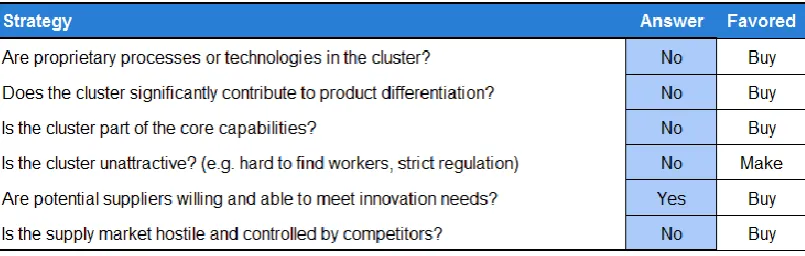
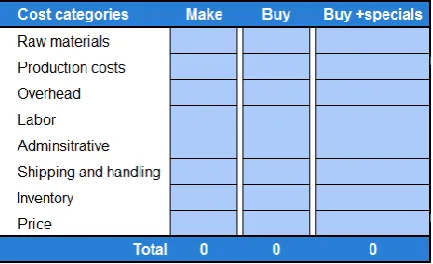
To make decisions for individual production processes, a decision-making model is established, which is based on the publication by Schwarting and Weissbarth (2011). The decision model has been discussed with the procurement manager and adjusted to suit Company A. It is in the form of Excel sheets, because it is widely used, easy to use and is practically viable for a decision-making model. The aim of the decision model is to perform a comprehensive analysis, before making a make or buy decision. It is then the basis for discussion, after which a final decision is made.
production capabilities in-house where volume is too low. Each make-or-buy decision is made for a so-called cluster: a set of machines that together can perform a set of transformations. For example, a variety of metal modification machines are a cluster. Keeping only one of these metal modification machines in-house doesn’t make sense, because then the whole set of transformations are not possible anymore, since multiple machines are necessary for each of the transformations.
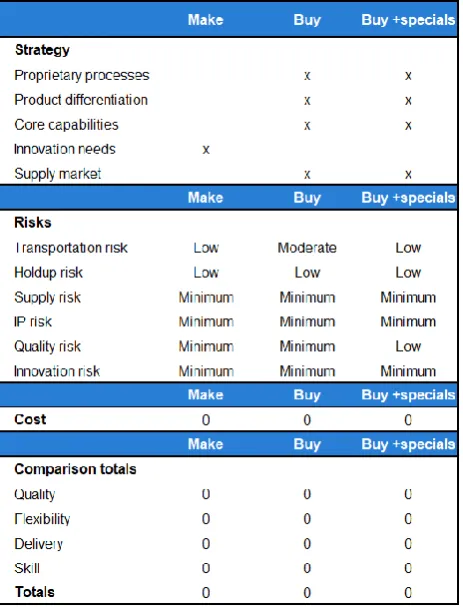
[image:28.595.73.305.262.566.2]Now, the decision-making model will be discussed for each excel sheet. Figure 5 is the final sheet of the decision-making model, which automatically summarizes the results, based on what is filled in in the respective sheets. I show this first, because it gives a good overview, before discussing each individual aspect of the model. This sheet is useful to provide a solid ground for further discussion and the final decision. None of the important aspects can be ignored this way, while otherwise these decisions could for example be made with a focus on cost, while disregarding other important aspects, such as quality.
Figure 5. Sheet 6: summary of the decision making model results.