University of Warwick institutional repository:http://go.warwick.ac.uk/wrap
A Thesis Submitted for the Degree of PhD at the University of Warwick
http://go.warwick.ac.uk/wrap/73548
This thesis is made available online and is protected by original copyright. Please scroll down to view the document itself.
Development of a Model of Internal Diffusion and
Infusion of Enterprise Systems
by
Oswaldo
J.
Lorenzo Ochoa
Thesis submitted for the fulfillment of the requirements for the
degree of Doctor of Philosophy in Industrial and Business Studies
University of \Varwick, \Varwick Business School
TABLE OF CONTENTS
LIST OF TABLES ... v
LIST OF FIGURES ... vi
ACKNOWLEDGEMENTS ... viii
DECLARATION ... ix
SUMMARy ... x
ABBREVIATIONS ... xi
CHAPTER 1 : INTRODUCTION ... 1
1.1 Enterprise Systems ... 2
1.2 The ES Challenge: Implementation, Diffusion & Use ... 3
1.3 ES Implementation: The need of a broader perspective ... 5
1.4 Objectives and Scope of Study ... 8
1.5 An Outline of the Thesis ... 10
CHAPTER 2: A COMPREHENSIVE REVIEW OF ENTERPRISE SYSTEMS .11 2.1 Origins of Enterprise Systems ... 11
2.2 How do Enterprise Systems work? ... 14
2.3 Complementary Applications and Technologies ... 18
2.4 The Importance and Impact of Enterprise Systems ... 20
2.4.1 ES in the context of information system development ... 21
2.4.2 B usiness Value of Enterprise Systems ... 23
2.4.3 Economic and Social Consequences of Enterprise Systems ... 25
2.5 Summary ... 26
CHAPTER 3 : LITERATURE REVIEW ... 27
3.1 A General Review of the Enterprise Systems Research ... 27
3.2 A Discussion of the Enterprise Systems Implementation Research ... 35
3.2.1 Factors Research Stream ... 36
3.2.2 Success Measures Research Stream ... 37
3 .2.3 Descriptive Case Studies ... 40
3.2.4 Long-term Requirements and Challenges ... 40
3.2.5 Summary of the ES Implementation Research ... 43
3.3 A Technological Innovation Perspective for the ES Implementation Research ... 44
3.4.1 Types ofIS Innovations ... .47
3.4.2 Knowledge Barriers ofIS Innovations ... .48
3.4.3 IS Implementation as a Technological Innovation ... .49
3.4.4 The Managerial Challenges to Support IS Innovations ... 52
3.5 A Review of the Technological Innovation Perspective in the Innovation Literature ... 53
3.5.1 The Innovation Process within Organizations ... 54
3.5.2 Experiential Learning and the Problem-Solving Process ... 56
3.6 Summary ... 59
CHAPTER 4: RESEARCH METHODOLOGy ... 60
4.1 Philosophical Position ... 60
4.2 The research approach: theory generation from case study evidence ... 62
4.3 The process of theory generation from case study evidence ... 63
4.3.1 Focusing and Bounding ... 64
4.3.2 Site Selection and Data Sources ... 69
4.3.3 Data Collection and Analysis ... 76
4.3.4 Enfolding Literature ... 80
4.4 Strengths and weaknesses ofthe theory generation from case study evidence ... 81
4.5 Summary ... 82
CHAPTER 5: A MODEL OF INTERNAL DIFFUSION OF ... 85
ENTERPRISE SYSTEMS ... 85
5.1 Definition of Concepts and the Logic of the Model ... 86
5.2 Coffee Company (CC) ... 92
5.2.1 Selection ofthe new functionality for implementation ... 92
5.2.2 Process Modelling and Organizational Adaptation ... 93
5.2.3 System Configuration and Tailoring ... 94
5.2.4 End-user Training ... 96
5.2.5 ES-Use ... 96
5.2.6 Summary of Activities ... 103
5.3 Engineering Services Company (ESC) ... 107
5.3.4 End-user Training ... 113
5.3.5 ES-Use ... 114
5.3.6 Summary of Activities ... 121
5.4 Chemical Products Company (CPC) ... 126
5.4.1 The First Period: 1996-2000 ... 126
5.4.2 The Second Period: 2000-2002 ... 131
5.4.3 Summary of Activities ... 146
5.5 Discussion ... 149
5.5.1 The Distinctive Features ofES Internal Diffusion ... 149
5.5.2 The Learning Challenges Required By ES Diffusion ... 151
5.5.3 The Timing ofES Diffusion: Continuous and Discontinuous Patterns ... 154
CHAPTER 6: A MODEL OF ENTERPRISE SYSTEMS INFUSION ... 159
6.1 ES Capabilities: The ES potential and its impact upon the business ... 160
6.1.1 Transaction Automation ... 162
6.1.2 Decision-Making Process Support ... 163
6.1.3 Monitoring Performance ... 164
6.1.4 Coordination ... 164
6.1.5 Customer Service ... 165
6.1.6 Process Management Automation ... 166
6.2 ES Capabilities in CC ... 168
6.2.1 Transaction automation ... 168
6.2.2 Decision-making process support ... 169
6.2.3 Monitoring Performance ... 170
6.2.4 Coordination ... 171
6.2.5 Customer service ... 172
6.2.6 Process management automation ... 173
6.3 The ES Infusion in CC ... 173
6.4 ES Capabilities in ESC ... 177
6.4.1. Transaction automation ... 177
6.4.2 Decision-making process support ... 178
6.4.3 Monitoring Performance ... 179
6.4.4 Coordination ... 180
6.4.6 Process management automation ... 183
6.S The ES Infusion in ESC ... 184
6.6 The ES Capabilities in CPC ... 187
6.6.1 Transaction automation ... 187
6.6.2 Decision-making process support ... 189
6.6.3 Monitoring Performance ... 190
6.6.4 Coordination ... 190
6.6.5 Customer Service ... 192
6.6.6 Process Management Automation ... 193
6.7 The ES Infusion at Chemical Products Company ... 194
6.8 Discussion ... 198
6.8.1 The Levels of the Total Infusion Process ... 198
6.8.2 Linking the Total Infusion Levels and the Diffusion Model ... 200
6.8.3 The Levels of the Capability's Infusion Process ... 203
CHAPTER 7: CONCLUSIONS ... 20S 7.1 Conclusions of the Research and Study Contributions ... 20S 7.2 Implications to ES Research and Suggestions for Future Research ... 212
7.3 Implications for Qualitative Research ... 2l6 7.4 Implications to ES Practice ... 217
7.S Limitations of Study ... 21 8 REFERENCES ... 221
APPENDIX 1: Major ES Vendors ... 241
APPENDIX 2: Brief Chronology of the ES Implementation in UC ... 247
APPENDIX 3: INTERVIEW PROTOCOL (Second Round) ... 249
LIST OF TABLES
Table 2.1 The Major ES Vendors' Strengths in Business Practices of Specific
Industries ... 16
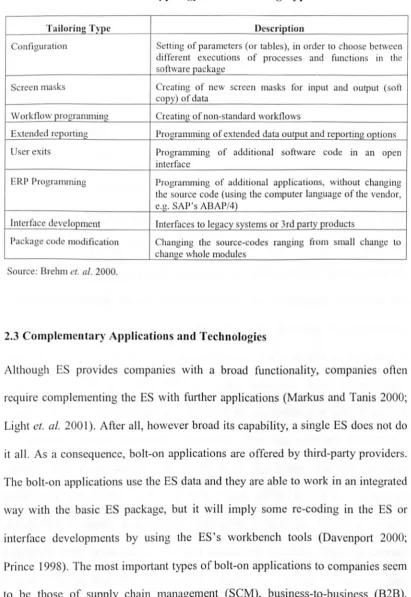
Table 2.2 Typology of ES Tailoring Types ... 18
Table 3.1 A Sample ofES Research by Main Topics and Areas ... 28
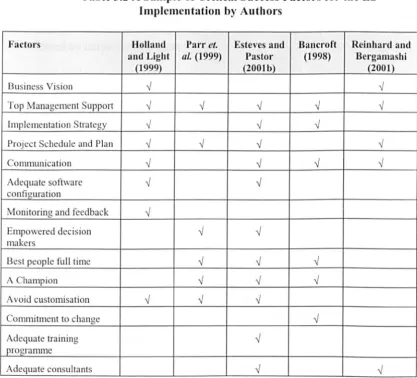
Table 3.2 A Sample of Critical Success Factors for the ES Implementation by Authors ... 37
Table 3.3 Success Metrics for the ESEC Phases ... 39
Table 3.4 The Cooper and Zmud's Six-Phase IT Implementation Model.. ... 51
Table 4.1 Questions and Topics covered in the Pilot Case Study ... 66
Table 4.2 Position and Number ofInterviews Conducted at CC ... 72
Table 4.3 Position and Number ofInterviews Conducted at ESC ... 74
Table 4.4 Position and Number of Interviews Conducted at CPC ... 76
Table 5.1 The ES Diffusion Process in CC: Events by Chronological Time Periods and Activities-Loops ... 105
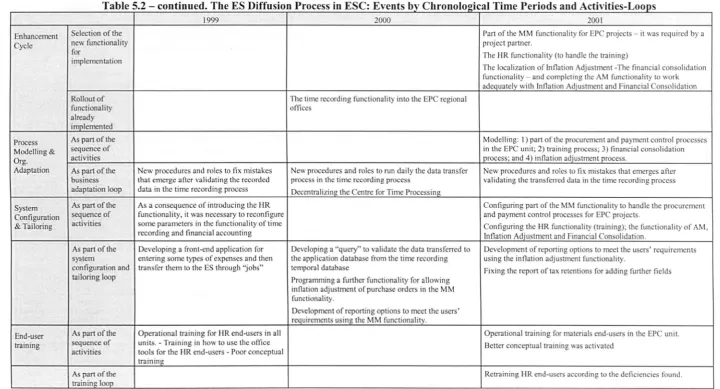
Table 5.2 The ES Diffusion Process in ESC: Events by Chronological Time Periods and Activities-Loops ... 123
Table 5.3 The CPC's Procurement Cycle: Gap Analysis between the Organizational Needs and the ES Functionality ... 138
Table 5.4 The ES Diffusion Process in CPC: Events by Chronological Time Periods and Activities-Loops ... 147
Table 5.5 The Learning Challenges related to each activity of the ES Internal Diffusion ... 153
Table 6.1 The ES Impact into the CC's Business by Time & Types ofES Capabilities ... 176
Table 6.2 The ES Impact into the ESC's Business by Time & Types ofES Capabilities ... 186
LIST OF FIGURES
Figure 2.1 Beyond the transactions-oriented Enterprise Systems ... 13
Figure 2.2 The Anatomy of an Enterprise System ... 15
Figure 2.3 Middleware creates new choices for ES ... 20
Figure 2.4 The Divided Software Life Cycle Model for ES ... 22
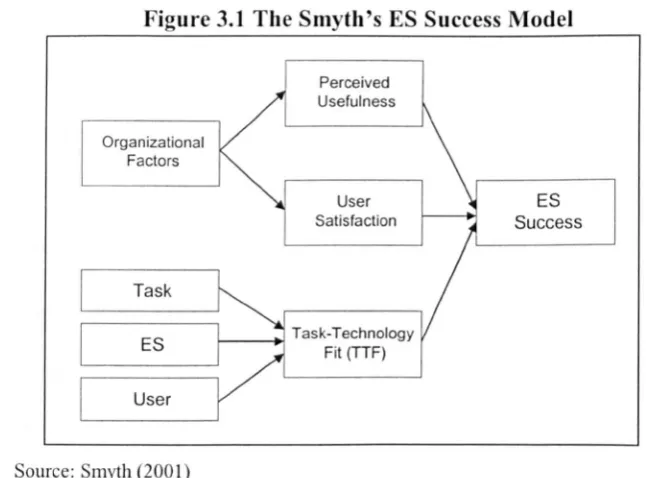
Figure 3.1 The Smyth's ES Success Model.. ... 40
Figure 3.2 A Model ofIT Implementation Process ... 50
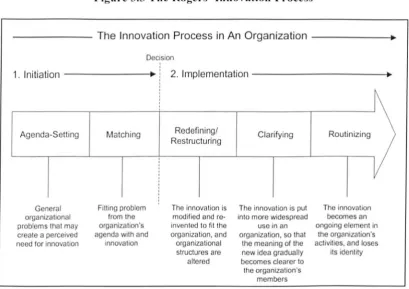
Figure 3.3 The Rogers' Innovation Process ... 55
Figure 3.4 The Lewinian Experiential Learning Model. ... 58
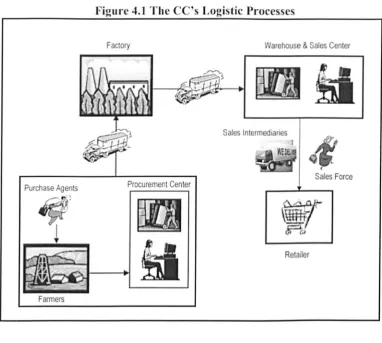
Figure 4.1 The CC's Logistic Processes ... 71
Figure 4.2 epc's Value Chain ... 75
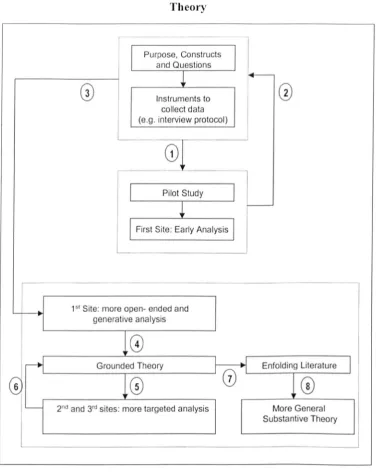
Figure 4.3 The Iterative and Cyclical Process used in the Generation of Theory .. 83
Figure 5.1 The Model of Internal Diffusion of ES ... 87
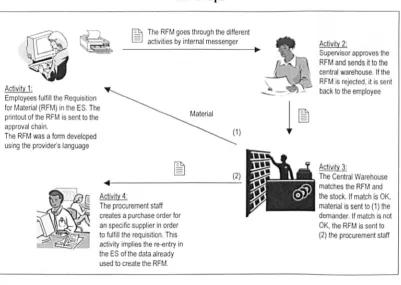
Figure 5.2.a The Procurement ofIndirect Materials using the RFM - before the Loops ... 98
Figure 5.2.b The Procurement ofIndirect Materials using the RFM - after the Loops ... 99
Figure 5.3 The Time Recording Process before running the Loops ... 116
Figure 5.4 Impacts of the Loops on the Time Recording Total Time* ... 117
Figure 5.5 Aligning the ES and the CPC's Business Objectives ... 127
Figure 5.6 The CPC's Business Processes and The ES's Business Cycles ... 128
Figure 5.7.a The CSO Processing in CPC - before running the Loops ... 133
Figure 5.7.b The CSO Processing in CPC - after running the Loops ... 136
Figure 5.8 The CPC's Procurement Cycle - after running the Loops: The Four Key Processes and Their Relationships with Other Processes ... 137
Figure 5.9 The CPC's Enterprise Information Model:_An example of Business Objectives and Key Performance Indicators ... 145
Figure 5.10 The Timing of the Two Distinctive Features ofES Diffusion ... 157
Figure 6.1.a. The ES Infusion in CC ... 175
Figure 6.l.b The Infusion Process of the Transaction Automation in CC ... 187
Figure 6.2.a. The ES Infusion in ESC ... 185
Figure 6.2.b The Infusion Process of the Transaction Automation in ESC ... 187
Figure 6.3.a. The ES Infusion in CPC ... 196
ACKNO\VLEDGEMENTS
I am grateful to so many people who have kindly helped in some way to make this dissertation possible.
I wish to thank my supervisor, Dr. Peter Kawalek who has provided very skillful guidance and insightful comments. To my co-supervisor, Dr. James Storbeck who has been extremely helpful in providing invaluable advice on improving the quality of my thesis.
To Instituto de Estudios Superiores de Administraci6n (lESA), especially Dr. Paul Esqueda and Dr. Angel Diaz, who encouraged me to start my PhD study and have provided inestimable guidance in the development of my academic career. To Gaston Gonzalez who has advised me during my PhD study. To my friends Rafael, Fer, Pavel y Lud who helped my family and me in a number of ways in the completion of this project.
To over seventy business managers and specialists participating in this study who contributed to the multiple case study, responded my questions or coordinated with the managers in their organizations. Specially to Juan C. Gonzalez, Rafael Hernandez, and Antonio Vicentelli.
DECLARATION
x
SUMMARY
After most large industrial companies have installed enterprise systems (ES), the managerial concern moves to the effective diffusion and infusion of ES throughout a company. Diffusion means the degree in which a system has been shared throughout the company and infusion is the degree in which a system has penetrated a company in terms of importance, impact, and significance. Little of the ES literature has considered these new larger issues.
This thesis develops a model of internal diffusion and infusion of ES. The ES diffusion model presents the ES implementation as an iterative, cumulative, and virtuous process over time. The model recounts and validates the authentic characteristics of ES projects, places "use" as both product and fomenter of the implementation activity, and putting emphasis upon the importance of experiential learning. The ES infusion model develops a framework of ES capabilities to analyse the extent and quality of the use of ES in organizational contexts (i.e. infusion).
ABBREVIATIONS
ABC: Activity-Based Costing
A CM: The Association for Computer Machinery AM: Assets Management Functionality
AMCIS: The Americas Conference on Information Systems AMR: Advanced Manufacturing Research
APICS: American Production and Inventory Control Society ARIS: Architecture oflntegrated Information Systems B2B: Business-to-Business
BI: Business Intelligence BOM: Bill of Materials BSC: Balanced Scorecard
BPR: Business Process Redesign
CAIS: Communications of the Association for Information Systems CC: The Coffee Company
CEO: Chief Executive Officer CFO: Chief Finance Officer
CPC: The Chemical Products Company
CRM:
Customer Relationship Management CSO: Customer Sales OrderCSF: Critical Success Factors CO: Controlling Functionality
D&S: Distribution and Sales Functionality DRP: Distribution Requirements Planning DSS: Decision Support Systems
EAI: Enterprise Application Integration
EIS: Enterprise Information System Functionality EJIS: European Journal ofInformation Systems ERP: Enterprise Resource Planning
ES: Enterprise Systems
ESC: The Engineering Service Company
ESEC: The Enterprise Systems Experience Cycle EVCS: End User Computing Satisfaction
HER: Harvard Business Review HHC: Hand Help Computers HR: Human Resource Functionality
ICIS: International Conference on Information Systems !JIM: International Journal of Information Management IS: Information Systems
ISJ: Information Systems Journal ISR: Infornlation Systems Research JIT: Journal of Information Technology LIFO: Last In First Out
MISQ: Management Information Systems Quarterly MM: Materials Management Functionality
MRP II: Manufacturing Resource Planning MRP: Materials Requirements Planning
PACIS: Pacific Conference on Information Systems SCM: Supply Chain Management
CHAPTER 1: INTRODUCTION
Since the beginning of 1990s, an important innovation has shaped the way organizations operate their business processes and infonnation systems; the enterprise system (ES)l. These systems have been implemented by thousands of companies worldwide. For instance, by 1998 about forty percent of companies with annual revenues over $1 billion had implemented an ES (Caldwell and Stein 1998). James and Wolf (2000) point to an investment of $300 billion in ES during the 1990s. These facts suggest that many businesses are convinced of the necessity and benefits of an ES. The attraction of these systems is related to their ability to integrate all the infornlation flowing through a company, bringing huge improvements in organizational efficiency and effectiveness - for instance, standardized processes, lower back-office staff requirements, faster delivery time, reduced inventory and improved customer service (Davenport 1998; James and Wolf2000).
While ES can result in great rewards, their risks are also great (Davenport 1998). The ES implementation is definitely a complex voyage with high chances of failure. The road for reaching these benefits may be painful with angry employees, personnel turnover, costly reengineering processes, and projects that seemingly never end (Worthen 2002; Davenport 1998; Lorenzo 1998b). The literature reveals that many implementations of these systems have failed over the project phase or have failed to reach the original promise (i.e. expected business results) after the system has gone live (Buckhout et. al. 1999; Davenport 1998). On the other hand, in a more positive light, ES is commonly advocated as a means of changing the wayan organization works. Much evidence reflects that an ES imposes its own
2
logic on a company's processes, strategy, and culture (Davenport 1998; Markus and Tanis 2000). Given the big implementation challenges and the corresponding business implications, enterprise systems can be considered as an important contemporary phenomenon in organizational adoption and use of information technology (Markus and Tanis 2000).
This chapter explores the characteristics, importance and problematic character of Enterprise Systems and their implementation, diffusion and use inside organizations. The chapter then argues for the need of a broader technological diffusion perspective, which allows academics and practitioners to reach better understanding of the ES phenomenon. Finally, the objectives, the scope of the study and the structure of the thesis are addressed.
1.1 Enterprise Systems
Enterprise systems "enable the integration of transactions-oriented data and business processes throughout an organization" (Markus and Tanis 2000, p. 4). The base of an ES is a single database that receives data from and feeds data into an associated set of modular applications. These modular applications support different company functions such as sales, finance, human resources, and manufacturing. When new information is entered into a modular application, related information is automatically updated for the others (Davenport 1998). ES are also able to encourage integration of different business units or facilities located that geographically scattered around a country or abroad.
3 under a phased scheme in which each phase encompasses the implementation of a set of functionalities or just one of them. But, each phase is just a part of the entire journey. Companies have to implement the system throughout all departments, divisions or locations for realizing the value that integration provides (Shepherd 2001; Davenport 1998). As a consequence, the complete implementation of ES and reaching the expected business benefits may become a long-term journey - mainly in big companies.
The other principal characteristic is that ES are standard, off-the-shelf, commercial packages, which are purchased from software vendors (Markus and Tanis 2000). The main technical differentiator to traditional information systems is that when an organization adopts an ES, it does not design a new system to meet its extant or proposed ways of working. Instead, there is much greater emphasis on the organization adapting its business processes to the package's generic functionality. When installing the ES, companies may have to fit their business process to the system's requirements. Typically this will involve some degree of business process redesign (Davenport 1998; Markus and Tanis 2000). The major technical activity installing the system is the configuration process, which implies setting software parameters to tailor the system to reflect particular organizational models and business rules (Brehm et. al. 2000). It follows that both business process redesign and software configuration are key spheres of activity in any ES project.
1.2 The ES Challenge: Implementation, Diffusion & Use
4
failed to diffuse and incorporate the system throughout the organization's operations and activities (Shepherd 2001; James and Wolf 2000; Gilbert 1999), or have failed to reach the expected business benefits after the system has gone live (Shepherd 2001; Markus and Tanis 2000; Davenport 1998).
According to a Standish Group's study in companies with more than $500 million in revenues, few ES implementations hit their project targets; that is costs, schedule and functional scope (Buckhout et al. 1999). Some of these stories have ended up as horror cases in which, after millions of dollars invested, a project was cancelled (Scott 1999; Davenport 1998; Lorenzo 1998b). The study of causes of failure of these stories has originated several responses. Most research on ES has been undertaken to understand the implementation problems in project phases and which factors encourage the success. Such factors research has generated a set of issues that appear to be related to ES success and failure. For instance, business vision (Holland and Light 1999; Davenport 1998), management support (Parr et. al. 1999; Holland and Light 1999), the organization of the project team (Newell et al. 2001; Bancroft 1998), minimal customisation (Parr et. al. 1999; Brehm et. al. 2000; Bancroft 1998), and communication and training (Couillard et. al. 1999; Bancroft 1998).
(Markus and Tanis 2000; James and Wolf 2000; Couillard et. al. 1999); and 2) the
deployment to additional departments, divisions, and locations (Shepherd 2001).
Finally, companies that already have ES in place are asking themselves whether they are able to realize value from their ES investments (James and Wolf 2000; Irving 1999; Davenport 1998). Most companies that have implemented an ES seem to be focusing on creating tactical value (e.g. transaction automation) instead of strategic value (e.g. customer service) (Davenport 2000). This suggests that ES have not fully penetrated companies in terms of higher level of organizational objectives and uses. For some authors (Davenport 2000; James and Wolf 2000), companies can develop the ES capabilities through a "staircase of value" beginning from cost savings, following with progress into process efficiency and effectiveness until finally achieving competitive advantage. However no work has investigated this pattern in depth.
1.3 ES Implementation: The need of a broader perspective
Although ES implementation is a young research field, considerable progress has occurred over its short life. Important findings have been presented in the literature referenced above and elsewhere. However, our understanding of ES implementation is as yet incomplete. The ES implementation literature remains fragmented with most studies following a factors research stream, consistent with
Experience Cycle. Following emergent process theories (Soh and Markus 1995; Orlikowski and Robey 1991), they argue that ES can be described as moving through several phases, characterized by key players, typical activities, characteristics problems, performance metrics and a range of possible outcomes.
After most large industrial companies have installed ES, the managerial concern is moving to the long-term ES requirements and challenges related to maintenance, support, continuous improvement and changes, continuous training, spreading the systems throughout the company beyond first installation, using the system to its complete potential, and realizing the expected benefits (Shepherd 2001; Light 2001; Brehm et. al. 2000; Davenport 2000; James and Wolf2000). As the first implementation phases, activities related to improvements, diffusion and use are also characterized by the involvement of a large number of stakeholders (Soh et. al. 2000), the assimilation of a large amount of knowledge (Soh et. al. 2000; Couillard et. al. 1999) and the development of additional user skills (Markus and Tanis 2000).
Given the above evidence, the effective diffusion of ES throughout a company and the extent of ES infusion inside companies have become new managerial concerns. Diffusion means the degree in which a system has been shared throughout the company (Kwon and Zmud 1987; Sullivan 1985) and infusion is the degree in which a system has penetrated a company in terms of importance, impact, and significance (Cooper and Zmud 1990; Sullivan 1985).
7
an innovation spreads inside an organization, that is its internal diffusion. He states clearly the problem when concludes: " ... adoption, implementation and use of an innovation in one organizational subunit does not lead naturally and inevitably to widespread use throughout an organization" (Kimberly 1981, p. 91). This perspective is appropriate for reaching better understanding of the ES phenomenon because it concerns the implementation process beyond the installation stage. Different authors represent distinct stages in the implementation of a technological innovation. But all of them seem to agree that the process finishes when the usage of the technology is encouraged as a normal activity - i.e. routinizing or infusion (Rogers 1995; Coopers and Zmud 1990; Kimberly 1981). Hence, under a technological innovation perspective, diffusion and use of the technology is part of the implementation issue.
This perspective has been widely used in the implementation of many other kinds of information systems (Cooper and Zmud 1990; Kwon and Zmud 1987; Sullivan 1985). For Kwon and Zmud (1987) information systems implementation can be defined as an organization effort to diffuse an appropriate IT within a user community. They have developed an IT implementation research model, which is based on the organizational change, innovation, and technological diffusion literature. Afterwards Cooper and Zmud (1990) used this model to study the implementation of production and inventory control information systems. On the other hand, Sullivan (1985) studied the relationships between the extent of diffusion and infusion of information systems and the distinct practices of information systems planning.
processes of diffusion and infusion might be quite distinctive. This work adds to this research stream by looking at ES implementation as an effort in technological diffusion within a user community. This is a broader perspective upon ES implementation, and relates to the earlier body of IS research (Cooper and Zmud 1990; Kwon and Zmud 1987).
1.4 Objectives and Scope of Study
As described above, most ES studies have focused on small pieces of the ES implementation puzzle and most of them have followed the factors research stream. On the other hand, few works have considered these new larger issues related to diffusion and infusion of the enterprise systems throughout a company. It
is not yet known, for example, how widely these technologies have been diffused and assimilated in organizations, how extensively they are used inside organizations, or how effectively they are used (Markus and Tanis 2000). Hence this work revisits some key information systems themes - the innovation and diffusion of information systems - but in the changed context of ES.
For this, this investigation aims to study the following research questions:
1. How do ES diffuse inside organizations?
2. How do ES infuse inside organizations?
The following research objectives are stated to address the above problem
questions:
9 implementation and internal diffusion of ES features throughout an organization.
2. To develop a model of ES capabilities (ES uses) and apply this model to analyse how ES infuse inside organizations.
The study borrows the perspective of technological innovation, which has already been used in both the innovation and information systems disciplines (Rogers 1995; Kimberly 1981; Kwon and Zmud 1987). This brings clear benefits to the study. Firstly, many of the concepts and theoretical issues have already been identified by others researchers. Secondly, for the theoretical and practical implications, the study will allow academics and practitioners to see the ES phenomenon 111 a new way, bringing forward better understanding of the ES
implementation.
10
1.5 An Outline of the Thesis
CHAPTER 2: A COMPREHENSIVE REVIE\V OF ENTERPRISE SYSTEMS
11
This research relies on the comprehension of the Enterprise Systems' functional and technical characteristics. It follows from this that the objective of this chapter is to introduce the several features of ES. To do this, five sections are written below. First, the origins of the ES from manufacturing concepts and systems are presented. This section also describes the extension of ES from back-office applications to front-office applications. Secondly, the technical and functional foundations of ES are described. This encompasses main ES issues such as the concepts of integration, configuration and tailoring, and best practices. Thirdly, the chapter depicts the complementary applications and technologies that allow ES to provide companies with a broad functionality. Finally, a discussion of the impact and importance of ES to the IS field, the businesses and the society is presented. A number of concepts, ideas, trends, and concerns already described by several authors are connected to accomplish these chapter's objectives.
2.1 Origins of Enterprise Systems
ES are also known as Enterprise Resource Planning (ERP) systems. ERP has its roots in the manufacturing industry (Escalle and Cotteleer 1999; Davenport 2000; Chung and Snyder 2000). A number of authors suggest that ERP is an extension of MRP II with enhanced functionality (Gumaer 1996; Hayes 2002; Yusuf and Little
12 been always identified as pioneers in organizational integration efforts (Davenport and Short 1990; Ettlie, 1992). The integration of tasks and technologies in the manufacturing processes has been a major objective in manufacturing (Chung and Snyder 2000). The need for this integration led to the development of packaged software. From MRP (Material Requirements Planning) in the seventies, through MRP II in the eighties, to the development of ERP in the nineties, the integration dream has, reportedly, come true (Chung and Snyder 2000). In addition, this evolution has been in a way that the earlier package is included inside the new one. While MRP is the heart of an MRP II, the ERP's manufacturing applications are similar to the MRP II application (Parker 1996; Chung and Snyder 2000).
However, ERP systems go beyond the manufacturing domain. ERP can support thousands of business activities (Markus and Tanis 2000). In addition, although ERP began being "back-office" systems, automating the business transactions, nowadays ERP systems encompass "front-office" applications, supporting supply chain optimisation and customer relationships management (Davenport 2000). Because of this, some authors such as Davenport (2000), Markus and Tanis (2000), and Kawalek and Wood-Harper (2002) refer to ERP systems as Enterprise Systems (ES). As Davenport (2000) argues, "these systems have transcended their origins that the somewhat clumsy ERP name is no longer appropriate." (p. 2). This work agrees with this position. Then, ES is used instead ofERP systems.
value chain for a specific company, Figure 2.1 shows how the ES functionality has
been extended into:
• Business intelligence applications (BD, which take data from the ES database for analysing it. These applications include data-warehouse, data-mining, and decision support systems.
• ustomer relationship management (CRM) applications, which provide
front-office solutions such as sales force automation or call centres.
• Business-to-business (B2B) applications, which allow the company to integrate
data and information beyond its own limits (i.e. inter-organizational
integration). These applications include solutions such as e-procurement (to
place orders to suppliers) and e-commerce (to receive orders [Tom clients).
Figure 2.1 Beyond the transactions-oriented Enterprise Systems
Supplier
Intra-organizational Integration
@]
!
B2BCompany
Intra-organizational Integration
I
ERPI
+-+I
CRMI
Inter-organlzatlonal Integration
ERP: Enterprise Resource Planning (back-office applications) BI: Business Intelligence Applications
CRM: Customer Relationship Management Applications B2B: Business-te-Business Applications
Source: Lorenzo (200 1 b).
(J)
-
c:B2B .~
u
On the other hand, ES have been related to the management philosophy known
as business process reengineering (BPR). According to Davenport (2000), ES can
be seen as the saviour of reengineering. Davenport argues that one of the major
process-oriented systems. Once ES arrived, they were viewed as "processware." The integration philosophy and work structure of ES mean that they can easily support a process-oriented organizational design, which is the major premise of BPR.
2.2 How do Enterprise Systems work?
ES "enable the integration of transactions-oriented data and business processes throughout an organization" (Markus and Tanis 2000, p. 4). The base of an ES is a single database that receives data from and feeds data into an associated set of modular applications (Figure 2.2). These modular applications support different company functions such as sales, finance, human resources, service, inventory and manufacturing. When new information is entered into a modular application, related information is automatically updated in the others (Davenport 1998). ES are designed for client-server architectures. However, early versions ran on centralized mainframes. Recently, some vendors have released web-enabled versions of their ES (Markus and Tanis 2000; Davenport 2000).
to reflect organizational models and business rules (Brehm et. al. 2000). Configuration is itself a difficult exercise, requiring that business decisions and their rationale be recorded (Markus and Tanis 2000). It follows that business process redesign and software configuration are key spheres of activity in any ES project.
Figure 2.2 The Anatomy of an Enterprise System
Managers and stakeholders
Reporting
applications
Sales Financial
and delivery T .&
"t1
applicationsVJ applications
y
II'
CD VJet:: CI) C
U III "0
W ~ • Manufacturing n
::E !E Single ;lit" "C
.2 '1 6 r
0 database ~ applications
~ iii
l - e ...,1
...
;:aVJ
e
n::J _"r"'f (1) en
u Ii.
Service
""'
applications ." ~ Inventory
Human and supply resources applications applications
Employees
Source: Davenport 1998.
Most of the ES vendors2 have tried to design their systems to reflect the best-business practices (Davenport 1998). These practices reflect the experiences and suggestions of leading companies (Curran and Keller 1998). They also look to academic theory (e.g. APICS3) about the best way to do or manage some types of
processes - e.g. production floor or inventory control (Markus and Tanis 2000). ES vendors are sometimes classified according with their strengths in business practices of specific industries (see Table 2.1). SAP's R/3 fits very well to the
2 See Appendix I for a brief description of the major ES vendors
16
personal computer, semiconductor, oil, gas and petrochemical industries (Davenport 1998; 2000). Baan's product has aimed to target the aerospace and
defence, transportation, electronics and discrete manufacturing industries (Sullivan 2002; Davenport 2000). Peoplesoft supports very well the health care, education,
and government markets (Krill 2002). This concept of best practices is a powerful
reason to implement ES without modifying them. But, as aforementioned, when a company wants to realize the benefits of the best practices embedded in these systems, it must carry out some degree of business process redesign (Markus and
Tanis 2000; Brehm et. al. 2000).
Table 2.1 The Major ES Vendors' Strengths in Business Practices of Specific Industries
Industry SAP Baan Peoplcsoft Oracle JD Edwards
Aerospace and Defence ..J ..J ..J
Automotive ..J ..J ..J ..J
Chemicals ..J ..J ..J
Consumer Products ..J ..J ..J ..J
Engineering and Construction ~ ~
Financial Service Provider ..J ..J ~ ~
Healthcare ..J ..J ..J
Higher Education and ..J ..J ..J
Research
High Tech ..J ..J ..J ..J ..J
Industrial Equipment and ..J
Machinery
Oil and Gas ..J ..J ..J
Retail ..J
Utilities ..J ~ ..J ..J
Source: Web-pages from vendors: www.sap.com; www.baan.coll1; www.pcoplesoft.com;
[image:30.526.60.501.246.773.2]17 Configuring an ES encompasses two sets of decisions (Davenport 1998). First, as most ES are modular, companies have to decide which system's modules or functionalities will be adopted. For instance, almost all companies choose implementing the system in the finance and accounting areas (Knapp and Shin 2001). Second, companies have to set parameters in the package to reflect organizational features (Brehm et. al. 2000). This is done through configuration tables. The first task in the customisation process is to establish the basic company parameters - e.g. country settings, tax settings, organizational unit's settings (Prince 1998). Then each configuration team identifies and establishes base parameters that enable the activity of each business process. For example, types of inventory accounting to be used - FIFO or LIFO (Davenport 1998), creating standard reports (Brehm et. al. 2000), and formulating available-to-promise logic (Brehm et. al. 2000).
Table 2.2 Typology of ES Tailoring Types
Tailoring Type Description
on figuration Setting of parameters (or tables), in order to choose between
different executions of processes and functions 111 the software package
Screen masks reating of new screen masks for input and output (soft
copy) of data
Workflow programming Creating of non-standard workflows
Extended reporting Programming of extended data output and reporting options
User exits Programming of additional software code in an open
interface
RP Programming Programming of additional applications, without changing
the source code (using the computer language of the vendor, e.g. SAP's ABAP/4)
Interface development Interfaces to legacy systems or 3rd party products
Package code modification hanging the source-codes ranging from small change to change whole modules
ource: BrelUll et. al. 2000.
2.3 Complementary Applications and Technologies
Although ES provides companies with a broad functionality, companies often
require complementing the ES with further applications (Markus and Tanis 2000;
Light et. al. 2001). After all, however broad its capability, a single ES does not do
it all. As a consequence, bolt-on applications are offered by third-party providers.
The bolt-on applications use the ES data and they are able to work in an integrated
way with the basic ES package, but it will imply some re-coding in the ES or
interface developments by using the ES's workbench tools (Davenport 2000;
Prince 1998). The most important types of bolt-on applications to companies seem
to be those of supply chain management (SCM), business-to-business (B2B),
customer relationship management (CRM), and business intelligence (BD
-(Davenport 2000; James and Wolf2000). Providers ofthese systems include i2 and
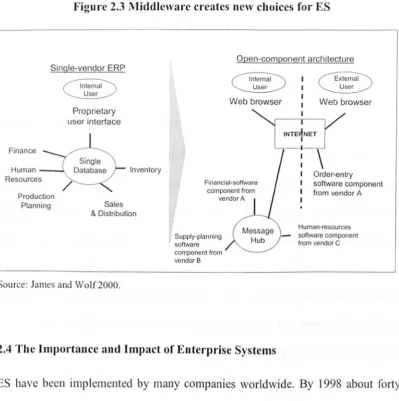
[image:32.526.61.472.79.676.2]19 Clarify and Trilogy Development for CRM and BI. Given that these capabilities have become sufficiently popular today, the major ES providers (e.g. SAP and Oracle) have extended the functionality of their ES product to compete against these third-party providers in these popular functional areas. In other cases, ES providers have made acquisitions of small third-party providers to incorporate quickly this hot functionality inside their ES products as new functionality (e.g. SAP has acquired shares of companies such as Commerce One).
Figure 2.3 Middleware creates new choices for ES
Single-vendor ERP
Finance Human Resources
Production Planning
Proprietary user interface
Sales
Inventory
& Distribution
ouree: James and Wolf2000.
Open-component architecture
Web browser
Financial-software component from
vendor A
Supply-planning software component from vendor B
Web browser
Order-entry
software component
from vendor A
Human-resources software component (rom vendor C
2.4 The Importance and Impact of Enterprise Systems
20
ES have been implemented by many companies worldwide. By 1998 about forty percent of companies with annual revenues over $1 billion had implemented an ES
(Caldwell and Stein 1998). Small and medium enterprises over the world are also considering and implementing ES (Davenport 2000). Advanced Manufacturing
Research (1999) estimates a compound annual growth rate of 32% for the ES
market from 1998 to 2003. International Data Corporation predicts that the ES industry will reach almost $25 billion by 2004 (Romeo 2001).
Judging from these indicators and facts, ES can be considered as one of the
most important contemporary phenomenon in organjzational adoption and use of
information technology (Markus and Tanis 2000). Hence, this section attempts to
21
perspective of infonnation system methodology, 2) from the perspective of the business value, and 3) from the perspective of the economic and social consequences.
2.4.1 ES in the context of information system development
From the perspective of IS methodology, ES can be considered as a remarkable discontinuity (Kawalek and Wood-Harper 2002). As aforementioned, the main technical differentiator to traditional infonnation systems is that when an organization adopts an ES, it does not develop a new system to meet its extant or proposed ways of working. Instead, there is much greater emphasis on the organization adapting its business processes to the package's generic functionality. With ES the organizational focus is radically different. The organization focuses on configuration instead of development. As a consequence, ES change the Software Life Cycle (SLC) in important ways (Brehm and Markus 2000).
of feed from the vendor and the adopter (e.g. releasing upgrades or new
functionality) and indirect feedback from the adopter to the vendor (e.g. desired
bug fixes and enhancements).
Figure 2.4 The Divided Software Life Cycle Model for ES
Coding & Test Configuration
Rollout
Design
Analysis
"-. _ _ _ IndIrect Innuance _ _ - ./
--- Usage
Vendor ERP Adopter
Source: Brehm and Markus (200 I).
The impact of the DSLC on adopters is enormous. At least two major
consequences can be described. First, adopters reqUIre new skills and roles
different to those previously needed and played for a traditional IS development
and adoption. In particular, the ES team and users have to develop skills related to
1) mapping organizational requirements, 2) terminology used by the vendor, 3)
modelling business processes, and 4) making choices about the parameter
configuration (Markus and Tanis 2000; Brehm and Markus 2000; Rosemann et. ai.
2001). In relation to new roles to be played in an ES project, Kawalek and Wood
-Harper (2002) found important evidence related to user-participation. In their language, user-participation in an ES context is related to "the findings of thorns"
-i.e. users provide the ES project team with an intelligence function, which allows
clearly different to, and more limited than, that played by users in a traditional IS context (e.g. shaping requirements, designing processes and helping set the direction of the IS programme).
Second, a long-term relationship emerges between the ES vendor and the adopter. New challenges appear for organizations. They have to handle and influence this relationship in a way that guarantee to them package maintenance, support, and enhancement. Organizations rely on the vendor for continued enhancement for the package - see Scott and Kaindl (2000). A clear dependence
exits. The creation of an internal ES support team is often recommended as a manner to reduce the vendor's dependency. Further skills have to be developed for handle this support team successfully (Markus and Tanis 2000; Prince 1998).
2.4.2 Business Value of Enterprise Systems
ES are able to provide value to the business in different manners. Distinct authors have classified this value through different frameworks (Davenport 2000; James and Wolf 2000; Markus and Tanis 2000). This section describes briefly the ES benefits by grouping them in three key business benefits: 1) tackling IT problems and costs, 2) process efficiency, and 3) organizational effectiveness.
Markus and Tanis (2000) describe how ES can solve many IT problems
The ability of ES to integrate data and standardize processes brings many improvements in the organizational efficiency - e.g. faster cycle time, lower back-office staff requirements, reduced inventory, eliminated transactional errors, standardized business language, easier financial consolidation (Markus and Tanis 2000; Davenport 1998 and 2000; James and Wolf2000; Whorten 2002). A number of examples have been already described in the literature. AutoDesk, a manufacturer of computer-aided design software, reduced its delivery cycle time to customers from two weeks to twenty-four hours. The company also cut its financial closing time from 12 days to six (Davenport 2000). Hoechst Marion Roussel (HMR) reduced its order cycle time from four days to one day. HMR also reduced its inventory by twenty percent as a result of a better planning (Benchmarking Partners 1997b). A recent example is that of Nestle (Worthen 2002). Nestle has saved $325 million by using an ES. The main savings are related to the reduction of inventory and the reduction of distribution expenses. As with HMR, a detailed demand planning is accounted for this huge improvement.
There is also evidence related to improvements in the organizational effectiveness - e.g. improved customer service, supporting the business growth, improved access to better information, laying the groundwork to e-business (Davenport 2000; Lorenzo 1998a; James and Wolf 2002). By using ES and the Internet, some companies have been able to offer self-serve capabilities to
25
to more than one hundred thousand customers (Lorenzo 1998a). The use of an ES in HMR has allowed the sales manager to track sales by client, zone, total orders and product group for each month. This resulted in the reorganization of the distribution network. (Benchmarking Partners 1997b). Finally, the ES infrastmcture eases the implementation of a range of technologies, which extend and enhance the capabilities of the ES - e.g. sell-side e-commerce, electronic procurement, customer relationship management, and supply chain optimisation (James and Wolf2000).
2.4.3 Economic and Social Consequences of Enterprise Systems
to Davenport (2000), this context can be similar to that of the airline industry in seventies. When every airline had the same basic reservation systems, yield management systems, and frequent-flyer programs, the basis of competition changed into the search of the leadership in costs. Finally, and as a consequence of the first aspect, the improvements in the organizational efficiency may bring out the need for fewer employees. Then, the surviving employees will be those whose have a broader range of new abilities. This learning process will be beneficial for the society, but it will be difficult to accomplish.
2.5 Summary
27 CHAPTER 3: LITERATURE REVIE\V
This chapter examines the ES implementation literature and its relation to the IS and innovation fields. In order to structure the argument, the discussion first reviews the main ES topics and areas that have been investigated thus far. A sample of ES works are selected and discussed. Secondly, a comprehensive review of the ES implementation research is presented. As a result of this, a set of research gaps and problems are identified. Then, the chapter suggests the need for looking at the ES implementation from a technological innovation perspective and examines how this perspective has been used in the IS field. Finally, a review of key works from the innovation literature to be applied in the ES implementation problem is presented.
3.1 A General Review of the Enterprise Systems Research
Although ES appeared in the market more than a decade ago, the interest of the IS scholars on ES is recent (Esteves and Pastor 2001a). By matching two previous works, which include a comprehensive literature review of ES (Parr et. al. 1999; Esteves and Pastor 2001a), one can see that the first few academic works and investigations on ES were published on 1997 and 1998. Most of them were works presented in conferences such as AMCIS, ICIS, and PACIS4• To 2000 there were just published twenty-one works on ES in IS joumals5 (Esteves and Pastor 2001a). After 2000, the number of publications had increased. The interest of the IS community and ES-related areas, such as Supply Chain Management and
4 AMCIS: The Americas Conference on Information Systems
ICIS: The International Conference on Information Systems PACIS: The Pacific Conference on Information Systems
28
Accounting, was finally growing, which suggested that research and publications
also would grow in the next years. The ES topic has been introduced gradually in
IS cUlTicula and universities are discussing how ES may affect research in the
future (Davenport 2000; Lorenzo and Pinero 2001; Rosemann el. af. 200 I;
Becerra-Fernandez 2000). FurthemlOre, many universities have created research
areas in ES.
In the light of the above, ES can be considered as a novel phenomenon for
the IS research and other academic fields, which has opened an immense potential
and opportunities for research (Markus and Tanis 2000). This section aims to
review a sample of important contributions of the ES works published to date (see
Table 3.1.). To do this, the selected works have been classified in four key topics:
business implications, technical issues, managerial issues, and implementation
issues. As ES implementation is the focus of this thesis, the three first topics are
discussed in this section and the implementation topic is separately developed in
the next section.
Table 3.1 A Sample of ES Research by Main Topics and Areas
ES Topic Areas of Research Authors
Business Implications Strategic and Organizational Davenport (1998; 2000)
Implications Ni and Kawalek (2001)
Buckhout et. al. (1999)
Markus, Tanis & Fenema (2000)
Technical Issues ES Life Cycle Brehm and Markus (2000)
Modelling Rosemann et. al. (2001a; 2001b)
Scheer and Habermann (2000) Curran and Keller (1998) Configuration and Tailoring Brehm et. al (2000)
ES Topic
Managerial Issues
Implementation issues related to adoption, installation project,
diffusion, and uses.
Areas of Research
Evolving
Knowledge Creation
User Involvement and User
Satisfaction
IS Function Role
Vendor/Consultants
Management
Change Management
ES and BPR
ritical Success Factors
Success Measures
Case Studies
Long-term requirements and challenges
Authors
Markus (2000)
Light et. al. (200 I)
Lorenzo (200 I b)
Scott and Kaindl (2000) James and Wolf (2000)
Chung and Snyder (2000)
Sproot (2000)
Newell et. al. (200 I) Coulliard (1999)
Hislop et. al. (2000)
Jones (200 I)
Soh et. al (2000)
Kawalek and Wood-Harper (2002)
Rodecker and Hess (2001)
Nelson and Somers (200 I)
Willcocks and Styke (2000)
Volkoffand Sawyer (2001)
Taylor (1998)
Soliman and Youssef (1998)
Ng et. al. (1999)
Davenport (2000)
Holland and Light (1999)
Esteves and Pastor (200Ib)
Parr et. al. (1999) Bancroft el. 01. (1998) Shanks et. al. (2000)
Stefanou (1999) Summer (1999)
Reinhard and Bergamashi (200 I)
Markus and Tanis (2000) Markus et. al. (2000)
Smyth (2001)
Bechmarking Partners (1997a; 1997b)
Ross (1999a)
Hirt and Swanson (1999)
McAfee (1997)
Cotteleer (1998)
Westerman and Cotteleer (1999)
Lorenzo (1998a; 1998b)
Brown and Vessey (2001)
Bhattacherjee (2000)
Whang et. al. (1995)
James and Wolf (2000)
Within the group of pioneer works on ES one in particular to be noted is that published by Davenport in Harvard Business Review called "Putting the Enterprise into the Enterprise System" (1998). In this article, Davenport placed the ES in the context of their impact on the businesses. The author presented evidence of important organizational and strategic implications. Examples described how ES streamline management structure, centralize the control over the information, and standardize business processes. With Davenport also emerged the debate about how ES can impact the companies' competitive advantage. That is, the strategic implications of ES. According to Davenport, companies in which the competitive advantage derives from process differentiation should evaluate cautiously the implementation of ES. Davenport argues that an ES can unify the business practices in a particular industry as a consequence of the implementation of the ES in every company in that industry. In this sense, managers and researchers are asking themselves whether an ES can erode the source of differentiation of a company in a particular market. Davenport's works (1998; 2000) have allowed managers and academics to view the ES phenomenon from a business perspective rather than a technical perspective.
31
implementation. They analyse the business implications of each in terms of decision-making autonomy, coordination, decentralization and centralization. Finally, Ni and Kawalek (2001), by looking at a local government authority, provide insights of the impact of an ES on business efficiency, changes of organizational roles, and customer satisfaction. These implications were measured by them under the lens of users' perceptions.
Another topic that has been tackled by researchers is that of technical issues of ES. Four research areas can be identified: 1) life cycle, 2) modelling, 3) configuration and tailoring, and 4) evolving. These areas are discussed in tum: 1. ES Life Cycle: The research on the ES life cycle is concerned with the
identification and understanding of the similarities and differences between the traditional software life cycle and the ES life cycle. Brehm and Markus (2000) proposed the Divided Software Life Cycle for ES, which represents the activities performed by both the adopter and the vendor. That is, the divided responsibilities (see section 2.4.1: ES in the context of information system development).
32 (e.g. usmg the Baan's Dynamic Enterprise Modelling - DEM), and the application. This results in parameter decisions and unresolved issues. Once it is documented, knowledge management is enabled for continuous process improvement.
3. Configuration and Tailoring: As mentioned before, configuration refers to setting parameters in the ES in a way that the company follows the system's precepts. However, many companies have modified ES in different ways to meet their specific business needs. In this case, the system is modified to follow the company's needs. Then, some ES works have developed frameworks to categorize the configuration and modification options. Brehm and his colleagues (2000) proposed a framework named as Typology of Tailoring Options (see Table 2.2). In addition, works in this area have also assessed the impact of the different types of tailoring on future maintenance and post-implementation activities (Brehm et. al. 2000; Light 2001).
33 integrative value chain relies on the adoption of an ES. Sproot (2000) attempts to foresee how the componentisation of ES will evolve.
ES projects are "managerially challenging" (Markus and Tanis 2000). The research around this concern encompasses the following areas: 1) knowledge creation, 2) user involvement and user satisfaction, 3) IS function role, 4) vendor/consultants management, 5) change management; 6) ES in the context of a business process redesign initiative. They are explained in tum:
1. Knowledge creation: ES can be considered as the most knowledge-intensive project an organization can undertake (Coulliard et. al. 1999). Because of this, a number of researchers have focused on studying the process of sharing, acquiring and transferring knowledge in the context of an ES implementation. Coulliard and his colleagues (1999) identify a set of knowledge transfer activities occurring in each phase of the SAP implementation. Hislop, Newell, Scarborough and Swan (2000), examine how the political process affects the appropriation of IT -based innovations in an ES environment. Later, by examining a case study in UK, Newell, Tansley and Huang (2001) demonstrate the paradoxical effects of the project team's social capital to access necessary knowledge for the system design. Jones (2001) has studied the factors that enable companies to integrate the diversity of knowledge required to make effective use of ES. Soh and her colleagues (2000) have also recognized the difficulty behind the integration of the knowledge in ES implementation. They suggest that key-users have the bigger role in the knowledge acquisition challenge.
IS research to measure ES success from the end-user's perspective (Rodecker and Hess 2001; Nelson and Somers 2001). Kawalek and Wood-Harper (2002) have also recognized the importance of user-participation in an ES project. They suggest that user participation can be deployed to serve the interests of the project team in reporting local circumstances as the implementation project moves across different sites. They have called it the users' intelligence function.
3. IS function role: This has been one of the neglected research areas in the ES
context. As an extension of their previous IS works, Willcocks and Styke (2000) identify key in-house IT capabilities required to enter into ES projects. The capabilities are: IT leadership, business systems thinking, relationship building, technology fixing, informed buying, contract facilitation, contract monitoring and supplier development.
4. Vendor/consultants management: When an organization implements an ES, it enters into risky long tern relationship with the software vendor (Markus and Tanis 2000). In addition, companies have to contract consultants to reduce knowledge barriers (Volkoff and Sawyer 2001; Attewell 1992). Then, the vendor/consultant management has become a key concern in companies implementing ES. There is few works tackling this concern. A recent one is
that of Volkoff and Sawyer (2001), whose build a model of collaboration between project teams and ES consultants.
35
have developed models to guide the change management in an ES context. An exception is the Taylor's approach (1998). Taylor used the socio-technical systems (STS) theory to propose a method of implementing ES. Amongst the benefits of his method is the motivational improvement oflocal participation. 6. ES and Business Process Redesign (BPR): A number of works have focused on
the implementation of ES under an enterprise re-engineering (BPR) context. Ng and her colleagues (1999) propose a conceptual model to implement ES in a BPR context. Davenport (2000) argues that ES can be considered as "processware." As a consequence, organizations are using new approaches to process change (Soliman and Youssef 1998; Davenport 2000). One of them is that of Davenport called "ES-enabled reengineering." This approach consists of reconciling the process the company wants with what the ES models allow the company to do.
3.2 A Discussion of the Enterprise Systems Implementation Research
The number of publications that are related to implementation process is greater than the number related to other issues (Esteves and Pastor 2001a). The ES implementation research can be categorized into four main topics. A first group of publications falls into the investigation of the critical success factors (CSF). A second group is related to how to measure success throughout the implementation stages. A third set of studies is based on descriptive case studies. A final recent group of works is concerned with the implementation's long-term requirements and challenges. (see Table 3.1).
3.2.1 Factors Research Stream
The factors research stream is concerned with the identification of factors that influence on the success or failure of the ES implementation. The most ES studies follow the factors research stream. A variety of variables have been identified and examined as being important to the different implementation stages. The results are relatively consistent given that a group of factors reappear in different works. Table 3.2 depicts the factors appearing in five selected works. The most recurrent factors are: top management support (Holland and Light 1998; Reinhard and Bergamashi 2001; Esteves and Pastor 2001 b; Parr et. al. 1998; Bancroft 1998), project schedule and plan (Holland and Light 1998; Reinhard and Bergamashi 2001; Esteves and Pastor 2001; Parr et. al. 1998), and communication (Holland and Light 1998; Reinhard and Bergamashi 2001; Esteves and Pastor 2001; Bancroft 1998).
fulfilled yet. First, there is the need for identifying the CSF for each implementation stage and for different implementation strategies. Two recent
works can be mentioned. Esteves and Pastor (200 1 b) categorized the CSF along
the SAP implementation phases. Reinhard and Bergamashi (200 I) identi tied the
CSF for each project phase. This type of works will bring about an important guideline for practitioners and managers. Second, there is the need to dev lop
approaches to manage, control and monitor the CSF (Esteves and Pastor 2001 b).
Table 3.2 A Sample of Critical Success Factors for the ES
Implementation by Authors
Factors Holland Parr ef. E tcvc and Bancroft Rcinhard and
and Light al. (1999) Pastor (1998) Bcrgamashi
1]999) (2001b) 1 2001)
Business Vision ...J ...J
Top Management Support ...J V ...J V V
Implementation Strategy ...J V
.J
Project Schedule and Plan V V ...J V
Communication ...J ...J
.J
VAdequate software V ...J
configuration
Monitoring and feedback
.J
Empowered decision V
.J
makers
Best people full time V ...J ...J
A Champion V ...J ...J
A void customisation V ...J ...J
Commitment to change ...J
Adequate training ...J
programme
Adequate consultants ...J ...J
3.2.2 Success Measures Research Stream
[image:51.528.65.483.270.648.2]38 colleagues (2000). They have modelled the ES experience and the dynamics of ES success by using a framework that has been called as the Enterprise Systems Experience Cycle (ESEC). They have modelled the ESEC framework by following emergent process theories (Soh and Markus 1995; Orlikowski and Robey 1991). For them, ES can be described as moving through several phases, characterized by key players, typical activities, characteristics problems, performance metrics and a range of possible outcomes. Hence, each enterprise systems experience is unique. They also explain that there are factors which impacts on the outcomes in each phase, which become inputs in the next phase. Under this view, early success can be followed by failure or vice versa.
The ESEC framework consists of four phases: chartering, project, shakedown, and the onward and upward phase. The chartering phase comprises decisions leading up the funding of an ES. The project phase consists of activities intended to get the system up and running in one or more organizational units. The shakedown phase is the period of time from 'going live' until 'normal operation' has been achieved. Finally, the onward and upward phase continues from normal operation until the system is replaced with an upgrade or a different system. Table 3.3 shows the success metrics for the ESEC phases.