© 2019, IRJET | Impact Factor value: 7.34 | ISO 9001:2008 Certified Journal
| Page 974
Current Reduction for Power Assisted Steering Control in Electric
Vehicle Using Soft Computing Techniques
Patnala Sesha Sai
1, B.T. Krishna
21
PG Scholar, Dept. ECE, UCEK, JNTU Kakinada, AP, India
2
Professor, Dept. ECE, UCEK, JNTU Kakinada, AP, India
---***---Abstract - In electric vehicle technology, battery energyconservation is paramount due to the dependency of all system operations on the available battery. The proportional, integral and derivative (PID) controller parameters in the electric power assisted steering system for electric vehicle needs to be tuned with the optimal performance setting so that less current is needed for its operation. This proposed two methods under the umbrella of swarm intelligence technique namely Particle Swarm Optimization (PSO) and Ant Colony Optimization (ACO) in order to reduce current consumption and to improve controller performance. The investigation involves an analysis on the convergence behavior of both techniques in search for accurate controller parameters. A comprehensive assessment on the assist current supplied to the assist motor of the system is also presented. Investigation reveals that the proposed controllers, PID Particle Swarm Optimization and PID-Ant Colony Optimization are able to reduce the assist current supplied to the assist motor as compared to the conventional PID controller. This study also demonstrate the feasibility of applying both swarm intelligence tuning method in terms of reduced time taken to tune the PID controller as compared to the conventional tuning method.
Key Words: Particle Swarm Optimization (PSO) and Ant Colony Optimization (ACO), Electric vehicle, modified PSO.
1. INTRODUCTION
Worldwide document the road transportation sector is recognized as the largest contributors to the emission of greenhouse gasses (GHG). The fluctuating and unpredictable oil prices also served as the catalyst to the resurgent interest in electric vehicle (EV) technology .In electric vehicles, the battery serves as the sole energy supply that supports all of its system operation. Therefore, a major concern in EV technology in terms of battery energy capacity is related to range anxiety and its ability to support long-range operations. EV also faces a huge challenge in terms of costing where battery contributes to one-third of the total EV price.
As one of the electrical loads in the EV system, Electric Power Assisted Steering or simply called EPAS can be manipulated and controlled for less current draws during its operation. EPAS improves on the energy efficiency of the EV system with its on demand feature which only consumes power during operation. Unlike hydraulic power assisted steering, EPAS eliminates the need for
hydraulic pump and hydraulic components by utilizing the electric motor to provide the required assist torque to the driver .A simpler and less rigid assembly configuration coupled together with the presence of an electronically controlled-motor gives an advantage to the EPAS system in terms of its control flexibility. The controller in the EPAS system needs to be tuned with an optimal performance setting so that less current is needed for its optimum operation.
The PID controller located in the electronic control unit (ECU) is used to control the assist current to be provided in the assist motor. The amount of assisting current supplied to the assist motor is monitored and analysed for the current reduction evaluation. In order to obtain the optimum operation of the EPAS system, the controller needs to be tuned with an optimal performance setting so that less current is needed. Swarm Intelligence algorithms, specifically the Particle Swarm optimization (PSO), Modified Particle Swarm optimization (MPSO) and the Ant Colony Optimization (ACO) are used to tune the parameter values of 𝑘𝑝, 𝑘𝑖and 𝑘𝑑 of the PID controller.
In vehicle system application, in the PSO algorithm is applied in in auxiliary power unit (APU) of Series Hybrid Electric Vehicle (SHEV) to improve fuel consumption and emission. For the vehicle routing problems, proposed a multiple ACO system for the system with time window constraint and under travel time uncertainty. The ACO is also applied by in a hybrid artificial intelligence technique to solve a complex energy resource management problem in electric vehicle application.
Regardless of the aforementioned strategies and control method, the PID controller attracts the interest of many researcher because of its practicability. With the dynamic changes of vehicle speed and external disturbance resulting from road conditions, the controller needs to be able to deliver a sufficient and the best possible assist torque to the driver. For that reason, significant improvement should be made to the controller of the EPAS system to ensure an optimum performance with the lowest possible current draws from the battery. The potential of applying the swarm intelligence algorithm namely Particle Swarm Optimization (PSO) Modified Particle Swarm optimization (MPSO) and Ant Colony Optimization (ACO) to the control technique of EPAS system is proposed. Therefore, this study investigates the energy conservation in the EPAS system by minimizing the current used by the assist motor in the system.
2. EPAS SYSTEM MODELLING
This section proposes and analyses the EPAS system applied in this study. The electric motor is attached to the steering rack or column via a gear mechanism and sensors are located on the input shaft. Electromechanical actuation is used in the system by means of the sensors that determines the driver’s torque, steering angle and speed and direction of the steering wheel.
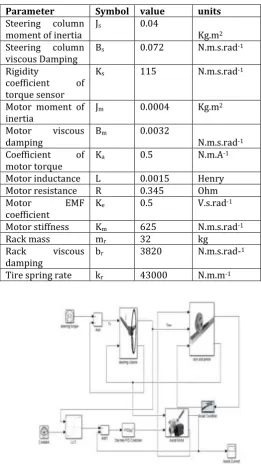
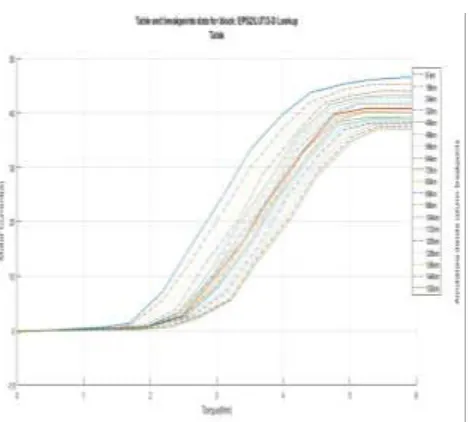
The sensors together with the vehicle velocity are fed into electric controller unit (ECU). The resulting value from the ECU process is then used to excite the circuitry of the motor and finally gives an output to the rack. Fig. 1 shows a schematic arrangement of column-type EPAS. When the driver applies torque to the steering wheel, the torque sensor will sense the applied torque and feed the reading into the ECU. The ECU will then determine the assist current to be fed into the assist motor from the boost curve based from the input from the torque sensor and the vehicle’s speed. Assist current is supplied to the electric motor to produce assisted torque, which then combines with the torque from the driver to provide the total steering torque.
JSӪS+BSӨ S=TS-TSEN (1)
TSEN =KS (ӨS-ӨOUT) (2)
JmӪm +BmӨ m=Tm-Ta (3)
Tm= Kaia (4)
Va=Ria + L(dia)/dt + KeӨ m (5)
Ta=Km (Өm-GӨout) (6)
JoutӪout +BoutӨ out=TSEN+GTa-Tl (7)
Tl = TSEN + Ta (8)
mrx r+brx r= Tl/rs - FTR (9)
FTR=Krxr+Fd (10)
[image:2.595.303.565.160.631.2]Xr=Өoutrs (11)
Table -1: PARAMETER OF EPAS SYSTEM
Parameter Symbol value units
Steering column
moment of inertia Js 0.04 Kg.m2 Steering column
viscous Damping Bs 0.072 N.m.s.rad -1
Rigidity
coefficient of torque sensor
Ks 115 N.m.s.rad-1
Motor moment of
inertia Jm 0.0004 Kg.m
2
Motor viscous
damping Bm 0.0032 N.m.s.rad-1
Coefficient of
motor torque Ka 0.5 N.m.A
-1
Motor inductance L 0.0015 Henry
Motor resistance R 0.345 Ohm
Motor EMF
coefficient Ke 0.5 V.s.rad
-1
Motor stiffness Km 625 N.m.s.rad-1
Rack mass mr 32 kg
Rack viscous
damping br 3820
N.m.s.rad-1
Tire spring rate kr 43000 N.m.m-1
Fig -1: Mathematical modeling of EPAS using MALAB
3. SYSTEM CONTROLLER
© 2019, IRJET | Impact Factor value: 7.34 | ISO 9001:2008 Certified Journal
| Page 976
Fig -2: Lookup tablea. Particle Swarm Optimization (PSO)
In Particle Swarm Optimization or PSO algorithm, a swarm Which comprises of a set of individuals or particles moving around the search space and each particle represent a potential solution (fitness) to a problem. Particle Swarm Optimization (PSO) is a population based evolutionary algorithm which was originally developed by J. Kennedy and R. C. Eberhart in 1995. Each particle has its own velocity and memorizes of both the current position and its own best position/solution so far. The position at which the particle encounter its best fitness is called personal (local) best position, 𝑝𝑖 . Another value that is recorded by the PSO is the best overall value and its position obtained so far by the particle in the swarm is called global best position, 𝑝𝑔 . The velocity and position of each particle will be updated on each iteration until the maximum iteration is reached. The update velocity and position equations are listed as in (12) and (13) below. The velocity, 𝑣𝑖𝑑𝑛𝑒𝑤 and position, 𝑥𝑖𝑑𝑛𝑒𝑤 update are influenced by those best values 𝑝𝑖𝑑 and 𝑝𝑔 .
Vi(j+1)=W*Vi^j+C1*rand1(∙)*(Pbest-Pi^j )+C2*rand2(∙)*(Gbest-Pi^j ) (12)
Pi(j+1)=Vi(j+1)+Pij (13)
b. Ant Colony Optimization (ACO)
The Ant Colony Optimization is a general-purpose metaheuristic algorithm in optimization problems, which was proposed by Dorigo and colleagues . The pheromone trail laying and the following behavior of real ants became the inspiring source in this algorithm. Starting from the source node, each of the ant constructs a complete tour by choosing the next node according to the probabilistic
transition rule defined in equation (14). Where 𝜂𝑖𝑗
represent the objective function assigned to each feasible
solution (heuristic information) and the pheromone intensity of the corresponding trail (pheromone value) is
denoted by 𝜏𝑖𝑗. The heuristic information is generated by
the objective function in the algorithm and the indicators
of how beneficial it seems to make a move from node-𝑖 to
node-𝑗 is given by 𝜏𝑖𝑗 . Parameters 𝛼 and 𝛽 provide balance
for the exploration and exploitation respectively of the
algorithm as 𝛼 reflects the relative influence of the
pheromone trail while 𝛽 determines the heuristic
information in the algorithm.
P( | )= ∑ ( )
( ) (14)
c. Modified Particle Swarm Optimization (MPSO)
MPSO was proposed by Eberhart and Shi in 1997 and 1998. In this algorithm, the birds have a memory about the previous best and worst positions so that particles have 2 experiences, a bad experience helps each particle to remember its previous worst position. To calculate the new velocity, the bad experience of each particle is considered. The new velocity update equation is given as follow
𝑉𝑖 𝑗+1 = 𝑊 ∗ 𝑉𝑖 𝑗+ 1g ∗ 𝑟𝑎𝑛𝑑1(∙) ∗ (𝑃𝑏𝑒 𝑡 − 𝑃𝑖 𝑗 ) + 1𝑏 ∗
𝑟𝑎𝑛𝑑2(∙) ∗ (𝑃𝑖𝑗 − 𝑃𝑤𝑜𝑟 𝑡) + 2 ∗ 𝑟𝑎𝑛𝑑3(∙) ∗ (𝐺𝑏𝑒 𝑡 − 𝑃𝑖 𝑗 ) (15)
4. CONTROLLER ANALYSIS
The effectiveness of the PID controller tuning using PSO, MPSO, and ACO algorithms is first evaluated in Simulink platform by analysing the assist current supplied to the assist motor in the EPAS system. Fig. 3 shows the convergence and the meansquared error (MSE) with 100th iterations for PID tuning using PSO. The MSE served as the objective function for optimization process as in equation (16):
𝑀𝑆𝐸 = 1/ ∑N t=1|𝑦(𝑡) −𝑦 (𝑡)|2 (16)
[image:3.595.58.293.93.304.2]where, represents a number of data points, 𝑦(𝑡) is the actual motor current and 𝑦 (𝑡) is the predicted motor current.
[image:3.595.318.541.625.754.2]It was observed that the objective function fluctuated before finally converging at a stable value after about 43 iterations. After all iterations had finished, the final value of 𝐾𝑃 = 254.431, 𝐾𝑖 = 9.4227 and 𝐾𝑑 = 3.1409 with the meansquared error of 6.9306×10⁻⁶ were obtained. The value of 𝐾𝑃, 𝐾𝑖 and 𝐾𝑑 converge accordingly within the same range of 30 iterations as illustrated in Fig. 4. In Fig.3, at the range of 0 to 20 iterations, the MSE values fluctuated significantly because all of the individual parameter 𝐾𝑃,𝐾𝑖 and 𝐾𝑑 values were still searching for best possible solution as shown in Fig. 6. While at the range of 30 to 40 iterations, the MSE value fluctuates slightly due to the unsettled convergence process for 𝐾𝑖 and 𝐾𝑑 before those values finally stabilized at about 43 iterations.
Fig.4. PSO KP, Ki and Kd convergence
For the PID tuning using ACO, the MSE was used as the cost function and the convergence of the MSE is illustrated in Fig. 5. It is observed that the cost function of the ACO becomes stable at a value of 2.3215×10⁻⁴. After the maximum tour was achieved, the optimum value of 𝐾𝑃 = 251.02, 𝐾𝑖 = 5.59 and 𝐾𝑑 = 2.48 were obtained. Fig. 6 shows the convergence profile for all those parameters. The PID parameters tuned using ACO converged at about 33 iterations. However, further examination of each individual convergence process for the parameters shows that 𝐾𝑖 and 𝐾𝑑 have not yet converged in the range of 40 to 50 iterations. Changes in the two parameters do not change the MSE value, and thus they revert to their previous values and finally become stable at 50 iterations.
Fig.5 ACO MSE
Fig.6. ACO KP, Ki and Kd convergence
For the PID tuning using MPSO,
Fig.7. MPSO MSE
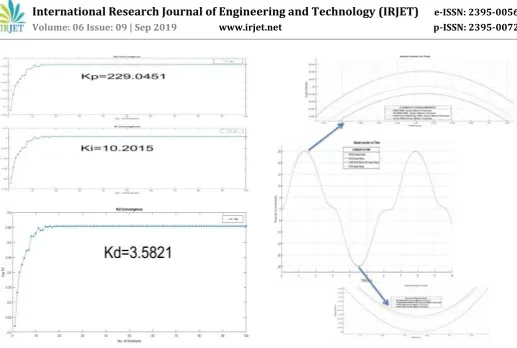
the MSE was used as the cost function and the convergence of the MSE is illustrated in Fig. 6.5. It is observed that the cost function of the ACO becomes stable at a value of 4.216×10⁻⁶. After the maximum tour was achieved, the optimum value of 𝐾𝑃=229.0451, 𝐾𝑖=10.2015
and 𝐾𝑑=3.5821 were obtained. Fig. 6.6 shows the
© 2019, IRJET | Impact Factor value: 7.34 | ISO 9001:2008 Certified Journal
| Page 978
Fig.8. MPSO ACO KP, Ki and Kd convergenceTable -1: PERFORMANCE EVALUATION OF PID-SWARM BASED CONTROLLER
Fig.9. DIFFERENCE IN ASSIST CURRENT Vs TIME FOR ALL CONTROLLERS PROFILE
4. CONCLUSIONS
This research investigates the potential of swarm intelligence technique in tuning the EPAS system controller with an objective to reduce current draws from the battery. In EV technology, the importance of energy conservation is very essential. PSO and ACO algorithms are applied in the EPAS system model as the tuning mechanism of the PID controller. Three algorithms are able to generate the optimal parameter values of PID controller and tested in Simulink model for the assist current reduction feasibility. Results show that the PID-PSO controller and PID-ACO controller and PID-MPID-PSO controller are able to reduce the assist current supplied to the assist motor as compare to the conventional PID. Furthermore, this study also demonstrate the feasibility of applying PID-PSO tuned and PID-ACO PID-MPSO tuned controllers in terms of reducing time taken to tune the PID controller compared to the conventional tuning method. Hence, PSO ,ACO and MPSO algorithms helps in tuning the PID automatically rather than the heuristic method.
REFERENCES
[1].Shi, Guobiao and Zhao, Songhui and Min, Jun, “Simulation Analysis for Electric Power Steering Control System Based On Permanent Magnetism Synchronization Motor”, 2nd International Conference on Electronic & Mechanical Engineering and Information Technology, 2012.
Controller PID parameters
value Maximum assist current Conventional
PID Kp =300 Ki =10 25.02 −25.02 A A and Kd =5
PID –PSO tuned Kp =254.4130 25.00 A and −24.85 A
Ki =9.4227 Kd =3.1409
PID-ACO tuned Kp =251.02 24.99 A and −24.81 A
Ki =5.59 Kd =2.48
PID-MPSO Kp=229.045 25.00 A and -24.82A
[image:5.595.35.282.466.640.2][2].R. A. Hanifah, S. F. Toha, and S. Ahmad, “Energy Consumption Optimization with PSO Scheme for Electric Power Steering System,”International Journal of Computer Theory and Engineering vol. 7, no. 4, pp. 297-301, 2015.
[3].B. Nagaraj, S. Subha, B. Rampriya, “Tuning Algorithms for PID Controller Using Soft Computing Techniques”. IJCSNS International Journal of Computer Science and Network Security, VOL.8 No.4, April 2008.
[4].Hassan, M.K., et al., Optimal Design of Electric Power Assisted Steering System (EPAS) Using GA-PID Method. Procedia Engineering, 2012. 41(0): p. 614-621
[5].N. E. Toklu, L. M. Gambardella and R. Montemanni, “A multiple ant colony system for a vehicle routing problem with time windows and uncertain travel times,”Journal of Traffic and Logistics Engineering, vol. 2, no. 1, 2014.
[6].A. Marouf, M. Djemai, C. Sentouh and P. Pudlo, "A New Control Strategy of an Electric-Power-Assisted Steering System," in IEEE Transactions on Vehicular Technology, vol. 61, no. 8, pp. 3574-3589, 2012.
[7].Y. Wang, Y. Shen, X. Yuan, Y. Yang, "Operating point optimization of auxiliary power unit based on dynamic combined cost map and particle swarm optimization", IEEE Trans. Power Electron., vol. 30, no. 12, pp. 7038-7050, Dec. 2015.
[8]. N. E. Toklu, L. M. Gambardella, R. Montemanni, "A multiple ant colony system for a vehicle routing problem with time windows and uncertain travel times", J. Traffic Logist. Eng., vol. 2, no. 1, pp. 52-58, 2014.
[9]. T. Sousa, Z. Vale, J. Paulo, T. Pinto, H. Morais, "A hybrid simulated annealing approach to handle energy resource management considering an intensive use of electric vehicles", Energy, vol. 67, pp. 81-96, 2014.
[10]. T. Yang, "A new control framework of electric power steering system based on admittance control", IEEE Trans. Control Syst. Technol., vol. 23, no. 2, pp. 762-769, Mar. 2015.
[11]. H. Liu, G. Chen, C. Zong, "Friction compensation control method research of electric power steering system", Apr. 2016.
[12]. J. H. Lee, H. T. Moon, J. Y. Yoo, "Current sensorless drive method for electric power steering", Int. J. Autom. Technol., vol. 13, pp. 1141-1147, 2012.
[13]. G. H. Lee et al., "Torque ripple minimization control of permanent magnet synchronous motors for EPS applications", Int. J. Autom. Technol., vol. 12, pp. 291-297, 2011.
[14]. J. Wang et al., "Independent wheel torque control of 4WD electric vehicle for differential drive assisted steering", Mechatronics, vol. 21, pp. 63-76, 2011.