IMAGE COMPRESSION TECHNIQUE FOR QUANTIZED ENCRYPTED
IMAGES USING SVD
CHALAPAKA VEERENDRA BHARGHAV KUMAR
1, K DURGA GANGA RAO
21
Student, Dept. of ECE, UCEK, JNTUK, AP, India
2Assistant Professor, Dept. of ECE, UCEK, JNTUK, AP, India.
---***---
Abstract -A lossy compression technique for encrypted images using Discrete Wavelet Transform (DWT), Singular Value Decomposition (SVD) and Huffman coding is analyzed in this paper. At the sender side first the image is encrypted by using quantized wavelet coefficients and secret key. In the image selection of significant and less significant coefficients are performed by using the wavelet domain. Encrypted LL sub-band data is quantized and compressed by Huffman coding while; other sub-bands encrypted data is efficiently compressed by discarding irrelevant information using SVD and compressed by Huffman coding techniques. At receiver side, a reliable decompression and decryption technique is used to reconstruct the original image content with the help of compressed bit streams and inverse quantization & secret key. The proposed method is evaluated using parameters such as Compression Ratio (CR) and Peak-Signal-to-Noise Ratio (PSNR). This scheme has an advantage of using SVD due to which we have obtained good compression performance while retaining the desirable features of the reconstructed image.Key Words: Compression ratio, Quantized image coefficients (QIC), Quantized wavelet coefficients (QWC), discrete
wavelet transform, Huffman coding, Singular value decomposition, Image compression, Peak signal to noise ratio.
1. INTROUCTION
Image compression is an application of data compression that encodes the original image with few bits. The objective of image compression is to reduce the redundancy of the image and to store or transmit data in an efficient form. The main goal of such system is to reduce the storage quantity as much as possible, and the decoded image displayed in the monitor can be similar to the original image as much as can be. The rapid increase in of transmitting images in social networking sites has raised two problems like secure transmission and large size of image. To rectify this problem we need quantized & encrypt the image and then compression the image.
Lossy compression for Gaussian source can be achieved through Wyner–Ziv theorem [1]. Recently, a prediction error based ETC technique is proposed by Vaish et al. [2]in which prediction errors are calculated by using a sub-image and efficient compression is achieved by using quantization and Huffman coding. More recently, an efficient compression of encrypted image using wavelet difference coding is given by Kumar and Vaish [3].In this paper, a lossy ETC technique is proposed through which good compression performance can be achieved while ensuring the security of images.
2. RELATED WORK
2.1 Singular value decomposition
SVD does is split a matrix into three important sub matrices to represent the data. Given the matrix A, where the size of a is 𝑚 × 𝑛 where 𝑚 represents the number of rows in the matrix, and 𝑛 represents the number of columns, A can be broken down into three sub matrices 𝐴 = 𝑈S𝑉𝑇 where 𝑈 is of size 𝑚 × 𝑚, S is of size 𝑚 × 𝑛 and is diagonal, and 𝑉 T is of size 𝑛 × 𝑛.
Um×n=Um×n× Sm×n×(Vn×n)T (1)
S m × n =[S’ c × d ...0; 0 ...0], c ≤ m, d ≤ n (2)
As S’ has less number of rows and columns with respect to S, therefore, to make matrix multiplication possible some columns of U and rows of V need to be reduced as given below in eq.(3):
Um×m= U’m×c× U’m×(m-c)
and Vn×n = V’n×d ×V’n×(n-d) (3)
Hence the reconstructed matrix can be obtained as:
Since the singular matrix stores singular values (in descending order) therefore by the use of psychovisual concept, ignoring the lower singular values will not significantly reduce the visual quality of the image [5].
2.2 Discrete Wavelet Transform
At first, the input image will be filtered into lowpass and highpass components through analysis filters. After filtering, the data amount of the lowpass and highpass components will become twice that of the original signal; therefore, the lowpass and highpass components must be downsampled to reduce the data quantity. At the receiver, the received data must be upsampled to approximate the original signal. Finally, the upsampled signal passes the synthesis filters and is added to form the reconstructed approximation signal.
Figure (1) One level wavelet decomposition
3. PROPOSED METHOD
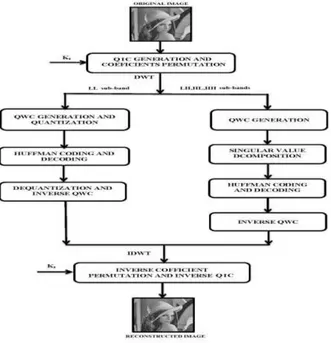
Block diagram of proposed ETC technique is demonstrated in Fig.2, and the complete process is summarized in the following subsections.
[image:2.595.221.374.217.323.2] [image:2.595.134.465.411.754.2]Step1: Initially we will find QI Coefficients for the input image.
Step2: Then encryption will be carried out by using pseudo random coefficient permutation method.
Step3: apply DWT for encrypted image, then will get LL, LH, HL and HH sub-bands.
Step4: For LL sub-band section we will apply QWC and quantization.
Step5: Then Huffman coding decoding and Dequantization & inverse QWC are applied.
Step6: For LH, HL, HH sub-bands we will find QW coefficients.
Step7: Then SVD and Huffman coding decoding and inverse QWC will be carried out.
Step8: LL sub-band section and LH, HL, HH sub-band section will be merged by inverse DWT.
Step9: We apply inverse QI coefficients and inverse pseudo random coefficients permutation.
Step10: Finally reconstructed image is obtained.
Required equations list: [8]
QIC (i, j) = ((I (i, j)-IC min).R)/(IC max- IC min) (5)
E( i , j) = mod[QWC( i , j)-S( i , j) , 512] (6)
QWC( i, j )=|((WC(I ,j)-WCmin).R)/(WCmax- WCmin )|,
1 ≤ i ≤ P/2,1 ≤ j ≤ Q/2 (7)
Q( i, j ) =|E(i ,j)/ƞ|, 1 ≤ i ≤ P/2,1 ≤ j ≤ Q/2 (8) B=B1+B2+B3+B4 (9) CR=B/(P×Q)
(10)
Q’’ (i, j) as: Q’’ (i, j) = Q’(i, j)×ƞ.
A( i,j)=(Q’(i, j)/R).(WCmax – WCmin)+WCmin (11)
E’( i , j) = mod[A( i , j)-S( i , j) , 512] (12)
I’( i , j ) =(E’(i ,j)/R).( IC max – IC min)+IC min) (13)
4. EXPERIMENTAL RESULTS
The proposed ETC technique is implemented using Matlab 9.4.0. To demonstrate various 8-bit gray scale images like Lena, Peppers each of size 512 ×512,are used which are shown in Figure(3)and Reconstructed images are shown in Figure(4).
4.1.1 Security analysis
The values of input image are encrypted using the pseudo random permutation is used to scramble the position of each of the detail wavelet coefficients independently. Hence, it would be difficult to any attacker to practically implement a successful brute force search on encrypted detail wavelet subbands. Therefore, the proposed scheme has attained a desired level of security
4.1.2 Compression performance evalution
are3.7174,3.714,3.7108,3.7124 and 3.7185 respectively while the corresponding PSNR values are 45.4934dB, 45.4366dB, 45.5626dB, 45.5292dB and 45.5087dB.
Figure(3) Original images
TABLEI
PSNR (DB) AND CR VARIOUS TEST IMAGES WITH VARYING SINGULAR VALUES ON BIORTHOGONAL (BIOR3.1) WAVELET.
TABLEII
PSNR(DB)ANDCRVARIOUSTESTIMAGESWITHVARYINGSINGULARVALUESONHAAR(HAAR)WAVELET.
SINGULAR VALUES 256 128 64 32 16
PSNR CR PSNR CR PSNR CR PSNR CR PSNR CR
Lena 44.671 3.7144 31.1763 3.7131 27.2194 3.6697 26.5266 3.6074 26.3631 3.5458 Peppers 42.8998 3.7707 25.7576 3.7684 22.3036 3.7372 21.7012 3.6924 22.03 3.6495 Girl 44.6989 3.7285 36.3321 3.7346 32.5316 3.7047 31.9208 3.6607 32.2602 3.6089 Couple 43.0768 3.7211 29.9602 3.7178 25.8559 3.686 24.3602 3.638 23.8525 3.5921 Barbara 42.8276 3.6877 26.2814 3.6874 19.4147 3.6593 18.3028 3.6019 19.0613 3.5343 Boat 43.2044 3.7251 25.5841 3.705 21.9666 3.6764 21.204 3.6058 22.1529 3.5291 Baboon 40.5183 3.6501 28.2007 3.6436 24.6837 3.595 23.2061 3.525 22.4326 3.4464 Man 42.6831 3.7523 14.2492 3.7512 11.891 3.7198 11.9537 3.6747 12.4548 3.6326 Average 43.0724 3.7187 27.1927 3.7151 23.2333 3.681 22.3969 3.6257 22.5759 3.5673
SINGULAR VALUES 256 128 64 32 16
PSNR CR PSNR CR PSNR CR PSNR CR PSNR CR
Figure (4) Reconstructed images
5. CONCLUSIONS
This paper proposed a simplest effective Encryption-then-Compression technique using SVD and Huffman coding. At the sender end, content owner decomposed the original image into a wavelet decomposition using DWT. At the sender side the input image is quantized and encrypted using pseudo random permutation, which makes the proposed scheme secure against any brute force search. The encrypted LL sub-band is compressed by quantization and Huffman coding, the encrypted LH, HL, HH sub-bands are compressed using SVD and Huffman coding technique. The receiver can perform the decompression, decryption and inverse of DWT and inverse quantization to get the reconstructed image.
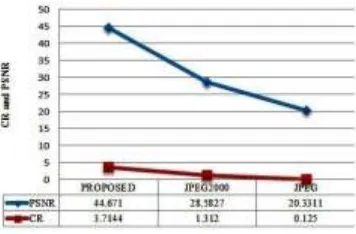
Figure (5) Graph between CR&PSNR for different compression schemes with comparison table.
The performance analysis of proposed work is evaluated by comparing the unencrypted images. It is evident from the quantitative and visual results that the proposed scheme over JPEG&JPEG2000 on compression of encrypted image. Proposed scheme has an advantage of using SVD due to which we have obtained good compression performance while retaining the desirable features of the reconstructed.
6. REFERENCES
[1] A. Wyner, J. Ziv, The rate-distortion function for source coding with side infor-mation at the decoder, IEEE Trans. Inf.
Theory IT-22 (1976) 1–10.J.
[2] A. Vaish, M. Kumar, Prediction error based compression of encrypted images, in: ICCCT-2015, ACM Digital Library, 2015,
pp.228–232.
[3] M. Kumar, A. Vaish, An efficient compression of encrypted images using WDR coding, in: SocPros-2015, in: Springer Series
Advances in Intelligent Systems and Computing, vol.436, 2016, pp.729–741..
[4] http://www.math.utah.edu/~goller/F15_M2270/BradyMathews_SVDImage.pdf.
[5] A.M. Rufai, G. Anbarjafari, H. Demirel, Lossy image compression using singular value decomposition and wavelet difference
reduction, Digit. Signal Process. 24 (2014) 117–123.
[image:5.595.44.554.45.267.2] [image:5.595.210.388.383.500.2][7] J.C. Yen, J.I. Guo, Efficient hierarchical chaotic image encryption algorithm and its VLSI realization, IEE Proc., Vis. Image
Signal Process. 147(2) (2000) 167–175.