ISSN 2348 – 7968
Application of Ant Colony Optimization for finding the
Navigational path of Mobile Robot- A Review
Suhel Shaikh1, Shrikant Taras2, Harish Wagh3,Keval Nikam4
Department of Mechanical Engineering
Pad. Dr. D. Y. Patil Institute of Engineering, Management and Research, Akurdi, Pune
Abstract
In industries as well as in day to day life the use of Mobile Robots is increasing because to optimize our lives. But the difficult issue in robot navigation or path planning in an unknown environment with static or dynamic obstacle is to find a globally optimal path from the start to target point and at the same time avoid collisions. So one of the techniques for path planning or shortest path finding is ANT COLONY OPTIMIZATION (ACO). An algorithm based on behavior of real ants which is applied to artificial ants in this case artificial ant is robot. So in this paper using ACO algorithm in MATLAB the path planning problem of mobile robot is solved.
.
Keywords: ACO, Mobile robot, shortest path, MATLAB.
I.
INTRODUCTION
Ant Colony Optimization (ACO) studies artificial systems that take inspiration from the behavior of real ant colonies and which are used to solve discrete optimization problems. In
1999, the Ant Colony Optimization metaheuristic was defined by Dorigo, Di Caro and Gambardella. The first ACO system was introduced by Marco Dorigo in his Ph.D. thesis (1992), and was called Ant System (AS). AS is the result of a research on computational intelligence approaches to combinatorial optimization that Dorigo conducted at Politecnico di Milano in collaboration with Alberto Colorni and Vittorio Maniezzo. AS was initially applied to the edge detection [1], and to the quadratic assignment problem. Dorigo, Gambardella and Stutzle have been working on various extended versions of the AS paradigm. Dorigo and Gambardella have proposed Ant Colony System (ACS)[3].
Several ant species are able to select the shortest path, among a set of alternative paths, from their nest to a food source. Ants lay a chemical trail called pheromone when they walk to attract other ants to take the path that has the most pheromone; this mechanism manifests
effect
of
positive feedback. ACO algorithm is a stochastic, distributed and collective approach that has been used to solve different hard combinatorial optimization problemssuch as the Traveling Salesman Problem (TSP), Quadratic Assignment, or the Vehicle Routing Problem [2].
Mobile robot path planning is an essential issue of mobile robotics in the past two decades. Path planning is the determination of a path that a robot must take in order to pass over each point in a location in a given environment while minimizing the total cost associated with the path and path is a plan of geometric locus of the points in a known space where the robot has to pass through. In the past two decades, various conventional methods have been developed to solve the path planning problem; some methods are cell decomposition, road map and potential field [1].
ACO is a search technique inspired by the foraging behaviour of real ants. ACO has the ability to solve a hard combinatorial optimizations problem, the use of Ant Colony Optimization has contribute to the achievement of many investigation on Robot path planning. Any Colony Optimization algorithm is used to solve the mobile robot path planning problem in such a way that the artificial ant reaches the target point from source point avoiding obstacles [1].
2. LITURATURE SURVEY:
ISSN 2348 – 7968
solution. The mobile robot environment is treated as a grid based environment in which each grid can be represented by an ordered pair of row number and column number. The mobile robot is considered as a point in the environment, to reduce computational complexities. After multiple experiments in MATLAB, ACO-MH results show better convergence speed and reduction in computational time than that of SACO.
Anasari Muqueet Husain et al. [2] utilized Ant Colony Optimization for path planning of mobile robot. An algorithm is used on ant‟s behavior, pheromone update & pheromone evaporation. This applied to path planning of mobile robot motion in warehouses for materials handling with starting from any location to reach a certain goal. To validate the proposed algorithm, the program has been developed in Visual C++. This technique can generated feasible, stable and optimal robotic materials handling sequence and then path sequence can satisfying the materials handling constraints with minimum travel time.
Dilpreet kaur et al. [3] presented comparison of proposed algorithm with the old algorithm using Ant Colony optimization. This algorithm is basically designed for edge detection but here is implemented to find the path through hurdles. ACO is a class of optimization algorithms modeled on the actions of an ant colony. It forms a zig zag track which will be randomly generated by the algorithm every time we implement our algorithm. Arena which is randomly created has white pixels showing clear area and black one for restricted entry. The main aim is to pass through environment in secure form and to avoid obstacles.
Vinay Rishiwal et al. [4] proposed application of Ant Colony Optimization algorithm to find optimal paths in terrain maps. The algorithm uses penalty maps of the terrain maps as an input. The Terrain features such as land, forest etc are identified with different colors. Each color is associated with a distinct penalty value for a region on terrain map with respect to the constraint under consideration. Using ACO an artificial ant was simulated to search an optimum path between source and target station. The ant selects the succeeding node to visit from the list of probable nodes based on transition probability and directional biasing. Transition probability maintains a balance between pheromone intensity and heuristic information. The next node is selected on the basis of maximum probability and the process is continued till target station is reached. The directional probability increases the chances to select the next node that is in the direction of destination.
Buniyamin N. et al. [5] presented an overview of mobile robot path planning algorithms for autonomous robots. They also focused on the bug algorithm family which is a local path planning algorithm. Bug algorithms exploits sensors to detect any obstacle present on the path of the mobile robot towards target station , with limited information about the environment. The proposed algorithm makes use of obstacle border as guidance towards the target as the robot circumnavigates the obstacle till it discovers certain condition to fulfill the algorithm criteria to avoid the obstacle towards the target point. The robot is able to scan the entire environment with sensors that allows it to rotate itself from 0° to 360°.They also introduced an approach utilizing a novice algorithm called PointBug. This algorithm minimized the use of outer perimeter of an obstacle by searching for points on the outer perimeter of obstacle area as a turning point to target and eventually generates a complete path from source station to target station. The initial position of robot heading straight towards the target point and then it rotates left or right searching for sudden point. After the first sudden pint was observed, the rotation of the mobile robot is in accordance to the position of d min line where d min is the shortest distance between sudden point and target point in a straight line. Its value is recorded each time the robot reaches new sudden point.The mobile robot neglects sensor reading at 180° rotation to avoid detection of preceding sudden point. If no sudden point is found within a360° rotation, the robot stops immediately. This algorithm produces shorter total path length taken by a mobile robot. This approach was compared with other existing local path planning algorithms for total distance.
ISSN 2348 – 7968
environment.
3. PROBLEM STATEMENT:
The mobile robot environment is treated as a grid based environment in which each grid can be represented by an ordered pair of row number and column number. The environment of the mobile robot is represented in 2-D grid model. The map consists of a 20x20 square grids of identical pattern which is shown in Fig 1. The X-axis is divided equally into 20 parts and the Y-axis is also divided into 20 equal parts. The size of grids is considered in such a manner that they can be used to accommodate obstacles of variable size and shape. The edge of each cell is of unit length. The origin or the source station (S) of the robot is at the bottom left corner with coordinate (1, 1). The target station (G) of the robot is at the top right corner with coordinate (20, 20). The mobile robot is considered as a point in the environment to reduce the computational complexities. We need to plan a path between two specified locations, a start and goal point. The path should have no collision and satisfies certain optimization criteria (shortest distance).[1]
Figure 3.1 Grid model for the problem [1]
4. METHODOLOGY:
The objective is to construct a shortest path from the source station S, to the target station (goal point) G, which avoids every obstacle in the map. To solve this different methods and various algorithms are in existence. [1] used Simple Ant Colony Optimization and Ant Colony Optimization Meta-Heuristic (ACO-MH).
Meta-heuristic algorithms[4] are algorithms which, in order to escape from local optima, drive some basic heuristic: either a constructive heuristic starting from a null solution and adding elements to build a good complete one, or a local search heuristic starting from a complete solution and iteratively modifying some of its elements in order to achieve a better one.
Ant Colony Optimization (ACO) simulates the behavior of ant colony in nature when they are foraging for food and finding the most efficient routes from their nests to food sources, it is a stochastic search algorithm, and good effect has been obtained in solving function and combination optimization, identification of various system, Path planning of mobile robots, Mining of data, network routing by using the algorithm. According to the intensity of the pheromone trail and evaporation the probability of the motion path is chosen by an ant. The probability is called as the transition probability [1,2,3]. It is also known as Ant Colony System. The following are terms used in Ant Colony Optimization:
1. Artificial ant: In this mobile robot is treated as an artificial ant inspired from real ants which makes movement based Pheromone attraction.[1,2,3,4,5] 2. Pheromone: It is a chemical essence deposited by ants when walking; each ant probabilistically prefers to follow a direction rich in pheromone rather than a poorer one.
The equation for finding the transition probability in the ant colony algorithm is[1,2,4]
Where, pheromone trail, m = No. of
Ants =Weight value (Positive Constant)
[1]
In the equation (1) represents the transition probability
in which ant k will navigate from node i to node j. The numerator on the right side of the equation represents the intensity of the pheromone trail between nodes i and
j with a corresponding weight value of . The
denominator on the right side of the equation is a summation of the products of the pheromone intensity for all possible moving paths [1].
ISSN 2348 – 7968
iteration. This is done by first evaporative the pheromone value on all paths by a constant factor, and adds pheromone on the paths. Pheromone evaporation is implemented by [1].
Where 0 < ρ ≤1 is the pheromone evaporation rate. The parameter ρ is utilized to avoid limitless accumulation of the pheromone trails and it enables the algorithm to “forget” bad decision previously taken [1]. After evaporation all ants deposit pheromone on the paths they have crossed in the motion paths. The change of the pheromone is following:
Where, is the amount of pheromone ant k deposits on
the paths it has visited. It is given as:
Where , the length of the path build by the ant.
4.1 Pseudo Code of ACS Algorithm for Mobile Robot Path Planning:
The Pseudo Code sequence of ACS is given below [1].
Represent the solution space by constructing a grid map
Locate the static obstacles, start and goal point Initialize ACO parameters
If iteration (i) =1, 2, 3, 4, 5, 6, ……… + n
Else if ant (m) =1, 2, 3, 4, 5, 6, ……… + n
Else if nodes (n) =1, 2, 3, 4, ……… + n Compute the probability of the mth ant next nodes
Move to the next nodes by computed probability
Store history of past location of nodes in an array
If current location of nodes is equal to destination
Break the nodes (n) loop End
End
Evaluate fitness and store path distance of mth ant
Compute pheromone amount generated by mth ant
End
Update pheromone amount of the entire map
End
5. EXPERIMENTS:
5.1 Experiment 1
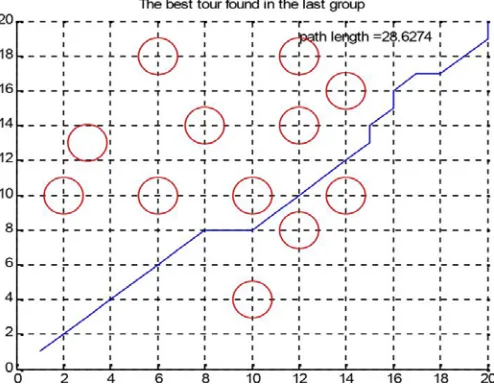
In this experiment the obstacles are located in random manner for obtain the optimal path. The figure 2 shows result of ACO algorithm. The feasible path cost of ACO-MH 28.6274cm was obtained which has the minimum path cost compare to the SACO algorithm. While increasing the number of ants the algorithm founds the optimal path.
Fig. 5.1 Optimal path found with ACO-MH
5.2 Experiment 2
In this experiment the obstacles are located in vertical line to block optimal diagonal path. The Figure 3 shows the optimal results of ACO algorithm in MATLAB.
ISSN 2348 – 7968
Fig. 5.2 Optimal path found with ACO
The algorithm is unable to follow the diagonal path because of the obstacles location on the grid map.
5.3 Experiment 3
The static obstacles are placed in horizontal line to block the easiest diagonal path. The proposed ACO algorithm, utilizes the heuristic function to forget the bad decisions which previously taken by the ants (mobile robots). For this experiment ant algorithm follow the shortest path avoiding collision with the horizontal obstacles.
Fig. 5.3 Optimal path found using ACO
The above fig. Shows the optimum path followed by mobile robot avoiding obstacles using ACO algorithm. Its path cost is 32.1421cm which optimal from start station to destination station.
6. RESULTS:
Sr.No Experiment Optimal distance(cm)
1 Experiment1 28.6274
2 Experiment2 32.1421
3 Experiment3 32.1421
7. CONCLUSION:
Finding the navigational path of mobile robot is currently among the most intensively studied area of research in robotics. It has verified application in different field of works, especially where human presence is dangerous and harmful, to avoid human error or economically not viable. In this paper, ACO is used for finding the shortest navigational path of autonomous mobile robot avoiding obstacles from source station to target station. Using MATLAB the output is found to be optimal and satisfying for the given problem. With increase in complexities i.e. with increase in number of obstacles ACO algorithm can be applied effectively giving result in lesser time.
8.FUTURE SCOPE:
The proposed method can be applied to various applications like for material handling robot, path finding on Terrain maps, optimization of Process plan, Flow shop scheduling problem, etc.[2,4,10,12]
9. ACKNOWLEDMENT:
The authors gratefully acknowledge and thank to our college Pad. Dr. D. Y. Patil Institute of Engineering, Management and Research, Akurdi, Pune for their valuable support.
10.REFERENCES:
[1] T. Mohanraj, S. Arunkumar, M. Raghunath, M. Anand, „Mobile Robot path planning using Ant Colony Optimization‟, International Journal of Research in Engineering and Technology, June-2014.
[2] Ansari Muqeet Husain, Shaikh Mohammad Sohail, V. S. Narwane, „Path planning of material handling robot using Ant Colony Optimization (ACO) technique‟, International Journal of Engineering and Applications, sep-oct 2012.
[3] Dilpreet kaur, Dr. P. S. Mundra, „Ant Colony Optimization: ATechnique Used For Finding Shortest Path‟, International Journal of Engineering and Innovative Technology, May2012.
ISSN 2348 – 7968
„Finding Optimal Paths on Terrain Maps using Ant Colony Algorithm‟, International Journal of Computer Theory and Engineering, June 2010.
[5] Buniyamin N., Sariff N., Wan Ngah W.A.J., Mohamad Z., „Robot global path planning overview and a variation of ant colony system algorithm‟, International Journal of Mathematics and Computers in Simulation, 2011.
[6] Bashra K. O. ChaborAlwawi and Hubert Roth, Bahaa I. Kazem and Mustafa W. Abdullah, „ Mobile Robot Motion Planning and Multi Objective Optimization Using Improved Approach‟, International Journal of Mechanical Engineering and Robotic Research, Oct. 2015.
[7] O. Hachour, „Path planning of Autonomous Mobile Robot‟, International Journal of System Applications, Engineering and Development, 2008.
[8] GUO Yue, SHEN Xuelian, ZHU Zhanfeng, „Research on the Mobile Robots Intelligent
Path Planning based on Ant Colony Algorithm Application in Manufacturing Logistics‟.
[9] Ritesh Maurya, Anupam Shukla, „Generalized and Modified Ant Algorithm for Solving Robot Path Planning Problem‟, IEEE, 2010.
[10] P S Srinivas, V Ramachandra Raju, C S P Rao, „An Ant Colony Optimization Algorithm for Optimization of Process Plans‟, IJMERR, October 2012.
[11] Dr. S. M. GiriRajkumar, Dr. K. R. Ramkumar, Sanjay Sarma O. V, „Real Time Application of Ants Colony Optimization‟, International Journal of Computer Applications, June 2010.
[12] Ahmad Rabanimotiagh, „An Efficient Ant Colony Optimization Algorithm for Multiobjective Flow Shop Scheduling Problem‟, International Journal of Mechanical, Aerospace, Industrial, Mechatronic and Manufacturing Engineering, 2011.