©Owned by the authors, published by EDP Sciences, 2017
Mass problem in the Standard Model
R. Martinez1,aand S. F. Mantilla1,b
1Departamento de Física, Universidad Nacional de Colombia,
Ciudad Universitaria, Carrera 45 # 26-85, Bogotá D.C., Colombia.
Abstract.We propose a new SU(3)C⊗SU(2)L⊗U(1)Y⊗U(1)X gauge model which is
non universal respect to the three fermion families of the Standard Model. We introduce additional one top-like quark, two bottom-like quarks and three right handed neutrinos in order to have an anomaly free theory. We also consider additional three right handed neutrinos which are singlets respect to the gauge symmetry of the model to implement see saw mechanism and give masses to the light neutrinos according to the neutrino os-cillation phenomenology. In the context of this horizontal gauge symmetry we find mass ansatz for leptons and quarks. In particular, from the analysis of solar, atmospheric, re-actor and accelerator neutrino oscillation experiments, we get the allow region for the Yukawa couplings for the charge and neutral lepton sectors according with the mass squared differences and mixing angles for the two neutrino hierarchy schemes, normal
and inverted.
1 Introduction
A large amount of high-energy phenomena have been understood in the context of the Standard Model (SM)[1], nowadays one of the most successful frameworks in physics. Nevertheless, there are some observations which might be out of the scope of the SM such as the fermion mass hierarchy (FMH), the origin of the large differences among scales of fermion masses, from units of MeV to hundreds of GeV is not completely understood without using unpleasant fine-tunings. Moreover, according to neutrino detectors[2], the evidence of light neutrino masses from neutrino oscillations enlarges this issue by extending the mass scales until meV. However, in contrast with charged fermions, neutrino masses are known until their squared mass differences∆m212and∆m3, where the last one determines the ordering, normal ordering (NO) if∆m213>0 and inverted ordering (IO) if∆m223<0[3, 4].
There are many models which propose different scenarios where FMH could be understood. One of the most important is the left-right model SU(2)L⊗SU(2)R⊗U(1)B−L[5] from which the Fritzsch
texture is obtained[6]. Such a scheme was extended to leptons and neutrinos by Fukugita, Tanimoto and Yanagida, who also implemented Majorana masses so as active neutrinos can acquire tiny masses, with the respective lepton violation processes produced by the existence of Majorana fermions[7].
Among different schemes, abelian extensions of the SM show a fertile scenario where some issues can be understood by implementing simple tools such as symmetry breaking or chiral anomaly can-cellation. Their suitability has been shown in addressing quark masses[8], dark matter[9, 10], scalar
potential stability[11] and lepton masses[12], where light fermions acquire masses through radiative corrections. However, by doing a slight modification in adding an additional doublet, a completely new scheme emerges with interesting texture matrices from which the FMH can be obtained naturally. The proceedings presents the particle content and the set of U(1)X charges[13]. Thereafter, the
mass matrices are shown from the Yukawa Lagrangians with their respective eigenvalues in which the FMH can be inferred. After that, the suitability of the model is checked by exploring the neutrino parameter space in order to fit neutrino oscillation data. Finally, some conclusions are outlined with a summary.
2 Particle content
The scheme proposed consists on extending the SM with a new nonuniversal abelian interaction U(1)X
together with a discrete symmetryZ2 which distinguish among families in such a way that fermion mass matrices can suggest the FMH without any kind of fine-tuning on Yukawa coupling constants. Moreover, because of the new gauge bosonZ, an extra singlet Higgs fieldχis needed to break U(1)
X
with its vacuum expectation value (VEV). Additionally, there are three Higgs doublets so as every fermion gets massive, reducing the need of radiative corrections to the minimum. There is also a scalar fieldσwithout VEV, whoseU(1)X charge is the same ofχ but with the opposite parityZ2 available to do radiative corrections when they are deserved. Furthermore, the scalar sector shows the vacuum hierarchy (VH)vχ > v1 > v2 > v3, required to get the suited masses. vχ,v1,v2andv3are at units of TeV, hundreds of GeV, units of GeV and hundreds of MeV, respectively.
On the other hand, the set of charges U(1)X of the fermion sector is strongly constraint by the
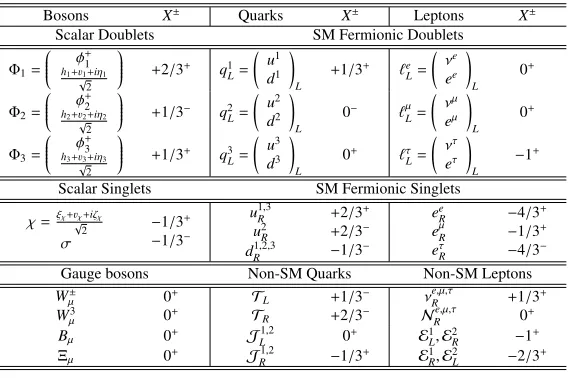
cancellation of chiral anomalies[8]. Thus, in order to obtain nonuniversal charges and also cancel any chiral anomaly in the model, exotic quarksT,J1,2and leptonsE1,2have been included, together with right-handed neutrinosνeR,µ,τand Majorana fermionsN1,2,3
R so as inverse seesaw mechanism (ISS) is
available to get small neutrino masses[14]. All of them acquire mass throughχexceptN1,2,3 which have their own Majorana massMN. Additionally, the Z2 is in charge to make distinguishable the fermions with the same U(1)X charges. It is outlined in the condensed notationX±in tab. 1 of the
particle content.
The resulting Yukawa Lagrangian of the model for the neutral, charged lepton, up-like and down-like sectors are given by, respectively
−LN=hee3νeLΦ˜3νeR+he3µνeLΦ˜3νµR+he3τνLeΦ˜3ντR+hµ3eν µ
LΦ˜3νeR+hµµ3ν µ
LΦ˜3νµR+hµτ3ν µ LΦ˜3ντR
+gi jχNνi CR χ∗NRj+1 2NRi CM
i j
NN
j
R+h.c., (1)
−LE=he3µeeLΦ3eµR+h µµ
3e µ LΦ3e
µ
R+hτ3eeτLΦ3eeR+hττ2eτLΦ2eτR+he11EeLΦ1E1R+hµ11E µ LΦ1E1R
+g1χeeE1Lχ∗eeR+g2χµeE2LχeµR+g1χEE1LχE1R+g2χEE2Lχ∗E2R+h.c., (2)
−LU=h113uq1LΦ˜3u1R+h122uq1LΦ˜2u2R+h133uq1LΦ˜3uR3 +h221uq2LΦ˜1u2R+h311uq3LΦ˜1u1R+h133uq3LΦ˜1u3R
+h12Tq1LΦ˜2TR+h21Tq2LΦ˜1TR+g1σuTLσuR1+g2χuTLχu2R +g3σuTLσu3R +gχTTLχTR+h.c., (3)
−LD=h111JqL1Φ1JR1+h212Jq2LΦ2JR1+h313Jq3LΦ3JR1+h121Jq1LΦ1JR2+h222Jq2LΦ2JR2+h332Jq3LΦ3JR2
+h213dq2LΦ3dR1+h223dq2LΦ3d2R+h323dq2LΦ3d3R+h312dq3LΦ2d1R+h322dqL3Φ2d2R+h233dq3LΦ2d3R
+g11σdJL1σ∗dR1+g11σdJL1σ∗d2R+g13σdJL1σ∗d3R+g21σdJL2σ∗dR1+g22σdJL2σ∗d2R+gσ23dJL2σ∗d3R
potential stability[11] and lepton masses[12], where light fermions acquire masses through radiative corrections. However, by doing a slight modification in adding an additional doublet, a completely new scheme emerges with interesting texture matrices from which the FMH can be obtained naturally. The proceedings presents the particle content and the set of U(1)X charges[13]. Thereafter, the
mass matrices are shown from the Yukawa Lagrangians with their respective eigenvalues in which the FMH can be inferred. After that, the suitability of the model is checked by exploring the neutrino parameter space in order to fit neutrino oscillation data. Finally, some conclusions are outlined with a summary.
2 Particle content
The scheme proposed consists on extending the SM with a new nonuniversal abelian interaction U(1)X
together with a discrete symmetryZ2 which distinguish among families in such a way that fermion mass matrices can suggest the FMH without any kind of fine-tuning on Yukawa coupling constants. Moreover, because of the new gauge bosonZ, an extra singlet Higgs fieldχis needed to break U(1)
X
with its vacuum expectation value (VEV). Additionally, there are three Higgs doublets so as every fermion gets massive, reducing the need of radiative corrections to the minimum. There is also a scalar fieldσwithout VEV, whoseU(1)X charge is the same ofχ but with the opposite parityZ2 available to do radiative corrections when they are deserved. Furthermore, the scalar sector shows the vacuum hierarchy (VH)vχ > v1 > v2 > v3, required to get the suited masses. vχ,v1,v2andv3are at units of TeV, hundreds of GeV, units of GeV and hundreds of MeV, respectively.
On the other hand, the set of charges U(1)X of the fermion sector is strongly constraint by the
cancellation of chiral anomalies[8]. Thus, in order to obtain nonuniversal charges and also cancel any chiral anomaly in the model, exotic quarksT,J1,2and leptonsE1,2have been included, together with right-handed neutrinosνeR,µ,τand Majorana fermionsN1,2,3
R so as inverse seesaw mechanism (ISS) is
available to get small neutrino masses[14]. All of them acquire mass throughχexceptN1,2,3which have their own Majorana massMN. Additionally, the Z2 is in charge to make distinguishable the fermions with the same U(1)X charges. It is outlined in the condensed notationX±in tab. 1 of the
particle content.
The resulting Yukawa Lagrangian of the model for the neutral, charged lepton, up-like and down-like sectors are given by, respectively
−LN=hee3νeLΦ˜3νeR+he3µνeLΦ˜3νµR+he3τνLeΦ˜3ντR+hµ3eν µ
LΦ˜3νeR+hµµ3ν µ
LΦ˜3νµR+hµτ3ν µ LΦ˜3ντR
+gi jχNνi CR χ∗NRj+1 2NRi CM
i j
NN
j
R+h.c., (1)
−LE=he3µeeLΦ3eµR+h µµ
3e µ LΦ3e
µ
R+hτ3eeτLΦ3eeR+hττ2eτLΦ2eτR+he11EeLΦ1E1R+hµ11E µ LΦ1E1R
+g1χeeE1Lχ∗eeR+g2χµeE2LχeµR+g1χEE1LχE1R+g2χEE2Lχ∗E2R+h.c., (2)
−LU=h113uq1LΦ˜3u1R+h122uq1LΦ˜2u2R+h133uq1LΦ˜3uR3 +h221uq2LΦ˜1u2R+h311uq3LΦ˜1u1R+h133uq3LΦ˜1u3R
+h12Tq1LΦ˜2TR+h21Tq2LΦ˜1TR+g1σuTLσuR1+g2χuTLχu2R +g3σuTLσu3R +gχTTLχTR+h.c., (3)
−LD=h111Jq1LΦ1JR1+h212Jq2LΦ2JR1+h313Jq3LΦ3JR1+h121Jq1LΦ1JR2+h222Jq2LΦ2JR2+h332Jq3LΦ3JR2
+h213dq2LΦ3dR1+h223dq2LΦ3dR2+h323dq2LΦ3dR3+h312dq3LΦ2dR1+h322dqL3Φ2d2R+h233dq3LΦ2d3R
+g11σdJL1σ∗d1R+g11σdJL1σ∗d2R+g13σdJL1σ∗dR3+g21σdJL2σ∗dR1+g22σdJL2σ∗d2R+gσ23dJL2σ∗d3R
+g1χJJL1χ∗JR1+gχ2JJL2χ∗JR2+h.c., (4)
Bosons X± Quarks X± Leptons X±
Scalar Doublets SM Fermionic Doublets
Φ1=
φ+
1 h1+v√1+iη1
2
+2/3+ q1 L= u1 d1 L +1
/3+ e L= νe ee L 0 +
Φ2=
φ+
2 h2+v√2+iη2
2
+1/3− q2 L= u2 d2 L 0 − µ L= νµ eµ L 0 +
Φ3=
φ+
3 h3+v√3+iη3
2
+1/3+ q3 L= u3 d3 L
0+ τ
L= ντ eτ L − 1+
Scalar Singlets SM Fermionic Singlets
χ=ξχ+v√χ+iζχ
2
σ
−1/3+ −1/3−
u1,3 R
u2 R
d1,2,3 R
+2/3+
+2/3−
−1/3−
ee R eµ R eτ R
−4/3+ −1/3+ −4/3−
Gauge bosons Non-SM Quarks Non-SM Leptons
W±
µ
W3
µ
0+
0+ TTL
R
+1/3−
+2/3− ν e,µ,τ R Ne,µ,τ
R
+1/3+
0+
Bµ 0+ J1L,2 0+ E1L,E2R −1+
Ξµ 0+ JR1,2 −1/3+ E1R,E2L −2/3+
Table 1.Non-universalXquantum number andZ2parity for SM and non-SM fermions.
whereΦ =iσ2Φ∗are the scalar doublet conjugates.
3 Mass matrices
The up-like quark sector is described in the basesU =(u1,u2,u3,T) andu =(u,c,t,T), where the former is the flavor basis while the latter is the mass basis. The mass term in the flavor basis turns out to be
−LU=ULMUUR+h.c., (5)
whereMUis
MU= √1
2 h11
3uv3 h122uv2 h133uv3 h12Tv2 0 h22
1uv1 0 h21Tv1 h31
1uv1 0 h331uv1 0
0 g2χuvχ 0 gχTvχ
. (6)
Since the determinant ofMUis non-vanishing, the four up-like quarks acquire masses. The four mass
eigenvalues are
m2
u=
h11
3uh331u−h133uh311u
2
(h33
1u)2+(h311u)2 v23
2, m2c=
h22
1ugχT −h21Tg2χu
2
(gχT)2+(g2χu)2 v21
2,
m2
t =
(h33
1u)2+(h311u)2
v21
2, m2T =
(gχT)2+(g2χu)2
v2χ
2, (7)
The down-like quarks are described in the basesD=(d1,d2,d3,J1,J2) andd=(d,s,b,J1,J2), where the former is the flavor basis while the latter is the mass basis. The matrix in the flavor basis is
−LD=DLMDDR+h.c., (8)
whereMDturns out to be
MD= √1
2
0 0 0 h11
1Jv1 h121Jv1 h21
3dv3 h223dv3 h233dv3 h212Jv2 h222Jv2 h31
2dv2 h322dv2 h332dv2 h313Jv3 h323Jv3 0 0 0 g1χJvχ 0 0 0 0 0 g2χJvχ
(9)
AlthoughMDhas a vanishing determinant and the quarkdremains massless, it can acquire a small
mass with radiative corrections, given by the expression
Σ1dk=
i=1,2
fσgiσ1d∗hkikJvk (4π)2mJi C0
mσ
mJi,
mhk
mJi
(10)
wherek=1,2,3, fσis the trilinear coupling constant involvingσandΦ1,2,3, andC0(x, y) is[15]
C0(x, y)=(1 1
−x2)(1−y2)(x2−y2)
x2y2lnx2
y2
−x2lnx2+y2lny2 (11)
Thus, up to one-loop correction the mass matrix is
MD= √1
2
Σ11d Σ12d Σ13d h111Jv1 h121Jv1 h21
3dv3 h223dv3 h233dv3 h212Jv2 h222Jv2 h31
2dv2 h322dv2 h332dv2 h313Jv3 h323Jv3 0 0 0 g1χJvχ 0 0 0 0 0 g2χJvχ
(12)
whose determinant does not vanish. The eigenvalues are, according to VH,
m2
d=
Σ11d h223d−Σ12d h213dh332d+Σ13d h213d−Σ11d h233dh322d+Σ12d h233d−Σ13d h223dh312d2
(h21
3d)2+(h223d)2
(h33 2d)2+
(h23
3d)2+(h213d)2
(h32 2d)2+
(h22
3d)2+(h233d)2
(h31 2d)2
,
m2
s=
(h21
3d)2+(h223d)2
(h33 2d)2+
(h23
3d)2+(h213d)2
(h32 2d)2+
(h22
3d)2+(h233d)2
(h31 2d)2
(h33
2d)2+(h322d)2+(h312d)2
v23
2, (13)
while the masses ofb,J1andJ2are
m2
b=
(h33
2d)2+(h322d)2+(h312d)2
v22
2, m2J1=(g1χJ)2
v2χ
2, m2J2=(g2χJ)2
v2χ
2. (14) The heaviest quarksJ1andJ2acquire masses at TeV scale withv
The down-like quarks are described in the basesD=(d1,d2,d3,J1,J2) andd=(d,s,b,J1,J2), where the former is the flavor basis while the latter is the mass basis. The matrix in the flavor basis is
−LD=DLMDDR+h.c., (8)
whereMDturns out to be
MD= √1
2
0 0 0 h11
1Jv1 h121Jv1 h21
3dv3 h223dv3 h233dv3 h212Jv2 h222Jv2 h31
2dv2 h322dv2 h332dv2 h313Jv3 h323Jv3 0 0 0 g1χJvχ 0 0 0 0 0 g2χJvχ
(9)
AlthoughMDhas a vanishing determinant and the quarkdremains massless, it can acquire a small
mass with radiative corrections, given by the expression
Σ1dk=
i=1,2
fσgiσ1d∗hkikJvk (4π)2mJi C0
mσ
mJi,
mhk
mJi
(10)
wherek=1,2,3, fσis the trilinear coupling constant involvingσandΦ1,2,3, andC0(x, y) is[15]
C0(x, y)=(1 1
−x2)(1−y2)(x2−y2)
x2y2lnx2
y2
−x2lnx2+y2lny2 (11)
Thus, up to one-loop correction the mass matrix is
MD= √1
2
Σ11d Σ12d Σ13d h111Jv1 h121Jv1 h21
3dv3 h223dv3 h233dv3 h212Jv2 h222Jv2 h31
2dv2 h322dv2 h332dv2 h313Jv3 h323Jv3 0 0 0 g1χJvχ 0 0 0 0 0 g2χJvχ
(12)
whose determinant does not vanish. The eigenvalues are, according to VH,
m2
d=
Σ11d h223d−Σ12d h213dh332d+Σ13d h213d−Σ11d h233dh322d+Σ12d h233d−Σ13d h223dh312d2
(h21
3d)2+(h223d)2
(h33 2d)2+
(h23
3d)2+(h213d)2
(h32 2d)2+
(h22
3d)2+(h233d)2
(h31 2d)2
,
m2
s=
(h21
3d)2+(h223d)2
(h33 2d)2+
(h23
3d)2+(h213d)2
(h32 2d)2+
(h22
3d)2+(h233d)2
(h31 2d)2
(h33
2d)2+(h322d)2+(h312d)2
v23
2, (13)
while the masses ofb,J1andJ2are
m2
b=
(h33
2d)2+(h322d)2+(h312d)2
v22
2, m2J1=(g1χJ)2
v2χ
2, m2J2=(g2χJ)2
v2χ
2. (14) The heaviest quarksJ1andJ2acquire masses at TeV scale withv
χ, whilebquark get mass throughv2 at GeV. The strange quark acquire mass withv3at hundreds of MeV, and the lightestddid not acquire mass at tree-level but at one-loop, where radiative corrections supress its mass.
The neutrinos involve both Dirac and Majorana masses in their Yukawa Lagrangian. The flavor and mass basis areNL=(νeL,µ,τ, νeR,µ,τC,NRe,µ,τC) andnL=(ν1L,2,3,N1,2,3
L ,N˜L1,2,3), respectively. The mass
term expressed in the flavor basis is
−LN =1
2NCLMNNL, (15)
where the mass matrix has the following block structure
MN =
0 MT
ν 0
Mν 0 MTN
0 MN MN
, (16)
withMN=diag
h1
N,h2N,h3N
√vχ
2 the Dirac mass in the (ν
C
R,NR) basis, and
Mν= v3 √ 2 hee
3ν h eµ
3ν he3τν
hµe
3ν h µµ
3ν h µτ
3ν
0 0 0
, (17)
is a Dirac mass matrix for (νL,νR).MN=µNI3×3is the Majorana mass ofNR. The ISS, together with
the VHvχv3 |MN|yields
VNL,SS†MNVNL,SS=
mν 0 0
0 mN 0
0 0 mN˜
(18)
where the resultant 3×3 blocks are[16]
mν=MTν(MN)−1MN
MTN
−1
Mν, MN ≈ MN−MN, MN˜ ≈ MN+MN. (19)
The charged leptons are described in the bases of flavor E = (ee,eµ,eτ,E1,E2) and mass e = (e, µ, τ,E1,E2). The mass term obtained from the Yukawa Lagrangian is
−LE =ELMEER+h.c. (20)
whereME turns out to be
ME = √1
2
0 heµ
3ev3 0 he11Ev1 0 0 hµµ
3ev3 0 h µ1 1Ev1 0 hτe
3ev3 0 hττ2ev2 0 0
g1χeevχ 0 0 g1χEvχ 0
0 g2χµevχ 0 0 g2χEvχ
(21)
The determinant ofME is non-vanishing ensuring that the five charged leptons acquire masses.
By using the VH, the eigenvalues are
m2
e=
heµ
3eh µ1 1E−h
µµ
3ehe11E
2
(he1 1E)2+(h
µ1 1E)2
v23
2, m2µ=
heµ
3ehe11E+h µµ
3eh µ1 1E
2
(he1 1E)2+(h
µ1 1E)2
v23
2 +
hτe
3e
2
v23
2 , m2 τ= hττ 2e 2
v22
2 , m2E1=
g1χE2+g1χee
2v2χ
2, m2E2=
g2χE2+g2χµe
2v2χ
θE12 he
ν h
µ
ν hτν θ
µ
ν θτν−θ µ ν
Normal Ordering
0o 0.270±0.007 0.738±0.040 0.747±0.040 ±(39.49±2.99) ±(38.79±0.78)
15o 0.294±0.008 0.737±0.045 0.738±0.043 ±(66.73±1.02) ±(33.32±0.81)
30o 0.400±0.008 0.689±0.035 0.734±0.035 ±(46.38±1.91) ±(27.53±1.12)
45o 0.495±0.003 0.548±0.004 0.796±0.005 ±(42.61±0.82) ±(19.10±0.75)
Inverted Ordering
0o 0.984±0.006 0.725±0.031 0.700±0.032 ±(81.88±0.84) ∓(163.17±0.56)
1o 0.982±0.006 0.732±0.030 0.695±0.031 ±(81.57±0.74) ±(161.91±0.55)
2o 0.980±0.006 0.747±0.022 0.681±0.022 ±(81.54±0.51) ∓(160.77±0.50)
3o 0.978±0.006 0.759±0.014 0.671±0.013 ±(81.51±0.32) ∓(159.56±0.46)
Table 2.Some parameter domains which reproduce data for NO and IO from [4].θeν=0.
The exoticE1andE2leptons acquired mass at the TeV scale.τgot mass at the GeV scale withv 2.µ andehave acquired mass throughv3, the smallest VEV at hundreds of MeV. Moreover, theemass is suppressed by the difference between the Yukawa coupling constants, which can be assumed to be at the same order of magnitude. Finally, because the mixing angle betweeneandµis not small and can contribute importantly to the PMNS matrix, is set as a free parameter namedθ12E.
4 PMNS fitting
By replacing the Dirac mass matrix from (17) into the light mass eigenvalues in (19) and redefining the Yukawa coupling constants by a polar parametrization
Mν= v3
√
2ρ
ρheνceν ρh µ
νcµν ρhτνcτν
he νse h
µ
νsµ hτνsτ
0 0 0
, (23)
the effective mass matrix for the light neutrinos is
mν= µNv23
h1 N
2
v2
χ
he
ν2 heνh µ
νceνµ heνhτνceντ
he νh
µ νceνµ
hµ ν
2 hµ
νhτνc µτ ν
he
νhτνceντ h µ νhτνc
µτ
ν hτν2
, (24)
wherecαβ
ν =cos(θαν −θ β
ν). While the mass scale is fixed by the constrainµNv23/
h1 Nvχ
2
=50 meV, the other parameters can be explored with Montecarlo procedures in order to reproduce neutrino oscillation data[4]. Sincemνonly depends on angle differences,θeνis set null. Tab. 2 presents some domains were neutrino oscillation data are reproduced at 3σ[4] in function of the charged lepton mixing angleθE12. Thus, the model is able to reproduce neutrino oscillation data in NO and IO schemes.
5 Discussion and Conclusions
The model proposes an extension to the SM by including a new nonuniversal abelian interaction U(1)X
θE12 he
ν h
µ
ν hτν θ
µ
ν θντ−θ µ ν
Normal Ordering
0o 0.270±0.007 0.738±0.040 0.747±0.040 ±(39.49±2.99) ±(38.79±0.78)
15o 0.294±0.008 0.737±0.045 0.738±0.043 ±(66.73±1.02) ±(33.32±0.81)
30o 0.400±0.008 0.689±0.035 0.734±0.035 ±(46.38±1.91) ±(27.53±1.12)
45o 0.495±0.003 0.548±0.004 0.796±0.005 ±(42.61±0.82) ±(19.10±0.75)
Inverted Ordering
0o 0.984±0.006 0.725±0.031 0.700±0.032 ±(81.88±0.84) ∓(163.17±0.56)
1o 0.982±0.006 0.732±0.030 0.695±0.031 ±(81.57±0.74) ±(161.91±0.55)
2o 0.980±0.006 0.747±0.022 0.681±0.022 ±(81.54±0.51) ∓(160.77±0.50)
3o 0.978±0.006 0.759±0.014 0.671±0.013 ±(81.51±0.32) ∓(159.56±0.46)
Table 2.Some parameter domains which reproduce data for NO and IO from [4].θeν=0.
The exoticE1andE2leptons acquired mass at the TeV scale.τgot mass at the GeV scale withv 2.µ andehave acquired mass throughv3, the smallest VEV at hundreds of MeV. Moreover, theemass is suppressed by the difference between the Yukawa coupling constants, which can be assumed to be at the same order of magnitude. Finally, because the mixing angle betweeneandµis not small and can contribute importantly to the PMNS matrix, is set as a free parameter namedθE12.
4 PMNS fitting
By replacing the Dirac mass matrix from (17) into the light mass eigenvalues in (19) and redefining the Yukawa coupling constants by a polar parametrization
Mν= v3 √ 2ρ
ρheνceν ρh µ
νcµν ρhτνcτν
he νse h
µ
νsµ hτνsτ
0 0 0
, (23)
the effective mass matrix for the light neutrinos is
mν= µNv23
h1 N 2 v2 χ he
ν2 heνh µ
νceνµ heνhτνceντ
he νh
µ νceνµ
hµ ν
2 hµ
νhτνc µτ ν
he
νhτνceντ h µ νhτνc
µτ
ν hτν2
, (24)
wherecαβ
ν = cos(θαν −θ β
ν). While the mass scale is fixed by the constrainµNv23/
h1 Nvχ
2
=50 meV, the other parameters can be explored with Montecarlo procedures in order to reproduce neutrino oscillation data[4]. Sincemνonly depends on angle differences,θeνis set null. Tab. 2 presents some domains were neutrino oscillation data are reproduced at 3σ[4] in function of the charged lepton mixing angleθE12. Thus, the model is able to reproduce neutrino oscillation data in NO and IO schemes.
5 Discussion and Conclusions
The model proposes an extension to the SM by including a new nonuniversal abelian interaction U(1)X
and a discrete symmetryZ2, with extended fermion and scalar sectors such that chiral anomalies get cancelled and the majority of fermions can acquire mass. The existence of the VH, together with the
Leptons Quarks
Family Mass Mass
1 ν1L µNv
2 3 h1 N 2 v2 χ h2
ν1 u h2
u−hu2 ht
v3 √
2
2 ν2L µNv
2 3 h1 N 2 v2 χ h2
ν2 c h2
c−hc2 hT
v1 √
2
3 ν3L µNv
2 3 h1 N 2 v2 χ h2
ν3 t
htv1 √
2
Exot Ni
L hi
Nvχ √
2 ∓µN T
hTvχ
√
2
1 e h
2
−h2
hv1
v3 √
2 d
Σdh2d h2
s+hs2
2 µ h
2
+h
2
hv1
v3 √
2 s
h2
s+hs2 hb
v3 √
2
3 τ h√τv2
2 b
hbv2 √
2
Exot E1 hE√1vχ
2 J
1 hJ√1vχ
2
Exot E2 hE√2vχ
2 J
2 hJ√2vχ
2
Table 3.Summary of fermion masses showing their VEVs as well as the suppression mechanism if it is
involved. The orders of magnitude ofvχ,v1,v2,v3andµNare units of TeV, hundreds of GeV, units of GeV,
hundreds of MeV and units of MeV, respectively.
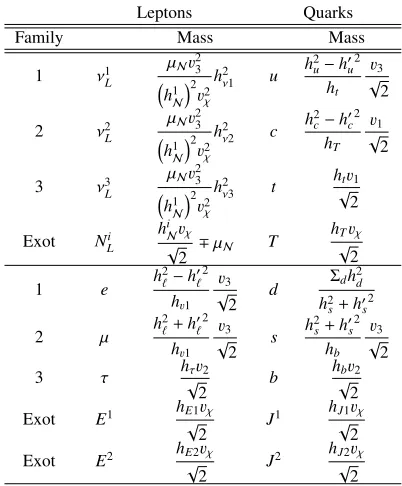
suited Yukawa coupling constants yield mass matrices whose eigenvalues suggest the presence of sup-pression mechanisms which could offer a fermionic spectrum spanning different order of magnitude of mass, from units of MeV to units of TeV. Such mass eigenvalues are outlined in tab. 3.
These eigenvalues are produced by the very structure of the mass matrices where a heavier mass suppress a lighter one. For instance, the subblock involving theuandtquarks is
Mut∝
h11
3uv3 | h133uv3
— — —
h31
1uv1 | h331uv1
,
whose eigenvalues turn out to be (with the assumptionv3/v11 from VH)
m2u=
h11
3uh331u−h133uh311u
2
(h33
1u)2+(h311u)2 v23
2, m2t =
(h331u)2+(h311u)2
v21
2 +
h11
3uh331u+h133uh311u
2
(h33
1u)2+(h311u)2 v23
2.
This result is repeated with thecquark and thee. Thus, the FMH is addressed from the structure of the mass matrices, which is also produced by the nonuniversal interaction U(1)X and the discrete
symmetryZ2. In contrast, thedquark acquires mass through radiative corrections involvingσ,Φ1,2,3 and the exotic quarksJ1,2.
More-over, the model is able to reproduce NO and IO schemes according to current neutrino oscillation data. The squared mass differences and PMNS mixing angles were obtained without fine-tunings.
Acknowledgment
This work was supported by COLCIENCIAS in Colombia.
References
[1] Glashow, S.L., Nucl. Phys.22, 579 (1961); Weinberg, S., Phys. Rev. Lett.19, 1264 (1967); Salam, A., inElementary Particle Theory: Relativistic Groups and Analyticity (Nobel Symposium No. 8), edited by N.Svartholm (Almqvist and Wiksell, Stockholm, 1968), p. 367.
[2] Davis Jr, R., Harmer, D. S., Hoffman, K. C. Phys. Rev. Lett.20, 1205 (1968).
[3] Bian, J. [NOνA Collaboration], ICHEP2016, Chicago, 06 August, 2016; P. Adamson et al. [NOνA Collaboration], Phys. Rev. Lett.116(2016) no.15, 151806.
[4] Gonzalez-Garcia, M. C., Maltoni, M., and Schwetz, T. Nucl. Phys. B908, 199 (2016) [5] Fritzsch, H. Weak-interaction mixing in the six-quark theory. Phys. Lett. B73, 317 (1978). [6] Fritzsch, H., Phys. Lett. B70, 436 (1977); B 73, 317 (1978); Nucl. Phys. B155, 189 (1979);
Fritzsch, H. and Xing, Z. Z., Phys. Lett.555, 63 (2003); Carcamo, A.E., Martinez, R. and Ro-driguez, J.A., Eur. Phys. J. C50, 935 (2007).
[7] Fukugita, M., Tanimoto, M., and Yanagida, T. Progress of Theoretical Physics89, 263 (1993). [8] Martínez, R., Nisperuza, J., Ochoa, F., and Rubio, J. P. Phys. Rev. D89, 056008 (2014) [9] Martinez, R., Nisperuza, J., Ochoa, F., and Rubio, J. P. Phys. Rev. D90, 095004 (2014) [10] Martinez, R., Ochoa, F., JHEP05, 113 (2016).
[11] Martinez, R., Nisperuza, J., Ochoa, F., Rubio, J. P., and Sierra, C. F. Phys. Rev. D92, 035016 (2015)
[12] Mantilla, S. F., Martinez, R., and Ochoa, F. Phys. Rev. D95, 095037 (2017) [13] Mantilla, S. F., and Martinez, R., arXiv:1704.04869 (2017)
[14] Mohapatra, R. N., Phys. Rev. Lett.56, 561 (1986); Mohapatra, R. N., Valle, J. W. F., Phys. Rev. D34, 1642 (1986).