Query Evaluation using Overlapping Views:
Completeness and Efficiency
Gang Gou, Maxim Kormilitsin, Rada Chirkova
Computer Science Department, North Carolina State University
Campus Box 8206, Raleigh, NC 27695-8206
email:
{
ggou,mvkormil,rychirko
}
@ncsu.edu
ABSTRACT
We study the problem of finding efficient equivalent view-based rewritings of relational queries, focusing on query optimization using materialized views under the assump-tion that base relaassump-tions cannot contain duplicate tuples. To enable consideration of such rewritings in a cost-based query optimizer, we develop local conditions under which two views can be combined in an efficient query rewrit-ing, under bag-set and set semantics for query evaluation. For each semantics and for SQL select-project-join queries and views, possibly involving grouping and aggregation, we propose efficient sound and complete algorithms for testing equivalence of a query to a rewriting (the algorithms are complete with respect to the language of rewritings). Our results apply not only to query optimization, but to all areas where the goal is to obtain efficient equivalent view-based query rewritings. Based on these results, for the problem of finding an efficient execution plan for a user query in terms of materialized views we propose sound algorithms that ex-tend the cost-based query-optimization approach of System R [19]. We present a study of the completeness-efficiency tradeoff in the algorithms, and provide experimental results that show the viability of our approach and test the limits of query optimization using overlapping views.
1. INTRODUCTION
We study the problem of finding efficient equivalent rewrit-ings of relational queries using views. The problem has re-ceived significant attention because of its applications in a number of data-management problems [15], such as query optimization [6, 17, 24], maintenance of physical data inde-pendence [22, 23], and data warehousing [14, 21]. Our paper focuses in particular on one application, query optimization in presence of materialized views. Given a user query, the task of a query optimizer is to search the space of all physi-cal query plans for an optimal plan. Besides being correct, the process should be efficient, cost based, and as complete
as possible. Traditional optimizers such as the System-R optimizer [19] search in the space of left-deep join trees of a logical plan for an optimal physical plan, which specifies ex-ecution details such as join ordering and implementation of a join (e.g., hash join or sort-merge join). As shown in [6], a System-R-style query optimizer can be extended to consider logical plans that stem from various rewritings of the query using materialized views; the optimizer of [6] can choose in a cost-based and syntax-independent way between a mate-rialized view and a view expansion. The optimization algo-rithm of [6] produces only valid view-based query rewritings (i.e., issound) for SQL select-project-join (SPJ) queries and views with inequality comparisons and without grouping or aggregation, and produces all such valid rewritings (i.e., is
complete) for SPJ queries and views without inequality com-parisons, under the assumption that both base relations and query answers can have multiple identical tuples — that is, underbag semanticsfor query evaluation [7].
We continue the line of work of [6] by studying query opti-mization using views in a System-R-style optimizer [19], for SPJ queries and views that may involve grouping and aggre-gation. We make an important assumption that base rela-tions cannot contain duplicate tuples. In this setting there may exist efficient equivalent rewritings of a given query using given views such that these rewritings cannot be ob-tained using the approach of [6]. We distinguish between two possible scenarios:
• bag-set semantics for query evaluation [7], where du-plicate tuples are retained in query answers, and • set semantics, where duplicate tuples are eliminated
from query answers.
Note that evaluation under bag-set semantics is essential for aggregate SQL queries involving aggregation functions
SUMor COUNT[1, 8], whereas, for instance, queries with the
DISTINCTkeyword must be evaluated under set semantics.
the goal is to obtain equivalent view-based query rewritings. Consider an example that highlights the novelty and focus of our approach.
Example 1. Consider a star-schema [5] data warehouse with five base relations (key attributes are underlined):
Sales (saleID, custID, prodID, saleMonth, price) Customers (custID, custType, nationID)
Products (prodID, supID) Suppliers (supID, supRegion) Nations (nationID, nationName)
Here, Sales is the fact table, and the remaining tables are dimension tables. We make the following realistic assump-tions about the contents of these relaassump-tions. First, each of the first three relations stores a large number of tuples (e.g., hun-dreds of millions forSales, tens of thousands forCustomers, etc). Second, customers make frequent repeat purchases of the same multiple types of products; as a result, many spe-cific combinations of the values of cust ID, prodID, and
saleMonth occur each in a large number of tuples in the
Sales table. Third, on average Customers stores a large
number of customer IDs per customer type, and Products — a large number of product IDs per supplier. Finally, cus-tomer types are nation specific.1 While our approach is ap-plicable in presence of indexes (cf. [6]), in this example we assume that there are no indexes on the base relations.
Suppose a user is interested in the maximal product price per customer type per product-supplier region per month, start-ing in January 2005; the answer should include information about the customers’ nations. This queryQcan be expressed in SQL as follows:
Q: SELECT custType, supRegion, saleMonth, nationName, MAX(price)
FROM Sales S, Customers C, Products P, Suppliers SP, Nations N
WHERE S.custID = C.custID AND S.prodID = P.prodID AND C.nationID = N.nationID AND P.supID = SP.supID AND saleMonth >= ‘2005-01’
GROUP BY custType, supRegion, saleMonth, nationName;
Suppose the data warehouse maintains materialized aggre-gate viewsVandW. The viewVis defined onSales,
Custom-ers, and Nations and returns maximal product price per
customer type per product ID per month, including informa-tion about the customers’ nainforma-tions. The viewW, defined on
Sales, Products, and Suppliers, returns maximal
prod-uct price per customer ID per prodprod-uct ID per supplier region per month. Under our assumptions on the base data, the size of the relation for each of V andW would be much smaller than the size of theSalesrelation. (Note that the values of
nationName and supRegion are functionally determined by
the values ofcustType andprodID, respectively.)
It is straightforward to find a plan for answering the user queryQexactly (i.e., using an equivalent rewriting) by using either materialized view in combination with the “missing” dimension tables. That is, the viewVcan be combined with tables Products andSuppliers into a rewriting Q(V), and the view W — with tables Customers and Nations into a rewritingQ(W). In fact, some commercial query optimizers, as well as extensions to query optimizers proposed in the
1None of these functional dependencies is needed for the correctness of the rewritings in the example.
literature (see, e.g., [3, 12, 20, 24]) would find both rewrit-ings. Each ofQ(V)andQ(W)would be worth considering in a cost-based query optimizer, as either rewriting would reduce significantly the evaluation costs of Q on data warehouses that satisfy our assumptions.
We now show that we can use the two viewsVandWtogether
to answer the user query Q, and argue that the reduction in the evaluation costs for Q in this case is significant under our assumptions — in particular, it is at least on par with the reduction in costs obtained in each of Q(V) and Q(W). Consider this rewritingRof the queryQusing the two views:
R: SELECT custType, supRegion, V.saleMonth, nationName, MAX(vMaxPrice) FROM V, W
WHERE V.prodID = W.prodID AND V.saleMonth = W.saleMonth AND V.saleMonth >= ‘2005-01’
GROUP BY custType, supRegion, V.saleMonth, nationName;
Here,vMaxPriceis the aggregated attribute of the viewV. It can be shown [1, 8] that R is an equivalent rewriting of the query Q. At the same time, under our assumptions on the base data, Rwould result in a more efficient evaluation ofQ than eitherQ(V)orQ(W), provided that the size ofProducts
(Customers, respectively) is comparable to the size of the
view V(W, respectively). Thus, it would be desirable to con-sider the rewritingRin a cost-based optimizer.
We use this example to make two observations. First, R
would not be an equivalent rewriting of the query Qif the viewWdid not haveprodIDamong its grouping attributes, even though each ofQ(V)andQ(W)would still be an equiv-alent rewriting of Q. This observation leads us to consider
local conditions for combining a pair of views in an equiva-lent rewriting of a given query. Second, if we modify each of
Q,V,W, andRto be aSUM- rather thanMAX-query (we give an extended example in the full version of the paper), the mod-ified rewritingR’will not be an equivalent rewriting of the modified queryQ’, as the unaggregated SPJcoreofRis not equivalent to the core ofQunder bag-set semantics for query evaluation [1, 8]. (The cores of Q and Q’are the same, as are those ofRandR’.) This observation leads us to consider construction of efficient view-based query rewritings sepa-rately under set semantics (for, e.g., MAX- orMIN-queries or for queries with theDISTINCT keyword) and under bag-set semantics [7] (for, e.g.,SUM- orCOUNT-queries).
Our contributions: To enable consideration of all efficient view-based rewritings of a relational query when base rela-tions contain no duplicate tuples, for each of bag-set and set semantics for query evaluation we develop efficient local con-ditions under which two views can be combined in a query rewriting, for SPJ queries and views with or without aggre-gation. For each of bag-set and set semantics we propose an efficient sound and complete algorithm for testing equiv-alence of queries and rewritings; the algorithm for the set-semantics case builds on results of [2, 18]. (Our algorithms are complete with respect to the language of rewritings — SPJ rewritings for SPJ queries, and central rewritings [1] for queries with aggregation.) Areas where our algorithms are applicable include query optimization, maintenance of physical data independence, and data warehousing.
for user queries using indexes and materialized views; queries and views may have grouping and aggregation. Our ap-proach is a relatively simple generalization of the cost-based query-optimization algorithm of [6], which works in an ex-panded search space of rewritings. While exploring strictly more rewritings than the approach of [6], in general our al-gorithms for bag-set and set semantics are incomplete; we present a theoretical study of the completeness-efficiency tradeoff and describe enhancements that would make the algorithms complete. Finally, we provide experimental re-sults that show good efficiency and scalability of one of our algorithms for bag-set and set semantics and test the limits of query optimization using overlapping views.
We start by giving the background and our problem state-ment in Section 2. We use Datalog for concise notation, but all our results hold for SPJ queries, views, and rewritings with equality comparisons and possibly with theDISTINCT
keyword or with aggregationSUM, COUNT,MAX, orMIN. Sec-tions 3 and 4 introduce (1) our efficient local condiSec-tions un-der which two views can be combined in a rewriting, and (2) our equivalence-testing algorithms. We describe our op-timization algorithms in Section 5, and present experimen-tal results in Section 6. Section 7 discusses related work; we conclude in Section 8. Due to space constraints, we are unable to provide full proofs of our theoretical results in this paper; we provide intuition for the results wherever possible.
2. PRELIMINARIES
In this section we review bag, bag-set, and set semantics for query evaluation, discuss some concepts in answering queries using views, give a formal statement of the problem consid-ered in this paper, and discuss some relevant past work.
2.1 Equivalent rewritings and views
We consider SQL SPJ queries with equality comparisons, a.k.a. safeconjunctive queries(CQs), possibly with group-ing and aggregation, posed on stored (base) relations in a relational database. A relation can be either a set or abag;
a bag can be thought of as a set of elements with multiplici-ties attached to each element. A database isset-valuedif all its base relations are sets, and isbag-valuedotherwise.
Two CQ queriesQ1andQ2areset-equivalent ( bag-set-equiv-alent, bag-equivalent, respectively), denoted by Q1 ≡s Q2 (Q1 ≡bs Q2, Q1 ≡b Q2, respectively), if they produce the same set (or bag, respectively) of answers on every database (every set-valued database for the first two cases, every bag-valued database for the third case). Chandra and Merlin [4] show that under set semantics, a CQQ1 is contained in a CQQ2,Q1sQ2, if and only if there exists acontainment mapping,which maps the head and all the subgoals of Q2 toQ1; the mapping maps each variable to a single variable or constant, and each constant to the same constant. Q1 and Q2 are equivalent under set semantics if and only if
Q1 s Q2 and Q2 s Q1. For bag and bag-set semantics, the following conditions hold for CQ query equivalence [7]:
Theorem 1. LetQ1 andQ2 be conjunctive queries. (1) Q1 and Q2 are equivalent under bag semantics if and only
ifQ1 andQ2 are isomorphic. (2)Q1 andQ2 are equivalent underbag-setsemantics if and only ifQ1 andQ2are equiv-alent underbagsemantics, where Q1 andQ2 are canonical
representations ofQ1 andQ2 respectively.2
Aviewrefers to a named query. A viewV is said to be ma-terializedin a databaseDif its answerV(D) is stored in the database;D{V1,...,Vn}is a databaseD with added relations for the viewsV1, . . . , Vn. A rewriting Rof a query Qon a set of viewsVis anequivalent rewritingunder set semantics if for every set-valued database D,R(DV) =Q(D), that is,
R(DV) andQ(D) are the same as sets. The definitions for the bag-set and bag semantics are analogous. In the rest of the paper, unless otherwise noted, the term “rewriting” means an “equivalent rewriting” of a query using views, un-der the semantics specified either explicitly or by the con-text. We also assume that the definitions of queries and views under consideration are minimized [4].
For a rewritingR of a query Qusing views, we obtain the
expansionRexpofRby replacing all view atoms in the body of R by their definitions in terms of base relations. We now give necessary and sufficient conditions for CQ query-rewriting equivalence under each of the three semantics:
Theorem 2. For a CQ query Qand a set of CQ views
V, letRbe a CQ rewriting ofQusingV. Then (1)Q≡sR iffRexp≡sQon all set-valued databasesD; (2)Q≡bRiff
Rexp≡
bQon all bag-valued databasesD; and (3)Q≡bsR
iffRexp≡bQon all set-valued databasesD.
We consider CQ queries and views with or without aggre-gation, and assume that all aggregate queries and views are unnested and use aggregation functionsCOUNT,SUM,MAX, or
MIN. We denote such queries and views CQA; CQ(A) stands for CQ queries that may or may not involve aggregation. We consider only central rewritings [1] of CQA queries. In-tuitively, these are rewritings where the unaggregated core
is a CQ query, and only one view contributes to computing the aggregated query output. For instance, rewriting Rin Example 1 is a central rewriting of the queryQ. Equivalence tests for a CQA query Qand a central rewritingR are [1, 8] by reduction to (1) bag-set equivalence of the unaggre-gated cores ofQandRexpforSUMandCOUNTqueries, and to (2)setequivalence of the cores forMAXandMINqueries. In our analysis, we chose central rewritings for their simplicity — compare these with rewritings in [8] where, in general, the aggregate term in the rewriting is a product of aggre-gate terms from all constituent views. However, as there is a natural relationship between some classes of rewritings in [8] and in [1], our results also apply to rewritings of [8].
We now show that given a CQ query and a set of CQ views, in general the search space of all equivalent rewritings of the query using the views depends on whether the base relations or query answer may contain duplicate tuples.
Example 2. Consider a database D with three base re-lations, P(A, B),S(B, C, F), and T(F, G).Let a CQ query Qbe a natural join ofP, S, T that returns the values of all attributes ofP andT.Let the database include three mate-rialized views, U, V, andW;each view is a natural join of two of the base relations. For instance,U is a join ofP and S that returns the values of attributesA, B,andF.Here are the definitions of the query and views in Datalog:
q(X1, X2, X3, X4) ←p(X1, X2), s(X2, X5, X3), t(X3, X4).
u(Y1, Y2, Y3) ←p(Y1, Y2), s(Y2, Z, Y3).
v(Y1, Y2, Y3, Y4) ←p(Y1, Y2), s(Y2, Y4, Y3).
w(Y2, Y3, Y4, Y5) ←s(Y2, Y4, Y3), t(Y3, Y5).
We can rewrite the queryQas a queryR1 that joins the view U with the base relation T;R1 is an equivalent rewriting of Qunder bag semantics. In addition,R1≡Qunder bag-set and set semantics, because each semantics is a restriction on the bag-semantics setting. Under bag-set semantics, in addition toR1, Qhas another rewritingR2— a natural join of viewsV andW;R2≡Qunder bag-set but not under bag semantics. (R2 is also equivalent toQunder set semantics, because it is a restriction on the bag-set-semantics setting.) Finally, under set semanticsQhas an additional rewriting R3, which is a natural join of views U and W. R3 is not equivalent toQunder bag or bag-set semantics.
In the full version of the paper we spell out assumptions on the base relations and indexes in the databaseD,under which (1) evaluatingR1is cheaper than evaluatingQwithout views, (2) under bag-set semantics, evaluatingR2 is cheaper than evaluatingR1,and (3) under set semantics, evaluating R3 is cheaper than evaluating eitherR1 orR2.
Given that bag-set semantics is a restriction on bag seman-tics, to find an optimal view-based rewriting of a given query under bag-set semantics we need to consider at least all the equivalent rewritings for the bag-semantics case. A similar relationship holds between bag-set and set semantics. At the same time, as shown in Example 2, given a CQ query and a set of CQ views, the search space of equivalent rewrit-ings of the query that use the views can be strictly larger (1) under bag-set semantics than under bag semantics, and (2) under set semantics than under bag-set semantics.
2.2 Our problem statement
We now introduce feasible, efficient, and optimal rewritings, give a formal statement of our problem, and discuss our assumptions. For a fixed database schemaS and given a CQ(A) queryQonS and a set of CQ(A) viewsV defined onS, a CQ(A) queryRis afeasible rewriting ofQfor set, bag-set, or bag semanticsX if (1)R is defined in terms of V, and (2) R is equivalent to Q under the semantics X,
R≡X Q. Efficient rewritings are defined as follows: Given a databaseD with schemaS, a CQ(A) queryQonD, and a set of CQ(A) viewsVdefined onS, a CQ(A) queryR is anefficient rewriting ofQfor set, bag-set, or bag semantics
Xand given a cost modelM, if (1)Ris a feasible rewriting ofQ, and (2) the cost of evaluatingRonD using the cost model M, CM(R, D), is lower than the cost CM(Q, D) of evaluating the queryQin its original formulation. A feasible rewriting R is optimal if CM(R, D) is minimal among all
CM(R, D) whereR is a feasible rewriting of Qfor V, X. The costCM(F, D) of evaluating a queryQon database D using some formulationFofQ(e.g., a rewriting using views) is the cost of computing the answer toQusing a lowest-cost query plan forF onD, for a fixed cost modelM.
Our problem statement is as follows: Produce an optimal CQ(A) rewriting of a minimized [4] CQ(A) queryQ on a databaseD using minimized CQ(A) views V, for set, bag-set, or bag semanticsX and given a cost modelM.
All theoretical results in this paper hold under monotonic cost models [2]. Intuitively, a cost model is monotonic if replacing a relation by a smaller relation in — or removing a redundant subgoal from — a query plan never results in higher execution costs; many cost models proposed for and used in query optimization are monotonic.
Our results in this paper hold under the following additional assumptions. We consider CQ(A) queries, views, and rewrit-ings of the form described in Section 2.1. Further, we allow rewritings that use base relations alongside views (see, e.g., rewritingsQ(V)andQ(W)in Example 1 and rewritingR1in Example 2). As the database schema is not part of our prob-lem input, in proving our complexity results we assume that the number of attributes in each base relation is a constant. For the cases of bag-set and set semantics, we assume that each rewritingRthat is equivalent to a given queryQ con-tains no filtering views [2, 17, 18], that is, does not contain views whose removal does not result in loss of equivalence of
RtoQ. Finally, we assume that a query optimizer considers only left-deep join trees for query plans [6, 11, 19].
2.3 View tuples and ef
fi
cient rewritings
In this paper we use the results of [2] on restricting the search space of efficient rewritings under set semantics. We first give the definition of a view tuple [2, 17]. Given a query
Q, a canonical database DQ of Q is obtained by turning each subgoal into a tuple by replacing each variable in the body ofQby a distinct constant, and treating the resulting subgoals as the only tuples inDQ. LetV(DQ) be the result of applying the view definitionsVonDQ. For each tuple in V(DQ), we restore each new constant back to the original variable of Q, and obtain a view tuple of each view with respect to the query. By definition, each variable in each view tuple of Qoccurs in the definition of Q. LetT(DQ) denote the set of all view tuples after the replacement.
LEMMA 3.2 of [2]. Under set semantics for any equivalent CQ rewritingR:r( ¯X)←p1( ¯Y1), . . . , pk( ¯Yk)of a CQ query Q using CQ views V, there is a CQ rewriting R ≡s Q, such that R is in the formr( ¯X)←p1( ¯Y1), . . . , pk( ¯Yk).In addition, eachpi( ¯Yi)is a view tuple inT(DQ), andRR.
[2] gives examples, for the set-semantics case, of equivalent rewritings whose subgoals are not view tuples.
Theorem 3. Given a databaseD, a CQ(A) queryQ, and a set of CQ(A) viewsV, under set, bag-set, or bag semantics X and using a monotonic cost modelM,consider the setR of all feasible CQ(A) rewritingsR of Qin terms of V. Let
Ropt ⊆ Rbe the set of optimal CQ(A) rewritings ofQ on D using the cost modelM. Then for at least one rewriting Ropt∈ Ropt,each subgoal ofRoptis a view tuple inT(DQ).
the remainder of the paper we consider only rewritings that consist entirely of view tuples (in a broader sense than that of [2], i.e., we also consider view tuples for base relations), for a given query, views, and base relations.
2.4 Some additional terminology
We now describe some terminology that we will need to present our approach. First, we extend the notion of tuple core of [2] by defining “tuple coverage.” Intuitively, given a query and a view tuple, a tuple coverage of the view tuple is some set of query subgoals that can be “covered” by the view tuple in some rewriting of the query. Formally, given a CQ queryQ, a CQ rewriting R≡s Q, and a CQ viewV inR, lettV ∈ T(DQ) beV’s view tuple forQ. Then atuple coverages(tV, Q) oftV is a nonempty set Gof subgoals of
Q, such that (1)Gis isomorphic to some set of subgoals in the expansiontexpV oftV, and (2) each variableY ofGis a head variable oftV whenever either Y is a head variable of the queryQorY is used in a subgoalpi( ¯Yi) ofQsuch that
pi( ¯Yi) is not inG. [2] introduced the notion of tuple core smax(tV, Q) of a view tupletV for queryQ: smax(tV, Q) is
a tuple coverage that uses a maximal setGof subgoals of
Q. A tuple core is unique for a given pair (Q, tV) [2].
The notions of tuple core and tuple coverage extend nat-urally to CQA queries and views, provided that central rewritings [1] are used. We will see in Section 4 how our approach decides on whether it is possible to combine two view tuplestV andtWin a rewriting that is equivalent to the given queryQunder set semantics; the idea of the approach is to examine tuple coverages s(tV, Q) of tV and s(tW, Q) oftW, where s(tV, Q) ands(tW, Q) are not necessarily full tuple cores of the respective view tuples. At the same time, under bag-set and bag semantics the only tuple coverages that matter in equivalent rewritings are full tuple cores.
We now restate the bag-semantics part of Theorem 2 using the notion of tuple core, and extend the theorem to aggre-gate queries, views, and rewritings under bag semantics:
Proposition 1. Given a CQ(A) query Q on database with schema S, and given a CQ(A) rewriting R in terms of CQ(A) viewsV1, . . . , Vm defined onS. Lets1, . . . , smbe the tuple cores of all the view tuples in the rewritingR. Then Qand R are equivalent under bag semantics if and only if (1) all thesi’s are pairwise disjoint, and (2) the union of all thesi’s is the set of all subgoals of the queryQ.
2.5 Query optimization under bag semantics
The cost-based query-optimization algorithm of [19] uses dy-namic programming to find optimal query plans. The ap-proach of [6] (we call it “the CKPS apap-proach”) extends the algorithm of [19] by including view-based query plans into the search space of the optimizer. The CKPS approach uses a preprocessing stage, which determines for each view or base relationV whetherV is usable in answering the query and, if so, which subgoals of the queryV “covers.” That is, for each view (or base relation)V which is usable for the query, the preprocessing stage returns all view tupleshj of
V and the respectivenonemptytuple coresDj. The output of this stage is a mapping table calledMapTable. The main stage of the CKPS approach is given as Algorithm 1. Intu-itively, the algorithm considers each set of query subgoals as
a subproblem (we call it “cell”) in dynamic programming; while the algorithm of [19] finds for each cell an optimal plan in terms of base relations only, the CKPS algorithm also checks whether each cell is “exactly covered” by (i.e., whether each cell is the tuple core of) any view tuple re-turned by the preprocessing stage and, if so, estimates the cost of evaluating the cell using each relevant view tuple. Then the algorithm chooses for the cell one optimal plan from all available (including view-based) plans.
Algorithm 1: Query-optimization algorithm CKPS of [6]
Input : queryQ, tableMapT able, cost modelM
Output: optimal execution plan forQw.r.t. M
begin
foreach cellDiof P lanT ablein increasing size do foreach(Dj, hj)in MapTable do
if cellsDi andDj are disjointthen
AddPlan(Di∪Dj, P =P lanT able[Di] hj)
//setP as plan for cellDi∪Dj
//if cost(P) is the best so far for that cell
return the plan for the cell for all subgoals ofQ
end
Note that the CKPS algorithm considers only those query rewritings whose all possible pairs of view tuples have non-overlapping tuple cores. (In Example 2 the algorithm would produce the rewriting R1 but notR2 or R3.) It is shown in [6] that the CKPS algorithm is sound and complete for CQ queries and views under bag semantics. We use the CKPS approach as the basis of our query-optimization al-gorithms, see Section 5.
3. REWRITINGS: BAG-SET SEMANTICS
In this section and in Section 4 we characterize equivalence of queries and rewritings using tuple coverages. Under bag-set semantics we need only tuple cores for the characteriza-tion, whereas under set semantics (Section 4) tuple cover-ages that are not tuple cores play a very important role.
Recall rewritingsR1,R2 in Example 2; unlikeR1, the tuple cores of two view tuples in R2 overlap on subgoals of the queryQ, and each ofR1andR2is bag-set equivalent toQ. The following theorem gives conditions for possible overlaps of CQ views in such equivalent rewritings:
Theorem 4. Given a CQ(A) query Q and two CQ(A) views V and W,with view tuples tV and tW, respectively, such that the tuple cores oftV and oftW inQhave in com-mon a nonempty set Gof subgoals of Q. Then tV andtW can be combined in an equivalent rewriting ofQunder bag-set semantics if and only if all the variables in Gare head variables of both view tuples tV andtW.
(Recall that under bag semantics, tuple cores of two view tuples in an equivalent rewriting cannot have a nonempty overlap.) This result follows from Theorem 1; an extension to the CQA case is not hard due to use of central rewritings.
under bag-set semantics; we give a complexity proof in the full version of the paper. For instance, in Example 2 rewrit-ing R2 is equivalent to queryQ because all the attributes of the subgoalsof Qare head attributes of both views,V and W,in R2. This condition is not satisfied in rewriting
R3, which is not equivalent toQunder bag-set semantics.
4. REWRITINGS: SET SEMANTICS
We now characterize set-equivalence of CQ(A) queries and rewritings. We start with a motivating example.
Example 3. Consider a CQ queryQand three CQ views:
q(X1, X5) ←p1(X1, X2), p2(X2, X3), p3(X3, X4, X5).
v1(Y1, Y3) ←p1(Y1, Z1), p2(Z1, Y3).
v2(Y2, Y5) ←p2(Y2, Z2), p3(Z2, Z3, Y5).
v3(Y2, Y3, Y5) ←p2(Y2, Y3), p3(Y3, Z4, Y5).
The definition of each view has the subgoalp2 of the query Q; the only difference between V2 and V3 is an extra head variable inV3. We look for efficient rewritings of Q using only these views (i.e., no base relations) under set seman-tics. AsV1(X1, X3),V2(X2, X5), andV3(X2, X3, X5)are all the view tuples of the three views for the queryQ, any such rewriting would use these view tuples and nothing else. Us-ing containment mappUs-ings [4] we can show that a productR1 of V1(X1, X3) with V2(X2, X5) is not an equivalent rewrit-ing of the queryQ, even though the union of the tuple cores of the view tuples forV1 andV2 is the set of all subgoals of Q. At the same time, a natural joinR2 of V1(X1, X3)with V3(X2, X3, X5)is equivalent to the queryQ.
We proceed to define a local condition for checking whether two view tuples can be combined in a rewriting that is equiv-alent to the given query under set semantics. This local con-dition will help us disqualify combinations such asV1 with
V2in Example 3, and will help us pursue combinations such asV1 withV3 in the same example.
4.1 Containment: partition condition
In this subsection we formulate a necessary and sufficient
partition conditionfor combining two view tuples in a rewrit-ing of a CQ(A) query usrewrit-ing CQ(A) views under set seman-tics; this condition gives us a procedure for constructing efficient equivalent rewritings of queries using views.
Intuitively, a queryQis equivalent to a rewritingR if and only if there is a partition of the set of subgoals of Qinto subsets, such that each subset Gi is “covered” by a view tuple for viewViinR. We now state this result formally, as Theorems 5 (extended from [2] to the CQA case) and 6.
Theorem 5. Given a CQ(A) queryQon a database with schemaSand a set of CQ(A) viewsV1, . . . , Vndefined onS, with view tuplestV1, . . . , tVn, respectively. Then a rewriting Rusing tV1, . . . , tVn containsQunder set semantics,Qs
R, if and only if the union of the tuple cores oftV1, . . . , tVn
is the set of all subgoals of the queryQ.
Theorem 6. Given a CQ(A) queryQon a database with schemaSand a CQ(A) rewritingRin terms of CQ(A) views V1, . . . , Vn defined on S, with view tuples tV1, . . . , tVn,
re-spectively. Let R set-contain Q, Q s R. Then R s Q
(and thereforeR≡sQ) if and only if the set {tVj} of view
tuples in R has a subset {t∗Vi}, i ∈ {1, . . . , m}, with tuple coveragess(t∗Vi, Q), such that the followingpartition condi-tionholds: (1)s(t∗Vk, Q)Ts(t∗Vl, Q)is an empty set for each k, l ∈ {1, . . . , m} (k = l), and (2) Sim=1s(t∗Vi, Q) = GQ, whereGQis the set of subgoals of the queryQ.
We illustrate this result using Example 3. It is easy to see that each ofR1andR2contains the queryQ. The rewriting
R2=tV11tV3is contained in the queryQbecause the tuple coverages s(tV1, Q) ={p1, p2}and s(tV3, Q) ={p3} of the two view tuples partition the set{p1, p2, p3}of all subgoals of Q. At the same time, for the rewritingR1 =tV1 1 tV2 in Example 3, the partition condition does not hold for any combination of tuple coverages of the view tuplesV1andV2. As a result,R1 isnotcontained in the queryQ. Intuitively, we cannot find a containment mapping fromQtoRexp1 ,such that the mapping could map the attributes of Q’s subgoal
p2(X2, X3) consistently intoRexp1 .
4.2 Ef
fi
cient algorithm for partition checking
In this subsection we study the complexity of checking the partition condition of Theorem 6. Consider a CQ queryQ and a CQ rewriting R that contains Q, such that R com-prises two view tuplestV andtW. Let the union of the tuple cores oftV andtW be the set of subgoals ofQ; thus,QsR. DoesQalso containR? Suppose the intersectionSI of the tuple cores of tV and tW has “nearly all” subgoals of Q. Not surprisingly, if we try to check the partition condition of Theorem 6 by exploring subsets of subgoals ofQin this “overlap area” SI, we can use an adversarial argument to show that the complexity of the checking can be exponential in the number of subgoals ofQand of the two views.
We now present a polynomial-time algorithm E-MCD-Rewr-iting for checking the partition condition of Theorem 6 un-der set semantics, for CQ(A) queries, views, and rewritings. The algorithm has been inspired by MiniCon Descriptions (MCDs), developed in [18] in the context of computing max-imally contained rewritings. We adapt MCDs to our context of equivalent rewritings, by defining anE-MCDfor a given view tuple tV of a CQ(A) viewV on CQ(A) queryQas a
minimaltuple coverage of tV. That is, an E-MCD is any tuple coverage s(tV, Q) of tV on Q, such that no proper subset of subgoals ofs(tV, Q) is also a tuple coverage oftV
on Q. (In Example 3, {p2, p3} is the only E-MCD of tV2, whereastV3 has two E-MCDs,{p2}and{p3}.) It is easy to see that, given a CQ(A) queryQand a view tupletV for a CQ(A) view V,the set of all E-MCDs oftV onQprovides a partition of the tuple core of tV on Q. There exists a quadratic-time procedure for finding all E-MCDs of a view tuple for a query. (Quadratic is also an upper bound on the cost of finding the tuple core of a view tuple for a query.)
SU,and (b) the intersectionSI of the tuple cores oft V and
tW is not an empty set. We require additionally that neither view tuple be redundant in the rewriting. That is, the tuple core of each oftV andtW includes at least one subgoal in
SU−SI. Given such an inputI, E-MCD-Partition returns
trueif there is a partitionP of some E-MCDs oftV andtW, such thatP “covers” exactly the setSU.
Algorithm 2: Procedure E-MCD-Partition
begin SV
1 ←tV’s E-MCDs “crossing border” (SI,SU−SI)
SW
1 ←smax(tW, Q);i←2;if SV1 =φthen
returntrue; //one partition usestW’s tuple core
whiletrue do SW
i ←all subgoals inSWi−1 covered by those E-MCDs intW that do not overlap withSVi−1;
if SiW misses some subgoal of smax(tW, Q)−SI
then
returnfalse; //no partition exists
SV
i ←alltV’s E-MCDs that coverSI−SiW;
if SiV =SiV−1 then
returntrue; //one partition uses all E-MCDs
//oftW that coverSiW
i←i+ 1;
end
We give a pseudocode for E-MCD-Partition as Algorithm 2. In each iterationithe algorithm maintains a partial setSiV of E-MCDs intV that must be in each partition P; S1V is initialized to the set{s}of E-MCDs intV where eachs cov-ers subgoals in bothSI andSU−SI, that is, “crosses the border” between the two sets. (If S1V is empty, E-MCD-Partition returns true, because a partition P exists that has all E-MCDs oftW.) S1W is initialized to the tuple core
smax(tW, Q) oftW. Each setSiW contains all subgoals ofSU that are covered by those E-MCDs intW that do not overlap withSiV. If no partitionP exists, thenSWi for someimust miss at least one subgoalsin the tuple core oftW, such that
sisnotin the “overlap area”SI; the algorithm returnsfalse
when it first discovers any such subgoals. Whenever at least one partitionP exists, SVi for some iis the same asSVi−1; the algorithm returnstrueonceSiV =SVi−1. OtherwiseSiV grows in each iteration, by all E-MCDs oftV that cover the subgoals ofSI that are neither inSWi nor inSVi−1.
Our algorithm E-MCD-Rewriting is an easy generalization of E-MCD-Partition to an arbitrary number of views in the problem input. We have the following correctness result:
Theorem 7. Algorithm E-MCD-Rewriting is sound and complete for CQ(A) queries, views, and rewritings.
In the full version of the paper we prove that the complexity of E-MCD-Partition is quadratic in the number n of sub-goals of the query and views in the inputI, and thus the complexity of E-MCD-Rewriting isO(n3) for locally mini-mal[17] rewritings, that is, for rewritings that never contain more thannview tuples.
5. COST-BASED QUERY OPTIMIZERS
FOR BAG-SET AND SET SEMANTICS
When looking for an efficient view-based execution plan for a given CQ query, the dynamic-programming optimization
algorithm CKPS of [6] (Section 2.5) considers all combina-tions of view tuples with each other and with base rela-tions, such that the respective tuple cores “do not overlap” — that is, all pairwise intersections of the tuple cores are empty; see, for instance, rewriting R1 in Example 2. To be able to produce additional view-based query plans un-der bag-set and set semantics, such as rewritingsR2andR3 in Example 2, we look for simple efficient local conditions on combining, in a partial rewriting, view tuples whose tu-ple cores do overlap. For the set-semantics case we present efficient local conditions for special cases, as the “overlap test” for the general case could lead the algorithm to revisit some dynamic-programming (DP) subproblems once it has visited unrelated DP subproblems, which would defeat the purpose of dynamic programming. Section 6 reports our experimental validation of the results of this section.
5.1 Basic DP algorithm BDPV
Our basic DP algorithm with views (BDPV) is the CKPS algorithm of [6] enhanced by processing view tuples with overlapping tuple cores. The preprocessing step of BDPV is exactly the same as that of CKPS; the pseudocode for the main stage of BDPV is shown as Algorithm 3. Just like the main stage of the CKPS algorithm, BDPV consid-ers each set of query subgoals as a subproblem, or “cell,” in dynamic programming, and checks whether each cell is “ex-actly covered” by (i.e., whether each cell is the tuple core of) any view tuple returned by the preprocessing stage. Then BDPV chooses for each cell one optimal plan from all the available — including view-based — plans.
Algorithm 3: Query-optimization algorithm BDPV
Input : queryQ, tableMapT able, cost modelM
Output: optimal execution plan forQw.r.t. M
begin
foreach cellDiof P lanT ablein increasing size do foreach(Dj, hj)in MapTable do
if cellsDi andDj are disjointthen
AddPlan(Di∪Dj, P =P lanT able[Di] hj)
//setP as plan for cellDi∪Dj
//if cost(P) is the best so far for that cell
else
if GoodNontrivialOverlap(P lanT able[Di], Dj) == truethen
AddPlan(Di∪Dj, P lanT able[Di] hj)
return the plan for the cell for all subgoals ofQ
end
The only difference between CKPS and BDPV is the Good
NontrivialOverlap segment in Algorithm 3. Intuitively, at
each DP cell we try to ensure that the partial rewriting we are building is contained in some part of the queryQ. In
the GoodNontrivialOverlap segment, after deciding on an
optimal planPi =P lanT able(Di) for a cell Di of a query
Q, BDPV additionally checks whether the set SDi of base
relations and views in the planPi4 can be combined with each view tupletV whose tuple coresmax(tV, Q) “nontriv-ially overlaps” with the set of query subgoals Di. Then, for each view tupletV that can be successfully combined with a
4S
cell planPi(with tuple coreDi), BDPV adds the resulting combination to the set of candidate plans for the DP cell whose set of query subgoals is exactly the union of the tu-ple cores oftV and Pi. For instance, in Example 2 BDPV would send to the cell for all subgoals of the queryQ (1) a combination of view tuples for V and W (i.e., rewriting
R2) under bag-set semantics, and (2) two combinations of view tuples under set semantics, (U, W) and (V, W), where (U, W) — that is, the rewritingR3 — could be chosen as the more efficient plan forQ.
We now give an outline of this additional processing in BDPV, by first defining the nontrivial-overlap condition and then describing the combination test, that is, necessary and sufficient conditions for combining view tuples with partial query plans. We say that two sets s1 and s2 of subgoals of queryQnontrivially overlapif (1) the intersection of s1 and s2 is nonempty, as is (2) each of the sets s1−s2 and
s2−s1. Intuitively, condition (1) provides the “overlap,” whereas condition (2) ensures that each ofs1 and s2 con-tributes to the combination some query subgoals that the other set does not. (Recall that our cost model discourages rewritings with redundant base-relation or view subgoals.)
We now describe the combination test that BDPV does. Consider a DP cellDi and the combinationSDi of base re-lations and views in an optimal planPiforDi; supposetV is a view tuple whose tuple coresmax(tV, Q) nontrivially over-laps with the set of query subgoals inDi. The view tuple
tV can be combinedwith the planPiif anequivalent-overlap conditionholds. The equivalent-overlap condition is not the same for bag-set and set semantics, as the equivalence con-ditions between a query and rewriting are different in these two cases. Either equivalent-overlap condition we give here ensures generation of equivalent view-based rewritings of a given query under the respective semantics, as the condi-tions are based on Theorem 4 in Section 3 (for bag-set se-mantics) and on Theorem 6 in Section 4 (for set sese-mantics). We will see shortly that using the DP-algorithm template re-sults in loss of completeness, and will discuss in Section 5.2 what should be done to restore completeness in the context of a cost-based query-optimization approach of [19].
Under bag-set semantics, view tuple tV and optimal plan
Pi for DP cell Di can be combined if for each subgoals in
the intersection of the tuple coresmax(tV, Q) oftV with the expansion of the set SDi of subgoals ofPi, it holds thats
does not have nonhead variables in eithertV orSDi. Under set semantics,tV and Pican in general be combined if the partition condition of Theorem 6 (Section 4) holds for the union of some tuple coverages(tV, Q) oftV with some tuple coverage ofPi. In our BDPV algorithm under set semantics we use efficient equivalent-overlap conditions for the special cases of chain and star queries. The following example illus-trates the reasons for this restriction.
Example 4. We look for equivalent CQ rewritings of a CQ queryQin terms of CQ viewsV, W,andU:
q(X, Y, U) ←p1(X, Y), p2(Y, Z), p3(Z, S), p4(S, T), p5(T, U).
v(A, B, D) ←p1(A, B), p2(B, H), p3(H, D).
w(C, F, G) ←p3(C, J), p4(J, F), p5(F, G).
u(B, F) ←p2(B, C), p3(C, D), p4(D, F).
Let the view tupletV for viewV be an optimal planP123for the DP cellD123 ={p1, p2, p3}; we now combineP123 with
the view tupletW for viewW.Mapping the queryQinto the cross product tV ×tW [4] shows us that tV ×tW has two
tuple cores, S1 ={p1, p2, p3, p5} and S2 = {p1, p3, p4, p5}. Moreover, S2 isnot a superset of the DP cellD123. At the same time, the combination oftV withtW should be consid-ered when looking for equivalent rewritings of the query Q, as(tV ×tW)1tU is a set-equivalent rewriting ofQ.
As shown in Example 4, the first complication of dynamic-programming query optimization under set semantics is that, unlike the bag-set-semantics case, an optimization algorithm may produce in a DP cellDitwo or more partial query plans
P1
i, . . . , Pikfor other DP cells, where eachPijis a
combina-tion of an optimal planPi forDiwith some view tupletVj,
andnot all the combinationsPijuse the same tuple coverage of Pi. (In Example 4, we use tuple coverage{p1, p2, p3}of plan P123 to obtain a combination (P123, tW) whose tuple core isS1, and use tuple coverage{p1}ofP123 to obtain a combination (P123, tW) whose tuple core isS2.) While this problem could be solved by considering all tuple coverages of
Piwhen producing partial plansPij, the second point
illus-trated by Example 4 is that a combination of two view tuples might have to be sent from a DP cellDi (cellD123 in Ex-ample 4) to another DP cellDj(cellS2 in Example 4) that may miss some subgoals of Di — which would defeat the purpose of dynamic programming. While this behavior can also be demonstrated for queries whose shape is not chain or star, in developing our equivalent-overlap conditions we suc-ceeded in ruling out this undesirable flow behavior for BDPV for chain and star queries. For the set-semantics case we re-quire that BDPV do not consider cross products of partial plansPi (for DP cellsDi) with view tuples that satisfy the nontrivial-overlap condition. This choice has been made in other query-optimization approaches as well (e.g., [19]); note that this no-cross-products requirement is satisfied naturally in BDPV in the bag-set semantics case.
For the special cases of CQ chain and star queries under set semantics, BDPV uses the following necessary and sufficient equivalent-overlap conditions:
• for chain queries, a view tuple and a partial query plan must have a query (i.e., head) variable in com-mon; note that this requirement is exactly the no-cross-products assumption;
• for star queries, we distinguish thehub variableof the query, which is the “center of the star”; if a view tu-pletV and a partial query planP overlap on a query subgoal that has the hub variable, we require that the hub variable be the head variable of bothtV andP.
The following result holds by construction of BDPV:
Theorem 8. The cost-based DP algorithm BDPV is sound (1) for all CQ queries, views, and rewritings under bag-set semantics, and (2) for chain or star CQ queries, views, and rewritings under set semantics.
that for each dynamic-programming cell BDPV additionally considers overlaps of its optimal plan with at mostlviews.
5.2 Complete algorithm CDPV
In this subsection we justify the need for and give a descrip-tion of our complete cost-based algorithm with views. It has been shown [6] that the CKPS algorithm is complete for CQ queries and views under bag semantics; in Proposition 1 we extended this result to aggregate queries and views under bag semantics. In contrast, while our algorithm BDPV is sound under bag-set or set semantics (Theorem 8), it is in general incomplete for CQ(A) queries and views. This result is not suprising, because it is possible for a query to have an optimal equivalent rewriting that uses views, such that for some cells in DP search, partial plans for this particular rewriting are not the most efficient plans for the cells. In the full version of this paper we (1) give examples that prove incompleteness of BDPV for CQ queries and views for each of bag-set and set semantics, and (2) show completeness of BDPV for the following special cases:
• all variables in all applicable views are head variables, under bag-set or set semantics;
• for each pair of view tuples applicable to a query, ei-ther the two view tuples have no query subgoals in common, or in all the common subgoals all the vari-ables in both view tuples are head varivari-ables, under bag-set semantics;
• each pair of views has the same head variables on each base relation they have in common, under set seman-tics (e.g., in Example 2 views V and W satisfy this condition, while viewU violates it on base relationS).
For combinations of CQ queries and views that do not satisfy the above requirements, we can augment BDPV to make it complete, by trying at each DP cell to combine with overlap-ping viewsallpossible partial plans for the cell, rather than just one optimal partial plan; in this sense, these partial plans can be compared to “interesting orders” in [19]. All successful combinations are then “sent up” to the relevant cells for consideration. We call this complete cost-based al-gorithm with views CDPV. Note that while it uses BDPV’s DP search structure, CDPV isnota DP algorithm.
Theorem 9. The cost-based algorithm CDPV is sound and complete (1) for all CQ queries, views, and rewrit-ings under bag-set semantics, and (2) for chain or star CQ queries, views, and rewritings under set semantics.
While having a complete algorithm for these cases may sound like good news, there are two problems: First, CDPV breaks the flow of dynamic programming by potentially using two or more partial query plans for some DP cells. Second, the complexity of CDPV isO(r×l×2n), whereris the number of equivalent rewritings of the query (rmay be exponential in the number of applicable views), and O(l×2n) is the complexity of BDPV. This complexity makes CDPV im-practical in general. At the same time, using the complete algorithm CDPV might be time efficient either for queries with just a small number of subgoals, or for precompilation of time-critical queries, when it is important to find an opti-mal query plan under the assumption that the base relations do not change significantly over long periods of time.
5.3 Optimizing aggregate queries
In this subsection we discuss how to use views to find effi-cient central rewritings [1] of queries with aggregation, such as rewriting R in Example 1. It is rather straightforward to extend our algorithm BDPV for CQ queries, views, and rewritings to queries and views with aggregation using cen-tral rewritings. (Similarly, it is not hard to extend the op-timization algorithm of [6] to queries, views, and rewrit-ings with aggregation under bag semantics using Proposi-tion 1.) The extension is straightforward because using cen-tral rewritings allows us to first find an equivalent rewriting of the unaggregated core of the query, by applying BDPV to unaggregated cores [8] of the views, and to then take care of the needed grouping and aggregation on top of that core rewriting. It is shown in [1] that (1) some or even all views in a central rewriting of an aggregate query may have no aggregation, and that (2) depending on the available aggre-gate views, an equivalent rewriting of an aggreaggre-gate query does not even have to have aggregation in the head.
We still need to address two issues in our extension of BDPV to aggregate queries and views. First, BDPV needs to decide which grouping and aggregation operators, if any, to select as operators on top of the winning (possibly view-based) query plan for the unaggregated core of the query. This issue is addressed by using the algorithm of [1] for choosing the central view in a central rewriting: Intuitively, the central view determines the grouping/aggregation operators in the rewriting. (A view is central in a central rewriting if the view’s head argument is used to obtain the aggregated head argument of the rewriting; for instance, viewVis the central view in rewritingRin Example 1.)
Second, we need to modify the view-overlap conditions that BDPV uses for CQ queries, views, and rewritings without aggregation. We have to consider separately the cases of bag-set and set semantics: We usebag-setequivalence to find efficient equivalent rewritings ofSUM or COUNTqueries, and
setequivalence forMAXorMINqueries. Under set semantics, our approach applies to queries on star-schema data ware-houses [5]; it generates rewritings that join aggregate views on one base relation with (possibly views on) other rela-tions, and additionally covers the case of combining several aggregate views, such as in rewritingRin Example 1.
ForMAXor MINqueries on a star-schema database, a neces-sary and sufficient view-overlap condition is as follows. We use the same no-cross-products condition as in the CQ case, and require additionally that the head of the rewriting ag-gregate further (if needed) only the agag-gregated output argu-ment of the view whose tuple coverage in the rewriting in-cludes the table whose attribute is aggregated in the query. (This covers aggregation on either fact or dimension tables.) This condition is satisfied in rewritingRin Example 1.
In case of bag-set semantics, we do not restrict ourselves to star-schema queries. Notably, in rewritings ofSUMorCOUNT
Star query Q3 (8 subgoals) under set semantics
0 0.5 1 1.5 2 2.5 3 3.5 4
0 1000 2000 3000 4000 5000 6000 7000 8000 Number of equivalent rewritings of query Q3
Re la ti ve o pt im iz at io n ti me
BDPV System-R-style DP (no views)
Figure 1: BDPV: Relative optimization time
It is straightforward to extend CDPV to queries and views with aggregation. In the full version of the paper we prove for the extensions of BDPV and CDPV to aggregate queries that (1) our extension of BDPV is sound, and (2) our exten-sion of CDPV is complete with respect to central rewritings.
6. EXPERIMENTAL RESULTS
In our experiments we measured the relative increase in opti-mization time (cf. [6]) for our view-based algorithms BDPV and CDPV; in addition, we studied the scalability of both al-gorithms in the number of views and of potential rewritings. The results of our tests seem to point to the computational efficiency of our algorithm BDPV for reasonable numbers of applicable views and rewritings per query.
In this section we give the details of our experimental setup and results. We implemented all the algorithms in C++. All the experiments were run on a machine with a 1 GHz Pentium3 processor, 1GB RAM, and a 18 GB hard drive, running RedHat Linux 3.2.3 and its built-in GCC compiler.
For the experiments we implemented a generator for CQ queries and views with only binary subgoals and without self-joins; the generator takes as inputs (1) the number of base relations, (2) the number of views, (3) the number of subgoals in a query/view, and (4) the shape of the query and views. The views were generated based on the respective queries; for instance, each chain view was generated by ran-domly selecting the “start point” and “end point” relations in the chain for the respective query, and by then randomly selecting the head variables of the view. In our experiments we used twelve chain and star queries consisting of between five and eight relations. For each query, between around 100 and 300 views were generated; the head variables of the views were chosen in such a way that between 35 and 100 views could be used in rewritings of the respective queries. (That is, for each query, only between 35 and 100 of the views ended up in the table MapTable, see Section 2.5.) For each query, the number of applicable views determined the number of rewritings per query. We have explored queries with up to 8000 possible equivalent rewritings, which cor-responded to only 100 applicable views. (Recall that our rewritings can use both base relations and views.)
In all the experiments, we tested each query and its
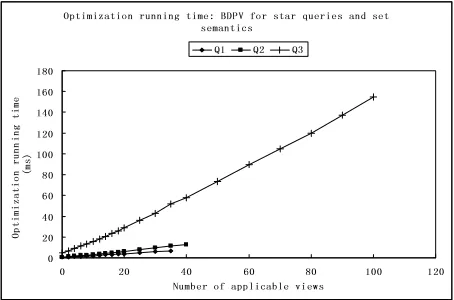
respec-Optimization running time: BDPV for star queries and set semantics
0 20 40 60 80 100 120 140 160 180
0 20 40 60 80 100 120 Number of applicable views
Op ti mi za ti on r un ni ng t im e
(m s)
Q1 Q2 Q3
Figure 2: BDPV: Absolute optimization time
tive views using the bag-set- and set-semantics versions of our DP algorithm BDPV and of its complete version CDPV. We used an experimental framework similar to that of [6]. Our optimizer cost model estimated query-plan costs us-ing the sizes of base and intermediate relations, in bytes, and the costs of joins as described in [11]; we did not take indexes into account. In the optimizer cost estimates, we used several sets of database statistics for each version of the query-shape/semantics setting (e.g., for chain queries under set semantics); in the statistics, the ratio of the sizeS of the base relations to the value of the parameter M for mem-ory size was in the interval 0< S < M4. When measuring running times for query optimization, we did not take into account the preprocessing time (i.e., building the mapping table MapTable), as it is linear in the number of applica-ble views [6] and, in our experiments, in nearly all cases it used less than 10% of the total optimization time. (This dis-tinghuishes our setting from that of, e.g., [12], where view matching takes up a significant portion of the total optimiza-tion time.) For each query-shape/semantics setting, each result we recorded was the average of the elapsed time for ten runs for each query. Due to lack of space, in this section we present mainly our BDPV results for star queries under set semantics. The full version of the paper has all the de-tails for BDPV and CDPV for all four settings: bag-set or set semantics, for chain or star queries and views.
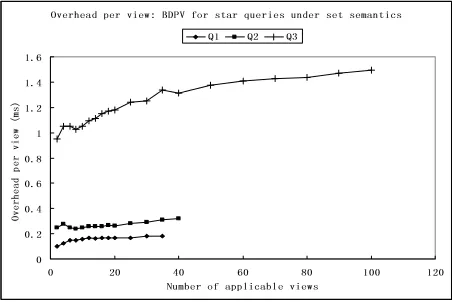
rewrit-Overhead per view: BDPV for star queries under set semantics
0 0.2 0.4 0.6 0.8 1 1.2 1.4 1.6
0 20 40 60 80 1 00 1 20 Number of applicable views
Ov er he ad p er v ie w (m s)
Q1 Q2 Q3
Figure 3: BDPV: Overhead per view
ings for chain queries under set semantics), and decreased5 with the increase in the number of query subgoals. As the rewritings that are equivalent to a given query under set semantics include all rewritings that are equivalent to the same query under bag-set semantics (when using the same applicable views), the low range of the number of equivalent rewritings in our experiments was much higher under set than under bag-set semantics — for instance, 2000 vs 200 for star queryQ3.
We saw that our algorithm BDPV can handle over 7000 equivalent rewritings with somewhat reasonable scalability. For the case of up to 20 equivalent rewritings — that is, for the experimental setting of [6] — for both semantics (bag-set or set) and both query shapes (chain or star), the relative optimization time of BDPV was comparable to that of the CKPS approach of [6]. This effect is easy to explain using the theoretical complexity of BDPV, because for each combination of a partial planPi for a DP cell Di with an overlapping view tuplehj, the additional work in BDPV (as compared to CKPS on which BDPV is based) is done using (1) efficient view-overlap tests, and (2) cost estimates for just one planPi1hj.
We now discuss our results on scalability of BDPV and CDPV in the number of applicable views. Figure 2 shows absolute running times for BDPV for three star queries un-der set semantics; queriesQ1,Q2, andQ3 have five, six, and eight subgoals respectively, and had up to 35, 40, and 100 applicable views respectively. (The expectably disappoint-ing execution time of CDPV is not shown.) In Figure 2, we show on the X-axis only applicable views, as the preprocess-ing step takes care of filterpreprocess-ing out all other views. Figure 2 shows that, for instance, when we provided 20 applicable views to each query, the running time of BDPV was under 10 ms for queriesQ1 andQ2 and under 40 ms forQ3. Over-all, the running time of BDPV grows linearly in the number of views; it was under 160 ms for star queries under set se-mantics (Figure 2) and under 35 ms for chain queries under set semantics, and was correspondingly lower for star and chain queries under bag-set semantics. These results show good scalability of BDPV in the number of applicable views, in all four query-shape/semantics settings.
5Recall that we report running times that arerelativeto the running times of the optimizer that does not use views.
Finally, we considered overhead per applicable view for both BDPV and CDPV. We measured overhead as the difference between the running time with views and the running time without views (i.e., using a System-R-style optimizer), di-vided by the number of views. As expected, the overhead numbers for CDPV were not acceptable. Figure 3 shows the overhead values for BDPV for the same queries and experi-mental setting as those for Figure 2. We can see in Figure 3 that overhead per view is modest for each query for under 40 applicable views; even at 100 applicable views, the over-head per view for queryQ3 does not exceed 1.5 ms. The overhead values for up to 100 applicable views were under
.3 ms for chain queries under set semantics; under bag-set semantics, the respective values were lower as expected.
The reason BDPV has good efficiency and scalability for a realistic number of views per query is that we use effi-cient local view-overlap tests. Note that under set seman-tics, equivalent rewritings of a query include at least all those rewritings that are equivalent to the query under bag-set se-mantics, which explains the relatively higher efficiency of the bag-set-semantics version of both algorithms. In summary, our experiments show two points. (1) While the running times of CDPV were acceptable in our experiments in the “easiest case” of chain queries under bag-set semantics, in general CDPV did not show promising performance or scal-ability. It seems that to obtain efficient rewritings of a query using overlapping views under bag-set or set semantics, we may need to settle for incomplete query optimizers, such as BDPV. (2) The BDPV optimization algorithm has good effi-ciency and scalability for CQ queries and views whose shape is chain or star, under both bag-set and set semantics.
7. RELATED WORK
Algorithms for rewriting queries using views are surveyed in [15]. Algorithms have been developed for CQ queries with comparison predicates [23], aggregate queries and views [9, 13, 20], and for queries and views in presence of integrity constraints [12, 22]. Cohen et al. [9] present algorithms for rewriting aggregate queries using views, under bag-set and set semantics. The novelty of the approach is in extending to aggregate queries previously known algorithms for obtaining view-based rewritings of CQ queries. In contrast, we propose a systematic unified approach to finding efficient view-based rewritings for queries with or without aggregation.
Query optimization using materialized views has been ex-plored extensively [3, 10, 12, 16, 22, 24]. Zaharioudakis and colleagues [24] describe an efficient bottom-up algorithm for semantic matching of complex aggregate queries with views. The work does not address integration with a cost-based op-timizer. The syntactic-matching approach of [22] enhances a System-R-style query optimizer to integrate views and in-dexes into plans for queries without aggregation. Our work goes beyond query optimization and covers evaluation of queries with or without aggregation. In addition, in our op-timization algorithms we guarantee completeness for some practical cases.
Goldstein et al. [12] present an approach to expanding a set of query plans in a transformation-based query optimizer, by matching queries and views with aggregation SUM and