A Review of Six Sigma Implementation in
Small Scale Foundry
Chintan C. Rao
1, Darshak A. Desai
2M.E. Scholar, Industrial Engineering, Mechanical Engineering Department G.H.Patel College of Engineering & Technology, Vallabh Vidyanagar, Gujarat, India1
Professor & Head, Mechanical Engineering Department, G.H.Patel College of Engineering & Technology, Vallabh Vidyanagar, Gujarat, India 2
ABSTRACT: Now A Days In The Global Market Competition Is Very High And If Maintain The Place In Global Market Quality Is Very Important And For Improvement The Quality The Breakthrough Improvement Methodology Is Available Named Six Sigma. With The Use of Six Sigma In To the Foundry Rejection Rate Is Reduced, Customer Satisfaction Is Improved And Financial Benefits Also Increase. In This Paper Author Review The Previous Published Papers, And Give The Where The Industry Have To Work, This Paper Mainly Focusing On The General Overview Of Publication And The Case Industry, This Paper Gives Which Methodology Adopted By Industry, Discuss On The Various Tools And Techniques Used By The Company And How Much Benefits Got By The Company By Using DMAIC Methodology.
KEYWORDS: Six Sigma Definitions, Small Scale Foundry, DMAIC Methodology, Tools and Techniques, Benefits
I. INTRODUCTION
A. SIX SIGMA DEFINITION:
Fig. 1. This is the main step of six sigma methodology 1) define 2) measure 3) analyse 4) improve 5) control this is a six sigma step circle [4].
The Relationship Between DPMO And Process Sigma Assumes The Normal Distribution. Currently The Concept of The Six Sigma Is Proposed As A Management Tool For Achieving Process Improvement, Reduced Cost, Reduced Wastage, Increased Customer Satisfaction And Above All, Increased Profitability [4]. Six Sigma Quality Level Allows An Off-Centering of The Process Up To 1.5 Σ. As Can Be Seen From Fig. 2, The Properties of Normal Distribution:
68.27% of the area lies within mean μ ± 1 σ
99.73% of the area lies within mean μ ± 3 σ
99.9999998% of the area lies within mean μ ± 6 σ [39].
TABLE 1 , Is for the performance measure here in the table sigma level, percent output and DPMO were shown here if defects and sigma levels are inversely proportional. It means if defects increased sigma level decreased and if defects decreased sigma level increase.
Sigma Level Percent Output DPMO
1σ 30.23 697700
2σ 69.13 308700
3σ 93.32 66810
4σ 99.379 6210
5σ 99.9767 233
6σ 99.99966 3.4
Six Sigma implies three things: statistical measurement, management strategy and quality culture. It tells us how good products, services and processes really are, through statistical measuring of quality level [1]. It is also a quality culture. It provides the way to do things right the first time and to work smarter by using data information [2]. Six Sigma helps to identify hidden waste and costs, eliminate defects, increase profit margins, customer satisfaction, employee’s satisfaction and level of commitment, and expand the business. In short, Six Sigma is about eliminating process defects and human defects [6].
B. SMALL SCALE FOUNDRY-AN OVERVIEW:
In the era of globalization, producing good quality castings as per the standards needs multidirectional competitiveness [1]. Indian foundry industries are constantly on the alert to gain a competitive edge. Yet, the Focus is deviating from overall operational excellence. To compete globally, foundry men have to move ahead from the slogan of ‘satisfying customer’ and adopt and rigorously Endeavour for ‘customer delight’. Meeting customer demands will not be sufficient, requirements will be to exceeding them through quality and productivity improvement [2]. For global competitiveness, foundry industries are trying many techniques such as quality circles, total quality management (TQM), International Organization for Standardization certifications, etc. All these techniques are well capable of producing the desired results, but the darker side of the coin is the issues related with their implementation and longer time span to realize the benefits [1]. There are myths that Six Sigma is suitable for large organizations only but, Six Sigma is equally suitable for Small scale foundry too [41].
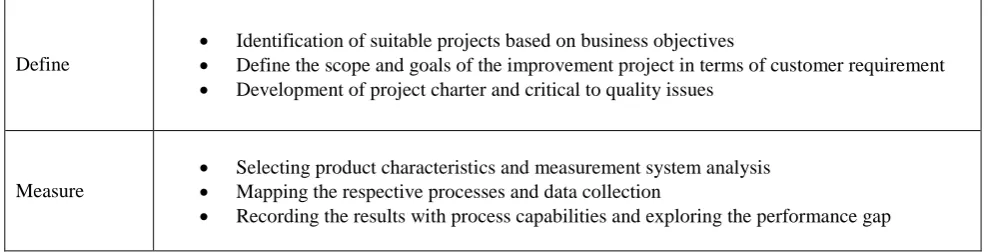
TABLE 2 , is phase wise process here in the table all the step 1) define 2) measure 3) analyse 4) improve 5) control all the things explain in shortly the main aim of this table to give shortly detail of six sigma each phase
Define
Identification of suitable projects based on business objectives
Define the scope and goals of the improvement project in terms of customer requirement
Development of project charter and critical to quality issues
Measure
Selecting product characteristics and measurement system analysis
Mapping the respective processes and data collection
Analyze
Detailed analysis to find out various root causes
Validation of the root causes
Prioritizing of most affecting root causes
Improve
Brainstorming possible alternative improvements for implementation
Implementation of the selected improvements
Verification of key process variables for improved conditions
Control
Control process variations to meet customer requirement
Develop a strategy to monitor and control the improved process
Verify the project objectives
II. RESEARCH METHODOLOGY
The aim of this study is to give find out the benefits which Six Sigma provides to the small scale foundry for reduce the casting defects and improve the quality and productivity. It is an attempt to show road map to small scale foundry for initiation of Six Sigma projects. Here the strategy is to collect relevant information about six sigma collect the different literature and case studies where Six Sigma approach is successfully implemented in small scale foundry. All the case studies (available from established publications) to show the real research and give impactful path to small scale foundry.. These case studies are taken from the established journals and publications. However most of the research studies are not disclosed easily by the authors, we have taken case studies from small scale foundry to explore the concept. The study of all the cases is then compared and is presented in the following sequence
1) General overview of publication and the case industry.
2) Methodology adopted by the cases industries
3) Tools and Techniques used in various phase by them
4) Benefits reaped by each of them
III.GENERAL OVERVIEW OF PUBLICATIONS AND CASE INDUSTRY
TABLE 3 is general overview of publications and case industry here in the table all research paper that author studied for casting only, and give all the details, about title ,journal year authors and product name.
Referred
Name Title Journal, Year Author/Authors Products
A
Increasing Bottom-Line Through Six Sigma Quality Improvement Drive: Case Of Small Scale Foundry Industry
UdhygPragati, Vol.
36 No. 2,2012 Darshak A. Desai
Cooler Plate, Hammer, Nose –Ring Segment
B
Quality And Productivity Improvement Through Six Sigma In Foundry Industry
Int. J. Productivity And Quality Management, Vol. 9, No. 2.2012
Darshak A. Desai Flange
C
Application Of Six Sigma Methodology In Small Scale Foundry Industry
International Journal Of Lean Six Sigma,2013 E.V. Gijo,Shreeranga Bhat,N.A. Jnanesh Leaf Springs D
Empirical Study On Employee Job Satisfaction Upon Implementing Six Sigma DMAIC Methodology In Indian Foundry – A Case Study
"International
Journal Of
Engineering, Science And Technology Vol. 3,No. 4, 2011"
A.
Kumaravadivel,U. Natarajan
Gate Valves, Flywheel Outer Casings
E
Utilization Of Six Sigma(DMAIC) Approach For Reducing Casting Defects
International
Journal Of
Engineering Research And General Science Volume 2, Issue 6,2014
Virender Verma,Amit Sharma, Deepak Juneja
Upper Gear, Lower Gear, Key, Roller Sporting Arm, Worm Gear
F
Application Of Six Sigma Method To Reduce Defects In Green Sand Casting Process: A Case Study
International Journal On Recent Technologies In Mechanical And Electrical
Engineering (Ijrmee) Volume: 2 Issue: 6,2015
Suraj Dhondiram Patil, M M Ganganallimath, Roopa B Math, Yamanappa Karigar
Transmission Case Casting
G
A Systematic Methodology For The Creation Of Six Sigma Projects: A Case Study Of Semiconductor Foundry
Expert Systems With Applications (Elsevier),2008
Chao-Ton Su ,
IV.METHODOLOGY ADOPTED BY CASE INDUSTRIES
As Discussed earlier six sigma concept that there is two methodology DFSS and DMAIC mostly industry applied DMAIC Methodology. In our 7 research paper of casting there was applied six sigma methodology and that all the methodology shown in table in the detail.
TABLE 4 is for methodology adopted by case industries name of the research paper, methodology, and goals are in the table here table shown that what is the methodology of the case industry and what is the goal of the industry after applying six sigma methodology
Name Methodology GOAL
A DMAIC Reducing rejection in casted products in foundry
B DMAIC Improving rejection rate and cycle time of the flange casting
C DMAIC Reducing rejection in the hardening process of leaf spring leaf spring manufacturing
D DMAIC Reduce the incidence of defects and increase the sigma level of the sand casting process.
E DMAIC Reducing rejection in defects in all types of bearing
F DMAIC reducing the defects in transmission case casting
G DMAIC reducing rejection rate in semiconductor
V. TOOLS AND TECHNIQUES USED IN VARIOUS PHASE BY THEM
In the DMAIC Methodology the most important thing is tools and techniques. In each phase of DMAIC they have different-different tools and techniques. The table shows all the tools and techniques that were used in the small scale foundry with the use of Six Sigma. General tools and technique which are used in different phases are shown below: Define Phase: Project Charter, Pareto Diagram, Flow Chart, CTQ Tree, Process Map, and Supplier-Input-Process-Output-Customer (SIPOC) Diagram.
Measure Phase: Pareto Diagram, Data Collection form, Control Charts, Gauge R & R, and Detailed Process Map, Process capability analysis
Analyze Phase: Histogram, Run Chart, Control Charts, Scatter Chart, Cause and Effect Diagram, Analysis of Variance
(ANOVA), Design of Experiment (DOE), Failure Mode and Effect Analysis (FMEA), Regression Analysis, Hypothesis Testing, Multivariate Chart, Interrelations Diagram.
Improve Phase: Brainstorming, Affinity Diagram, Multi Voting, Suitability Matrix, DOE.
Control Phase: Related Activity Chart, Standard Operating Procedure (SOP), Control Charts [41].
TABLE 5 is for tools and techniques used in various phase by the industries here the analysis of 7 research paper and also shown all the tools and techniques that used in to the six sigma that was arranged as per applied tools in each phase
Phase Wise Use of Tools and Techniques (where, D=Define, M=Measure, A=Analyse, I=Improve and C=Control)
Tools and techniques A B C D E F G
Affinity diagram
Analysis of variance I I
Benchmarking
Brainstorming
Cause & Effect diagram A A A M A
Check sheet
Control chart C C C C
Correlation analysis
Critical to Quality matrix I A
Descriptive statistics
Design of Experiments I
Flow chart D
FMEA
Gantt chart
Gauge R & R
Histogram
Hypothesis testing
KANO model
Matrix data analysis
Matrix Diagram
Multivoting A A A
Non-parametric tests
Pareto Diagram A A M M
Pie, bar charts M
Poka yoke
Prioritization matrix
Project Charter D D D
Process capability analysis C
Process decision Program Chart
Process map A
QFD
Regression analysis
Relation diagram
Root Cause analysis
Run charts
Scatter diagram
SIPOC diagram D M
Statistical Process Control
Voice of customer D D
Why-why analysis A A
VI.BENEFITS GAINED BY CASE INDUSTRIES
The main aim of the industries to apply any kind of tools and techniques was to gain benefits. Same as six sigma application is also one of the most important technique from that we get a benefits and the table shows the benefit in to the foundry industry that applied Six Sigma Methodology. In Six Sigma Methodology benefits are kind of reduced rejection rate or improve sigma level that all thing shown in to the table.
TABLE 6 is benefits gained by case industries here company name that applied six sigma in the foundry and after applying six sigma what was the benefits gained by the industries was shown in to the table
Name Benefits
A Annual financial savings cooler plate 44%,Hammer 45%, Nose-ring segment 22.5%
B The sigma level of grey iron flange casting improved from 1.979 to 2.260 and S.G. iron flange casting from 1.638 to 1.954.
C Rejection was reduced from 48.33 to 0.79 per cent, the reduction in rejection and was to the tune of USD 8,000 per year.
D sigma level of the process being increased from 3.32 to 3.47
E The rejection due to Blow holes defects were reduced from 2.74% to 0.11%,The rejection due to slag defects were reduced from 2.52% to 0.89%,The rejection due to Misrun defects was reduced from 0.96 % to 0.68%,The rejections due to rough surface defects were reduced from 0.73 % to 0.42%,saving of cost Rs 2.35 lac app.
F the casting defects of the moulding process were 9.58 % of the Transmission Case castings was reduced to the 5.6%
G Increase of machine utilization in photo module 0.130%,Establish CAR systems 0.066% ,Polishing of wafer project 0.134 %,Recruit advanced manpower 0.042%
VII. CONCLUSION
From the study of all the research paper of six sigma conclude that six sigma is a breakthrough improvement methodology with the use of six sigma it is confirm that we get a min.50% improvement, if we work hard and top management involvement is good. It can also be concluded that DMAIC methodology is mostly used by the industries for their performance improvement. This study will help small scale foundry to initiate Six Sigma projects in their organizations and improve their performance in terms of customer satisfaction as well as financial benefits with increase in competitiveness in worldwide market of foundry.
REFERENCES
1) Increasing Bottom-Line Through Six Sigma Quality Improvement Drive: Case Of Small Scale Foundry Industry By Darshak A. Desai 2) Quality And Productivity Improvement Through Six Sigma In Foundry Industry By Darshak A. Desai
4) Empirical Study On Employee Job Satisfaction Upon Implementing Six Sigma Dmaic Methodology In Indian Foundry – A Case Study By A. Kumaravadivel1, U. Natarajan
5) Utilization Of Six Sigma(Dmaic) Approach For Reducing Casting Defects By Virender Verma, Amit Sharma, Deepak Juneja
6) Application Of Six Sigma Method To Reduce Defects In Green Sand Casting process: A Case Study By Suraj Dhondiram Patil, M M Ganganallimath, Roopa B Math, Yamanappa Karigar
7) Application Of Six Sigma Methodology For Process Design By M. Sokovic , D. Pavletic, S. Fakin
8) Improving The Quality Of Asbestos Roofing At Pt Bbi Using Six Sigma Methodology Byjonnya And Jessika Christyantib* 9) Defining Quality Management In Auto Sector: A Six Sigma Perception By Amitkumar Singh,Dr. Dinesh Khanduja
10) Improving Productivity And Profitability Through Six Sigma: Experience Of A Small-Scale Jobbing Industry By Darshak A Desai
11) Minimization Of Defects In The Sewing Section Of A Garment Factory Through Dmaic Methodology Of Six Sigma By Uddin S.M.* And Rahman C.M.L.
12) Implementing The Lean Six Sigma Framework In A Small Medium Enterprise (SME) – A Case Study In A Printing Company By Joshua Chan Ren Jie, Shahrul Kamaruddin And Ishak Abd Azid
13) Study Of Feasibility Of Six Sigma Implementation In A Manufacturing Industry : A Case Study By Mehdiuz Zaman, Sujit Kumar Pattanayak & Arun Chandra Paul
14) A Case Study Of Defects Reduction In A Rubber Gloves Manufacturing Process By Applying Six Sigma Principles And Dmaic Problem Solving Methodology By Ploytip Jirasukprasert, Jose Arturo Garza-Reyes, Horacio Soriano-Meier, Luis Rocha-Lona
15) Impact Of Six Sigma In A Developing Economy: Analysis On Benefits Drawn By Indian Industries By Darshak A. Desai, Mulchand B. Patel 16) Lean Six Sigma: A Literature Review By Qun Zhang, Muhammad Irfan, Muhammad Aamir Obaid Khattak, Xiaoning Zhu
17) A Survey On The Six Sigma Implementation In The Iranian Service Organizations By Changiz Valmohammadi And Mohammad Beladpas 18) Improvement Process For Rolling Mill Through The Dmaic Six Sigma Approach By Kunal Ganguly
19) Reduction In Rework Of An Engine Step Bore Depth Variation Using Dmaic And Six Sigma Approach : A Case Study Of Engine Manufacturing Industry By Sunil Dambhare, Siddhant Aphale, Kiran Kakade, Tejas Thote, Uddhava Jawalkar
20) A Review: Six Sigma Implementation Practices In Indian Manufacturing SMES By Tejaskumar S.Parsana, Dr.Darshak A. Desai 21) Application Of Six Sigma Methodology To Reduce Defects Of A Grinding Process By E. V. Gijoa, Johny Scariab And Jiju Antonyc
22) Application Of Six-Sigma In Four Wheeler Platform Truck With Quality Tools And Techniques By Abhishek Kishor Sardeshpande, Prof. H.P.Khairnar
23) Journey Of Six Sigma In Indian Smes–Literature Snapshots By Rajeshkumar U. Sambhe
24) Barriers For Implementation Of Six Sigma By Small And Medium Enterprises By Raghunath A, Dr. Jayathirtha R V
25) An Assessment Of The Critical Success Factors For Six Sigma Implementation In Indian Industries By Darshak A. Desai, Jiju Antony, M.B. Patel
26) Applying Lean Six Sigma For Waste Reduction In A Manufacturing Environment By Mohamed K. Hassan*
27) Productivity Improvement Of A Fan Manufacturing Company By Using Dmaic Approach: A Six-Sigma Practice By Hemendra Nath Roy, Sudipta Saha, Prof. Dr. Tarapada Bhowmick & Sufal Chandra Goldar
28) Empirical Study For Six Sigma Success: Mapping Organizational Hierarchy With Barriers By M. Shanmugaraja, M. Nataraj And N. Gunasekaran
29) Six Sigma Implementation – Hurdles And More Hurdles By E. V. Gijo & Tummala S. Rao 30) Critical Success Factors Of Six Sigma Implementations In Italian Companies By Alessandro Brun
31) A Systematic Methodology For The Creation Of Six Sigma Projects: A Case Study Of Semiconductor Foundry By Chao-Ton Su *, Chia-Jen Chou
32) Quality And Productivity Improvement Using Six Sigma And Taguchi Methods By M. Shanmugaraja, M. Nataraj And N. Gunasekaran 33) Improving Customer Delivery Commitments The Six Sigma Way: Case Study Of An Indian Small Scale Industry By Darshak A Desai 34) Improve Customer Complaint Resolution Process Using Six Sigma By Sanjit Ray, Prasun Das, Bidyut Kr. Bhattacharya
35) Using Six Sigma To Improve Complaints Handling Bypatrícia Abreu, Sérgio Sousa, Member, Iaeng, And Isabel Lopes
36) Improving The Hospital Discharge Process With Six Sigma Methods By Theodore T. Allen1, Shih-Hsien Tseng, Kerry Swanson, Mary Ann Mcclay
37) Optimization Of Submerged Arc Welding Process Using Six Sigma Tools By Shashank Soni, Ravindra Mohan, Dr. Lokesh Bajpai, Dr. S. K. Katare
38) Applying Six Sigma To Manufacturing Processes In The Food Industry To Reduce Quality Cost By Hsiang-Chin Hung* And Ming-Hsien Sung 39) Six Sigma Implementation Using Dmaic Approach By Asmita S.Joshi
40) Quality Improvement Of Foundry Operation In Nigeria Using Six Sigma Technique By Abidakun Oa, Leramo Ro, Ohunakin Os, Babarinde To And Ekundayo-Osunkoya Ao
![Fig. 1. This is the main step of six sigma methodology 1) define 2) measure 3) analyse 4) improve 5) control this is a six sigma step circle [4].](https://thumb-us.123doks.com/thumbv2/123dok_us/1656815.1207784/2.595.177.431.540.713/sigma-methodology-define-measure-analyse-improve-control-circle.webp)