Opening and Chosen Ciphertext Attacks
?Dingding Jia1,2, Xianhui Lu1,2, and Bao Li1,2 1
State Key Laboratory of Information Security, Institute of Information Engineering,CAS Data Assurance and Communication Security Research Center, CAS
2
University of Chinese Academy of Sciences, Beijing, China
{ddjia,lb,xhlu}@is.ac.cn
Abstract. In this paper we study public key encryption schemes of indistinguishabil-ity securindistinguishabil-ity against receiver selective opening (IND-RSO) attacks, where the attacker can corrupt some receivers and get the corresponding secret keys in the multi-party setting. Concretely:
– We present a general construction of RSO security against chosen ciphertext attacks (RSO-CCA) by combining any RSO secure scheme against chosen plain-text attacks (RSO-CPA) with any regular CCA secure scheme, along with an appropriate non-interactive zero-knowledge proof.
– We show that the leakage-resistant construction given by Hazayet al.in Euro-crypt 2013 from weak hash proof system (wHPS) is RSO-CPA secure.
– We further show that the CCA secure construction given by Cramer and Shoup in Eurocrypt 2002 based on the universal HPS is RSO-CCA secure, hence obtain a more efficient paradigm for RSO-CCA security.
Keywords: receiver selective opening, chosen ciphertext security, hash proof system
1
Introduction
Indistinguishability against chosen plaintext and chosen ciphertext attacks (CPA, IND-CCA) are widely accepted security notions for public key encryption (PKE). However, in the multi-party situation, when attacks such as selective opening [7, 11] are possible, the above security requirements are not enough.
Generally, in selective opening attacks the adversary may corrupt a fraction of parties and get the plaintext messages together with internal randomness for encryption or decryption, while it is hoped that messages for uncorrupted parties remain protected. The notion of selective opening attacks is considered in two settings: sender selective opening (SSO), where part of senders are corrupted and messages together with randomness for encryption are revealed; and receiver selective opening (RSO), where part of receivers are corrupted and messages together with secret keys for decryption are revealed [8].
Formal study of selective opening in PKE scenario was initiated by Bellare, Hofheinz and Yilek [4, 5] in 2009. They gave rigorous definitions with two styles: indistinguishability-based (IND) and simulation-based (SIM). Considering that in the selective opening scenario, part
?
of random coins or secret keys are opened, whether the ciphertext is consistant with the plaintext can be checked. In security proof this restricts the way how the target ciphertext generated, thus whether the ordinary IND security implies SO security and relations of SO security of different styles attracts much attention [1, 3, 21–23, 12, 30].
Earlier constructions of SO security either depended on erasures, updating secret keys, with long secret keys or were in the random oracle model [7, 8, 29]. As to the result in the random oracle model, Heueret al. [17] proved that the practical schemes RSA-OAEP and DHIES were SIM-SSO-CCA secure. Next we review constructions that are stateless, non-interactive and without erasures in the standard model.
For constructions secure in the SSO setting a lot of works have been done in recent years [4, 19, 28, 13, 27, 18, 17, 26]. Up to now constructions secure in the RSO setting [8, 23] are relatively less, and these constructions are only RSO-CPA secure. In this paper we will focus on the constructions that are secure against RSO of the indistinguishability style and CCA attacks simultaneously.
1.1 Our Contribution
In this paper we show the existence of IND-RSO-CCA secure schemes by giving a con-struction from a variant of the Noar-Yung paradigm [6]. The concon-struction is a combination of any IND-RSO-CPA secure scheme, any IND-CCA secure scheme and an appropriate non-interactive zero-knowledge proof (NIZK). And we prove that the leakage-resistant con-struction from weak hash proof systems (wHPS) in [20] is actually IND-RSO-CPA secure. For more efficient constructions, we prove that the Cramer-Shoup paradigm [9, 10] from universal HPS is IND-RSO-CCA secure. In the following we outline the main idea of the construction.
To modify an IND-RSO-CPA secure scheme to be IND-RSO-CCA secure, one should handle decryption queries appropriately. We observe that when applying the Noar-Yung paradigm (or its variant), it is possible to keep secret keys unchanged by taking only the first copy of the secret key of the IND-RSO-CPA secure scheme as the secret key for the whole encryption scheme. Our first construction, which is constructed from an IND-RSO-CPA secure scheme, an IND-CCA secure scheme, an appropriate NIZK and a one-time signature, is inspired by the paradigm to achieving key-dependent message security against chosen ciphertext attacks (KDM-CCA) [6]. The proof sketch is shown in Fig. 5.
Although the framework we give above implies the existence of IND-RSO-CCA secure PKE, the use of NIZK makes it less efficient. In the final part, we prove that the construction from universal hash proof system (HPS) [9], which is more efficient, is IND-RSO-CCA secure. Here we give a general explaination. Hazay et al. demonstrated that smooth HPS implies tNCER, which leads to IND-RSO-CPA security [21]. Although the CCA construction from universal HPS adds elements in secret key for ciphertext verification compared with construction for CPA security, this does not affect the non-committing property, for the simulator is able to open messages along with secret keys which it holds.
One may notice that constructions in this paper can only achieve single-message security, while a more reliable requirement for practice is security for multi-message. In Appendix A we give a reduction from multi-message security to single-message case through a hybrid argument. The reduction leads to a security loss related to the number of messages. We leave constructions that are secure for multi-messages with a tight reduction as an open problem.
Organization.The rest of our paper is organized as follows: in section 2 we give definitions and preliminaries; in section 3 we give a variant of the Noar-Yung paradigm to build IND-RSO-CCA secure encryption and prove that the leakage-resistant construction given by Hazayet al.from wHPS is IND-RSO-CPA secure; in section 4 we prove that the construction in [9] is IND-RSO-CCA secure.
2
Preliminaries and Definitions
2.1 Preliminaries
Notations.In this paper we use PPT to represent probabilistic polynomial time for short. Let [n] be the set of{1,2, ..., n}.a←Ais to denote choosing a random element fromAwhen
A is a set, and to denote picking a uniformly distributed randomness, runningA with the randomness and assigning the output toawhenAis a PPT algorithm. we use the lower case boldface to denote vectors. Enc(pk,m) := (Enc(pk1, m1), ..., Enc(pkn, mn)) when pk,m are vectors of dimensionn. The statistical distance of two distributions X,Y is defined as
SD(X,Y) := 12Σx|Pr[X =x]−Pr[Y=x]|.
Besides efficiently samplable, the message space is required to be efficiently conditional resamplable to accompany the security definition we will give later.
Definition 1 (Efficiently Conditional Resamplable [4]). Let dist be a joint distribu-tion overMn, where Mis the message space, thendistis efficiently conditional resamplable
if there is a PPT algorithm Redist such that for any I ⊂ [n] and any mI := (mi)i∈I, wherem= (mi)i∈[n] is sampled fromdist, the outputm0←Redist(mI)satisfies thatm0 is distributed according todist andm0i=mi fori∈I.
2.2 Security Definitions
Keygen: the key generation algorithm takes as input a security parameter 1λ and outputs a public key pkand a secret keysk.Keygen(1λ)→(pk, sk).
Enc: the encryption algorithm takes as input the public keypk, a messagemin the message spaceM, a labell and outputs a ciphertextc.Enc(pk, m, l)→c.
Dec: the decryption algorithm takes the secret keysk, a ciphertextcand a labellas input and outputs a messagemor ⊥.Dec(sk, c, l)→mor ⊥.
Correctness.A PKE scheme satisfies correctness, if for all (pk, sk)←Keygen(1λ), m∈
M,
Dec(sk, Enc(pk, m, l), l) =m.
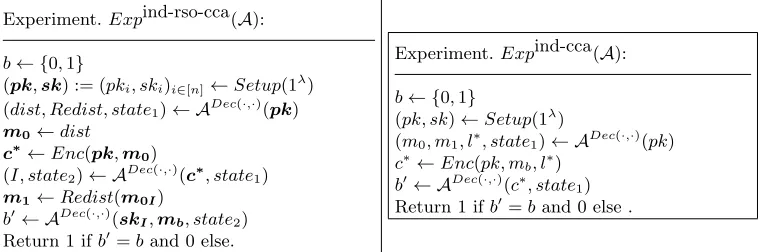
Clearly, an ordinary PKE scheme can be seen as a PKE scheme with empty label spaces. Security. Here we give the definition of indistinguishability based security against receiver selective opening chosen ciphertext attacks (IND-RSO-CCA) as in [21] and IND-CCA se-curity definition for ciphertexts with labels in Fig. 1. As in [4, 19], we require the message space be efficiently conditional resamplable. The security experiment proceeds as follows:
Experiment.Expind-rso-cca(A):
b← {0,1}
(pk,sk) := (pki, ski)i∈[n]←Setup(1λ)
(dist, Redist, state1)← ADec(·,·)(pk) m0←dist
c∗←Enc(pk,m0)
(I, state2)← ADec(·,·)(c∗, state1) m1←Redist(m0I)
b0← ADec(·,·)
(skI,mb, state2)
Return 1 ifb0=band 0 else.
Experiment.Expind-cca(A):
b← {0,1}
(pk, sk)←Setup(1λ)
(m0, m1, l∗, state1)← ADec(·,·)(pk) c∗←Enc(pk, mb, l∗)
b0← ADec(·,·)
(c∗, state1)
Return 1 ifb0=band 0 else .
Fig. 1.The IND-RSO-CCA and IND-CCA experiment
Note that inExpind-rso-cca(A), the decryption query is of the form (c, j) satisfying that
c6=c∗j, and is answered byDec(skj, c). And after the adversary getsskI, it is required that
j /∈I. The advantage is defined asAdvIND-RSO-CCA
A =
2 Pr[Expind-rso-cca(A) = 1]−1 . And in Expind-cca(A), the decryption query is of the form (c, l) such that (c, l)6= (c∗, l∗), where l is a label, and the query is answered byDec(sk, c, l). The advantage is defined as
AdvIND-CCA
A =
2 Pr[Expind-cca(A) = 1]−1
. When omitting the decryption oracle, the above experiment gives a definition of IND-RSO-CPA and IND-CPA security respectively. Definition 2 (IND-RSO-CCA/CPA Security). A PKE scheme is IND-RSO-CCA se-cure if for any PPT adversaryA,AdvIND-RSO-CCA
A is negligible inλ. And it is IND-RSO-CPA secure if for any PPT adversaryA,AdvIND-RSO-CPA
A is negligible inλ. IND-CCA/CPA security are defined similarly.
One-time Signature. A signature scheme consists of three PPT algorithms as follows:
Sig.Kg: the key generation algorithm takes as input a security parameter 1λ and outputs a verification keyvkand a signing keysigk. Sig.Kg(1λ)→(vk, sigk).
Sign: the signing algorithm takes as input the signing keysigk, a messagem, and outputs a signature σ.Sign(sigk, m)→σ.
V er: the verification algorithm takes the verification key vk, a messagemand a signature
σas input and outputs a decision bit of 1 or 0.V er(vk, m, σ)→1 or 0.
Correctness.A signature scheme satisfies correctness, if for all (vk, sigk)←Sign.Kg(1λ), m∈
M, V er(vk, m, Sign(sigk, m)) = 1.
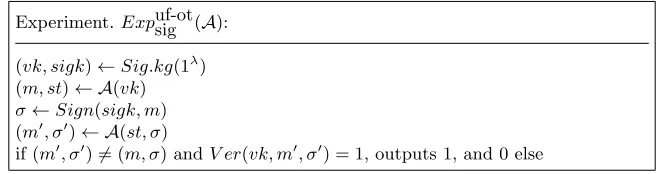
Security. Here we give the security notion of strong existential unforgeability under one-time chosen message attack in the following experiment between a challengerC and a PPT adversaryA:
Experiment.Expuf-otsig (A): (vk, sigk)←Sig.kg(1λ) (m, st)← A(vk)
σ←Sign(sigk, m) (m0, σ0)← A(st, σ)
if (m0, σ0)6= (m, σ) andV er(vk, m0, σ0) = 1, outputs 1, and 0 else
Fig. 2.One-time Unforgeable for Signatures
Definition 3 (One-time Unforgeable Security). A signature scheme is strongly ex-istential unforgeable under one-time chosen message attack if for any PPT adversary A,
Advots
A := Pr[Exp uf-ot
sig (A) = 1] is negligible inλ.
2.3 Non-interactive Zero-Knowledge Proofs
LetRbe a binary relation that is efficiently computable. LetL:={x:∃w, s.t.(x, w)∈R}. A non-interactive zero-knowledge (NIZK) proof system for R consists of three PPT algo-rithms (CRSGen, P, V) as follows: CRSGengenerates a common reference string (CRS),
CRSGen →C; for (x, w) ∈R, the prover generates a proof, p ←P(C, x, w); a verifier V
outputs 1 if it accepts the proof and 0 otherwise,V(C, x,p)→ {0,1}.
Definition 4 (NIZK[14, 2]).(CRSGen, P, V)is an NIZK proof system forRif it satisfies the following properties:
Completeness: For allC←CRSGen, all(x, w)∈R, and p←P(C, x, w), V(C, x,p) = 1. Computational Soundness: For any PPT A,Advcsnizk
,A = Pr[A(C)→(x,p)∧x /∈ L ∧
V(C, x,p) = 1]is negligible, whereC←CRSGenis given toA.
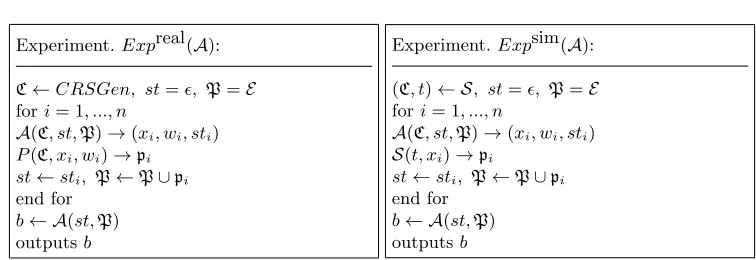
Computational Zero-knowledge: There exists a simulator S such that for any PPT adversary A, Advczknizk
,A = |Pr[Exp
Experiment.Expreal(A): C←CRSGen, st=, P=E
fori= 1, ..., n
A(C, st,P)→(xi, wi, sti)
P(C, xi, wi)→pi
st←sti, P←P∪pi
end for
b← A(st,P) outputsb
Experiment.Expsim(A): (C, t)← S, st=, P=E
fori= 1, ..., n
A(C, st,P)→(xi, wi, sti)
S(t, xi)→pi
st←sti, P←P∪pi
end for
b← A(st,P) outputsb
Fig. 3.Computational Zero-knowledge
Loosely speaking, CZK means that with the help of the secret information t generated with C, the simulator S can produce a proof that is indistinguishable from the real proof without the witness forx∈ L. For the construction in this paper, although only one message is encrypted for each public key, there are multi public keys, the one-time definition of computational zero-knowledge given by Blumet al.[2] is not enough.
3
An IND-RSO-CCA Secure Construction
In this section, we give an IND-RSO-CCA secure construction analogous to that in [6] with the following building blocks: a PKEE1with IND-RSO-CPA security, a regular CCA secure PKEE2that supports ciphertexts with labels, an NIZK proof system for the language consisting of the set of all pairs that encrypt the same message usingE1andE2, and a strong existential unforgeable one-time signature scheme. Then we prove that the construction from wHPS [20] is IND-RSO-CPA secure.
3.1 Preliminaries for Section 3
Tweaked Non-committing Encryption for Receivers (tNCER). In [21], Hazayet al. defined tNCER and proved that a tNCER is IND-RSO-CPA secure. A tweaked PKE (tPKE) consists of five algorithms (tKeygen, tEnc, tEnc∗, tDec, tOpen), where (tKeygen, tEnc, tDec) form a regular PKE and the algorithms (tEnc∗, tOpen) are as follows:
tEnc∗: the PPT tweaked encryption algorithm takes as input the public keypk, the secret keysk and a messagem, and outputs a fake ciphertextc∗.tEnc∗(pk, sk, m)→c∗.
tOpen: the open algorithm (possibly inefficient) takes as input the public key pk, a fake ciphertextc∗ and a messagemin the message spaceM, and outputs a secret keysk∗←
tOpen(pk, c∗, m), satisfying thattDec(sk∗, c∗) =m.
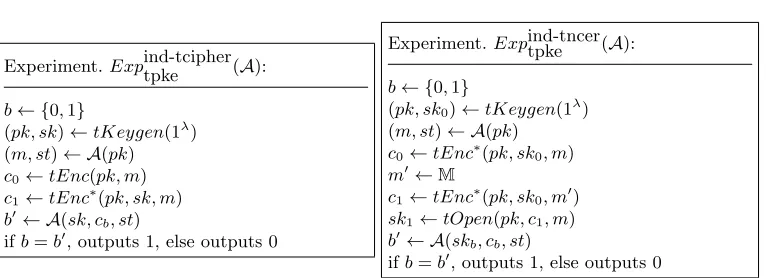
Security. A tPKE is a tweaked NCER if real and fake ciphertexts are indistinguishable, and fake ciphertexts are non-committing, which means that fake ciphertexts hide messages completely.
Experiment.Expind-tcipher
tpke (A):
b← {0,1}
(pk, sk)←tKeygen(1λ)
(m, st)← A(pk)
c0←tEnc(pk, m) c1←tEnc∗(pk, sk, m) b0← A(sk, cb, st)
ifb=b0, outputs 1, else outputs 0
Experiment.Expind-tncertpke (A):
b← {0,1}
(pk, sk0)←tKeygen(1λ)
(m, st)← A(pk)
c0←tEnc∗(pk, sk0, m) m0←M
c1←tEnc∗(pk, sk0, m0) sk1←tOpen(pk, c1, m) b0← A(skb, cb, st)
ifb=b0, outputs 1, else outputs 0
Fig. 4.tweaked NCER
– for any PPT adversary A, Advind-tcipher
tpke,A :=|2 Pr[Exp
ind-tcipher
tpke (A) = 1]−1| is neg-ligible.
– for any unbounded adversary A, Advind-tncer
tpke,A := |2 Pr[Exp
ind-tncer
tpke (A) = 1]−1| is negligible.
Weak Hash Proof System (wHPS) Weak hash proof system, which can be seen as a generalization of HPS, was proposed by Hazay et al. to provide leakage resistant security from CPA secure schemes [20]. Here we give a brief review. A wHPS is an ordinary KEM in addition with a fake encryption algorithmEnc∗ as follows:
Keygen: The key generation algorithm takes as input the security parameter 1λand outputs a pair of public key and secret key. (pk, sk)←Keygen(1λ).
Enc: The encapsulation algorithm takes as inputpk, outputs a valid ciphertext and a session key. (c, K)←Enc(pk).
Enc∗: The fake encapsulation algorithm takes as input pk, outputs an invalid ciphertext.
c∗←Enc∗(pk).
Dec: The decapsulation algorithm takes as input skand a ciphertextc, outputs a session key.K←Dec(sk, c).
It should satisfy correctness, indistinguishability and smoothness properties.
Correctness. For all (pk, sk)←Keygen(1λ),(c, K)←Enc(pk), Dec(sk, c) =K.
Indistinguishability. Given (pk, sk) ← Keygen(1λ), any PPT adversary A cannot dis-tinguish a valid ciphertext from an invalid ciphertext. That is, for any PPT adversary
A, AdvCI
A,wHPS is negligible, where
AdvCI
A,wHPS=|Pr[A(pk, sk, c|(c, K)←Enc(pk)) = 1]
−Pr[A(pk, sk, c∗|c∗←Enc∗(pk)) = 1]|.
3.2 Construction
LetE1:= (Keygen1, Enc1, Dec1) be IND-RSO-CPA secure, andE2:= (Keygen2, Enc2,
Dec2) be IND-CCA secure and supports ciphertext with labels,S:= (Sig.Kg, Sign, V er) be strong existential unforgeable under one-time chosen message attack,Leq :={(c1, c2, l)|∃m,
r1, r2, s.t.c1 =Enc1(pk1, m;r1), c2=Enc2(pk2, m, l;r2)}. Let P:= (CRSGen, P, V) be an NIZK proof forLeq. The scheme is described as follows:
Keygen: Generate (pki, ski)←Keygeni(1λ) fori= 1,2, runCRSGento get the common reference string Cof the NIZKP. Setpk:= (pk1, pk2,C), sk:=sk1.
Enc: Generate (vk, sigk)←Sig.Kg(1λ), randomly chooser
1, r2 and compute
c1 = Enc1(pk1, m;r1), c2 =Enc2(pk2, m, vk;r2),p ← P(C,(c1, c2, vk),(m, r1, r2)), σ =
Sign(Sigk, c1kc2kp). The ciphertextc= (vk, c1, c2,p, σ).
Dec: Verifies whetherV(C, c1kc2kvk,p) = 1 andV er(vk, c1kc2kp, σ) = 1, if both equations hold, output m=Dec1(sk, c1), otherwise reject.
Correctness of the decryption algorithm is trivially follows from the completeness of NIZK, correctness of the signature scheme and correctness of the IND-RSO-CPA scheme.
Theorem 1. Let E1 be IND-RSO-CPA secure, E2 be IND-CCA secure that supports ci-phertext with labels, Sbe existential unforgeable under one-time chosen message attack,P be an NIZK proof for Leq, then the scheme constructed above is IND-RSO-CCA secure. Concretely,
AdvIND-RSO-CCA
pke ≤2q(Adv cs
nizk+nAdv uf-ot
sig ) + 2nAdv cca
pke+ 2Adv czk nizk+Adv
IND-RSO-CPA pke
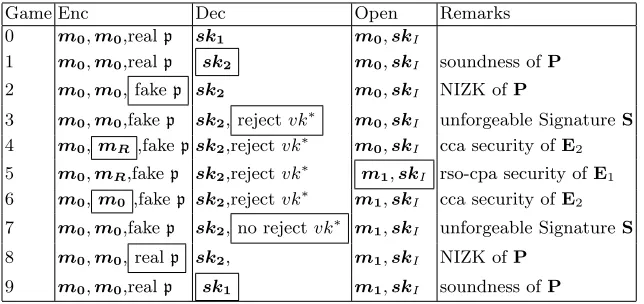
Proof. The proof is through a sequence of games depicted in Fig. 5, where the boxed item is the change from the former game.
Game Enc Dec Open Remarks
0 m0,m0,realp sk1 m0,skI
1 m0,m0,realp sk2 m0,skI soundness ofP
2 m0,m0, fakep sk2 m0,skI NIZK ofP
3 m0,m0,fakep sk2, rejectvk∗ m0,skI unforgeable SignatureS
4 m0,mR ,fakepsk2,rejectvk∗ m0,skI cca security ofE2
5 m0,mR,fakep sk2,rejectvk∗ m1,skI rso-cpa security ofE1
6 m0,m0 ,fakep sk2,rejectvk∗ m1,skI cca security ofE2
7 m0,m0,fakep sk2, no rejectvk∗ m1,skI unforgeable SignatureS
8 m0,m0, realp sk2, m1,skI NIZK ofP
9 m0,m0,realp sk1 m1,skI soundness ofP
Fig. 5.Game transform for RSO-CCA security from RSO-CPA security
Next we give the formal description of the games. Let Wi denote the event that the adversary outputs 1 in Gamei.
Game1: the same as Game0, except that when responding to a decryption query (c, j), the challenger computes m =Dec2(sk2j, c2) instead of m =Dec1(sk1j, c1). From the soundness property of P, one can get that Pr[W1]−Pr[W0] is negligible.
Game2: the same as Game1, except that C is generated by a simulator S and when re-sponding to the encryption query dist, the challenger produce simulated proofs p ← S(t,(c1, c2, vk)) instead of a realp. From the zero-knowledge property ofP, one can get that Pr[W2]−Pr[W1] is negligible.
Game3: the same as Game2, except that when responding to a decryption oracle (c, j), where c = (vk, c1, c2,p, σ), the challenger checks whether vk = vkj∗, if the equation holds, then it just rejects. From the existential unforgeable property of S, one can get that Pr[W3]−Pr[W2] is negligible.
Game4: the same as Game3 except that when responding to the encryption query dist, the challenger samplesm0←dist, and randommR from the message space, generates
(vk,sigk)←Sig.Kgn(1λ), computesc∗1=Enc1(pk1,m0),c∗2=Enc2(pk2,mR,vk∗),
and other parts of the ciphertext vector as in Game3. From the CCA security of E2, by a hybrid argument one can get that Pr[W4]−Pr[W3] is negligible. Note that since
vk6=vk∗
j, decryption queries can be answered with the decryption oracle of E2. Game5: the same as Game4, except that in the corruption phase, the adversary resamples
m1←Redist(m0I) and responds with (skI,m1). From the RSO-CPA security ofE1,
one can get that Pr[W5]−Pr[W4] is negligible.
Game6: the same as Game5, except that when responding to the encryption querydist, the challenger computes c2 =Enc2(pk2,m0,vk∗), with the real sampled message vector
instead of randomly chosen one. From the CCA security ofE2, one can get that Pr[W6]− Pr[W5] is negligible.
Game7: the same as Game6, except that when responding to a decryption query (c, j), the challenger no longer rejects when vk=vk∗j. From the existential unforgeable property ofS, one can get that Pr[W7]−Pr[W6] is negligible.
Game8: the same as Game7, except thatCis normally generated and when responding to the encryption querydist, the challenger produce real proofsp. From the zero-knowledge property of P, one can get that Pr[W8]−Pr[W7] is negligible.
Game9: the same as Game8, except that when responding to a decryption query (c, j), the challenger computes m=Dec1(sk1j, c1) as in the original security definition. Note that this game is the real security game whenb= 1. From the soundness property ofP, one can get that Pr[W9]−Pr[W8] is negligible.
It is not difficult to prove the following lemmata and we put the concrete proof in Appendix B.
Lemma 1. |Pr[W1]−Pr[W0]| ≤qAdvnizkcs , |Pr[W9]−Pr[W8]| ≤qAdvnizkcs .
Lemma 2. |Pr[W2]−Pr[W1]| ≤qAdvczk
nizk, |Pr[W8]−Pr[W7]| ≤qAdvnizkczk . Lemma 3. |Pr[W3]−Pr[W2]| ≤nqAdvsiguf−ot,|Pr[W7]−Pr[W6]| ≤nqAdvuf−otsig .
Lemma 4. |Pr[W4]−Pr[W3]| ≤nAdvpkecca,|Pr[W6]−Pr[W5]| ≤nAdvccapke.
Lemma 5. |Pr[W5]−Pr[W4]| ≤Advpkeind−rso−cpa.
Similar as that in [6], when we use an NIZK proof that provides unbounded simulation soundness, the IND-CCA scheme use in the construction can be replaced with a scheme of IND-CPA security.
3.3 IND-RSO-CPA Secure PKE from wHPS
Up to now there are instantiations of RSO-CPA secure PKE [21], CCA secure scheme with labeled ciphertext [6], NIZK for equal message relations [16, 6], one-time signatures [15]. Here we prove that the leakage-resistant construction from wHPS [20] is IND-RSO-CPA secure. Since in [20] Hazayet al.showed that wHPS can be realized from CPA secure PKE schemes, our result implies that IND-RSO-CPA secure PKE can be constructed from any IND-CPA PKE.
In [21] they showed that if a tPKE is a tNCER, then it is IND-RSO-CPA secure.
Lemma 6 ([21]).For any PPT adversaryAattacking tPKE in the IND-RSO-CPA scheme,
there exists a PPT adversaryBand an unbounded adversaryC, such thatAdvind-rso-cpa
tpke (A)
≤2n(Advind-tcipher
tpke (B) +Advind-tncertpke (C)).
Construction. Next we show that the PKE constructed from wHPS [20] is a tNCER. The scheme is described as follows.
tKeygen(1λ) : The key generation algorithm is the generation algorithm of wHPS. (pk, sk)
←wHP S.Keygen(1λ).
tEnc(pk, m) : c= (c1, c2), where (c1, K)←wHP S.Enc(pk), c2=K+m, here we assume that the encrypted messages are in an additive group.
tDec(sk, c) : K←wHP S.Dec(sk, c1), m←c2−K.
tEnc∗(pk, sk, m) : c∗ = (c∗1, c∗2), c∗1 ← wHP S.Enc∗(pk), K∗ ← wHP S.Dec(sk, c∗1), c∗2 =
K∗+m.
tOpen(pk, c∗, m) : Parse c∗ as c∗ = (c∗1, c∗2), compute K∗ =c∗2−m, find ansk∗ such that
wHP S.Dec(sk∗, c∗) =m.
Correctness can be easily verified from the correctness property of wHPS. It is obvious that the decryption of a fake ciphertextc∗outputs the encrypted messagem. Sincec∗1 is an output ofwHP S.Enc∗(pk), from the smooth property of wHPS, (pk, c∗1, wHP S.Dec(sk, c∗1)) is distributed as (pk, c∗1, K) for randomly chosenK. Hence for a givenK∗, there exists ask∗
corrsponding topk such thatwHP S.Dec(sk∗, c∗1) =K∗, an unbounded algorithm can find it. The ciphertext indistinguishability of tPKE easily follows from the indistinguishability of wHPS. And the non-committing property for fake ciphertexts follows from the smoothness property of wHPS.
4
IND-RSO-CCA Secure PKE from Universal HPS
The construction of the above section implies the existence of IND-RSO-CCA secure scheme. However, due to the employment of NIZK (pairing), the construction is less efficient, and the ciphertext is not compact. In this section we prove that the compact and efficient CCA secure scheme in [9] based on HPS is IND-RSO-CCA secure.
4.1 Universal Hash Proof System
Projective Hash Family. Firstly we recall the concept of hash proof system (HPS) in-troduced by Cramer and Shoup [9]. A projective hash family consists of (Λ,SK,X,L,W,
Y,PK, µ), whereX,Y,L,W,SK, PK are sets andL ⊂ X is a language, LetΛ be a fam-ily of hash functions indexed by sk ∈ SK mapping from X to Y. Let µ be a polynomial time function mapping fromSKto PK. A hash family H= (Λ,SK,X,L,W, Y,PK, µ) is projective if for allsk∈ SK, the action ofΛsk onLis determined byµ(sk).
Definition 6 (-smoothness [9]).The projective hash family is -smooth if for randomly chosensk← SK,X ← X \L, pk=µ(sk), givenpk, X, the distribution of Y =Λsk(X)and randomly chosenY˜ ∈ Y are statistically indistinguishable,
SD((pk, X, Y),(pk, X,Y˜))≤.
In this work we give a definition of ι-related-smooth property of hash family to prove the IND-RSO-CCA security of the constructed scheme.
Definition 7 (ι-related -smoothness).The projective hash family is ι-related-smooth if for ι randomly chosen sk = (sk1, ..., skι)← SKι, X= (X1, ..., Xι) ←(aL)ι, a← X \L, compute pk= (µ(sk1), ..., µ(skι)), Y= (Λsk1(X1), ..., Λskι(Xι)), for randomly chosenY˜ ∈
Yι,
SD((pk,X,Y),(pk,X,Y))˜ ≤.
ι-related -smoothness property can be easily deduced from the ordinary smoothness property of hash family with a hybrid proof argument.
SD((pk,X,Y),(pk,X,Y˜))
≤X
κ
SD((pk,X,(Λsk1(X1), ..., Λskκ−1(Xκ−1),Y˜κ, ...,Y˜ι), (pk,X,(Λsk1(X1), ..., Λskκ(Xκ),Y˜κ+1, ...,Y˜ι))
=X
κ
SD((pkκ, Xκ, Λskκ(Xκ)),(pkκ, Xκ,Y˜κ)) (1)
≤ιSD((pk, X, Λsk(X)),(pk, X,Y˜))
Equation 1 holds for the reason that the key pairs are independently randomly generated. As in [9], we introduce a finite setEto extend the setsX andL. An extended projective hash family H = (Λ,SK,X × E,L × E,W, Y,PK, µ) is universal2 if for any X1, X2 ∈
X \L, E1, E2 ∈ E, (X1, E1) 6= (X2, E2), even given µ(sk) and Λsk(X1, E1), the output of
Definition 8 (universal2 [9, 24]).The extended projective hash family is universal2 if for allpk∈ PK,X1, X2∈ X \L, E1, E2∈ E, (X1, E1)6= (X2, E2), for allY1, Y2∈ Y,
Pr[Λsk(X2, E2) =Y2|µ(sk) =pk, Λsk(X1, E1) =Y1] = 1
|Y|.
Subset Membership Problem (SMP). An SMP specifies an instance ensembles{In}n such that for eachn,In specifies a distribution over instanceΓ = (X,L,W,R), where
– X,L,W are non-empty sets andL ⊂ X.
– R ⊂ X ×W is a binary relation such thatx∈ Liff there exists awsatisfying (x, w)∈ R.
We assume that there are efficient algorithms to sample instances fromIn, elements from
X,X \Land elementsLfromLtogether with its witnessw∈ W. Also we require thatX,Y
being abelian groups (with computational symbol “+”) andLbeing subgroup ofX.
Definition 9 (Subset Membership (SM) Problem [9]). The SMP is to distinguish a randomly chosen Z0∈ L from a randomly chosen Z1∈ X \L. Concretely, the advantage of an adversaryA in breaking SMP is defined as:
AdvSM
A =|Pr[A(Γ, Z0) = 1]−Pr[A(Γ, Z1) = 1]|,
where the probability is taken over the randomness of choosing instance Γ and elements
Z0, Z1, the internal randomness ofA. We say that the SM problem is hard if for every PPT
A, AdvSM
A is negligible.
Hash Proof System (HPS). An HPS associates each SM instanceΓ with a projective hash family H= (Λ,SK,X,L,W,Y,PK, µ). In addition, it provides efficient algorithm to choose sk∈ SK andX ∈ X uniformly at random, PPT algorithm to computeµ(sk), and PPT algorithms (P riv, P ub) to computeΛsk(L) forL∈ Lwith witnessw:
Λsk(L) =P riv(sk, L) =P ub(µ(sk), L, w).
HPS with Trapdoor.Following [24, 25], we also require that the SM problem can be efficiently solved with a master trapdoor, which will be used not in the actual scheme but in the security proof. In fact, all known hash proof systems have such a trapdoor.
4.2 Construction
LetH1= (Λ1,SK1,X,L,W,Y1,PK1, µ1) be a smooth projective hash proof system,H2= (Λ2,SK2,X × Y1,L × Y1,W,Y2,PK2, µ2) be an extended universal2projective hash proof system. Public parameters are set aspp= (H1,H2).
Keygen(pp) : The key generation algorithm chooses random secret key sk1 ← SK1, sk2←
Enc(pk, m) : The encryption algorithm samples randomL ∈ Lwith witness w, and com-putes the ciphertextc= (c0, c1, c2) as:
c0=L, Y1=P ub(pk1, L, w), c1=Y1+m, c2=P ub(pk2, L, c1, w).
Dec(sk, c) : The decryption algorithm first verifies whether c2 = P riv(sk2, c0, c1), if the equation does not hold, it just rejects, else it computes the message as:
Y1=P riv(sk1, c0), m=c1−Y1.
Correctness can be easily verified from the projective property of the HPS.
4.3 Security Proof
The proof intuition is as follows: since the simulator holds secret keys, secret key opening is easy to realize. As in [9], the universal2property guaranties that decryption answers leak no information of secret keys. Since public/secret key pairs are chosen independently, the openness of some secret keys and decryption answers has no influence on secret keys un-opened. Furthermore, related smoothness property of HPS assures that messages unopened are completely hidden. Note that in the reduction, encryption answers can be transformed to be invalid in one shot from the self-reducibility property of the group structure, hence we get a tighter reduction than that from tNCER.
Theorem 2. IfH1 is a1-smooth projective HPS with the corresponding SM problem hard, H2 is an extended universal2 projective hash proof system with the same corresponding SM problem hard, then our PKE scheme is IND-RSO-CCA secure. Concretely,
AdvIND-RSO-CCA
A ≤Adv
SM,HPS
B +q(
1 (|X | − |L|)· |Y1|
+ 1
|Y2|
) +n1.
whereqis the number of decryption queries,nis the number of key pairs.
Proof. A ciphertextc is invalid ifc0∈ L/ . The master trapdoormtis used to solve the SM problem.
To prove the security of our scheme, we define a sequence of games whereby any PPT adversary can not tell the difference between consecutive games.
Game0: the real security game. The challengerCselectsnrandom secret keys (ski1, ski2)i∈[n], computespk= (pki= (µ1(ski1), µ2(ski2)))i∈[n]and sendspkto the adversaryA. In the encryption query phase, for alli∈[n], the challengerCselectsc∗i0∈ Lwith witnessw∗i, computes Yi1∗ = P ub1(pki1, c∗i0, wi∗), c∗i1 = Yi1∗ +m0i, c∗i2 = P ub2(pki2, c∗i0, c∗i1, w∗i) and responds with c∗ = (c∗i0, c∗i1, c∗i2)i∈[n] to the adversary. In the decryption query phase, the challenger C answers decryption queries with the corresponding secret keys. In the open phase, the challenger randomly selects a bitb, sends the secret keysskI related to
I and the message vectormbto the adversaryA. FinallyAoutputs its guessb0. Game1: the same asGame0 except that the challenge ciphertexts are generated using the
secret keys. That isYi1∗ =P riv1(ski1, c∗i0), c∗i2=P riv2(ski2, c∗i0, c∗i1).
Game2: the same asGame1 except that the challenge ciphertexts are invalid. Concretely,
Game3: the same asGame2 except that the decryption oracle rejects all queries (c, j) that satisfyc0∈ L/ . This can be achieved with the help of the master trapdoormt.
LetAdvAi denoteA’s advantage inGamei fori= 0,1,2,3.
It is clear to see AdvA0 =Adv1Afrom the projective property of HPS.
Lemma 7. Suppose that there exists a PPT adversaryAsuch thatAdv1
A−AdvA2 =, then there exists a PPT adversaryB with advantage in solving the SM problem.
Proof. B receives D = (Γ, Z) and its task is to decide whetherZ ∈ L or not. B picks n
random secret keys (ski1, ski2) ∈ SK1× SK2, computes pki1 = µ1(ski1), pki2 = µ2(ski2) and sendspktoA.
Whenever A submits (ˆc, j), B simply runs the decryption algorithm with the secret key skj. When A submits a distribution dist, B samples m0 ← dist, randomly
choos-es n elements in L,X¯i∗ ← L and computes Xi∗ = Z + ¯Xi∗, it sets c∗i0 = Xi∗, Yi1∗ =
P riv1(ski1, c∗i0), ci1∗ =Yi1∗+m0i, c∗i2=P riv2(ski2, c∗i0, c∗i1) and responds withc∗= (c∗i0, c∗i1,
c∗i2)i∈[n]. WhenAsubmits a corruption query withI,Bsamplesm1←Redist(m0I), picks
a random bitb and responds with (skI,mb). WhenAoutputs its guess b0, Boutputs 1 if b=b0 and 0 otherwise.
Note that when Z ∈ L, (c∗i0)i∈[n] are randomly distributed in L, then the above game perfectly simulatesGame1; whenZ∈ X \L, (c∗i0)i∈[n] are randomly distributed in the coset
ZL, then the above game perfectly simulatesGame2.
Lemma 8. Adv2
A−AdvA3 ≤ if the projective HPS H2 satisfies the universal2 property, where=q((|X |−|L|)·|Y1
1|+ 1 |Y2|).
Proof. Let E be the event that a query (ˆc, j) is rejected in Game3 but not rejected in
Game2. Then we have|Adv2
A−AdvA3| ≤qP r[E]. Consider the following cases: Case 1: (ˆc0,ˆc1) = (c∗j0, c∗j1).
– when such a query is proposed before challenge phase, the adversary has no informa-tion about the challenge ciphertexts, then the equainforma-tion holds with the probability
1
(|X |−|L|)·|Y1|, which is negligible.
– when such a query is proposed after challenge phase, it must holds that ˆc26=c∗j2=
P riv2(skj2,cˆ0,ˆc1), then such a query will be certainly rejected in Game2, too. Case 2: Case 1 does not happen, but there exists some i 6= j satisfies that (ˆc0,ˆc1) =
(c∗
i0, c∗i1). In fact this will give no extra help to the adversary sinceskiandskjare chosen independently. Anyone can choose such key pairs and generate ciphertext ˆc2from (ˆc0,ˆc1) with the chosen secret key. So the only information the adversary gets about skj ispkj andc∗j, then from the universal2 property ofH2, Pr[ˆc2=P riv2(skj2,ˆc0,ˆc1)]≤ |Y12|. Case 3: For all i ∈ [n], it holds that (ˆc0,cˆ1)6= (c∗i0, c∗i1). The analysis of this case is the
same with that of Case 2 and the upper bound probability is identical, too.
Proof. Since the key pairs are generated independently, the opened secret keysskI leak no information aboutskJ, whereJ = [n]\I.
InGame3, all decryption queries (ˆc, j) such that ˆc0∈ L/ are rejected. For queries satisfies that ˆc0 ∈ L, the computation result of Y1 and ˆc2 are completely determined by the public keypkj, so decryption answers will leak no information aboutskj other thanpkj.
So here the adversary getspkJ, c∗Jwithc∗J0∈(aL)|J|for some randoma /∈ L, from the1 smoothness property ofH1, the distribution ofYJ1 isn1close to the uniform distribution ofY1|J|. And whenYJ1 is uniformly distributed, obviously the adversary has no advantage.
Instantiations. The instantiations are the same as that in [9] from the DDH,DCR and QR assumptions.
Acknowledgments We are grateful to Yamin Liu and Haiyang Xue for helpful discus-sions and advice. We also thank the anonymous reviewers of CT-RSA 2017 for their useful comments.
References
1. Bellare, M., Dowsley, R., Waters, B., Yilek, S.: Standard security does not imply security against selective-opening. In: Pointcheval, D., Johansson, T. (eds.) EUROCRYPT 2012. LNCS, vol. 7237, pp. 645-662. Springer, Heidelberg (2012)
2. Blum, M., Feldman, P., Micali, S.: Non-interactive zero-knowledge and its applications (extend-ed abstract). In: STOC 1988, pp. 103-112 (1988)
3. B¨ohl, F., Hofheinz, D., Kraschewski, D.: On definitions of selective opening security. In: Fischlin, M., Buchmann, J., Manulis, M. (eds.) PKC 2012. LNCS, vol. 7293, pp. 522-539. Springer, Heidelberg (2012)
4. Bellare, M., Hofheinz, D., Yilek, S.: Possibility and impossibility results for encryption and commitment secure under selective opening. In: Joux, A. (ed.) EUROCRYPT 2009. LNCS, vol. 5479, pp. 1-35. Springer, Heidelberg (2009)
5. Bellare,M., Yilek, S.: Encryption schemes secure under selective opening attack. IACR Cryp-tology ePrint Archive 2009: 101 (2009)
6. Camenisch, J., Chandran, N., Shoup, V.: A public key encryption scheme secure against key dependent chosen plaintext and adaptive chosen ciphertext attacks. In: Joux, A. (ed.) EURO-CRYPT 2009. LNCS, vol. 5479, pp. 351-368. Springer, Heidelberg (2009)
7. Canetti, R., Feige, U., Goldreich, O., and Naor, M.: Adaptively secure multi-party computation. In Twenty-Eighth Annual ACM Symposium on Theory of Computing, Proceedings of STOC 1995, pages 639-648. ACM Press, 1996.
8. Canetti, R., Halevi, S., and Katz, J.: Adaptively-secure, non-interactive public-key encryption. In: Kilian, J. (ed.) TCC 2005. LNCS, vol. 3378, pp. 150-168. Springer, Heidelberg (2005) 9. Cramer, R. and Shoup, V.: Universal hash proofs and a paradigm for adaptive chosen ciphertext
secure public-key encryption. In: Knudsen, L.R. (ed.) EUROCRYPT 2002. LNCS, vol. 2332, pp. 45-64. Springer, Heidelberg (2002)
10. Cramer, R. and Shoup, V.: Design and analysis of practical public-Key encryption schemes secure against adaptive chosen ciphertext attack. SIAM J.Compt. 33(1), 167-226 (2003) 11. Dwork, C., Naor, M., Reingold, O., Stockmeyer, L.: Magic functions. Journal of the ACM 50(6),
852-921 (2003)
13. Fehr, S., Hofheinz, D., Kiltz, E., Wee, H.: Encryption schemes secure against chosen-ciphertext selective opening attacks. In: Gilbert, H. (ed.) EUROCRYPT 2010. LNCS, vol. 6110, pp. 381-402. Springer, Heidelberg (2010)
14. Feige, U., Lapidot, D., Shamir, A.: Multiple non-interactive zero knowledge proofs based on a single random string (extended abstract). In: FOCS 1990, pp. 308-317 (1990)
15. Groth, J.: Simulation-sound NIZK proofs for a practical language and constant size group signatures. In: Lai, X., Chen, K. (eds.) ASIACRYPT 2006. LNCS, vol. 4284, pp. 444-459. Springer, Heidelberg (2006)
16. Groth, J., Sahai, A.: Efficient non-interactive proof systems for bilinear groups. In: Smart, N.P. (ed.) EUROCRYPT 2008. LNCS, vol. 4965, pp. 415-432. Springer, Heidelberg (2008)
17. Heuer, F., Jager, T., Kiltz, E., Sch¨age, S.: On the Selective opening security of practical public-key encryption schemes. In: Katz, J. (ed.) PKC 2015. LNCS, vol. 9020, pp. 27-51. Springer, Heidelberg (2015)
18. Huang, Z., Liu, S., Qin, B., Chen, K.: Fixing the sender-equivocable encryption scheme in Eurocrypt 2010. In INCOS(2013) 366-372.
19. Hemenway, B., Libert, B., Ostrovsky, R., Vergnaud, D.: Lossy encryption: constructions from general assumptions and efficient selective opening chosen ciphertext security. In: Lee, D.H., Wang, X. (eds.) ASIACRYPT 2011. LNCS, vol. 7073, pp. 70-88. Springer, Heidelberg (2011) 20. Hazay, C., L´opez-Alt, A., Wee, H., Wichs, D.: Leakage-resilient cryptography from minimal
assumptions. In: Johansson, T., Nguyen, P.Q. (eds.) EUROCRYPT. 2013. LNCS, vol. 7881, pp. 160-176. Springer, Heidelberg (2013)
21. Hazay,C., Patra, A, Warinschi, B.: Selective opening security for recievers. In: Iwata, T., Cheon, J. (eds.) ASIACRYPT 2015. LNCS, vol. 9452, pp. 443-469. Springer, Heidelberg (2015) 22. Hofheinz, D. and Rupp, A.: Standard versus selective opening security: separation and
equiva-lence results. In Theory of Cryptography (pp. 591-615). Springer Berlin Heidelberg.(2014) 23. Hofheinz, D., Rao, V., Wichs, D.: Standard security does not imply indistinguishability under
selective opening. In: Hirt, M., Smith, A.(eds.) TCC 2016(B). LNCS, vol. 9986, pp. 121-145. Springer, Heidelberg (2016).
24. Kurosawa, K. and Desmedt, Y.: A new paradigm of hybrid encryption scheme. In: Franklin, M. (ed.) CRYPTO 2004. LNCS, vol. 3152, pp. 426-442. Springer, Heidelberg (2004)
25. Kiltz, E., Pietrzak, K., Stam, M. and Yung, M.: A new randomness extraction paradigm for hy-brid encryption. In: Joux, A. (ed.) EUROCRYPT 2009. LNCS, vol. 5479, pp. 590-609. Springer, Heidelberg (2009). Also Cryptology ePrint Archive, 2008/304.
26. Lai, J., Deng, R.H., Liu, S., Weng, J. and Zhao, Y.: Identity-based encryption secure against se-lective opening chosen-ciphertext attack. In: Phong Q., Elisabeth Oswald (eds.) EUROCRYPT 2014. LNCS, vol. 8441, pp. 77-92. Springer, Heidelberg (2014)
27. Liu, S. and Paterson, K. G.: Simulation-based selective opening CCA security for PKE from key encapsulation mechanisms. In: Jonathan Katz (ed.) PKC 2015. LNCS, vol. 9020, pp. 3-26. Springer, Heidelberg (2015)
28. Liu, S., Zhang, F., Chen, K.: Public-key encryption scheme with selective opening chosen-ciphertext security based on the Decisional Diffie-Hellman assumption. Concurrency and Com-putation: Practice and Experience 26(8): 1506-1519 (2014)
29. Nielsen, J.B.: Separating random oracle proofs from complexity theoretic proofs: The non-committing encryption case. In: Yung, M. (ed.) CRYPTO 2002. LNCS, vol. 2442, pp. 111-126. Springer, Heidelberg (2002)
30. Ostrovsky, R., Rao, V., Visconti, I.: On Selective-opening attacks against encryption schemes. In: Abdella, M., De Prisco, R. (eds.) SCN 2014. LNCS, vol. 8642, pp. 578-597. Springer, Hei-delberg (2014)
A: Single-time Security Implies Multi-time Security
Experiment.Expind-mrso-cca(A):
b← {0,1}, state=
(pk,sk) := (pki, ski)i∈[n]←Setup(1λ)
fork= 1, ..., l
(distk, Redistk, statek)← ADec(·,·)(pk, state)
m0k←distk
c∗k←Enc(pk,m0k)
state←statek
end for
(I, state)← ADec(·,·)(c∗
, state)
m1k←Redistk(m0kI)
b0← ADec(·,·)
(skI,{mbk}k=1,...,l, state)
Return 1 ifb0=band else 0.
Fig. 6.IND-mRSO-CCA security
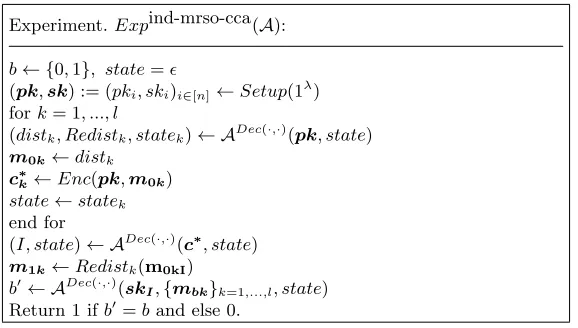
The security experiment for multi-message security is defined as in Fig. 6. The advantage is defined asAdvIND-mRSO-CCA
A =
2 Pr[Expind-mrso-cca(A) = 1]−1 .
Definition 10 (IND-mRSO-CCA).A PKE scheme is IND-RSO-CCA secure for multi-messages if for any PPT adversaryA,AdvIND-mRSO-CCA
A is negligible in λ.
Theorem 3. A PKE scheme is IND-RSO-CCA (CPA) secure for multi-message vectors if and only if it is IND-RSO-CCA (CPA) secure for single-message vector.
Proof. It is clear that single-time security can be implied by multi-time security as a special case.
To prove the opposite direction, we define a sequence of games that any PPT adversary cannot tell the difference between two adjacent games. Here we discuss the CPA case, situations in the CCA case are similar.
Gamek: the same as that in the definition except that for 0≤k≤l, in the corruption phase, the challenger responds to the adversary with (skI ={ski}i∈I,{mj1}j≤k,{mj0}j>k).
LetAdvAk the probability thatAoutputs 1 inGamek fork= 0, ..., l.
Lemma 10. If there exists a PPT adversaryAto distinguishGamek fromGamek+1, then there exists a PPT B to break the IND-RSO-CPA security for single-message vector. In concrete,AdvAk+1−Advk
A≤AdvBsIND-RSO-CPA.
Proof. Bproceeds as follows, on receivingpk, it sendspk= (pk1, ..., pkn) toA. WhenAsubmits a message samplerdistj,Bresponds withcj∗ as follows.
– forj6=k+ 1, it samplesmj0←distj, generatescj∗←Enc(pk,m j 0).
When A submits a corruption query withI, B sends the same I to its challenger and gets (skI,mb) as response, then it sets mk+1 =mb and samples m
j
1 ←Redist j(mj
0I) for
j < k, and responds toAwith (skI,{m j
1}j≤k,m
k+1,{mj
0}j>k+1). WhenAoutputs its guessb0, Boutputs the same bit b0. Note that when b = 0, that is, mk+1 = mk+1
0 , then the above game is identical to that of Gamek; when b = 1,mk+1 =mk+11 , then the above game is identical to that of
Gamek+1, henceAdvAk+1−Advk
A= Pr[b0= 1|b= 1]−Pr[b0= 1|b= 0] = 2(Pr[b0=b]− 1 2) =
AdvsIND-RSO-CPA
B .
It is clear thatGame0is the IND-RSO-CPA security experiment for multi-message vector whenb= 0, whileGamelis the IND-RSO-CPA security experiment for multi-message vector whenb= 1. Then we have:
AdvmIND-RSO-CPA
A = (Adv l A−Adv
0
A)≤lAdv
sIND-RSO-CPA
B .
B: Security Proofs for Lemmata of Theorem 1
Proof of Lemma 1.|Pr[W1]−Pr[W0]| ≤qAdvnizkcs , |Pr[W9]−Pr[W8]| ≤qAdvnizkcs .
Proof. LetE1 denote the event that in Game0 the PPT adversary promotes a decryption query with (vk, c1, c2,p, σ) such thatDec2(sk2, c2)=6 Dec(sk1, c1) andV(C, c1kc2kvk,p) = 1. Clearly, there is|Pr[W1]−Pr[W0]| ≤qPr[E1].
Next we prove that Pr[E1]≤Advcs
nizk. Let B be an algorithm that receives a common reference stringCas input and its task is to output ((c1, c2, vk),p) such thatDec2(sk2, c2)6=
Dec(sk1, c1) andV(C, c1kc2kvk,p) = 1. ThenBgenerates key pairs, sends (pk1, pk2,C) toA, and interacts withAas inGame0. When eventE1happens,Bresponds with ((c1, c2, vk),p).
|Pr[W9]−Pr[W8]| ≤qAdvnizkcs can be proved similarly.
Proof of Lemma 2.|Pr[W2]−Pr[W1]| ≤qAdvczk
nizk, |Pr[W8]−Pr[W7]| ≤qAdvnizkczk . Proof. LetB be an algorithm that receives a common reference stringC as input and can promote n queries (c1i, c2i, vki),(mi, r1i, r2i) and receives a proof pi, its task is to decide whether it is in a real world or a simulated world. On receiving C, B generates key pairs, sends (pk1, pk2,C) toA, and interacts withAas inGame1. WhenApromotes a distribution,
B picks m0 ← dist, picks random r1,r2, generates (vk,sigk) ← Sig.kg(1λ)n, computes
c1 =Enc1(pk1,m0;r1),c2 =Enc2(pk2,m0,vk;r2), sends (c1i, c2i, vki),(mi, r1i, r2i)i∈[n] to its challenger and receives proofs (pi)i∈[n], then it generates signatures (σi)i∈[n]and sends c∗to A.
Finally,BoutputsA’s outputb0.
Note that when B is in the real world of its computational zero-knowledge game, A
proceeds inGame2; when B is in the simulated world of its computational zero-knowledge game,Aproceeds inGame3.
Proof of Lemma 3.|Pr[W3]−Pr[W2]| ≤nqAdvsiguf−ot,|Pr[W7]−Pr[W6]| ≤nqAdvsiguf−ot. Proof. Define E3 to be the event that in Game3, the adversary promotes a decryption query satisfies that vk = vk∗z for some z and V er(vk, c1kc2kp, σ) = 1. Clearly, there is
|Pr[W3]−Pr[W2]| ≤qPr[E3].
Next we prove that Pr[E3]≤nAdvuf−otsig . LetB be an algorithm that receives a vk as input, then B generates key pairs, sends (pk1,pk2,C) to A, and interacts with A as in
Game3. When Apromotes a distribution dist, Bpicks m0←dist, picks random r1,r2, it
picks a random j ∈ [n], sets vkj = vk and generates (vki, sigki)← Sig.kg(1λ) for i6= j, computes c1 = Enc1(pk1,m0;r1),c2 = Enc2(pk2,m0;r2) and the simulated proof pj, sends (c1j, c2j,pj) to its challenger and receives a signatureσj, then it generates signatures (σi)i6=j and sendsc∗to A.
Since j is randomly chosen, the probability that j = z is exactly n1, when event E3 happens andj=z,B can promotes (c1kc2kp, σ) as a success forge.
|Pr[W7]−Pr[W6]| ≤qnAdvsiguf−ot can be proved similarly.
Proof of Lemma 4.|Pr[W4]−Pr[W3]| ≤nAdvccapke,|Pr[W6]−Pr[W5]| ≤nAdvpkecca. Proof. To prove that |Pr[W4]−Pr[W3]| ≤ nAdvcca
pke, we define a sequence of intermediate games {Hi}i=0,...,n. Let Hi be the same as Game Hi−1, except that the i-th ciphertext is change to be the encryption of a random message. H0 is Game3. Next we prove that
|Pr[b0 =b inHj]−Pr[b0=bin Hj−1]| ≤Advpkecca.
Let B be an IND-CCA adversary, on receiving pk, it sets pk2j = pk and generates
{pk1i}i∈[n] and {pk2i}i∈[n],i6=j normally, generates a simulated CRS C for NIZK, sends (pk1,pk2,C) toA.
– WhenAmakes decryption queries with ((vk, c1, c2,p, σ), i), ifi6=j, Banswers decryp-tion queries with sk2i; if i =j, B verifies the signature and NIZK, if both equations hold, it transmits (c2, vk) to its decryption oracle and sends the answer toA.
– WhenA promotes a distribution,B picks m0←dist and random{mRi}i=1,...,j, picks random r1,r2, and generates (vki, sigki) ← Sig.kg(1λ), it sends (m0j, mRj, vkj) to its challenger and sets the answer as c2j, then it computes c1i = Enc1(pk1i, m0i;r1i) and c2i = Enc2(pk2i, mRi;r2i) for i < j, c2i = Enc2(pk2i, m0i;r2i) for i > j and the simulated proofpi, signatureσi, sendsc∗ toA.
– WhenA’s outputb0 =b,Boutputs 1 and 0 else.
Note that whenc2jis an encryption ofm0j, the above game simulates GameHj−1perfectly; whenc2j is an encryption ofmRj, the above game simulates GameHj perfectly.
Proof of Lemma 5.|Pr[W5]−Pr[W4]| ≤Adv
ind−rso−cpa
pke .
Proof. Let B be an IND-RSO-CPA adversary, on receiving pk, it sets pk1i = pki and generates{pk2i}i∈[n] normally, generates a simulated CRSCfor NIZK, sends (pk1,pk2,C) toA.
– WhenApromotes a distribution (dist, Redist),Btransmits (dist, Redist) to its encryp-tion oracle and sets the answer as c1, then it picks random mR and random r2, and
generates (vki, sigki) ← Sig.kg(1λ), computes c2i = Enc2(pk2i, mRi, vki;r2i) and the simulated proofpi, signaturesσi, sendsc∗ toA.
– When Amakes the reveal query with I, Btransmits the same I to its challenger and sends the answer (mb,skI) toA.
– FinallyB setsA’s answer as its output.