Mobile Applications Scene Text Recognition by Character
Descriptor and Structure Configuration
Ch.Lakshmi Prasad
1& Koteswarao.M.
21.M.Tech student,Amara Institute of Engineering&Technology,JNTUK,NRT,AP.
2. Assistant professor,Amara Institute of Engineering&Technology,JNTUK,NRT,AP.
Abstract-
The text characters and strings in natural sciene can provide valuable and useful information for many applications. Extracting text directly from natural scene images or videos is a challenging task because of variant text patterns and variant background interferences. This project proposes a method of scene text recognition from detected text regions. In text detection, our previously proposed algorithms are applied to gain text regions from scene image. First, we design a discriminative character descriptor by combining several state-of-the-art feature detectors and descriptors. Second, we model character structure at each character class by designing stroke configuration maps. Our algorithm design is compatible with the application of scene text extraction in smart mobile devices. An Android-based demo system is developed to show the effectiveness of our proposed method on scene text information extraction from nearby objects. The demo system also provides us some insight into algorithm design and performance improvement of scene text extraction. The evaluation results on benchmark data sets demonstrate that our proposed scheme of text recognition is comparable with the best existing methods.
Keywords— Scene text detection; scene text
recognition; mobile application; character
descriptor; stroke configuration; text understanding;
text retrieval; mobile application
.
1. INTRODUCTION
characters. Text recognition technique distinguishes different characters which are part of text word. We have presented two schemes text recognition process. First, a character recognizer to predict the category of a character in an image patch. Second, binary classifier which predicts existence of category.
Two schemes of text recognition are
compatible with applications related to scene text, which are text understanding and text retrieval. Text understanding acquires text information from natural scene to understand surrounding environment and objects, while text retrieval matches some stated user query against a set of free-text records. we design a
discriminative character descriptor by
combining several state-of-the-art feature detectors and descriptors.We model character structure at each character class by designing stroke configuration maps. It involves 62 identity categories of text characters, including 10 digits [0-9] and 26 English letters in upper case [A-Z] and lower case [a-z]. An Android- based demo system is developed to show the effectiveness of our proposed method on scene text information extraction from nearby objects. Besides, previous work rarely presents the mobile implementation of scene text extraction, and we transplant our method into an Android based platform. We propose an Android application that detects the text information within an image taken with a mobile phone camera, extracts it, recognizes it and translates it.
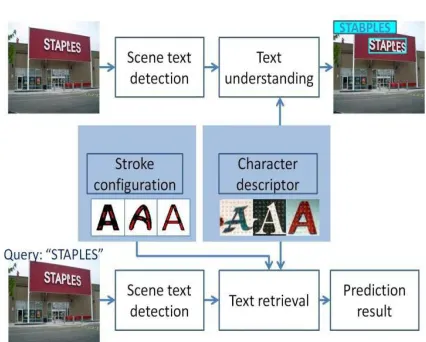
Fig .1. The flowchart of our designed scene text extraction method.
Objective of this system is the extraction of text from any image and then displaying its related information on the mobile screen. Main goal of this system is that if a person doesn’t have or know any specific thing then he/she could get its information with the help of this android application. In text extraction feature text is being extracted from the natural scene or an image. Here text extraction is done with the help of character with the description and stroke configuration. Firstly the text will be detected, understood and then recognized. In searching process extracted text is being searched over net or in database. Here searching is done with the help of item ranking according to the item of interest. It basically derives meta data information about the item of interest by extending the user’s given interest.
2.EXISTING SYSTEM:
characters from different categories are distinguished by boundary shape and skeleton structure, which plays an important role in designing character recognition algorithm. Current optical character recognition (OCR) systems can achieve almost perfect recognition rate on printed text in scanned documents. In the existing system the inner character structure is modelled by defining a dictionary of basic shape codes to perform character and word retrieval without OCR on scanned documents.
In Scale Invariant Feature Transform (SIFT) feature matching was adopted to recognize text characters in different languages, and a voting and geometric verification algorithm was presented to filter out false positive matches. Dictionary of words to be spot is built to improve the accuracy of detection and recognition. Character structure was modelled by HOG features and cross correlation analysis of character similarity for text recognition and detection. In, Random Ferns algorithm was used to perform character detection and constructed a system for query-based word detection in scene images. The disadvantages of existing system are: The existing system cannot accurately recognize text information directly from camera-captured scene images and videos. The existing system is sensitive to font scale changes and background interference.
3.PROPOSED SYSTEM
We have presented a method of scene text recognition from detected text regions, which is compatible with mobile applications. It detects text regions from natural scene image/video, and recognizes text information from the detected text regions. In scene text detection, layout analysis of colour decomposition and
horizontal alignment is performed to search for image regions of text strings. In scene text recognition, two schemes, text understanding and text retrieval, are respectively proposed to extract text information from surrounding
environment. Our proposed character
descriptor is effective to extract representative and discriminative text features for both recognition schemes. The main aadvantages of proposed system are:
Proposed system is compatible with
mobile applications.
Text understanding and Text retrieval
are used to extract text from the surrounding
Produces more efficiency.
4.RELATED WORK
I present a general review of previous work on scene text recognition respectively. I observe that text characters from different categories are distinguished by boundary shape and skeleton structure, which plays an important
role in designing character recognition
SIFT reduces false positive rates by more than an order of magnitude relative to the best Haar wavelet based detector . Another source of information is found in the similarity and dissimilarity between pairs of characters. Weinman and Learned-Miller two characters which have nearly identical appearance have different labels. Text recognition system using above source of information have proved that two characters which have nearly identical appearance have different labels.
5. LAYOUT-BASED SCENE TEXT
DETECTION
Layout Analysis of Color Decomposition:
Test strings on signage boards consist of characters in uniform color and aligned arrangement. We can locate text information by extracting pixels with similar colors. A boundary clustering algorithm based on bigram color uniformity in our previous work [3]. Text boundaries on the border of text and its
attachment surface are described by
characteristic color-pairs, and we are able to extract text by distinguishing boundaries of
characters and strings from those of
background outliers based on color pairs. We then model color difference by a vector of color pair, which is obtained by cascading the RGB colors of text and attachment surfaces. Each boundary can be described by a color-pair, and we cluster the boundaries with similar color pairs into the sample layer. The boundaries of text characters are separated from those of
background outliers. Layout Analysis of
Horizontal Alignment: In each color layer, we
analyze geometrical properties of the
boundaries to detect the existence of text characters. According to our observation, text information generally appears in text strings
composed of several character members in similar sizes rather than single character, and text strings are normally in approximately horizontal alignment. This method involves following steps. Here we assume that length of signage and other text is enough to get benefit from repeatability of words while decoding. Here adjacent character grouping method is adopted from previous work [4]. For each connected component C we search for its siblings in similar size and vertical locations. When connected components C and C′ are grouped together as sibling components, their sibling sets will be updated according to their relative locations. When C is located on the left of C′, C′ will be added into the right-sibling set of C, which is simultaneously added into the left-sibling set of C′. For connected component C, if several siblings are obtained on its left and right, then we merge all these involved siblings into a region. This region contains a fragment of text string. To create sibling groups corresponding to complete text strings, we repeat above method to calculate all text string fragments in this color layer, and merge the string fragments with intersections.
6. STRUCTURE-BASED SCENE
TEXT RECOGNITION
Our goal is to find the most likely word from this set of characters. We formulate this problem in an energy minimization framework, where the best energy solution represents the ground truth word we aim to find. The text retrieval schemes to verify whether a piece of text information exists in natural scene. In text
retrieval, binary classifier distinguishes
character class from other classes or
background outliers. In text understanding
classification problem. For each of the 62 character classes, we train a binary classifier to distinguish a character class from the other classes or non- text outliers. The specified character classes are defined as queried characters. In text retrieval, to better model
character structure, we define stroke
configuration for each character class based on specific partitions of character boundary and skeleton. In the text recognition technique as used the Optical Character Recognition (OCR) process is divided into following phases preprocessing, segmentation, feature extraction and classification.
Input Image
Fig .2.Optical Character Recognition
Character Descriptor
Four types of character descriptors are used to model character structure. Harris detector to extract key points from corners and junctions. MSER detector to extract key points from stroke components. Dense detector extracts key points uniformly. Random detector extracts present number of key points in a random pattern. By cascading BOW and GMM – based feature representations we get character descriptor as shown in figure 2 below. In GMM model the numbers and locations of key points from each patch should be identical. Therefore, it is only applied to the key points from DD and
RD. Four feature detectors are able to cover
almost all representative key points related to the character structure. At each of the extracted key points, the HOG(Histogram of Oriented Gradients) feature is calculated as an observed feature vector x in feature space. Each character patch is normalized into size 128 × 128, containing a complete character. In the process of feature quantization, the Bag-ofWords Model and Gaussian Mixture Model are employed to aggregate the extracted features. BOW model represent the frequency of word occurrence, but not their position. SIFT and SURE are not employed in our method because their performance on character recognition is low. Every character patch is normalized into size 128 × 128 containing complete character. In both models, character patch is mapped into characteristic histogram as feature representation.
BOW Model -The BOW representation is computationally efficient and resistant to intra-class variations. At first, k-means clustering is performed on HOG features extracted from training patches to build a vocabulary of visual words. Then feature coding and pooling are performed to map all HOG features from a character patch into a histogram of visual words. We adopt soft-assignment coding and average pooling schemes in the experiments. More other coding/pooling schemes will be
tested in our future work. At a character patch,
the four detectors are applied to extract their
respective key points, and then their
corresponding HOG features are mapped into the respective vocabularies, obtaining four frequency histograms of visual words. Each histogram has 256 dimensions. Then we cascade the four histograms into BOW-based Pre-Processing
Segmentation
Feature exaction
feature representation in 256 × 4 = 1024 dimensions.
Character Stroke Configuration:- In previously proposed method stroke width consistency is used to detect scene text in complex background and achieve outstanding performance. Stroke is region bounded by two parallel boundary segments. Their orientation is regarded as stroke orientation and the distance between them is regarded as stroke width. The
stroke configuration is estimated by
synthesized characters generated from
computer software. Character boundary and character skeleton are obtained by applying discrete contour evolution (DCE) [10] and skeleton pruning on the basis of DCE [11]. The accuracy of the skeleton position and stability of skeletons is guaranteed in this pruning method.DCE and skeleton pruning are invariant to deformation and scaling. Our estimate the stroke width and orientation on sample points of character boundary. N points are sampled evenly from the polygon character boundary, with the polygon vertices reserved. In our experiment, we set N = 128. The number of points to be sampled on each side of the polygon boundary is proportional to its length. Secondly, stroke is contiguous part of an image that forms a band of a nearly constant width. We take b and its two neighboring sample points to fit a line when they are approximately collinear or else quadratic curve. Then the slope or tangent direction at b is used as stroke orientation. Characters are connected strokes with orientation. Thirdly, we calculate the skeleton-based stroke maps. At each boundary sample point, values of stroke width and orientation are compared with its neighboring points. Constituency of stroke width and
orientation consistency 3 and π/8 respectively. Construct stroke section if sample points satisfy stroke related features. If not construct junction. These parameters are compatible with the synthesized character patches with size 128 × 128. While the other sample points, around 100.
7. CONCLUSION
Thus this paper achieves the objective of text extraction from image and displaying its information on android platform, with the help of text extraction algorithm.It detects text regions from natural scene image/video, and recognizes text information from the detected text regions. Text understanding and text retrieval are respectively proposed to extract
text information from surrounding
environment. Character descriptor is effective to extract representative and discriminative text features for both recognition schemes. To model text character structure for text retrieval scheme, we have designed a novel feature representation, stroke configuration map, based on boundary and skeleton. Quantitative experimental results demonstrate that proposed method of scene text recognition outperforms most existing methods.
8.REFERENCES
[1] Chucai Yi, ―Scene Text Recognition in
Mobile Applications by Character Descriptor and Structure on figuration, ‖IEEE Trans.
Image Process., vol. 23, no. 7,
July2014,pp.2972-2982.
[2] D. L. Smith, J. Feild, and E.
[3] C. Yi and Y. Tian, ―Localizing text in scene images by boundary clustering, stroke
segmentation, and string fragment
classification,‖ IEEE Trans. Image Process., vol. 21, NO. 9, PP. 4256–4268, SEP. 2012.
[4] C. Yi and Y. Tian, ―Text string
detection from natural scenes by structure-based partition and grouping,‖ IEEE Trans. Image Process., vol. 20, no. 9, pp. 2594– 2605, Sep. 2011.
[5] N. Dalal and B. Triggs, ―Histograms of
oriented gradients for human detection,‖ in Proc. IEEE Conf. Comput. Vis. Pattern Recognit., Jun. 2005, pp. 886–893.
[6] T. de Campos, B. Babu, and M. Varma,
―Character recognition in natural images,‖ in Proc. VISAPP, 2009.
[7] B. Epshtein, E. Ofek, and Y. Wexler.
Detecting text in natural scenes with stroke width transform. In CVPR, 2010.
[8] M. Everingham, L. Van Gool, C. K. I.
Williams, J. Winn, and A. Zisserman. The pascal visual object classes (voc) challenge. IJCV, 2010.
[9] 9 C. Colombo, A. D. Bimbo, and P.
Pala, Semantics in Visual Information Retrieval, IEEE Multimedia, 6 (3) (1999) 38-53.
[10] T. Sato, T. Kanade, E. K. Hughes, and M. A. Smith, Video OCR for Digital News Archive, Proc. of IEEE Workshop on Content
based Access of Image and Video Databases, 1998, pp. 52-60.