Tao Huang, Ivan Tjuawinata, Hongjun Wu
Division of Mathematical Sciences School of Physical and Mathematical Sciences,
Nanyang Technological University, Singapore
[email protected] [email protected]
Abstract. ICEPOLE is a CAESAR candidate with the intermediate level of robustness un-der nonce misuse circumstances in the original document. In particular, it was claimed that key recovery attack against ICEPOLE is impossible in the case of nonce misuse. ICEPOLE is strong against the differential cryptanalysis and linear cryptanalysis. In this paper, we de-veloped the differential-linear attacks against ICEPOLE when nonce is misused. Our attacks show that the state of ICEPOLE–128 and ICEPOLE–128a can be recovered with data com-plexity 246and time complexity 246; the state of ICEPOLE–256a can be recovered with data complexity 260and time complexity 260. For ICEPOLE–128a and ICEPOLE–256a, the secret
key is recovered once the state is recovered. We experimentally verified the attacks against ICEPOLE–128 and ICEPOLE–128a.
Key words: ICEPOLE, Authenticated cipher, CAESAR, Differential-linear cryptanalysis
1
Introduction
ICEPOLE is a new hardware-oriented single-pass authenticated cipher designed by Morawiecki et al.. It was submitted to the CAESAR competition [14] and published in CHES 2014 [15]. ICEPOLE is designed to be hardware-efficient. It can achieve 41 Gbits/s on the modern FPGA device Virtex 6 which is over 10 times faster than the equivalent implementation of AES-128-GCM [12]. ICEPOLE adopts the well-known duplex construction by Bertoniet al. [2] and uses a Keccak-like permutation as its iterative function.
The ICEPOLE family of authenticated ciphers includes three variants: ICEPOLE-128, ICE-POLE–128a and ICEPOLE–256a. Note that the definition of ICEPOLE–128 has been slightly mod-ified in the CHES 2014 version, which removed the use of secret message number. In this paper, we will follow the version submitted to the CAESAR competition. For the security of ICEPOLE, the designers claim that the confidentiality is the same as the key length, which is 128-bit for ICEPOLE–128 and ICEPOLE–128a and 256-bit for ICEPOLE–256a. The authentication security is 128-bit for all the three variants. In particular, it is mentioned in the document that the internal permutation is strong enough such that “in the case of nonce reuse the key-recovery attack is not possible” and the authenticity “is not threatened by nonce reuse”.
In this paper, we apply the differential-linear cryptanalysis to study the security of the permuta-tion of the ICEPOLE family. The differential-linear cryptanalysis is the combinapermuta-tion of differential cryptanalysis [5] and linear cryptanalysis [11]. It was introduced by Langford and Hellman in [9] in 1994 to attack the block cipher DES, and later Biham, Dunkelman and Keller gave an enhanced version of this method [3] . This method has been applied to analyze a number of block ciphers such as Serpent [4, 7], CTC2 [8, 10] and SHACAL–2 [16]. Differential-linear attack is also successful in the analysis of certain stream ciphers, e.g., Phelix which involves the message in the state update function [17].
Although the design of authenticated cipher ICEPOLE is different from block ciphers, we manage to exploit the differential-linear property of the permutation when the nonce is reused1. We show 1 Herenonce includes the public message number and secret message number. The associated data is set
that under the nonce-reuse assumption, there exists distinguishing attacks on ICEPOLE with both time and data complexity less than 236. Furthermore, it is possible to recover the 256 bits unknown state of ICEPOLE–128 and ICEPOLE–128a with practical complexity 246, and recover the 320 bits unknown state of ICEPOLE–256a with complexity 260. We experimentally verified our results by recovering the state of ICEPOLE–128 using a 64-core server within 10 days. Thus, the security claims of ICEPOLE do not hold under the nonce-reuse circumstances.
Due to the analysis of this paper, the designers have updated the security claims as “in the case of nonce misuse, the intermediate level of robustness (specified in the documentation) holds only when the SMN is present and respected, namely each message has the corresponding, unique secret message number” [13]. In the presence of unique SMN, the attack in this paper will no longer work. The reason is that the unique SMN plays the role of the nonce in the initialization, and prevents the differential attack in the message processing.
The rest of this paper is structured as follows: The specification of ICEPOLE is given in Section 2. Section 3 describes a differential-linear distinguishing attack on ICEPOLE. Section 4 introduces the state-recovery attack. Section 5 provides our experimental results of the state-recovery attack on ICEPOLE-128. Section 6 concludes the paper.
2
The ICEPOLE Authenticated Cipher
The ICEPOLE family of authenticated ciphers uses three parameters: key length (128 or 256 bits), secret message number (SMN) length (0 or 128 bits) and nonce length (96 or 128 bits). ICEPOLE –128 has 128-bit secret message number, 128-bit key, and 128-bit nonce. The other two variants, ICEPOLE –128a and ICEPOLE –256 a, have no secret message number with 128- and 256-bit secret key respectively. The nonce length for these two variants is 96-bit. We will briefly describe the specification of ICEPOLE authenticated cipher. The full specification can be found in [14]. An overview of ICEPOLE–128 is provided in Figure 1.
Fig. 1.General scheme of ICEPOLE encryption and authentication (Fig. 1 of [14])
2.1 Notations
2.2 The ICEPOLE permutation P
The permutation P is applied iteratively on the ICEPOLE state S during the encryption and authentication. Each permutation is called around orR. The 6–and 12–round ofP are represented as P6 andP12respectively. Each round includes five operations: µ,ρ,π,ψ, andκ.
R=κ◦ψ◦π◦ρ◦µ
The operations are defined as follows: µ:
A column vector (Z0, Z1, Z2, Z3) is multiplied by a constant matrix to produce a vector of four
5-bit words.
2 1 1 1 1 1 18 2 1 2 1 18 1 18 2 1
×
Z0
Z1
Z2
Z3
=
2Z0+Z1+Z2+Z3
Z0+Z1+ 18Z2+ 2Z3
Z0+ 2Z1+Z2+ 18Z3
Z0+ 18Z1+ 2Z2+Z3
The operations are done in GF(25). The irreducible polynomial x5+x2+ 1 is used for the field
multiplication. And µ can be efficiently implemented with simple bitwise equations, see Appendix B in [14].
ρ:
Theρstep is the bitwise rotation on each of the 20 64-bit words. It is defined as:
ρ(S[x][y]) =S[x][y]≪offsets[x][y] for all(0≤x≤3), (0≤y≤4)
The rotation offsets are as follows:
offset[0][0] := 0 offset[0][1] := 36 offset[0][2] := 3 offset[0][3] := 41 offset[0][4] := 18 offset[1][0] := 1 offset[1][1] := 44 offset[1][2] := 10 offset[1][3] := 45 offset[1][4] := 2 offset[2][0] := 62 offset[2][1] := 6 offset[2][2] := 43 offset[2][3] := 15 offset[2][4] := 61 offset[3][0] := 28 offset[3][1] := 55 offset[3][2] := 25 offset[3][3] := 21 offset[3][4] := 56 π:
πreorders the bits within each slice. It mapsS[x][y] toS[x0][y0] using following rule:
- x0 := (x+y) mod 4
- y0:= (((x+y) mod 4) +y+ 1) mod 5 φ:
φis the S-box layer. ICEPOLE uses following 5-bit S-box:
{31,9,18,11,5,12,22,15,10,3,24,1,13,4,30,7, 20,21,6,23,17,16,2,19,26,27,8,25,29,28,14,0}
Theφapplies the 5-bit S-box to all the 256 rows of the state. κ:
2.3 Initialization
First, the stateS is initialized with 1280-bit constant:
S[0][0] := 0XFF97A42D7F8E6FD4 S[0][1] := 0X90FEE5A0A44647C4 S[0][2] := 0X8C5BDA0CD6192E76 S[0][3] := 0XAD30A6F71B19059C S[0][4] := 0X30935AB7D08FFC64 S[1][0] := 0XEB5AA93F2317D635 S[1][1] := 0XA9A6E6260D712103 S[1][2] := 0X81A57C16DBCF 555F S[1][3] := 0X43B831CD0347C826 S[1][4] := 0X01F22F1A11A5569F S[2][0] := 0X05E5635A21D9AE61 S[2][1] := 0X64BEFEF28CC970F2 S[2][2] := 0X613670957BC46611 S[2][3] := 0XB87C5A554FD00ECB S[2][4] := 0X8C3EE88A1CCF32C8 S[3][0] := 0X940C7922AE3A2614 S[3][1] := 0X1841F924A2C509E4 S[3][2] := 0X16F53526E70465C2 S[3][3] := 0X75F644E97F30A13B S[3][4] := 0XEAF1FF7B5CECA249
Then, the key (K) and thenonceare XORed to the state. Thenonceis 128-bit for ICEPOLE–128. And the 96-bitnoncefor ICEPOLE–128a and ICEPOLE–256a will be padded with 32 zeros to form a 128-bitnonce.nonce0 andnonce1 denote two 64-bit words of the padded nonce.
For ICEPOLE–128 and ICEPOLE–128a,K0 andK1 denote two 64-bit words of the key,
S[0][0] :=S[0][0]⊕K0
S[1][0] :=S[1][0]⊕K1
S[2][0] :=S[2][0]⊕nonce0
S[3][0] :=S[3][0]⊕nonce1
For ICEPOLE–256a,K0,K1,K2andK3 denote four 64-bit words of the key,
S[0][0] :=S[0][0]⊕K0
S[1][0] :=S[1][0]⊕K1
S[2][0] :=S[2][0]⊕K2
S[3][0] :=S[3][0]⊕K3
S[0][1] :=S[0][1]⊕nonce0
S[1][1] :=S[1][1]⊕nonce1
After that, the P12 permutation is applied to the stateS.
2.4 Processing associated data and plaintext
ICEPOLE–128 uses 128-bit secret message number (SMN)σSM N. It will be processed before
asso-ciated data and the plaintext. Since ICEPOLE–128a and ICEPOLE–256a do not have SMN, only the associated dataσAD
i and the plaintextσPi will be processed.
For ICEPOLE–128 and ICEPOLE–128a, the length of blocksσAD
i andσPi is in the range [0,1024]
bits. The blocks will be padded to 1026 bits according to following rule. First, aframe bitis appended. It is set to ‘1’ for the lastσADblock and allσP
i except the last one. For all other blocks, it is set to
‘0’. Then, a bit ‘1’ is appended, following by ‘0’s to make the length of padded block be 1026-bit. The number of blocks under a single key is less than 2126.
For ICEPOLE–256a, the associated data and plaintext blocks have length in the range [0,960]. The same padding rule is applied and the padded blocks have length 962-bit. The number of blocks under a single key is less than 262.
σSM N :=pad(σSM N) Sb1026c:=Sb1026c⊕σSM N
S:=P6(S)
The process of associated data and plaintext blocks is as below: for allblocksσAD
i {
σAD
i :=pad(σiAD)
Sb1026c :=Sb1026c⊕σADi
S:=P6(S)
}
for allblocksσP i {
ci:=Sblc⊕σPi (l is the length ofσPi )
σiP :=pad(σiP)
Sb1026c :=Sb1026c⊕σPi
S:=P6(S)
}
2.5 Tag generation
After the AD and P are processed, the 128-bit tagT is derived: (T0 andT1 are two 64-bit words of
T).
T0:=S[0][0]
T1:=S[0][1]
The decryption and verification is trivial and we omit it here.
2.6 Security goals of ICEPOLE
The main security goals of ICEPOLE are: 128-bit encryption security for ICEPOLE–128 and ICEPOLE–128a; 256-bit encryption security for ICEPOLE–256a; and 128-bit authentication se-curity for all variants.
An important property of ICEPOLE is that the intermediate level of robustness under nonce-misuse circumstance. It claimed that
1. “...in the case of nonce reuse the key-recovery attack is not possible”.
2. “Authenticity (integrity) in the duplex construction does not need a nonce requirement, thus is not threatened by nonce reuse.
3
Differential-Linear Distinguishing Attack on ICEPOLE
In [14], the designers have performed initial cryptanalysis on ICEPOLE, including the differential cryptanalysis, linear cryptanalysis and rotational cryptanalysis. In this section, we will revisit the cryptanalysis in [14] and introduce our analysis on ICEPOLE based on the differential-linear crypt-analysis. We would like to emphasize that our attacks only work under the assumption that the nonce andsecret message number can be reused.
The main idea is to query messages with certain input difference and analyze the statistics of the differences of chosen bits (according to the linear mask) in the output. When the XORed differences of the chosen bits have a significant bias from 0.5, the adversary can distinguish the cipher from a random permutation. In [10], Lu studied the implicit assumptions made in [9] and [3] and gave a theorem to compute the probability for the differential-linear distinguisher under the original two assumptions:
2. The two inputsE0(P) andE0(P⊕α) of the linear characteristic forE1behave as independent
inputs with respect to the linear characteristic, where E0 is the encryption for the differential
rounds and E1 is the encryption for the linear rounds, P is the plaintext and α is the input
difference.
Let ˆpbe the probability that the input of the linear mask has no XORed difference after the differential step while be the linear characteristic bias for the linear step. The theorem says that the probability that the XORed difference of the output linear mask to be 0 is 12 + 2(2ˆp−1)2.
In [6], C´eline et al. further developed a method on computing the bias which only relies on the independence of the two parts of the cipher.
Hence, when the bias is large enough, it is possible to distinguish it from a random permutation. In the analysis on ICEPOLE, we first divide the encryption P6 into two parts with equal number
of rounds. So the first 3 rounds will be the differential step and the last 3 rounds will be the linear step.
Our task is to find good 3-round differential characteristics and 3-round linear characteristics. Unless otherwise specified, we are discussing the ICEPOLE–128 and ICEPOLE–128a in this section under the nonce-misuse assumption. The ICEPOLE–256a is similar and we will discuss it later.
3.1 Constructing the differential characteristics
In ICEPOLE, S-box is the only non-linear operation, and the maximum differential probability of the S-box is 2−2. The differential probability is largely determined by the number of active
S-boxes. Although the designers expected that only 3% of the difference transitions has the maximum probability 2−2, this probability is not rare in the early rounds. This is because most of the active
S-boxes have 1 bit input difference after the diffusion and the differential probability of a single ICEPOLE S-box is 2−2 when the input and output differences are identical with weight 1. Those 1-to-1 identical difference transitions are preferred to the 1-to-n(n≥2) cases even with the same probability as they will propagate to less number of active S-boxes in the next round.
In [14], the designers analyzed the minimum number of active S-boxes using SAT solver and found that the minimum number is 9 for 3 rounds ICEPOLE. There is an intuitive way to construct the differential characteristics reach this lower bound. We can place 1 active S-box in the middle round and let it propagate backward and forward for one round. Then the number of active S-boxes will be in the form of 4–1–4, which reaches the minimum number 9.
However, the above 3 round differential path is not feasible. In fact, only at most 1024 bits(for ICEPOLE–256a, 960 bits) out of the 1280 bits in a state can be affected by the plaintext and are feasible to introduce difference. Thus, we have the following observation on the operationµ.
Observation 1 For any 20-bit slice, when the output difference is one bit after µ, there is at least one bit input difference at the last column (S[·][4]).
This observation can be easily verified by analyzing the inverse operation ofµ.
Therefore, when an active S-box is propagated backward, it is likely that a number of active bits will be propagated to the last column of the input state, which is infeasible to introduce. And we programed to verify that it is impossible to find such feasible 4–1–4 differential path.
It implies that for any feasible differential characteristics of ICEPOLE, the minimum number of active S-boxes is 2 in the first round. As a result, we will consider the differential characteristics with two active S-boxes in the first round. The ideal case is that the output difference of each active S-box is only 1-bit. Then afterµ, this 1-bit difference in a slice will propagate to 4 bits. So we expect the good differential characteristics will have 8 active S-boxes in round 2 and no more than 32 active S-boxes in round 3.
We searched for good 3-round differential characteristics, and found 5 possible initial differences in Table 1 (the rotated differences on the 64-bit word are not considered here), which can lead to feasible 3-round differential characteristics. We will name them asD1,D2,D3, D4 andD5.
(a)D1 0x0 0x0 0x1 0x0 0x0 0x1 0x0 0x1 0x0 0x0 0x1 0x1 0x1 0x1 0x0 0x0 0x1 0x0 0x0 0x0
(b) D2 0x0 0x0 0x1 0x0 0x0 0x1 0x1 0x1 0x1 0x0 0x0 0x1 0x0 0x1 0x0 0x1 0x0 0x1 0x0 0x0
(c)D3 0x1 0x1 0x0 0x0 0x0 0x1 0x0 0x0 0x1 0x0 0x0 0x0 0x0 0x1 0x0 0x1 0x1 0x1 0x0 0x0
(d)D4 0x0 0x0 0x0 0x0 0x0 0x1 0x0 0x1 0x0 0x0 0x1 0x1 0x1 0x1 0x0 0x0 0x1 0x0 0x1 0x0
(e)D5 0x0 0x0 0x0 0x0 0x0 0x0 0x1 0x0 0x1 0x0 0x1 0x0 0x1 0x0 0x0 0x1 0x1 0x1 0x1 0x0
Table 1.The initial differences. Each entry represents a 64-bit word.
are satisfied. As long as the number of active S-boxes is relatively low (note that 32 is only 1/8 of the total 256 S-boxes), there is a high probability for the differential step.
3.2 Constructing the linear characteristic
The bias of an ICEPOLE linear characteristic is determined by the S-boxes involved in the linear characteristic. We use the following method to construct the 3-round linear characteristics.
Take a single bit in both the input and output masks of an S-box in the middle round. Then find related bits in the input of the first round (input linear mask) and the output of the third round before S-box (output linear mask), assuming that the S-boxes are identical mappings. The rationale here is that the 1-bit identical mappings have a bias 163, it nearly reaches the maximum bias 2−2 while keeping the masks low-weight.
The most essential criterion for the input and output masks is low-weight. When the input linear mask has lower weight, the probability that the input linear mask does not have XORed difference after the 3-round differential step will be higher. When the output linear mask has lower weight, less number of active S-boxes in round 6 will be involved in the linear relation.
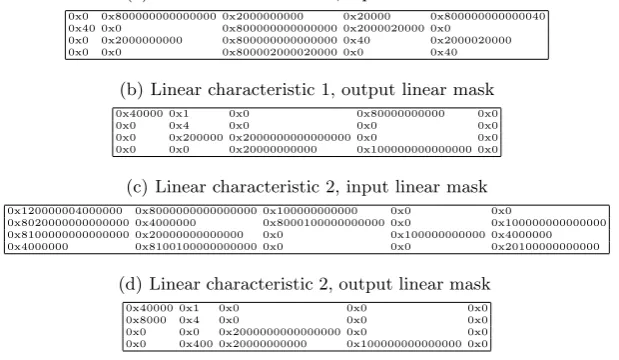
Two good linear characteristics we found are given in Table 2. They are denoted asL1 andL2.
(a) Linear characteristic 1, input linear mask
0x0 0x800000000000000 0x2000000000 0x20000 0x800000000000040 0x40 0x0 0x800000000000000 0x2000020000 0x0
0x0 0x2000000000 0x800000000000000 0x40 0x2000020000 0x0 0x0 0x800002000020000 0x0 0x40
(b) Linear characteristic 1, output linear mask
0x40000 0x1 0x0 0x80000000000 0x0 0x0 0x4 0x0 0x0 0x0 0x0 0x200000 0x2000000000000000 0x0 0x0 0x0 0x0 0x20000000000 0x100000000000000 0x0
(c) Linear characteristic 2, input linear mask
0x120000004000000 0x8000000000000000 0x100000000000 0x0 0x0
0x8020000000000000 0x4000000 0x8000100000000000 0x0 0x100000000000000 0x8100000000000000 0x20000000000000 0x0 0x100000000000 0x4000000 0x4000000 0x8100100000000000 0x0 0x0 0x20100000000000
(d) Linear characteristic 2, output linear mask
0x40000 0x1 0x0 0x0 0x0 0x8000 0x4 0x0 0x0 0x0 0x0 0x0 0x2000000000000000 0x0 0x0 0x0 0x400 0x20000000000 0x100000000000000 0x0
Table 2. The linear characteristics, assuming S-boxes are identical mappings
3.3 Observations to improve the attack
Observation 2 When the 1024 bitsS[0..3][0..3]of an ICEPOLE state S are known, we are able to determineS[0][2],S[1][3],S[2][4],S[3][0],S[3][2]after µ,ρandπ operations are performed onS.
According to the above observation, we are able to determine the values of certain input bits to the S-boxes in the first round. Thus, we can update the differential tables for the S-boxes with fixed input values.
The following example shows how this will help to improve the differential probability. Suppose the input of an S-box is in the form “1∗0∗ ∗”, where the ‘∗’s are the unknown bits and the ‘1’ and ‘0’ are the bits with fixed values, and the input difference is 2, then the output difference is 2 with probability 1, which is larger than the 0.25 in the general case. To get the fixed values, we can manipulate the input bits according to the mask in Table 3.
0x0 0x800000010 0x200000001 0x0 0x0 0x800000010 0x0 0x0 0x200000001 0x0 0x0 0x800000010 0x0 0x200000001 0x0 0x800000010 0x0 0x800000010 0x200000001 0x0
Table 3. Input mask for the fixed bits in round 1.
By setting the bits in S[0][1] selected by the mask 0x800000010 as ‘1’ and all the other bits selected by the other masks as ‘0’, the two active S-boxes in round 1 will satisfy the above condition on the input values.
Our next observation is about the S-box in the round 6 ofP6.
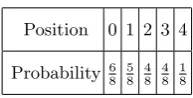
Observation 3 When 4 of the 5 bits in the output of an S-box are known, it is possible to recover some of the input bits from the output bits of the S-boxes. Table 4 provides the probability that we can recover a bit at each position of the S-box input.
Position 0 1 2 3 4
Probability 6 8
5 8
4 8
4 8
1 8
Table 4.Probability that the input bits can be recovered for an S-box at round 6.
Since the ciphertext is generated by XORing the keystream and the plaintext, we can obtain the values of at most 1024 bits in the state after 6 rounds. For ICEPOLE–128 and ICEPOLE–128a, 4 of the 5 bits in the output of all the S-boxes are known. And for ICEPOLE–256a, 4 of the 5 bits for 192 S-boxes and 3 of the 5 bits for 64 S-boxes in the output are known.
Therefore, instead of using the bias of the linear relation in the round 6, we can recover the chosen input bits in round 6 before S-box by enumerating the values of output bits. This can then be used to recover the value of the bit in the linear relation in the output of round 5.
For example, if we consider the output linear mask of L1, the probability that we can recover
the 8 bits can be computed as
P rL1 = (3/4)×(5/8)
3×(1/2)4= 2−6.45.
And using these 8 bits, we can compute the value of bitS[1][1][0] at the output of round 5. Similarly, the probability forL2 is
P rL2= (3/4)
3.4 Concatenating the differential and linear characteristics
After the 3-round differential characteristics and 3-round linear characteristics are constructed, we can concatenate them to form 6-round differential-linear characteristics.
First, we choose the initial differenceD2because the two active S-boxes in round 1 are in the last
row which has two known bits. The difference of state before the S-box for D2 is given in Table 5.
0x0 0x0 0x0 0x0 0x0 0x0 0x0 0x0 0x0 0x0 0x0 0x0 0x0 0x0 0x0 0x0 0x400 0x20000000000 0x0 0x0
Table 5.The difference of state before the first S-box inD2.
To choose the 3-round linear characteristic, we consider all the possible rotations of the two linear characteristicsL1andL2 given in Section 3.2. There are 128 possible rotated linear characteristics.
The selection of linear characteristic is done experimentally:
1. Randomly pick 1024-bit plaintext blocks pairs with the chosen initial differenceD2and the fix
values (1, 0) for the two known bits at positions 0 and 2 in the round 1 active S-boxes.
2. After 5 rounds, verify whether the XORed difference of the states under the linear characteristic is zero or not. If it is zero, add it to a countercntSame.
3. Repeat the above process, and choose the one with highest bias atcntSamefrom 0.5.
ForD2 as the initial difference, the highest bias is 2−9.2 when the linear characteristicL1 left
rotated by 33 bits is used.
We remark that since round independence does not hold in the case of ICEPOLE, the experi-mental results would be better choices for the biases rather than the theoretical estimation.
From the bias above, we immediately get a distinguishing attack on ICEPOLE.
1. Generate 233.9pairs of two-block plaintext such that the first 1024-bit plaintext block has initial
differenceD2 and the fixed values as specified above. All the other bits are random.
2. Use ICEPOLE to encrypt the plaintext blocks and then decide the 1024 bits input and output state of the first P6. Discard those pairs if the two bits in round 5 output in the linear
char-acteristicL1 left rotated 33 bits cannot be recovered. Note that for each bit, the probability is
2−6.45to recover. So there are 221 pairs left. Then compute the bit at positionS[1][1][33] of the output of round 5 using the recovered bits from round 6.
3. Analyze the bias of the XORed difference of those two bits (S[1][1][33]). If the bias is larger than 2−10.2 we conclude that it is the ICEPOLE encryption.
The success probability is computed by using the normal distribution to approximate the bi-nomial distribution of the bias. For ICEPOLE, the bias is a random variable X ∼ N(n(1/2 + 2−9.2), n(1/2 + 2−9.2)(1/2−2−9.2)), where nis the number of pairs of the recovered 5 rounds
out-put. Whenn= 221, the probability thatX≥2−10.2 is 99.3%. A random permutation, on the other
hand, has its bias to be a random variableY ∼N(n/2, n/4). The value is larger than 2−10.5 with
probability 0.7%. Hence, we have a very good chance to distinguish the ICEPOLE encryption from a random permutation by using 235.9plaintext blocks (a pair of two-block messages are counted as 4 plaintext blocks), assuming the nonce can be reused.
4
State Recovery Attack on ICEPOLE
In this section, we will use the differential-linear characteristics to launch state recovery attacks on ICEPOLE.
4.1 State recovery attacks on ICEPOLE–128 and ICEPOLE–128a
For ICEPOLE–128 and ICEPOLE–128a, there are 256 unknown bits in the state before P6. They
4.1.1 Recovering U0 and U3
To recover the unknown bits in the state, we will analyze the input values at the active S-boxes. ForD2, there are two active S-boxes in round 1. One has input difference 2 and the other has input
difference 4. We will focus on the one with input difference 4 and denote the five input bits as b0, b1, ..., b4 according to their positions (b0 being the least significant bit).
When the two bits of an ICEPOLE S-box are fixed with values b0 = 1 and b2 = 0, there are
8 possible values for the remaining three bits. When the input difference is 4 (at b2), the output
difference have weight 1 only whenb1= 1 andb3= 0. Intuitively, the lower the weight of the output
difference after the first round, the higher the probability that there is no XORed difference at the output linear mask after 5 rounds. Hence, it is possible to relate the input value of the active S-box in round 1 to the bias of XORed output difference in round 5.
We experimentally find the following biases for different values of the input bitb1 andb3. Note
that we collected 230 data in the experiments to compute the bias and repeated for several time.
When the bias is less than 2−14, the experimental results were not very stable, and the average
number is listed in the table. In fact, it is not necessary to consider those low biases as only the highest ones could be useful for our analysis.
values bias (log based 2)
b1= 0,b3= 0−13.0
b1= 1,b3= 0−7.3
b1= 0,b3= 1−13.9
b1= 1,b3= 1−11.9
Note that b1 is related to an unknown bit in U3, and b3 is related to two unknown bits, in U0
andU3. So we have following relations:
b1=U331⊕a0
and
b3=U049⊕U 49 3 ⊕a1,
whereUxis thex-th bit in the 64-bit wordU;a
0anda1are constants which can be computed from
the 1024-known bits.
We describe the state recovery process given as below:
1. Generate 233.9 pairs of two-block plaintext satisfied following requirements. The first block of
the plaintext has differenceD2 and each active S-box has fixed values ‘1’ and ‘0’ in bit 0 and 2
respectively. All the other bits are random.
2. Use ICEPOLE to encrypt the plaintext blocks and then decide the 1024 bits input and output state of the firstP6. Discard the pairs if the two bits in round 5 output in the linear characteristic
L1 left rotated 33 bits cannot be recovered. There are 221 pairs left. Then compute the bit at
positionS[1][1][33] of the output of round 5 using the recovered bits from round 6.
3. If the two bits at the position S[1][1][33] are the same, we compute the values of a0 and a1
according to the input and increase the counter for the value of (a0, a1) by 1.
4. Suppose the largest counter of (a0, a1) takes valuea0=v0anda1=v1, we guess thatU331=v0⊕1
andU49
0 ⊕U349=v1.
5. By rotating the differential-linear characteristic for the other 63 bits, we can recover the two 64-bit unknown wordsU0 andU3.
The success probability of this scheme is equivalent to the probability that a random variable X ∼ N(n(1/2 + 2−7.3), n(1/2 + 2−7.3)(1/2−2−7.3)) has value greater than the random variable
Y ∼N(n(1/2 + 2−11.9), n(1/2 + 2−11.9)(1/2−2−11.9)).Whenn= 219, the probability is almost 1. Since we have 221 pairs of input, each of the four choices ofb0 andb1 will be around 219pairs.
4.1.2 Recovering U2
Assuming that U0 andU3 have been recovered correctly, we can use similar method to recover
U2. In this case, we useD1 andL2 left rotated by 58 bits as the differential-linear characteristic.
The difference of state before the first round S-box forD1 is given in the Table 6.
0x0 0x0 0x0 0x0 0x0 0x0 0x4 0x0 0x0 0x0 0x0 0x200000 0x0 0x0 0x0 0x0 0x0 0x0 0x0 0x0
Table 6.The difference of state before the first S-box inD1.
Fixed bits: With the knowledge ofU0andU3, we fix bit 0, 2, 3 with the values (1, 0, 0) respectively
for the active S-box at the second row. This is to ensure the output difference of this active S-box has weight exactly 1. And we fix bit 0, 4 with the values (1, 1) for the active S-box at the third row. Then, the weight of output difference can be distinguished from the input value of bit 2, which is denoted asb2.
We experimentally find the following biases forb2 after 5 rounds. The biases are based on the
difference of the output bit at positionS[3][1][58].
values bias (log based 2)
b2= 0−11.0
b2= 1−15.4
From the active S-box at the third round, it is possible to find following relation: b2=U224⊕a,
where the constant acan be computed from the known input bits. The state recovery process process:
1. Generate 236.7 pairs of two-block plaintext satisfying following requirements. The first block of
the plaintext has differenceD1 and each active S-box has fixed values according to the above
paragraph. All the other bits are random.
2. Use ICEPOLE to encrypt the plaintext blocks and then decide the 1024 bits input and output state of the first P6. Discard the pairs if the two bits in the linear relation (according to L2
rotated by 58 bits) in the output of round 5 cannot be recovered. There are 225pairs left. Then compute the bit at positionS[3][1][58] of the output of round 5 using the recovered bits from round 6.
3. If the two bits at the positionS[3][1][58] are the same, we compute the value ofaaccording to the input and increase the counter for that value by 1.
4. Suppose the largest counter ofatake valuea=v, we guess thatU0 1 =v.
5. By rotating the differential-linear characteristic for the other 63 bits, we can recover the 64-bit unknown wordU1.
The estimated success probability is 99.6% for each bit.
4.1.3 Recovering U1
At this stage, we assume thatU0,U2andU3have been recovered correctly. In this case, we select
D3andL2left rotated by 35 bits as the differential-linear characteristic.
0x0 0x0 0x80000000000000 0x0 0x0 0x8000 0x0 0x0 0x0 0x0 0x0 0x0 0x0 0x0 0x0 0x0 0x0 0x0 0x0 0x0
Table 7. The differential of state before the first S-box inD3.
Fixed bits: We fix bit 1, 2, 4 with the values (1, 0, 1) for the active S-box at the first row. It is to ensure that the weight of output difference of this active S-box is determined by the value of input bit 3 which is denoted as b0,3. And we fix bit 0, 2, 3, 4 with the values (0, 1, 1, 1) for the active
S-box at the second row. It is to ensure that the weight of output difference is determined by the value of input bit 1 which is denoted asb1,1.
Theb0,3 andb1,1 are related to the unknown bits:
b0,3=a0⊕U112
b1,1=a1⊕U113
where a0 anda1 are constants which can be computed from the known input.
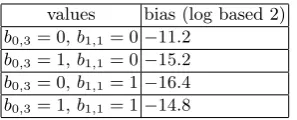
We experimentally find the following biases for different values of the input bitb0,3andb1,1. The
biases are base on the difference of the output bit at position S[3][1][35].
values bias (log based 2)
b0,3= 0,b1,1= 0−11.2 b0,3= 1,b1,1= 0−15.2 b0,3= 0,b1,1= 1−16.4 b0,3= 1,b1,1= 1−14.8
We remark that the biases other than the first row in above table may not be very accurate considering the small bias.
The state recovery process process:
1. Generate 237.7 pairs of two-block plaintext satisfied following requirements. The first block of the plaintext has differenceD3 and each active S-box has fixed values according to the above
paragraph. All the other bits are random.
2. Use ICEPOLE to encrypt the plaintext blocks and then decide the 1024 bits input and output state of the firstP6. Discard those pairs if the two bits in the linear relation (according toL2
rotated by 35 bits) in the output of round 5 cannot be recovered. There are 226pairs left. Then compute the bit at positionS[3][1][35] of the output of round 5 using the recovered bits from round 6.
3. If the two bits at the position S[3][1][35] are the same, we compute the value of a0 and a1
according to the input and increase the counter for (a0, a1) by 1.
4. Suppose the largest counter of (a0, a1) take valuea0=v0 anda1=v1, we guess thatU112=v0
andU13 1 =v1.
5. By rotating the differential-linear characteristic for the other 31 even bits less than 64, we can recover the 64-bit unknown wordU1.
Note that in each rotation of the differential-linear characteristic, we are able to recover two consecutive bits, so we only need to test 32 rotations to recover the 64-bitU1. The estimated success
probability is 98.7% for each bit.
4.1.4 Correcting the recovered state
still possible that the state we recovered has some error bits. Whether the state is correct can be easily verified by encrypting some new messages and compare the ciphertext.
We can correct up to 7 error bits with relatively low complexity. To correct i error bits is to choose any ibits from the 128 bits and flip the values. Then test whether the modified unknown state is correct.
Suppose that for the 128 bitsU1 andU2, the probability that each bit is correct is 0.99, we can
compute the probability that the number of error bits is less than 8 as
7
X
i=0
128 i
×.99128−i×.01i= 0.99995.
The total number of encryptions to correct up to 7 error bits is 237.5, which is negligible to the whole attack.
4.1.5 Summary of the attack
The data complexity is:
- U0andU3: 2×2×233.9×26. We multiply 233.9by 2 two times due to the fact that we use 233.9
pairs of 2-blocks plaintext. - U2: 2×2×236.7×26
- U1: 2×2×237.7×25
- Total: 245.8
The time complexity is the 245.8 encryptions of the one block plaintext and the possible 237.5
encryptions for correction.
The memory cost is mainly on the storage of some counters, which is negligible.
The success rate of this attack is close to 1, and can be adjusted through the number of input messages.
4.2 State recovery attack on ICEPOLE–256a
In the case of ICEPOLE–256a, there are 320 unknown bits in the input and output states in the encryption of a block. In addition to theU0 toU3 in the previous subsection, we use U4 to denote
the unknown 64-bit wordS[3][3].
Different from the ICEPOLE–128 and ICEPOLE–128a, in the last row of the output in ICE-POEL–256a, there are only 3 known bits instead of 4 known bits. Consequently, it is impossible to recover the input bits given the output bits for that row. To deal with this issue, we have to consider the linear relation of the input mask of the S-box. When the value of the input mask is less than 8, the largest bias is 3/16, but if the value of the input mask is 8, the largest bias is 1/16.
For L1, there are two mask bits placed in the last row, one is 4 and the other is 8. From the
Piling-Up Lemma [11], the bias is 2−5.4.
ForL2, there are three mask bits placed in the last row, 2, 4, and 8. By Piling up Lemma, the
bias is 2−6.8.
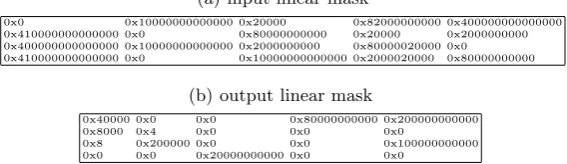
To increase the bias of the last row, we introduce another linear characteristicL3 (Table 4.2),
which has only 1 bit in the last row of the input mask of round 6 S-box. ForL3, the bias is 3/16 and the probability to recover other bits is 2−9.6.
To recover the U4, we use the differential characteristic D2 with linear characteristic L1 left
rotated 33 bits, same as the recovery of U0 andU3. Since the value ofS[3][2] is not known, we will
only fix the active bits in S[3][0], setting it to 1.
We will find the value of bit 2 in the input of active S-box related to S[3][1] with difference 0x400. We denote this bitb3,2, and we have b3,2=a⊕U433, whereais a constant from the known
input.
We experimentally find the following biases for the input bit values b3,2 after 5 rounds. The
(a) input linear mask
0x0 0x10000000000000 0x20000 0x82000000000 0x400000000000000 0x410000000000000 0x0 0x80000000000 0x20000 0x2000000000 0x400000000000000 0x10000000000000 0x2000000000 0x80000020000 0x0
0x410000000000000 0x0 0x10000000000000 0x2000020000 0x80000000000
(b) output linear mask
0x40000 0x0 0x0 0x80000000000 0x200000000000 0x8000 0x4 0x0 0x0 0x0
0x8 0x200000 0x0 0x0 0x100000000000 0x0 0x0 0x20000000000 0x0 0x0
Table 8.The linear characteristic 3, assuming S-boxes are identical mappings
values bias (log based 2)
b3,2= 0−9.2
b3,2= 1−15.3 (negative)
Considering the linear relation of this XORed value to the 4 bits in the two output states, the bias of the XORed difference of the 4 bits becomes 2−18 by Piling up lemma. To ensure the high
probability of correctly guessing the value, we need around 240 pairs of two-block plaintext. The
total data needed is around 258.7.
Next, the complexity of recovering the other unknown words need to be amended. We omit the similar attack process and discuss the estimated complexities here.
For U0 and U3, the increased bias is 2−8.8 which needs to be compensated by around 217.6
additional messages. Furthermore, some of the bits from the S-box layer in round 6 can directly be recovered from the linear relation, hence increasing the success probability by a factor of 24. The
total effect is the data complexity becomes 255.5.
ForU2,D1withL3left rotated 13 bits will be used and forU1,D3withL1left rotated 2 bits will
be used. The increased bias is roughly 2−2.8 for both cases (including the increased 5-round bias).
And the decreased probability for recovering the values before round 6 S-box has a factor 2−7.5.
Therefore, the total data complexity for recovering each bit is increased by 213.1, which is 257.8.
Therefore, the total data complexity of the state recovery attack for ICEPOLE–256a is estimated to be 259.8, which is less than the constraint 262.
4.3 Implications of the state recovery attacks
For ICEPOLE–128, the state recovery attack implies the failure of encryption security if both the nonce and the secret message number are reused. When an adversary has the full knowledge of a state, he can invert the cipher until the secret message number is injected. Thus, the adversary can decrypt arbitrary plaintext blocks. It also implies a forgery attack on the authentication of plaintext and associated data since the valid tag for any modified associated data or plaintext block can be computed. Since both the key and secret message number are unknown, the adversary cannot recover the key.
For ICEPOLE–128a and ICEPOLE–256a, the state recovery attack implies the whole security is broken if the nonce is reused. The initialization of ICEPOLE–128a is invertible, so the adversary can directly recover the secret key from the known state. Then both the encryption and authentication are insecure.
Summary of the security of ICEPOLE under our analysis when nonce is reused is given in Table 9.
5
Experimental Results
ICEPOLE-128 ICEPOLE-128a ICEPOLE-256a confidentiality for the plaintext 46 46 60 confidentiality for the secret message number 128 - -integrity for the plaintext 46 46 60 integrity for the associated data 46 46 60 integrity for the secret message number 46 - -integrity for the public message number 46 46 60
Table 9. Number of bits of security when nonce and secret message number can be reused.
U0= 0x1e7aed5bf aeb535f
U1= 0xe0dcc6422595e5ba
U2= 0x892bf76586876c23
U3= 0x8b2ef3bf50e902f6
To recover U0 and U3, we run the attack in Sect. 4.1.1 on a server with 64 cores (AMD
Opteron(tm) Processor 6276). Instead of checking the constants from input, we used an equivalent method: directly extract the input bits of the active S-box in the first round, and decide whether they are the estimated ones. The number of plaintext pairs we used is 234for each bit. The attacks
takes 15.3 hours and all the 128 bits recovered are correct.
To recoverU2, we run the attack in Sect. 4.1.2 on the server. The number of plaintext pairs we
used is 237 for each bit. The attacks takes 3.5 days and all the bits are correct.
To recoverU1, we run the attack in Sect. 4.1.3 on the server. The number of plaintext pairs we
used is 238 for each bit. The attacks takes 3.5 days and there is one error bit.
Since the number of error bits is very small, the experiments show that our state recovery attack indeed works for ICEPOLE–128a.
6
Conclusion
In this paper, we analyzed the security of the ICEPOLE family of authenticated ciphers using the differential-linear cryptanalysis when nonce is misused. ICEPOLE is strong against differential cryptanalysis since only part of the input difference is affected by message in the attack (so the best differential attack against the permutation cannot be applied to break ICEPOLE); and ICEPOLE is strong against linear cryptanalysis since only part of the input and output of the permutation are known in the attack (so the best linear attack against the permutation cannot be applied to break ICEPOLE). We successfully developed the differential-linear cryptanalysis against ICEPOLE by bypassing the input/output constraints of ICEPOLE. Our attacks show that the states of all the ICEPOLE variants can be recovered, and the secret key of ICEPOLE–128a and ICEPOLE–256a can also be recovered. The security claims of ICEPOLE do not hold under the nonce misuse cir-cumstances.
From the attacks against ICEPOLE, the lesson we learned is that when we are designing a strong cipher based on a permutation, it is better to consider the best attacks against the permutation in which the input/output can affect the whole state. Furthermore, if the performance of a cipher is improved by considering input/output constraints, the designers should analyze whether the input/ output constraints could be bypassed in the attacks.
References
1. G. Bertoni, J. Daemen, M. Peeters, and G. Van Assche. Keccak Sponge Function Family Main Docu-ment. Submission to NIST (Round 2), 2009.
2. G. Bertoni, J. Daemen, M. Peeters, and G. Van Assche. Duplexing the sponge: Single-pass authenticated encryption and other applications. In A. Miri and S. Vaudenay, editors,Selected Areas in Cryptography, volume 7118 ofLecture Notes in Computer Science, pages 320–337. Springer Berlin Heidelberg, 2012. 3. E. Biham, O. Dunkelman, and N. Keller. Enhancing Differential-Linear Cryptanalysis. In Y. Zheng,
4. E. Biham, O. Dunkelman, and N. Keller. Differential-Linear Cryptanalysis of Serpent. In T. Johans-son, editor,Fast Software Encryption, volume 2887 ofLecture Notes in Computer Science, pages 9–21. Springer Berlin Heidelberg, 2003.
5. E. Biham and A. Shamir. Differential Cryptanalysis of DES-like Cryptosystems. Journal of Cryptology, 4(1):3–72, 1991.
6. C. Blondeau, G. Leander, and K. Nyberg. Differential-Linear Cryptanalysis Revisited. InFast Software Encryption–FSE 2014. Springer, 2014.
7. O. Dunkelman, S. Indesteege, and N. Keller. A Differential-Linear Attack on 12-Round Serpent. In D. Chowdhury, V. Rijmen, and A. Das, editors,Progress in Cryptology - INDOCRYPT 2008, volume 5365 ofLecture Notes in Computer Science, pages 308–321. Springer Berlin Heidelberg, 2008.
8. O. Dunkelman and N. Keller. Cryptanalysis of ctc2. In M. Fischlin, editor, Topics in Cryptology CT–RSA 2009, volume 5473 of Lecture Notes in Computer Science, pages 226–239. Springer Berlin Heidelberg, 2009.
9. S. Langford and M. Hellman. Differential-Linear Cryptanalysis. In Y. Desmedt, editor, Advances in Cryptology–CRYPTO 1994, volume 839 ofLecture Notes in Computer Science, pages 17–25. Springer Berlin Heidelberg, 1994.
10. J. Lu. A Methodology for Differential-Linear Cryptanalysis and Its Applications. In A. Canteaut, editor,
Fast Software Encryption, volume 7549 of Lecture Notes in Computer Science, pages 69–89. Springer Berlin Heidelberg, 2012.
11. M. Matsui. Linear Cryptanalysis Method for DES cipher. InAdvances in Cryptology–EUROCRYPT’93, pages 386–397. Springer, 1994.
12. D. McGrew and J. Viega. The Galois/Counter Mode of Operation (GCM). http://csrc.nist.gov/ CryptoToolkit/modes/proposedmodes/gcm/gcm-spec.pdf.
13. P. Morawiecki. Nonce reuse in ICEPOLE. available from http://competitions.cr.yp.to/round1/ icepole-misuse.html, Jul 2014.
14. P. Morawiecki, K. Gaj, E. Homsirikamol, K. Matusiewicz, J. Pieprzyk, M. Rogawski, M. Sre-brny, and M. W´ojcik. ICEPOLE v1. submission to CAESAR competition, available from http://competitions.cr.yp.to/round1/icepolev1.pdf.
15. P. Morawiecki, K. Gaj, E. Homsirikamol, K. Matusiewicz, J. Pieprzyk, M. Rogawski, M. Srebrny, and M. W´ojcik. Icepole: High-speed, hardware-oriented authenticated encryption. In L. Batina and M. Rob-shaw, editors, Cryptographic Hardware and Embedded Systems, CHES 2014, volume 8731 of Lecture Notes in Computer Science, pages 392–413. Springer Berlin Heidelberg, 2014.
16. Y. Shin, J. Kim, G. Kim, S. Hong, and S. Lee. Differential-Linear Type Attacks on Reduced Rounds of SHACAL-2. In H. Wang, J. Pieprzyk, and V. Varadharajan, editors,Information Security and Privacy, volume 3108 ofLecture Notes in Computer Science, pages 110–122. Springer Berlin Heidelberg, 2004. 17. H. Wu and B. Preneel. Differential-Linear Attacks Against the Stream Cipher Phelix. In A. Biryukov,
![Fig. 1. General scheme of ICEPOLE encryption and authentication (Fig. 1 of [14])](https://thumb-us.123doks.com/thumbv2/123dok_us/7944826.1318733/2.595.98.514.427.564/fig-general-scheme-icepole-encryption-authentication-fig.webp)