Attacks on the AJPS Mersenne-based
Cryptosystem
Koen de Boer1, L´eo Ducas1, Stacey Jeffery1,2, and Ronald de Wolf1,2,3 1
CWI, Amsterdam 2
QuSoft
3 University of Amsterdam
Abstract. Aggarwal, Joux, Prakash and Santha recently introduced a new potentially quantum-safe public-key cryptosystem, and suggested that a brute-force attack is essentially optimal against it. They consider but then dismiss both Meet-in-the-Middle attacks and LLL-based at-tacks. Very soon after their paper appeared, Beunardeau et al. proposed a practical LLL-based technique that seemed to significantly reduce the security of the AJPS system. In this paper we do two things. First, we show that a Meet-in-the-Middle attack can also be made to work against the AJPS system, using locality-sensitive hashing to overcome the difficulty that Aggarwal et al. saw for such attacks. We also present a quantum version of this attack. Second, we give a more precise analysis of the attack of Beunardeau et al., confirming and refining their results.
1
Introduction
Aggarwal, Joux, Prakash and Santha [1] recently proposed a variant of the NTRU public-key encryption scheme [13]. This variant uses integers with sparse binary representation as a secret key, rather than polynomials with small coefficients. In particular, their cryptosystem is suspected to be resistant to quantum attacks.
Their system works as follows. Consider aMersennenumberN = 2n−1, with nprime. Then we can identify the ringR=Z/NZwith the set ofn-bit strings, where 1n is identified with 0n. To set up the keys of the cryptosystem, choose f, g ∈ R of fixed Hamming weight w =b√n/2c uniformly at random, subject to g having a multiplicative inverse inR. Set the public key to h:=f /g (this corresponds to an n-bit string of arbitrary Hamming weight) and the private key tog. In the next section we describe how Aggarwal et al. use these keys for encryption and decryption.
The security of this system relies on the assumption that it is hard to solve the following Mersenne Low Hamming Ratio Search Problem: given n, w ∈ N
andh∈R, findf, g∈Rof weightwsuch thath=f /g, assuming such f andg exist. A brute-force attack on this system would just try out all wn−−11possible g’s of weightw that start with a 1 (the latter is without loss of generality) and check whetherhghas weightw. Aggarwal et al. [1] suggest that this brute-force attack is close to optimal. This would correspond to roughly λ= log wn−−11
≈
1
be implemented using Grover’s quantum search algorithm [11] in time roughly q n
−1 w−1
, corresponding to roughly 14·wlognbits of security.
In particular, Aggarwal et al. [1] consider and then dismiss two possible lines of attack that could be better than brute force. First, they suggest that a com-binatorial Meet-in-the-Middle attack would fail due to a problem of “approxi-mate collisions”. Second, they argue that their variation makes an adaptation of known lattice attacks against NTRU ineffective. The latter claim was rapidly challenged, when a faster experimental attack using LLL reduction was found by Beunardeau et al. [6]. This attack exploits the low weight of f and g, and is able to find f, gusing partition-search in the integer interval {0, . . . ,2n−1}. The authors argue that their attack reduces the bit security to about λ≈2w. Beunardeau et al. [6] warn that their attack is only practically feasible, and might not work with, for example, increasing parameters. They further expect that slightly changing the cryptosystem protects against this attack [6,§4].
1.1 This work
In this work we revisit the security of the AJPS cryptosystem. We first pro-pose a Meet-in-the-Middle attack that circumvents the issues raised by [1] and gives a polynomial speed-up over a brute-force attack. It runs in classical time
˜
Oq wn−−11
, and can be accelerated on a quantum computer to ˜Oq3 n−1 w−1
. Our analysis requires several minor heuristics, which we have confirmed experi-mentally. Secondly, we formally analyze the attack of Beunardeau et al. [6]. Our analysis suggest that the attack is slightly less efficient, asymptotically, than sug-gested in [6]. However, this small difference in complexity makes little difference in practice.
Meet-in-the-Middle attack. Aggarwal et al. [1,§5.1] described a failed attempt at a Meet-in-the-Middle (MITM) attack on their cryptosystem. It fails because the “collisions” in the “middle” are not exact, and they view this failure as evidence for the optimality of the brute-force attack. In contrast, we show how a MITM attack on their system can nonetheless be executed, using locality-sensitive hashing to overcome the issue of inexact, approximate collisions.
The idea is still, given public keyh∈ {0,1}n, to find an n-bit stringg ∈R of weight ≤ w, such that hg also has low weight. Split the n-bit string g = g1⊕g2 into an n-bit string g1 with roughly αw 1s in the first αnbits and 0s elsewhere, and a g2 with roughly (1−α)w 1s in the last (1−α)n bits and 0s elsewhere. Now hg = hg1+hg2 having low weight corresponds to hg1 and hg2being approximately equal (i.e., having low Hamming distance), so our goal becomes to find an “approximate collision” between the two sets {hg1} and
In the classical case, setting the split at α= 1/2, the runtime of the attack is roughly w/2n/2
≈ wn1/2, which corresponds to roughly 1
4·wlognbits of security. In the quantum case, settingα= 1/3 yields an algorithm similar to [5], which has runtime roughly w/3n/3
≈ n w
1/3
, corresponding to 16·wlognbits of security. A meet-in-the-middle attack on NTRU, which has a similar structure to the AJPS cryptosystem, is due to Odlyzko, and is described in [15]. The first example of a quantum meet-in-the-middle algorithm was the collision-finding algorithm of Brassard, Høyer and Tapp [9]. Similar ideas were later used in a quantum algorithm for the subset sum problem [5], and a quantum attack on the NTRU cryptosystem [23], which have a similar structure to the algorithm presented here. One difference in our new algorithm is the use of Ambainis’s variable-cost quantum search algorithm [3], described in Section 2.2.
To complement our theoretical analysis we also implemented this attack on a classical computer and ran a simulation for quantum computers. Our source code is available athttps://github.com/lducas/MiTM-Mersenne.
Analysis of the lattice attack of Beunardeau et al. Although Beunardeau et al. [6] provide experimental evidence for the efficiency of their attack, they leave open the task of providing a theoretical analysis to support the correctness of their approach. This leaves some uncertainty for a concrete security estimate of the cryptosystem of Aggarwal et al. We attempt to fill this gap with a more in-depth analysis of their attack. We conclude that the cost of their attack is in fact of the form (2 +δ+o(1))2w for some very small constant δ >0. Besides clarifying the heuristic asymptotic complexity of the attack of Beunardeau et al. [6], it also essentially confirms their practical claim that their attack reduces the security to roughly 2wbits. Hence it remains the best known attack on the AJPS cryptosystem (better than our MITM attack).
1.2 Impact
The impact of this work is mostly of a conceptual nature. Our Meet-in-the-Middle attack is a reminder that inexact collisions can sometimes be circum-vented, depending on the metric at hand. While a similar near-collision MITM attack was well known against NTRU (attributed to Odlyzko in [15]), it was rather easy due to how close the near-collisions were. The setting of Aggarwal et al. is more demanding. Our work also shows another application of Nearest-Neighbor Search (NNS) techniques to cryptanalysis, which have already found important application to lattice problems [18,4,17].
Our analysis of the attack of Beunardeau et al. [6] also provides better confi-dence in the revised security estimate of the treated cryptosystem [1]. Moreover, we hope that it provides clear tools and heuristics to understand the behavior of LLL in more general scenarios.
the lattice attack and the MITM attack could be combined into an even faster attack, as was already done against NTRU by Howgrave-Graham [14]. At first sight, it seems that this approach would not lead to an exponential acceleration, yet it may make it possible to amortize the polynomial cost of each call to the LLL algorithm.
More generally, our work highlights the question of Nearest-Neighbor Search using quantum computers. This question was already approached in [17,19], which considered generic application of Grover’s algorithm over classical NNS techniques. It seems an important question to determine whether less generic approaches could perform better.
1.3 Organization
The remainder of this paper is organized as follows. In Section 2, we give the necessary preliminaries, including a description of the AJPS cryptosystem of [1], and a description of a variant of the quantum search algorithm due to [3], for settings where the cost of checking if an element is marked varies. In Section 3, we present and analyze our classical Meet-in-the-Middle attack, and in Section 4, we present and analyze our quantum Meet-in-the-Middle attack. In Section 5, we present our formal analysis of the Beunardeau et al. attack [6].
2
Preliminaries
2.1 The AJPS Cryptosystem
In this section, we will describe the cryptosystem of Aggarwal et al. [1] (the AJPS cryptosystem). Let N = 2n −1, where n is a prime number4, and let R = Z/NZ be the integer ring modulo N. We define w = b
√
n/2c to be the upper bound on what we will consider “low weight”.
We will identify a number inR with its binary representation. In this way, we can represent the elements of Rby the elements ofFn
2, with 1n and 0n both representing 0∈R, and all other elements ofRhaving unique representatives in
Fn2. For nonzero a∈R, denote by|a|the Hamming weight of the unique binary representation ofa, and define|0|= 0. Similarly, denote by∆(a, b) the Hamming distance between the binary representations ofaandb(using the representation 0n for 0∈R). Note that it is not necessarily the case that|ab|and |a| · |b| are equal nor that |a+b|and|a|+|b|are equal. However, we have the following.
Lemma 1 ([1]). Let a, b∈R. Then
(i) |a+b| ≤ |a|+|b|, (ii) |ab| ≤ |a| · |b|, and
4 Numbers of the form N = 2n−1 with n ∈
(iii) ifa6= 0, then| −a|=n− |a|.
Elements of the ringRhave the special property that for anyi∈ {0, . . . , n−1}
anda∈R, the binary representation ofa·2i modN is just a cyclic shift of the binary representation ofabyi.
We now describe the AJPS cryptosystem [1] with public parametern.
Key Generation Randomly choose two elementsf, g∈Rof Hamming weight w, where g is invertible in R. Set h = f /g. The public key is h, and the secret key isg.
Encryption To encrypt a bit s, pick random p, q ∈R of Hamming weight at mostw. Output the ciphertextc= (−1)s(ph+q)∈R.
Decryption To decrypt c, compute cg = (−1)s(phg+qg) = (−1)s(pf+qg). Sincep,q,f andgall have Hamming weight≤w, then-bit stringpf+qghas Hamming weight≤2w2< n/2 by Lemma 1. Thus ifs= 0, then|cg|< n/2. On the other hand, if s = 1, then | −cg| < n/2, so by Lemma 1, |cg| > n−n/2 =n/2. Thus, to decryptc, output 0 if|cg|< n/2, and 1 otherwise.
To attack this cryptosystem, it suffices to solve the following problem:
Given h∈R, findg∈Rof Hamming weightwsuch that
|hg|=w, assuming such ag exists.
Since multiplication by 2ijust shifts the binary representation of an element ofRbyi, ifgis a solution to the above problem, then so is 2ig. Thus, if a solution exists, then a solution with the first bit set to 1 exists, and so we can restrict our attention to such solutions. Since a brute-force attack can find such a solutiong in time wn−−11
, to achieve security parameterλ,nandwmust satisfy nw−−11 >2λ andw <√n/2. Our results, however, imply that a stronger condition is required to achieveλ-bit security.
2.2 Quantum search with variable costs
In this section we will introduce the quantum search algorithm, originally due to Grover [11] and later generalized [7,8]. This algorithm searches a universe of sizeNfor a particularmarked item, given access to some procedure for checking if a given item is marked, using O(√N) calls to the checking procedure. We will also make use of an elegant variant of the quantum search algorithm due to Ambainis [3], that has better complexity when the cost of checking if a given item is marked varies by item.
LetU be some set ofN objects, and letC:U → {0,1} be some procedure, called the checking procedure, that outputs 1 when given a marked item, and suppose the complexity of the procedure C is C. Then there exists a quantum algorithm with complexity ˜O(C√N) that outputs u ∈ U such that C(u) = 1 with probability at least 2/3, assuming such auexists.
We may also consider the scenario in which the complexity of computing
standard quantum search algorithm, we can search foru∈U such thatC(u) = 1 in ˜O(maxu∈UC(u)
√
N) steps. However, we can do better:
Theorem 1 (Quantum search with variable costs (Ambainis [3])). Let
C:U → {0,1} be any checking procedure. There exists a quantum algorithm that outputs u∈U such thatC(u) = 1with probability at least2/3 (assuming such a uexists), and has complexity
˜ O
s
X
u∈U
C(u)2
,
whereC(u)is the cost of computingC(u), and needn’t be known in advance. We call this algorithm quantum search for u∈U that satisfies C.
In the case whereC(u) =Cis constant, the algorithm from Theorem 1 has complexity ˜O(C√N), as in the standard quantum search algorithm.
3
Classical Meet-in-the-Middle Attack
3.1 Introduction
The “Meet-in-the-Middle attack” (MITM attack) is a well-known generic cryp-tographic attack that can be deployed against a variety of cryptosystems, often achieving an improved time complexity in breaking the system, at the cost of greater space complexity. It may have originated in [12].
To illustrate this attack, we give an example in the context of the knapsack problem, which can be described as follows. Given numbersh1, . . . , hn∈Z, find
g∈Fn2 such that
n X
i=1
hig[i] = 0.
The MITMA idea is to splitFn
2 =G1⊕G2 into two equally-large subspaces of dimensionn/2, whereG1={(g,0dn/2e) :g∈F2bn/2c} andG2={(0bn/2c, g) : g ∈ Fd2n/2e}. We calculate all numbers H(g1) =−Pihig1[i] for g1 ∈ G1 and store them in a database D. This costs 2n/2 time and space, up to a poly(n) factor.
Description of our MITM attack on the AJPS system Givenh∈R, we want to findf, g∈R, each of Hamming weightw, such thath=f /g— or equivalently, such thatgh=f. In other words, our task is, informally, to findg∈Fn
2 of weight wsuch that|gh|is small.
Forα∈[0,1] to be specified later, we define
G(α)1 ={(g,0d(1−α)ne) :g∈Fb2αnc,|g|=bαwc} and G(α)2 ={(0bαnc, g) :g∈F2d(1−α)ne,|g|=d(1−α)we}. We note that whileG(α)1 ⊕G(α)2 does not include all g∈Fn
2 such that|g|=w, restricting to this set is without loss of generality, since, ifg=g1+g2is a solution, meaning that bothg andghhave weightw, then for anyz∈ {0, . . . , n−1}, 2zg is also a solution. This is because 2zg just shifts the binary representation of g byz in a cyclic manner, so 2zg and 2zgh also have weight w. Thus, if there exists a solution, then there exists a solution in which g1 and g2 have weights
bαwcandd(1−α)we, respectively.
The attack will begin by enumerating (g1, g1h) for allg1∈G (α)
1 , after which we will search over G(α)2 for some g2 that is in collision with some g1 ∈ G
(α) 1 , where, intuitively, we want to defineg1, g2to be in collision whenever the Ham-ming distance∆(g1h,−g2h) is not much bigger than 2w. The difficulty is that, given some value−g2h, while it would be easy to find a stored value ofg1hthat isequal to−g2h, it is not immediately clear how to find such a stored value that isclose in Hamming distance to−g2h.
Locality-sensitive hash functions Our solution is to use a simple form of locality-sensitive hashing [16]. Intuitively, a locality-locality-sensitive hash should take the same value, with high probability, on two elements that areclose with respect to some desired distance. In our case, forB={i1, . . . , iB} ⊂[n] withi1<· · ·< iB, define
HB : Fn2 → F |B|
2 by HB(s1, . . . , sn) = (si1, . . . , siB). We will use the function family FB ={HB : |B|=B} for some B to be specified later. This works for our purposes, because if two strings are close in Hamming distance, then on a random small subsetBof their bits, they are likely to agree.
Detailed description of algorithm Our Meet-in-the-Middle attack proceeds as follows:
1. Choose a uniformly randomH ∈ FB.
2. Initialize an empty hash table D, with 2B (initially empty) linked lists, one for each element in the range ofH.
3. For eachg1∈G (α) 1 :
(a) Insert (g1,H(g1h)) intoD. 4. For eachg2∈G
(α) 2 :
(a) Look upH(−g2h) inD, and letL be the resulting list of valuesg1such thatH(g1h) =H(−g2h).
(b) For eachg1in L:
Analysis of algorithm We first argue that our algorithm succeeds in finding a solution if one exists. The next lemma shows that if−g2his uniformly random fromR, andbis an arbitrary element ofRwith Hamming weightw, then (with high probability)−g2handg1h=−g2h+bdo not differ in much more than 2w bits of their binary representations, i.e., ∆(−g2h, g1h) is not much larger than 2w.
Lemma 2. Leta∈R=Z/(2n−1)Zbe chosen uniformly at random, letw∈N
and letb∈Rbe any element such that|b|=w. Then, for everys >0, we have:
P∆(a, a+b)>2w+s
√
w
≤exp
− s
2 8 + 4s/√w
+ 2−n. (1)
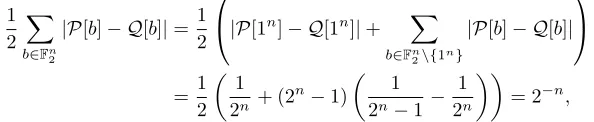
Proof. We assumeato be chosen uniformly at random fromFn2, instead of from R. These two distributions P,Q on the set of n-bit strings only differ by 2−n with respect to the total variation distance:
1 2
X
b∈Fn2
|P[b]− Q[b]|=1 2
|P[1
n]− Q[1n]|+ X b∈Fn2\{1n}
|P[b]− Q[b]|
=1 2
1 2n + (2
n−1)
1
2n−1 − 1 2n
= 2−n,
which accounts for the 2−n-term in the right-hand side of Equation (1). Givena, b, we define the carry elementcncn−1. . . c1=c∈Rbyc= (a+b)⊕ (a⊕b). One can show that cequals the ‘carry vector’ that one puts above the sum of a and b when doing addition on a blackboard (see Table 1). Note that a⊕b⊕c = a+b, implying that ∆(a, a+b) = |b⊕c| = |b|+|c| −2|b∧c| = w+|c| −2|b∧c|.
c 0111 1110
a 0010 1111
b 0001 0001
b∧c0001 0000
Table 1.Having a nonzero bit inb∧cleads necessarily to an extra carry.
We now want to analyze the number of carry bits, i.e., the random variable
1-bit. The number of positions where this can happen is the random variable
|b∧c|. Therefore the random variable |c| is majorized5 by the random variable
|b∧c|+S, where S =Pwi=1Gi is the sum ofw i.i.d. geometrically distributed random variables (each with parameter 1/2, and support{0,1,2, . . .}).
Therefore we have
P∆(a, a+b)>2w+s
√
w =P
w+|c| −2|b∧c|>2w+s√w =P
|c|>2|b∧c|+w+s√w
≤P
|c|>|b∧c|+w+s√w
≤P
S > w+s√w
=PBin(2w+s
√
w,1/2)< w
≤exp
− (s √
w)2 8w+ 4s√w
= exp
− s
2 8 + 4s/√w
.
The second inequality uses majorization. The penultimate equality holds because the event ‘S > w+s√w’ is the same as the event that in a sequence of 2w+s√w fair coin flips, there are fewer thanwsuccesses. We upper bound the probability of the latter by Chernoff’s inequality.
Heuristic 1. The above lemma still holds when setting a=hg1 andb=f for f, g, hdistributed as in the AJPS cryptosystem.
Remark 1. The above heuristic is corroborated by experiments, see Appendix A. More concretely, for primesn≤2000, it holds that∆(−g2h, g1h)≤2w−1 for more than half of the keys, and that ∆(−g2h, g1h)≤2w+ 7 for about 90% of the keys.
We are now ready to analyze the space and time complexity of the algo-rithm. We will setα= 1/2. We can see immediately that the algorithm requires
˜
O(|G(α)1 |) = ˜O w/2n/2space.
To analyze the time complexity, we first note that Step 3 of the algorithm costs|G(α)1 |insertions into the data structure, so the cost is ˜O(|G(α)1 |) = ˜O n/2w/2. The loop in Step 4 runs |G(α)2 | times, and the iteration corresponding to some g2 ∈G
(α)
2 costs approximately 1 +`(g2), where`(g2) =|{g1 ∈G (α)
1 :H(g1h) =
H(−g2h)}|. The total cost of Step 4 is thus at most:
|G(α)2 |+ X g2∈G(2α)
`(g2).
We can rewrite the above as
|G(α)2 |+ X v∈FB2
|{(g1, g2)∈G (α) 1 ×G
(α)
2 :H(g1h) =H(−g2h) =v}|
=|G(α)2 |+|{(g1, g2)∈G (α) 1 ×G
(α)
2 :H(g1h) =H(−g2h)}|. Heuristic 2. For every fixed H ∈ FB, with high probability over g and f as chosen in the AJPS system, we have |{(g1, g2) ∈ G
(α) 1 ×G
(α)
2 : H(g1h) =
H(−g2h)}| ≈ |G (α) 1 | · |G
(α) 2 |2−
B.
5
Remark 2. The above heuristic is obtained by considering allH(g1h) andH(g2h) values as independent random uniform strings of B bits. The validity of this heuristic is confirmed by the experiments presented in Appendix A.1.
Letg=g1∗+g2∗be a solution. The algorithm will only find thisgifH(g1∗h) =
H(−g2∗h), in which case we say H is good for g. By Lemma 2 and assuming Heuristic 1, ∆(g1∗h,−g2∗h) ≤ 2w+s√w happens with high probability, for a fixed constant s. So, assuming ∆(g∗1h,−g2∗h) ≤ 2w+s√w, the hash function
His good with probability at leastp(B) = (
n−2w−s√w B ) (n
B)
where the probability is over the function familyFB={HB:|B|=B}.
Lemma 3. Under the above heuristics, settingα= 1/2andB=dlog2 w/2n/2
e(≈
w
2 log(n/w) +O(w)), the time complexity of the algorithm is O˜ q n
w
.
Proof. Ignoring polylogarithmic factors, the complexity of the algorithm equals
|G(α)1 |+|G(α)2 |+|G(α)1 | · |G(α)2 |2−B. Note that|G(α)
2 |2−B≤1, by the choice ofB and the fact that |G(α)2 |= w/2n/2
. Therefore the complexity of steps 1-4 equals
2|G(α)1 |+|G(α)2 |= 3 n/2w/2
= ˜Oq wn
. To achieve constant success probability, we repeat the algorithm 1/p(B) times, which is, as we will show, polynomial inn. We use the identity ln m`=`ln(m/`) +`+O(lnm) whenever`= ˜O(√m), and the fact thatw2≈n/4. We have:
ln 1 p(B) = ln
n
B
−ln
n−2w−s√w B
=−Bln
n−2w−s√w n
+O(lnn)
= (1 +o(1))2wB
n +O(lnn) = (1 +o(1)) w2
n ln(n/w) +O(lnn) =O(lnn).
4
Quantum Meet-in-the-Middle Attack
We now present our quantum meet-in-the-middle attack. The first example of a quantum meet-in-the-middle algorithm was the collision finding algorithm of Brassard, Høyer and Tapp [9]. Similar ideas were later used in quantum algo-rithm for the subset sum problem [5], and a quantum attack on the NTRU cryptosystem [23], which have a similar structure to the algorithm presented here. One difference in our new algorithm is the use of Ambainis’s variable-cost quantum search algorithm [3], described in Section 2.2.
The quantum algorithm presented and analyzed in this section is then very similar to the classical MITM attack, except we use quantum search to search over all g2 ∈G
(α)
2 , and then since the complexity of this step of the algorithm decreases in the quantum case, it is optimal to useα= 1/3 rather thanα= 1/2.
Detailed description of algorithm Our quantum MITM attack proceeds as fol-lows:
1. Choose a uniformly randomH ∈ FB. 2. Initialize an empty hash tableD. 3. For eachg1∈G
(α) 1 :
(a) Insert (g1,H(g1h)) intoD.
4. Quantum search (using Theorem 1) forg2∈G (α)
2 that satisfies the following checking procedure:
(a) Look up H(−g2h) inD, and letL(g2) be the resulting list of values g1 such thatH(g1h) =H(−g2h).
(b) Quantum search forg1 inL that satisfies the following checking proce-dure:
i. If|g1+g2|=w and|(g1+g2)h|=w, then output 1.
Analysis of algorithm We will use α = 1/3. The algorithm requires |G(α)1 | = αn
αw
= w/3n/3
quantum accessible memory, andO(log|G(α)2 |) = O(n) quantum memory.
In order to upper bound the time complexity, we will make use of Heuristic 2 withα= 1/3. Then we have the following.
Lemma 4. Assuming Heuristic 1 and Heuristic 2 with α = 1/3, setting B =
dlog2 w/3n/3
e, the time complexity of the algorithm isO˜ wn1/3.
Proof. As in the classical algorithm, the time complexity of Steps 1 to 3 of the quantum algorithm is ˜O(|G(α)1 |) = ˜O αwαn, which, in this case, is ˜O w/3n/3. For a particular g2 ∈ G
(α)
2 , Steps 4a and 4b together cost (neglecting negligi-ble factors) 1 +p`(g2), so using variable cost quantum search, as described in Section 2.2, the total cost of Step 4 is
v u u t
X
g2∈G(2α)
(1 +p`(g2))2=O
q
|G(α)2 |+ v u u t
X
g2∈G(2α) `(g2)
.
By Heuristic 2 and the choice ofB, we haveP
g2∈G(2α)`(g2)≈ |G (α) 1 |·|G
(α) 2 |2−B≤
|G(α)2 |. Thus, the total complexity of steps 1-4 of the attack isO q
|G(α)2 |
=
Oq 2w/32n/3
= ˜O w/3n/3
. Finally, as in Section 3,Hisgood with probability
p(B) = (
n−2w−s√w B ) (n
B)
5
Analysis of the Beunardeau et al. attack
Within a week of the publication of the AJPS cryptosystem [1], an experimental attack was proposed by Beunardeau et al. [6]. This attack exploits the fact that a certain lattice, derived from the public key of the AJPS cryptosystem and two well-chosen partitions, has very short vectors. One of these short vectors, which can be found by means of the LLL lattice reduction algorithm [20], represents the private key.
Although Beunardeau et al. do not give a clear asymptotic estimate of the complexity of their attack, they do suggest tentatively that it might run in time 22wnO(1), where w = b√n/2c is the Hamming weight of secret keyg ∈ R [6,
§2.2]. More specifically, once a partition is chosen, the attack runs in polynomial timenO(1), and the probability that it is successful should be about 2−2w. Remark 3. Note that this probability is taken only over the randomness of the secret key. It is not obvious that one can amplify the success probability for a fixed key up to a constant by repeating the attack with 22w different partitions. Indeed, there could be certain keys that are caught by a fraction of partitions significantly smaller than 2−2w.
In this section, we propose an analysis of a simplified version of their attack. Using standard lattice heuristics we can argue that, for each pair of partitions, the probability that a secret key will be found by applying LLL on the derived lattice equals (12 −c wd2+o(1))2w, where dis the lattice dimension, and c is a very small constant, say 1/140. The lattice dimension d corresponds to the number of blocks in a partition of the bits off andg. While in theory we can choosedbetween 2 andO(w), in order to findf andgfor a particularh, we will generally need to choosedas large asΩ(w). We discuss this more at the end of Section 5.3. While asymptotically slightly different from the tentative conclusion of [6], this analysis certainly does not contradict the fact that this attack is quite efficient in practice, and remains the best known attack (better than our MITM attack).
We remark that one could also replace LLL with a perfect SVP-oracle to raise the success probability to (12+o(1))2w, but this would increase the running time of the lattice reduction step to 2Θ(d). Namely, for partitions of size d =Θ(w) the ratio of the cost over success probability remains at least 2(2+δ)w+o(w) for a fixedδ >0.
5.1 Partitions
In this section, we show how partitioning of [n] = {0, . . . , n−1} can lead to a short representation of the secret keyg∈R=Z/NZ. The overall idea is to write
gas a binary string inFn2, as before. Sinceghas a low Hamming weight, one can imagine the one-valued bits scattered sparsely among then possible positions. One then chooses interval-like subsets of [n] such that, with any luck, each one-valued bit falls in the right-half of one of these subsets. In that case, each subset of [n] in the partition corresponds to a binary substring of g representing a “small” number. Consequently, the array of these numbers can be considered as a short representation ofg. An example is depicted in Table 2.
Remark 4. Because of the bit-wise arithmetic in R, it is natural to consider interval-like partitions only. An interval-like partitionP of [n] consists of subsets that are of the form{a, a+1, a+2, . . . , b−1, b}fora, b∈[n], i.e., subsets without ‘gaps’. Due to the fact that multiplication by 2i in R simply shifts all binary representations byi, we also allow subsets of the form{a, a+ 1, . . . , n−2, n−
1,0,1, . . . , b}.
Remark 5. Formally, our approach is slightly different from the one of Beu-nardeau et al. [6]. Namely, they define partitions with black and white blocks, hoping that all 1-valued bits of the secret key fall into the white blocks of the partitions. It turns out, however, that the black blocks do not play any role in the construction of the lattice related to this partition. Therefore, we prefer to omit the black partitions in our approach. This alteration has no algorithmic impact and is merely an editorial choice simplifying the analysis.
g 00100000000001000010
Partition {19,18,17,16},{{15,14,13,12},{11, . . . ,6}, 5, . . . ,0}
gpartitioned in a “good” way 0010 0000 000001 000010 Array of decimal numbers
representingg [2,0,1,2],g= 2·2
16
+ 0·212+ 1·26+ 2·20
Table 2.Example partition ofgwith Hamming weight 3.
5.2 Lattice Reduction
Lattice construction Given any two interval-like partitions P = {P1, . . . , Pk}, Q={Q1, . . . , Q`}of [n] and a public keyh∈R. Letpi, qi be the least elements ofPi, Qi respectively. Then, one can consider the following lattice.
LP,Q,h=
(x1, . . . , xk, y1, . . . , y`) h·
k X
i=1 2pi·x
i− ` X
j=1 2qi·y
i≡0 modN
This latticeLP,Q,hhas determinant∆=N and dimensiond=k+`. Namely, asLP,Q,his a sublattice ofZd, we have det(LP,Q,h) = det(Zd)·[Zd:LP,Q,h] =N, since det(Zd) = 1 and the group index equalsN.
This lattice contains vectors of the form (0, . . . ,0,2m,−1,0, . . . ,0), for some m, which we will call ‘structural’ vectors. These structural vectors have length
√
4|Pi|+ 1 and√4|Qi|+ 1. For example, (2p2−p1,−1,0, . . . ,0)∈ L
P,Q,his a struc-tural vector which is easily seen to have the described length, observing that p2−p1=|P1|. Applying this example for every two subsequent variables of the same kind, one arrives at all structural vectors.
Definition 1 (Secret vector).Leth=f /g∈Rbe as in the AJPS-cryptosystem, suppose P ={P1, . . . , Pk} and Q={Q1, . . . , Q`} are interval-like partitions of [n] and denote pi= minPi andqj= minQj. We define the secret vector
s:= (g1, . . . , gk, f1, . . . , f`)∈ LP,Q,h,
where 0 ≤ gi <2|Pi| and 0 ≤fj <2|Qj| are the unique natural numbers such that Pki=1gi·2pi=g and
P`
j=1fj·2qj =f.
Remark 6. The vectorsis actually just the concatenation of the vectors (g1, . . . , gk) and (f1, . . . , f`), which are constructed fromg, P andf, Qrespectively as in Ta-ble 2.
Applying LLL Let us recall the guarantees provided by the LLL algorithm.
Lemma 5 ([20,21]). For any γ >p4/3, the LLLγ-algorithm applied to a d -dimensional lattice L returns, within polynomial time, a basis (b1, . . . , bd) of L satisfying
– kb1k ≤HF(L) :=γ(d−1)/2·∆ 1/d
L (Hermite factor bound); – kb1k ≤AF(L) :=γd−1·λ1(L) (Approximation factor bound).
where λ1(L) is the length of a shortest nonzero vector of L, and ∆L is the determinant of the latticeL.
In practice, LLL performs much better. For cryptanalytic purposes, one often assumesγ= 1.04, which is corroborated by many experiments [22]. In the current analysis, this practical value ofγwill be used.
The inequalities in Lemma 5 give rise to two so-calledregimes of LLLγ, the Hermite regime and theApproximation regime. A latticeL lies in the Hermite regime when HF(L)≤AF(L), and lies in the Approximation regime whenever AF(L)<HF(L). One distinguishes these two cases because the output of LLL differs significantly between the regimes. This effect is most prominent when a single, unique short vector causes a lattice to be in the Approximation regime; in that case LLL typically outputs this particular short vector [10,§3.3].
the structural vectors are too short, causing s not to be unique. However, we will rule out this possibility by comparing the lengths of these structural vectors to theGaussian heuristicof LP,Q,h.
The Gaussian heuristic uses a geometric argument to estimate the length of the shortest vector of a lattice [10]. For d-dimensional lattices Lone expects λ1(L)≈
p
d/(2πe)·∆1/dL , according to this heuristic. Applying this to the lattice of interest, one obtains λ1(LP,Q,h)≈
p
n/(2πe)·2nd. Recall that the structural vectors have approximate length 2|Pi|and 2|Qi|. So, whenever|P
i|,|Qi|> n/d+ Θ(logn), we have 2|Pi|,2|Qi| >pd/(2πe)·2nd. So, in this case, the structural vectors are not shorter than the estimate of the Gaussian heuristic and hence longer than the secret vectors. Note that the average size of |Pi|,|Qi| is 2n/d, meaning that this constraint is not so restrictive.
Therefore, we assume the following heuristic.
Heuristic 3. The attack of Beunardeau et al. is successful in recovering the secret vectorsifs(as in Definition 1) is the shortest vector and causes the lattice
LP,Q,h to fall into the Approximation regime, i.e.,AF(LP,Q,h)<HF(LP,Q,h). From the above heuristic we can deduce that the lattice attack succeeds if
ksk ·γd−1< γ(d−1)/2·2n/d= HF(LP,Q,h).
Moreover, according to the study of Albrecht et al. [2] on the behavior of LLL for unique-SVP instances, this condition should be essentially tight. More precisely, we expect the attack to fail with overwhelming probability when AF(LP,Q,h)> O(
√
d)·HF(LP,Q,h). The metric boundsksk∞ ≤ ksk ≤
√
d· ksk∞ imply that the attack passes when√d· ksk∞< γ−(d−1)/2·2
n
d and is expected to fail whenksk∞> O(
√
d)·
γ−(d−1)/2·2n
d. Sinceksk∞ = max{gi, fi}, we can writeksk∞ = 2r, where r is the bit size of the maximum of thegiandfi. Putting this in the inequalities and taking base-two logarithms, yields the following. The attack succeeds whenever r < nd(1−δ1−δ2) and is expected to fail when r > nd(1−δ1+δ2+O(d/n)), where
δ1=
d(d−1)·log2(γ)
2n and δ2=
d·log2(d)
2n .
5.3 Success probability analysis
LetPandQbe partitions with block sizes at leastn/d+Θ(logn), whered=k+` withk=|P|and`=|Q|. We analyze the success probability of the lattice attack with respect to randomf andg∈R both of Hamming weightw=b√n/2c.
From the previous section, we found that it suffices that the non-zero bits off and gfall in the rightmostrbits of each block, in order to make LLL find the secret vector. So, forg, the total number of bits that are allowed to be one equals k·r. Therefore, we can approximate the probability of the bits off and g all falling in the good region by
`·r
n
wk·r
n w
Putting in the upper and lower bound forr, we obtain an upper and lower bound for the success probabilitypof the attack.
`k(1−δ 1−δ2)2 d2
w < p <
`k(1−δ
1+δ2+O(d/n))2 d2
w .
In order to maximize the above probability, we will assume thatk=`=d/2 andd=O(w). Namely, the fraction (`+k)`k 2 attains its maximum at`=k=d/2. Recalling w2 ≈ n/4, we obtain δ
1 = d(d−1)
2n ·log2(γ) ≈ 18 d w
2
·log2(γ) and δ2=o(1) asn→ ∞. Therefore
1
−δ1−o(1) 2
2w < p <
1
−δ1+o(1) 2
2w .
Thus, assuming Heuristic 3, the success probability of LLL recovering a randomly chosen AJPS secret key pair (f, g)∈R2from the latticeLP,Q,h(whereh=f /g), is roughly12 −c wd2+o(1)
2w
, wherec= log2(γ)/8 = log2(1.04)/8≈1/140. This probability value suggests that one should start with partitions with a small number of blocks, exploiting both the low dimensionmof the latticeLP,Q,h and a slightly larger success probability. Note, however, that it is not likely that the secret key s= (g, f) will be recovered in this stage; the smallerd is, the fewer possible partitions there are, so the need to sample new partitions will require us to increasedtoΩ(w) for most keys.
Replacing LLL by an SVP-oracle. If one replaces LLL by an SVP-oracle, the success condition from Heuristic 3 needs to be amended. Instead, the attack would be successful when s is the shortest vector of L. Heuristically this is the case if and only if s is shorter than what is predicted by the Gaussian Heuristicλ1(L)≈
p
d/2πe·∆1/dL . Using a similar analysis, this leads to a success probability of 2−2w+o(1). Note however that the best SVP-solvers [4] need time (3/2)d/2, which would increase the overall complexity of the attack significantly.
5.4 Generalization to scaled partitions
The attack that is treated above is a simplification of the attack of Beunardeau et al.; essentially we omitted a ‘scaling’ technique [6, §2.2, ‘Trying partitions’]. This particular technique allows the variation of partition sizes and the fraction of each partition block that must consist of leading 0s.
The latticeLP,Q,h scaled by the vectorσ= (σ1, . . . , σk, σ01, . . . , σ`0)∈Rdcan be defined explicitly as follows.
Lσ P,Q,h =
(
(σ1x1, . . . , σkxk, σ01y1, . . . , σ`0y`)
h·
k X
i=1
2pi·xi− ` X
j=1
2qi·yi≡0 modN )
Allocating less weightσi to the contentxi of a certain partitionPi lets a lattice reduction algorithm tolerate larger valuesxi; this means that the required frac-tion of leading 0s in this partifrac-tion is diminished. This technique implies more freedom in choosing block sizes and required fractions of leading 0s.
Note, however, that scaling the entire lattice L 7→cL by a constant won’t affect the attack at all. Therefore, one might require, without loss of generality, that Qki=1σi
Q`
j=1σj0 = 1. This implies that the increase and decrease of the fractions of leading 0s of the blocks are in an equilibrium, not affecting the total region where non-zero bits are allowed.
So, this extension possibly increases the number of public keys that can be broken but does not affect the running time nor the success probability of the attack. Even considering this generalization, we were not able to prove that this improved attack could recoverevery key with constant probability in time 2(2+δ)w+o(1) for some small constantδ >0.
Acknowledgments
The authors wish to thank David Naccache, Antoine Joux and Marc Beunardeau for helpful discussions, and the anonymous PQCrypto reviewers for useful feed-back. LD is supported by a NWO Veni Innovational Research Grant under project number 639.021.645. SJ is supported by an NWO WISE Grant and an NWO Veni Innovational Research Grant under project number 639.021.752. RdW is partially supported by ERC Consolidator Grant 61530-QPROGRESS.
References
1. D. Aggarwal, A. Joux, A. Prakash, and M. Santha. A new public-key cryptosystem via Mersenne numbers. Cryptology ePrint Archive, Report 2017/481, 2017. http: //eprint.iacr.org/2017/481.
2. M. R. Albrecht, F. G¨opfert, F. Virdia, and T. Wunderer. Revisiting the Expected Cost of Solving uSVP and Applications to LWE. Cryptology ePrint Archive, Re-port 2017/815, 2017. https://eprint.iacr.org/2017/815.
3. A. Ambainis. Quantum search with variable times.Theory of Computing Systems, 47(3):786–807, Oct 2010.
4. A. Becker, L. Ducas, N. Gama, and T. Laarhoven. New directions in nearest neighbor searching with applications to lattice sieving. InProceedings of the 27th Annual ACM-SIAM Symposium on Discrete Algorithms (SODA 2016), pages 10– 24, 2016.
5. D. J. Bernstein, S. Jeffery, T. Lange, and A. Meurer. Quantum algorithms for the subset sum problem. In Proceedings of the 5th International Conference on Post-Quantum Cryptography (PQCrypto 2013), pages 16–33, 2013.
6. M. Beunardeau, A. Connolly, R. G´eraud, and D. Naccache. On the hardness of the Mersenne low Hamming ratio assumption. In Progress in Cryptology – LATINCRYPT 2017, 2017. Available athttp://eprint.iacr.org/2017/522. 7. M. Boyer, G. Brassard, P. Høyer, and A. Tapp. Tight bounds on quantum
8. G. Brassard, P. Høyer, M. Mosca, and A. Tapp. Quantum amplitude amplification and estimation. In Quantum Computation and Quantum Information: A Millen-nium Volume, volume 305 ofAMS Contemporary Mathematics Series Millennium Volume, pages 53–74. AMS, 2002.
9. G. Brassard, P. Høyer, and A. Tapp. Quantum algorithm for the collision problem.
ACM SIGACT News, 28:14–19, 1997. arXiv:quant-ph/9705002.
10. N. Gama and P. Q. Nguyen. Predicting lattice reduction. Advances in Cryptology – EUROCRYPT 2008, pages 31–51, 2008.
11. L. K. Grover. A fast quantum mechanical algorithm for database search. In
Proceedings of the 28th Annual ACM Symposium on the Theory of Computing (STOC 1996), pages 212–219, 1996.
12. M. Hellman. A cryptanalytic time-memory trade-off. IEEE Transactions on In-formation Theory, 26(4):401–406, July 1980.
13. J. Hoffstein, J. Pipher, and J. H. Silverman. NTRU: A ring-based public key cryptosystem. In International Algorithmic Number Theory Symposium, pages 267–288. Springer, 1998.
14. N. Howgrave-Graham. A hybrid lattice-reduction and meet-in-the-middle attack against NTRU. Advances in Cryptology – CRYPTO 2007, pages 150–169, 2007. 15. N. Howgrave-Graham, J. H. Silverman, and W. Whyte. A meet-in-the-middle
attack on an NTRU private key. Technical report, NTRU Cryptosystems, June 2003.
16. P. Indyk and R. Motwani. Approximate nearest neighbors: Towards removing the curse of dimensionality. InProceedings of 30th Symposium on Theory of Computing (STOC 1998), 1998.
17. T. Laarhoven.Search problems in cryptography. PhD thesis, Eindhoven University of Technology,http://www.thijs.com/docs/phd-final.pdf, 2015.
18. T. Laarhoven. Sieving for shortest vectors in lattices using angular locality-sensitive hashing. InAnnual Cryptology Conference, pages 3–22. Springer, 2015.
19. T. Laarhoven, M. Mosca, and J. van de Pol. Finding shortest lattice vectors faster using quantum search. Designs, Codes and Cryptography, 77(2-3):375–400, 2015. 20. A. K. Lenstra, H. W. Lenstra, and L. Lovasz. Factoring polynomials with rational
coefficients. Mathematische Annalen, 261:515–534, 1982.
21. P. Q. Nguyen. Hermite’s constant and lattice algorithms. InThe LLL Algorithm, pages 19–69. Springer, 2009.
22. P. Q. Nguyen and D. Stehl´e. LLL on the average. Algorithmic Number Theory, pages 238–256, 2006.
A
Experiments
Since our MITM attack is not fully provable due to the presence of Heuristics 1 and 2, we provide some experimental verifications. Thepython scripts of those experiments are available athttps://github.com/lducas/MiTM-Mersenne.
One tweak in our implementation is that whenwis odd, we do not split our space exactly into two equal parts. Instead we choosew1=bw/2c,w2=w−w1, and then choosen1, n2, such that wn11
≈ n2 w2
. We will also simulate the quantum case, and choose w1=dw/3e, w2 =w−w1, and then choose n1, n2, such that
n1 w1
2
≈ n2 w2
. In both the classical and quantum case, we setB=blog2 n1 w1
c.
A.1 Verification of Heuristic 2
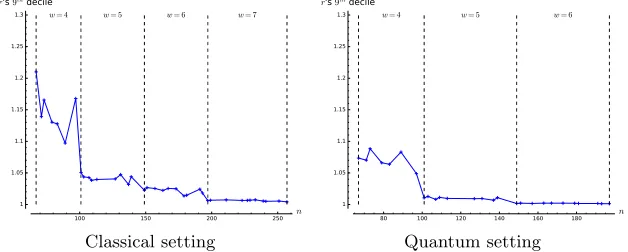
We recall that Heuristic 2 states that the number of collisions c =|{(g1, g2)∈ S1×S2:H(g1h) =H(−g2h)}|is approximately given byc0=|S1| · |S2|2−B. We measure the ratior=c/c0experimentally, over 100 samples for each dimensionn. Infrequently, this ratio may get as large as 3, yet for 90% of the experiments, it was very close to 1. Figure 1 below shows the 9th decile ofras ngrows.
Classical setting Quantum setting
Fig. 1.9thdecile of the ratio between the measured number of collisionscand expected number of collisionsc0according to Heuristic 2, over 100 experiments per dimension.
A.2 Running time and success probability
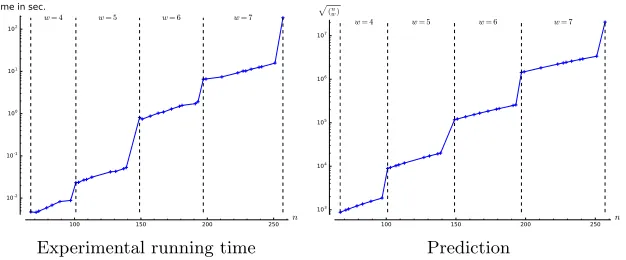
In Figure 2 and Figure 3, we report on the practical efficiency of our attack and compare it to our heuristic prediction. Note that in the quantum regime, the success probability of this MITM attack in practice is sometimes significantly larger than the theoretical prediction. This is most likely due to the fact that our analysis is done for one particular solution, while certain rotations of the same key may be found as well if its bits are properly balanced with respect to the splitFn
Classical setting Quantum setting
Fig. 2.Success rate of the attack over 100 trials (in blue), compared to the theoretical success rate (1−2w/(n−B))B (in red). The rather discontinuous shape of the red curve is due to the rounding ofw=b√n/2candB=blog2
n1 w1
c.
Experimental running time Prediction
Fig. 3.Average running time of the classical attack over 100 trials in comparison with the function
q n w