On the reliability and inter-annotator agreement of
human semantic MT evaluation via HMEANT
Chi-kiu Lo
Dekai Wu
HKUST
Human Language Technology Center Department of Computer Science and Engineering Hong Kong University of Science and Technology
Clear Water Bay, Kowloon, Hong Kong
{jackielo|dekai}@cs.ust.hk
Abstract
We present analyses showing that HMEANT is a reliable, accurate and fine-grained semantic frame based human MT evaluation metric with high inter-annotator agreement (IAA) and correlation with human adequacy judgments, despite only requiring a minimal training of about 15 minutes for lay annotators. Previous work shows that the IAA on the semantic role labeling (SRL) subtask within HMEANT is over 70%. In this paper we focus on (1) the IAA on the semantic role alignment task and (2) the overall IAA of HMEANT. Our results show that the IAA on the alignment task of HMEANT is over 90% when humans align SRL output from the same SRL annotator, which shows that the instructions on the alignment task are sufficiently precise, although the overall IAA where humans align SRL output from different SRL annotators falls to only 61% due to the pipeline effect on the disagreement in the two annotation task. We show that instead of manually aligning the semantic roles using an automatic algorithm not only helps maintaining the overall IAA of HMEANT at 70%, but also provides a finer-grained assessment on the phrasal similarity of the semantic role fillers. This suggests that HMEANT equipped with automatic alignment is reliable and accurate for humans to evaluate MT adequacy while achieving higher correlation with human adequacy judgments than HTER.
Keywords: semantic MT evaluation, HMEANT, inter-annotator agreement
1.
Introduction
HMEANT is a human metric that fully realizes a semantic frame based approach to MT evaluation that we originally envisioned in Lo and Wu (2010) and then subsequently im-plemented and refined over a substantial series of develop-ment cycles (Lo and Wu, 2011a,d). In this paper we present new focused empirical analyses showing that HMEANT achieves high inter-annotation agreement (IAA) and corre-lation with human judgments of transcorre-lation adequacy, de-spite requiring only minimal training for inexpensive lay annotators. Through extensive IAA analyses—particularly on the semantic frame alignment task, an interesting ques-tion raised for example by by Birchet al.(2013)—we show that annotators align semantic frames consistently when the SRL output comes from the same SRL annotator, although the pipeline effect of accumulating the disagreement in the two annotation tasks significantly degrades the overall IAA of HMEANT when the alignment annotators align the SRL output from different SRL annotators. However, our results further show that instead of manually aligning the seman-tic roles, using an automaseman-tic algorithm in the alignment task not only helps maintain a high overall IAA for HMEANT, and at the same time also provides a finer-grained assess-ment of the phrasal similarity of semantic role fillers, such that HMEANT achieves higher correlation with human ad-equacy judgments than HTER or any automatic metric. These results indicate that HMEANT equipped with auto-matic alignment is a reliable and accurate methodology for human subjective evaluation of MT adequacy.
The MEANT family also includes other fully automatic ap-proximations of HMEANT, that are accurate, inexpensive, and tunable semantic frame based MT evaluation metrics quantifying the semantic similarity between reference and machine translations in terns of how well their semantic
frames match. HMEANT (Lo and Wu, 2011a,d), the hu-man variant in the family, correlates better with huhu-man ad-equacy judgments than HTER at a significantly lower la-bor cost. MEANT (Lo et al., 2012), the fully automatic metric in the family, correlates better with human adequacy judgments than the other commonly used automatic MT evaluation metrics, such as, BLEU (Papineniet al., 2002), NIST (Doddington, 2002), or TER (Snover et al., 2006). Since a high MEANT score is contingent on correct lexical choices as well as syntactic and semantic structures, tuning MT systems against MEANT improves both adequacy and fluency and outperforms BLEU-tuned and TER-tuned sys-tems across different languages and different genres, such as formal newswire, informal web forum and informal pub-lic speech (Loet al., 2013a; Lo and Wu, 2013a; Loet al., 2013b).
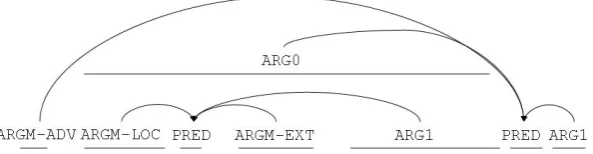
fun-Figure 1: Examples of human semantic frame annotation. Semantic parses of the Chinese input and the English reference translation are from the Propbank gold standard. The MT output is semantically parsed by monolingual lay annotators according to the HMEANT guidelines. There are no semantic frames for MT3 because there is no predicate.
damental design of HMEANT.
Based on our findings in Lo et al. (2012) that MEANT equipped with automatic SRL and automatic semantic role alignment outperforms HMEANT equipped with automatic SRL and manual semantic role alignment, we evaluate the feasibility and reliability of replacing human seman-tic frame alignment with an automaseman-tic alignment algorithm in HMEANT. Since automatic alignment aligns semantic frames more consistently and measures phrasal similarity of the role fillers in a finer-grained manner, we believe HMEANT using human SRL and automatic alignment will be more reliable in terms of IAA and more accurate in cor-relation with human adequacy judgment.
In this paper we focus on the problem of inter-annotator agreement for the semantic frame alignment task in HMEANT, and on evaluating the feasibility and reliability of replacing HMEANT’s human semantic role filler ment step with a cheaper yet more accurate automatic align-ment algorithm instead.
2.
Related work
2.1.
The MEANT family of metrics
2.1.1. HMEANTHMEANT, proposed in Lo and Wu (2011a,c,d), has been found to correlate significantly better with human adequacy
judgments than other commonly used automatic MT eval-uation metrics, as well as other human metrics like HTER (Snover et al., 2006). HMEANT consists of two manual steps: (1) human semantic role labeling, which labels as-pects of the meaning of the reference and machine trans-lations in terms of semantic predicate-argument structure; and (2) human semantic frame alignment, which aligns the annotated semantic predicates and role fillers. Monolingual (or bilingual) human annotators label the semantic roles and fillers in both the reference and machine translations, so that human semantic frame aligners can align the predicates and semantic role fillers in the MT output to the reference trans-lations. These human annotations (semantic role labeling and semantic frame alignment) allow HMEANT to then ag-gregate the translation accuracy for each role into semantic frame accuracy, which is then aggregated into the overall sentence accuracy in meaning. The HMEANT score is sim-ply defined in terms of a modified weighted f-score over these aligned predicates and role fillers. More precisely, HMEANT is computed as follows:
1. Human labelers annotate the shallow semantic struc-tures of both the references and MT output.
REF roles REF MT2 roles MT2 decision
PRED ceased Action stop match
ARG0 their sale — — incorrect
ARGM-LOC in mainland China Agent the mainland of China correct* ARGM-TMP for almost two months Temporal nearly two months correct
— — Experiencer SK - 2 products incorrect
PRED resumed Action resume match
ARG0 sales of complete range of SK -II products
Experiencer in the mainland of China to stop selling nearly two months of SK - 2 products sales
incorrect
ARGM-TMP Until after , their sales had ceased in mainland China for al-most two months
Temporal So far partial
ARGM-TMP now — — incorrect
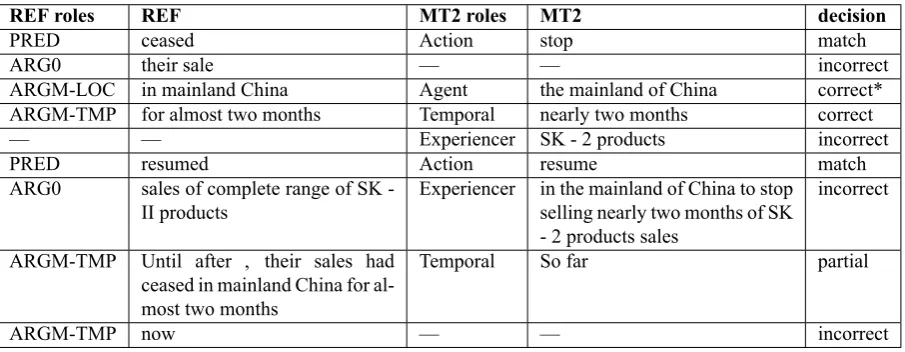
Table 1: Example of SRL annotation for the MT2 output from figure 1 along with the human judgements of translation correctness for each argument. *Notice that although the decision made by the human judge for “in mainland China” in the reference translation and “the mainland of China” in MT2 is “correct”, nevertheless the HMEANT computation will not count this as a match since their role labels do not match.
the predicates.
3. For each pair of aligned semantic frames,
(a) Human aligners determine the translation correct-ness of the semantic role fillers.
(b) Human aligners align the semantic role fillers be-tween the reference and MT output according to the correctness of the semantic role fillers.
4. Compute the weighted f-score over the matching role labels of these aligned predicates and role fillers.
mi ≡
#tokens filled in aligned frame i of MT total #tokens in MT
ri ≡
#tokens filled in aligned frame i of REF total #tokens in REF
Mi,j ≡ total # ARG j of aligned frame i in MT
Ri,j ≡ total # ARG j of aligned frame i in REF
Ci,j ≡ # correct ARG j of aligned frame i in MT
Pi,j ≡ # partially correct ARG j of aligned frame i in MT
wpred ≡ weight of similarity of predicates
wj ≡ weight of similarity of ARG j respectively. These weights estimate the degree of contri-bution of each frame to the overall meaning of the sentence.
Mi,jandRi,jare the total counts of argument of type jin
frameiin the MT and REF respectively. Ci,j andPi,jare
the count of the correctly and partial correctly translated ar-gument of type j in frameiin the MT output. wpredand
wjare the aligned predicates and the aligned arguments of
typejbetween the reference translations and the MT out-put. There are a total of 12 weights for the set of semantic role labels in HMEANT as defined in Lo and Wu (2011c) and they are determined in a supervised learning manner by optimizing the correlation with human adequacy judgments through simple grid searching (Lo and Wu, 2011a). Figure 1 shows examples of human semantic frame annotation on reference and machine translations as used in HMEANT. Table 2.1.1. shows examples of human judges’ decisions for semantic frame alignment and translation correctness for each semantic roles, for the “MT2” output from Figure 1. Birchet al.(2013) reported that the final IAA of HMEANT drops below 50% due to the pipelining effect, where anno-tation disagreements in the SRL task and the semantic role alignment task accumulate.
2.1.2. MEANT and UMEANT
Unlike HMEANT, MEANT (Lo et al., 2012) is fully au-tomatic; but nevertheless, it adheres to HMEANT’s princi-ples of Occam’s razor simplicity and representational trans-parency and outperforms BLEU, NIST, METEOR, WER, CDER and TER in correlation with human adequacy judg-ments. MEANT automates HMEANT by replacing the hu-man sehu-mantic role labelers with shallow sehu-mantic parsers and replacing the human semantic frame aligners with the maximum weighted bipartite matching algorithm based on a context vector model that computes the lexical similarity of the semantic role fillers. The minimal changes in the math-ematics formula from HMEANT to MEANT are illustrated as follow:
Si,pred ≡ predicate similarity in aligned frame i
Si,j ≡ ARG j similarity in aligned frame i
whereSi,pred andSi,j are the lexical and phrasal
similari-ties based on a context vector model of the predicates and role fillers of the arguments of type j between the refer-ence translations and the MT output. The lexical similarities of the semantic role fillers can be computed using different statistical similarity measures while the phrasal similarities can be aggregated from lexical similarities using different heuristics, like the geometric mean used in Loet al.(2012) and Tumuluruet al.(2012) or the normalized phrasal aggre-gation (Mihalceaet al., 2006) used subsequently in Loet al.
(2013a); Lo and Wu (2013a); Loet al.(2013b). In MEANT, the weightswpredandwjare estimated in the same way as
HMEANT, i.e. by optimizing the correlation with human adequacy judgments through simple grid searching. As for UMEANT (Lo and Wu, 2013b), these weights are estimated in an unsupervised manner using relative frequency of each semantic role label in the reference translations. UMEANT can thus be used when human judgments on adequacy of the development set are unavailable.
Loet al. (2012) show that fully automated MEANT out-performs semi-automated HMEANT (automatic SRL and human semantic frame alignment) in correlating with hu-man adequacy judgments. Recent studies (Loet al., 2013a; Lo and Wu, 2013a; Loet al., 2013b) show that tuning MT systems against MEANT produces more robustly adequate translations than the common practice of tuning against BLEU or TER across different data genres, including for-mal newswire text, inforfor-mal web forum text, and inforfor-mal public speech. The work shows that the automatic align-ment algorithm aligns semantic frames more consistently and measures phrasal similarity of the role fillers in a finer-grained manner, and thus suggests that the reliability of HMEANT would be improved by automatically aligning the manually labeled semantic frames.
2.2.
Other human MT evaluation
HTER (Snoveret al., 2006) is only used in large-scale MT evaluation campaign because of its high labor cost. It not only requires well-trained professional human translators reading and understanding both the reference translation and the MT output, but also relies on the minimum edits made by those translator on the MT output so as to match the meaning expressed in the edited MT output with that in the reference translation. This requirement of heavy man-ual decision making in HTER greatly increases the cost of evaluation.
In contrast, task based human MT evaluation in Voss and Tate (2006) reduces labor cost by requiring human evalu-ators to finish some simple question answering tasks after reading the MT output. However, task based human MT evaluation do not generalize across different test sets.
3.
IAA on the alignment task in HMEANT
To address the interesting questions raised by Birchet al.
(2013), we systematically analyze the IAA for semantic frame alignment task by asking the alignment annotators to align SRL output from the same SRL annotators. This avoids directly diving into rough aggregation of the overall IAA for the entire evaluation pipeline, which might
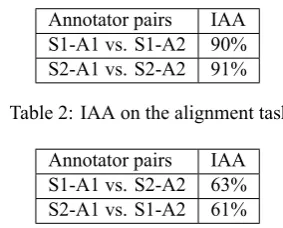
mis-Annotator pairs IAA S1-A1 vs. S1-A2 90% S2-A1 vs. S2-A2 91%
Table 2: IAA on the alignment task
Annotator pairs IAA S1-A1 vs. S2-A2 63% S2-A1 vs. S1-A2 61%
Table 3: IAA on the overall annotation pipeline
leadingly jump to the conclusion that HMEANT is not reli-able.
3.1.
Setup
For our benchmark comparison, the evaluation data for our experiments is the same set of sentences, GALE-A, that were used in Lo and Wu (2012). The reference and each of the MT system outputs are labeled by two SRL annota-tors for IAA analysis. For the purpose of cross-validation, we setup two rounds of alignment tasks. In the first round, two alignment annotators align the SRL output from the first SRL annotator. In the second round, the two alignment an-notators align the SRL output from the second SRL anno-tator. As described in Lo and Wu (2011b), in all the human SRL task and the alignment task, we supplement annotators with one double sided sheet with three examples. As a re-sult, we have alignment output from four combinations of the two SRL annotators and the two alignment annotators. For inter-annotator agreement, we follow the definition as in Lo and Wu (2011a).
3.2.
Results
Table 3.1. shows the IAA on the alignment task of HMEANT is over 90% consistently when the alignment an-notators align the SRL output from the same SRL annota-tor. This shows that the instructions on the alignment task is sufficient and effective.
However, table 3.1. shows the final IAA where the align-ment annotators align the SRL output from different SRL annotators falls to only 61% due to the pipelining effect on the disagreement in the two annotation tasks.
4.
Don’t align semantic frames manually
Loet al.(2012) reported that MEANT equipped with auto-matic SRL and autoauto-matic semantic frame alignment outper-forms HMEANT equipped with automatic SRL and manual semantic role alignment. The natural question following such findings is whether the reliability of HMEANT im-proves by replacing human semantic roles alignment with automatic alignment algorithm, and if so, the extent to which it helps.
4.1.
Setup
Annotator pairs IAA S1-auto vs. S2-auto 70%
Table 4: IAA on the overall annotation pipeline where the human alignment annotators are replaced by an automatic alignment algorithm
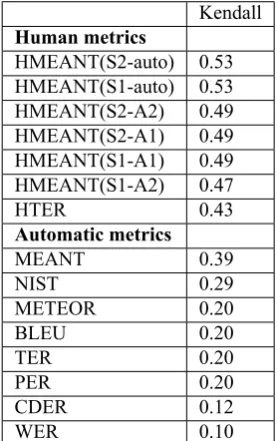
Table 5: Sentence-level correlation with human adequacy judgment on GALE-A
is estimated in an unsupervised manner like UMEANT (Lo and Wu, 2013b).
4.2.
Results
Table 4.1. shows the IAA on HMEANT using automatic semantic role alignment algorithm rises to 70%. These re-sults are expected because the automatic alignment algo-rithm handles the partial alignment more consistently, es-pecially on cases where the role fillers of the semantic roles in the reference is split into role fillers in more than one role in the MT output.
Table 4.1. shows that performing the semantic frame align-ment automatically is better than aligning manually. The results are in line with the findings in Lo et al. (2012). Since automatic alignment algorithm aligns semantic roles more consistently and measures phrasal similarity of the role fillers in a finer-grained manner, we believe HMEANT using human SRL and automatic alignment is more reliable in term of IAA and accurate in correlating with human ad-equacy judgments.
5.
Conclusion
We have shown that HMEANT is a reliable, accurate and fine-grained semantic frame based human MT evaluation metric with high IAA and correlation with human ade-quacy judgment, despite requiring only minimal training for lay annotators. Our results show that the IAA on the semantic frame alignment task of HMEANT is over 90% when the human annotators align SRL output from the same SRL annotator, although the final IAA of HMEANT based
on alignment results from annotators aligning SRL output from different SRL annotators falls to only 61% due to the pipelining effect of the disagreement in the two annotation tasks.
More importantly, we have shown that to improve the reli-ability of HMEANT, completely replacing the manual se-mantic frame alignment with fully automatic alignment not only helps to maintain the overall IAA of HMEANT at a 70% level, but also provides a finer-grained assessment on the phrasal similarity of the semantic role fillers, so that HMEANT achieves higher correlation with human judg-ments of translation adequacy than HTER. This has the ad-ditional important benefit of making HMEANT even more cost effective. The results show that HMEANT equipped with automatic alignment algorithm is a highly reliable and accurate methodology for MT evaluation.
6.
Acknowledgments
This material is based upon work supported in part by the Defense Advanced Research Projects Agency (DARPA) under BOLT contract nos. HR0011-12-C-0014 and 12-C-0016, and GALE contract nos. HR0011-06-C-0022 and HR0011-06-C-0023; by the European Union under the FP7 grant agreement no. 287658; and by the Hong Kong Research Grants Council (RGC) research grants GRF620811, GRF621008, and GRF612806. Any opinions, findings and conclusions or recommendations ex-pressed in this material are those of the authors and do not necessarily reflect the views of DARPA, the EU, or RGC.
7.
References
Alexandra Birch, Barry Haddow, Ulrich Germann, Maria Nadejde, Christian Buck, and Philipp Koehn. The feasi-bility of HMEANT as a human MT evaluation metric. In
8th Workshop on Statistical Machine Translation (WMT 2013), 2013.
George Doddington. Automatic evaluation of machine translation quality using n-gram co-occurrence statistics. InThe second international conference on Human Lan-guage Technology Research (HLT ’02), pages 138–145, San Diego, California, 2002.
Chi-Kiu Lo and Dekai Wu. Evaluating machine translation utility via semantic role labels. InThe Seventh Interna-tional Conference on Language Resources and Evalua-tion (LREC 2010), 2010.
Chi-kiu Lo and Dekai Wu. MEANT: An inexpensive, high-accuracy, semi-automatic metric for evaluating transla-tion utility based on semantic roles. In49th Annual Meet-ing of the Association for Computational LMeet-inguistics: Human Language Technologies (ACL HLT 2011), 2011. Chi-kiu Lo and Dekai Wu. A radically simple, effective an-notation and alignment methodology for semantic frame based SMT and MT evaluation. InInternational Work-shop on Using Linguistic Information for Hybrid Ma-chine Translation (LIHMT-2011), 2011.
Chi-kiu Lo and Dekai Wu. Structured vs. flat semantic role representations for machine translation evaluation. InFifth Workshop on Syntax, Semantics and Structure in Statistical Translation (SSST-5), 2011.
Chi-kiu Lo and Dekai Wu. Unsupervised vs. supervised weight estimation for semantic MT evaluation metrics. InSixth Workshop on Syntax, Semantics and Structure in Statistical Translation (SSST-6), 2012.
Chi-kiu Lo and Dekai Wu. Can informal genres be bet-ter translated by tuning on automatic semantic metrics? In14th Machine Translation Summit (MT Summit XIV), 2013.
Chi-kiu Lo and Dekai Wu. MEANT at WMT 2013: A tun-able, accurate yet inexpensive semantic frame based mt evaluation metric. In 8th Workshop on Statistical Ma-chine Translation (WMT 2013), 2013.
Chi-kiu Lo, Anand Karthik Tumuluru, and Dekai Wu. Fully automatic semantic MT evaluation. In7th Workshop on Statistical Machine Translation (WMT 2012), 2012. Chi-kiu Lo, Karteek Addanki, Markus Saers, and Dekai
Wu. Improving machine translation by training against an automatic semantic frame based evaluation metric. In
51st Annual Meeting of the Association for Computa-tional Linguistics (ACL 2013), 2013.
Chi-kiu Lo, Meriem Beloucif, and Dekai Wu. Improv-ing machine translation into Chinese by tunImprov-ing against Chinese MEANT. InInternational Workshop on Spoken Language Translation (IWSLT 2013), 2013.
Rada Mihalcea, Courtney Corley, and Carlo Strapparava. Corpus-based and knowledge-based measures of text se-mantic similarity. InThe Twenty-first National Confer-ence on Artificial IntelligConfer-ence (AAAI-06), volume 21, page 775. Menlo Park, CA; Cambridge, MA; London; AAAI Press; MIT Press; 1999, 2006.
Kishore Papineni, Salim Roukos, Todd Ward, and Wei-Jing Zhu. BLEU: a method for automatic evaluation of ma-chine translation. In40th Annual Meeting of the Asso-ciation for Computational Linguistics (ACL-02), pages 311–318, Philadelphia, Pennsylvania, July 2002. Matthew Snover, Bonnie Dorr, Richard Schwartz, Linnea
Micciulla, and John Makhoul. A study of translation edit rate with targeted human annotation. In 7th Bien-nial Conference Association for Machine Translation in the Americas (AMTA 2006), pages 223–231, Cambridge, Massachusetts, August 2006.
Anand Karthik Tumuluru, Chi-kiu Lo, and Dekai Wu. Ac-curacy and robustness in measuring the lexical similarity of semantic role fillers for automatic semantic MT eval-uation. In 26th Pacific Asia Conference on Language, Information, and Computation (PACLIC 26), 2012. Clare R. Voss and Calandra R. Tate. Task-based