Generalized Selection Weighted Vector Filters
Rastislav Lukac
The Edward S. Rogers Sr. Department of Electrical and Computer Engineering, University of Toronto, 10 King’s College Road, Toronto, ON, Canada M5S 3G4
Email:[email protected]
Konstantinos N. Plataniotis
The Edward S. Rogers Sr. Department of Electrical and Computer Engineering, University of Toronto, 10 King’s College Road, Toronto, ON, Canada M5S 3G4
Email:[email protected]
Bogdan Smolka
Department of Automatic Control, Silesian University of Technology, Akademicka 16, 44-101 Gliwice, Poland Email:[email protected]
Anastasios N. Venetsanopoulos
The Edward S. Rogers Sr. Department of Electrical and Computer Engineering, University of Toronto, 10 King’s College Road, Toronto, ON, Canada M5S 3G4
Email:[email protected]
Received 21 July 2003; Revised 11 December 2003
This paper introduces a class of nonlinear multichannel filters capable of removing impulsive noise in color images. The here-proposed generalized selection weighted vector filter class constitutes a powerful filtering framework for multichannel signal pro-cessing. Previously defined multichannel filters such as vector median filter, basic vector directional filter, directional-distance filter, weighted vector median filters, and weighted vector directional filters are treated from a global viewpoint using the pro-posed framework. Robust order-statistic concepts and increased degree of freedom in filter design make the propro-posed method attractive for a variety of applications. Introduced multichannel sigmoidal adaptation of the filter parameters and its modifica-tions allow to accommodate the filter parameters to varying signal and noise statistics. Simulation studies reported in this paper indicate that the proposed filter class is computationally attractive, yields excellent performance, and is able to preserve fine details and color information while efficiently suppressing impulsive noise. This paper is an extended version of the paper by Lukac et al. presented at the 2003 IEEE-EURASIP Workshop on Nonlinear Signal and Image Processing (NSIP ’03) in Grado, Italy.
Keywords and phrases:multichannel image processing, color image processing, nonlinear vector filtering, order-statistic theory, adaptive filter design, noise removal.
1. INTRODUCTION
Vector signal processing is of paramount importance in ap-plication areas such as biomedicine, computer vision, mul-timedia, robotics, industrial inspection, and remote sensing. In all these areas, end-users and system developers have to work with multidimensional vectorial data sets. The growing interest in the development of vector processing techniques can be attributed primarily to the importance of color im-age processing [1,2]. The surge of emerging applications [1] such as web-based processing of color images and videos, en-hancement of DNA microarray images, digital archiving and culture heritage preservation, multimedia sequence mining,
and the proliferation of devices [3] such as video-enabled wireless phones and personal digital assistant (PDA) tools suggests that the demand for new, more powerful, and cost-effective vector-filtering solutions will continue.
used. It comes therefore, as no surprise, that the most com-mon signal processing task is the noise filtering. Noise filter-ing is an essential part of any image processfilter-ing-based system, whether the final information is used for human inspection or for an automatic analysis.
In the last decades, several noise reduction techniques have been proposed. They can be divided into two classes: linear filters and nonlinear filters.
Linear processing techniques have been widely used in digital signal processing applications. However, many image processing tasks are suitable for linear operations as well. On the other hand, image signals are nonlinear in nature due to the presence of structural information (edge and flat ar-eas) and are perceived via the human visual system which has strong nonlinear characteristics [4]. Therefore, nonlin-ear methods can potentially preserve important multichan-nel structural elements, such as color edges, and eliminate degradations occurring during signal formation or transmis-sion through nonlinear channel.
This paper contributes to the progressive generalization of vector filtering operators. The main emphasis is on the development of a unified framework for the description and analysis of color image filters. Existing, vector color image processing solutions can be discerned as follows:
(i) componentwise (marginal) methods [5,6], which sep-arately operate on color channels;
(ii) vector (multichannel) methods [1,2], which process the color pixels as vectors.
In the case of red-green-blue (RGB) image representa-tion which is most often used for image acquisirepresenta-tion, stor-ing and displaystor-ing systems, componentwise filters produce strong, visible color artifacts due to independent (separate) processing of the correlated RGB channels. Their projection into the restored RGB image often produces a new color quite different from the neighbors. Therefore, vector filters, espe-cially nonlinear vector filters, which process the color pixels as vectors seem to be more appropriate [1,2,7].
The most popular class of nonlinear vector operators is the one based on the theory of order statistics [8,9,10,11]. In such an approach, the center of the ordered sequence, known as a median [10], represents the sample which has the largest probability to be noise free. In vector-valued sig-nals such as color images, outliers are associated with the maximum extremes of aggregated distances to other input vectors in the sliding window [12,13,14]. For that reason, the output of the vector filters based on ranking is the low-est ranked vector in a predefined sliding window. Mostly used vector filtering techniques such as vector median fil-ters (VMFs) [15] and vector directional filters (VDFs) [16] utilize either the aggregated Euclidean distance (in the VMF designs) or the aggregated angular distance (in the VDF de-signs) of the input vectors within a processing window. How-ever, these measures do not take into account neither the importance of the specific samples in the filter window nor structural contents of the image. Much better results can be obtained when distances appropriately modified by weight-ing coefficients represent the degree to which each input
vec-tor contributes to the output of the filter. The relationship between the image vector at the window center and its neigh-bors should be reflected in the decision for the weights of the filter.
This paper focuses on a class of nonlinear filters termed selection weighted vector filters (SWVFs) [17]. As the name implies, the output of the filter is selected from an input set associated with the positive weight vector (or two inde-pendent weight vectors for Euclidean and angular distances). These weights express the degree of which the specific dis-tances between multichannel inputs contribute to the aggre-gated measure serving as an ordering criteria. To adapt the filter weights to varying signal and noise statistics, we provide the generalized multichannel adaptation algorithms based on the sigmoidal function [17]. The proposed approach has the advantage of optimal weighted medians (WMs) [18], is fast, saves the memory space and is easy to implement. More-over, the achieved weights are sufficiently robust and the pro-posed method is able to remove impulsive noise while pre-serving edge information.
The rest of this paper is organized as follows. InSection 2, the formulation of the problem is introduced and an overview of the most commonly used vector filters is pre-sented. A generalized framework for vector filtering is intro-duced inSection 3. Motivation and design characteristics are discussed in detail. Variations of the proposed structure are recommended and analyzed with respect to their properties and parameters used. InSection 4, the proposed methods are tested using a variety of noise corrupted test images. Conclu-sions are offered inSection 5.
2. MULTICHANNEL IMAGE FILTERING FUNDAMENTALS
We consider aK1×K2multichannel imagex(i) :Zl→Zm rep-resenting a two-dimensional matrix ofm-component sam-plesxi=(xi1,xi2,. . .,xim)∈Zl. Note that standard color im-ages such as RGB imim-ages relate to parameterslandmequal to 2 and 3, respectively. Componentsxik, fork=1, 2,. . .,m andi=1, 2,. . .,Q;Q=K1K2, represent thekth elements of the vectorial inputsxi.
Each multichannel samplexi =(xi1,xi2,. . .,xim) can be considered as anm-dimensional vector in the vector space. For a color vectorxi, its magnitudeMx(i) :Zl→R+,
Mxi=xi=
xi1 2
+xi2 2
+· · ·+xim
2 , (1)
constitutes a measure of their brightness. Its directionDx(i) : Zl→Sm−1,
Dxi = 1 xixi=
1 Mxixi,
dxik=xik
xi= xik
Mxi, fork=1, 2,. . .,m,
(2)
whereSm−1is a unit ball inRmandD
2.1. Problem formulation
In many practical applications, vectorial signals such as mul-tichannel images are corrupted by additive noise. The most commonly used model is defined [1,15,19] as
xi=oi+vi, (3)
wherexi=(xi1,xi2,. . .,xim) represents the observed (noisy) sample,oi=(oi1,oi2,. . .,oim) is the desired (noise free) sam-ple,vi = (vi1,vi2,. . .,vim) is the vector describing the noise process (e.g., thermal noise mixed with bit errors), andi de-notes the spatial position of the samples in the image. Note thatvican describe signal-dependent noise as well as noise to be considered independent.
The appearance of the noise and its influence on the im-age relates to its characteristics. Noise signals can be either periodic in nature or random. In certain cases (e.g., sensors), noise can be described in terms of the commonly used Gaus-sian noise model. However, noise-corrupted signals are of-ten characterized by abrupt local changes, in which case the noise masking the true signal can be modelled as impulsive sequences, which occur in the form of short time duration, high energy spikes attaining large amplitudes with probabil-ity higher than that predicted by a Gaussian densprobabil-ity model. Such impulsive noise can be introduced into the images by electronic interference, flaws in the data transmission proce-dure, or through the aging of the storage material [2].
2.2. State of the art in color image filtering
The most popular vector image processing filters, such as the VMF and the VDF, are operating on some type of sliding windowW = {xi ∈ Zl; i =1, 2,. . .,N}of a finite sizeN, which usually affects one image sample (mostly the sample
x(N+1)/2placed in the center of the window) at a time, chang-ing its value by some function of a local neighborhood area {x1,x2,. . .,xN}. This window operator slides over the image to affect individually all the image pixels.
Probably the most well-known filter is the VMF [15]. The VMF can be derived as a maximum likelihood estimate (MLE) when the underlying probability densities ofvi ∈Zl are double exponential. The output of the VMF scheme can be equivalently expressed as the samplex(1)∈W, that is, the sample of the input setW, minimizing the distance to other samples insideW:
min arg x(1)∈W
N
i=1
x(1)−xi
L, (4)
wherexi−xjLis the generalized Minkowski metric [20] determining the distance between two m-channel samples
xi=(xi1,xi2,. . .,xim) andxj=(xj1,xj2,. . .,xjm),
xi−xj L=
m
k=1
xik−xjkL 1/L
, (5)
whereLdenotes the norm parameter, for example, the city-block distance (L = 1) or Euclidean distance (L = 2), and xikis thekth element ofxi. If the vector dimensionm =1 (gray-scale case), the VMF is equivalent to the scalar median filter (MF).
Properties of the VMF scheme have been summarized in [15]. One of the most important is the robust noise attenua-tion capability which makes the VMF very attractive for vari-ous applications. However, the drawback of the VMF scheme is its low signal-detail preserving capability, as the VMF tends to produce streaks, that is, regions of constant or nearly con-stant brightness. This was a motivation for developing of the VMF-based modifications, for example, fast switching schemes [21], weighted filtering structures [22,23], gradient-based design [24], and combinations with the linear filters [15], rational filters [25], and fuzzy sets [26,27]. The prop-erties of color spaces have been followed in [28]. To speed up the calculation of the distances between the color vectors, the VMF based on linear approximation of the Euclidean norm has been provided [29].
Another class of vector operators, termed VDF filters [16], is operating on the directional domain of color images. It has been observed [30] that the output of the basic VDF (BVDF) [16] is the color vectorx(1)∈Wwhose direction is the MLE of directions of the input vectors. Thus, the BVDF outputx(1)minimizes the angular ordering criteria to other samples inside the sliding filtering windowW:
min arg x(1)∈W
N
i=1
Ax(1),xi
, (6)
where
Axi,xj
=arccos
xi·xj xixj
(7)
represents the angle between twom-dimensional vectorsxi andxj.
In [30], it has been proven that in the case of color im-ages, the angular minimization approach is useful for di-rectional data such as color data. Therefore, the filtering schemes based on directional processing of color images (or directional processing followed by magnitude processing) [1,2,16] may achieve better performance than the VMF-based approaches in terms of the color chromaticity (direc-tion of color data) preserva(direc-tion. On the other hand, the VDF filters do not take into account the brightness of color vec-tors. To utilize both features in color image filtering [2,16], the generalized VDFs (GVDFs) and double window GVDF first eliminate the color vectors with atypical directions in the vector space and consequently process the vectors with the most similar orientation according to their magnitude. Thus, the GVDF splits the color image processing into the directional processing and the magnitude processing.
angular criteria (6) excluding the constraints of the output sample lying in the filter windowW. In order to develop ro-bust smoothing algorithms operating on vectors’ direction-ality, fuzzy adaptive filters have been provided [19,33]. Re-cently developed weighted VDF (WVDF) filters [34,35] im-prove the signal-detail preserving capability of the VDF op-erators.
3. PROPOSED FRAMEWORK
3.1. Generalization
Let W = x1,x2,. . .,xN be a set of vector-valued samples spawned by a filter window of a finite sizeNand letx(N+1)/2 be the central sample corresponding to the window refer-ence position. We assume that w = [w1,w2,. . .,wN] and
u = [u1,u2,. . .,uN] represent sets of positive real weights, where the weightswi andui, fori =1, 2,. . .,N, are associ-ated with the input samplexi.
Applying a minimization procedure similar to the one used for VMF or BVDF, the obtained SWVF output is the samplex(1)minimizing
min arg x(1)∈W
N
i=1
wix(1)−xiL
1−pN
i=1
uiA
x(1),xi p
, (8)
where pis a design parameter ranged from 0 to 1. Weight coefficientwi signifies the importance of the input sample
xibased on the aggregated Euclidean distance and ui mea-sures the importance of xi according to the aggregated an-gular distance. A design parameter p can be used to tune the overall filter characteristics in terms of color fundamen-tals [1]. It should be mentioned at this point that the aggre-gated Euclidean distance relates to the brightness character-istics of the color vectors under consideration, whereas the aggregated angular distance relates to the chromaticity prop-erties of specific samples. Weight coefficients associated with
xiemphasize its importance in (8) by adding the multiplied distances to the aggregated measures of its neighbors. Due to zero self-contribution ofxito the corresponding aggregated measure,wianduimakexifavorable. Thus, the weight coef-ficients used in the SWVF scheme allow to control its detail-preserving and noise attenuating characteristics.
The output of the SWVF can be determined using the vector order statistics. We denote
ψi= N
j=1
wjxi−xjL
1−p
× N
j=1
ujA
xi,xj
p (9)
as the combined aggregated measure associated withxi, for i =1, 2,. . .,N. Then the ordered sequence ofψ1,ψ2,. . .,ψN is given by ψ(1) ≤ ψ(2) ≤ · · · ≤ ψ(N). Assuming that the ordering of ψ(i)’s implies the same ordering of the in-put set x1,x2,. . .,xN, the procedure results in the ordered set x(1),x(2),. . .,x(N), where x(i) is associated with ψ(i). In
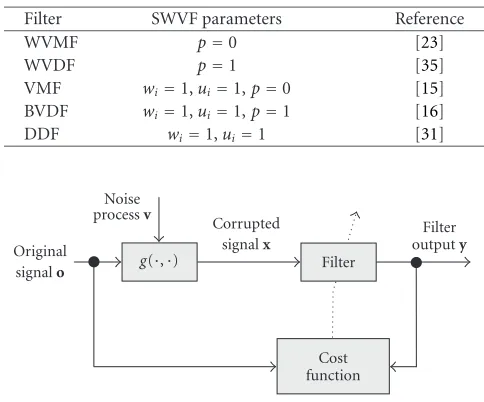
Table1: Special cases of the proposed SWVF framework.
Filter SWVF parameters Reference
WVMF p=0 [23]
WVDF p=1 [35]
VMF wi=1,ui=1,p=0 [15]
BVDF wi=1,ui=1,p=1 [16]
DDF wi=1,ui=1 [31]
Original signalo
Noise processv
g(·,·)
Corrupted signalx
Filter
Filter outputy
Cost function
Figure1: The filtering problem statement, where a filter is usually designed under the minimization of the cost function.
this case, the SWVF output is defined as the lowest order-statisticsx(1), which is equivalent to the sample-minimizing earlier definition (8). From this algorithm, it is evident that the SWVF output is restricted to the dynamic range of the input samples and thus, it can never cause new outliers.
A class of SWVFs includes (Table 1) a number of previ-ously introduced vector filters as their subclasses. These fil-ters can be achieved by appropriate configuration of the de-sign parameter pand the weight coefficientsw1,w2,. . .,wN andu1,u2,. . .,uN. Thus, the SWVF includes the WVMF (for p=0) and WVDF (forp=1) such as basic subclasses. Spe-cial cases such as VMF (p=0), BVDF (p=1), and DDF are obtained withwi=1,ui=1, fori=1, 2,. . .,N.
3.2. Adaptive filter design
SWVFs constitute a wide class of vector operators. Each set-ting of the filter parameters represents a specific filter which can be used for specific purposes. Using optimization scheme (Figure 1), the weight coefficients can follow the statistics and structural context of desired signal and be adapted in re-quired manner. To simplify the SWVF optimization and pro-vide better illustration of the weight adaptation [17], we con-sider the equivalence between the weight vectorswanduso thatwi=ui, fori=1, 2,. . .,N. Thus, in the rest of this paper, we will make the use of the weight coefficientsw1,w2,. . .,wN only. These coefficients are adaptively determined using gen-eralized multichannel sigmoidal optimization approach [17] of the standard WM filters [18].
We consider the generalized difference between two
vec-Note that the polarity function introduced here preserves the sign of the difference between the scalar image samplesa andbsince for a scalar case, that is,m =1 and p =0, the magnitude ofaandbis equivalent toaandb, respectively.
Given an input setW = {x1,x2,. . .,xN} and a weight vectorw=[w1,w2,. . .,wN], we denote the SWVF output as
y =y(w,W) =x(1). The loss in performance (error in the filtering operation) is defined as
e=D(o−y). (12)
Although this function is not convex in nature, it allows to express the error criteria using the same design parameterp like in the SWVF scheme and thus, (12) well describes behav-ior of the SWVF framework.
One (but no only) natural way of choosing the weight co-efficientsw1,w2,. . .,wN is to require that this choice should minimize the average loss or risk. Therefore, the cost func-tion of the SWVF filtering is defined as follows:
JSWVF(w)=ED(o−y), (13)
whereE{·}indicates statistical expectation.
With the constraint of nonnegative weights keeping the aggregated measure (9) positive, the optimization problem with inequality constraints can be expressed as follows:
minimizeJSWVF(w) subject towi≥0 fori=1, 2,. . .,N.
(14)
During processing, the sliding filtering window is mov-ing over an image domain. The weight coefficientswi, for i = 1, 2,. . .,N, are adjusted by adding the contribution of the samples multiplied by a certain regulation factorµ[17]:
wi=P
where y is the output of the sigmoidally optimized SWVF related to the actual weight coefficientsw.
This iterative algorithm determines the weight coeffi -cients with respect to the filter weights at the previous point. IfD(o−y) is zero, a filter holds the preserving characteristics and all weight coefficients remain unchanged. IfD(xi−y) is zero, the input samplexidenotes the same noise attenuation and detail preserving capability as y and the correspond-ing weightwiremains also unchanged. In the rest of cases, D(o−y) andD(xi−y) influence the weight update in terms of the tradeoffbetween the noise smoothing and the signal-detail preservation. Note that the initial weight vectorwcan
be set to arbitrary positive values, but the best choice is to start the weight adaptation with equal weights—for exam-ple,wi=1, fori=1, 2,. . .,N—corresponding to the robust smoothing functions such as VMF, BVDF, and DDF. To end the description of (15), notation sgn(·) denotes the sign sig-moidal function,
which changes the negative values to zero during the weight adaptation.
For illustration purposes, we consider the scalar case (e.g., componentwise filtering for a particular value ofk). In this case and forp=0, (15) can be written as follows:
Assuming for the moment thatP(·) is an identity function, forxik ykand positiveµ, the adaptation formula (18)
re-According to (19), the importance of the sample occupying the ith position in a supporting window increases if ok is greater than the actual output yk and decreases ifok is less than yk. Thus, this difference multiplied by a regularization factor represents the weight increment (for 0< ok−yk), the weight decrement (for 0> ok−yk), or it can keep the weights unchanged (forok−yk=0).
It is clear that the availability of original (training) signal in (15) is essential in the development of the filter. However, noise-free (training) samples may not be available in prac-tical image processing applications. In such a case, the pro-posed scheme can be optimized using training sets available from other natural images. Upon completion of the train-ing, the filter can be applied to real images. Another way is to replace the desired signalowith the input central sample
x(N+1)/2as follows:
(a) (b) (c) (d)
(e) (f) (g) (h)
(i) (j) (k) (l)
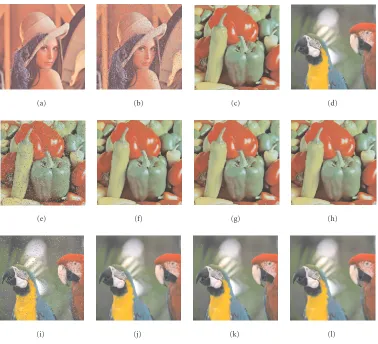
Figure2: Color images test: (a) original image Lena, (b) image Lena corrupted by 10% impulsive noise (pv =0.10), (c) original image
Peppers, (d) original image Parrots, (e) image Peppers corrupted by 10% impulsive noise (pv =0.10), and (i) image Parrots corrupted by
5% impulsive noise (pv=0.05). The results obtained by filtering the images shown in Figures2eand2iare, respectively, (f) VMF output,
(g) SWVF1output (p=0.5), (h) SWVF2output (p=0.5), (j) VMF output, (k) SWVF1output (p=0.5), and (l) SWVF3output (p=0).
wherek, fork =1, 2,. . .,m, denotes the color channel,xik, fori=1, 2,. . .,N, represent thekth component of the input samplexi, and med is a median operator.
Such a filter is characterized by robust noise attenuation capability and is able to remove strong image noise. Its draw-back is a worse signal-detail preservation. Therefore, it can be desirable to combine noise attenuating and detail-preserving characteristics of (20) and (21). Thus, the SWVF adaptation formula is given by
wi=P
wi+2µ
Dy∗−y+Dx(N+1)/2−y
sgnDxi−y
. (23)
4. APPLICATION TO COLOR IMAGES
In this section, the performance of the SWVFs is evaluated in the most important area of vector processing, namely, color image filtering. Note that all filtering results presented in this paper were obtained with a 3×3 square window, that is, for N = 9. Firstly, the noise attenuation
prop-erties and color/structural preservation capability of the SWVF framework are examined by utilizing the color im-age Lena (Figure 2a). The test image has been contaminated (Figure 2b) by impulsive noise [35] given by
xi=
vi with probabilitypv,
oi with probability 1−pv,
(24)
where i characterizes the sample position, oi is the orig-inal sample, xi represents the sample from the noisy im-age and pv is a corruption probability (also refereed as a percentage number of corrupted pixels). The impulse vi = (vi1,vi2,. . .,vim) is independent from pixel to pixel and has generally much larger and smaller amplitude than the neigh-boring samples at least in one of the components.
To provide some measure of closeness between two dig-ital images, a number of different objective measures based on the difference in the statistical distributions of the pixel values can be utilized. In this paper, we will make the use of commonly employed objective measures [7,19,21] such as mean absolute error (MAE), mean square error (MSE), and normalized color difference criteria (NCD). The MAE and MSE are defined as follows:
MAE= 1 position in a K1×K2 color image, andk characterizes the color channel.
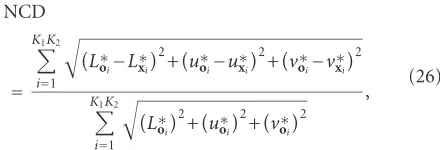
To evaluate the measure of color distortion in the percep-tual way to humans [2], we also use the NCD criteria defined as follows: nance values corresponding to originaloi and noisy (or fil-tered)xisamples expressed in the CIELUV color space.
The second evaluation approach is the subjective evalua-tion of the image quality with respect to the structural con-tent (edges, textures, and fine details) preservation and the presence of unremoved impulses or introduced color arti-facts as a result of faulty processing. Note that the human visual system is sensitive to changes in color, and maintain-ing the sharpness of the edges is as important as removmaintain-ing the image noise. Edges are important features since they pro-vide an indication of the shape of the objects in the image. From this point of view, it is evident that the noise removal tasks in color images may be understood as achieving the best balance between the noise suppression and color/structural content preservation.
Tables2and3allow for the objective comparison of a va-riety of vector image filtering techniques. The results indicate that the proposed SWVF framework (SWVF1 and SWVF2, both defined in (15), were trained using the test image Lena corrupted by impulsive noise pv = 0.10 and 0.20, respec-tively; SWVF3 is a self-adaptive technique defined by (23)) provides the best results among the tested filters, and per-formance of the filters designed within the SWVF frame-work is satisfactorily robust for a wide range of the im-pulsive noise corruption. Moreover,Figure 2shows that the proposed SWVF methods achieve excellent balance between noise attenuation and signal-detail preserving
characteris-tics. These results are also confirmed by the corresponding estimation errors shown in Figure 3, and zoomed parts of the test images depicted in Figures 4and5. It can be easily observed that the standard filtering techniques such as VMF and MFs excellently suppress impulses present in the image; however, their excessive smoothing capability results in edge blurring. In some situations, the decreased noise attenuation capability of the BVDF can result in the presence of impulses in the filtered image. It can be seen that the proposed SWVF filters achieve excellent balance between signal-detail preser-vation and noise suppression. This is also reflected in very small estimation error depicted in Figures3b,3c,3e, and3f.
Figure 6shows the adaptation capability of the proposed SWVF scheme (15) starting with the same initial weighting vectorw=[1, 1, 1, 1, 1, 1, 1, 1, 1]. These results are related to the training set represented by the test image Lena and its corrupted versions with 2% and 10% impulsive noise, re-spectively. Objective criteria MAE, MSE, and NCD are ex-pressed in dependence on the regularization factor µ rang-ing from 10−12 to 103 and the design parameter pranging from 0 to 1. The obtained results indicate that the SWVF adaptation depends strongly on µ. For its small value, the SWVF provides worse detail-preserving characteristics and performs the smoothing operation similar to the DDF, which depends on design parameter p. This is caused by achieved weight coefficients like in the initial weight vectorwsince too small value ofµdoes not have large enough influence on the adaptation ofw. FromFigure 7, it can be seen that the error criteria related to the SWVF performance increase with the noise corruptionpv. Simultaneously, the growth ofpvresults in smaller difference between the best and the worst perfor-mance of the SWVF technique related to the same noise in-tensity pv. To end this,Figure 8shows the dependence ofµ onp. It can be observed that the SWVF (for any value ofp) usually achieves the best balance between all considered ob-jective measures forµlarger than 0.5.
Figure 9corresponds to the convergence properties of the SWVF framework. The results show that the SWVFs con-verge to an appropriate weight vector within the first itera-tion and the addiitera-tional adaptaitera-tion cycle usually does not im-prove the performance of the SWVFs.
Figure 10 relates to the SWVF robustness. The basic SWVF (p =0.5) was trained using the test image Lena cor-rupted by a wide range of impulsive noise and consecutively tested using statistically different noisy test images Peppers and Parrots. It can be seen that the training samples with low impulsive noise intensity pvlead to worse robustness of the SWVF framework, especially in terms of the MSE values.
Apart from the numerical behavior (actual performance) of any algorithm, its computational complexity is a real-istic measure of its practicality and usefulness. Therefore, the selected filtering classes are analyzed here in terms of normalized operations, such as additions (ADDs), multipli-cations (MULTs), divisions (DIVs), square roots (SQRTs), comparisons (COMPs), and arc cosines (ARCCOSs).Table 4
Table2: Comparison of the presented algorithms using the test image Peppers.
Impulsive noise pv=0.05 pv=0.10 pv=0.15
Method/criterion MAE MSE NCD MAE MSE NCD MAE MSE NCD
Noisy 3.988 486.1 0.0441 7.677 943.3 0.0869 11.474 1402.4 0.1279
MF 3.248 43.1 0.0484 3.579 53.9 0.0546 3.996 70.3 0.0620
VMF 3.169 43.9 0.0452 3.503 55.0 0.0494 3.858 68.7 0.0540
BVDF 3.740 60.7 0.0438 4.151 82.7 0.0484 4.598 113.2 0.0532
DDF 3.182 44.6 0.0431 3.512 56.6 0.0475 3.844 70.8 0.0518
GVDF 3.433 57.9 0.0453 3.785 73.4 0.0492 4.139 92.0 0.0534
SMF 3.442 42.9 0.0456 3.723 52.3 0.0499 4.101 64.8 0.0545
HVF1 3.282 42.9 0.0441 3.626 53.6 0.0485 3.992 68.0 0.0530
HVF2 3.274 41.9 0.0441 3.614 52.4 0.0485 3.994 67.2 0.0530
SWVF1(p=0) 0.995 19.9 0.0138 1.460 50.7 0.0203 2.221 114.1 0.0299
SWVF1(p=0.5) 0.962 18.1 0.142 1.381 43.1 0.0196 2.088 88.4 0.0275
SWVF1(p=1) 1.595 31.0 0.0193 2.068 65.5 0.0244 2.667 113.0 0.0311
SWVF2(p=0) 1.454 21.2 0.0204 1.754 33.3 0.250 2.189 56.1 0.0309
SWVF2(p=0.5) 1.783 24.0 0.0255 2.068 35.1 0.0295 2.448 55.1 0.0346
SWVF2(p=1) 2.522 39.3 0.0295 2.879 58.5 0.0338 3.346 93.3 0.0390
SWVF3(p=0) 2.032 27.7 0.0287 2.409 37.4 0.0345 2.916 52.9 0.0414
SWVF3(p=0.5) 2.378 33.0 0.0329 2.734 42.6 0.0378 3.201 58.5 0.0436
SWVF3(p=1) 3.241 53.4 0.0377 3.894 79.4 0.0456 4.170 100.4 0.0484
Table3: Comparison of the presented algorithms using the test image Parrots.
Impulsive noise pv=0.05 pv=0.10 pv=0.15
Method/criterion MAE MSE NCD MAE MSE NCD MAE MSE NCD
Noisy 3.805 443.6 0.0432 7.526 882.0 0.0857 11.115 1311.5 0.1270
MF 2.718 63.1 0.0170 2.960 70.0 0.0198 3.275 80.9 0.0236
VMF 2.669 64.2 0.0132 2.890 69.6 0.0142 3.178 80.0 0.0158
BVDF 3.460 109.0 0.0116 3.630 113.5 0.0127 3.883 125.2 0.0144
DDF 2.645 65.3 0.0117 2.839 69.7 0.0128 3.070 76.7 0.0143
GVDF 3.036 93.6 0.0126 3.188 96.2 0.0137 3.321 97.0 0.0165
SMF 2.927 61.6 0.0130 3.133 67.1 0.0141 3.492 87.5 0.0153
HVF1 2.786 65.7 0.0122 3.002 69.9 0.0132 2.786 65.7 0.0122
HVF2 2.771 63.5 0.0121 2.999 68.6 0.0131 2.771 63.5 0.0121
SWVF1(p=0) 0.903 27.1 0.0042 1.267 47.2 0.0067 1.942 104.1 0.0129
SWVF1(p=0.5) 0.745 18.5 0.0033 1.021 29.8 0.0049 1.539 67.2 0.0086
SWVF1(p=1) 1.373 43.2 0.0046 1.611 53.6 0.0058 2.065 88.9 0.0087
SWVF2(p=0) 1.256 30.9 0.0056 1.501 41.6 0.0069 1.857 60.9 0.0095
SWVF2(p=0.5) 1.399 36.0 0.0058 1.624 43.4 0.0070 1.881 53.3 0.0086
SWVF2(p=1) 2.199 70.0 0.0070 2.385 75.2 0.0081 2.643 89.5 0.0099
SWVF3(p=0) 1.581 38.1 0.0072 1.909 46.7 0.0090 2.229 56.4 0.0110
SWVF3(p=0.5) 2.098 51.8 0.0091 2.370 58.2 0.0105 2.691 67.1 0.0124
SWVF3(p=1) 3.380 105.2 0.0113 3.559 111.2 0.0124 3.748 120.4 0.0139
above-mentioned filtering classes and thus, it is expected that the proposed generalization will increase the overall cost. As it can be seen, the VMF is a computationally most attractive case among the considered filtering schemes.
(a) (b) (c) (d) (e) (f)
Figure3: Estimation error corresponding to filtering of the images shown in Figures2eand2i, respectively: ((a), (d)) VMF output; ((b), (e)) SWVF1output (p=0.5); ((c), (f)) SWVF3output (p=0).
(a) (b) (c) (d)
(e) (f) (g) (h)
Figure4: Zoomed parts of images corresponding to filtering ofFigure 2e: (a) original image, (b) noisy image (pv=0.10), (c) MF output,
(d) VMF output, (e) BVDF output, (f) SWVF1output (p=0.5), (g) SWVF2output (p=0.5), and (h) SWVF3output (p=0).
increases with the degree of the impulsive noise corruption present in the training set; (iii) the proposed SWVFs atten-uate impulsive noise present in the color images while ex-cellently preserving color/structural information; (iv) SWVF filters are sufficiently robust and provide better results than widely used image filtering schemes, both vectorial in na-ture and componentwise; (v) the filter complexity is com-parable with widely used vectorial schemes; (vi) the pro-posed multichannel adaptation tool is relatively fast, for ex-ample, in the case of a 256 ×256 color image less than 1 second using Intel PIV 2.4 GHz processor and program written in C on the MS VC++ 5.0 platform, and is easy to implement.
5. CONCLUSION
The paper introduced a generalized vector signal process-ing framework based on the order-statistics theory. The pro-posed SWVF framework generalizes many attractive vector processing schemes by selecting filtering parameters in a
sim-ple, consistent, and systematic manner. The behavior of the introduced vector processor was analyzed in details. Color image filtering was introduced as an example of important vectorial processing. In order to adapt the filter character-istics to varied signal and noise statcharacter-istics, a new generalized multichannel weight adaptation was introduced. This adap-tation tool based on the sigmoidal function is fast, easy to implement, and achieves convergence within the first few it-erations. Simulation results and comparisons reported here indicate that the proposed class is able to achieve excellent tradeoffbetween smoothing and detail preservation, is suf-ficiently robust, and it can outperform the commonly used filtering schemes in terms of both objective and subjective evaluation approaches.
(a) (b) (c) (d)
(e) (f) (g) (h)
Figure5: Zoomed parts of images corresponding to filtering ofFigure 2i: (a) original image, (b) noisy image (pv =0.05), (c) MF output,
(d) VMF output, (e) BVDF output, (f) SWVF1output (p=0.5), (g) SWVF2output (p=0.5), and (h) SWVF3output (p=0).
APPENDIX
Let the weight vectorw = {w1,w2,. . .,wN}define the com-ponentwise WM filter which is separately applied to the RGB color channels. In this case,Wk= {x1k,x2k,. . .,xNk}denotes the input set, whileyk=y(w,Wk) is the WM output for the kth color channel. Given an estimation errorek = ok−yk, the cost function defined under the MAE is expressed as JMAE(w) = E{|ok−y(w,Wk)|}, whereE{·}represents sta-tistical expectation. Similarly to (14), the constrained solu-tion [18] leads to the minimization ofJMAE(w) with simulta-neous consideration ofwi≥0, fori=1, 2,. . .,N.
Assuming thatJMAE(w) is nonconvex in the weights and the optimal weights are at one of the multiple local minima, the conditions for optimality can be derived as follows:
∂JMAE(w)
∂wi =E
sgnok−yk ∂yk
∂wi
, (A.1)
where sgn(ok−yk) is the sign function equal to 1, 0, and−1 for (ok−yk)>0, (ok−yk)=0, and (ok−yk)<0, respectively. Based on the WM optimization framework [18], mini-mization of (A.1) leads to the adaptation step defined as fol-lows:
wi=P
wi+ 2µ∂J(w) ∂wi
, (A.2)
wherei=1, 2,. . .,N, andP(·) is defined in (17). Replacing the expectation operator with the instantaneous estimates results in the following adaptation formula:
wi=P
wi+ 2µ ∂y(w)
∂wi sgn
ok−yk
, (A.3)
whereek = ok−yk denotes the error of the actual output. Assuming the sigmoidal approximation of the sign function [18], another simplification of (A.3) results in (18).
To extend (18) to vector arrays such as the color images, the differences between thekth components should be re-placed with the distances between the vector-valued inputs. There exist at least two ways to obtain the vector extension of (18). By modifying (18) as follows:
wi=P
wi−2µ
yk−ok
sgnxik−ok
−yk−ok
, (A.4)
the first solution reduces to
wi=P
wi−2µψ(y,o) sgn
ψxi,o−ψ(y,o), (A.5)
whereψ(a,b) = (a−bL)1−p(A(a,b))p denotes the error criterion corresponding to the proposed SWVF scheme. It can be emphasized that (A.5) is numerically stable, and de-pending onµandp, the obtained SWVF weight vectorwcan represent the robust solution.
0
−12 −8 −4 0
Figure7: Comparison of the SWVF adaptation capability expressed via ((a)–(d)) MAE, ((e)–(h)) MSE, and ((i)–(l)) NCD error criteria using the different noise probabilitypvin the dependence on the regularization factorµ: ((a), (e), (i))p=0; ((b), (f), (j))p=0.3; ((c), (g),
0 0.2 0.4 0.6 0.8 1
Figure8: Optimal values of regularization factorµversus design parameter p: ((a), (c), (e)) achieved values related to objective measures (a) MAE, (c) MSE, and (e) NCD using different noise intensitypv; ((b), (d), (f)) approximated suboptimal values for a wide range ofpv.
0 1 2 3 4 5
0.2
Table4: Number of elementary operations for a complete processing cycle corresponding to a 3×3 supporting window.
Filter/operation ADDs MULTs DIVs SQRTs COMPs ARCCOSs
VMF 186 63 — 21 8 —
BVDF 375 210 21 21 8 21
DDF 540 282 21 42 8 21
WVMF 186 135 — 21 8 —
WVDF 375 282 21 21 8 21
SWVF 540 426 21 42 8 21
ACKNOWLEDGEMENT
The work of the first author is supported by a NATO/NSERC Science Award.
REFERENCES
[1] R. Lukac, B. Smolka, K. Martin, K. N. Plataniotis, and A. N. Venetsanopoulos, “Vector filtering for color imaging,” to ap-pear inIEEE Signal Processing Magazine,Special issue on color image processing.
[2] K. N. Plataniotis and A. N. Venetsanopoulos,Color Image Pro-cessing and Applications, Springer-Verlag, Berlin, Germany, 2000.
[3] J. Li, K. Yu, T. He, Y. Lin, S. Li, and Y.-Q. Zhang, “Scalable portrait video for mobile video communication,”IEEE Trans. Circuits and Systems for Video Technology, vol. 13, no. 5, pp. 376–384, 2003.
[4] O. Faugeras, “Digital color image processing within the framework of a human visual model,” IEEE Trans. Acoustics, Speech, and Signal Processing, vol. 27, no. 4, pp. 380–393, 1979. [5] H. Rantanen, M. Karlsson, P. Pohjala, and S. Kalli, “Color video signal processing with median filters,” IEEE Transac-tions on Consumer Electronics, vol. 38, no. 3, pp. 157–161, 1992.
[6] J. Zheng, K. P. Valavanis, and J. M. Gauch, “Noise removal from color images,”Journal of Intelligent and Robotic Systems, vol. 7, no. 3, pp. 257–285, 1993.
[7] B. Smolka, K. N. Plataniotis, and A. N. Venetsanopoulos, “Nonlinear techniques for color image processing,” in Non-linear Signal and Image Processing: Theory, Methods, and Ap-plications, K. E. Barner and G. R. Arce, Eds., pp. 445–505, CRC Press, Boca Raton, Fla, USA, 2004.
[8] J. Astola and P. Kuosmanen,Fundamentals of Nonlinear Digi-tal Filtering, CRC Press, Roca Baton, Fla, USA, 1997. [9] S. K. Mitra and G. L. Sicuranza, Nonlinear Image Processing,
Academic Press, London, UK, 2001.
[10] I. Pitas and A. N. Venetsanopoulos, Nonlinear Digital Fil-ters: Principles and Applications, Kluwer Academic Publishers, Boston, Mass, USA, 1990.
[11] I. Pitas and A. N. Venetsanopoulos, “Order statistics in digital image processing,”Proceedings of the IEEE, vol. 80, no. 12, pp. 1893–1921, 1992.
[12] R. C. Hardie and G. R. Arce, “Ranking inRp and its use in multivariate image estimation,”IEEE Trans. Circuits and Sys-tems for Video Technology, vol. 1, no. 2, pp. 197–209, 1991. [13] B. Smolka, R. Lukac, A. Chydzinski, K. N. Plataniotis, and
W. Wojciechowski, “Fast adaptive similarity based impulsive noise reduction filter,” Real-Time Imaging, vol. 9, no. 4, pp. 261–276, 2003.
[14] K. Tang, J. Astola, and Y. Neuvo, “Nonlinear multivariate im-age filtering techniques,”IEEE Trans. Image Processing, vol. 4, no. 6, pp. 788–798, 1995.
[15] J. Astola, P. Haavisto, and Y. Neuvo, “Vector median filters,”
Proceedings of the IEEE, vol. 78, no. 4, pp. 678–689, 1990. [16] P. E. Trahanias, D. Karakos, and A. N. Venetsanopoulos,
“Di-rectional processing of color images: theory and experimental results,” IEEE Trans. Image Processing, vol. 5, no. 6, pp. 868– 880, 1996.
[17] R. Lukac, K. N. Plataniotis, B. Smolka, and A. N. Venet-sanopoulos, “Generalized sigmoidal optimization of selection weighted vector filters,” inProc. IEEE-EURASIP Workshop on Nonlinear Signal and Image Processing (NSIP ’03), Grado, Italy, June 2003.
[18] L. Yin and Y. Neuvo, “Fast adaptation and performance char-acteristics of FIR-WOS hybrid filters,”IEEE Trans. Image Pro-cessing, vol. 42, no. 7, pp. 1610–1628, 1994.
[19] K. N. Plataniotis, D. Androutsos, and A. N. Venetsanopoulos, “Adaptive fuzzy systems for multichannel signal processing,”
Proceedings of the IEEE, vol. 87, no. 9, pp. 1601–1622, 1999. [20] R. O. Duda, P. E. Hart, and D. G. Stork, Pattern Classification
and Scene Analysis, John Wiley & Sons, New York, NY, USA, 2nd edition, 2000.
[21] R. Lukac, “Adaptive vector median filtering,”Pattern Recogni-tion Letters, vol. 24, no. 12, pp. 1889–1899, 2003.
[22] L. Lucat, P. Siohan, and D. Barba, “Adaptive and global opti-mization methods for weighted vector median filters,”Signal Processing: Image Communication, vol. 17, no. 7, pp. 509–524, 2002.
[23] T. Viero, K. Oistamo, and Y. Neuvo, “Three-dimensional median-related filters for color image sequence filtering,”
IEEE Trans. Circuits and Systems for Video Technology, vol. 4, no. 2, pp. 129–142, 208–210, 1994.
[24] R.-S. Lin and Y.-C. Hsueh, “Multichannel filtering by gradient information,” Signal Processing, vol. 80, no. 2, pp. 279–293, 2000.
[25] L. Khriji and M. Gabbouj, “Vector median-rational hybrid filters for multichannel image processing,” IEEE Signal Pro-cessing Letters, vol. 6, no. 7, pp. 186–190, 1999.
[26] L. Khriji and M. Gabbouj, “Adaptive fuzzy order statistics-rational hybrid filters for color image processing,” Fuzzy Sets and Systems, vol. 128, no. 1, pp. 35–46, 2002.
[27] H. H. Tsai and P. T. Yu, “Genetic-based fuzzy hybrid mul-tichannel filters for color image restoration,” Fuzzy Sets and Systems, vol. 114, no. 2, pp. 203–224, 2000.
[28] C. S. Regazzoni and A. Teschioni, “A new approach to vector median filtering based on space filling curves,” IEEE Trans. Image Processing, vol. 6, no. 7, pp. 1025–1037, 1997.
[30] N. Nikolaidis and I. Pitas, “Nonlinear processing and analysis of angular signals,” IEEE Trans. Signal Processing, vol. 46, no. 12, pp. 3181–3194, 1998.
[31] D. G. Karakos and P. E. Trahanias, “Generalized multichannel image-filtering structures,”IEEE Trans. Image Processing, vol. 6, no. 7, pp. 1038–1045, 1997.
[32] M. Gabbouj and F. A. Cheikh, “Vector median-vector direc-tional hybrid filter for color image restoration,” inProc. 8th European Signal Processing Conference (EUSIPCO ’96), vol. 2, pp. 879–882, Trieste, Italy, September 1996.
[33] K. N. Plataniotis and A. N. Venetsanopoulos, “Vector pro-cessing,” inColour Image Processing, S. J. Sangwine, Ed., pp. 188–209, Chapman & Hall, London, UK, May 1998. [34] R. Lukac, “Adaptive color image filtering based on
center-weighted vector directional filters,”Multidimentional Systems and Signal Processing, vol. 15, no. 2, pp. 169–196, 2004. [35] R. Lukac, B. Smolka, K. N. Plataniotis, and A. N.
Venet-sanopoulos, “Selection weighted vector directional filters,”
Computer Vision and Image Understanding, vol. 94, no. 1-3, pp. 140–167, 2004.
Rastislav Lukac received the M.S. (Ing.) and Ph.D. degrees in Telecommunications from the Technical University of Kosice, Slovak Republic in 1998 and 2001, respec-tively. From February 2001 to August 2002 he was an Assistant Professor at the Depart-ment of Electronics and Multimedia Com-munications at the Technical University of Kosice. Since August 2002 he has been a Re-searcher in Slovak Image Processing Center
in Dobsina, Slovak Republic. From January 2003 to March 2003 he was a Postdoctoral Fellow at the Artificial Intelligence & In-formation Analysis Lab at the Aristotle University of Thessaloniki, Greece. Since May 2003 he has been a Postdoctoral Fellow with the Edward S. Rogers Sr. Department of Electrical and Computer En-gineering at the University of Toronto in Toronto, Canada. His re-search interests include digital camera image processing, microar-ray image processing, multimedia security, and nonlinear filtering and analysis techniques for color image & video processing. Dr. Lukac is a Member of the IEEE Signal Processing Society. In 2003 he was awarded the NATO/NSERC Science Award.
Konstantinos N. Plataniotisreceived the B. Engineering degree in computer engineer-ing from the Department of Computer En-gineering and Informatics, University of Pa-tras, PaPa-tras, Greece, in 1988, and the M.S. and Ph.D. degrees in electrical engineering from the Florida Institute of Technology (Florida Tech), Melbourne, Florida in 1992 and 1994, respectively. He was affiliated to the Computer Technology Institute (CTI),
Patras, Greece, from 1989 to 1991. From August 1997 to June 1999, he was an Assistant Professor at the School of Computer Science, Ryerson University. He is currently an Assistant Professor at the Edward S. Rogers Sr. Department of Electrical & Computer En-gineering, where he researches and teaches adaptive systems and multimedia signal processing. Dr. Plataniotis is a Senior Member of IEEE, a past Member of the IEEE Technical Committee on Neu-ral Networks for Signal Processing, and the Technical Cochair of the Canadian Conference on Electrical and Computer Engineering (CCECE) 2001 and CCECE 2004.
Bogdan Smolka received the Diploma in Physics degree from the Silesian Univer-sity, Katowice, Poland, in 1986, and the Ph.D. degree in automatic control from the Department of Automatic Control, Silesian University of Technology, Gliwice, Poland. From 1986 to 1989, he was a Teaching Assis-tant at the Department of Biophysics, Sile-sian Medical University, Katowice, Poland. From 1992 to 1994, he worked as a
Teach-ing Assistant at the Technical University of GoeppTeach-ingen, Germany. Since 1994, he has been with the Silesian University of Technol-ogy. In 1998, he was appointed as an Associate Professor at the Department of Automatic Control, Silesian University of Technol-ogy. Since 1999, he is also an Associate Researcher at Multimedia Laboratory, University of Toronto, Canada. His current research in-terests include low-level color image processing, human-computer interaction, wavelet-based methods of image compression, and the visual aspects of image quality.
Anastasios N. Venetsanopoulos received the B.S. degree in electrical and mechani-cal engineering from the National Techni-cal University of Athens, Greece, in 1965 and the M.S., M.Phil., and Ph.D. degrees in electrical engineering from Yale University in 1966, 1968, and 1969, respectively. Since 1969, he has been a Professor at the Ed-ward S. Rogers Sr. Department of Electri-cal and Computer Engineering, University