Android Operated Pick and Place System by
Using Flexible Minimal Grasper
Dhairyashil M. Patil1, Dr. S. K. Shah2
PG Student [VLSI and Embedded Systems], Dept. of E&TC, Smt. Kashibai Navale College of Engineering- Pune,
Maharashtra, India1
Professor and HOD of PG, Dept. of E& TC, Smt. Kashibai Navale College of Engineering- Pune, Maharashtra, India2
ABSTRACT: In this paper, a flexible enveloping grasper is proposed for pick-and-place tasks with low manipulation and task planning complexity for practical applications. The proposed grasper has two main characteristics: self-adaptivity and flexibility and can grasp variable shaped objects. The grasper is mounted on the mobile robot which is controlled by using android mobile with application installed on it. Various sensors are interfaced like PIR, Tempera-ture, Gas and Light for monitoring environmental conditions. The data is collected by using RF transceiver and dis-played on the PC using the Visual Basic.
KEYWORDS:Flexible, Self-adaptivity, android , RF transceiver, Visual Basic.
I. INTRODUCTION
The robot Hand is a very complicated system composed of a large number of joints. Also, there are limitations of size and weight in the development of the robot because of these reasons, to manufacture an useful robot hand is a difficult work. Firstly, define several requirements of a robot hand in the sense of structure and function. Although it is difficult to satisfy all of the requirements. There are two main requirements as performance and simplicity. Perform-ance is the ability to perform fine manipulation in stable and robust ways. Simplicity means mechanical, control, and computational simplicity, which directly relates to the cost of products [4].
There have lots of grasping technologies which has developed and implemented on the industrial technologies but for the future implements there is need for more manipulated and accurate technologies. For that this will be the more and efficient method for grasping in the human hand has 17000 tactile sensors distributed over the outer skin of the hand. Like that other systems use several sensors for this sensing. A number of studies have been performed to de-velop anthropomorphic dexterous hands. Anthropomorphic robotic hands are advantageous in that both a precision grasp and a power grasp are possible.
Design and realization of the mobile application for the Android operating system and mobile robot was real-ised for the purpose of engineering education. Mobile application for Android operating sys- tem was developed in Eclipse integrated development environment [7].
Visual Basic (VB) is used to design the output interface in order to display the value of temperature , light, gas, fire and PIR sensors. The communication between the system and the PC is done by using the RF transceiver [10].
II.RELATEDWORK
“Grasping” indicates an action of a hand on an object consisting in preventing its motions relative to the hand, possibly in the face of disturbance forces acting on the object itself [5]. Different types of graspers have been proposed to im-prove manipulability of the robotic hands for grasping tasks. These are controlled by using wired or wireless systems. The previous studies related to system can be categorized as following:
1. Current grasper system 2. Wireless control system
First, as shown in [1] numerous under actuated manipulators have been proposed. As an intermediate solution to decrease the complexities of control, manipulation, and sensor–motor coordination It outlines the 2nd generation of multisensory hand design at DLR. The results of the use of DLR's Hand I were analysed and enabled in addition to the big efforts made in grasping technology to design the next generation of dextrous robot hands.
NASA's space humanoid is an important accomplishment in humanoid systems, but it is even more significant considering NASA’s need for a system that can operate in the extreme environments of space [2]. In the past two dec-ades, engineers have developed many dexterous robotic hands that can grasp and manipulate various objects.
The TAKO gripper system is prototyped into two types of hardware models. The prototype I is a three finger, total 15 DOF system driven by a wire-pulley driving mechanism with one single DC motor [3]. With a careful design of the pulley diameter, the whole grasp of an arbitrary shape object with uniform grasping force.
In wireless control system the mobile robots are controlled by using the wireless technology like RF or zig-bee [5] [10].
Exponential growth in the mobile device market over the last several years changed devices from telephone conversations into small pocket personal computers with operating system. Mobile application development is the process by which application software is developed for low-power handheld devices, such as mobile phones or tab-lets[7][8][9]. Mobile app development has been steadily growing, both in terms of revenues and jobs created. Android software development is the process by which new applications are created for the Android operating system. Applica-tions are usually developed in the Java programming language using the Android Software Development Kit, but other development tools are available. The officially supported integrated development environment (IDE) is Eclipse using the Android Development Tools (ADT) Plug-in. Eclipse is an IDE which contains a base workspace and an extensible plug-in system for customizing the environment. Written mostly in Java, Eclipse can be used to develop applications in Java. By means of various plug-in, Eclipse may also be used to develop applications in other programming languages [11]. The Android software development kit (SDK) includes a comprehensive set of development tools. These include a debugger, libraries, a handset emulator based, documentation, sample code, and tutorials. A mobile device emulator is a virtual mobile device that runs on computer and lets programmer to develop and test Android applications without using a physical device. The Android emulator mimics all of the hardware and software features of a typical mobile device, except that it cannot place actual phone calls, there is no support for Bluetooth and determining network con-nected state.
III. PROPOSED SYSTEM
The proposed system architecture is divided into three parts as grasper system , mobile robot and the control system. The grasper system consist of the V-belt controlled by the DC motor and the pulleys. Mobile robot system con-sist of the grasper system mounted on the two wheeled robot having RF transceiver. And the control section contains the android phone.
A. Grasper system
Properties of an object are unknown in many real cases, and an unstructured working environment has a high degree of uncertainty that can easily cause manipulation errors in positioning and force control [6].
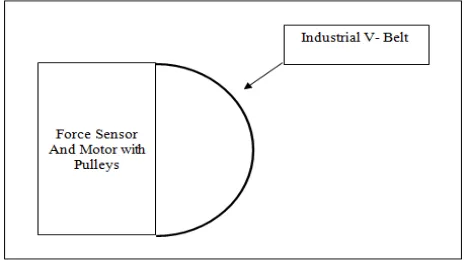
The grasper system consist of the force sensor with dc servo motor and industrial V- belt. The two main tasks in the enveloping phase are the squeezing and sensing of a construction of the force closure. As squeezing proceeds, the grasper adapts itself to an object. The motor control depends on the force sensor. Here FSR 400 force sensor is used. A simple force control scheme is implemented which gradually increases the motor current input until a force higher than a certain threshold is detected. The V-belts are generally endless, and their general cross-section shape is trapezoidal (hence the name "V"). The "V" shape of the belt tracks in a mating groove in the pulley (or sheave), with the result that the belt cannot slip off as shown in fig. 2.
Fig. 2. Industrial V-Belt
V-belts may be homogeneously may be fibers embedded in the rubber or polymer for strength and reinforce-ment. The fibers may be of textile materials such as cotton, polyamide (such as Nylon) or polyester or, for greatest strength, of steel or aramid (such as Twaron or Kevlar).
B. Mobile robot system
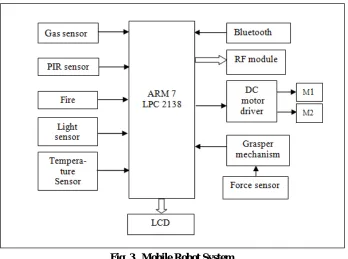
Fig. 3. Mobile Robot System
target object in a downward manner from the top of the object. As shown in fig. 3 the mobile robot system having RF trance receiver and grasper system also consist of various sensors like Temperature , Gas , PIR, Light mounted on it for monitoring environment. There are total five motors used in the system. Two motors are used for grasping opera-tion, Two for movement of mobile robot and one is used for movement of grasper in up and down position. The mobile robot is controlled by using the android mobile phone having application installed on it. The communication between mobile robot and PC is done by using RF module. The RF module is connected to the controller port by using MAX 232.
C. Control System
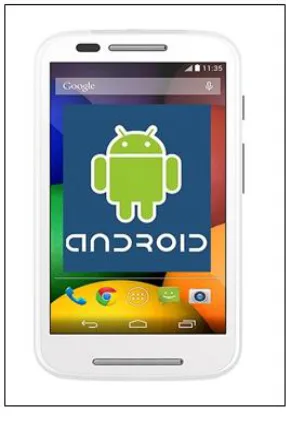
The control system is used to operate the whole grasper as well as the mobile robot system. It consist of the android phone having application installed on it. The mobile robot system is connected to the android phone by using the bluetooth HC 05. The operations like forward ,reverse , right and left of robot system as well as the open and close operations of the grasper system are also controlled by using the android phone.
When application is open it will ask for bluetooth connection with the robot. After successful connection with the robot it will be in working mode. When any button from the application is pressed the control signal is stored in the bluetooth buffer then it is given to the controller.
Fig. 4. Control System D. Data monitoring system:
It consist of the PC with RF module as shown in fig. 5. The data form sensors like Temperature , Gas , PIR, Light is collected by using the RF module and is displayed on the PC by using the Visual basic.
Fig. 5. Data monitoring system A. Hardware
Temperature Sensor Fire Sensor
Force Sensor Personal Computer RF module Bluetooth Module
B. Software
Keil
Visual Basics
Basic Android Programming
VI. RESLTS AND DISCUSSIONS
The performance of the proposed grasper was validated in two stages: manual experiment and semiautomatic experi-ment. By “manual,” here mean that the objects were manually placed on the grasping part prior to enveloping. The semiautomatic experiment is designed to demonstrate that the grasper can be used in real-life applications. Here, the term “semiautomatic” accounts for the fact that all the procedures were automatically conducted except the calculation of the object location. In this experiment, the operator controls the robotic system . To calculate a quantitative success rate, a scoring rule is set in a way that whenever the system successfully conducts the following subgoals, as shown in Figure insertion of grasping part downward to the object, enveloping, lifting and releasing the object.
A. Manual Experiment
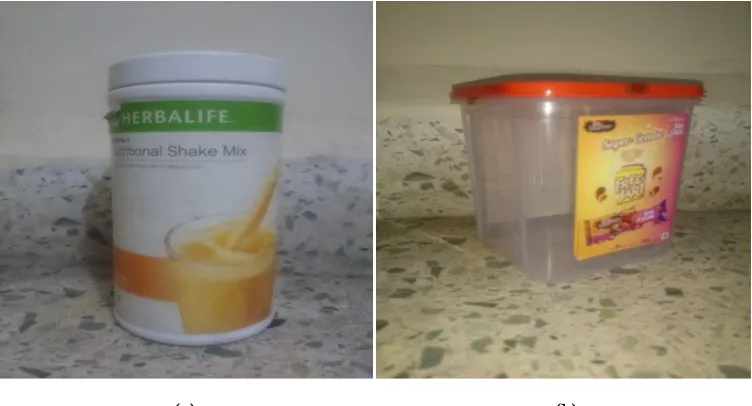
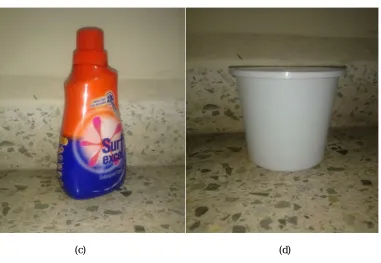
In this experiment the variable shape objects are placed in grasping part manually for the grasping operation. The dimensions of the object like height width are not considered. In manual grasping system there is no need for locat-ing the object only the object is placed in the grasplocat-ing part manually. Followlocat-ing (fig. 6) objects are grasped by uslocat-ing the grasper in manual experiment.
(c) (d)
Fig. 6. Objects (a) Herbal life (b) Britannia box (c) Surf excel bottle (d) Conical jar
For experimental purpose four objects are grasped having variable shape, Weight and dimensions as shown in table 1 .
Table 1 Objects to be grasp with their dimensions and weight Object Shape Weight
(gram)
Dimension Height
(cm)
Width/ Diameter
(cm)
Herbal life Cylindrical 108 19 10
Britannia box Cubical 106 14.5 12.5
Surf excel bottle Arbitrary 58 22 -
Conical jar Conical 30 11.5 12
B. Semiautomatic Experiment
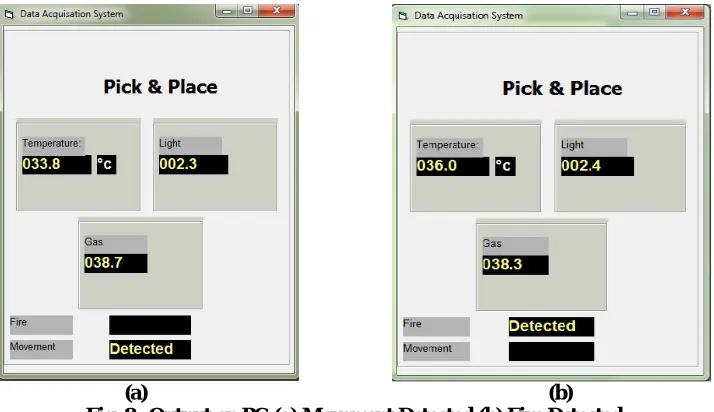
In semiautomatic experiment the mobile robot is controlled by using the android mobile phone having applica-tion installed on it. The control of robot like forward, reverse, right, left can be done as well as the grasper control like open , close, up and down can also be done by using the android phone. The data from the sensors like temperature, PIR, gas and fire is displayed on the PC by using the visual basic.
Fig. 7. Maximum and Minimum Height of grasper
The object which is within this range of the grasper height only can be grasped or can be pick. Otherwise the robot sys-tem cannot locate the grasper on the object. In this experiment the results obtained on the PC is shown in fig. 8.
(a) (b) Fig. 8. Output on PC (a) Movement Detected (b) Fire Detected
In this experiment the object is located first then the grasper will be in grasping phase. As soon as the object is grasped the grasper will be in lifting phase. Then the object will be placed to the desired location. The sensor data like temperature, light, gas, fire, and movement (output from PIR sensor) is displayed on the PC as shown in fig. 8 (a) and (b).
V. CONCLUSION
user friendly interface, light weight and portability of android OS based smartphone has overtaken the sophistication of technologies.
ACKNOWLEDGMENT
The author would like to express his sincere thanks to his Head of Department Dr. S.K. Shah for her valuable refer-ences and support throughout the seminar work. The author would also like to thank Prof. R.H. Jagdale for their sup-port, co-operation and valuable suggestions.
The author would be grateful to his Principal, Dr. A.V. Deshpande and Vice Principal, Dr. K.R. Borole for their en-couragement and guidance throughout the course.
Also author would express his sincere thanks to all teaching and non teaching staff of Electronics and Telecommuni-cation department of Smt. Kashibai Navale College of Engineering- Pune, for their help.
REFERENCES
[1] J. Butterfass, M. Grebenstein, H. Liu, and G. Hirzinger, “DLR-hand II: Next generation of a dextrous robot hand,” in Proc. IEEE Int. Conf. Robot. Autom, pp. 109–114, 2001.
[2] R. O. Ambrose, H. Aldridge, R. S. Askew, R. R. Burridge, W. Bluethmann, M. Diftler, C. Lovchik, D. Magruder, and F. Rehnmark, “Ro-bonaut: NASA’s space humanoid,” IEEE Intell. Syst. Appl., vol. 15, no. 4, pp. 57–63, Jul./Aug. 2000.
[3] N. Hiroki, O. Katsuhisa, N. Akiko, N. Arata, and Y. Kazuya, “The TAKO (Target Collaborativize)-flyer a new concept for future satellite ser-vicing,” Inst. Electon., Inf. Commun. Eng., Tokyo, Japan, Tech. Rep. 638, 2001.
[4] Y. H. Lee, J. F. Jin, C. Nam, J. Kim, and N. L. Doh, “Development of minimal grasper: Preliminary result of a simple and flexible enveloping grasper,” in Proc. IEEE/RSJ Int. Conf. Intell. Robots Syst., , pp. 1779–1784, 2009.
[5] Guangming Song, Kaijian Yin, Yaoxin Zhou , Xiuzhen Cheng, "A Surveillance Robot with Hopping Capabilities for Home Security", IEEE Transactions on Consumer Electronics, Vol. 55, No. 4, Nov. 2009.
[6] Zhu Jianguo, Gao Junyao, Li Kejie, Lin Wei, Bi Shengjun, "Embedded Control System Design for Coal Mine Detect and Rescue Robot" 978-1-4244-5540-9/10, IEEE, 2010.
[7] Jan Nádvorník, Pavel Smutný, " Remote Control Robot Using Android Mobile Device ", IEEE , 978-1-4799-3528-4/14,2014.
[8] Sung Wook Moon ,Young Jin Kim, Ho Jun Myeong, Chang Soo Kim, Nam Ju Cha, and Dong Hwan Kim ," Implementation of Smartphone Environment Remote Control and Monitoring System for Android Operating System-based Robot Platform", 8th International Conference on Ubiquitous Robots and Ambient Intelligence (URAI), 978-1-4577-0723-0 / 11, Nov. 23-26, 2011.
[9] Goebel S, Jubeh R, Raesch S-L & Zuendorf A. Using the Android Platform to control Robots, In Proceedings of 2nd International Conference on Robotics in Education (RiE 2011). Vienna, Austria, pp. 135-142, INNOC - Austrian Society for Innovative Computer Sciences, September, 2011.
[10] A. Ali, N.A. Razali, N.H. Saad, N. Vitee," Implementation of Automatic Meter Reading (AMR) Using Radio Frequency (RF) Module ", 2012 IEEE International Conference on Power and Energy (PECon), pp. 876-879, 2-5 December 2012.
[11] Arpit Sharma1 , Reetesh Verma, " Android Phone Controlled Robot Using Bluetooth ", International Journal of Electronic and Electrical Engi-neering. ISSN 0974-2174, Volume 7, pp. 443-448, Number 5 (2014).
BIOGRAPHY
Dhairyashil Mansingrao Patil did his Bachelors of Engineering in 2013 in Electronics and Telecom-munication Engineering form D.K.T.E. Ichalkaranji, Maharashtra. Currently Pursuing Masters of Engi-neering in VLSI and Embedded systems from STES’s Smt. Kashibai Navale College of EngiEngi-neering- Pune, Maharashtra.