Time Comparison of Various Feature Extraction of
Content Based Image Retrieval
Srikanth Redrouthu1, Annapurani.K2
1
PG Scholar, Department of Computer Science and Engineering, SRM University, Chennai, TamilNadu, 603203, India
2
Assistant Professor (S.G), Department of Computer Science and Engineering, SRM University, Chennai, TamilNadu, 603203, India
Abstract--Recently there has been tremendous increase in
usage of multimedia contents like images and videos. So there has been a collection of varied image databases and video databases in digital format. These databases are more widespread and increasing larger. A system has been implemented for efficient and effective search engine and the system is referred as content-based image retrieval (CBIR) systems. Semantic gap is the drawback of CBIR systems. CBIR systems cannot extract and perform poorly in extracting high-level (semantic) features which include objects, feelings and their meanings. Semantic Gap can be reduced in CBIR system by using User Feedback. It is also referred as Relevance Feedback. This paper presents Content Based Image Retrieval (CBIR) system that uses multiple feature fusion to retrieve images and time is compared for each and combination of various features and also for improving the retrieval results in terms of its accuracy relevance feedback is suggested. The features like color and shape are used. The color histogram is used to extract color feature and edge detection is used for shape extraction. This paper also presents the time comparison for different CBIR systems. The experimental results show that the enhanced CBIR system is better in terms of system evaluation parameters like recall and precision.
Keywords— CBIR, Color, Edge Detection, Relevance Feedback, Shape, Time Comparison
I. INTRODUCTION
Images are the best and simplest way of representation of ideas. An Image can speak more than 1000 words. The significance of images has been drastically increased by the web pages .Hence an efficient image retrieval systems are essential. Generally images can be retrieved using two approaches. One is Text based and other is Content based [1]. Text based is based on annotations or keywords. Text based approach is easy and easily implemented but may not be accurate.
Content-Based Image Retrieval (CBIR) is a two- step process that searches and retrieves images from a large set of image database based on features like color, texture and shape. The first step is feature extraction and second step is similarity matching [2]. CBIR systems have become a reliable tool for many image database applications. There are several advantages in CBIR systems compared to other retrieval approaches like text based approach. This field of research is providing solutions in areas like crime prevention, medical imagery, medical diagnosis, home
entertainment, satellite imagery web searching, architecture, fashion and publishing.
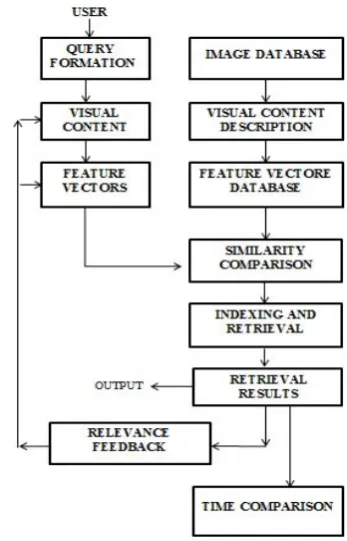
The CBIR system extracts the visual content description of the query image matches them to visual content description of the images in database. Visual content description in other words can be referred as feature extraction. CBIR is a process to retrieve similar image or images in the image database when a query image is given by the user. This can be done by extracting the features of the images such as color, texture and shape. The image features are used to compare between the query image and images in the database. There are different types of distance measures [3].
The distance measure is used to calculate the degree of similarity between the query image and the whole database images. The images are sorted in an order. Few Image search engines available are Visual Seek, Virage, Netra, AltaVista, SIMBA, ALIPR, QBIC etc. [3]. Before CBIR was widely used to retrieve images, various image retrieval systems, including Query by Image Content (QBIC) and Visual Seek were used.
The rest of the paper is organized as follows: section II covers the related work and section III presents the enhanced CBIR system for image retrieval, section IV provides the enhanced CBIR system evaluation and section V discusses the conclusion.
II. RELATED WORK
CBIR refers to techniques used to retrieve images from databases based on their visual content and index. Visual content can be defined as a set of low level features extracted from an image that describe the features like color, texture [4] and shape.
2.1. Feature Extraction
Feature extraction means obtaining the useful information that can describe the image with its content. Image feature selection is an important step so that it can represent the good content of the image. Color, texture and shape are features considered for content image description.
2.2. Color
image processing. Color features sometimes provide very powerful information about images which is useful for image retrieval.
To extract the color features from of an image, there is a need to select a color space and extract features by using its properties. Color histograms are widely used for the Content-Based Image Retrieval [5]. There are two types of color histograms, Global color histograms (GCHs) and Local color histograms (LCHs). The whole image is represented with a single color histogram in GCH whereas an image is divided into fixed blocks and for each block histogram is taken. Traditional method for color based image retrieval is GCH [2].
2.3. Texture
Quantifying texture content of an image is the most important method to image content description. There is no formal definition for texture, but it provides the measurement of properties such as energy, entropy, homogeneity, smoothness, coarseness, contrast and correlation [6]. Texture can be defined as repeated patterns of pixels over a spatial domain. Statistical, Model-based, and Transform-based methods are some commonly used methods for texture feature extraction. GLCM (Gray Level Co-occurrence Matrix) is the traditional method for texture feature extraction.
2.4. Shape
One of the common image features used to represent the image is shape feature. By using shape humans can recognize the surrounding environment. In CBIR systems shapes are used to identify images interest region. Generally, Region representation involves two choices. First choice is to represent the region in terms of its boundary (external characteristics). Second choice is to represent the region in terms of its pixels comprising the region (internal characteristics).
There are different boundary-based shape descriptors. Area, perimeter, equivalence diameter, compactness and eccentricity are some of these descriptors [7]. Other descriptors like aspect ratio, bounding box, circularity, elongation, centroid, convexity, ratio of principle axes, circular variance, and elliptic variance are simple geometric attributes [8]. Fourier descriptors, chain codes, polygonal approximation and statistical methods are used for representing Complex boundaries. Multi resolution attributes are CSS (Curvature Scale Space) and Wavelet Transform Modulus Maxima (WTMM)
.
The CSS technique is also adopted as MPEG-7 Contour Shape descriptor [9]. To represent shape; region-based methods take all pixels into account. The most commonly used descriptors to extract features from shapes are moment descriptors.2.5 Similarity Comparison
One fundamental step in CBIR system is the similarity measures. Similarity between two images is to find the distance between them. The distance between two images can be calculated using feature vectors that are extracted from the images. Therefore, similar to the query image a single image is not retrieved as a result, but many images are retrieved.
[10] describes a CBIR system where the feature extraction of Color, Texture and Shape are included in Visual Content Description. The enhanced CBIR system uses HSV color space for color feature and Edge Detection for shape feature extraction and Relevance Feedback.
III. ENHANCED CONTENT BASED IMAGE RETRIEVAL 3.1 Color feature of HSV
In digital image processing, the most common choice is RGB Color space. The main drawback of the RGB color space is not suitable for describing colors in terms of human interpretation [11]. Imagine the RGB color space as a unit cube with red, green, and blue axes. Any color in the RGB color space can be represented as a vector of three coordinates (r, g, b). Different color spaces are proposed to overcome the drawback of RGB color space. The color space which is commonly used in digital image processing is HSx color space that converts the color space of the image from RGB color space to one of the HSx color spaces. HSx color space contains the HSB, HSI, HSV color spaces. There are other color spaces like NTSC, HMMD color space and YCbCr color space [6]. HSx color spaces are common to human color perception. HS stands for Hue and Saturation. B, I, and V stand for Brightness, Intensity and Value respectively.
3.2 Enhanced CBIR System color extraction
Color feature extraction in this is done by using HSV color space instead of RGB color space which is generally used. In HSV color space, preprocessing is done first. Images are taken from WANG Database.
In preprocessing step image is resized to 256x384. Then convert the RGB image into HSV image. Color moments and color histograms are used. Color histograms can be calculated using the individual component of each color in RGB image.
The steps for extraction are given in section 3.3.
3.3 Pseudo Code for color feature extraction in enhanced CBIR system
The various steps to retrieve images based on color feature are given below:
Step 1: Load database in the Mat lab workspace. Step 2: Resize the image for [256,384].
Step 3: Convert RGB image to HSV image. Step 4: Generate the histograms of H, S and V. Step 5: Quantization of values into number of bins. Step 6: Store the values of database images into the mat file
Step 7: Load the Query image and set timer.
Step 8: Apply the procedure 2-6 to find quantized HSV values of Query image.
Step 9: Calculate the Euclidean distance of Query image with database.
Step 10: Sort the distance values to perform indexing. Step 11: Calculate the precision and recall values. Step 12: Display Results and set timer off. Step 13: Relevance Feedback is given by user.
Step 14: Display the next relevant images based on sorted distance.
Other than usual features like color and texture, a new feature extraction called edge histogram is introduced [10]. Edges are significant local changes of intensity in an image. Edges typically occur on the boundary between two different regions in an image. The goals of edge detection are to produce a line drawing of a scene from an image of that scene and important features can be extracted from the edges of an image (e.g., corners, lines, curves). These features are used by higher-level computer vision algorithms (e.g., recognition).
3.5 Enhanced CBIR System color and edge detection
Color and edge detection extraction in this is done by using HSV color space instead of RGB color space which is generally used for color extraction.
Edge detection is the process of localizing pixel intensity transitions. The edge detection has been used by segmentation, object recognition and target tracking. Therefore, one of the most important parts of image processing is edge detection. There mainly exist several edge detection methods Sobel, Prewitt, Roberts, Canny [12]. Sobel edge detection method is considered here because of the simplicity and common uses. The steps for extraction are given in section 3.6.
An example for Sobel edge detection [13] shown in Figure 1.
Figure 1: Coins Image and Sobel Edge Image
3.6 Pseudo code for color and shape features extraction in enhanced CBIR system
The various steps to retrieve images based on color and shape features are given below:
Step 1: Load database in the Mat lab workspace. Step 2: Calculate the color histogram of an image. Step 3: Calculate the edge detection of an image
Step 4: Compute the above values and store in mat file for each image in the database.
Step 5: Load the Query image and set timer.
Step 6: Calculate the color histogram and edge direction of query image.
Step 7: Determine the Euclidean distance of Query image with database.
Step 8 Sort the distance values to perform indexing. Step 9: Calculate precision and recall values. Step 10: Display Results and set timer off. Step 11: Relevance Feedback is given by user.
Step 12: Display the next relevant images based on sorted distance.
3.7 Similarity Measures
Different similarity measures have been proposed based on the empirical estimates of the distribution of features, so the kind of features extracted from the image and the arrangement of these features in a vector will determine the
kind of similarity measures to be used. Different similarity measures will affect the retrieval performance of image retrieval significantly.
In conventional texture image retrieval, the Euclidean distances between the images in the database and the query image are calculated and used for ranking. The query image is more similar to the database images if the distance is smaller.
3.8. Time Comparison
In this modern world, Time is more considered. So the CBIR system which produces accurate results within less time is considered as an effective CBIR system. So, Time is calculated for each individual and combination of features like color feature and combination of color and shape feature.
Time taken by a system to retrieve the results can be calculated using simple Matlab commands.
3.9 Relevance Feedback
Relevance feedback is an effective scheme bridging the gap between high-level semantics and low level features in content-based image retrieval (CBIR).
This is not strange because images are more ambiguous than texts, making user interaction desirable. With relevance feedback, a user can label a few more images as new examples for the retrieval engine if he or she is not satisfied with the current retrieval result. Actually, these new images refine the original query implicitly, which enables the relevance feedback process to bridge the gap between high-level image semantics and low-level image features. Hence relevance feedback mechanism is a solution for the semantic gap between the images.
The Figure 2 depicts the enhanced CBIR systems where the feature extraction of Color and Shape are included in Visual Content Description. It also includes Relevance Feedback and Time Comparison.
IV. SYSTEM RESULTS &EVALUATION
4.1 Performance Evaluation Metrics for CBIR Systems
In CBIR, the most commonly used performance evaluation measures are Precision and Recall [10].
Precision is defined as the ratio of the number of relevant images retrieved to the total number of images retrieved.
Recall is defined as the ratio of the number of relevant images retrieved to the total number of relevant images in the database.
4.2 Enhanced CBIR System with Color Feature only
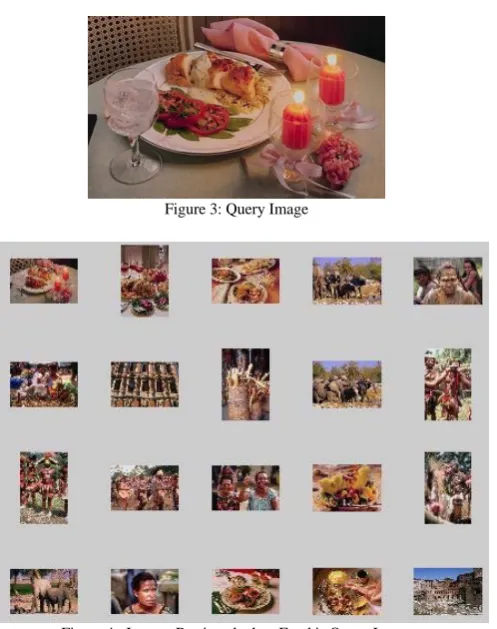
Selected the query image from the Food class randomly and retrieve the most top 20 images that are similar to the query image. Query Image is shown in Figure 3.The Output is shown in Figure 4.
Figure 3:Query Image
Figure 4: Images Retrieved when Food is Query Image
All images retrieved by the system are not relevant to the query image. The retrieved images are belonging to the other class of the query image, there are images like Elephants, Africans, Buildings and all the images are not similar in the color feature. So, the system retrieves only a few correctly. It shows about 6 relevant images and 14 irrelevant images for Query Image as Food.
Table 1: Precision and Recall for sample image of each class
The Table 1 shows the number of relevant and irrelevant images retrieved when a query image is specified from a particular class. The query image is taken randomly from each class. The table also shows the precision and recall values for each query image which is taken randomly from a sample of 100 images.
The precision and recall values can be improved by including color and shape feature.
4.3 Enhanced CBIR System with Color and Shape Feature
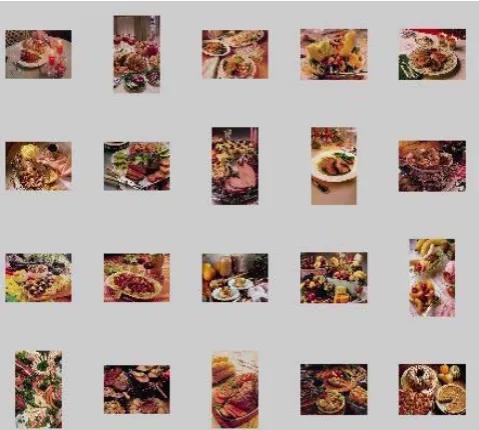
Selected the query image from the Food class randomly and retrieve the most top 20 images that are similar to the query image. Output is shown in Figure 5.
Figure 5: Images Retrieved when Food is Query Image
Table 2: Precision and Recall for sample image of each class
The Table 2 shows the number of relevant and irrelevant images retrieved when a query image is specified from a particular class. The table also shows the precision and recall values for each query image which is taken randomly from a sample of 100 images.
The precision and recall values can be improved by providing Relevance Feedback which is given by user.
4.4. CBIR System with Relevance Feedback
Selected the query image from the Food class randomly and retrieve the most top 20 images that are similar to the query image. Output is shown in Figure 6.
Figure 6: Images Retrieved for Query Image after Feedback
All images retrieved by the system are not relevant to the query image. The retrieved images are belonging to the same class. So, the system retrieves almost all correctly. It shows about 20 relevant images and 0 irrelevant images for Query Image as Food.
Table 3: Precision and Recall for sample image after Feedback
The Table 3 shows the number of relevant and irrelevant images retrieved when a query image is specified from a particular class. The query image is taken randomly from each class. The table also shows the precision and recall values for each query image which is taken randomly from a sample of 100 images.
By giving Relevance Feedback, almost all the irrelevant images are removed and only relevant images are retrieved. Relevant Feedback is given by the user. It works for all images in all classes in the database.
4.5 Time comparison of different CBIR systems
Time is compared for different CBIR systems based on less time. Generally time is measured in seconds. Time is compared for a random query image. It is shown in table 4.
Table 4: Time Comparison of CBIR systems
Color Color and Edge Detection
Precision 0.3000 0.6000
Recall 0.0600 0.1200
Time 0.772755 0.892863
V.CONCLUSIONS
VI. FUTURE WORKS
This system can be further improved by using different edge detection operators like Prewitts, Canny or Roberts and by using some other low level feature along with the fusion of features like Color, Texture and Shape including Relevance Feedback within less time.
ACKNOWLEDGEMENT
The authors would like to thank Professor James Wang for his online support in providing WANG database. The database is free and easily downloadable. It is widely used for testing CBIR systems. Database is available at http://wang.ist.psu.edu/docs/related/.
REFERENCES
[1] Asadollah Shahbahrami, Demid Borodin, Ben Juurlink, Comparison Between Color and Texture Features for Image Retrieval, Department of Computer Engineering, Faculty of Engineering, University of Guilan, Rasht, Iran.
[2] P.S.Suhasini, Dr. K. Sri Rama Krishna, Dr. I. V. Murali Krishna, “CBIR Using Color Histogram Processing”, Journal of Theoretical and Applied Information Technology Vol6.No1. (pp. 116-122), 2005-2009, JATIT.
[3] M.Braveen, P.Dhavachelvan , “Evaluation of Content Based Image Retrieval Systems Based on Color Feature”, International journal on Recent Trends in Engineering,Vol.1,No.2,May 2009 ON Information Science and Technology.
[4] B. Jerome, V. Regine, and S. Georges, “A Signature based on Delaunay Graph and Co-occurrence Matrix”, Laboratoire Informatique et Systematique, University of Paris, Paris, France, July 2002.
[5] J. Eakins and M. Graham, “Content-based Image Retrieval,” A report to the JISC technology applications programme, Institute for image database research, University of North Umbria at Newcastle, October 1999.
[6] B.S.Manjunath, Jens-Rainer Ohm, Vinod V. Vasudevan, and Akio Yamada, “Color and Texture Descriptors”, IEEE Transactions on Circuits and Systems for Video Technology, Vol. 11, No. 6, pp. 70-715,June 2001.
[7] Nishant Shrivastava, Vipin Tyagi, “Multistage Content Based Image Retrieval”, Department of Computer Science and Engineering, Jaypee University of Engineering and Technology, Software Engineering Congress.
[8] M.Trimeche, “Shape Representations for Image Indexing and Retrieval”, Master of Science Thesis, Tampere University of Technology, May 2000.
[9] M. Bober, “MPEG-7 Visual Shape Descriptors”, IEEE Trans. on Circuits and Systems for Video Technology, vol. 11, no. 6, pp. 716-719, June 2001.
[10] S.Nandagopalan, B.S.Adiga and N.Deepak, “A Universal Model for Content Based Image Retrieval”, International Journal of Computer Science, 4:4, 2008.
[11] P.B.Thawari, N.J.Janwe, “CBIR based on Color and Texture”, International Journal of Information Technology and Knowledge Management, January – June 2011, Volume 4, No. 1, pp.129-132. [12] Wenshuo Gao, Lei Yang, Xiaoguang Zhang Dig, Huizhong Liu, “An
Improved Sobel Edge Detection”, IEEE 2010.